Walter Hayes heard the truck before he saw it.
The sound traveled across the wet Iowa fields like distant thunder, deep enough to shake the loose glass in the kitchen window of his farmhouse.
He stopped pouring coffee.
Outside, rain had finally weakened to a fine drizzle after nearly thirty-six hours of relentless weather. The farmyard looked more like a shallow lake than a working property. Water filled the tractor ruts. Corn stubble rose from flooded rows. The narrow lane leading from the county road toward Walter's barn had become two strips of brown mud separated by grass.
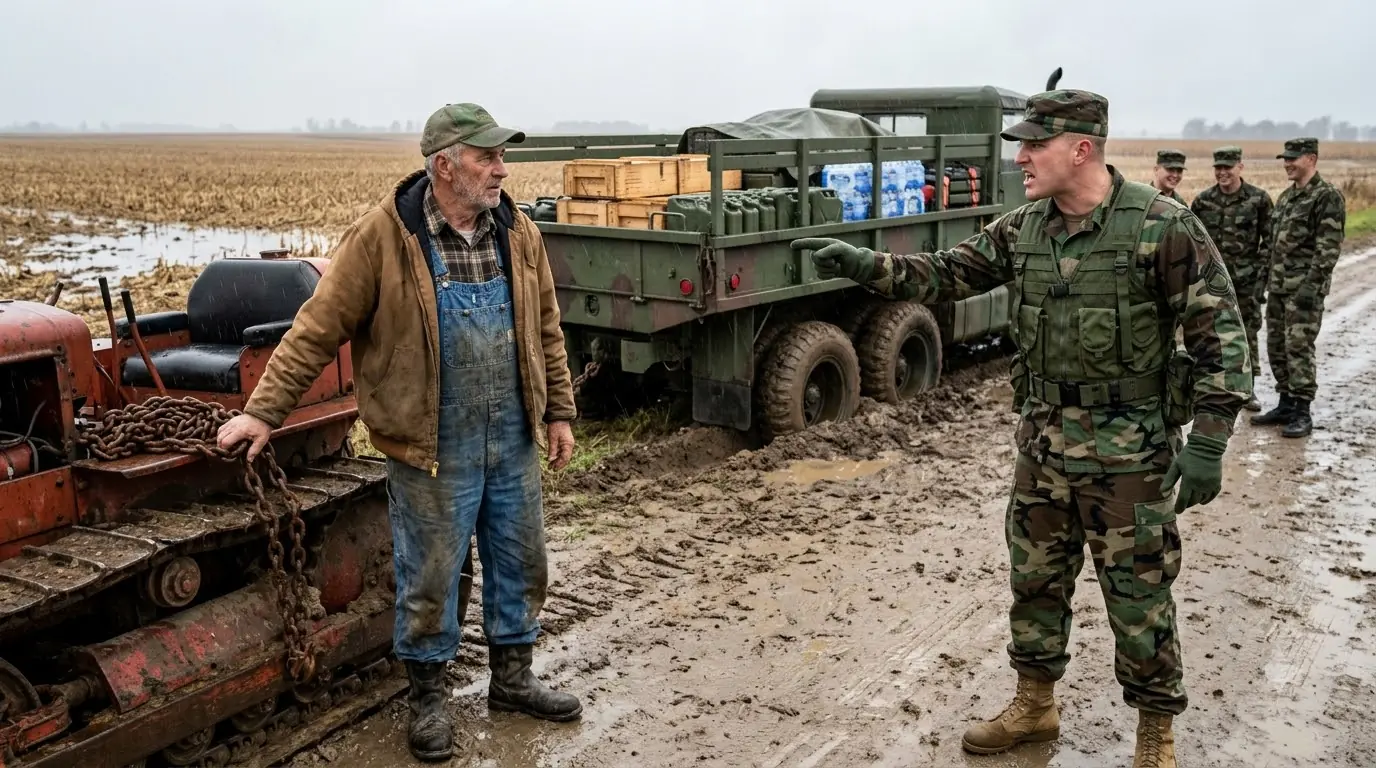
Another engine roared.
Then stopped.
Then roared again.
Walter sighed.
“That isn’t good.”
His old dog, Pepper, raised her head beneath the kitchen table.
Walter walked to the window.
At seventy-four, he moved slower than he once had, but his eyes remained sharp.
Through the mist, he could see the rear portion of a large olive-green six-wheel cargo truck beyond the barn.
The vehicle was loaded high.
Water cases.
Cardboard cartons wrapped in plastic.
Fuel cans.
Portable generators.
Emergency food.
Blankets.
Medical supplies.
The county had been moving relief shipments through rural communities since the rain began.
Several roads were underwater.
Two small bridges had closed.
Families west of Harmon Creek had been isolated since yesterday afternoon.
Walter already knew why the truck had come through his property.
County Road 14 was flooded.
His old farm lane connected to a gravel service road on the opposite side of his acreage.
On paper, it looked like a useful shortcut.
On dry ground, maybe.
Today?
Absolutely not.
Walter watched the driver accelerate again.
The truck moved perhaps six inches.
Mud sprayed from beneath the rear tires.
Then the entire back of the vehicle settled lower.
Walter put down his coffee.
“Pepper.”
The dog stood.
“We better go save somebody from themselves.”
He pulled on a brown canvas coat over his plaid shirt, stepped into mud-covered boots, and found his faded green cap on the hook beside the door.
Outside, cold moisture immediately touched his face.
The truck was worse than it had appeared from the house.
Its front axle had reached slightly firmer ground, but all four rear wheels had sunk into a narrow depression beside the old cornfield.
The right side was lower than the left.
Three men in bright olive-green emergency-service uniforms stood near the vehicle.
Another man remained inside the cab.
Their clothing was clean enough to tell Walter they had not spent much time working farms.
One was young.
Early thirties.
Muscular.
Short blond hair under a green patrol cap.
Name patch:
MERCER
He stood with his hands on his hips while staring at the tires.
Walter approached along the grass.
“Morning.”
The young man turned.
“Sir, you need to stay back.”
Walter stopped.
He looked around.
At his own barn.
His own field.
His own tractor shed.
Then back at Mercer.
“I do?”
The two men behind Mercer exchanged smiles.
Mercer seemed to realize the problem.
“I mean away from the vehicle.”
Walter nodded.
“That makes more sense.”
One of the men laughed quietly.
Mercer ignored him.
“We’ve got a recovery situation.”
“I noticed.”
Walter looked at the tires.
Then at the mud piled behind them.
“How long you been spinning those?”
Mercer frowned.
“Excuse me?”
“The tires.”
Walter pointed.
“You’ve polished the hole pretty good.”
One of the crewmen turned away to hide a grin.
Mercer did not.
“We’re working it.”
Walter nodded.
“That’s what worries me.”
Mercer stared.
Walter stepped closer to the truck.
The mud around the rear wheels moved strangely.
Not like ordinary saturated ground.
Water pulsed upward after each engine vibration.
Walter crouched.
Touched the surface with two fingers.
Then pushed a thin stick into the mud.
It went farther than expected.
His expression changed.
“When did you turn onto this lane?”
“About ten minutes ago.”
“From the north?”
“Yes.”
“You come across the cattle grid?”
“Yes.”
Walter nodded slowly.
“You should have stopped there.”
Mercer sighed.
“Sir, we were directed through this property because the county road is closed.”
“Who directed you?”
“Dispatch.”
“Dispatch sitting in this mud?”
“No.”
“Then dispatch doesn’t know this lane.”
Mercer folded his arms.
“This vehicle is designed for poor terrain.”
Walter looked at it.
“Good truck.”
“It is.”
“Too heavy.”
Mercer smiled.
There it was.
The small expression Walter had seen thousands of times in younger men who believed age had automatically made him obsolete.
“Sir, this truck has more than enough power.”
Walter stood.
“Power isn’t the problem.”
“Traction.”
“Not that either.”
Mercer pointed toward the rear wheels.
“We lost traction.”
Walter shook his head.
“You lost ground.”
The men behind Mercer stopped smiling.
Mercer looked irritated.
“What does that mean?”
Walter pointed beneath the vehicle.
“Something hollow under there.”
Mercer laughed.
“Hollow.”
“Yes.”
“This is a field.”
“Used to be more than a field.”
“What?”
Walter did not answer immediately.
He looked toward the barn.
Then toward the drainage ditch.
Something old stirred in his memory.
His father digging.
Concrete sections.
Timber cribbing.
A trench.
He had been eight or nine years old.
Walter walked several paces toward the edge of the lane.
“Don’t move that truck.”
Mercer followed.
“We have supplies that need to arrive by noon.”
“You won’t arrive anywhere if you bury the rear axle.”
“We’re not buried.”
Walter looked toward the vehicle.
“Not yet.”
One crewman laughed.
Mercer snapped:
“Enough.”
The laughter stopped.
Walter looked toward the tractor shed.
Inside sat his old crawler.
Rust-red.
Low.
Wide steel tracks.
Built decades before anyone standing near the truck had been born.
Walter had bought it used in 1967.
By then it was already old.
It pulled fence posts.
Dragged logs.
Pushed snow.
Recovered combines.
Moved wagons through spring mud.
The paint had faded nearly brown.
The seat was cracked.
The exhaust pipe leaned slightly.
But the engine still started.
Most days.
Walter pointed toward it.
“I can pull you back.”
Mercer followed his finger.
Then stared.
“That?”
“Yes.”
The crewmen began laughing.
Not cruelly at first.
Mostly disbelief.
One said:
“That thing still runs?”
Walter nodded.
“Usually.”
Another man laughed harder.
Mercer smiled.
“Sir, that machine weighs maybe half what this truck does.”
“Closer to a third.”
“You’re going to pull eighteen tons with that?”
“Not through solid ground.”
“What does that mean?”
Walter looked back at the mud.
“You don’t need eighteen tons moved uphill.”
“You need the truck moved six feet backward to where the ground still exists.”
Mercer shook his head.
“We have recovery equipment coming.”
“When?”
“Forty minutes.”
Walter looked at the sinking wheels.
“You may not have forty minutes.”
Mercer laughed.
“Now the truck is going to disappear?”
Walter did not smile.
“Maybe.”
That reduced the laughter.
A crewman named Harris approached.
“Sergeant—”
He corrected himself quickly.
“Supervisor Mercer, the rear right is lower than five minutes ago.”
Mercer looked.
It was.
Maybe two inches.
He walked toward the cab.
Walter said:
“Don’t.”
Mercer stopped.
“What?”
“Don’t spin them again.”
“We need to straighten the vehicle.”
“You’ll drop it.”
Mercer turned.
“You said something hollow is underneath.”
“Yes.”
“You know that for a fact?”
“No.”
“Then?”
“I know what mud looks like when it’s sitting over more mud.”
Walter pointed beneath the rear tire.
“And I know what it looks like when water is pumping through a void.”
Mercer looked.
He saw nothing useful.
Just brown water.
“This is exactly why we have high-clearance vehicles.”
Walter nodded.
“And exactly why farmers use tracked machines in soft ground.”
Mercer laughed again.
“Your tractor?”
“Yes.”
“With fifty-year-old steel tracks?”
“Yes.”
“This truck has six-wheel drive.”
Walter shrugged.
“Six wheels can sink six holes.”
The men behind Mercer laughed loudly.
Mercer’s face reddened.
Walter almost regretted the line.
Almost.
Mercer climbed into the cab.
Walter’s expression changed.
“What are you doing?”
“Getting us out.”
“Don’t.”
The engine started.
Walter raised his voice.
“Mercer!”
The truck revved.
Mud sprayed.
Rear tires rotated.
The left side moved slightly.
The right side did not.
Then came a sound Walter immediately recognized.
Not mechanical.
Earth.
A deep sucking collapse beneath the vehicle.
The truck dropped.
Hard.
Nearly a foot.
One of the crewmen shouted.
Everyone moved backward.
The loaded bed tilted sharply toward the drainage ditch.
Several water cases shifted against the side rails.
Mercer killed the engine.
Silence followed.