The candlelight in the great hall of Ashcombebe Manor made every silk gown look like it was made of water. Cecily Marlo stood near the tall window at the far end of the room, and she pressed her fingers against the cold glass, because it helped her not think about the sound of laughter behind her. The laughter had been going on for some time now.
It had started small, the way cruel things always start, and it had grown as more people joined in. She did not turn around. She could see herself in the dark window.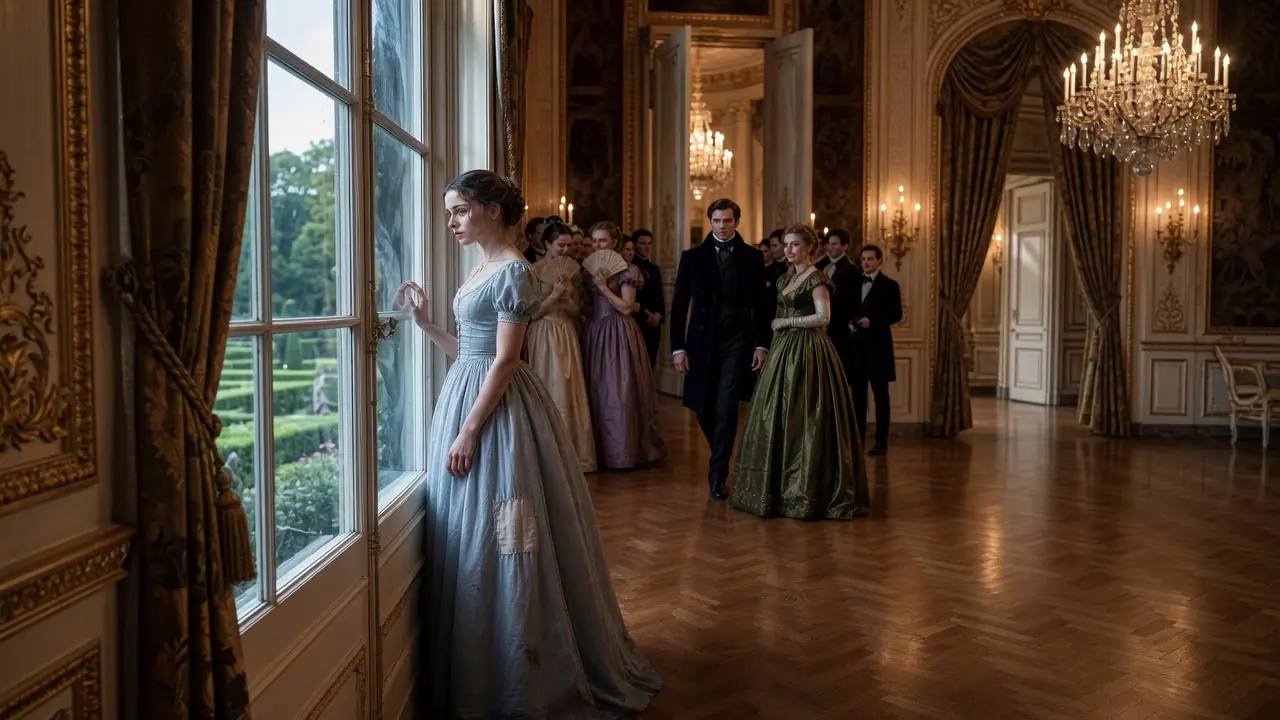
Her dress was pale blue, or it had been once, now it was the color of old milk in some places, and there was a patch on the left side of the skirt where her aunt had sewn a piece of new cloth over a tear. The new cloth did not match. It never could have matched because the dress was six years old, and the color had been washed out of it by rain, and by scrubbing, and by too many winters in a house that could not afford a good fire.
The patch sat there like a small brown island in a pale blue sea, and everyone in the room had seen it.
“My dear, is that a bandage or a dress?” That had been the first voice.
Cecily did not know who had spoken. She had only heard the laugh that followed. Then a second voice.
“I believe the poor girl has been in a fight with her own wardrobe.” Then a third: “And lost.” The laughter after that had been the kind that spread from person to person like a small fire in dry grass.
Cecily had felt it move across the room. She had felt it pass over her shoulders. She had felt it land on the back of her neck.
And then she had walked to the window calmly without looking at anyone. And she had put her hand on the cold glass. She counted the panes.
There were twelve. She had counted them once before at another ball in another year when she had felt this same kind of quiet burning in her chest. Counting things was something she did to keep her face still.
If her face was still, no one could see that she was hurting. If no one could see that she was hurting, then they had not really won. The smell of the room was heavy.
Beeswax from the many candles, rose water from the ladies, wood smoke from the fireplace at the other end of the hall. Under all of that, the faint smell of the wet garden coming in through a door someone had left cracked open. It had been raining earlier.
The path outside would be soft.
Cecily’s aunt had told her not to come. "“You will only be sad, dear,”" her aunt had said that morning, sitting in the kitchen with her hands folded in her lap.
Aunt Mariellele was a small woman with tired eyes. She had raised Cecily since Cecily was seven years old when Cecily's mother had died of a fever and her father had followed six months later. Aunt Mariellele had a small house at the edge of the village and she took in sewing to pay for bread.
She had done her best. She had done more than her best, but her best had never been enough to buy a new gown.
“I want to go,” Cecily had said.
“They will not be kind.” “I know.” “Then why?” Cecily had not answered.
She had not been able to say the true reason, which was that if she did not go, she would sit in the kitchen and grow older. And one day she would look up and find that she had been 43 and had never once stood in a room with candles and music. She did not want a husband.
She did not want to be chosen. She wanted just once to hear the music from inside the room instead of from the road outside. That was all.
So she had put on the dress. She had let Aunt Marielle sew the new patch on. She had walked the two miles to Ashcombebe Manor because the Marlo did not own a carriage.
She had arrived with mud on the hem of her dress, and she had cleaned the mud off in the servants' side room before entering. She had eaten one small piece of bread from the long table because she had not eaten since morning. And then the laughter had started.
Cecily pressed her forehead against the cold window for one small moment and then she lifted her head. She would not leave yet. If she left now, they would say she had run.
She would stand here until the music started and then she would walk out during the music when everyone was busy with the dance and no one would notice. She could wait. She had waited for many things in her life.
Waiting was something she was good at. She counted the panes again. twelve. She started counting the small marks in the glass, the tiny bubbles where the glass had not set right behind her.
Somewhere in the room, a woman said, "“I heard she walked here.
Can you imagine?”" Someone else said, "“Perhaps she thought she was coming to help in the kitchen.”" More laughter, softer this time.
The kind of laughter that people share when they think the person they are laughing at cannot hear them, but they do not really care whether she can or not. Cecily kept counting the bubbles in the glass. Then the room changed.
She felt it before she understood it. The sound of the room shifted. The laughter stopped.
The music that had been about to begin did not begin. A hush moved across the great hall like a hand pressed against a bell.
She heard someone say, "“Oh,”" very softly.
The way a person says it when they see something they were not ready to see. Cecily did not turn around. She did not want to know what had made the room go quiet.
It was not her business. She was counting bubbles. But then the room stayed quiet, and the quiet lasted longer than it should have.
She turned her head just a little, just enough to see from the corner of her eye that everyone in the room was looking toward the tall doors at the other end of the hall. And in the doors stood a man. He was not smiling.
He was not doing anything at all. He was simply standing there, and the room had gone quiet because of him. He was tall.
His coat was dark, almost black, and it was cut plainly without the shining buttons and the bright silk that most of the other gentlemen wore. His hair was dark, too, and cut short. His face was not what people would call handsome.
Exactly. It was too still for that. His eyes were the kind of eyes that made a person feel as though he had already thought about them for a long time before he ever looked at them.
Cecily did not know who he was. She had lived a quiet life in a quiet village. She did not read the London papers, but she saw the way the room shifted around him.
Every servant in the room had gone still in the same second, and then they had all moved all at once in small ways. A footman near the wine table straightened his back. A maid near the fire moved one step to the side.
The butler at the door stepped forward and bowed low and stayed bowed. It was the movement of people who knew this man very well and had known him for a long time.
He actually came.” Someone else whispered.
“I was told he never comes to country balls.” Someone else, he must have a reason.
And then the whispers stopped because the Duke was walking into the room. He did not walk quickly. He did not walk slowly.
He walked as though the floor was his floor, which in a way half the floors in this county were. Ashcombebe Manor did not belong to him, but it was said that Ravenshade Court, three valleys to the north, was one of the great estates of England, and that the Duke owned more land than any three of his neighbors combined. He walked into the room, and the young ladies who had been laughing a moment before, straightened themselves, and pinched their cheeks to bring color into them.
The mothers of those young ladies moved closer to their daughters. The daughters of ears, of viscounts, of barons, arranged themselves along the sides of the room like flowers in a border. The Duke did not look at any of them.
He walked past a young woman in a bright yellow gown who had positioned herself directly in his path. He walked past a girl in green, who curtsied so low her forehead, almost touched her knee. He walked past three sisters in matching pink dresses who were the daughters of the hostess.
His head was turning slowly. He was looking for something or someone. Cecily turned back to the window.
Her breath had made a small circle of fog on the glass. She wiped it away with her sleeve and started to count the bubbles again. The room was still quiet.
The music had not started. She could hear each footstep of the Duke as he walked. She could hear the soft creak of the floorboards under him.
She could hear one lady somewhere behind her breathing very quickly. Then the footsteps stopped. Cecily did not turn around.
She kept counting. Seven bubbles.
8 9 “Miss Marlo.” His voice was quiet, not loud at all, but it carried through the great hall the way a stone carries through still water.
It reached her and it reached every other person in the room and every one of them heard him say her name. Cecily's hand went still against the glass. He had said her name.
He knew her name. She had never met this man in her life. She was almost sure of it.
She would have remembered. She turned around slowly. She kept her hands folded in front of her so that they would not shake.
She looked up at him. He was much taller up close. He smelled of rain and of wood smoke and of something underneath that she could not name.
Something like cold air and old leather and a very faint bitter smell that might have been ink. "“Yes,”" she said.
Her voice sounded steady, which surprised her. He was looking at her, not at her dress, not at the patch on the skirt, at her face.
His eyes moved once quickly from her eyes to her mouth to her hands and then back to her eyes and stayed there. "“I hope you will forgive me,”" he said for not being introduced properly. "“There is no one to introduce us,”" Cecily said. "She did not know where the words came from.
They came out before she had time to stop them. There was a small silence. Then the Duke’s mouth moved very slightly at one corner.
It was not a smile. It was closer to a small acknowledgement as though she had said something he had not expected and he was making a note of it.
“That is true,” he said.
“Then we must introduce ourselves.
I am Alistair Thorne. Some people call me Ravenshade.
You may call me whichever you prefer.” She did not know what to say to this.
In her aunt’s small kitchen, one did not receive lessons on how to speak to dukes.
“I prefer “Alistair,”” she said, because it was the shorter word, and she was not sure her voice could hold up under longer ones.
His mouth moved again. Not a smile.
Something then, “Alistair,” he said.
The room was still quiet. Cecily became aware all at once of how many faces were watching them. She felt the heat of them on her back.
She saw at the corner of her eye a woman in a green gown with a face like a folded fan watching her with a look that was not friendly. The Duke saw where her eyes had gone. He did not turn his head.
“There is a smaller room,” he said beyond that door.
It is quieter there. Would you sit with me for a moment? Cecily did not know how to say no to a duke.
She was not sure she wanted to. She was not sure of very much. She nodded.
He offered her his arm. She placed her hand on it. His coat was warm.
Through the wool, she could feel the shape of his arm, which was solid and still like a beam of oak. They walked together across the great hall. The room parted for them.
No one spoke. She kept her eyes forward. She did not look at the woman in the green gown.
She did not look at the three sisters in pink. She did not look at anyone. At the door, the Duke paused.
He turned his head just slightly back to the room.
“The music,” he said without raising his voice, “may begin.” Then he led her through the door.
The smaller room was a sort of side parlor with two small windows and a low fire. It smelled of dry flowers and of the leather of old books. There were three chairs and a small table with a china bowl on it.
The bowl was cracked on one side. Cecily noticed the crack. She was still counting things, but now she was counting quieter things.
The Duke let go of her arm. He did not sit.
He stood near the fire and looked at her. "“You are wondering how I know your name,”" he said. "“I am wondering many things,”" Cecily said. "Behind them faintly, the music had begun in the great hall.
A slow piece for strings.
It sounded far away." “Your father was Thomas Marlo,” the Duke said.
It was not a question. Cecily's breath caught for a moment. It had been a long time since anyone had said her father’s name out loud.
Aunt Marielle had stopped saying it years ago because it hurt her too much.
“Yes,” Cecily said.
He served under my father in the war. The Duke said in the year 1812, he carried my father off the field at Salamanca when my father was wounded. He carried him three miles on his back.
My father would have died on that field if your father had not carried him. Cecily could not speak. She had known her father had been a soldier.
She had known he had come home from the war with a bad leg and a cough that never went away. She had known he had died young because of what he had brought back with him. But she had not known this.
My father lived 12 more years, the Duke said, long enough to see me grown. He spoke of your father to me many times. He told me his name.
He told me the name of the village where he came from. He told me that if I ever heard of any need in the family of Thomas Marlo, I was to see to it. It was a promise he made me before he died.
The fire popped in the hearth. A small piece of ember jumped out onto the stone and glowed for a moment and then went dark.
“I have tried,” the Duke said, for four years to find you.
Your father had moved after the war. The village he was born in had no record of him. His widow had died.
His daughter had been taken in by an aunt whose name no one seemed to remember. I sent letters. I made inquiries.
I paid a man in London to look. And then three weeks ago my steward mentioned that a woman named Marielle Aldwin in a village called Witam had come to Ravenshade to ask if we would take her niece into service. She had been turned away by my housekeeper, who did not know the name Marlo.
Cecily's hand went to her mouth. Aunt Mariellele had never told her. Aunt Mariellele had walked eight miles to Ravenshade Court and been turned away, and she had come home and said nothing because she had not wanted Cecily to feel ashamed. "I only heard of it two days ago," the Duke said. "I came at once.
I was told there was to be a ball tonight at Ashcombebe and that your aunt had said you might attend. I did not know how else to find you quickly. I came here.
Cecily lowered her hand from her mouth. She looked at the cracked china bowl on the table.
“You came here to find me?” She said.
“Yes,” because of a promise your father made.
“Yes,” she thought about this.
The music from the great hall was still going slow and thin through the wall.
Her heart was going quickly, but her hands, she noticed, had stopped shaking. "“Then it is a debt,”" she said. "“Not a kindness.”" He looked at her for a long time before he answered. "“I would have called it a debt,”" he said. "“An hour ago, before I came into the room.
And now, now I am not sure what to call it.”" The fire popped again.
Cecily became aware that she was breathing quickly and she made herself slow down.
She looked up at him. "Your grace," she said. "“Alistair,” “Alistair,” “I do not know what you expect of me.
I do not know why you had to come into the great hall in front of every person in this county.
I do not know why you had to say my name in front of them, but I would like to go home now.”" He blinked.
It was the first time she had seen him look surprised.
“You wish to go home?” he said.
“Yes,” I have upset you.
“I am not upset.
I am tired. I have walked two miles tonight. I have stood in that room for two hours.
People have laughed at my dress. And now a duke I have never met has told me that my father saved his father’s life and that he has been looking for me for 4 years. It is a great deal to hold at once.
I would like to go home and sit in my aunt’s kitchen and drink a cup of tea and think about it.” She had not meant to say all of that.
It had come out of her without her giving it permission. She braced herself for him to be angry. Great men did not like to be told that a lady wished to leave.
The Duke did not look angry. He looked, if anything, as though he had heard the answer he had been waiting for.
“I will send my carriage for you,” he said.
“Wait in this room.
I will fetch my coachman.
You will not walk home tonight.” “That is not necessary.” “It is necessary.
It has been raining.” “It has stopped.” “It will begin again.” Cecily looked at him.
He looked back at her. Neither of them looked away. The moment stretched.
It went on longer than a moment should. The fire made a small sound. The music in the great hall moved into a new part, slower still.
She noticed for the first time that his eyes were not simply dark as she had thought at first, but had a small ring of lighter color around the very edge, almost gold. She noticed a small mark on his jaw, a scar no longer than her fingernail. She noticed that he was breathing more slowly than she was.
She was not sure how long they stood there.
Then he said quietly, "Please wait in this room, “Miss Marlo.” I will return in a few minutes." He left.
The door closed behind him. Cecily sat down in the nearest chair. Her legs, which had held her up for two hours in a hall full of laughing strangers, and had held her up through the walk across the room on a duke's arm, gave up all at once.
She sat with her hands in her lap and looked at the cracked bowl on the table, and she thought about her father. She had not thought about him in this much detail in years. She had a memory of him lifting her onto his shoulders in a garden, and another of him teaching her to write her name with a stick in the mud.
She could not remember his voice. She had tried for years to remember his voice, and she could not. She wondered if the Duke’s father, when he had been carried on her father’s back for three miles, had known that the man carrying him had a small daughter at home who would grow up not remembering the sound of his voice.
The door opened. She stood up quickly. It was not the Duke.
It was a servant, a young woman with a kind face.
“His Grace’s carriage is at the side door, miss.
He asks that I bring you to it.” Cecily nodded.
She followed the young woman out through a narrow passage that did not pass through the great hall. She was glad of that. She did not want to walk through the great hall again tonight.
At the side door, the Duke was already there speaking quietly to a coachman. He turned when he saw her. He did not offer his arm this time.
He simply held out his hand toward the open carriage door in the way a man does when he is asking a woman to step forward without touching her. She stepped forward. She climbed into the carriage.
It was warmer inside than she had expected. There was a soft blanket folded on the seat. The Duke did not get in with her.
He stood at the open door.
“May I call on you tomorrow?” he said.
“At my aunt’s house, if she permits it.” Cecily thought about the small kitchen, the one good chair, the mended tablecloth, the window with a crack down one pane.
She thought about her aunt’s face when a duke walked through the door.
“You may call,” she said, “but not before noon.
My aunt takes her sewing to the village every morning, and I would like her to be at home when you come.
“Noon.” Then he closed the carriage door.
The coach began to move. Cecily leaned back against the seat and watched the lit windows of Ashcombebe Manor slide past. She could see through one of the tall windows the dancers moving.
She could see the woman in the green gown standing in a small group of ladies. And she could see from the way the woman was speaking with her hand near her mouth that she was speaking about Cecily. She was speaking quickly and the ladies around her were listening.
Cecily looked away from the window. She looked down at her hands. They were red and rough at the knuckles from the cold weather and from washing floors in her aunt’s house.
She turned them over. The palms were softer, but they had two small, hard places where a needle passed over them every day. She was not ashamed of her hands.
She had never been ashamed of them. The carriage rolled down the drive of Ashcombe and turned onto the road. She heard the sound of the horse's hooves change as they moved from gravel to packed earth.
The smell of wet leaves came in through the small gap around the door. The blanket on the seat smelled faintly of the same rain and wood smoke that the Duke had smelled of. She pulled the blanket over her lap.
She thought before she reached her aunt’s house about the moment in the parlor when neither of them had looked away. She thought about how still his face had been. She thought about how when she had told him she wanted to go home, he had not argued.
That she decided was the strangest thing of all. She had known men who insisted, not many because she had known few men, but she had known the vicar's son, who had once tried to press a small ring on her that she had not wanted. She had known the miller's brother, who had come to her aunt’s house twice to ask if Cecily would help him with his letters, though he had a wife who was perfectly capable.
Men, when they wanted something from a woman, tended to insist. The Duke had not insisted. He had heard her and he had done what she asked.
She was still thinking about that when the carriage stopped at her aunt’s small gate. Aunt Marielle was standing in the doorway with a candle. She had heard the sound of a carriage.
Her face in the small light was frightened because a carriage on their lane at that hour meant news, and news, in her experience, was rarely good. Cecily climbed down and thanked the coachman. She walked up the short path to the door.
“Whose carriage was that?” Her aunt whispered," “The Duke of Ravenshade.” Her aunt did not speak for a long moment.
Then she said, "“Come inside, dear.
Come inside and sit down and tell me everything.”" Cecily went inside.
She sat by the small fire. She told her aunt everything about the great hall and the laughter and the patch on her dress and the man who had said her name in the middle of a silent room about her father about Salamanca about the promise. Her aunt cried a little quietly into her apron.
When Cecily was finished, her aunt said, "“I did not tell you about going to Ravenshade because I did not want you to feel small.”" "“I know,”" Cecily said.
“I did not think they would look for us.” I know.
Her aunt reached out and took Cecily's hand and held it in both of hers.
“Your father would have been very proud of you tonight,” she said, for how you carried yourself in that room.
Cecily did not cry until she was in bed, and even then she cried very quietly into her pillow so that her aunt would not hear. The next morning was gray and slow. The rain had come again in the night as the Duke had said it would.
Cecily woke before her aunt and lit the fire in the kitchen and set water on to boil. She swept the small floor. She wiped the window.
She put the last of the good tea into the pot, the tea her aunt saved for the vicar's yearly visit. She took the mended tablecloth and shook it out and laid it over the small table. She set out three cups instead of two.
She looked at the small kitchen and knew that no amount of scrubbing would make it look like anything other than what it was. Then she stopped trying to make it something else. And she sat down.
Her aunt came down at 7. Aunt Mariellele had put on her Sunday dress, which was gray wool, and had brushed her hair carefully.
Cecily saw this and understood that her aunt was more nervous than she was letting on. "“You do not have to be nervous,”" Cecily said.
He is a duke.
“He is a man whose father owed my father a debt.” “That is not how the world sees it, dear.” “Then the world is silly.” Aunt Mariellele gave a small laugh in spite of herself and sat down at the table.
At noon, exactly at noon, they heard the carriage on the lane. Cecily rose and opened the door before he could knock. The Duke was standing on the small stone step in a dark coat, wet at the shoulders from the light rain.
He held his hat in his hand. He looked in daylight less imposing than he had looked in the great hall. He also looked, she thought, less tired.
His eyes were the same. The small ring of gold around the dark part was still there.
“Miss Marlo,” he said, Your Grace. “Alistair,” come inside.
“Alistair,” my aunt has made tea.
He stepped inside. He was too tall for the low doorway and had to bend his head. He straightened again in the kitchen and looked around, and Cecily watched him look.
She watched his eyes take in the mended tablecloth, the crack in the window, the small worn chair by the fire. She watched him take it in without any expression at all. He did not look pleased.
He did not look sorry. He looked, she thought, as though he was making notes. Aunt Marielle curtsied.
She had never curtsied to anyone in her life as far as Cecily knew. She did it badly. The Duke seemed not to notice.
“Mrs. Aldwin,” he said, “I owe you an apology.” Your grace.
You came to my door 4 years ago, you were turned away. If I had been at home that day, or if my housekeeper had known the name Marlo, we would have met then. I am sorry that you had to walk eight miles for nothing.
Aunt Mariellele opened her mouth and closed it. She had not expected to be apologized to by a duke in her own kitchen at noon on a Wednesday.
It was no trouble “Your Grace,” she said, which was not true.
It was trouble, the Duke said. May I sit? Please.
He sat at the small table. He was too big for the chair in the way he had been too big for the door, but he did not seem uncomfortable. He accepted the cup of tea when Cecily poured it, and he thanked her, and he did not drink it right away.
I will speak plainly, he said. It is a habit of mine, and it will save us time. I told Miss Marlo last night that my father made me a promise before he died that I would look after the family of Thomas Marlo, who saved his life at Salamanca.
I have found you, and I intend to keep that promise. What that looks like is your choice, not mine. Aunt Mariellele looked at Cecily.
Cecily looked at the Duke. "“What are the choices?”" Cecily asked. "“There are several.
I can settle a sum of money on you and Mrs. Aldwin that will allow you to live comfortably in this house or in another without the need to take in sewing or to worry about the winter." "That is the simplest arrangement, and it is the one I would have offered you if I had never come into the great hall last night." “And now that you have come into the great hall?”" Cecily said, the Duke set his cup down, "Now I would like to offer you something else in addition, but I will not offer it here in front of your aunt without your leave. It is a conversation between the two of us, and I will only have it if you wish to have it." Cecily looked at her aunt.
Her aunt looked at her.
Speak plainly “Your Grace,” Aunt Mariellele said. "“I raised her.
She has no father. I am the closest thing she has.
Say what you came to say.” The Duke looked at Aunt Mariellele for a long moment.
Then he nodded once.
“Very well.” I would like Miss Marlo to consider coming to Ravenshade Court as a guest of my household.
There is a position there that I believe would suit her. My mother, the Dowager Duchess, is in ill health. She does not wish for a nurse.
She wishes for a companion, someone to read to her in the afternoons and to walk with her in the mornings when she is able. My housekeeper has interviewed six young women for the position. My mother has disliked all of them.
She would rather be alone than sit with someone she does not like. Cecily said.
“And you think she would like me?” “I think she might.
I told her about you this morning. She asked me to describe you. I told her what I could.
She said she wished to meet you.
“You told her about me this morning?” “Yes.” “Before you knew whether I would accept?” “Yes.” Cecily looked at him.
He was looking back at her and he was not smiling. "“What did you tell her?”" she said.
The Duke did not answer right away. He looked at his cup of tea for a moment and then he looked back up. I told her, he said, that I had met a young woman last night who counted the panes of a window while a room of people laughed at her, and who did not turn around, and who, when I asked her to sit with me, told me she was tired, and wished to go home, and that when I said the word tired, she meant tired, not offended, not proud, not looking to be persuaded, simply tired.
My mother said that was the first woman she had heard described in 20 years that she would like to meet. Aunt Mariellele made a small sound somewhere between a laugh and a sob and covered her mouth. Cecily sat very still.
“You watched me count the panes,” she said.
“I watched you for some time before I spoke.” “How long?” “Long enough.” The room was very quiet.
Somewhere outside a bird called once and then was quiet again. The fire popped softly. Cecily's tea had grown cold in front of her.
She had not touched it. "“What would I do at Ravenshade?”" she said finally. "You would live in a small suite of rooms on the south side of the house.
You would take breakfast with my mother in her sitting room. You would walk with her in the garden when she was able. You would read to her in the afternoons.
She favors travel books and old poems. You would dine with the family in the evenings when there were no guests and with the housekeeper when there were. You would be paid a wage of one hundred pounds a year in addition to your room, board, and clothing.
Your aunt would be welcome to visit as often as she liked, and I would send a carriage for her whenever she wished. one hundred pounds a year, Aunt Mariellele whispered. It was more than three times what she made in a year with her sewing. And the Duke said, "If at any point you wish to leave, you would be free to do so with no debt to me.
The wage would be yours. The clothing would be yours. The friendship of my mother, if it grew, would be yours.
Nothing would be held over you.
Cecily was quiet for a long time." "“Why me?”" she said. "“Because you counted the panes,”" he said. "And because my father asked me to." She looked at him for a long time.
He did not look away. There was no smile on his face. He was, she thought, a man who did not smile often, but his face was not a hard face.
It was a careful one.
“I will think about it,” she said.
“May I have three days?” “You may have as many as you need.” “Three.” three, he rose.
He set the cup of tea down. He had drunk half of it, she noticed, which surprised her. He bowed to her aunt and he inclined his head to Cecily and he stepped through the low door and out into the wet lane and he was gone.
She thought for three days. On the first day she told herself that she would not go. It was too strange.
It was too much. She had lived quietly her whole life and she did not want to live in a great house where she would not know how to hold a fork. On the second day she thought about her aunt.
She thought about her aunt’s hands, which had grown thin over the years, and which shook a little now when she poured tea. She thought about the one hundred pounds a year, and what it would mean. She thought about how her aunt would never have to take in sewing again.
On the third day, she thought about the Duke. She thought about the moment in the small parlor when neither of them had looked away. She thought about how he had answered her question about why.
And she thought about how when he had told his mother about her, he had not told his mother that she was pretty or that she was well-mannered or that her father had saved his father. He had told his mother that she counted panes. That evening she wrote him a short letter.
It said, "I will come to Ravenshade Court for one month. If your mother and I do not suit, I will return to my aunt. If we do, I will stay.
Cecily Marlo. She sent it with the boy from the village who ran errands to the great houses. Two days later, a carriage came for her.
Ravenshade court was larger than she had known any building could be. She had thought Ashcombebe Manor was large. Ashcombebe Mana could have fit inside one wing of Ravenshade, and had room left over for a small orchard.
The house was gray stone, warm-looking in spite of its size, with tall chimneys that had smoke coming out of every one. There was a fountain in the front court. There was a garden that went on out of sight beyond the west wing.
There were more windows than Cecily could count. She counted them anyway on the way up the drive. She got to eighty-seven before the carriage stopped, and she gave up.
The Duke was on the front steps. He was not wearing a coat in spite of the cold. and he had his hands in his trouser pockets. He looked, she thought, as though he had been waiting for some time.
He did not smile when he saw her, but his shoulders, which had been high, came down.
“Miss Marlo,” Your Grace. Alistair.
Alistair. He offered her his arm. She took it.
They walked up the wide stone steps together. The Dowager Duchess was in her sitting room. She was a small woman with white hair and dark eyes wrapped in three shawls.
She looked Cecily up and down without saying anything at all. Cecily stood still and let herself be looked at.
She had let plenty of people look at her over the years. "“Come here, child,”" the Dowager said at last.
Cecily came closer. The Dowager took her hand and turned it over. She looked at the palm at the two small hard places where a needle had passed over the skin every day.
“You have worked,” the Dowager said.
“Yes.” “Do you mind reading to a sick old woman?” “I have never read to one before, but I do not mind.” “Do you have a soft voice?” “I do not know.
No one has ever told me.” “Read to me now.
There is a book on that table. The one with the blue cover. Read the first page.
Cecily picked up the book. It was a book of poems by a man named Cowper. She read the first page.
Her voice was quiet but steady.
When she stopped, the Dowager was watching her with her head tilted a little. "“You may stay,”" the Dowager said.
That was the beginning. Cecily lived at Ravenshade Court. She read to the Dowager in the afternoons.
She walked with the Dowager in the mornings when the Dowager was able. She dined with the family in the evenings. There were only two members of the family, the Duke and the Dowager.
There were sometimes guests, but not often. The Duke did not care for large parties. Two weeks after she arrived, she learned something.
She had been in the small library looking for a book the Dowager had asked for. She was standing on the small step ladder, reaching for a book on the third shelf when she heard voices from the corridor outside. The library door was open a crack.
She did not mean to listen. She had simply gone quiet because she was reaching for a book and the voices had come into the room before she could move. He was here again this morning.
Your grace. That was the housekeeper.
“Yes,” he is a persistent man.
I told him no last week.
He does not seem to accept no.” “He will have to.” There was a pause.
Then the housekeeper's voice. Softer Your Grace. I do not wish to speak out of turn.
“Speak.” The Grange cottage.
The tenants there. The old man is very ill and the wife is beside herself and they have no money for the physician from town. I only mention it because you asked me last week whether there was any pressing need on the estate.
I did not think to mention it then. How much does the physician charge? £2 for the visit perhaps three if he must stay the night.
“Send for him.
Have him come. Pay him for a week's stay. Do not tell the tenants where the money came from.
Tell them the parish has raised it. I do not wish to be thanked. Your grace.
And the girl, the little girl in the cottage. She had a doll. I saw it in her arms when I rode past the last time.
It was falling apart. See that she has a new one. Not from London.
From the village. Something a village child would have.
Do you understand me?” I do.
Your grace.
“That is all.” The footsteps moved away.
Cecily stood on the stepladder with a book in her hand and did not move for a long time. She did not tell anyone what she had heard. Not the Dowager, not her aunt in the letters she wrote each week.
Not the Duke. But she thought about it. She thought about it a great deal.
She thought about it more when a week later she was helping the housekeeper sort linens in the linen cupboard and the housekeeper said half to herself, "“The little girl at the Grange has a new doll. Her mother says she has not put it down in three days. It is only rag and calico." But you would think it was made of gold the way that child holds it.
Cecily said nothing. She kept folding the linens. six weeks passed, then eight, then ten. The Dowager grew stronger.
She said it was because she had someone to talk to now, who did not treat her like a piece of glass. Cecily walked with her every morning that the weather allowed. She read to her every afternoon.
Sometimes the Duke joined them in the afternoons and sat in the chair by the window and listened. He did not speak much, but he was there. Cecily and the Duke over those weeks spoke often, not for long and not in ways that anyone watching would have called courting.
They spoke about the estate, about books, about her aunt whom she visited every second Sunday in a small carriage the Duke sent, about his father whom he had loved, about her father whom she had barely known. They spoke about small things. They did not speak about large ones.
But something was happening, and Cecily knew it, and she thought perhaps he knew it, too. It was in how her heart lifted a little when she heard his footstep in the corridor. It was in how when she came into a room, his eyes found her before he had finished the sentence he was speaking.
It was in the way that once when she had reached for a book on the same shelf he was reaching for, their fingers had touched for one small moment, and neither of them had moved for longer than was necessary before he had drawn his hand back. three months after her arrival, there was a ball. It was not held at Ravenshade. It was held at Ashcombebe Manor.
It was the same ball, in fact, that was held every year, the same ball at which she had been laughed at. The Dowager had wished to go. She said she had not been to a ball in 10 years and that she wished to see her old friends before she died, which she said she would do soon, whether anyone liked it or not.
The Duke had agreed. Cecily was to accompany the Dowager as her companion. A gown had been made for Cecily.
It was pale gold, the color of the inside of a candle flame, and it had been fitted to her by a woman who had come out from London for 2 days. It had no patches on it. It had no torn places.
It was the finest thing Cecily had ever touched. She did not want to go. She told the Dowager so.
She told her plainly over tea one afternoon that the last time she had been at Ashcombe, she had stood at a window and counted the panes while a room full of people laughed at her. The Dowager listened. Then she said, "Child, I have been laughed at in a great many rooms in my life.
There is only one thing to do about it. “What is that?” “You go back to those rooms and you do not laugh at anyone.
And you carry yourself like the daughter of a man who saved a life at Salamanca because that is who you are. Cecily did not know what to say to that.
So she said, "“Yes,” Your Grace. “Do not Your Grace me.
I am tired of it.
Call me Wilhelmina.” “That is your name?”" “It is.
My mother had a taste for German novels.
Do not repeat it.” Cecily laughed.
It surprised her that she could still laugh in the days before that ball. They went to Ashcombebe on a cold evening in April. The great hall was as she remembered it.
The candles, the rose water, the wood smoke, the dancers, the daughters of rank their careful dresses, the mothers of the daughters of watching from the sides, the woman in the green gown, older by three months, but no kinder. Cecily walked in with the Dowager on her arm and the Duke walking behind them. She kept her eyes forward.
She did not look at the woman in the green gown. She did not look at anyone in particular. She helped the Dowager to a seat near the fire where the Dowager wished to sit and be seen by her old friends.
She stood by the daagger's chair and did what a companion does. She was quiet and useful and did not draw attention to herself. But attention came to her anyway.
She heard the whispers begin the moment she walked in. They were different from the whispers three months ago. They were the whispers of people trying to understand what they were seeing.
The girl in the patch dress had come back in a gold gown and she was standing beside the Dowager Duchess of Ravenshade and the Duke himself had walked in behind her. The woman in the green gown crossed the room. She did it in the way of a woman who has decided that not speaking is more suspicious than speaking.
She came to the Dowager's chair and curtsied and said, "Your grace, how wonderful to see you, Lady Falconbridge. May I present my daughter, Miss Falconbridge? She has been so hoping to meet you.
“Present her.” Lady Falconbridge presented her daughter.
The daughter was pretty with dark ringlets, and she curtsied deeply.
The Dowager looked at her without much interest and said, "“Charmed.” Lady Falconbridge did not leave.
Her eyes moved to Cecily. She had recognized her. Cecily saw the moment of the recognition.
She saw Lady Falconbridge's face register it and then decide how to use it.
“And this young lady,” Lady Falconbridge said, “I feel as though I have seen her before somewhere.
Have we met, my dear?” Cecily did not speak.
The Dowager did.
“This is Miss Cecily Marlo.
She is my companion. Her father served under my late husband in the peninsula. He saved my husband's life at Salamanca.
He carried him three miles on his back through a field under fire. My son has been looking for his family for 4 years out of a debt of honor. He found Miss Marlo at a ball in this very house three months ago, standing alone by a window, because certain persons in this room had thought it a fine sport to laugh at her dress.
The Dowager had not raised her voice, but her voice, like her sons carried, the room, which had been full of small conversations, had gone quiet again, just as it had three months ago. But this time, the quiet was different. Lady Falcon Brbridge's face had gone white and then red.
Your grace, I am sure I do not.
“I am sure you do,” the Dowager said.
But we shall let it pass. Miss Marlo does not hold grudges. It is a fault of hers, but I have grown fond of it." The Dowager turned her head slightly and looked up, and Cecily felt rather than saw the Duke step forward beside her.
He did not speak. He did not need to. He simply stood beside Cecily with his hand at her elbow, and he looked at Lady Falconbridge with the same still face he had used the night he had walked into this same room three months ago.
He did not glare. He did not sneer. He simply looked.
Lady Falconbridge dropped her eyes. She curtsied to the Dowager. She curtsied to the Duke.
She did not curtsy to “Cecily,” but Cecily saw her hand start to move as though she had almost done it before she caught herself.
Lady Falconbridge retreated across the room, and her daughter followed, and the two of them did not speak to anyone else. That evening, the music began.
The Duke turned to Cecily. "“May I?”" he said, and held out his hand.
She had not danced in her life.
She had never learned. "she said so quietly that only he could hear." "“Then I will teach you,”" he said, "now in front of every one.
It will take you 3 minutes to learn. I have watched you learn faster things than this." She put her hand in his. He led her onto the floor.
Every eye in the room followed them. She could feel the eyes. She kept hers on his face.
The music began. He counted the first steps quietly under his breath so that only she could hear. 1 2 3.
She followed. Her feet did what his feet did. He was patient.
He did not rush her. After a minute, she stopped looking at his feet and looked at his face. He was watching her with the small look at the corner of his mouth that was not quite a smile.
“You are doing very well,” he said.
“You are lying.” “I am not.” “Everyone is watching.” “Yes.” “Why did you do this here?” “Because this is where they laughed at you.” She missed a step.
He caught her without seeming to.
“You are angry on my behalf,” she said.
“I have been angry on your behalf for three months.
I did not know how to say so.” “You did not tell me.” “I am telling you now.” They moved through the music.
She began to feel the rhythm. Her feet began to know where they were going. She did not look at the room.
She looked at his face. The candlelight moved across it. She saw the small scar on his jaw.
She saw the ring of gold around the dark part of his eyes. The dance ended. He did not let go of her hand right away.
“Cecily,” he said.
It was the first time he had ever said her name without the miss in front of it.
“Yes,” I would like to ask you something.
Not here in the garden. if you will come into the cold for a moment, only a moment, and then I will bring you back." She let him lead her from the floor. The Dowager, in her chair by the fire, watched them go. Cecily saw the Dowager's face, and the Dowager gave her the smallest nod, and Cecily saw that the Dowager had known this was coming.
The garden at Ashcombe was small and formal, with clipped hedges and gravel paths. It was cold. The moon was up.
Cecily's breath came out in small white clouds. She could smell the wet earth of the flower beds and the sharp green smell of the boxwood hedges. She could hear the music from the great hall behind them, faint through the glass.
The Duke stopped by a small stone bench. He did not sit. He turned to her.
I have not spoken to you these three months about what I wish to say, he said. Because I did not want you to feel obliged. You came to Ravenshade because you were owed a debt.
I did not wish to press a second debt on top of the first. So I waited. You waited?
Cecily said, "“I waited to see whether you would leave. My mother told me at the end of the first month that if you left, I was to let you go. She said you would leave if I asked for anything too soon.
So I did not ask.
And now, now I would like to ask.” He did not kneel.
He did not take her hand. He stood a small distance from her and looked at her and his face was very still. Cecily's breath went in and out slowly.
Every small thing about the garden became sharp. the cold on her ears, the smell of the boxwood, the music, the stars, his face. The moment stretched. She let it stretch.
She had waited for many things in her life. She did not need this one to be quick.
“Ask, then,” she said softly.
“Cecily Marlo, I would like you to be my wife.” She looked at him.
She looked at him for a long moment.
“Why?” she said.
“That is not a fair question.” “Why?” “Because I have spent three months in a house that has never felt like a home to me.
And it has begun to feel like one. Because my mother has laughed twice this month, which is twice more than she has laughed in the last 3 years. Because the tenants on the west side of the estate have started to send you their small troubles instead of me.
Because they know you will listen. And I have watched you listen. Because you counted the panes. because I did not know until you walked into that great hall three months ago in a patch dress and did not turn around that I had been waiting for someone to walk into a room and not turn around.
I do not know how to say any of this well. I have never been good at saying things well.
I can only say them true.” Cecily did not speak.
She stood in the cold garden and looked at him. She thought about her aunt in the small kitchen. She thought about her father whom she could not remember.
She thought about the little girl at the Grange with the new rag doll.
“You paid for the physician,” she said.
He blinked.
“How did you know?” “I was in the library.” “Ah.” “You told the housekeeper not to say.” “Yes.” “Why did you not want anyone to know?” “Because it was not for anyone to know.
It was for the child to have a doll.” Cecily's eyes filled with water.
She did not let it fall. She had not cried in three months, and she was not going to cry in a garden at Ashcombebe Manor.
“Alistair,” she said, "“Yes,” I will marry you." He closed his eyes for a moment.
It was the smallest movement, but she saw it. She saw the breath leave him. She saw his shoulders come down again in the way they had come down when she had first stepped out of the carriage at Ravenshade.
He opened his eyes. He took her hand. He did not raise it to his lips.
He simply held it in his, and hers in his. and they stood in the cold garden for a long moment while the music played behind them.
Then he said, "“Come back inside before you catch your death.”" She laughed.
It was small, but it was a laugh. They went back inside. The great hall was as it had been, but Cecily walked through it now on the Duke’s arm, and she did not count anything.
She looked at the faces of the people in the room. Some of them looked away. Some of them smiled.
The false smiles of people who had realized they had made a mistake. Lady Falconbridge was gone. The woman in the green gown was gone.
Cecily did not miss them.
The Dowager took Cecily's other hand when they reached her chair by the fire. "“Well,”" said the Dowager. "“Yes,”" said Cecily.
The Dowager smiled. It was the first full smile Cecily had ever seen on her face. It made her look for one small moment like a young woman.
“Good,” the daagger said.
“I told him he was to ask you before the year was out or I would ask you myself.” They were married in the summer in the small chapel at Ravenshade.
Aunt Mariellele wore a new dress made for her by a woman in the village, and she cried through the whole ceremony quietly into a handkerchief the Duke had given her the night before. The Dowager sat in the front pew and did not cry, but she smiled the whole time. There were not many guests.
Cecily had asked for a small wedding. The Duke had agreed at once. A year after the wedding, on an evening in early autumn, Cecily was in the small parlor at Ravenshade, sitting in a chair by the window.
The window was one she had chosen for that room, because it had twelve panes. She had counted them on her first day in the house. She was mending a small tear in the sleeve of a child's dress.
There was a child now sleeping upstairs, a little girl six weeks old with dark hair and a small ring of gold around the dark part of her eyes. Cecily had named her Marielle after her aunt. The Duke came into the parlor.
He did not sit right away.
He stood by the fire and watched her mend the small tear. "“You do not have to do that,”" he said. "“There is a maid.”" "“I know.” “You could sit and rest.” “I like it.
It reminds me of my aunt’s kitchen.” He came and sat in the chair beside her.
He watched her hands. Her hands were not so red now, and the two small hard places on her palms had softened, but they still knew what to do with a needle. She finished the small tear.
She set the dress on her lap.
She looked up at him. "“Alistair,”" she said.
“Yes,” “Thank you for what?” “For crossing the room that night.
For saying my name.” He did not speak for a moment.
He reached across the small space between them and took her hand.
He looked at the palm at the small softened places where the needle had been. "“Thank you,”" he said, “for counting the panes.” They sat together for a long time by the fire, and the child upstairs slept, and outside the window the light went from gold to gray to blue, and neither of them moved to light a candle because for a long time they did not need one.