Elias Monroe was 16 years old the morning he walked into the Harlan County farm auction with a tin box pressed against his chest. Inside sat $340, every cent he and his grandfather had saved across four long years. He was the only Black face in a yard full of middle-aged men in cowboy hats and the youngest person there by 30 years. When he stopped in front of a dust-covered Ford 5000 tractor marked "BROKEN—SOLD FOR PARTS," the laughter started low and spread like smoke. Three hours later, nobody was laughing anymore.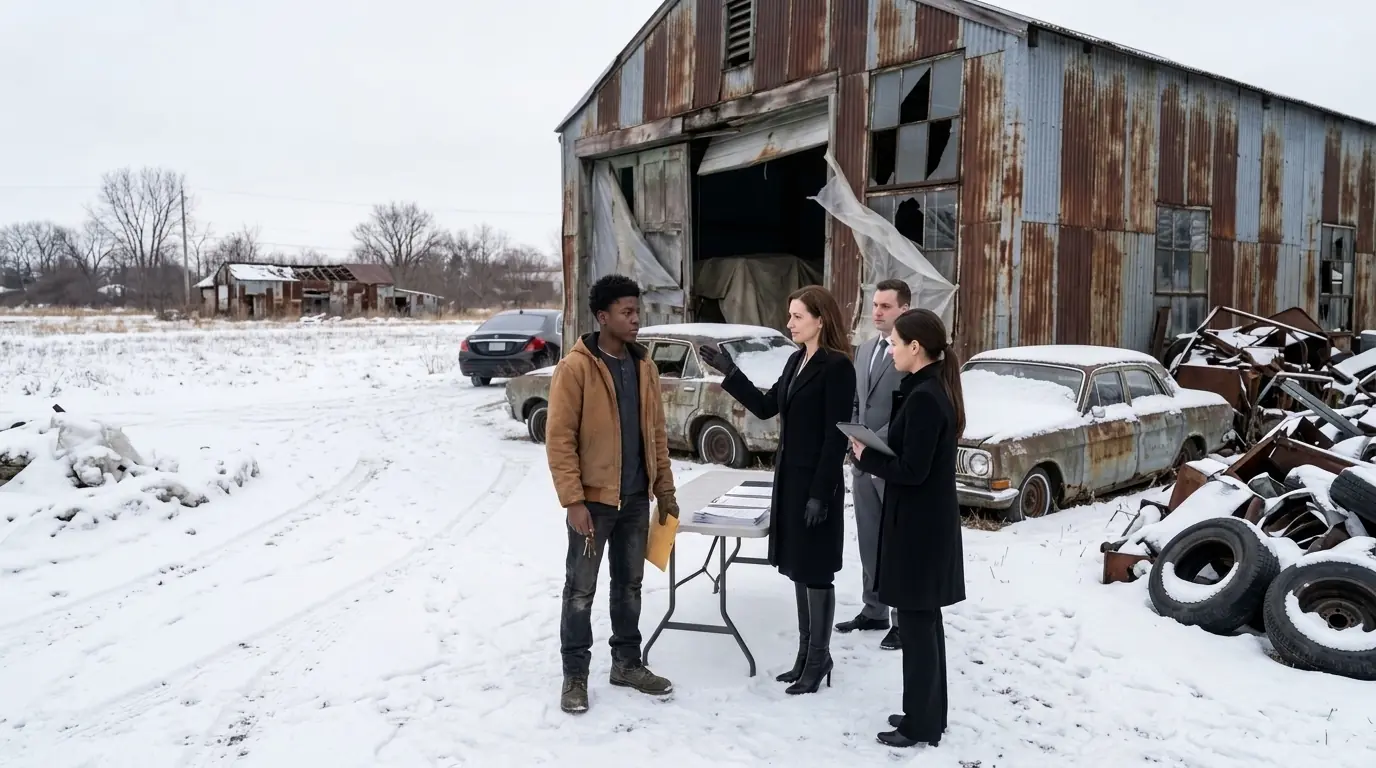
The kitchen smelled like chicory coffee and cornbread the morning Elias counted his money for the last time. October light came slanting through the yellow curtains his mother had sewn eight years earlier, back when his father was still alive to complain about the color. Elias sat at the small pine table, the tin box open in front of him, stacking bills in neat piles of 10. $340. He already knew the number.
He had known it for weeks. But counting it one more time felt like something he owed the money the way a man might tip his hat to a horse before a long ride. Ruth Monroe stood at the stove with her back to him. She had not said much since sunrise. She poured coffee into two chipped mugs, brought one over, and set it down beside the tin box without looking at the tin box.
"You eat something," she said. "Don't you go down there on an empty stomach, Elias. Hungry boys make hungry decisions." "Yes, ma'am." She watched him eat half a square of cornbread before she spoke again.
"I don't like you going alone." "Grandpa Silas said a good machine doesn't care who's holding the wrench," Elias said. "I figure people ought to be the same way." "People ain't machines, baby." He looked up at her then.
Ruth Monroe was 41 years old and carried herself like a woman who had already survived more than her share. Her hair was tied back with a blue cloth and there was flour on the heel of her left hand from where she had leaned against the counter. She was not crying but her mouth had that careful shape it got when she was holding something down. "I know they're not," Elias said. "But I'm not going down there to change anybody's mind. I'm going down there to buy a tractor."
She reached across the table and closed the lid of the tin box for him, pressing it shut with the flat of her palm. Then she wrapped a square of cornbread in a cloth napkin and handed it to him. "For the ride back," she said. "Whatever happens." He tucked it inside his jacket and stood.
On the way out the door he touched the leather band on his wrist without thinking the way a man touches his wedding ring when he is about to walk into something hard.
The road into town ran 4 miles through fields that had already been cut for the season. Elias pedaled the old Schwinn his grandfather had repainted green the summer before he died and the tin box rode in a canvas satchel slung across his back. The air was cool in the shade and warm in the sun and every so often he passed a fence post with a hawk on it and the hawk did not bother to move. He let his mind drift the way it always did on long rides and it drifted as it often had those past 6 months back to the old man. Silas Monroe had been a mechanic before he was anything else.
He had been one during the war fixing trucks and Jeeps for a supply company that never quite let him forget whose uniform he was wearing. After he came home, he had worked 30 years on the Harlan spread—the big one, the one with the white fence that ran along the county road for almost a mile and in 30 years he had never once been promoted and he had never once complained about it within earshot of his grandson. He had only ever said one thing about it and he had said it once when Elias was 13 and angry about something a boy at school had done. "Son," he had said. "Bitterness is a cracked gasket. It leaks everywhere and it ruins the whole engine. You feel what you feel but don't let it in the oil."
Elias remembered the afternoon he was 12 years old and the old man was working on a John Deere in the lean-to behind the house. The tractor belonged to a neighbor named Reuben who had paid in chickens and a promise of firewood. Silas did not take the cowl off first the way most mechanics would have. He put his hand flat on the block while the engine idled, closed his eyes, and listened. "Come here, boy."
Elias came and stood beside him. "Put your hand here. No, flat. Flat like you mean it." The metal was warm under his palm, warmer than he expected, and it hummed in a way that felt almost alive.
Not much, just enough. "Right there," he had said. "That's right." "That's friction where friction ain't supposed to be. Something in there is rubbing itself tired. Now most folks look at a machine they see it with their eyes and they think they know it but a machine talks, Elias. Noise is how it tells you it hurts. Shake is how it tells you it's tired. Heat is how it tells you where. You listen before you look. You hear me, boy?"
"Yes, sir." "Say it back." "Listen before you look." The old man had nodded and gone back to his work. That was the day or one of the days very close to it when Elias had decided that he wanted to be what his grandfather was only further along.
Not because the old man had pushed him toward it. Silas Monroe had never pushed anyone toward anything in his life. But because the old man made the work look like a conversation and Elias wanted to learn the language. 2 years later when Silas's hands had started to shake and he had known what was coming even before the doctor in Macon confirmed it he had given his grandson the leather band. He had cut it himself from an old harness strap and he had burned the words into the inside with a heated nail and he had handed it over on the porch one evening without ceremony.
"Someday you're going to have to stand by yourself in front of people who don't believe you." He had said. "When that day comes don't try to prove anything. Just do your work." "The work speaks for itself if you let it."
Elias had worn the band every day since. The leather had gone dark at the edges from sweat and weather but the words on the inside were still sharp. "Listen." "Before you look."
The auction yard was a flat stretch of packed dirt behind the cooperative's feed barn and by the time Elias coasted in on the Schwinn there were already 60 or 70 men moving through it. They stood in loose clusters around the equipment smoking, spitting, and pointing with the stems of unlit pipes. The air smelled of diesel and tobacco and old hay. A row of tractors ran along the north fence another row of harrows and rakes along the south and a handful of trucks sat clustered near the registration table. Elias leaned his bike against the feed barn wall, settled the tin box into the crook of his arm and walked in.
He felt the eyes almost at once. Not hostile, not yet. Just surprised the way people look at a dog that has wandered into the wrong yard. Two men standing by a disc harrow stopped talking mid-sentence. One of them, a thick-necked fellow, in a cattleman's crease looked Elias up and down, looked at the tin box, then looked at the other fellow and made a sound in the back of his throat that was not quite a laugh.
Elias kept walking. He had already picked out the auctioneer from 20 yards away an older man in a pressed denim shirt standing with a clipboard at the registration table. That would be Walt Crenshaw the name his grandfather had once mentioned with something close to respect. Crenshaw had run this auction for almost 20 years. Silas had told Elias once that Crenshaw was the only man in the county who would look a Black mechanic in the eye and nod before he looked at his hands.
Crenshaw watched him approach without expression. When Elias stopped at the table Crenshaw set down his pencil. "You lost, son?" "No, sir. I'm here to bid."
"You here with somebody?" "No, sir." Crenshaw looked at him for a long second then at the tin box then back at his face. Whatever he was measuring he seemed to finish measuring it. He slid a sign-in sheet across the table.
"Name and mark." "Elias Monroe." His pencil scratched across the paper. Crenshaw pointed at the yard with his chin. "Lots are numbered. Auction starts at 10. You want to inspect before you inspect now. Anything you see with red chalk is sold as is. Anything you break you buy. Anything you try to start without an owner present I put you out."
"Understood?" "Yes, sir." "Good luck, Mr. Monroe." The word "mister" caught Elias sideways. He nodded once and walked off toward the rows of equipment before he could let his face change.
The laughter found him around the 10th lot. It came from a knot of three men standing near a baling machine and the loudest of them was a heavy-set fellow in his mid-50s with a voice that carried the way a church bell carries. Hank Dalton had been buying and flipping farm equipment in Harlan County for the better part of 20 years and he was the kind of man who did not trouble himself with the difference between a joke and an insult. "Fellas, will you look at this?" Dalton said, not quite to Elias but plenty loud enough.
"We got ourselves a young engineer on the grounds." One of the men with him snickered. The other one had the decency to look at his boots. Elias did not turn his head. He kept his hand on the fender of the baler he was inspecting and counted to four inside his own mouth, which was something else his grandfather had taught him.
Four is long enough to stop. Four is short enough nobody else knows you stopped. He moved on. He passed a younger man near lot 14, maybe 30, maybe a little more in a clean work shirt and a feed store cap who was looking at a seed drill with the kind of careful attention that suggested he actually meant to buy it. The younger man glanced up as Elias went by and did not smile, but did not look away either.
He gave a small nod, the kind of nod one working man gives another, and went back to the seed drill. Elias walked on and did not let himself read too much into it. Lot 17 sat at the far end of the north row and three things about it caught his attention before he even got close. The first was its color, a Ford blue that had faded to something closer to slate with the yellow trim almost gone. The second was the chalk.
Someone had written broken sold for parts across the hood in thick white letters and had written it hastily, the way a man writes when he has already decided he is wasting his time. The third was the ground underneath. Elias stopped about 10 feet away and looked at the ground first. There was a stain on the dirt beneath the engine compartment. Most men would have glanced at it, registered oil leak, and moved on.
Elias crouched. The stain was not round. A round stain meant a steady drip, which meant a cracked pan or a failed seal, general damage, the kind that lived everywhere at once. This stain was a crescent. A long shallow arc darker at one end than the other.
A crescent meant the oil was only reaching the ground when the engine turned to a particular position, which meant the failure was not general. It was specific. It was one point of contact and it was a point of contact that moved. He stood up and put his hand flat on the hood. The metal was cool.
The machine had not run that morning and probably had not run in a while, but he left his hand there anyway and closed his eyes for a second, which was a thing Silas had done not because it helped him feel anything differently, but because it kept other people from reading his face while he was thinking. He heard footsteps behind him and knew without turning that someone had stopped to watch. He opened the hood. The engine bay was in decent shape for a machine that had been written off. Some surface rust, some oil film, nothing catastrophic.
He leaned in and put two fingers on the camshaft housing near the back, near the flywheel side, and ran them slowly along the metal. There was a faint ridge of residue that he could feel before he could see, and when he bent lower and looked, he found what he was looking for. A thin uneven seep around the number three bearing seat. Not the camshaft itself, the bearing. One bearing mounted on the cam journal worn just enough out of round that it let oil weep past at one point in the rotation.
An $8 part. He stood back up and wiped his fingers on the inside of his jacket where it wouldn't show. Somewhere off to his left, Hank Dalton was telling a story loud enough for everyone within 30 ft to hear. The story had the shape of a joke and Elias's name was not in it, but Elias was what the joke was about. Elias walked past Dalton without looking and went back across the yard toward the registration table.
The younger man in the feed store cap caught his eye as he passed. Elias still did not know his name and this time the younger man's expression had shifted. It had a question in it now. Not the kind of question that needed an answer. The kind a man asks himself.
At the registration table, Walt Crenshaw looked up from his clipboard. "Something catch your eye, Mr. Monroe?" "Lot 17." Crenshaw's pencil hovered. "The Ford?"
"Yes, sir." Crenshaw looked at him a long moment. Then he made a small mark next to Elias's name and slid the clipboard back. Auction starts in 12 minutes, he said. Stand wherever you like.
Elias walked back out into the sunlight and found himself a place near the fence at a clean sightline to lot 17 where he could see the chalk letters on the hood and the crescent-shaped stain on the dirt beneath it. He set the tin box down against his hip and he rested his hand on the top of it and he waited. Behind him somebody laughed again. He let them.
The 12 minutes before the auction started were the longest of Elias Monroe's life up to that point and he had already survived a few long stretches. He stood with his back against the fence and the tin box pressed against his hip and he watched the yard without seeming to watch it. The men moved the way men move at auctions everywhere in slow deliberate circles like cattle at a salt lick and every so often one of them would glance in his direction and then glance away. A few looked twice. One man, short and ruddy with a toothpick between his teeth, walked past Elias at a distance of 4 feet, looked him dead in the face and said to the fellow beside him, Now who let this boy in here?
The fellow beside him had the grace to answer quietly, Leave it alone, Marvin, and they kept walking. Elias did not turn his head. The weight of the tin box against his hip was the weight of a lot of things. It was the weight of three summers at Tucker's garage on the east side of town where an older Black mechanic named Roy Tucker had paid him $1.75 an hour to sweep floors and hand up wrenches and by the third summer to actually fix the small jobs nobody else had time for. It was the weight of the money his grandfather had set aside in a coffee can under the floorboard of the hall closet, money Silas had never spent on himself in his last 2 years, even when he needed a new pair of boots because he had meant it for the boy.
It was the weight of 3 months of rent on the small wood-frame house where his mother now stood alone with her hands flat against the kitchen counter, probably waiting to hear whatever there was to hear. His mother had said it to him the night before when he had laid out the money on the table and she had looked at the stacks for a long time before speaking. I believe in you, baby, she had said. I do. But belief don't pay the light bill.
He had not been able to find a good answer to that, so he had not tried. Now leaning against the fence with the sun climbing above the feed barn roof, he tried not to think about the light bill. He tried not to think about the rent. He tried to think about the crescent stain on the dirt beneath lot 17 because the crescent stain was a fact and facts were the only thing in the yard that did not care what he looked like. A shadow fell across the fence beside him.
He turned his head and the younger man in the feed store cap was standing there holding two cold bottles of Coca-Cola in one hand by the necks. He held one out without saying anything. "Hot day for October," the younger man said. Elias took the bottle. The glass was wet with sweat from an ice chest and cold enough to ache against his palm.
Thank you. "Name's Jimmy Polk. I farm the 40 acres out past the creek fork." "Elias Monroe." Jimmy nodded once, which was the second nod of the morning that had carried no complication in it.
He uncapped his own bottle against the fence post with an easy motion and took a long swallow. He did not look at Elias while he did it. He looked out across the yard toward the row of tractors in the general direction of lot 17. "That Ford," Jimmy said. "Yes, sir."
"I walked past it yesterday at the preview. Didn't see anything worth my time." Elias did not answer. It was not quite a question. Jimmy lowered his bottle and nodded again to himself this time and then he tipped the brim of his cap toward Elias and walked back across the yard without another word.
Elias watched him go. The whole exchange had taken maybe 40 seconds and Elias understood without being able to say exactly how that 40 seconds had changed something. Not in the yard, in him. He drank the Coca-Cola slowly and did not set the empty bottle down until Walt Crenshaw climbed up onto the flatbed of the auction trailer and rang the bell.
The auction moved the way auctions move, a blur of numbers and hand signals, and Walt Crenshaw's level voice calling out bids and counterbids in a cadence that was almost musical. Elias watched the first 10 lots go without moving. A harrow, a hay rake, two tractors that sold for decent money to buyers who raised a single finger and never changed expression. A walk-behind tiller that went to a man in a red cap for $65. By the time Walt called lot 17, the crowd had drifted into its final shape.
The serious buyers stood in a rough semicircle around the trailer. The curious ones, the ones who were there for the show as much as the equipment stood behind them. And somewhere in the middle of the crowd, Hank Dalton was positioned where his voice would carry. "Lot 17," Walt said, reading from his clipboard. "Ford 5000 tractor, listed as non-operational and sold as-is. Starting bid: $100."
The silence that followed was the silence Elias had been expecting. Nobody raised a hand. Nobody said a word. A man near the back actually turned his head and began a conversation with the fellow next to him as if the lot had already been passed. Elias raised his right hand.
"$100." The yard went still in a different way. Walt did not look surprised because Walt did not appear to let himself look surprised about things, but his pencil hovered for a single beat before he spoke again. "$100 from the young man at the fence. Do I have $110?"
Hank Dalton's voice came from the middle of the crowd loud and lazy and carrying the shape of a grin inside it. "$110." A ripple of laughter followed. A few men turned around to see who Hank was bidding against and when they saw the laughter came again a little louder. Elias kept his hand steady and his face still.
"$120." "$110 now, $120. Do I have $130?" Walt's voice was neutral the way a good auctioneer's voice is always neutral and it gave nothing away. "$130," Hank called.
The laughter was still there, but underneath it now something had shifted because the thing about a joke is that the joke wears out if you keep telling it past its natural length. The men who had laughed at 110 were still smiling at 130, but a few of them were watching Elias differently now. A boy who flinches at 110 is a boy who got in over his head. A boy who does not flinch at 130 is a boy who came here on purpose. Elias did not let himself think about the math.
He had already done the math. He knew what he could spend and still have enough to get the machine home and buy the bearing and leave something in the tin box for his mother. He knew where the line was. "$150." The jump from $130 to $150 was a $20 jump which was not the way the bidding was supposed to go.
It was not an escalation. It was a sentence. It said I am not going to do this $1 at a time with you. Hank Dalton opened his mouth and Elias watched him open it and he watched Hank look at him for the first time that morning as something other than a joke. Hank kept his mouth open for a beat too long and then he closed it and he raised both hands in a mock surrender that was meant to recover the laughter he had already lost.
"Fellas, he wants it. Let the boy have his heap." The laughter came again because it had to come. But there was less of it this time and it had a different shape. Walt did not smile or frown.
He looked across the trailer at the rest of the crowd. "$150. Do I hear $160? $160 anywhere?" Silence.
"Going once at $150. Going twice. Sold to Mr. Monroe at the fence." The gavel came down. Elias heard it and for about 2 seconds he did not hear anything else at all.
Then the ordinary sounds of the yard came back. Somebody coughing, somebody laughing quietly, the whine of a truck engine down the road and he let himself breathe. He walked up to the trailer to sign the papers with the tin box under his arm. When he passed the semicircle of buyers a few of them looked away. One or two did not.
Walt took the tin box, counted out $150 at the little folding table beside the trailer, handed Elias his change and his receipt and for a moment when their eyes met across the paperwork there was something in Walt's face that was not exactly a smile but was not far from one. "Hold on to that receipt, Mr. Monroe." "Yes, sir." Behind him as he stepped down off the trailer, he heard a man near the back of the crowd say to another man low, "What was he looking at over there when he was under the hood?" And he heard the second man say, "Damned if I know."
He was walking across the yard toward the parking area trying to figure out how he was going to get word to Roy Tucker to bring the flatbed down from the garage when the old man stepped in front of him. Elias did not need anyone to tell him who it was. The crowd had parted for this man the way crowds do for someone whose opinion actually costs something. He was tall and narrow, maybe 6 feet with a sun-cured face and eyes the color of old denim and he wore a work jacket that had been patched at the elbows so many times it was more patched than jacket. His hands held loose at his sides were the hands of a man who had spent 70 years using them.
"Son." The voice was quiet and exact. "My name is Chester Boone." I've been farming this county since before your daddy was born. I walked past that Ford yesterday afternoon and again this morning and I looked at it careful both times because I buy tractors and I was thinking about bidding on it for parts.
I concluded it had a bent camshaft which made it worth about $40 to me as scrap. You just paid $150 for it. The crowd had stopped moving. Elias could feel them behind him beside him all around and he knew because he was not stupid that the semicircle around lot 17 had reformed around this patch of dirt. Chester Boone did not raise his voice.
Now I am not a man who enjoys seeing a young person lose his money. So I'm asking you plain and I'd appreciate a plain answer. What did you see on that machine that I did not? Elias felt the heat climb the back of his neck. He could feel Hank Dalton somewhere in the semicircle watching.
He could feel Jimmy Polk off to his left. He could feel Walt Crenshaw at the registration table his pencil gone still. He thought very briefly about saying nothing. About walking past the old man with a polite excuse me, sir and letting the question hang unanswered in the air. He had the right to do that.
The tractor was paid for. The receipt was in his pocket. But the voice in his head was not his own voice. It was his grandfather's. Don't try to prove anything.
Just do your work. The work right then was an answer. Not a victory. Not a speech. An answer.
"Mr. Boone," Elias said, glad his voice did not shake. "I looked at the ground before I looked at the engine." The old man's eyes narrowed very slightly. "Go on." "There's an oil stain on the dirt under the block. It's not round, sir. It's a crescent. If that camshaft was bent you'd get oil weeping all the way around the rotation and the stain on the ground would spread out even. A crescent means oil is only getting past the seal when the shaft is in one particular position. That's not a bent shaft. That's one point of wear in one place that lines up with that position once every turn. A little breath went through the crowd. Not a laugh. Not a gasp. Something smaller and more involuntary than either. Elias kept going. His voice was steadier than he had expected it to be. Then I put my hand on the block. It was cold because the machine hadn't been run. But the metal still had some memory of the last time it ran and the back of the block on the flywheel side was the tiniest bit warmer to the touch than the rest. Not hot. Just warmer. My grandfather, sir, he taught me that warmth in the wrong place is friction in the wrong place. Heat tells you where the hurt is. Chester Boone had not moved. And so I opened the hood and I put my fingers on the camshaft housing near the back and I felt a little ridge of residue where oil had been seeping past. I'm fairly certain it's the number three bearing on the camshaft. It's worn out of round. When the shaft turns to the low side of that wear oil slips past. When it turns away it seals up. That's why the stain is a crescent. That's why the engine will turn but sound wrong and that's why the last owner probably figured the whole camshaft was bent because a tired bearing on a good shaft feels to the ear almost exactly like a tired shaft on good bearings. Almost. Not quite."
He stopped. The silence was complete now. Not a laugh in it anywhere. Chester Boone looked at Elias a long moment. Then he looked past Elias at the crowd behind him and when he spoke again his voice was pitched to carry.
"Which of you," he said, "got down on his knees and looked at the dirt under that machine this morning?" Nobody answered. "Which of you," he said, "put his hand on the block?" Nobody answered. Chester turned his eyes back to Elias and there was something in them now that had not been there before.
It was not quite respect yet because respect is a thing that has to be earned by results and the Ford had not yet been started. It was closer to the thing that comes just before respect. It was attention. "Son," Chester said. "What was your grandfather's name?"
"Silas Monroe, sir." The old man's face did something very small. Not a smile. A recognition. "Silas Monroe?"
"Yes, sir." "Out of the Harlan spread?" "Yes, sir. Thirty years." Chester Boone nodded slowly the way a man nods when he is confirming a thing to himself that he has known for a long time without having had a reason to say it out loud.
"I knew your grandfather, son. Not close, but I knew him. There wasn't a better mechanic in this county in 1965 and there wasn't one in 1975 either and everybody who worked with him knew it. And nobody, as far as I'm aware, ever gave him the credit for it." He reached up and took off his cap which was an old sweat-stained thing and he held it against his chest for a second, not long, just long enough to mean something.
"I apologize for not recognizing you, Mr. Monroe. I should have known the hands." Then he put the cap back on and he stepped aside and he let Elias walk through.
The rest of it happened fast. Walt Crenshaw came off the registration platform at an unhurried walk and set his hand on Elias's shoulder as he passed. Not hard, not performative, just the way one man lays a hand on another's shoulder to say, "I see you." "You got a way to haul that thing home, Mr. Monroe?" "I was going to ride into town and find Roy Tucker, sir."
"I've got a flatbed out back. I'll run it for you. No charge." Jimmy Polk was already walking toward them and now Elias saw what he had not quite been able to place before the young farmer had a quiet way of moving the way a man moves who does not waste motion and he carried himself like somebody who had been watching this whole morning with a mechanic's curiosity of his own. "Mr. Crenshaw, I'd like to ride along if it's all the same to you. I'd like to see how that bearing comes out."
"Fine by me if it's fine by Mr. Monroe." Elias looked at Jimmy. Jimmy held his eye without pushing anything into it. "Yes, sir," Elias said. "I'd appreciate the company."
Somewhere off to the side Hank Dalton was already walking away with his hands in his pockets and his eyes on the dirt. Elias saw him go and did not watch him long. There was no satisfaction in it. There was only the next thing to do which was to get the Ford onto Walt's flatbed and home before the sun moved much further. They winched the tractor up onto the flatbed with a hand crank and two men on the cable.
The Ford rolled reluctantly and then settled and Walt threw chains over the axles and ratcheted them tight. Elias loaded his bike in beside it. He climbed into the cab of the truck between Walt and Jimmy and the three of them pulled out of the auction yard together and the man who had laughed that morning watched them go.
The drive back toward the Monroe place was 20 minutes on the county road. For most of the first 10 minutes nobody said anything. Walt drove with both hands on the wheel and his eyes on the road and Jimmy Polk rode with his arm along the window frame and his cap tipped low against the sun. Elias looked out through the windshield at the fields going by and for the first time since he had walked into the yard that morning he let himself feel afraid. The fear came in a small clean shape.
It was not panic. It was a question. "What if I'm wrong?" He ran it again in his head. The crescent stain, the warm spot at the back of the block, the ridge of residue around the number three seat.
He had felt all of those things. He was sure of all of those things, but he had felt them on a cold machine with men laughing behind his back on a day when he had every reason in the world to want to be right. Wanting to be right was a contaminant. His grandfather had told him that too, though he had said it in different words. "A mechanic who needs to be right is a mechanic who misses things, boy. You work for the truth. You don't work for yourself."
What if he had wanted the bearing so badly that he had convinced himself he had felt what he needed to feel? What if the shaft actually was bent and the bearing wear was secondary and he had read the smaller sign instead of the larger one? What if his grandfather had taught him most of what there was to know, but not quite all of it because there had not been enough time at the end? He reached up with his right hand and touched the leather band on his left wrist and he found the inside seam with his thumb and pressed against it and he felt the faint burned ridges of the letters through the leather. "Listen before you look."
He had listened. He had looked. He had done it in the right order. Whatever the engine had told him was either the truth or it was not, but it was not his job to decide that now. It was his job to take the machine home and open it up and let it tell the rest of the story in front of witnesses.
Beside him Jimmy Polk shifted in the seat. "You all right, Mr. Monroe?" "Yes, sir." "First time somebody called me sir I was 22," Jimmy said. "You can call me Jimmy."
Walt kept his eyes on the road and did not quite smile, but the corner of his mouth changed. "Jimmy." "That's right." Elias lowered his hand from the leather band and set it open on his knee. He did not feel less afraid, but the fear had a shape now and he could work around a shape.
He could not work around something he could not see. The truck slowed at the crossroads and turned off the county road onto the rutted track that led down to his mother's house. Through the windshield in the afternoon light he could see the small wood-frame porch and the dog lying in the dirt beside the steps and after a moment his mother Ruth coming out the screen door with a dish towel in her hand. She stopped on the porch and looked at the flatbed. She looked at the tractor on the flatbed.
Then she looked at her son between the two white men in the cab of the truck and her face just for an instant did something Elias had not seen it do since before his father died. It relaxed.
Ruth Monroe came down off the porch with the dish towel still in her hand. Walt Crenshaw cut the engine of the flatbed and stepped down first removing his cap as he came around the front of the truck. He was not a man who removed his cap for most people and Elias noticed. "Mrs. Monroe, I'm Walt Crenshaw. I run the auction down at the cooperative. Your boy here is a better mechanic than any man on those grounds gave him credit for this morning. I thought I'd see the machine home."
Ruth looked at Walt then at Jimmy Polk who had climbed down on the other side and tipped his cap to her. "Jimmy Polk, ma'am. I farm up by the creek fork." She looked at both of them a long second and then she looked at her son and whatever question was behind her eyes she did not ask it in front of company. She folded the dish towel over her shoulder.
"Come around back then. Silas's tools are in the lean-to."
They rolled the Ford off the flatbed with the winch run in reverse and Elias steered it down the ramps with his hand on the wheel and his foot riding the brake because the brakes at least still worked. The tractor settled on the packed dirt beside the lean-to and in the October light with its faded blue paint and its chalk writing still scrawled across the hood it looked exactly like what the auction yard had said it was. It looked like a machine nobody wanted. Elias walked into the lean-to without speaking and came back out with his grandfather's tool roll. It was a canvas thing oil-darkened tied with a leather thong that Silas had cut from the same harness as the wristband.
Elias set it down on a clean square of plywood next to the tractor and untied the thong and rolled it open. The wrenches lay in their pockets in order of size the way Silas had kept them the way Elias kept them now. Jimmy Polk came and stood a respectful 3 feet back. Walt leaned against the fender of his truck with his arms crossed. Chester Boone who had followed them in his own truck from the auction yard and parked at the end of the drive walked up slowly and stopped beside Walt and said nothing at all.
Ruth watched from the porch. Elias took a rag out of his back pocket, wiped the chalked word "BROKEN" off the hood with two slow passes and did not say anything about it either.
Then he started. He worked the way his grandfather had worked, no wasted motion, no talking to himself, no showing. He pulled the valve cover first because the valve cover came off easiest and cleared his line of sight to the camshaft. Then he loosened the bolts around the camshaft housing in the order Silas had taught him crosswise, never in a circle, so the housing would come down even and not bind. Jimmy handed him tools once or twice without being asked and Elias saw that Jimmy knew how to hand up a wrench handle first turned the right way and he filed that away.
It took him 19 minutes to get to the number three bearing. When the housing came clear he reached in with his fingers and lifted the bearing out and he held it up to the light without saying a word. The outer race was worn into a shallow oval where it should have been a perfect circle. It was not a dramatic difference. A man could have run his finger around it and felt nothing.
But when Elias held it up at an angle and turned it slowly in the sun the light caught the long axis of the oval and the short axis of the oval and the difference was there and any mechanic standing within 6 feet of it could see it. Chester Boone stepped forward, looked once, and stepped back. "Well, I'll be damned." Walt said quietly. Chester took his cap off for the second time that day and held it against his chest and he did not put it back on right away.
"An $8 part," he said. "A man walks past a $3,000 machine because he can't read an $8 part. Mr. Monroe, I have been farming in this county for 51 years and I have made that mistake I do not know how many times—perhaps a dozen. You saved me from making it a thirteenth. Thank you."
Elias did not know what to say to that, so he did what his grandfather would have done, which was to nod once and keep working. He had the replacement bearing in the tool roll. Silas had always kept a small drawer of common bearings in the lean-to Fords, Massey Fergusons, and older Internationals, because Silas had always said a man ought to own the small parts he could not predict needing. The number three seat on a Ford 5000 took a bearing that a Massey Ferguson 135 used in three different places. It was not luck that Elias had the right part on hand.
It was the way his grandfather had run a tool drawer for 40 years. Elias seated the new bearing, torqued the housing bolts back down in the reverse of the order he had taken them off, reattached the valve cover, checked the oil, topped it up from a jug in the lean-to, and stepped back. He wiped his hands on the rag. He looked at the key in the ignition, which had been turned to off the whole morning and which nobody, not the previous owner, not the auction crew, not the buyers who had written the Ford off as scrap had thought to turn for weeks. He turned it.
The engine caught on the second turn, coughed once, sputtered, and then came smooth. It ran so smoothly that Jimmy Polk laughed out loud, a startled, happy laugh. The laugh of a man who has just watched a thing work the way it was supposed to work. A faint, clean exhaust drifted from the stack, and the whole machine settled into a smooth idle, the way a tired old dog settles onto a warm porch. Walt Crenshaw whistled low and slow.
Chester Boone did not whistle. He only nodded once to himself the way he had nodded at the auction yard when he had heard the name Silas Monroe. On the porch, Ruth Monroe laid her right hand flat against her chest over her heart and she kept it there.
By the end of the week, word had traveled. Roy Tucker came out to the house on Tuesday evening just to look and he walked around the Ford with his hands in his pockets and laughed the laugh of an old mechanic who has just heard a good story. On Wednesday, a neighbor came by and wanted to know what Elias would charge to look at his hay rake. On Thursday, a man Elias had never seen before driving a late-model pickup with a Macon dealership sticker on the bumper pulled into the yard and offered him $1,400 for the Ford cash that afternoon. Elias said no.
On Friday, another man offered him $1,900. Elias said no. On Saturday morning, a heavy-set man in a cattleman's crease, not from Harlan County, drove down from the next county over with a certified check already folded in his shirt pocket. He offered $2,400. Elias politely said no again, the same way, and the man looked at him as if he were slightly insane and drove off shaking his head.
That evening, Ruth came out onto the porch where Elias was sitting and cleaning the last of the oil off his hands with a clean rag and she sat down next to him on the top step. "Baby." "Ma'am." "$2,400 is a lot of money." "Yes, ma'am."
"We could use a good piece of that." "Yes, ma'am. I know." She waited. She was good at waiting.
It was a thing she had done for his father at the end and it was a thing she did for him now. He turned the rag in his hands. "It isn't a tractor, Mama. Not to me. It's the thing Grandpa taught me to see. If I sell it, it becomes a tractor again. I'd rather keep it. When I have my own piece of ground someday, I'd rather plow it with that machine than with one I bought clean."
She looked at him a long moment in the failing light. Then she leaned over and kissed him on the forehead the way she had when he was 6 years old and she got up and went back into the house and he heard her start humming something in the kitchen that he had not heard her hum in a long time.
He kept the Ford. Work started coming in for him that fall, small jobs at first, a tiller here, a mower deck there, and Roy Tucker told him that any job too big for the garage he could bring out to the lean-to and split the labor. By Christmas, Elias was putting money back into the coffee can that had once held his grandfather's savings and it was no longer empty and his mother's hands had stopped being quite as tight at the end of every month. He did not talk much about the auction. Jimmy Polk started coming out on Saturdays to help and to learn and the two of them worked together in a way that was quiet and useful and after a while, Jimmy became less of a neighbor and more of a friend, which was a category of person Elias had not expected to acquire that year.
The spring auction came around the following April. Elias rode into Harlan County with Jimmy in Jimmy's truck this time and he did not carry a tin box. He had his hands in his jacket pockets and the wristband on his left arm and a small notebook with the measurements of two specific implements he was thinking about bidding on.
Six months had put something in his shoulders that had not been there in October, not height exactly, but a way of holding himself that came from having already walked through one hard door and found another one on the other side. Walt Crenshaw saw him come through the gate and raised a hand in greeting from the trailer. A couple of the men near the registration table tipped their caps. One fellow, Elias did not remember the man's name, but he remembered the face because the man had been one of the louder ones in the crowd the October before, stepped aside to let him pass and did not quite meet his eye.
Elias was standing by the tractor row looking at a Massey Ferguson when he felt rather than saw somebody come up behind him. He turned. Hank Dalton stood there with his hat in his hand. He looked like a man who had come across the yard to do a specific thing and who wanted to do it without a crowd watching and had timed his approach accordingly. He did not look ashamed exactly because Hank Dalton was not a man built for shame, but he looked like somebody who had been sitting with a thing for six months and had finally decided to put it down.
"Elias." "Mr. Dalton." Hank turned his hat once in his hands. "Last October, the way I carried on, that wasn't right. I knew it wasn't right at the time, and I did it anyway because it was easy. There isn't a good excuse for it, and I'm not going to try to invent one. I'd like to shake your hand if you'll let me."
He held it out. Elias looked at the hand. He thought very briefly of his grandfather, of 30 years on the Harlan spread, of the promotions that never came and the apologies that never came with them, of a man who had worked his whole life for people who had never learned his name the way they learned the names of the horses they owned and who had died without ever being offered a handshake like this one. Elias thought, "I could say no." He had the right to say no.
He had more right than Hank Dalton had to ask. But he also thought, and this was the thing his grandfather had tried to teach him on the porch the evening he had given him the leather band, that a handshake is not a ledger. A handshake does not settle what was. A handshake is a thing two men do about what comes next. He took Hank Dalton's hand.
"Thank you, Mr. Dalton." That was all he said. He did not make a speech. He shook the hand once firmly the way his grandfather had shaken hands and then he let it go and he turned back to the Massey Ferguson and after a moment, Hank put his hat back on and walked away across the yard. Jimmy Polk, who had been standing 10 feet off and not pretending to look at anything else, came over and stood beside Elias at the tractor.
"That took something," Jimmy said. "Took less than you'd think."
That evening, Elias sat on the porch with his mother and the Ford 5000 sat in the side yard as it had for six months, now clean and freshly painted by him the previous month in the original Ford blue with the yellow trim done over carefully by hand. He took the leather band off his wrist and set it on the little pine side table between them so that the words on the inside lay face up in the last of the light. "Listen before you look." Ruth looked at it but did not touch it. "Your grandpa would be proud, baby."
Elias looked out across the side yard at the tractor standing quiet under the late sun and then he looked down at the band and he picked it up and he slid it back onto his wrist and fastened it. "He was always proud, Mama. He told me so enough times. It's just that now some other folks are starting to understand why." She did not answer that.
She did not need to.
They sat on the porch together, a mother and her son, and the evening came down over the fields and somewhere out past the tractor, a whip-poor-will started up its long, slow call and a door in the county had quietly closed behind them and a different one, which nobody in the auction yard had quite been expecting to have to open, stood propped a little wider than it had the October before.