Brad Cole laughed before Claire Moss had finished digging the eighth hole.
By the twentieth, three other men had joined him.
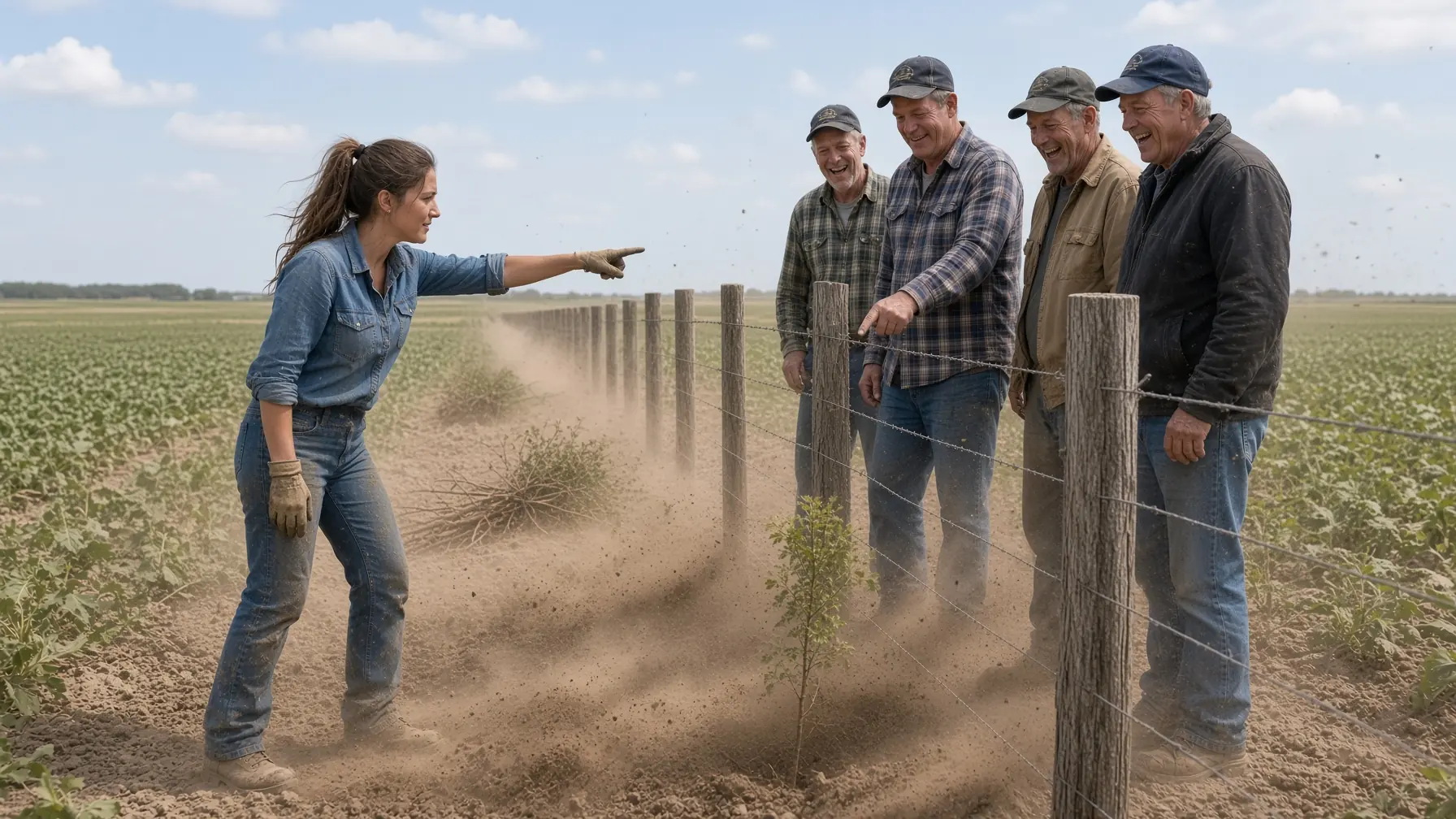
They stood on the opposite side of the east fence with coffee cups in their hands, boots clean enough to prove none of them had planned on helping, watching Claire lower another sapling into the Kansas soil.
Brad shook his head.
“Girl, you're wasting your best edge ground on sticks.”
Claire pressed soil around the roots with both hands.
She did not answer.
Brad looked down the long strip she had marked with flags.
“How many did you say?”
“Three hundred forty.”
One of the men whistled.
“You’re planting all of those?”
“Yes.”
“Along a crop field?”
“Yes.”
Brad laughed again.
“Plant crops to the fence. That's what the ground is for.”
Claire stood.
Picked up the shovel.
Moved twelve feet down the line.
The wind pushed loose soil past her boots.
That was the part none of them seemed to notice.
Claire did.
She had been noticing it since she came home.
The east edge of Moss Farm had been losing soil for years.
Not in dramatic gullies.
Not in one catastrophic storm.
A little every spring.
A little every dry autumn.
Dust lifting.
Fine particles leaving first.
Corn stalk residue collecting against the western fence of somebody else’s property.
By the time Claire returned to Callaway County at twenty-eight, the outer rows of her family’s east field sat several inches lower than portions farther inside.
Her mother, Ruth, had spent eight years farming the property mostly alone after Claire’s father left in 2014.
One hundred twenty-eight acres.
Not a huge operation.
Enough to keep one woman tired nearly every day of the year.
Ruth had done what people in that county did when margins were thin.
She planted every possible foot.
Fence to fence.
She repaired instead of replacing.
She postponed what could be postponed.
And every spring, she watched the wind take a little more from the eastern edge.
Claire had come home with an agroforestry degree and an idea that sounded, to almost everyone nearby, like giving farmland back to trees.
Brad Cole found that especially funny.
By the end of the first morning, he had already told two people at the feed store that Ruth Moss’s daughter had gone to college long enough to forget how acreage worked.
Claire heard about it that evening.
Ruth was at the kitchen table sorting seed invoices.
“You going to say anything to him?”
“No.”
“Why?”
Claire looked through the window toward the line of white planting flags.
“Trees don't care what Brad thinks.”
Ruth smiled.
“Your father would've laughed too.”
“I know.”
“That bother you?”
Claire considered.
“No.”
Then:
“Maybe a little.”
Ruth nodded.
“Good. Means you're human.”
Claire had not come home planning to prove anybody wrong.
That was the version people told later because it made the story cleaner.
The truth was more ordinary.
Her mother needed help.
The farm was getting harder to manage.
And Claire had spent six years studying the relationship between farms and the things farmers often treated as boundaries.
Trees.
Hedges.
Riparian strips.
Grassed waterways.
Shelterbelts.
Habitat edges.
The unused places between profitable places.
At university, Claire became fascinated by one simple contradiction.
Farmers regularly complained about wind erosion, moisture loss, snow blowing off fields, crop damage, and chemical drift.
At the same time, many removed the very structures that slowed wind.
Old hedgerows disappeared.
Tree lines were cleared.
Fence vegetation was sprayed down to dirt.
More acres went into production.
On paper, that gained land.
But land and productive land were not always identical.
Claire’s professor, Dr. Malcolm Reeves, once drew a rectangle on a whiteboard.
“This is a hundred-acre field.”
Then he shaded a narrow strip along one side.
“How many of you think this is wasted ground?”
Half the class raised hands.
He smiled.
“That depends entirely on what the strip is doing.”
Then he drew arrows representing wind.
“Sometimes the most productive acre on a farm is the one that never produces a crop.”
Claire wrote that sentence down.
She kept it.
Years later, standing along the Moss east fence while loose soil moved past her boots, she finally understood it outside a classroom.
The first person she called was James Reed.
Callaway County extension agent.
Fifty-three years old.
Patient.
Practical.
And accustomed to giving people advice they ignored until someone else succeeded with it.
Claire called at 7:40 Monday morning.