Clara Bramwell had thirty-five pounds of flour left.
That was all.
Thirty-five pounds in a half-collapsed burlap sack beside the back wall of Bramwell’s Bakery, leaning there like it was tired too. The shelves in the front room were empty. The cash drawer held fourteen cents, two bent buttons someone had mistaken for coins, and a receipt from the mill she could no longer afford to pay.
The oven had been cold for four days.
That was the part that hurt worst.
Her father would have hated that.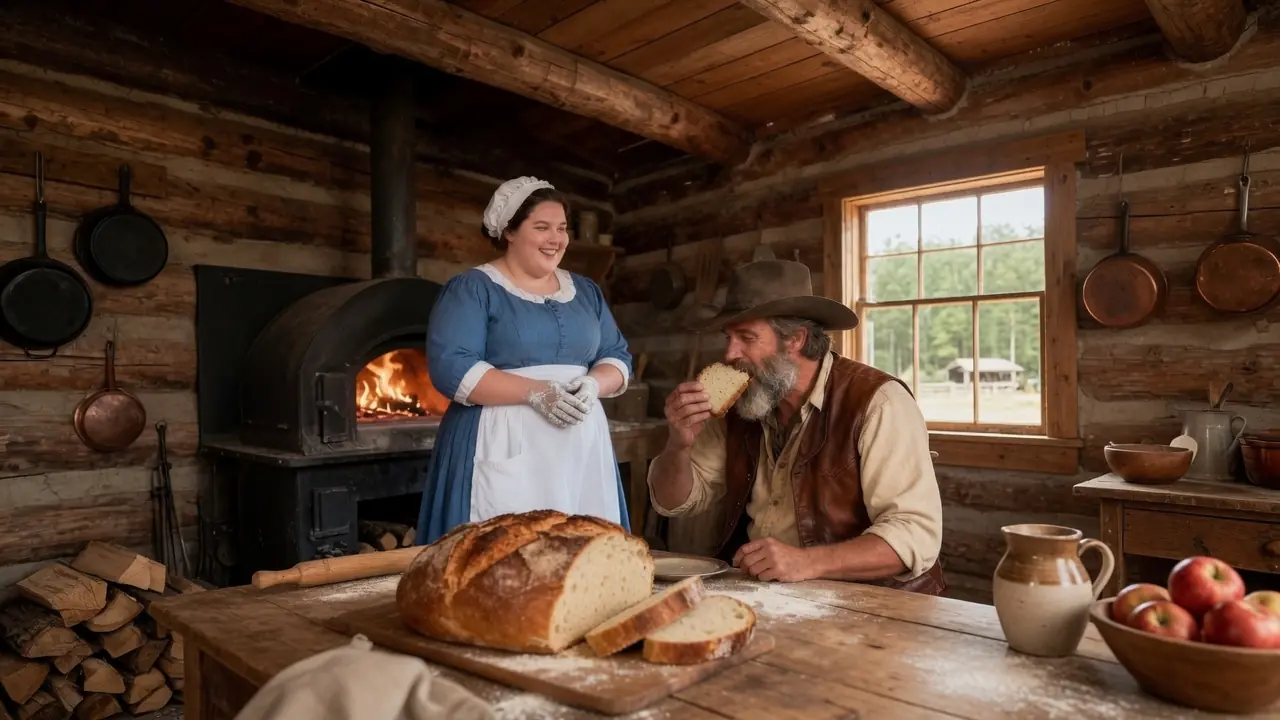
Elias Bramwell used to say an oven was like a heart. You could let it rest, but you could not let it go dead. Her mother, Ruth, would laugh and tell him to stop turning firewood into poetry, but she never let the oven cool either.
Not in blizzards.
Not in fever season.
Not even the week Clara broke her wrist at fourteen and her mother baked one-handed while Clara measured flour with the other.
Now Clara stood in the back room at twenty-four years old, large hands pressed flat on the scarred worktable, looking at the last sack of flour and feeling the town of Red Mesa waiting outside to see her fail.
They had been waiting for months.
Some politely.
Some loudly.
Some with the particular pleasure people take when they think a woman has inherited more hope than sense.
Red Mesa was a hard town in the Kansas dust, built out of cattle money, freight wagons, church bells, and stubbornness. It had one main street, two saloons, three churches that disagreed on nearly everything, and a population that could smell weakness before breakfast.
Clara knew that because she had grown up behind the bakery window, watching people decide things.
Who belonged.
Who would last.
Who was worth helping.
Who could be laughed at safely.
Her parents had arrived in Red Mesa with a wagon, a sourdough starter wrapped in cloth, and enough money to rent half a storefront beside the cooper’s shop. Within five years, Bramwell’s Bakery became the place travelers remembered when every other building in town blurred into dust and wood.
Her father’s crusty loaves fed ranch crews from three counties.
Her mother’s honey rolls sold out before the church bell finished ringing on Sunday mornings.
People used to stand in line before sunrise.
Now those same people crossed the street rather than meet Clara’s eyes.
Not all of them.
Never all.
But enough.
Her parents had been dead eleven months.
Her mother went first, taken by lung fever so quickly Clara still sometimes expected to hear her coughing from the little bedroom behind the pantry. Her father followed seven weeks later, though the doctor called it heart trouble and Clara called it sorrow. After the funeral, the bakery belonged to her.
So did the debt.
Doctor bills.
Burial fees.
A repair note for the cracked oven plate.
Two unpaid invoices for sugar and yeast.
And a building rent that came due in nine days whether grief had finished with her or not.
Clara had tried.
That was the thing she needed the empty room to know.
She had gotten up before dawn, fed the starter, kneaded until her shoulders burned, smiled at customers who looked past her toward the memory of her mother, and kept the recipes as close to the originals as she knew how. She had reduced prices. Added biscuits. Tried meat pies for the cowhands. Made smaller rolls when people said money was tight.
None of it had turned the tide.
Because part of the problem was not the bread.
Part of the problem was Clara herself.
She was a big woman.
That was the plain truth of it.
Tall, broad through the shoulders, heavy in the hips, with thick arms built from years of lifting flour sacks and working dough before most of the town had opened its shutters. She had soft cheeks, strong hands, and a body that Red Mesa considered an invitation for comment.
Men thought they were clever about it.
Women were often worse because they wrapped cruelty in concern.
“Bread must be good, considering how much she samples.”
“Hard to trust a baker who looks like she keeps half the inventory.”
“Poor Ruth. Clara has a sweet face, but no discipline.”
She heard it all.
People always think thick walls protect their words, but gossip knows how to travel through wood.
Her mother had taught her to stand straight.
Her father had taught her to look a person in the eye.
Neither had taught her how to stop a town from making her body the first thing it saw and her work the last thing it believed in.
So Clara learned silence.
Not the weak kind.
The kind that saved strength.
She stopped answering jokes. Stopped flinching at laughter. Stopped looking out the window when men paused on the boardwalk to see whether she had noticed them pointing.
But the bakery noticed.
Fewer customers came.
The Barlow outfit stopped ordering weekly loaves and bought cheap freight bread from the general store instead. Families who once came every Saturday now came once a month, then not at all. New settlers looked through the window, hesitated, and walked away after someone down the street whispered whatever Red Mesa had taught them to whisper.
Now there were thirty-five pounds of flour left.
The oven was cold.
And Clara was tired in a way sleep could not fix.
Outside, the town was beginning its morning.
Wagon wheels ground through dry dirt. A hammer rang at the blacksmith shop. Mrs. Bellamy from the church auxiliary walked by with two other women, glancing toward the bakery window before lowering her voice. A boy ran past, stopped when he saw Clara inside, then ran on as if being seen near the bakery might cost him something.
Clara turned away from the window.
She untied the flour sack.
If this was the end, she would not meet it with a cold oven.
She built the fire slowly, the way her father had taught her.
Small kindling first.
Then split wood.
Then patience.
The first flames took reluctantly, licking along the dry pieces before catching, and the sound filled the kitchen with something close to memory. Clara stood there longer than she needed to, watching fire return to iron.
Then she pulled the old starter from the shelf.
It had survived everything.
Her mother’s sickness.
Her father’s silence.
The lean months.
The empty shelves.
Even when Clara had eaten corn mush for supper three nights straight, she had fed that starter because some things were not supplies. Some things were inheritance.
When she lifted the cloth, the smell rose sharp and alive.
Sour.
Sweet.
Familiar.
For one foolish second, she almost said, “Morning, Papa.”
Instead, she measured flour.
She made sourdough first.
Not because it sold best anymore.
Because it mattered most.
She mixed the dough with steady hands, feeling the hydration by touch rather than measurement, adding a little water when the dough pulled too tight. The room was cold, so she adjusted the resting time. The flour was older than she liked, so she worked it gently, coaxing strength without tearing it.
Bread was not obedience.
Bread was conversation.
Her father had said that too.
And today, for the first time in months, Clara stopped trying to force the recipe to save her and simply listened to what the dough wanted.
While the sourdough rested, she made honey rolls with the last of the good honey.
She had been saving it.
For what, she did not know.
Some future day when the account book looked kinder.
Some miracle customer.
Some morning when hope returned politely and knocked before entering.
That morning did not come.
So she used the honey anyway.
She made them properly.
Butter rubbed into dough by hand.
Honey warmed just enough to loosen.
A little cinnamon from the bottom of the tin.
Not enough for extravagance.
Enough for memory.
By midmorning, the bakery smelled alive.
That was the only word for it.
Warm yeast, browned crust, honey, smoke, and something deeper beneath it all, something that belonged to home before home had become a place with ledgers and unpaid bills.
Clara pulled the first loaves from the oven at ten.
They were beautiful.
Not pretty.
Pretty was too small.
The crust had opened clean beneath the scoring, deep brown at the edges, golden along the ridges. The loaves sat heavy and proud on the cooling board. When Clara tapped the bottom of one, it answered hollow, exactly as it should.
She cut the heel while it was still too hot.
Steam rose.
She put butter on it because if ruin was coming, ruin could wait one more minute.
The first bite stopped her where she stood.
For months, she had been baking with fear in her hands.
Fear of wasting flour.
Fear of losing customers.
Fear of hearing another laugh through the window.
Fear of becoming proof that everyone had been right.
This loaf had none of that fear in it.
It tasted like the bakery when she was ten years old and her mother let her sit on the flour bin swinging her legs while her father pulled bread from the oven before dawn. It tasted like work done cleanly. It tasted like someone who knew what she was doing.
Clara leaned both hands on the table and lowered her head.
She did not cry.
Not quite.
Then she carried the loaves into the front room and filled the display shelf.
For an hour, no one came in.
People passed.
Some slowed.
A freighter looked through the window, sniffed the air, then kept walking.
Two men outside the livery glanced over and laughed at something Clara could not hear. She did not look at them long enough to find out whether the joke had a target. She went back to the kitchen and kept baking.
At eleven-thirty, the bell above the front door rang.
Clara wiped her hands on her apron and stepped through the curtain.
A man stood just inside the door, holding his hat in one hand.
She knew him instantly.
Everyone in Red Mesa knew Everett Shaw.
He owned the Stonecross Ranch, which was less a ranch than a kingdom of cattle, hired men, grassland, water rights, and silence. He was forty-three or forty-five, depending on who told it, tall and lean with dark hair silvering near his temples and a face made stern by sun, responsibility, and the habit of not explaining himself twice.
People said he was fair.
They also said he was impossible.
He paid on time, fired without sentiment, remembered debts, hated excuses, and had once ridden thirty miles in a thunderstorm to return a lame horse to a farmer because the animal had been sold under dishonest terms.
No one called Everett Shaw soft.
Not where he could hear.
He stood in Clara’s bakery looking at the bread shelf as if the rest of the room did not exist.
“Mr. Shaw,” Clara said.
He turned.
“Miss Bramwell.”
His voice was low, rough at the edges, not unkind but not decorated either.
“Those loaves yours?”
“They are.”
“Your father’s recipe?”
“His starter,” she said. “My adjustments.”
Everett’s eyes moved back to the shelf.
“What kind of adjustments?”
The question surprised her.
Not because it was hard.
Because it was serious.
“I changed the water ratio some. Less stiff than his dough. Longer rest. Covered bake for the first part to hold steam, then open heat to finish the crust.”
Everett looked at her with a stillness that made her feel examined but not judged.
“How much?”
“Twenty cents a loaf.”
He set a coin on the counter.
Then he picked up the nearest loaf.
He did not handle it like a man humoring a struggling woman.
He turned it over like a man who knew bread mattered if it was meant to feed working people. He pressed his thumb lightly against the crust and watched the spring. He held it close enough to smell, then placed it on the counter and took a knife from his pocket.
“May I?”
“You paid for it.”
He cut a thick slice.
Outside, Clara noticed three men had stopped on the boardwalk.
Harlan Voss was one of them, a feed-store loudmouth who had laughed the hardest when Clara repainted the bakery sign. Another was Boone Tully, who had once told her that women did better selling pies than running businesses. They were watching now, leaning with false casualness against the hitching rail.
Everett Shaw ate the bread.
Slowly.
He chewed with the grave attention of a man judging a horse before buying it.
Clara waited, hands folded so he would not see them tighten.
He swallowed.
Then he cut another slice.
That was the first answer.
The men outside stopped talking.
Everett ate the second slice, then looked at her.
“What flour?”
“Carver Mill high-gluten wheat from Stanton County. When I can get it.”
“When you can?”
She met his eyes.
“When I can pay for it.”
He nodded once.
Not pity.
Acknowledgment.
“How many loaves can you bake in a morning without losing quality?”
Clara almost gave the cautious answer.
Then did not.
“Sixteen with the current oven. Twenty if I start at three and run the timing tight. More if I had help, but I don’t.”
Everett wiped the knife on a clean cloth and folded it shut.
“My crews are eating wagon bread that tastes like wet cardboard and sits like fence stone in a man’s stomach.”
Clara said nothing.
“I’ve tried three suppliers in two years. None worth keeping.”
He reached inside his coat and removed an envelope.
It was thick.
Business thick.
Not charity thick.
He placed it beside the cut loaf.
“I need bread for Stonecross. Six dozen loaves a week to start. Sourdough, white pan bread, and something heavier for the men riding long days. Deliver Monday through Saturday before sunrise. I’ll send a wagon once the order grows.”
Clara looked at the envelope.
She did not touch it.
“What is that?”
“Three months advanced payment.”
Her breath caught despite her best effort.
Everett saw it but did not comment.
“If your bread holds at volume, we talk again at the end of the term. If it does not, we part clean.”
Outside, Harlan Voss had stepped closer to the window.
He was no longer laughing.
Clara looked from him to Everett.
“Why come yourself?”
Everett put his hat back on.
“Because I buy what I intend to trust.”
“That is not an answer most men would give.”
“I am not most men.”
He glanced once toward the window, where the boardwalk men were suddenly very interested in not being seen watching.
Then he looked back at her.
“And if Red Mesa needs help understanding that I am buying bread, not donating pity, I expect the town will catch up.”
Clara felt the words land somewhere deeper than business.
“I can have the first order ready by Friday,” she said. “Not tomorrow. I need time to build the starter and supply properly. I won’t send you rushed bread.”
Everett’s eyes held hers.
“Friday, then.”
He picked up the loaf he had bought, nodded once, and walked out.
The bell rang above the door.
Clara stood still until the sound faded.
Then she opened the envelope.
The number inside made the room tilt.
She read it again.
Then she sat on the stool behind the counter, laid the paper flat, and pressed both hands over it until the trembling stopped.
Through the window, she heard Harlan Voss mutter something.
Boone Tully did not laugh.
That was new.
Clara did not go to the window.
The oven was still hot.
And for the first time in months, she had work waiting that was bigger than fear.
The next morning, she went to Rusk & Sons Supply at seven sharp.
Mr. Abram Rusk stood behind the counter polishing his spectacles, surrounded by stacked crates, flour barrels, coffee tins, nails, rope, dried beans, and the smell of burlap. He was a narrow man with a pointed beard and a talent for doubting people politely.
He had doubted Clara for months.
Never rudely enough to be called rude.
Just enough.
“Miss Bramwell,” he said, looking up. “What can I do for you?”
“I need two hundred pounds of bread flour. Fifty pounds of soft flour. Butter. Salt. Yeast cakes. Cinnamon if you have enough. And I need a regular milk arrangement with Parsons Dairy.”
Abram blinked.
“That is a substantial order.”
“Yes.”
“Your account—”
“I’m paying now.”
She placed Everett’s envelope on the counter and counted out the first bills.
Abram looked at the money.
Then at the mark on the order slip.
“Stonecross.”
“Yes.”
“Mr. Shaw contracted you?”
“Yes.”
His expression shifted.
It was small, but Clara saw it.
The scale in his mind had changed weight.
“I can have the flour delivered by noon,” he said.
“I need it by ten.”
He hesitated.
Then picked up his pencil.
“By ten.”
“Good.”
When she turned to leave, Abram said, “Your mother’s honey rolls were the best in three counties.”
Clara stopped.
She did not look back.
“She taught me,” she said.
Then she walked into the morning with flour secured, milk arranged, and enough money left to pay the building rent before the landlord could look satisfied about asking.
Word moved through Red Mesa before noon.
Not accurately.
It never did.
Some said Everett Shaw had bought out the bakery. Some said Clara had begged him. Some said he had known her father. Some said he had taken one bite and ordered enough bread for an army.
By the time the flour arrived, people were passing the window more slowly.
Looking differently.
Not kindly, exactly.
Kindness was too generous a word.
They were reconsidering.
That was enough for the day.
Clara worked until after dark.
She pinned a production schedule beside the oven, divided into hours, batches, proofing times, delivery loads, and cooling windows. She recalculated twice. The order was possible, but it left no room for panic, self-pity, or burned batches.
On Friday, she rose at two-thirty.
The town was black and cold when she unlocked the bakery.
Her hands knew what to do before her mind finished waking. Fire first. Starter next. Flour measured. Water warmed. Dough mixed. Loaves shaped. Oven watched like a living thing.
By five-fifteen, twelve Stonecross loaves were wrapped in clean cloth in a borrowed cart.
The sky was only beginning to gray when she pushed the cart north toward the ranch gate.
The road was hard with frost.
Her breath fogged in front of her.
The cart wheels creaked over every rut.
At the Stonecross east gate, a ranch hand waited with a pencil tucked behind one ear. He was middle-aged, broad in the shoulders, with the calm face of a man who had been awake longer than Clara.
“Bramwell Bakery?”
“Yes.”
He lifted the cloth, inspected the loaves, then picked one up and pressed it the way Everett had done.
“These look right.”
“They are.”
He signed her delivery slip.
“See you Monday.”
“You will.”
By the end of the first week, Clara’s hands were blistered.
By the second, her shoulders ached so badly she had to roll them against the doorframe each night before sleeping.
By the third, the display shelves were no longer empty by accident.
They were empty because things sold.
Saturday honey rolls sold out before nine.
Then again before noon after she made a second batch.
A family from the northern homesteads placed an order for six loaves every other Thursday. A schoolteacher bought white bread and asked if Clara would consider making small rolls for classroom lunches. Mrs. Bellamy from the church auxiliary came in, looked around as if she had never judged the place in her life, and bought two honey rolls without comment.
Clara served her politely.
Then charged full price.
Her first help came through the back door on a Tuesday.
Mrs. Agnes Pruitt, a widow who lived behind the bakery, appeared at dawn carrying two quilted oven mitts and wearing an expression that made argument feel inefficient.
“I’ve smelled scorched cloth three mornings in a row,” she said.
Clara looked at the mitts.
“I burned through my old pair.”
“I know. That is why I made those.”
Clara took them.
“Thank you.”
Agnes looked past her into the kitchen.
“You need another pair of hands.”
“I cannot pay much.”
“I did not say I needed much.”
“I won’t take unpaid labor.”
Agnes’s mouth twitched.
“Good. I would have thought less of you if you did.”
That was how Agnes Pruitt became the first employee Bramwell’s Bakery had after Clara’s parents died.
She arrived at four each morning, kept the wood stacked, washed pans, wrapped loaves, and said fewer words than anyone Clara had ever met. Her silence was not cold. It was useful. It filled the kitchen like sturdy furniture.
One morning, while shaping rolls in the gray before dawn, Clara said, “You knew my mother.”
Agnes nodded.
“Everyone knew Ruth Bramwell.”
“I mean really knew her.”
The older woman’s hands kept moving.
“She brought me bread after my husband died. Every morning for two weeks. Never asked if I wanted it. Just left it by the door.”
Clara’s throat tightened.
“She did that sort of thing.”
“Yes,” Agnes said. “Now you are.”
Clara did not answer.
The dough did not require words, and neither did gratitude that early in the morning.
Everett Shaw returned to the bakery on a Sunday afternoon.
Not the front door.
The back.
Clara opened it to find him standing in the alley with his hat in hand and dust on his boots.
“This is unusual,” she said.
“I know.”
“Should I be worried?”
“Only if you dislike growth.”
She stepped aside.
He entered the kitchen and looked around, taking in the schedule pinned by the oven, the cooling racks, Agnes’s stacked pans, the flour barrels, the wrapped delivery cloths. He did not praise anything immediately. Clara had come to understand that Everett Shaw did not throw praise at things to make them feel better.
He looked until he knew what he thought.
Then he sat at the worktable.
“I want to increase the Stonecross order,” he said.
Clara poured two cups of coffee, though one had gone cold.
“To what?”
“Fifteen dozen loaves a week. Add a heavy grain bread if you can make one. Oats, rye, whatever will keep a man full through a long ride.”
“That is more than double.”
“Yes.”
“I can do it, but not tomorrow. I need two weeks to adjust production without dropping quality.”
“Good.”
That answer surprised her.
“You expected me to say that?”
“I hoped you would.”
He lifted the coffee and drank as if temperature did not concern him.
“A baker who says yes too fast worries me.”
Clara almost smiled.
“I need transport modified. I can deliver small orders by cart. I cannot push fifteen dozen loaves to your gate.”
“I’ll send a wagon at five-thirty every delivery morning. It will load at your back door.”
She nodded.
“I’ll need to test the grain bread.”
“Ask Rusk for red fife wheat if he can get it. My mother used it when I was a boy in Missouri. Stronger flavor. Good with oats.”
“You bake?”
“No.”
“But you know wheat.”
“I know what fed men through winter.”
He stood to leave, then paused at the door.
“Your father once repaired my saddle strap in a storm.”
Clara looked up.
“My father?”
“I was new to the territory. Young enough to think pride was useful. Strap broke south of town with weather coming in. He fixed it behind the bakery and refused payment.”
“That sounds like him.”
“He said neighbors do not charge neighbors for keeping a man from dying stupidly.”
For the first time since he arrived, Everett smiled.
Only barely.
But it was there.
“I did not forget.”
After he left, Clara stood in the kitchen with both hands on the table.
The contract was business.
But not only business.
An old kindness had returned wearing a rancher’s coat.
She did not know whether that made the help easier to accept or harder.
Either way, there was bread to bake.
The grain bread took six tests.
Straight red fife was too dense.
Rye made it too sharp.
Oats softened it.
A spoon of honey changed everything.
The winning loaf came out heavy, fragrant, with a firm crust and a deep, nutty flavor that stayed in the mouth after the bite was gone. It was not a bread for polite tea tables. It was bread for cold mornings, long rides, and men who burned through breakfast before noon.
Clara wrote the recipe into the blank back pages of her mother’s book.
Stonecross grain loaf.
She stared at the title for a while.
Then underlined it.
The first time Stonecross sent word back about it, the note contained only three words.
Men want more.
Agnes read it and said, “That is poetry from ranch hands.”
Clara laughed so suddenly she startled herself.
Growth came like weather.
Not gently.
The new schedule strained everything.
Her old oven could barely keep pace. Clara misjudged the grain loaf timing twice, burned one batch of rolls, and spent three nights with her hands wrapped in cold cloth because the blisters had opened. She learned which pain meant stop and which pain meant adjust your grip.
She adjusted.
Rusk & Sons began extending better supply terms.
The Parsons Dairy sent extra milk twice weekly.
A farm wife named Marion Holt rode eight miles to ask if Clara took standing orders. She brought three neighbors the next time. Soon the northern settlement had a regular account in Clara’s ledger.
Then Harlan Voss walked in.
He came alone, which made him look smaller.
Without his usual circle of men chuckling behind him, Harlan was just a broad man with a red face, a stiff collar, and the uncomfortable air of someone trying to cross a bridge he had personally set on fire.
Clara came out from the kitchen.
“Mr. Voss.”
“Miss Bramwell.”
He stared at the display shelf.
“I’ll take two sourdough.”
“Forty cents.”
He placed the coins on the counter.
She wrapped the loaves neatly, tied them with twine, and set them before him.
He did not leave.
“My wife likes your honey rolls,” he said.
Clara looked at him.
“She’s welcome Saturday mornings. They sell quickly now.”
“Yes. She said.”
His ears reddened.
“I said some things.”
“You did.”
He swallowed.
No apology came.
Clara waited and realized none would.
Some people could walk all the way to shame and still not know how to knock on the door.
“My wife said I ought to come myself,” he muttered.
“She sounds sensible.”
That almost startled a laugh from him, but he held it down.
“I suppose.”
He picked up the bread.
Clara did not forgive him.
Not in that moment.
But she served him.
That was enough for one morning.
Agnes appeared from the kitchen after the door closed.
“Could’ve charged him double.”
“I thought about it.”
“Why didn’t you?”
Clara straightened the shelf.
“Because then I would have been baking for him.”
Agnes nodded once.
“Good answer.”
The dinner at Stonecross came in the fifth month.
Everett entered through the front door on a Monday and asked for bread service for twenty-two guests: land buyers, cattlemen, attorneys, and a woman named Vivian Thorne, who ran the largest trading network west of Topeka.
Clara knew that name.
Everyone who wanted to grow beyond a single town knew that name.
Vivian Thorne could put a product in ten settlements or bury it under silence simply by deciding it was not worth shelf space.
“I want you to provide the table bread,” Everett said. “Whatever you think shows your work properly.”
“That is catering.”
“Yes.”
“It is priced differently.”
“Name it.”
She named a price that would have made her old self apologize.
Everett did not blink.
“Fair.”
Then he added, “Mrs. Thorne notices suppliers.”
Clara held his gaze.
“Is that why you asked me?”
“No. I asked you because your bread belongs on the table.”
That answer followed her for two weeks.
She planned the dinner like a battle.
Sourdough.
White pan bread.
Stonecross grain loaf.
Butter rolls folded three times.
Honey-apple sweet rolls with cinnamon glaze.
Agnes came at three in the morning without being asked. Together they worked in near silence until the kitchen filled with heat, steam, and the smell of every risk Clara was taking.
Nothing failed.
That felt like grace.
By one in the afternoon, everything was packed in wooden crates lined with clean cloth. Clara rode with the wagon because if her name was going to sit on that table, her hands would place it there.
Stonecross Ranch was larger than she imagined.
Not fancy.
Better.
The main house stood low and wide against the land, built for weather, work, and years. The kitchen belonged to a cook named Abel Ford, who inspected Clara’s rolls as if they had applied for employment.
“Good lamination,” he said finally.
“Three folds.”
“Could’ve used four.”
“Could’ve toughened the dough.”
He looked at her.
Then grunted.
Respect, apparently.
The bread went to the dining table at two-thirty.
At three, guests arrived.
Clara intended to leave after setup, but Everett came to the kitchen doorway before the meal began.
“Vivian Thorne asked who made the grain loaf.”
Clara looked at her flour-dusted sleeves.
“Am I meant to answer in person?”
“That is your decision.”
She untied her apron.
Her dress underneath was plain, and flour marked one forearm despite her washing. She was aware of her body, as she always was in rooms where wealthy people sat straight-backed and well-dressed. She let the awareness pass through her without commanding her feet.
Everett introduced her.
“Miss Clara Bramwell of Bramwell’s Bakery.”
Vivian Thorne sat near the middle of the table.
She was in her fifties, with steel-gray hair, a dark traveling dress, and eyes that made excuses feel foolish before anyone spoke them. A half-eaten slice of grain bread rested on her plate.
“This is yours?” she asked.
“Yes.”
“What grain?”
“Red fife wheat, blended with bread flour and oats. A little honey. Longer bake than standard because it needs time to set through the center.”
Vivian picked up the slice.
“It holds well.”
“It was made to.”
“For transport?”
“For working men first. Transport came after.”
Vivian’s mouth curved slightly.
“Good answer.”
The room watched them now.
Clara did not care as much as she expected to.
Vivian asked about capacity.
Clara answered plainly.
Current weekly volume.
Constraints.
Oven limitations.
Supply arrangements.
Possible expansion.
She did not exaggerate.
She did not shrink.
She stood in a ranch dining room with flour on her sleeve and spoke about her bakery as if it deserved serious discussion because it did.
After supper, Vivian asked to speak privately.
The conversation lasted nearly an hour.
No compliments wasted.
No false warmth.
Vivian wanted bread in two trading posts to start, twice weekly, with written standards and a sixty-day evaluation. She would advance payment against future orders, enough for Clara to build capacity, but not so much that failure would become sentimental.
“This is not charity,” Vivian said.
“I would not accept it if it were.”
“I thought not.”
Clara asked for time.
Vivian nodded.
“That is the correct answer.”
On Tuesday, they negotiated at the Red Mesa Hotel.
For two hours.
Hard.
Clean.
Fair.
Clara walked out with a signed agreement, an advance large enough to buy a second oven, and a transport allowance that made her sit down on the hotel steps for one full minute before she trusted her legs.
The second oven arrived three weeks later.
It took four men, a removed doorframe, two curses from the ironworker, and Agnes standing in the alley saying, “Tilt it left, unless you plan to rebuild the whole wall.”
When the oven finally sat beside the first one, Clara stood in the bakery kitchen and felt the room become something new.
Not her parents’ bakery.
Hers.
Built from theirs.
Carrying theirs.
But hers.
She hired a second baker named Levi Boone, a quiet man of twenty-seven who made white bread with such careful attention that Clara hired him after one test loaf.
Then came Molly Jensen, seventeen, from the northern settlement, who asked better questions than most grown men and learned the grain loaf in ten days.
By the end of the year, Bramwell’s Bakery employed four people.
The Saturday honey-roll line stretched out the door.
Stonecross renewed its contract at better terms.
Vivian Thorne expanded from two trading posts to four, then six.
Red Mesa changed slowly around the bakery.
Not like in stories, where one triumphant moment forces everyone to become better.
People rarely improve that neatly.
The town simply adjusted, one morning at a time, to the fact that Clara Bramwell had not failed.
Then to the fact that she was succeeding.
Then to the fact that her success fed half the region.
Harlan Voss’s wife became a regular.
Then Harlan did too.
He never became warm, but he became civil, and in Red Mesa civil was not nothing. It meant the jokes stopped. It meant men who had laughed began finding other things to do with their mouths.
Clara did not chase forgiveness.
She had ovens to tend.
Everett Shaw came to supper with her one Sunday evening.
Not for business.
That was new.
They ate steak at the hotel restaurant, and for two hours they talked about Missouri winters, dead parents, bad debts, cattle prices, bread, and the strange difficulty of making a life after loss.
He told her he had built Stonecross from nothing but a water claim and two stubborn cows.
She told him she had nearly closed the bakery with thirty-five pounds of flour left.
He did not say, “I saved you.”
She liked him better for that.
Instead, he said, “You lit the oven.”
Clara looked at him.
“That was all I had left to do.”
“No,” he said. “That was the first thing.”
That stayed with her.
Six months later, he asked to take supper again.
Then again.
Then often enough that Agnes began appearing from behind curtains with expressions Clara refused to acknowledge.
A year after the morning of the last flour sack, Clara stood on the bakery step at sunset.
The display shelves inside were empty because the day had sold clean through. Both ovens were cooling. Levi and Molly had gone home. Agnes had locked the back room and left with her usual brief nod. The account book sat balanced for the first time in years with money set aside for supplies, wages, savings, and repairs not yet urgent.
Main Street glowed amber under the falling sun.
A wagon rolled past.
Two children pressed their faces to the bakery window, hoping for leftover rolls.
Across the street, Everett rode in from the north road, dusty from the range. When he saw Clara, he slowed his horse and tipped his hat.
Not dramatically.
Not like a man claiming credit.
Just a simple gesture from one person to another.
Respect.
Clara nodded back.
He rode on.
She stood there a while longer.
Thinking of the cold oven.
The thirty-five pounds of flour.
The first perfect loaf.
The envelope.
The blisters.
The second oven.
The people in her kitchen.
The way the town had laughed and then, slowly, learned to chew its laughter before swallowing it.
She had not baked to prove Harlan Voss wrong.
She had not baked so Mrs. Bellamy would approve of her.
She had not baked to make Red Mesa apologize, because towns rarely apologize properly and waiting for one to do so is a poor use of a life.
She had baked because bread mattered.
Because her parents had taught her work could hold love if you did it carefully enough.
Because hungry people deserved something honest.
Because she had two good hands, thirty-five pounds of flour, and an oven that had been cold too long.
That was the lesson, if there was one.
Not that people should believe in themselves in some easy, pretty way.
Belief was too light a word for what Clara had done.
She had worked.
When her hands hurt.
When the money was gone.
When men laughed through the window.
When the thirty-seventh loaf mattered as much as the first.
She had let help come through the back door wearing a widow’s shawl. She had accepted a contract without letting gratitude become submission. She had turned one chance into a schedule, one schedule into a system, one system into a business, and one business into a place where other people could build their own steadiness.
Inside, the bakery still smelled warm.
Clara unlocked the door, stepped back in, and stood for a moment in the dark front room.
Her mother’s recipe book rested on the shelf.
Her father’s starter slept beneath cloth in the kitchen.
Tomorrow, before dawn, she would feed it.
She would light the ovens.
She would measure flour.
And Red Mesa would wake to the smell of bread made by the woman it once laughed at.
That was enough.
No.
More than enough.
It was a life.