The morning started with coffee, bare feet, and the kind of silence Evelyn Carter had not heard in months.
No phones ringing.
No lawyers arguing.
No clerk knocking with another emergency motion.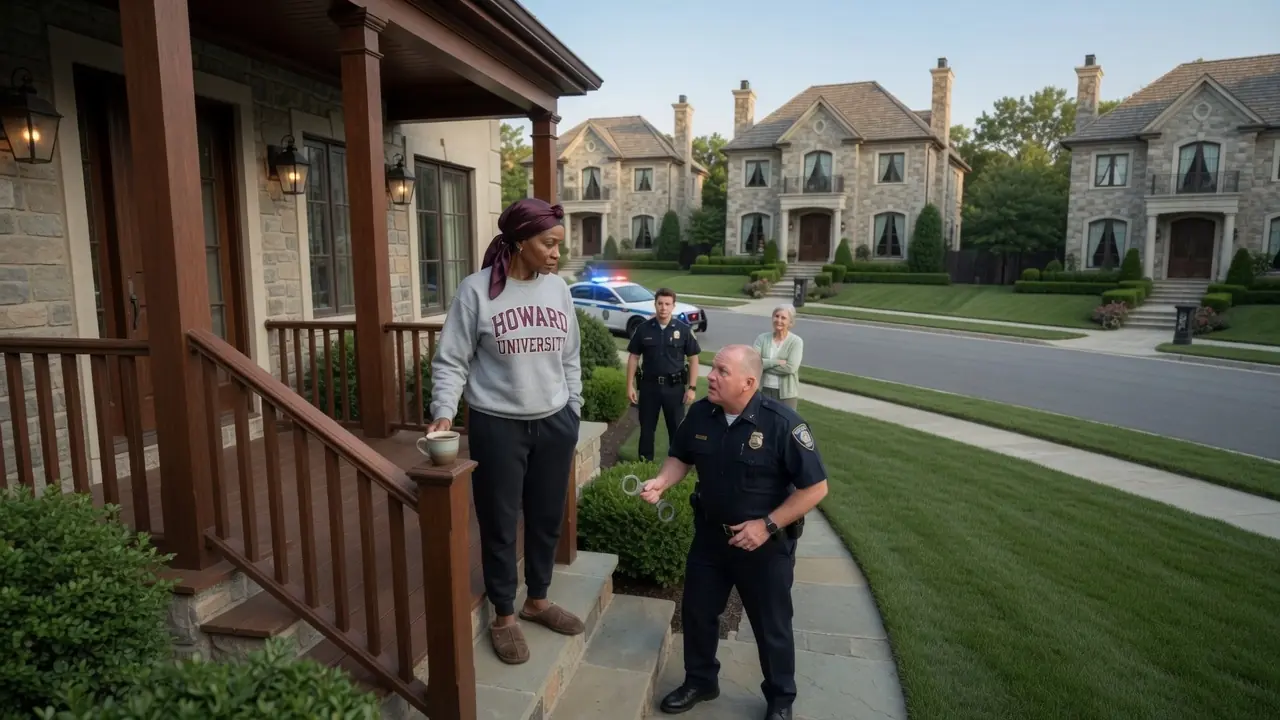
Just birds moving through the maple trees, a soft October breeze, and a mug of black coffee warming both of her hands while she stood on the front porch of the house she had bought only twelve days earlier.
She wore a faded Howard University sweatshirt, black joggers, and old house slippers with one flattened heel. Her hair was wrapped in a silk scarf. Her face had no makeup. She looked, by every fair human standard, like a woman enjoying a Saturday morning at home.
But Fairview Oaks was not always a fair place.
It was the kind of neighborhood where lawns were cut before they needed cutting, security cameras blinked from every corner, and people knew the difference between “new money” and “the right kind of money” without ever saying the words out loud.
The houses sat far apart, hidden behind trimmed hedges and stone mailboxes.
The kind of place where delivery drivers felt watched.
The kind of place where a woman in slippers on her own porch could become an emergency if the wrong neighbor saw her first.
That neighbor was Marjorie Bell.
She lived two doors down in a white brick colonial with blue shutters, a circular driveway, and enough opinions to fill a courtroom. Marjorie chaired the Fairview Oaks Community Safety Committee, though nobody had elected her to anything. She ran the neighborhood app like a sheriff with Wi-Fi.
At 8:23 that morning, Marjorie looked through her breakfast room window and saw Evelyn.
A Black woman.
Casually dressed.
Standing on the porch of the Carter residence, a house Marjorie knew had recently sold for just under two million dollars.
That was all Marjorie needed.
She did not walk over.
She did not introduce herself.
She did not ask, “Are you the new neighbor?”
Instead, she picked up her phone and called 911 in the breathless voice of a woman who had spent years confusing suspicion with civic duty.
“There’s a woman on the porch at 18 Briar Glen Lane,” Marjorie said. “She looks completely out of place. The owners just moved in, and I’m certain she isn’t one of them. She may be casing the house.”
The dispatcher asked if Marjorie had seen a break-in.
“No, but she’s just standing there,” Marjorie insisted. “Like she’s waiting for someone to leave. Please send someone quickly. This neighborhood has standards, and we’ve been having concerns lately.”
Concerns.
That was the word people used when they wanted fear to sound respectable.
Evelyn knew nothing about the call.
She was looking at the Japanese maple near the walkway, wondering whether it needed trimming, when the first patrol car turned hard onto Briar Glen Lane. Then a second. No sirens, but flashing lights. Red and blue reflected off the windows of every expensive house on the block.
She lowered her mug.
The cars stopped at the curb, angled like they had arrived at a crime scene.
Two officers stepped out.
The first was Sergeant Frank Harlan, heavyset, mid-forties, shaved head, hand already resting near his weapon with the confidence of a man who had made up his mind before his boots touched pavement.
The second was Officer Miles Reed, younger, thinner, nervous in the way rookies are nervous when they know something feels wrong but are still too new to name it out loud.
Harlan looked up at Evelyn.
“Hey. You. Step away from the door.”
Evelyn blinked once.
Then looked behind her at her own front door.
“Good morning, officers.”
“Step down from the porch,” Harlan said. “Keep your hands visible.”
Evelyn held up her coffee mug slightly.
“One hand is holding dark roast. The other is empty.”
“I said step down.”
She did not move.
She had spent twenty-one years listening to lawyers raise their voices when their arguments got weak. She had presided over criminal motions, civil rights hearings, federal injunctions, and emergency petitions that came in at two in the morning. A barking tone did not frighten her.
It clarified the person using it.
“Before I move anywhere,” Evelyn said calmly, “I’d like to know why two patrol units are in front of my home.”
Harlan’s jaw tightened.
“We got a call about a suspicious person on this property.”
“Suspicious in what way?”
“You don’t need to play games with me.”
“I am asking a direct question.”
Harlan walked closer, stopping at the bottom of the steps.
“You were reported as possibly trespassing or attempting to break in.”
Evelyn looked down at her slippers.
Then at the open front door behind her.
Then back at him.
“Sergeant, I am standing on my porch drinking coffee. If this is how burglaries are being committed now, criminals have become remarkably relaxed.”
Officer Reed shifted near the second patrol car.
Harlan did not appreciate the comment.
“Ma’am, I need identification.”
“No.”
The word was soft.
It still landed hard.
Harlan’s face reddened.
“Excuse me?”
“No,” Evelyn repeated. “You may ask. I am declining.”
“You are refusing to identify yourself during a police investigation.”
“I am refusing to produce identification without reasonable suspicion that I have committed, am committing, or am about to commit a crime.”
Harlan stared.
That was the first moment he realized the woman on the porch did not sound like the person he had expected to find.
Evelyn continued.
“A vague call from a neighbor who dislikes the way I look on my own property is not, by itself, probable cause. It does not give you authority to detain me, search me, enter my home, or demand identification.”
Officer Reed’s eyes widened slightly.
He knew enough law to recognize she was not guessing.
Harlan knew it too.
But men like Harlan often mistook being corrected for being challenged, and being challenged for being attacked.
“Listen,” he snapped. “I don’t know what video you watched online, but I am not standing here debating case law with you. Put the mug down. Step off the porch. Show ID. We clear this up, and everybody has a nice morning.”
“My morning was nice before you arrived.”
“Don’t get smart.”
“Then don’t ask me to become foolish.”
The curtains moved in three houses across the street.
Fairview Oaks had begun watching.
Marjorie Bell stepped out onto her porch in a pale green cardigan, arms folded, face arranged into the expression of someone waiting for a suspicion to become proof. Her husband stayed half-hidden behind the storm door, the way weak men often do when their wives start fires in public.
Harlan noticed the audience.
That made him worse.
“Turn around,” he said.
Evelyn’s eyes narrowed.
“Why?”
“You are being detained.”
“For what crime?”
“Trespassing.”
“On my own porch?”
“We don’t know that it’s your porch.”
“You haven’t asked a single investigative question designed to find out.”
“I asked for ID.”
“And I declined because your request is not supported by law.”
Harlan unclipped his handcuffs.
The sound was small, metallic, and ugly.
Officer Reed took a half step forward.
“Sergeant…”
Harlan shot him a look.
“Stay out of it.”
Evelyn set her mug on the porch rail.
Very slowly.
Very deliberately.
Then she faced Harlan fully.
“Sergeant Frank Harlan,” she said, reading the nameplate on his chest, “I am going to give you one chance to stop making this mistake.”
He sneered.
“You threatening me?”
“No. I am warning you.”
Her voice changed then.
It lost all casual warmth.
It became the voice of a woman who had sentenced powerful men without raising her volume. The voice of a woman who understood that authority was not volume, not posture, not a weapon, not a badge, but consequence.
“If you put those cuffs on me unlawfully, you will spend the rest of your career explaining why you ignored constitutional limits on a homeowner’s own property because a neighbor made a racially loaded assumption. You will not like that explanation. Your department will like it less.”
Harlan hesitated.
Only for a second.
But Evelyn saw it.
So did Officer Reed.
Across the street, Marjorie’s face tightened because the scene was not moving in the direction she had imagined.
Evelyn lifted one open hand and pointed toward Harlan’s radio.
“Call your watch commander.”
Harlan laughed once.
“I’m not calling a supervisor for a routine suspicious person call.”
“You should.”
“Why?”
“Because I am Chief Judge Evelyn Carter of the United States District Court for this district.”
The street went silent.
Even the birds seemed to pause.
Officer Reed went pale.
He had seen her name before. Everyone in the department had. The chief judge had signed warrants, reviewed consent decrees, and presided over the federal civil rights settlement that forced their department to rewrite half its training manual three years earlier.
Harlan looked at her sweatshirt.
Her slippers.
Her scarf.
His mind tried to make the pieces not fit.
“You’re lying,” he said.
Evelyn gave him a thin smile.
“That is a dangerous theory to test with handcuffs.”
Officer Reed reached for his radio before Harlan could stop him.
“Dispatch, Unit 2-14 requesting a supervisor at Briar Glen Lane. Code four, but immediate supervisor response needed.”
Harlan turned on him.
“Reed.”
The rookie swallowed.
“Sergeant, she said she’s Judge Carter.”
Harlan said nothing.
The wait lasted six minutes.
Six minutes of cold air.
Six minutes of neighbors gathering behind shrubs, windows, porch columns, and the comforting lie that watching injustice from a safe distance is not participation.
Evelyn picked up her coffee again.
It had gone lukewarm.
She drank it anyway.
Harlan stood at the edge of her walkway with his hands on his belt, trying to look in control while control drained out of him. Reed stood near the patrol car, staring at the pavement like a man calculating how quickly a career could end before it had really begun.
Then an unmarked black SUV turned onto the street.
It stopped hard behind the patrol cars.
A tall woman in a navy police uniform stepped out, silver hair pulled tight beneath her cap. Captain Alana Price had the face of someone who had survived too many public disasters to tolerate preventable ones.
She took in the scene once.
Evelyn on the porch.
Harlan with the cuffs still hanging open.
Reed pale near the car.
Half the neighborhood watching.
Price’s expression went flat.
“Harlan,” she barked. “Back away from the judge’s property. Now.”
Harlan swallowed.
“Captain, we responded to a burglary call.”
“I did not ask for your summary. I gave you an order.”
Harlan stepped back.
Reed stepped back too, though no one had asked him.
Captain Price walked up the driveway alone, removed her cap, and stopped at the bottom of the porch steps.
“Judge Carter,” she said, loud enough for everyone to hear. “I apologize on behalf of the department.”
Evelyn looked at her over the rim of her mug.
“Captain Price.”
“I understand there has been a serious failure here.”
“There has.”
Price nodded once.
“I will not insult you by pretending otherwise.”
That earned her the first trace of respect Evelyn had felt since the cruisers arrived.
Harlan tried again.
“Captain, the caller said—”
Price turned.
“One more word, Sergeant, and I will relieve you on this sidewalk before internal affairs gets the pleasure.”
Harlan shut his mouth.
Evelyn stepped down one porch step.
“I want the dispatch audio preserved. I want the body-camera footage preserved. I want both officers’ reports completed before memory has time to become convenient.”
“Already ordered,” Price said.
“Good.”
Evelyn looked past her toward Marjorie Bell, who was no longer standing quite so proudly. The green cardigan had lost some of its authority. Her arms were still crossed, but now they seemed to be holding herself together rather than judging someone else.
“And I want to know exactly who called.”
Price turned slightly.
“I believe we have that information.”
She pulled out her phone, tapped the screen, and played the call on speaker.
Marjorie’s voice filled the street.
“She looks completely out of place. The owners just moved in, and I’m certain she isn’t one of them. She may be casing the house.”
Evelyn listened without blinking.
When the recording ended, no one spoke.
Somewhere down the block, a dog barked once, then seemed to think better of it.
Evelyn handed her mug to Captain Price.
“Would you mind holding this?”
Price took it without hesitation.
Evelyn walked down the driveway in slippers.
The officers followed at a distance.
The neighbors pretended not to watch while watching harder than ever.
Marjorie Bell stood frozen on her walkway as Evelyn approached.
At first, she tried to arrange her face into innocence.
Then into concern.
Then into confusion.
None fit.
“Mrs. Bell?” Evelyn asked.
Marjorie swallowed.
“Yes?”
“My name is Evelyn Carter. I am the owner of 18 Briar Glen Lane. I closed on the property twelve days ago.”
Marjorie’s eyes flicked toward the patrol cars.
“I didn’t know.”
“No,” Evelyn said. “You didn’t.”
“I was only trying to protect the neighborhood.”
“From a woman drinking coffee?”
Marjorie flushed.
“You didn’t look like the owner.”
There it was.
The sentence everyone had been circling.
Evelyn tilted her head.
“What does an owner look like?”
Marjorie opened her mouth.
Closed it.
Opened it again.
Nothing useful came out.
Evelyn stepped closer, not angry, not loud, not theatrical. That made it worse for Marjorie. Anger would have given her something to defend against. Calm gave her only herself.
“You called the police because you saw a Black woman in casual clothes on a porch in a wealthy neighborhood and decided that was enough to create danger.”
Marjorie shook her head quickly.
“That is not what I meant.”
“But it is what you did.”
“I was concerned.”
“No,” Evelyn said. “You were certain. Your own call said so.”
Marjorie’s eyes filled.
That angered Evelyn more than anything.
Not the tears themselves.
The timing of them.
Some people cry only when consequence arrives, not when harm is done.
Captain Price stood several feet behind Evelyn, still holding the coffee mug.
Evelyn turned slightly toward her.
“Captain, I would like to file a formal complaint for misuse of emergency services and for knowingly or recklessly making a false report.”
Marjorie gasped.
“False report? I thought—”
“You assumed,” Evelyn said. “There is a difference.”
“I made a mistake.”
“No. You made a call.”
That silence was sharper than shouting.
Harlan stared at the street.
Reed looked sick.
A man across the road pulled his golden retriever back toward his porch, suddenly very interested in going inside.
Evelyn faced Marjorie again.
“If the officers who arrived had been more reckless, your mistake could have put me in handcuffs, on the ground, or dead. You do not get to turn that into a neighborhood misunderstanding because it is embarrassing now.”
Marjorie’s voice shook.
“I’m sorry.”
Evelyn looked at her for a long moment.
“I believe you are sorry it was me.”
The words landed across the entire street.
Marjorie had no answer.
Because every answer would have led back to the same truth.
If Evelyn had been a housekeeper, a delivery driver, a guest, a renter, a college student visiting family, or any other Black woman without a federal title, Marjorie would have slept that night believing she had done her duty.
That was the part Evelyn refused to let disappear.
She turned away.
Not because Marjorie deserved the conversation to end.
Because Evelyn had said enough.
Back at the porch, Captain Price returned her coffee.
It was cold now.
Evelyn set it on the rail.
“Captain, I expect your department to send me the incident number, officer names, body-camera footage preservation notice, and complaint procedure by noon.”
“Yes, Your Honor.”
That title did what the sweatshirt had not.
It made every neighbor understand, all at once, exactly how badly they had misread the woman on the porch.
Harlan finally spoke, his voice low.
“Judge Carter, I apologize.”
Evelyn looked at him.
“No, Sergeant. You regret.”
He flinched.
“Apology requires understanding. Regret only requires consequence. You are not there yet.”
Officer Reed looked up.
“I should have stopped it sooner.”
“Yes,” Evelyn said.
His eyes reddened.
“I knew it felt wrong.”
“Then remember this feeling,” she told him. “Not because shame is useful by itself, but because the next person you see on a porch may not know the law well enough to protect herself from you.”
Reed nodded.
Captain Price turned to both officers.
“Return to your vehicles. Do not speak to another resident. Do not turn off your cameras until I tell you.”
They obeyed.
For once, quickly.
The patrol cars left one by one.
No lights.
No speed.
No authority left to perform.
Captain Price remained a moment longer.
“I am sorry,” she said quietly.
Evelyn looked out at the street.
“So am I.”
Price understood the difference.
That afternoon, Fairview Oaks exploded on the neighborhood app.
Someone posted a blurry photo of the patrol cars.
Someone else wrote, “Does anyone know what happened on Briar Glen?”
Then someone who had clearly been watching through a window commented, “Marjorie called the police on the new homeowner. Turns out she’s a federal judge.”
The thread ran for six hours.
Some people defended Marjorie.
Most did so badly.
“She was only trying to be safe.”
“You can’t be too careful.”
“It’s unfair to ruin someone’s reputation over one mistake.”
Then a younger neighbor named Priya Shah posted one sentence that ended the argument better than any paragraph could have.
“Safety that only protects some people is just control.”
After that, the conversation changed.
People began sharing stories.
A Black delivery driver stopped twice in one month.
A Latino landscaper questioned while unloading his own tools.
A visiting college student followed by a resident’s SUV because she “didn’t look familiar.”
A nurse who cared for an elderly woman on Hawthorne Lane said she had been asked three times which agency sent her, even though she had worked there for a year.
Fairview Oaks had believed it was peaceful because the people harmed there had been quiet.
Evelyn’s porch made the silence break.
The department investigation moved quickly, partly because Captain Price did not try to bury it and partly because Judge Carter had a way of making delay feel unwise.
Harlan was suspended pending review.
His body camera showed everything: the hand near the weapon, the order to step down, the threat of handcuffs, the refusal to listen. It also showed Officer Reed hesitating and failing to intervene. That mattered too.
Reed kept his job but was reassigned, retrained, and placed under a supervisor who believed silence was not neutrality.
Harlan did not return to patrol.
Marjorie received a citation for misuse of emergency services and faced a civil claim she never imagined could come from a phone call. More painful to her, though, was the public collapse of the image she had spent years polishing.
The Community Safety Committee stopped meeting in her living room.
Then it stopped meeting altogether.
Two months later, Fairview Oaks held its first actual neighborhood gathering in the park at the end of Briar Glen Lane.
Not a safety meeting.
A neighbors’ meeting.
No whispering app threads. No suspicious-person alerts. No coded language about “certain people.” Just tables, coffee, folding chairs, and name tags because half the people who had lived near one another for years had apparently never bothered to learn names.
Evelyn almost did not go.
She had work.
She always had work.
But at 10:15 that Saturday, she walked down the street in jeans, boots, and the same Howard sweatshirt.
People noticed.
This time, they smiled too quickly.
Apology smiles.
Nervous smiles.
The kind people offer when they want forgiveness but do not want the discomfort of asking for it.
Evelyn accepted none of them as payment.
But she did not refuse conversation either.
Priya Shah came over first.
“I’m glad you came.”
Evelyn nodded.
“I almost didn’t.”
“I wouldn’t have blamed you.”
“No,” Evelyn said. “But I live here. I don’t intend to hide from my own block.”
Captain Price attended in plain clothes, not as a speaker, but as a neighbor from another part of town who had asked to listen. Officer Reed came too. He stood near the back for twenty minutes before approaching Evelyn.
“I wanted to tell you,” he said, “I’ve been thinking about what you said.”
“That is a start.”
“I froze because he outranked me.”
“You will face that again.”
“I know.”
“What will you do?”
Reed took a breath.
“Ask the question out loud before the damage happens.”
Evelyn studied him.
Then nodded once.
That was all he got.
It seemed to be enough.
Marjorie did not attend.
No one was surprised.
But later that afternoon, Evelyn found a note tucked beneath the stone planter near her porch. The handwriting was careful, stiff, and unmistakably embarrassed.
Judge Carter,
I am sorry for what I did. You were right. I did not make a mistake. I made an assumption and gave it authority by calling 911. I cannot undo that. I am enrolling in the city’s community accountability course because I do not trust myself to simply feel bad and become better. I hope one day I will deserve to apologize in person.
Marjorie Bell
Evelyn read it twice.
Then folded it and placed it inside her desk drawer.
She did not forgive Marjorie that day.
Forgiveness was not a door other people got to knock on whenever guilt made them uncomfortable.
But accountability had begun.
That mattered.
The seasons changed.
The maple by Evelyn’s porch turned red, then bare, then green again. The neighborhood slowly learned her rhythms. Early coffee. Late courthouse lights. Sunday calls with her sister. Grocery deliveries when trial weeks ran long. Jazz music on Friday evenings if she came home before dark.
People waved now.
Some because they meant it.
Some because they were afraid not to.
Evelyn could tell the difference.
One morning, nearly a year after the patrol cars had come screaming down the street, Evelyn stood on her porch in the same worn slippers, holding a fresh cup of coffee.
A moving truck stopped across the street.
A young Black couple stepped out with a little boy carrying a toy fire truck. They looked at the house, then at the block, then at the curtains moving in two windows nearby.
Evelyn saw the woman’s shoulders tighten.
She recognized that posture.
The quiet bracing before a place tells you whether you will have to fight to exist there.
Evelyn set her coffee down and walked across the street.
The woman watched her carefully.
“Hi,” Evelyn said. “I’m Evelyn Carter. I live two doors down. Welcome to Fairview Oaks.”
The woman’s face softened a little.
“I’m Dana. This is my husband, Marcus. And that’s Caleb trying to figure out if the tree is climbable.”
The little boy looked up.
“It is.”
His mother said, “It is not.”
Evelyn smiled.
“It is, unfortunately, very climbable.”
Marcus laughed.
Something eased.
Not everything.
Just enough.
Evelyn helped carry one box.
Then another.
By noon, three other neighbors came out too. Priya brought lemonade. An older man named Harold offered tools. Officer Reed, now off duty and living nearby with his aunt, stopped to help assemble a bed frame and did not mention once that he was a police officer.
That evening, Evelyn sat on her porch and watched the new family’s lights glow warm across the street.
Her coffee had gone cold again.
She did not mind.
A year earlier, a neighbor had looked at her standing on her own porch and seen a threat.
A year later, Evelyn looked across the street and saw a family arriving with hope, furniture, nerves, and a little boy who would absolutely climb that tree before the week ended.
That was not a perfect ending.
Fairview Oaks did not become righteous overnight.
No neighborhood does.
People do not unlearn prejudice because one powerful woman exposed it in public. They unlearn it, if they do at all, through discomfort, consequence, repetition, and the slow humiliation of admitting that politeness is not the same as goodness.
But something had changed.
The neighborhood no longer got to call suspicion safety without someone asking, “For whom?”
The police department no longer got to treat a vague call like a permission slip.
Marjorie Bell no longer got to use fear as a hobby.
And Evelyn Carter no longer had to prove she belonged in the house she bought with her own name, her own labor, and her own key.
She had never needed to prove it.
That was the lesson.
Not that she was important enough to be treated well.
Not that a federal judge deserved more respect than anyone else.
The lesson was sharper than that.
The same rights that protected Judge Evelyn Carter in fuzzy slippers on a mahogany porch should have protected a housekeeper, a delivery driver, a college student, a nurse, a guest, a tenant, a stranger asking for directions, or any other person somebody decided looked “out of place.”
Power did not create her dignity.
It only forced others to recognize what had already been there.
That morning, when the patrol cars came for her, Evelyn had been holding coffee, not a badge.
Wearing slippers, not a robe.
Standing on a porch, not a bench.
And still, the truth stood with her.
She was home.
And no accusation, no flashing light, no neighbor’s fear, and no officer’s ego had the authority to change that.