The wind came off the fields before sunrise.
Cold enough to sting Casey Bennett’s cheeks.
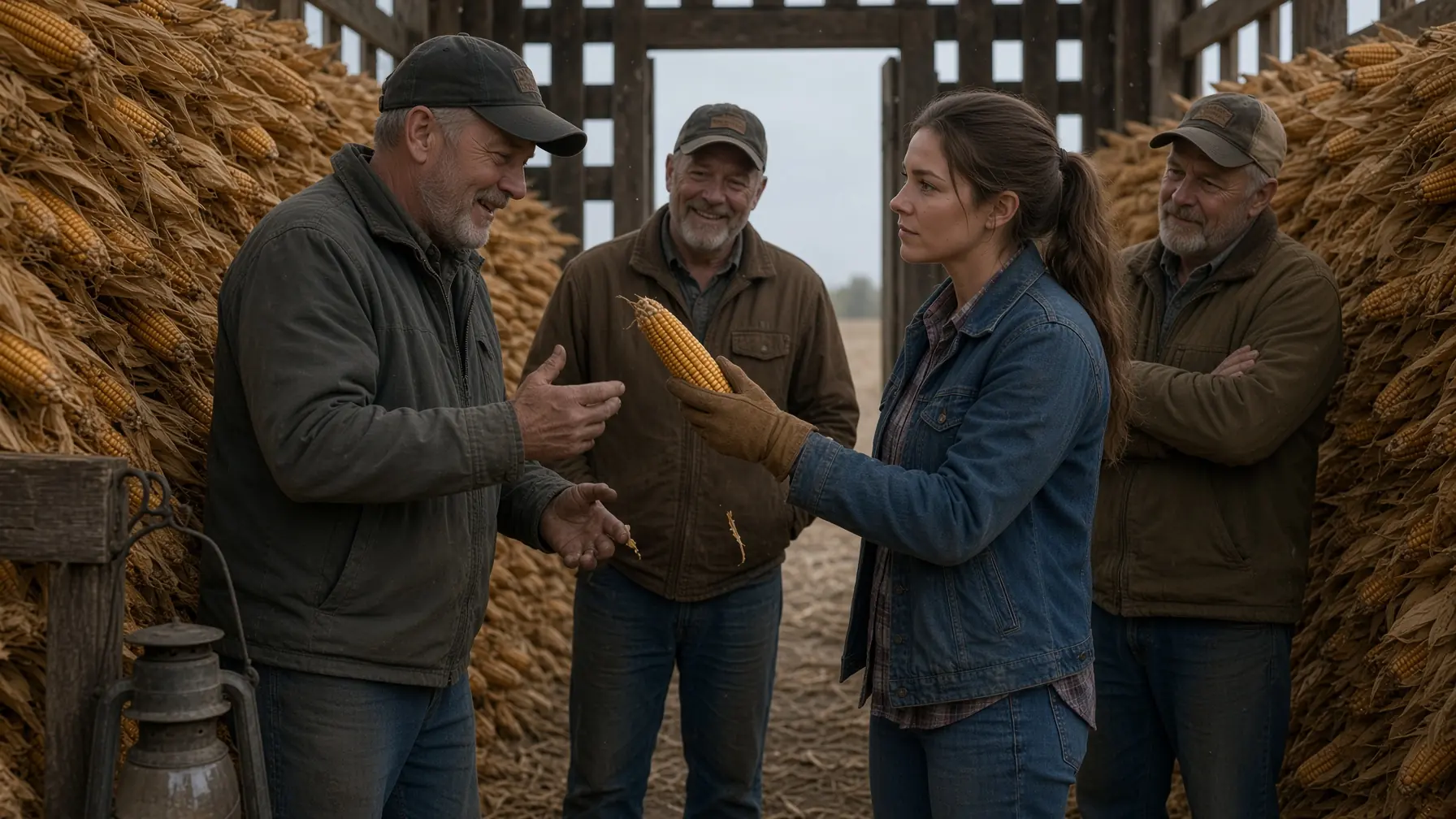
Strong enough to push through every narrow gap in the wooden slats of the old corn crib.
Inside, the air smelled of dust, dry husks, old lumber, and corn.
Casey stood beneath rafters her grandfather had raised more than forty years earlier and ran one bare hand along a row of ears stacked nearly to her shoulder.
Dry.
Firm.
Cool.
Exactly what she wanted.
Behind her, three neighboring farmers stood in the open doorway.
Arms crossed.
Caps pulled low.
Watching.
One of them, Warren Pike, finally broke the silence.
“You're going to lose every bushel in here.”
He did not say it cruelly.
That made it harder to dismiss.
Warren spoke the way an experienced farmer might warn somebody about ice on a bridge.
Not mocking.
Certain.
Another man, Leonard Baines, shook his head.
“You should've sold in November.”
Casey kept examining the corn.
“Price was decent.”
“Yes.”
“Elevator would've taken all of it.”
“Yes.”
“No storage risk.”
“Exactly.”
Leonard gestured toward the crib.
“This isn't how people store grain anymore.”
Casey broke an ear in her hands.
Pressed one kernel with her thumbnail.
Then another.
Listened when several dry kernels knocked against each other.
She had heard some version of this conversation every week since harvest.
At the co-op.
At church.
At the fuel pump.
At the feed store.
Everybody knew what she was doing.
Everybody had an opinion.
Casey had learned that arguing only made people more certain.
So she placed the ear back where she had found it.
Warren looked at her.
“You hear us?”
“Yes.”
“And?”
Casey finally turned.
“If it starts heating, I'll know.”
Leonard laughed softly.
“That's your plan?”
“No.”
She looked around the crib.
“This is part of it.”
None of the men knew that within a year, two of them would call Casey asking whether she had corn left.
Not to prove a point.
Not because they felt sorry for her.
Because they would need it.
Casey did not know that either.
She only knew that she had stored roughly a thousand bushels of ear corn in a structure everyone else considered obsolete.
And if she was wrong, her family could not afford the lesson.
Casey Bennett was twenty-nine years old.
She had been running most of Bennett Farm for three years, ever since her father’s health stopped allowing him to do it himself.
Her father, Daniel, had not retired by choice.
Farmers rarely did.
He developed heart problems at fifty-eight.
Then came surgery.
Medication.
Restrictions.
No twelve-hour days in the combine.
No climbing grain equipment alone.
No pretending fatigue was just weather.
Casey stepped in gradually.
Then all at once.
Bennett Farm covered a little more than three hundred acres in a part of the Midwest where the soil was good enough that outsiders assumed farming should be easy.
It wasn't.
Margins had tightened.
Machinery had grown expensive.
Seed had grown expensive.
Fertilizer had grown expensive.
Repairs came whenever they pleased.
The farm carried an equipment loan that had outlived the optimism with which it had been signed.
Their combine needed a replacement corn head.
The machine shed roof leaked in three places.
Property taxes arrived whether the crop did or not.
When Casey took over, one bad season would not necessarily destroy the farm.
But two bad seasons close together might.
That distinction was enough to keep her awake.
Casey was not dramatic about money.
She was precise.
She kept handwritten notebooks and spreadsheets.
She knew cost per acre.
Diesel use.
Expected drying costs.
Break-even yield.
Interest.
Repair history.
If the farm lost money on something, she wanted to know exactly where.
Her grandfather, Henry Bennett, had been different.
He also knew numbers.
But he carried most of them in his head.
Henry built the corn crib when Casey’s father was young.
Long.
Narrow.
Raised slightly above grade.
Wooden slats spaced to allow air through.
The structure had once been ordinary.
By Casey’s childhood, it had already become old-fashioned.
Modern farms had bins.
Steel.
Fans.
Augers.
Temperature cables.
Automated controls.
The Bennett crib survived mostly because Henry refused to tear down something that still had a roof.
When Casey was eight or nine, she followed him through it on winter mornings.
He would stop.
Pull an ear.
Break it.
Smell it.
Sometimes push his hand deep into the stored corn.
Once Casey asked:
“What are you looking for?”
Henry answered:
“Trouble.”
“What does trouble look like?”
“Sometimes it doesn't.”
That irritated her.
He smiled.
Then gave her the better answer.
“Warmth where it shouldn't be.”
“Soft kernels.”
“Mold.”
“Insects.”
“Anything that smells wrong.”
Casey nodded.
Henry continued.
“The crib isn't what keeps corn good.”
She looked around.
“What does?”
“The condition it goes in.”
Then he tapped her forehead lightly.
“And whether somebody keeps paying attention after.”
Casey remembered that sentence.
She just did not know she would build part of her future around it.
The harvest that changed everything began with unusually good yield.
Not record-breaking.
Not unbelievable.
Just better than Casey had budgeted.
The first field came off strong.
Then the second.
The yield monitor held above her conservative projections long enough that she stopped assuming it was a lucky patch.
For almost two weeks, the farm sounded like harvest.
Corn snapping through the header.
Chains rattling.
Diesel working under load.
Grain hitting steel.
Dust hanging in golden clouds behind the combine late in the afternoon.
Daniel rode with her several times.
He was supposed to be resting.
He considered sitting in the passenger seat of the combine a medical compromise.
Casey tolerated it.
On the third afternoon he watched the monitor.
“Better than you budgeted.”
“Yes.”
“How much?”
“Enough.”
“That isn't a number.”
“You taught me not to celebrate until it's weighed.”
Daniel smiled.
“That was my father.”
“Same disease.”
By the time the last acres came off, Casey had grain committed to contracts, some destined directly for the elevator, and roughly a thousand bushels of corn she had enough flexibility to market later.
The simple choice was to sell.
Cash immediately.
No storage concern.
No shrink.
No spoilage.
No extra handling.
The elevator price was respectable.
Daniel assumed she would take it.
Then Casey said:
“I want to keep a thousand.”
He looked toward the crib.
“No.”
“Yes.”
“That thing?”
“Yes.”
Daniel stared at her.
“You know Grandpa stored ear corn because he didn't have a grain bin.”
“I know.”
“We shelled in the spring because that's what farms did then.”
“I know.”
“And now we have elevators with professional storage.”
“I know.”
He frowned.
“You keep saying that.”
“Because I do know.”
“Then why?”
Casey opened her notebook.
She had done the math.
Elevator storage cost.
Expected basis movement.