The letter arrived on a bitter September morning in 1882, and nineteen-year-old Clara Bennett knew something was wrong before her father finished breaking the seal.
Henry Bennett had always been a careful man.
Even after losing the mercantile.
Even after the bank took the warehouse.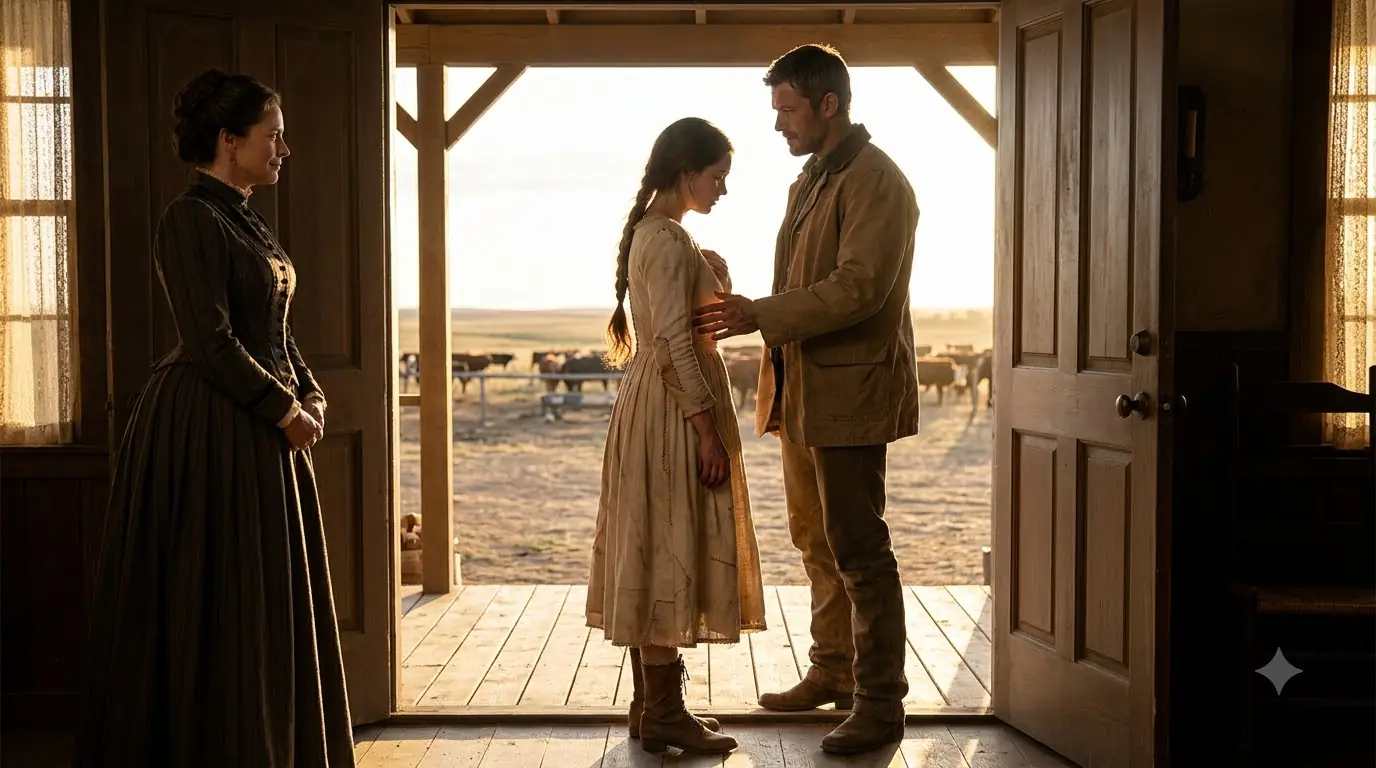
Even after creditors began appearing at the cabin so regularly Clara recognized horses before she recognized riders.
Henry still folded receipts into neat squares.
Still sharpened his pencil every morning.
Still sat at the kitchen table as though good posture might preserve a life collapsing around him.
But that morning his hands shook.
Clara stood beside the iron stove kneading the last flour into a small loaf.
She stopped.
“Papa?”
Henry read the letter again.
His face had gone gray.
Outside, wind scraped dried grass against the walls of their deteriorating cabin ten miles beyond Red Creek, Montana Territory.
Their roof needed shingles.
The south window had been patched with oilcloth.
Three potatoes remained in the cellar.
Winter was coming.
Clara wiped flour from her fingers.
“What happened?”
Henry folded the letter.
Then unfolded it.
“It’s an offer.”
“That usually means trouble.”
He almost smiled.
Almost.
Then he looked at her.
“They want you to marry Ethan Blackwood.”
Clara laughed.
Not because it was funny.
Because the sentence made so little sense that laughter arrived before thought.
“Ethan Blackwood?”
Henry nodded.
“The rancher?”
“Yes.”
“The Blackwood Ranch?”
“Yes.”
Clara stared at him.
Every person within fifty miles knew Blackwood Ranch.
Twenty thousand acres stretching across grassland and low foothills.
Hundreds of cattle.
Some said over a thousand.
Horse stock sold as far east as Chicago.
Three barns.
Two bunkhouses.
Its own blacksmith shed.
Ethan Blackwood had inherited part of it from his father and expanded the rest himself.
He was twenty-nine.
Unmarried.
Rich enough that people measured his land instead of his money.
Clara returned to kneading.
“Then someone has made a mistake.”
“No.”
Henry’s voice was quiet.
Clara stopped again.
“What does the letter actually say?”
Henry handed it over.
The paper was heavy.
Expensive.
Blackwood stationery.
The writer was not Ethan.
Margaret Whitmore.
His older sister.
Clara read.
The language was elegant enough to disguise cruelty if one did not read carefully.
Margaret explained that her brother had resisted numerous suitable introductions.
That the Blackwood family had become concerned about succession.
That Ethan was stubborn, independent, and apparently unimpressed by the accomplishments expected of fashionable women.
Therefore the family proposed something less conventional.
A woman of practical background.
Accustomed to hardship.
Unburdened by vanity.
Clara’s jaw tightened.
“Unburdened by vanity.”
Henry looked down.
She continued reading.
Travel would be paid.
If Ethan agreed to the match, settlement terms would follow.
If he declined, Clara would return home at Blackwood expense.
Then the final paragraph.
Regardless of Ethan’s decision, the Blackwood family would assume and discharge Henry Bennett’s outstanding commercial debts in exchange for Clara making the journey and presenting herself honestly for consideration.
Clara lowered the letter.
“How much do you owe?”
Henry did not answer.
“Papa.”
“Four thousand six hundred.”
Her stomach tightened.
That was not debt.
That was execution.
Their cabin was worth perhaps three hundred dollars.
Everything they possessed would not cover a tenth.
“How?”
“The warehouse fire.”
“You said insurance covered it.”
“Part.”
“The suppliers?”
“Some.”
Clara stared.
“You told me we were nearly clear.”
“I lied.”
The word seemed difficult for him.
Clara sat opposite him.
“Why?”
“Because you're nineteen.”
“I’m not nine.”
“I know.”
“Then why?”
Henry looked toward the stove.
“Your mother died believing I could keep you safe.”
Clara softened.
Her mother had been gone six years.
Cancer.
Slow.
Expensive.
Henry continued.
“Then I lost the business.”
“I thought if I worked longer…”
“If I sold the wagon…”
“If prices improved…”
His voice broke.
Clara reached across the table.
“Papa.”
He pulled his hand away.
Shame.
That hurt more.
“The creditors file in November.”
“What happens?”
“They take the cabin.”
Clara looked around.
The cabin was poor.
Cold.
Crooked.
Still home.
“And after?”
Henry shrugged.
“I don't know.”
Clara looked at the letter again.
“So they pay everything if I simply go?”
“Yes.”
“Even if Ethan refuses?”
“That is what it says.”
“Why?”
Henry’s face tightened.
“That part I learned from Mr. Larkin.”
“Who?”
“Blackwood’s attorney passed through Red Creek last week.”
Clara waited.
Henry finally said:
“This isn't kindness.”
“I assumed.”
“Ethan’s sisters have been trying to find him a wife.”
“I've heard.”
Everyone had.
Banker’s daughter from Helena.
Judge’s niece from Virginia City.
Cattle investor’s daughter from Wyoming.
A widow from St. Louis with substantial property.
One by one, each had visited Blackwood Ranch.
Each left unmarried.
Clara had heard varying versions.
Ethan was impossible.
Ethan hated society.
Ethan was cruel.
Ethan preferred cattle.
Ethan had loved someone who died.
Ethan was secretly engaged to the ranch.
Every teller added something.
Henry continued.
“Margaret believes Ethan rejects women because he thinks they want his money.”
“That seems reasonable if his family keeps sending wealthy women.”
“She apparently agrees.”
Clara stared.
Henry struggled.
“So she decided to prove something.”
Clara understood before he finished.
“They chose me because I'm poor.”
Henry’s eyes closed.
“They chose you because they believe he'll reject you for being poor.”
The room went very still.
Clara looked at herself.
Faded brown dress.
One cuff repaired three times.
Hands rough from laundry, chopping wood, sewing, cooking, gardening, helping neighbors through harvest season.
Boots resoled by her own father.
No jewelry except her mother’s small brass locket.
Margaret Whitmore had searched for the opposite of a banker’s daughter.
And found Clara Bennett.
Not because of character.
Not because of compatibility.
Because her poverty made a better experiment.
Henry whispered:
“I’m sorry.”
Clara folded the letter carefully.
“Did you agree?”
“No.”
She looked up.
He pushed another sheet across the table.
Unsigned.
“I told Larkin I would not answer for you.”
Clara loved him for that.
Even now.
Even drowning.
He had left the decision hers.
“What happens if I say no?”
Henry looked around the cabin.
“You know.”
Clara stood.
Walked to the window.
Outside, the garden was dead.
Fence leaning.
Beyond it stretched grass turned brown by approaching winter.
Her life had never contained wealth.
But it contained choice.
She understood precisely what Margaret Whitmore expected.
A desperate girl would arrive.
Ethan would look at patched clothes.
Reject her.
The sisters would win their argument about his impossible standards.
Henry’s debts would disappear.
Clara would return humiliated but financially rescued.
Everyone received something.
Except Clara.
She turned.
“I’ll go.”
Henry stood.
“No.”
“You just said it's my decision.”
“And I’m telling you not to do it.”
“Why?”
“Because I know that look.”
“What look?”
“The one your mother got whenever she decided suffering was practical.”
Clara almost smiled.
“I’m not suffering.”
“You're considering marrying a stranger.”
“I’m considering meeting one.”
“That family is using you.”
“Yes.”
“And you're going?”
“Yes.”
Henry stared.
Clara picked up the bread dough.
Placed it in the pan.
“Because if I don't, we lose the cabin.”
“I can work.”
“So can I.”
“You shouldn't have to pay my debts.”
“I’m not.”
She looked at him.
“I’m going to make Margaret Whitmore pay them.”
For the first time that morning, Henry laughed.
It sounded rusty.
Two days later, the Blackwood carriage arrived.
Not a stagecoach.
A private carriage.
Two matched bay horses.
Driver in a dark coat.
Leather interior.
Clara had never sat in anything so expensive.
She brought one trunk.
It contained two dresses.