Nobody in Mercy Ford wanted to look at the girl tied to the saloon post.
That was the ugliest part.
Not the rope around her wrists.
Not the blood at the corner of her mouth.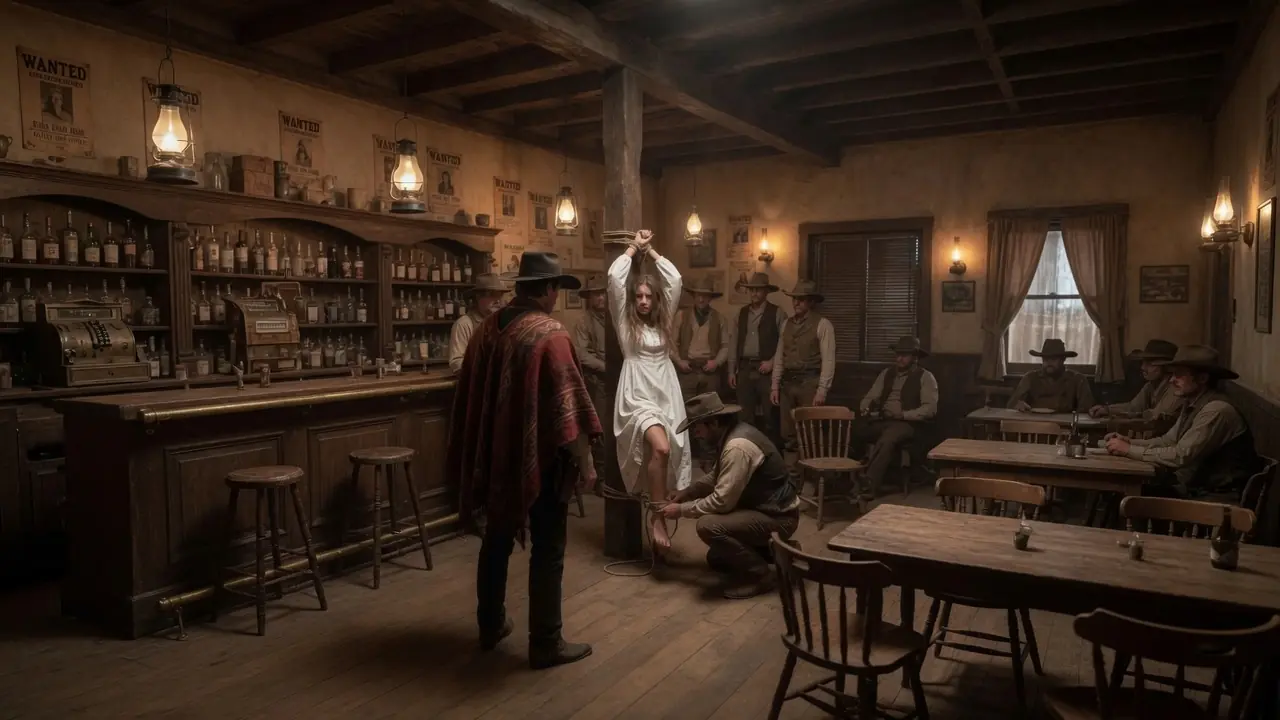
Not the way her dress had been torn at one sleeve after they dragged her through the mud behind the livery stable.
The ugliest part was the silence.
Men who could argue until midnight over cattle prices suddenly had nothing to say. Ranchers stared down into whiskey glasses as if answers might be floating at the bottom. Merchants pretended to study their cards. A deputy leaned near the door with his thumbs in his belt and his eyes fixed on the floorboards.
Lydia Harper stood tied to the center post of the Silver Spur Saloon with her hands pulled behind her and her shoulders aching from the strain.
She was twenty-three years old.
Dark hair had fallen loose around her face, damp with sweat and dust. Her green dress, the plain one she wore for work at the telegraph office, was streaked with dirt from the street. One cheek had begun to swell where someone had struck her before she stopped fighting.
But her eyes were clear.
That was what troubled the room.
A frightened woman could be pitied.
A broken woman could be ignored.
But Lydia looked at every man in that saloon like she was carving their names into stone.
Silas Crowe stood at the poker table near the bar, clean as a preacher and twice as dangerous.
He owned the stockyard, the freight line, the bank notes on half the farms west of Mercy Ford, and enough secrets to make honest men sweat when he smiled. His black coat fit perfectly. His boots shone even in lamplight. His hair was silver at the temples, and his face carried the calm patience of a man who had ruined families without ever raising his voice.
On the table in front of him lay a folded statement.
He tapped one finger against it.
“Sign it, Lydia.”
His voice moved smoothly through the smoke-heavy air.
“You admit you stole those papers from my office. You admit you forged your father’s records. You admit you lied about the land transfers, and by morning this unfortunate scene becomes a private matter.”
Lydia lifted her chin.
“My father kept records. You kept graves.”
A few men shifted.
One chair creaked.
Silas’s smile did not move, but something behind his eyes tightened.
“You always had Daniel Harper’s talent for making simple things difficult.”
“And you always hated that he wrote things down.”
The saloon seemed to shrink around that name.
Daniel Harper had been dead for seventeen years.
Officially, he had died trying to escape arrest after being accused of stealing county land records. That was the version Mercy Ford repeated when strangers asked. That was the version written in the courthouse ledger by men who had needed his mouth closed and his name dirtied.
But Lydia’s mother had never believed it.
Neither had Lydia.
Daniel had been the deputy land clerk, a careful man with round spectacles and ink stains on his fingers. He had known which homesteads were being stolen through false debts, which widows were being forced off their land, which signatures had been copied by the same hand, and which powerful men were buying ruined claims for pennies after the threats had done their work.
He had hidden a ledger beneath the floorboards of the Harper house.
Lydia found it after her mother died.
That ledger was why she was tied to a saloon post.
Silas leaned over the statement.
“You are young. You are grieving. I am willing to be merciful.”
Lydia laughed once.
A dry, cracked sound.
“You have never been merciful in your life.”
The six men around her moved a little closer.
They were not lawmen, though two had worn badges before.
Rafe Kincaid stood nearest to Lydia, a former deputy with a narrow face and fast hands. Jonah Sleet leaned against the piano, rolling a toothpick between his teeth. Briggs Morrow held a shotgun across his chest. Calvin Pike watched the back door. Otto Vale stood near the stairs, huge hands loose at his sides, waiting for permission to hurt someone.
Near the wall, half-hidden in shadow, stood Lydia’s cousin, Aaron Harper.
He was not holding a gun.
That almost made it worse.
His eyes never lifted from the floor. He had been at Lydia’s kitchen table every Christmas after his own father drank himself into the ground. Her mother had fed him, patched his coat, and called him family.
Now he stood twenty feet away while men who worked for Silas Crowe kept her tied like stolen livestock.
Lydia looked at him.
“Aaron.”
He flinched.
Silas saw it and smiled faintly.
“Don’t trouble your cousin. He has sense enough to know when a fight is already lost.”
A sound came from outside then.
Not horses.
Not shouting.
Just the slow creak of the saloon doors moving open.
Every head turned.
A man stood in the doorway with trail dust on his coat and rainwater darkening the brim of his hat.
He was lean, broad-shouldered, and weathered by long miles, with a face that looked carved more by loss than age. Maybe forty. Maybe older. The kind of man whose eyes gave little away because too much had already been taken from them.
He stepped inside and let the doors swing shut behind him.
Nobody knew him.
That alone made the room nervous.
A stranger in a saloon could be harmless.
A stranger who walked into a room like that and did not ask what was happening was something else entirely.
His eyes moved once across the men.
Rope.
Shotgun.
Blood.
Silas Crowe.
Then Lydia.
The stranger’s jaw tightened.
“This ends now.”
He said it softly.
That made men listen.
Loud men often hoped volume would stand in for courage. Quiet men were harder to read, and dangerous rooms hated what they could not read.
Silas turned toward him.
“You’ve wandered into private business, friend.”
“No.”
The stranger took one step forward.
“I’ve wandered into a town that forgot shame.”
Rafe Kincaid gave a short laugh and shifted his coat away from his holster.
“Careful.”
The stranger did not look at him.
That insult landed exactly where it was meant to.
Rafe’s smile disappeared.
Lydia stared at the stranger.
Something about him struck her strangely. Not the coat or the hat or the scar near his left eye. Something around the eyes. A hard blue-gray she had seen once before in an old photograph tucked inside her mother’s Bible.
Her father’s eyes.
“You know me?” she asked.
The stranger looked at her.
“No.”
“Then why are you here?”
His answer did not come quickly.
“Because somebody should be.”
Silas moved around the table.
His calm had changed shape now. It was still there, but thinner. Men like Silas were used to fear, greed, and obedience. A stranger with no visible stake in the game was harder to price.
“What’s your name?” Silas asked.
The man removed his hat.
“Isaac Ward.”
Lydia’s breath caught.
Not because she knew the name.
Because she knew another.
“My father had a sister,” she whispered.
The saloon grew quieter.
The stranger’s eyes narrowed slightly.
“What was her name?”
“Miriam Harper.”
The man’s face changed.
Only for a moment.
But it was enough.
“My mother was Miriam,” he said. “She left Mercy Ford before I was born.”
Lydia’s hands trembled against the rope.
“Then Daniel Harper was your uncle.”
The stranger looked at her wrists.
Then at the men around her.
“I reckon he was.”
The word moved through the saloon like a match dropped near dry straw.
Silas’s face hardened.
“Well, isn’t that touching. A family reunion.”
Isaac looked at him.
“Untie her.”
“No.”
“Then I will.”
Rafe finally turned fully toward him.
“You won’t cross this floor.”
Isaac’s gaze flicked to him at last.
“You sure?”
Nobody moved for three full breaths.
Then Lydia spoke, and her voice carried farther than anyone expected.
“My father was not a thief.”
Silas slammed his palm on the table.
“That name has been dragged through this town long enough.”
“No,” Lydia said. “It was buried in this town. There is a difference.”
She looked around the room.
“Every man here knows he was killed before he could testify. Every man here knows Crowe took the north claims after barns burned and families ran. Every man here knows widows signed away land after men like Rafe Kincaid came calling at midnight.”
Rafe stepped toward her.
Isaac stepped faster.
The room froze.
Isaac did not draw.
He did not need to.
Not yet.
“You touch her again,” he said, “and I stop asking.”
Silas glanced toward Briggs, and the shotgun lifted an inch.
A woman near the back of the saloon gasped softly. She was the piano player’s wife, Ellen May, who had spent ten years hearing things men said when they thought women were furniture. Her hands clenched around a tray of empty glasses.
Silas noticed her watching and spoke louder.
“Miss Harper stole from my private office. She invented stories to blackmail respectable men. This is not courage. This is desperation dressed up as righteousness.”
“If I’m lying,” Lydia said, “let me speak before Judge Whitcomb in the morning.”
No one answered.
The silence was a confession with no signature.
Then a new voice came from near the stairs.
“She won’t make morning if he has his way.”
Every face turned.
Marshal Gideon Price stood near the back wall, hat in one hand, badge in the other.
He was an old man now, though not old enough for the weight he carried. His mustache had gone white. His shoulders had rounded. He looked like someone who had spent years waking before dawn and deciding again not to tell the truth.
Silas stared at him.
“Gideon.”
The marshal looked at the badge in his palm.
Then at Lydia.
Then at Silas.
“I’m done being afraid of you.”
That sentence struck the room harder than a gunshot.
Silas’s voice dropped.
“You are making a mistake.”
“I made it seventeen years ago.”
Marshal Price reached inside his coat and pulled out a wrapped bundle of leather.
Lydia stopped breathing.
Silas took one step toward him.
“Don’t.”
The marshal placed the bundle on the table.
Slowly.
Carefully.
As though it were alive.
Isaac moved closer and unfolded the leather.
Inside lay a ledger.
Old.
Water-stained at one corner.
Bound in cracked brown hide.
Lydia knew it immediately.
The ledger she had copied before Crowe’s men tore her house apart.
Not the only one.
Her father had made two.
A sob rose in her throat, but she swallowed it down.
Silas stared at the book like it had crawled from a grave.
Marshal Price spoke to the room.
“Daniel Harper gave me this the night he died.”
Lydia’s voice shook.
“You had it?”
“Yes.”
“All this time?”
“Yes.”
The answer was so plain it almost sounded cruel.
She looked at him.
“You let my mother die with everyone calling him a thief.”
The marshal closed his eyes.
“Yes.”
That single word did more damage than any excuse could have.
The saloon turned restless.
Men who had survived by not knowing things were being forced to know them now.
Isaac opened the ledger.
The pages crackled softly beneath his fingers.
Daniel Harper’s handwriting filled them in tight, careful lines.
Names.
Dates.
Claims.
Payments.
Threats.
Isaac read the first entry aloud.
“Mary Ellis, widow. South creek claim. Debt forged by Silas Crowe. Barn burned two nights after refusal. Payment delivered to Rafe Kincaid.”
Rafe’s face went pale with fury.
Isaac turned the page.
“Thomas and Abigail Rowe. Land transfer witnessed by Deputy Briggs Morrow. Signature disputed. Rowe family left territory after threats from Jonah Sleet and Otto Vale.”
Someone near the bar whispered, “I remember the Rowes.”
Another man said, “They never sold. Not willingly.”
Silas’s mouth tightened.
Isaac continued.
“Daniel Harper. Scheduled to testify before circuit judge. Evidence copied. Murder arranged to prevent testimony. False theft charge prepared by Silas Crowe. Report filed by Marshal Gideon Price.”
The room went dead still.
Marshal Price looked like the words had struck him physically.
“I wrote the report,” he said. “Crowe told me my son would hang for killing that ranch hand if I didn’t. My boy had done it. I knew he had. So I chose my son’s life over Daniel Harper’s name.”
Lydia stared at him.
There were no tears now.
Only something colder.
“My father had a daughter.”
“I know.”
“My mother had a husband.”
“I know.”
“You knew all of that when you let them bury him as a thief.”
Price’s hand shook around the badge.
“Yes.”
Isaac closed the ledger.
The sound was soft.
Final.
Silas looked around and saw the room slipping from him.
That was the danger in truth. It did not need every man to become brave. It only needed enough men to realize they had been cowardly in public.
He smiled then.
A smaller smile.
A meaner one.
“Fine. Let the judge see an old book. Let him hear an old marshal trying to save what’s left of his soul. But she signed nothing. The girl is still a thief who broke into my office.”
Lydia lifted her bound hands as high as the rope would allow.
“You sent men to burn my house.”
“You have proof?”
“I have the ledger.”
“You have accusations.”
Isaac looked at the rope.
“No more talking while she’s tied.”
He stepped toward Lydia.
Rafe moved first.
His hand flashed for his pistol.
Isaac drew faster.
The shot cracked through the saloon and smashed the lamp above the bar, showering sparks and glass. Rafe froze with his gun half out, the warning bullet buried in the wall inches from his ear.
Isaac’s revolver was steady.
“I said no more talking while she’s tied.”
Nobody laughed.
Aaron Harper finally moved.
He had not spoken all night, and when he stepped forward, he looked sick enough to fall. Lydia watched him through a haze of anger and betrayal. He reached toward his boot and pulled out a small knife.
Rafe turned toward him.
“What do you think you’re doing?”
Aaron’s voice broke.
“What I should’ve done before.”
He cut the first rope.
Lydia’s right hand came loose, blood rushing hot into her fingers.
Then the second.
The rope fell.
For a moment, she nearly collapsed. Isaac caught her elbow, then released her as soon as she found her feet. The courtesy was so small and so careful that it almost hurt worse than the rope.
Lydia rubbed her wrists.
She looked at Aaron.
He could not meet her eyes.
“I owed him money,” he whispered.
“So you gave him me?”
His face crumpled.
“I thought they’d scare you. That’s all. I didn’t know they’d—”
“You knew enough.”
He nodded.
No defense came.
That mattered, though it did not heal anything.
Briggs lifted the shotgun again.
Marshal Price drew his pistol and aimed at him.
“Lower it.”
Briggs hesitated.
“You ain’t even sure what side you’re on, Gideon.”
The old marshal looked at Lydia.
Then at the ledger.
Then at the badge in his left hand.
“I am now.”
That did it.
Briggs lowered the shotgun.
Jonah Sleet slipped away from the piano and headed for the back door.
Ellen May picked up a whiskey bottle and smashed it against the piano edge.
The sound stopped him.
“You take one more step,” she said, voice shaking but fierce, “and I swear I’ll open your head before he opens the door.”
Jonah stared at her.
The room stared at her.
She had never spoken louder than a request for payment before.
Now she stood with broken glass in one hand and ten years of swallowed fear in her face.
One man near the bar rose slowly.
Then another.
Not heroes.
Not yet.
Just men beginning to understand that the room had changed and they could no longer hide inside it without being seen.
Silas saw it too.
His control, the thing he had spent twenty years building, began leaving the room one pair of eyes at a time.
So he reached for his gun.
He was fast.
Faster than a banker should have been.
But men who build empires on violence usually practice with the tools.
Isaac fired once.
Marshal Price fired at nearly the same time.
Silas staggered backward into the poker table, cards scattering beneath him like pale leaves. His hand opened. The pistol fell. He looked more surprised than hurt at first, as if consequence was a social insult he had not expected to suffer.
Then he went down.
No one cheered.
A dead man on a saloon floor is not justice by itself.
It is only a door closing.
The real work begins after the smoke clears.
Lydia stood over him for a moment.
Then turned away.
“Get Judge Whitcomb,” she said.
Her voice was hoarse.
But it carried the authority of a woman who had been tied up and still had not surrendered the truth.
By morning, Mercy Ford was no longer pretending.
The circuit judge arrived under a pale sunrise and found the town waiting outside the courthouse. Some came because guilt had finally gotten louder than fear. Some came because they wanted to be near the story before it turned into history. Some came because they had names in the ledger and hoped distance might soften memory.
It did not.
The ledger was read into record.
Page after page.
Widows.
Farmers.
Freight men.
Homesteaders.
Families who had vanished from Mercy Ford with nothing but shame that had never belonged to them.
Marshal Price testified for three hours.
His voice cracked only once, when he described the night Daniel Harper came to him with the duplicate ledger and asked him to protect Lydia if anything happened.
“I did not,” the marshal said.
The judge looked at him over his spectacles.
“No. You did not.”
That was all.
Sometimes judgment does not need decoration.
Aaron Harper testified too.
He admitted taking money from Silas.
He admitted telling Crowe’s men where Lydia had hidden the copy of the ledger.
He admitted standing by while they dragged her to the saloon.
When he finished, Lydia did not look at him.
Not because she hated him too much.
Because love and betrayal had become tangled in a way she could not separate yet, and the courtroom was not the place to try.
Rafe Kincaid and Briggs Morrow were arrested before noon.
Jonah Sleet tried to ride out before sunrise but was caught near the river crossing by two ranch hands whose families had both been named in the ledger.
Otto Vale surrendered quietly.
Calvin Pike disappeared into the hills and was found three weeks later in a mining camp, drunk enough to tell the entire story twice before realizing the man buying him drinks was a deputy.
By sundown, Daniel Harper’s name was cleared.
Seventeen years too late.
But cleared.
Lydia went to the cemetery at dusk.
Isaac walked beside her but did not crowd her. He had learned already that she did not need rescuing as much as she needed room to stand without someone deciding what she should feel.
Her father’s grave sat beneath a leaning cottonwood at the edge of the burial ground.
The marker was old.
Cheap.
Cruel hands had carved THIEF into the bottom years ago.
Her mother had scratched at the word whenever grief gave her strength. The letters were faded but still visible, like a lie refusing to die.
Lydia knelt.
For the first time since the saloon, she cried.
Not loudly.
Not for anyone to hear.
Isaac removed his knife and held it out.
She looked at it.
Then took it.
Together, they carved away what remained of the word.
The wood looked rough when they finished.
Scarred.
But clean enough.
“My mother should have seen this,” Lydia said.
“Yes,” Isaac answered.
“My father should never have needed it.”
“No.”
She sat back on her heels.
“Do you hate this town?”
Isaac looked down toward Mercy Ford.
Lamps were beginning to glow in windows. Men were moving slowly through streets that had seen too much and admitted too little.
“I don’t know it well enough.”
“I do,” Lydia said.
“And?”
Her answer took a long time.
“I hate what it allowed.”
That was more precise than hate.
And heavier.
Two weeks later, the town replaced Daniel Harper’s marker.
DANIEL HARPER
LAND CLERK
HUSBAND
FATHER
A MAN WHO KEPT THE TRUTH
Lydia stood in front of it with bandaged wrists and a black dress borrowed from Ellen May. Isaac stood beside her. Marshal Price stood at a distance, hat in hand, looking like a man who knew forgiveness was not owed and might never come.
The judge ordered restitution where possible.
Some lands were returned.
Some could not be.
Some families had moved too far, died too soon, or lost too much to be made whole by ink on paper. The law did what it could, which was less than people hoped and more than Silas Crowe had ever intended.
Mercy Ford changed slowly after that.
Very slowly.
Men who had once laughed too easily spoke more carefully.
The Silver Spur Saloon reopened under Ellen May’s management after her husband admitted she had always been better with money anyway.
The post where Lydia had been tied was removed and burned behind the building.
She watched it burn.
So did half the town.
Nobody said anything.
There are some apologies that sound false the moment they leave the mouth, and there are some moments when silence, finally honest, is better.
Isaac meant to leave once the court hearings ended.
He told himself that for days.
He bought supplies.
Checked his horse.
Collected his pay from a small tracking job he had taken before everything happened.
Then he found Lydia in the telegraph office, rebuilding the broken lock Silas’s men had smashed when they searched the place.
“You leaving?” she asked without turning.
“I usually do.”
“That’s not an answer.”
He smiled faintly.
“You talk like your father wrote.”
She looked at him then.
The comparison did not wound her the way it once might have.
“I’ll take that as a compliment.”
“It is.”
He leaned against the doorway.
“I don’t know how to stay.”
“I don’t know how to trust a man who disappears.”
“That’s fair.”
She tightened a screw.
“I’m not asking you to promise anything.”
“Good.”
“I’m asking whether you intend to run because staying might matter.”
Isaac looked past her toward the street.
For years, he had worn distance like protection. If no town knew him, no town could demand anything. If no one expected him to stay, he could never fail them by leaving.
But Mercy Ford knew his name now.
His real one.
Bell.
Harper.
Ward.
All the buried pieces of him had been dragged into the light, same as the ledger.
“I might stay through winter,” he said.
Lydia nodded.
“That is honest enough for now.”
Winter came hard that year.
Snow closed the eastern road twice.
The telegraph lines went down in a storm, and Isaac helped Lydia repair them while the wind cut through their coats and made their fingers useless. Ellen May brought them coffee. Marshal Price brought extra wire without being asked, then left before Lydia had to decide whether to thank him.
Aaron Harper served six months for his part in the abduction.
When he was released, he came to Lydia’s house with his hat crushed in both hands.
She let him stand on the porch.
Not inside.
Not yet.
He apologized without excuses.
That was the only reason she listened.
“I don’t know if I can forgive you,” she said.
“I know.”
“I don’t know if I want to.”
“I know that too.”
He nodded and left.
The next week, she found a stack of chopped wood by her back door.
Then another.
She did not thank him.
She also did not tell him to stop.
Some repairs begin like that.
No music.
No embrace.
Just wood by a door.
By spring, Isaac had stopped saying he would leave soon.
People noticed.
They always do.
He helped the blacksmith rebuild a fence. Rode with deputies when cattle thieves crossed the north ridge. Took over the old Harper house roof repairs after a hailstorm broke three boards loose. He slept in the room that had once belonged to Lydia’s uncle, his father’s brother in everything but name.
Sometimes, late at night, he would wake and think of all the years lost because his mother had fled with fear packed tighter than luggage.
He did not blame her.
He wished she had told him more.
Both feelings could live in the same chest.
Lydia kept the ledger in the courthouse behind glass.
She insisted on it.
Not locked away in some back room where men could forget it again, but displayed where anyone filing a claim or signing a deed had to pass it. Beneath it, a brass plate read:
LET THE RECORD REMAIN WHERE FEAR ONCE STOOD.
Some folks said that was too dramatic.
Lydia said they were welcome to look away, since they had plenty of practice.
The town learned to live with the plate.
It learned to live with other things too.
A woman testifying against a powerful man.
A marshal admitting cowardice.
A saloon owner who carried a broken bottle scar on one hand and ran a cleaner business than any man before her.
A stranger who turned out not to be a stranger at all.
Years later, people told the story of the night at the Silver Spur in many ways.
Children liked the gunfight.
Men who had done nothing liked to claim they had nearly stood up.
Travelers liked the part where Silas Crowe fell beside his own poker table.
But Lydia told it differently.
She said evil did not take Mercy Ford all at once.
It took it in bargains.
One unpaid debt overlooked.
One widow ignored.
One false signature accepted.
One frightened marshal staying quiet.
One cousin choosing money over blood.
One saloon full of men staring into their glasses while a woman stood tied to a post.
And then it lost the same way.
Not all at once.
One choice at a time.
A stranger crossed the room.
A marshal opened a ledger.
A woman with a tray raised her voice.
A coward cut a rope.
A town finally learned that silence is not the opposite of violence.
Sometimes silence is the room violence uses to breathe.
On the first anniversary of that night, Lydia walked to the cemetery alone at sunrise.
At least, she thought she was alone.
Isaac was already there, standing near Daniel Harper’s grave with his hat in his hands.
She stopped beside him.
The new marker stood straight.
Morning light touched the carved letters.
For a while, neither of them spoke.
Then Lydia said, “Do you ever wish you hadn’t come into that saloon?”
Isaac looked at the town below, then at her wrists, where faint scars still circled the skin.
“No.”
“Not even after all the trouble?”
“I was already trouble before I arrived.”
She smiled despite herself.
“That is true.”
He looked at her then.
“I wish I had come sooner.”
The words were simple.
They reached something in her that had been guarded for a long time.
“You came when you came,” she said. “And you stayed.”
He nodded.
“That surprised me too.”
The sun lifted higher.
Below them, Mercy Ford began to wake.
A hammer rang from the livery. Coffee smoke rose from kitchen chimneys. The Silver Spur’s doors opened under Ellen May’s hand. The courthouse bell sounded once, not for alarm, but for morning.
The town was not innocent.
It never would be.
Innocence was not something a town could reclaim after men like Silas Crowe had been allowed to rule it from behind smiles and ledgers.
But it could become responsible.
That was harder.
Better.
Lydia looked toward the courthouse where her father’s ledger waited behind glass.
“Do you think people really change?” she asked.
Isaac considered it.
“Some do.”
“And the rest?”
“They learn what happens if they don’t.”
She laughed softly.
“That is not very hopeful.”
“It’s western hopeful.”
That made her laugh harder.
For the first time in a long time, the sound did not surprise her.
Isaac smiled, and the morning seemed less cold.
They walked down the hill together, past the graves, past the wind-bent grass, toward a town that had once chosen silence and now had to wake every day inside the memory of what that silence cost.
The story did not end because a villain died.
It did not end because a ledger was read or a name was cleared.
It ended, if it ended at all, in the long work that came after.
In the way men lowered their voices when Lydia entered a room, not because she was weak, but because they remembered she had not broken.
In the way a boy at the courthouse once asked his father why the ledger was behind glass, and the father answered truthfully instead of politely.
In the way Aaron Harper kept chopping wood until one winter evening Lydia opened the door and let him leave it inside.
In the way Isaac Ward stopped using the name Rane and signed his first land deed as Isaac Bell Ward, not because the past had healed, but because it had finally been returned to him.
And in the way Lydia Harper never again let a room full of men decide the truth without her voice in it.
That was the lesson Mercy Ford carried.
Not proudly.
But permanently.
A town can stay quiet while cruelty stands in the center of the room.
It can call fear wisdom and silence peace.
It can let one woman bleed so everyone else can keep pretending they are safe.
But silence has a cost.
And one night, when the saloon doors opened and a stranger with her father’s eyes stepped into the lamplight, Mercy Ford finally had to pay it.