The first thing Officer Jared Pike told sixteen-year-old Jordan Ellis to do was stand up.
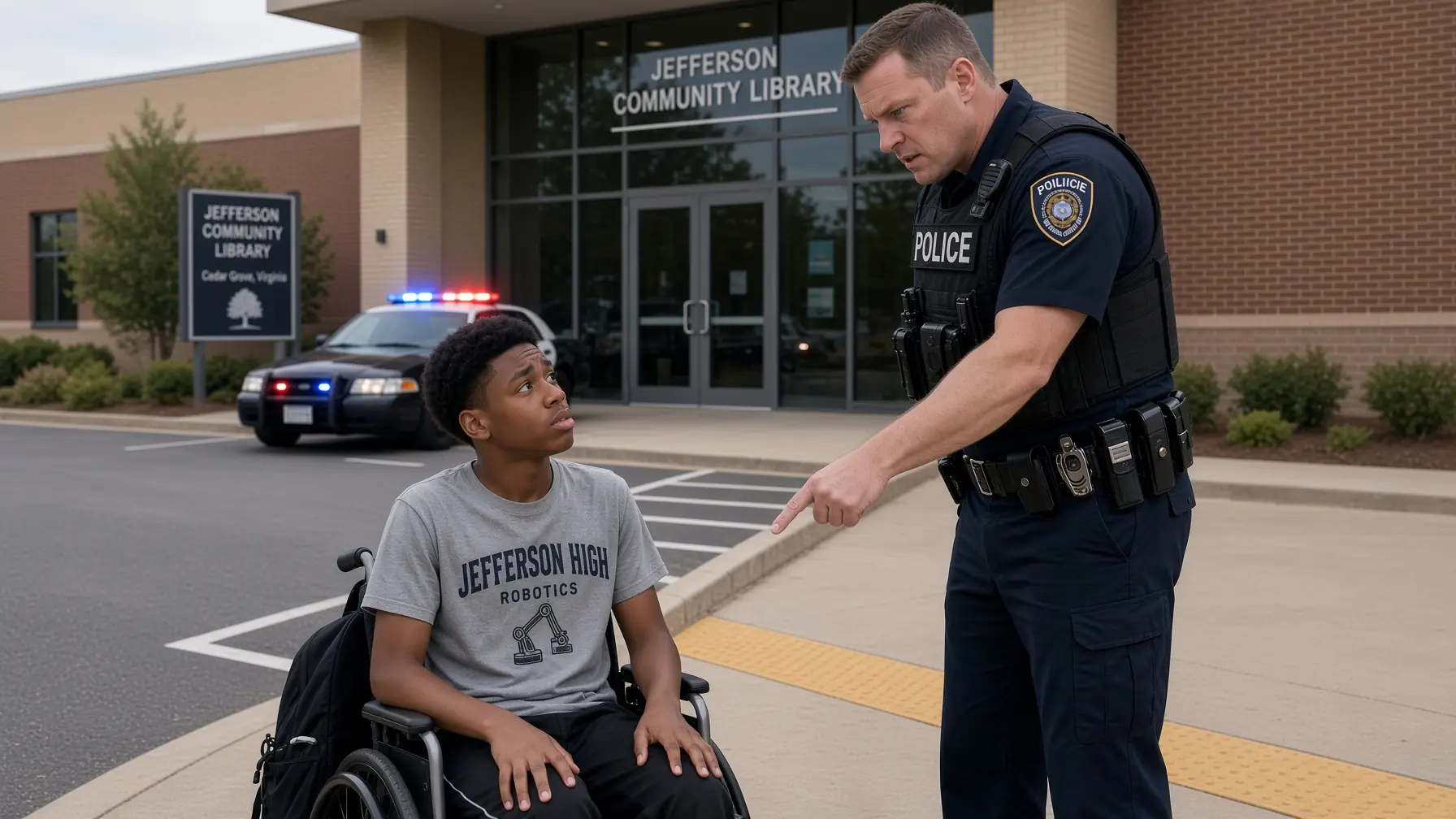
Jordan stared at him from his wheelchair, certain for a moment that he had misheard.
It was 7:12 on a Saturday evening outside the Jefferson Community Library in Cedar Grove, Virginia. The library had closed twelve minutes earlier. Most of the parking lot was empty except for Jordan, a silver sedan belonging to one of the librarians, and two patrol cars angled across the handicapped loading zone with their lights flashing. Jordan had been sitting beneath the awning waiting for his father to pick him up after a robotics club meeting ran late. His backpack hung from the handles of his chair. A partially assembled controller board rested inside it beside a laptop, three library books, and a bottle of water.
Officer Pike stood directly in front of him.
“I said get up.”
Jordan looked down at his legs, then back at the officer.
“I can’t.”
Pike folded his arms.
“What do you mean you can’t?”
“I use a wheelchair.”
“I can see the chair.”
Jordan glanced toward Officer Noah Bennett, who had arrived in the second patrol car and was standing several feet away.
Neither man smiled.
Jordan tried again.
“I have a spinal cord injury. I can’t stand safely.”
Pike pointed toward the concrete wall behind Jordan.
“Then how did you get over here?”
Jordan almost laughed because the question made so little sense.
“In my chair.”
“Don’t get smart with me.”
“I’m not.”
Pike leaned closer.
“You were reported checking vehicle doors in this lot.”
Jordan’s expression changed.
“I wasn’t.”
“Somebody called it in.”
“Then they called about somebody else.”
“There’s nobody else here.”
“There was ten minutes ago.”
“Who?”
“People leaving the library.”
“Names?”
Jordan looked at him.
“I don’t know everybody who uses the library.”
Pike nodded slowly, as if Jordan had just confirmed something.
“What’s in the backpack?”
“My stuff.”
“What stuff?”
“Laptop. Robotics parts. Books.”
Pike reached toward it.
Jordan grabbed one of his push rims and turned his chair slightly.
“Please don’t touch my bag.”
That movement changed the officer’s expression.
“Stop.”
Jordan stopped.
“Hands where I can see them.”
Jordan put both hands on his thighs.
Bennett finally spoke.
“Jared, dispatch said caller reported a male in a dark hoodie walking between cars.”
Jordan looked down at himself.
He wore a gray Jefferson High robotics T-shirt.
No hoodie.
Pike looked at Bennett.
“He could’ve taken it off.”
Jordan said, “I don’t have one.”
Pike turned back.
“Do you have identification?”
“In the small pocket of my backpack.”
“Then get it.”
Jordan reached behind his shoulder.
Pike’s voice snapped.
“Don’t reach!”
Jordan froze.
“You just told me to get it.”
“I said tell me where it is.”
“I did.”
Pike pulled the backpack from the chair.
Jordan felt the chair move backward half an inch.
“Careful.”
“What?”
“My chair.”
“It’s fine.”
“No, that bag is strapped around the push handles.”
Pike yanked harder.
The strap caught.
Jordan’s chair rolled backward.
One caster hit the expansion joint in the concrete.
For a second, the chair tipped enough that Jordan threw both hands onto his wheels to stabilize himself.
Pike stepped back.
“There. You moved your legs.”
Jordan stared at him.
“What?”
“I saw them move.”
“Yes.”
“So you can stand.”
Jordan could not believe the conversation had reached that point.
“Being able to move my legs doesn’t mean I can support my weight.”
“Convenient.”
Officer Bennett looked uncomfortable now.
“Jared.”
“What?”
“He says he’s disabled.”
“I heard him.”
Jordan felt something colder than fear begin settling into his chest.
Humiliation.
The kind that came when someone did not merely misunderstand you, but decided your explanation itself was evidence of dishonesty.
Two years earlier, Jordan had been a passenger in a crash that damaged his spinal cord. Rehabilitation had given him significant upper-body independence and limited voluntary movement in his legs, but not enough strength or stability to stand unsupported. He could transfer between his wheelchair and a bed or vehicle using his arms and carefully practiced techniques. On good days, with braces and parallel bars at therapy, he could bear partial weight for seconds.
None of that meant he could simply stand because a police officer ordered him to.
Jordan had spent two years explaining versions of that distinction to strangers.
Most listened.
Officer Pike did not.
Pike found the wallet.
“Jordan Ellis.”
“Yes.”
“Sixteen?”
“Yes.”
“Address?”
Jordan gave it.
Pike examined the ID.
“Whose laptop?”
“Mine.”
“You have proof?”
Jordan looked at him.
“It has my login.”
“What about the electronics?”
“Robotics club.”
“At a library?”
“Yes.”
“You expect me to believe a library runs robotics club after closing?”
Jordan pointed through the glass doors.
“Ask Ms. Reynolds. She’s still inside.”
Pike looked toward the darkened lobby.
A woman was visible through the glass stacking chairs.
Bennett said, “I can check.”
Pike held up a hand.
“Wait.”
That was the first unnecessary decision.
Not the stop itself.
The stop could be explained.
A caller had reported suspicious behavior in a parking lot.
Police arrived.
Jordan was there.
Officers were allowed to investigate.
The problem was what happened when facts began pointing away from Jordan and Pike kept pulling them back.
Pike opened the wallet farther.
A school ID.
Library card.
Debit card.
Emergency medical card.
He read the medical card.
Spinal Cord Injury — Mobility Impairment.
Jordan watched his face.
“That enough?”
Pike looked up.
“You're getting an attitude.”
“I’m asking if the card explains the wheelchair.”
“It explains what somebody printed on a card.”
Jordan exhaled.
Bennett said quietly, “We can run him and talk to the librarian.”
Pike ignored him.
“Where’s the hoodie?”
“I told you. I don’t have one.”
“What were you doing between the cars?”
“I wasn’t between the cars.”
“You were sitting here the entire time?”
“No. We came outside after the meeting.”
“We?”
“Four students and Ms. Reynolds.”
“Where are they?”
“Their parents picked them up.”
“And yours didn’t?”
“He’s coming.”
Pike’s eyes narrowed.
“You don’t know where your father is?”
“I know where he is.”
“Then call him.”
Jordan reached for the phone mounted in a clamp beside his seat cushion.
Pike immediately said, “Slow.”
Jordan stopped again.
“You told me to call him.”
“Then call him without making sudden movements.”
Something in Jordan finally broke through the humiliation.
Not anger exactly.
Exhaustion.
“You keep telling me to do things and then yelling when I do them.”
Officer Bennett looked away.
Pike did not.
“Give me the phone.”
“No.”
“Excuse me?”
“I can call my dad myself.”
“You want to make this difficult?”
“I’m sitting here.”
Pike stepped closer.
“Hand me the phone.”
Jordan looked toward Bennett.
“Am I under arrest?”
Bennett answered first.
“No.”
Pike turned sharply.
“He’s detained.”
Jordan nodded.
“Okay. Am I required to give you my phone?”
Neither officer answered immediately.
Pike reached for it.
Jordan put his hand over the device.
“Please don’t.”
Pike grabbed his wrist.
Jordan jerked instinctively.
“Let go.”
“Stop resisting.”
“I’m not resisting. You’re hurting me.”
Pike pulled Jordan’s arm behind the side of the wheelchair.
The chair shifted.
Jordan grabbed the opposite wheel with his free hand to stop himself from tipping.
Pike interpreted that movement as another act of resistance.
“Both hands behind your back.”
Jordan stared at him.
“I can’t do that safely in this chair.”
“Do it.”
“My balance—”
“Do it now.”
Bennett stepped closer.
“Jared, maybe just cuff him in front if you think we need to—”
“He keeps grabbing things.”