"What the hell is this? Why did you let someone like him in here?" Trevor's voice crackled over Hugh's radio. Owen Harrington folded his newspaper.
"I'm a customer."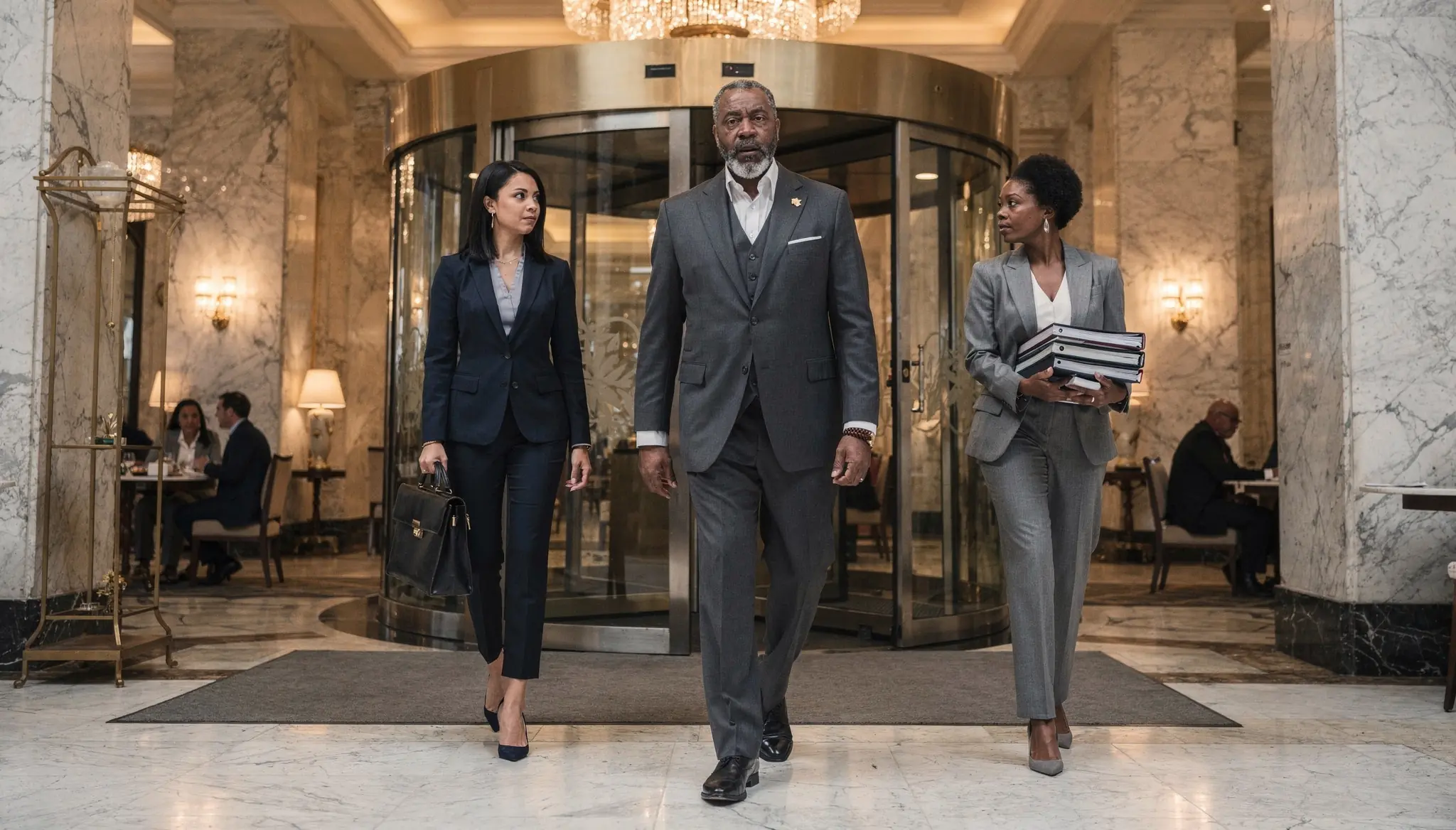
A short, cold laugh crackled over the radio. "In that jacket, with that unkempt beard? Try again, old man."
Owen stood. Six feet of him filled the worn navy coat. "Then bring me your manager."
"I am the manager. Hugh, get this man out of here."
Hugh Reardon smirked. His hand closed on Owen's bicep. "Walk, or wait for me to make you."
"Take your hand off me."
Hugh squeezed harder. The revolving door spat Owen onto Park Avenue.
"Go back where you belong."
They had no idea who the guest really was.
At 9:00 on a Tuesday night, Owen Harrington sat alone in his quiet office above a dry cleaner on Atlantic Avenue.
The fluorescent tube above his desk buzzed like a trapped insect. A cup of coffee had gone cold beside his elbow three hours earlier. On his desk, a manila folder lay open. The label read: BOWMONT ROYALE, Q2 COMPLAINTS.
Inside were 41 printed pages: guest complaint forms, comment cards, and two resignation letters. He had been reading for four hours. The Bowmont Royale was a 48-story, five-star hotel on Park Avenue, with a crystal lobby and a presidential suite overlooking Central Park. It was the flagship of Harrington Hospitality Group, the company Owen had built from a single bed and breakfast in Newark 31 years ago.
Nine hotels now, three states. Revenue the previous year had crossed $480 million. None of that mattered tonight. What mattered was page 14.
A Black couple from Philadelphia had booked the Bowmont Royale for their 25th wedding anniversary. The wife called ahead to request roses in the room. When they arrived, the front desk reassigned them from a Park View suite to a courtyard standard. No explanation given.
The roses were never ordered. A white couple who checked in 6 minutes later received the Park View suite and a complimentary champagne basket. The wife's comment card read, "We felt invisible, like we did not belong there." Owen turned the page. A Black businessman from Atlanta checked in wearing a three-piece suit and was asked for identification twice at the front desk.
The white guest behind him was waved through with a smile. Page after page, the same pattern, 41 complaints in six months, 85% from Black guests. The number had risen 340% in 18 months. Two long-tenured Black employees had also resigned.
Loretta Boone, housekeeper, 25 years of service. Anthony Briggs, sous-chef, 11 years. Neither received an exit interview. Both departure forms listed personal reasons.
Owen had read every quarterly report Trevor Bridgewater filed as general manager. Not one mentioned the complaints. Not one flagged the pattern. Not one addressed the resignations.
Every report ended the same way. Guest satisfaction remains strong. Staff morale is excellent. Owen closed the folder, pressed his thumbs against his eyes until he saw white sparks.
His phone lit up. Aaliyah Harrington. His daughter, 32, a corporate litigation attorney in DC. She called every Tuesday.
"Hey, Dad. You eat yet?"
"Not hungry."
"That bad?"
He told her enough: the folder, the numbers, and Trevor's clean reports that did not match a single page in front of him. Aaliyah went quiet for a long breath.
"Then send an auditor first thing tomorrow."
He leaned back in his chair, and the springs groaned. "I want to see what they do when nobody is watching."
"Dad, you are 62 years old."
"Exactly. A Black man in his sixties, plain clothes, no reservation. If they treat me right, I come home and sleep well. If they do not, I will know everything I need to know."
"You do not need to prove anything to anyone."
"This is not about proving. It is about seeing."
He hung up and walked to his bedroom closet.
On the left side hung five tailored suits, Italian wool, $3,200 each, cufflinks in a velvet drawer. Three watches in a leather case, the cheapest worth more than most cars. He reached to the right, a navy work jacket, faded jeans, scuffed leather shoes he had not worn in a decade. He laid them on the bed like a uniform.
Then he unclasped the watch from his wrist, placed it in the case, closed the lid with a soft click. On the nightstand sat a braided bracelet Aaliyah had made him when she was nine, shoelace and craft store beads. He tied it around his bare wrist. He looked in the mirror.
The man staring back looked like a retired maintenance worker waiting for a bus. Good. That was the point.
Downstairs, he flagged a cab on Atlantic Avenue, gave the driver a Park Avenue address.
The cab crossed the Queensboro Bridge. Manhattan skyline slid past the window. Glass and steel and money glowing against the dark. Owen leaned forward.
There it was, the Bowmont Royale. Forty-eight floors of limestone and brass. His name in gold letters near the top. Too high to read from the street, but he knew where each letter sat.
He paid in cash, stepped onto the sidewalk, straightened the worn navy jacket. Tomorrow, he would walk into his own hotel, and no one inside would know his name.
The next morning, Owen Harrington walked through the front doors of the Bowmont Royale at 10:15, wearing the navy work jacket, faded jeans, scuffed leather shoes, the braided bracelet on his left wrist. Nothing else. The lobby hit him like a cathedral. White Carrara marble wall to wall.
A crystal chandelier above the center fountain split morning light into tiny rainbows. The air smelled like fresh gardenias and polished brass. Behind the concierge station, a brass plaque read Harrington in letters 4 inches tall. Owen sat in a leather armchair near the window, picked up a complimentary Financial Times, crossed one leg, began to read.
No one greeted him. No one offered a menu. No one asked if he was a guest. Eleven minutes passed.
A young woman appeared at his side, dark-skinned, name tag reading Mia Hollings, food and beverage. She set a glass of water on the side table with a cloth napkin. "Good morning, sir. If you need anything, just wave me over."
Owen looked up. She was smiling. Not the tight performance smile the front desk wore. A real one.
"Thank you, Mia." She was the only person in the building who would treat him like a human being that day.
Three floors up, Trevor Bridgewater sat in the security room, 24 screens. He leaned forward and tapped one with his pen. Owen, leather chair, newspaper, water glass. "Been there 12 minutes," the officer beside him said.
Trevor pressed his radio. "Whitford, you see the gentleman in the brown jacket near the east windows?"
Caroline Whitford's voice came back. "I do, sir."
"Not a guest. Get him out."
A pause. "Sir, he has not caused any trouble."
"Whitford." Trevor's voice dropped. "I did not ask for your opinion. Remove him, or I will find someone who listens the first time." Caroline did not move from behind the desk.
She straightened a stack of key cards, picked up a pen she did not need. Fourteen seconds later, Trevor's voice came again. "Hugh, lobby. Now."
Hugh Reardon was already near the elevator bank, silver badge, security director, 63, carrying his weight like a man who wanted you to notice.
He crossed the lobby in eight strides. Owen saw him coming. Did not put down the paper. Hugh stopped, feet wide, arms folded.
"Room key."
"Good morning. I am a guest here."
"Room key."
"I do not carry it on me."
"Then come to the front desk to verify."
"I do not need to verify anything. I am sitting in a chair reading a newspaper."
Hugh's right hand moved to his radio. "Two more to the lobby." Owen folded the newspaper, set it beside the water glass, stood up slowly, six feet tall, 62 years old. He stood like a man who had never been afraid to take up space.
"I would like to speak with your general manager."
"I am handling this."
"That is what concerns me." Trevor's voice crackled through Hugh's earpiece.
Owen could not hear the words, but he saw Hugh's jaw tighten. Hugh closed his hand around Owen's left bicep. "Time to go."
"Take your hand off me."
A second officer gripped Owen's right arm. His feet shifted on the marble. The lobby went dead. The fountain still ran, but every other sound stopped.
A woman at breakfast set her fork down. A businessman near the elevator lowered his phone. Mia pressed her free hand against her mouth, tray still balanced in the other. Devon Carter stood at the bell cart 15 feet away. Twenty-four years old, Black, a white name tag on his chest. He watched two officers drag a man old enough to be his grandfather across the marble floor, his fingers locked around the cart handle, his chest barely moved. Owen did not shout, did not swing. He planted his feet once, the leather soles scraped against stone, a sharp sound that echoed off the high ceiling.
Then he let them move him. Not because he could not fight, because he needed to see exactly who they were. Hugh walked Owen into the revolving door. One push, the glass panels turned.
Owen stepped onto Park Avenue. Nobody followed him out. He stood on the sidewalk. Morning traffic, taxis sliding past.
He straightened his collar, checked his inside pocket. The notepad was still there. He did not look back at the building. Two blocks south, he found a bench near a bus stop.
He sat down. Three missed calls from Aaliyah on his screen. He called her back. First ring.
"Dad, where are you?"
"Park Avenue. On a bench."
"What happened?"
Owen looked at the sky, clear and blue, without a single cloud. "They dragged me out of my own hotel, sweetheart. Took about 90 seconds."
Five seconds of silence followed.
"Are you hurt?"
"No."
"Are you coming home?"
"No. There is still work to do."
He hung up and looked down at the braided bracelet on his wrist. Aaliyah had made it with her small hands a long time ago.
It was the most expensive thing he owned, and it had cost nothing. Owen sat on the bench for three more minutes. Then he stood up, crossed the street, and walked into the Marriott lobby across from his own building. Owen checked into the Marriott under a quiet alias and took a standard room on the 14th floor.
From the window, he could see the Bowmont Royale's front entrance, the revolving door still turning, guests walking in and out, bellhops moving luggage, everything looking normal. He sat on the edge of the bed and called Margaret Vaughn, his CFO for 11 years, the only person besides Aaliyah who knew he was in Manhattan. "I need 18 months of data from the Bowmont Royale," he said. "Scheduling records by employee race, room assignments by guest demographics, every complaint filed, every disciplinary writeup, every termination." Margaret did not ask why.
She had worked with Owen long enough to hear the difference between a routine request and an order. "When do you need it?"
"Before sunrise."
"I will be there by midnight."
He hung up and opened the notepad on his phone. Below the five names, he added one time: 9:15.
At 9:40 that night, someone knocked. Owen opened the door. Aaliyah stood in the hallway with a rolling carry-on and her work bag over one shoulder, eyes red, jaw set. "Caught the six o'clock shuttle from Reagan," she said. "Came straight here."
She turned to face him. "Dad, go public tonight. Call the press. Fire every person who touched you, and let the internet handle the rest."
Owen shook his head. "No."
"No? You were dragged across your own lobby like a criminal, in your own building."
"I know what happened. I was there."
"Then act like it."
Owen sat in the desk chair. The room was quiet except for the low hum of the air conditioner. Aaliyah was shaking, not from cold. "If I fire them tonight," he said, "it is a tantrum. An angry old man on the news for one cycle. They call it emotional. They call it reckless, and half the staff sues me because I skipped process."
He leaned forward. "If I do this tomorrow with documentation, with cause, and with counsel present, it is a correction. It holds up in court, and it holds up in the mirror." Aaliyah stared at him for a long moment. Then she pulled her laptop from her bag and sat on the bed.
"Fine. Then we build the case tonight."
"That is why I called you." She opened a blank document, titled it Bowmont Royale, cause documentation, cracked her knuckles. "Start from the beginning. Everything you saw today." They worked side by side. Owen talked. Aaliyah typed.
The lobby, the chair, Mia and the glass of water. Trevor's voice on the radio, Caroline's hesitation, Hugh's grip on his arm, the drag across the marble, every detail in order with timestamps he had memorized. Margaret arrived at 11:30 with a laptop bag and a folder of preliminary numbers. She sat up at the desk beside Aaliyah, two screens glowing, paper cups of coffee from the lobby that went cold within the hour.
By 2:00 in the morning, they had a framework. By three, they had a list. Owen stood at the window. The Bowmont Royale glowed across the street.
His name was up there somewhere in the dark, too high to see. Lobby lights still on. Night shift moving behind the glass. "Tomorrow," he said.
"9:15. Front door." Aaliyah looked up from her screen. "What happens at 9:15?" Owen did not turn from the window. "I walk back in, and this time they will know my name." Margaret closed her laptop.
Aaliyah saved the file. The room went dark except for city light pressing through the glass. Nobody slept. Owen was back inside the Bowmont Royale by 6:00 the next morning.
Different clothes this time: gray cargo pants, a dark blue polo with the delivery company logo he had bought at a uniform supply shop on Lexington the night before, a clipboard under his arm, a lanyard around his neck with a laminated card that read ATLANTIC COURIER DELIVERY. He entered through the service door on the east side of the building. The hallway was narrow, lit by bare fluorescent tubes. The air smelled like industrial bleach and hot linen.
A laundry cart rattled past him. The woman pushing it did not look up. Nobody stopped him. Nobody checked the badge.
Nobody asked his name. Owen spent the first hour moving through the back of house corridors. He carried the clipboard like it belonged in his hands. Walked with purpose, made notes in small, tight handwriting.
Anyone who saw him assumed he was supposed to be there.
At 7:15, he found the staff break room on the second floor, a narrow rectangle with dented lockers along one wall, a microwave with a stained door, a coffee maker with a cracked carafe, a scheduling board mounted beside the entrance. Owen stood in front of the board. It was divided by department. Housekeeping had the largest section.
Each employee's name was written on a magnetic strip with their weekly hours filled in by marker. Owen scanned the names. Loretta Boone, 25 years on the job. Her strip showed 22 hours this week.
Last month, 20 hours. The month before, 24. six months ago, her records would have shown 38. Owen looked at the next row.
Tara Mitchell, 1nine years, 20 hours this week. The trend was the same, steady decline over six months. Then he looked at the names above them. Jessica Ashmore, 3 years of tenure, 40 hours, full schedule.
Brendan Niles, 2 years, 38 hours, also full. The difference was not hard to see. Loretta and Tara were Black. Jessica and Brendan were not.
Owen wrote four names and four sets of numbers on his clipboard. Then he moved on.
At 8:45, he positioned himself near a supply closet with a clear line of sight to the front desk. He pretended to inventory boxes while he watched. Caroline Whitford was working the morning shift. Her posture was rigid.
Her smile was tight. She processed a guest check-in without incident. A white couple with matching luggage. Then a Black woman in a tailored blazer stepped up to the counter.
She had a confirmed reservation for a Park View suite. Owen could see the screen from his angle. The system had automatically assigned Room 1402. Caroline began the check-in.
Then her radio crackled. Trevor's voice. "Whitford, the guest at your counter. Move her to a courtyard standard."
Caroline's fingers stopped on the keyboard. She glanced toward the security camera above the desk. "Sir, she has a confirmed suite reservation."
"I can see that. Reassign her. We have a VIP arriving this afternoon who needs that room."
"There are three other Park View suites currently open, sir."
"Whitford, do it."
Caroline's hand hovered over the keyboard for two full seconds. Then she pressed four keys and changed the assignment. She smiled at the guest and handed over the new key card. "You are all set, ma'am. Room 1018, courtyard view. I hope you enjoy your stay." The woman took the card and walked toward the elevator. She had no idea what had just happened to her reservation.
Owen wrote it down. Time, room number, guest name on screen. Trevor's radio call sign.
At 10:30, he was near the bell stand when he heard Trevor's voice, not on the radio this time, but in person. Trevor had come down to the lobby. He walked past Owen without a glance. Owen was invisible in the delivery uniform, just another body moving through the building.
Trevor stopped in front of Devon Carter. The young bellhop was standing near the luggage cart, hands at his sides, waiting for the next arriving guest. Doing exactly what the position required. "Carter, what are you doing?"
Devon straightened. "Waiting on the next check-in, sir."
"You've been standing here for six minutes doing nothing. This is not a bus stop. You are not here to lounge."
"Sir, I am on bell duty. I am waiting for the next arrival."
"Find something to do or clock out. Your choice." Trevor turned and walked away.
Devon's jaw tightened. His nostrils flared once, his eyes dropped to the floor. He picked up a luggage tag from the cart and began writing on it. Something, anything, just to look busy, just to keep his hands from shaking.
3 feet to Devon's left, a white bellhop named Craig stood in the exact same posture, hands at sides, waiting for the next guest. Trevor had walked directly past Craig without a single word. Owen watched from behind a column. He did not write this one down.
He did not need to. He would remember it.
At 1:15, Owen carried a package into the third floor security office. The door was propped open with a rubber wedge. One officer sat inside monitoring the screens. Owen set the package on the counter and lingered.
On the desk beside the monitor sat a printed report. Hugh Reardon's signature at the bottom. Incident log Q2. 14 entries. Owen tilted his head and read the first page.
12 of the 14 incidents involved Black guests or visitors. The same phrase appeared in eight of the reports. Appeared out of place. A man reading in a chair appeared out of place.
A woman waiting for her husband in the lobby appeared out of place. A father carrying his child through the front door appeared out of place. Owen set the package down and walked out. His jaw was locked tight, his clipboard pressed flat against his side.
By 5 that afternoon, Owen had filled six pages on his clipboard. He found Loretta Boone in the staff break room again. She was sitting alone at a folding table, eating a sandwich from a plastic bag, a paper cup of water beside her. The fluorescent light above her flickered every few seconds.
No one else in the room. Owen sat down across from her. She looked up. Her face was tired.
Deep lines around her eyes, hands rough from 25 years of bleach and hot water and sheets that never ended. "How long have you worked here?" Owen asked. "Twenty-five years." She said it flat like a fact that had stopped meaning anything a long time ago. "Has anyone ever asked you that?" Loretta looked at him.
Really looked. Not a glance. A long careful look that took in his face, his uniform, his clipboard, the way he sat with his hands open on the table. She shook her head slowly.
"No. Nobody ever asks." Owen held her gaze. "Tomorrow morning, 9:15. I need you in the lobby. Wear your uniform." Loretta frowned.
"Sir, I do not even know who you are." "You will tomorrow." She studied him for a long time. The fluorescent tube buzzed above them. Then she picked up her sandwich and took another bite. "9:15," she said quietly. "I will be there." Owen stood up, walked out of the breakroom, down the service corridor, out the east door, into the evening air on Park Avenue. He crossed the street to the Marriott. The elevator doors closed around him.
He pressed 14 and leaned against the wall. Six pages of notes, four departments, 18 months of rot written in blue marker on a scheduling board and printed in black ink on an incident log, and one woman eating a sandwich alone who had been counting the same injustices for 25 years. The doors opened. Owen walked toward the room where Aaliyah and Margaret were waiting with open laptops and cold coffee.
It was time to build the case. The Marriott suite smelled like cold coffee and warm electronics. Three laptops open on the desk. A printer Margaret had bought from a drugstore two blocks south sat on the floor beside her chair, still warm.
Owen's clipboard notes were spread across the bed. Aaliyah's legal pad covered three pages of handwriting. Margaret Vaughn stood at the desk and opened her first binder. "Eighteen months of scheduling data," she said, "broken down by department, employee name, and race."
She turned to a flagged page. Housekeeping. Six Black employees have had their hours reduced by an average of 40% over the past two quarters. In the same period, nine non-Black employees with less seniority received either stable or increased hours.
The pattern is consistent across every pay period. She opened the second binder. Room assignments. I pulled every check-in record for the past 12 months.
Black guests with confirmed suite reservations were reassigned to standard rooms at a rate of 31%. The rate for non-Black guests with the same booking class was under 2%. Owen sat in the desk chair. He did not interrupt.
Aaliyah was typing on her laptop, building a timeline. Margaret opened the third binder. This one was thinner, she placed it on the desk with both hands. "This is the one that matters," she said.
Inside was a print out of an internal messaging channel called FOH Vibes. FOH stood for front of house. The channel was hosted on the hotel's staff communication platform. Trevor Bridgewater was the administrator.
He had created it 18 months ago. Margaret had pulled every message. Over 400 entries, commentary about specific guests by name. Commentary about specific employees by name.
Language that did not require interpretation. A guest named Denise Walters. Heads up, another one at the front desk. Make sure she gets courtyard, not Parkside.
An employee named Devon Carter. Kid stands around like he's waiting for a handout. Classic. A guest complaint.
They are always complaining. Comes with the territory. File it and forget it. Owen read three pages.
Then he closed the binder. "There is more," Margaret said. She turned her laptop toward him. On the screen was an audio file.
The hotel's conference room recording system runs automatically during all scheduled management meetings. Trevor did not know it was active. "This is from a manager's meeting six weeks ago." She pressed play.
Trevor's voice filled the quiet room. Laughter. Another voice, one of the assistant managers. A sentence about a Black guest that made Aaliyah stop typing.
Margaret paused it. "There are 11 more meetings on file. I have listened to all of them." Owen looked at the frozen waveform on the screen.
"How many of those recordings contain material like this?"
"Nine out of 11." The room was silent for ten seconds. Owen turned to Aaliyah.
"Legal status," he said. Aaliyah pulled up her document. Every termination in the list is supported by documented cause. Scheduling manipulation is a violation of the company's equal opportunity policy.
The messaging channel constitutes a hostile work environment under Title VII. The audio recordings were captured by a company-owned system on company property during official meetings. They were admissible. She scrolled down. Severance for each employee is calculated by tenure.
Every package includes benefits continuation, final pay timeline, and assigned release. They leave with what their contract entitles them to. Not more, not less. Owen nodded.
"Security." Margaret handed him a phone number on a card. Redline Executive Protection. Eight officers.
They will be in position at every entrance by 8:45 tomorrow morning, independent from the hotel security staff, briefed and ready. Owen took the card, set it beside his phone. He looked at the clock on the nightstand. 4:12 in the morning.
The Bowmont Royale glowed through the window, its lobby still lit. Night porters moving behind the glass. Somewhere in that building, Trevor Bridgewater was asleep in his office apartment on the 19th floor. He had no missed calls, no warning emails, no sense that anything had changed.
For Trevor, yesterday's incident in the lobby was a 30-second decision that had already left his mind. "Five hours," Owen said. Aaliyah closed her laptop. Margaret stacked the binders.
Owen stood at the window and looked across the street at his own name glowing faintly in gold against the dark stone. Aaliyah walked to the small coffee maker on the counter, started a fresh pot. "I will make enough for three," she said. Nobody argued.
Nobody slept.
At 9:15, the revolving door of the Bowmont Royale turned. Owen Harrington stepped into the lobby wearing a charcoal three-piece suit, Italian wool cut close at the shoulders, a white shirt with French cuffs.
On the left lapel, a small gold pin. Harrington Hospitality Group chairman. Aaliyah walked two steps behind him, dark suit, briefcase in her right hand. Margaret Vaughn followed with a leather portfolio and three binders stacked against her chest.
The doorman saw Owen first. He was the same young man who had been on shift two days ago. He had not opened the door for Owen then. Now he turned, saw the suit, saw the pin, and his face changed.
Not recognition from the lobby incident. Recognition from the framed portrait on the executive floor that every employee walked past on their first day of orientation. His lips parted. No sound came out.
He held the inner door open with both hands. Owen walked through without looking at him. The lobby was full. Breakfast service was underway.
Guests at white linen tables with silver coffee pots and fresh fruit. A couple reviewing a theater schedule, a businessman on his phone near the elevator bank. Morning light poured through the east windows and lit the marble floor in long gold stripes. Owen crossed the lobby floor.
His leather shoes clicked on the stone. The sound was different from two days ago. two days ago, the sound had been the scrape of soles being dragged. Today, it was the measured beat of a man walking into his own house.
Mia Hollings was behind the coffee station arranging cups on a tray. She looked up, saw the suit, saw the face. Her hands stopped moving. She set the tray down on the counter slowly as if it might break.
One hand came up and pressed flat against her mouth. She had served this man a glass of water 48 hours ago. She had smiled at him. She had called him sir.
And then she had watched two officers drag him across the floor she was standing on right now. Her eyes filled. She did not look away. Caroline Whitford was behind the front desk.
She saw Owen and stood straight. Her hands were flat on the counter. Her face was pale, but her breathing was steady. Margaret had called her at 6:00 that morning.
Caroline had been awake since 5. She had already moved her personal items out of the desk drawer, not because she had been told to, because she had decided to be ready for whatever came next. Owen gave her the smallest nod as he passed. She returned it.
Then the back office door opened. Trevor Bridgewater stepped into the lobby. He was holding a coffee mug. His expression was irritated.
He had heard movement and voices and something that disrupted the normal rhythm of his building. He did not see Owen at first. He saw the independent security officer standing at the east and west doors. He had not authorized that.
His eyes narrowed. Then he saw Owen, not the man from the lobby two days ago. Trevor Bridgewater had already forgotten that man. That incident had lasted 30 seconds in his memory.
He had not looked at the man's face then, and he did not connect this face to that one. Now, what Trevor saw was the charcoal suit, the gold pin, the posture, and behind Owen, two women with binders and a briefcase. Trevor's coffee mug lowered an inch. His face began to change.
He knew the pin. Every general manager in the Harrington portfolio knew that pin. He had seen it once before, three years ago, at a corporate retreat in Montauk on the lapel of the man who owned everything: the building, the brand, and the company that paid Trevor's salary. The blood left Trevor's face in stages.
First the cheeks, then the lips, then the hands. "Sir, I—there has been some kind of—"
Owen did not raise his voice. "My name is Owen Harrington. I own this building. I own every room, every floor, and every chair in this lobby."
He paused. "I am also the man you ordered dragged out of this hotel two days ago. But you do not remember that, because for you it was 30 seconds. Not worth a second thought." Trevor's mouth opened. Nothing came out. Owen continued.
"It was not 30 seconds for me, or for your guests, or for your employees. They have lived inside what you built here for 18 months." The lobby was silent. The fountain hummed.
A guest at the breakfast table slowly set her coffee cup down. The businessman near the elevator put his phone in his pocket. Owen turned away from Trevor. He walked to the bellstand where Devon Carter was standing.
Devon's hands were at his sides. His eyes were wide. His name tag was crooked. Owen stopped in front of him.
He reached out and straightened the name tag. Then he said quietly enough that only Devon could hear, "You did nothing wrong that day. I needed you to know that before anything else happens." Devon blinked. His voice came out barely above a whisper.
"Yes, sir." Owen turned to face the lobby. "Every department head, every floor supervisor, every shift manager, you have five minutes to be standing in this lobby, starting now." His voice did not echo. It did not need to. Every person in the room heard it clearly.
The clock above the concierge desk read 9:18. A folding table appeared beside the lobby fountain. Margaret placed three binders on the left side.
Aaliyah set her briefcase on the right and opened it. Inside were 30 kraft envelopes, each labeled with a name in black ink. Patricia Whitcomb, outside labor counsel, sat at the center of the table with a laptop open. Owen stood at the head.
Thirty people formed a half circle in front of him. Department heads, floor supervisors, shift managers, some had been called from their offices. Some were still holding coffee cups. Owen did not wait for the room to settle.
"I will read the cause. You will receive your envelope. You will exit through the service entrance. This is not a hearing. This is not a discussion."
At 9:19, Owen opened the first binder. Finding One: Scheduling. He read three names and three sets of numbers. "Loretta Boone: 38 hours reduced to 22 over six months. Tara Mitchell: 36 reduced to 18. Anthony Briggs: 40 reduced to 24. All three are Black employees with more than 15 years of tenure. In the same period, six employees with less tenure received increased hours. None of those six are Black." He closed the binder. Margaret turned her laptop toward the half circle and pressed play. Audio filled the lobby.
Trevor's voice filled the lobby, followed by laughter. A second voice, one of the assistant managers. One sentence, clear, specific, about a Black guest by name. Owen signaled.
Margaret stopped the playback. "There are 18 months of recordings like this one," Owen said. "I will not play more." "The lobby was so quiet that the fountain sounded like a river.
At 9:21, Owen looked up from the binder. "Trevor Bridgewater."
Trevor stepped forward. His face was gray. His hands hung at his sides. Owen read the cause.
Four items, each one a single sentence with a number. Violation of 14 equal opportunity provisions in employee scheduling. Administration of an internal channel containing discriminatory content from March 2024 to present. Falsification of quarterly reports, 11 guest complaints omitted, and two days ago ordering the physical removal of a guest from this lobby.
"That guest was me." Margaret slid a kraft envelope across the table. Patricia placed a release form beside it. Trevor picked up the envelope.
He turned toward the main entrance. "Service entrance," Owen said. "To your left." Trevor changed direction. As he passed the table, something small and gold fell from his lapel and landed on the surface with a quiet click.
His general manager badge. He had unclipped it without realizing. He did not reach back for it. Owen did not look at it.
He moved on.
At 9:23, Owen called, "Hugh Reardon." "Six security officers from the afternoon shift two days ago, step forward." Seven men formed a line. Hugh was at the front.
His jaw was tight. The hotel's radio system records all transmissions on a 72-hour loop. Owen said, "I have listened to the full recording from two days ago. After you removed me from the lobby, you transmitted on channel 4.
"Done. Out." Owen paused. "The six officers standing beside you laughed."
Hugh's face darkened. "That is not what those badges are for. Leave them on the front desk." The independent security team will escort you out.
Hugh did not move. "Mr. Reardon, you are no longer employed here. Step to the desk." Hugh stepped.
The six officers followed. Badges and radios landed on the marble counter one after another.
At 9:25, Owen called Garrett Mosley, Nathan Cross, Philip Ashford, Brenda Niles. Four people stepped forward. The assistant managers from the audio, the concierge, a front of house supervisor. Owen read one time stamp and one sentence from the transcript for each name.
No commentary. Four envelopes slid across the table. Garrett Mosley stopped at the edge of the lobby. He turned.
"Sir, I have a family." Owen looked at him. "Your severance is calculated on nine years of service. It covers six months of salary and benefits. I am not firing your family, Mr. Mosley. I am firing you." Garrett walked through the service door. It closed behind him with a soft click.
At 9:26, Owen opened the second binder. Eighteen names, each supported by documented cause inside your envelope. I will read the names. He read Eighteen names one after another.
Steady, no pause between them except for the sound of each person stepping forward, taking the envelope, and walking away. At the twelfth name, a man stopped. Marcus Webb, assistant manager, food and beverage. He looked at Owen.
"I knew," Marcus said. "I suspected what was happening. I did not say anything." Owen held his gaze.
"That is why you are in this envelope." Marcus nodded once, took the envelope, left.
At 9:29, 29 kraft envelopes had been collected. Twenty-nine people gone through the service entrance. One name remained. Caroline Whitford.
Caroline stepped forward from behind the front desk. Her hands were at her sides. Her back was straight.
"Two days ago, when Trevor Bridgewater ordered you to remove me from the lobby, you refused twice." Owen paused. "Margaret's data shows that over the past 18 months, you refused 23 similar orders." Caroline did not speak.
She waited. "You also did not report those orders to anyone above Bridgewater for 18 months." Owen let the words settle. "Two truths exist at the same time."
Margaret placed a cream-colored envelope on the table, not kraft. Caroline picked it up and opened it. "Acting general manager," Owen said. "Six-month performance review."
"An independent ombudsman will oversee every personnel decision you make for 12 months. You are not being pardoned, Miss Whitford. You are being given the chance to fix what you watched happen." Caroline's voice was steady.
"Understood, sir."
At 9:30, Margaret checked her list. Thirty envelopes, 29 terminations, one promotion. Owen looked up at the clock above the concierge desk, the same clock that had been there since the hotel opened. The hands pointed to 9:30.
"Fifteen minutes," he said, not in triumph or anger, but as a fact. The lobby was still, breakfast plates untouched, coffee cooling in cups. Guests stood near their tables. The morning light had shifted and the gold stripes on the marble had moved three inches west.
The only person moving was Loretta Boone. She had been standing near the service corridor since 9:15, still wearing her housekeeping uniform, white name tag, hands folded in front of her. She walked across the lobby toward Owen. Her shoes were soft-soled and made no sound on the marble.
But every person in the room watched her cross that floor. She stopped beside him, did not speak, just stood there. Two people in a building that had just changed. Owen turned to Loretta.
She was still standing beside him, hands folded, white name tag on her chest. He unpinned the gold chairman badge from his own lapel and set it on the folding table. "This is the chairman's pin," he said. "I am not giving you this one." Loretta blinked.
Margaret stepped forward with a small flat box, black velvet. She opened the lid. Inside, on white satin, lay a new gold badge. Engraved in clean block letters.
Loretta Boone, director of housekeeping operations. Owen held it out to her. Loretta looked at the badge, then at Owen, her chin lifted. She did not cry.
She took it with both hands and held it the way a person holds something they have waited 25 years to receive. "My knees have been telling me to sit down for two years," she said. "Then sit down," Owen said. "Behind a desk. Your desk." Loretta pinned the badge to her uniform right over the spot where the white tag had been. Gold on blue cotton. It looked like it had always been there. Owen turned to the bellstand. Devon Carter was still standing where he had been since 9:15, hands at his sides, eyes red, posture straight.
"Devon."
Devon stepped forward. "Sir?"
"Caroline Whitford is going to formalize a guest services management track within 30 days. Your name is first on the list of internal candidates."
Devon's mouth opened slightly. He closed it. "Sir, I am 24 years old." Owen looked at Loretta, still touching the edge of her new badge, then back at Devon. "Loretta was promoted for her work, not her age. The same applies to you." Devon nodded. He could not speak. He did not need to.
Owen walked across the lobby to the coffee station. Mia Hollings was standing behind it. A tray rested on the counter. Mia stood with her hands clasped in front of her apron, her eyes still damp. Owen stopped in front of her.
"Two days ago," he said, "I was sitting in a chair in this lobby, wearing a jacket that told everyone I did not belong. You walked over, set a glass of water on the table, smiled, said, 'If you need anything, wave me over.'" Mia's fingers tightened on her apron. "That was the only act of basic decency I received in this building that day." Mia shook her head.
"Sir, that is just what you are supposed to do."
"Yes, it is. And you were the only one who did." He paused.
"Margaret will contact you this week about the food and beverage supervisor position." Mia's hand came up to her face. She nodded twice and looked down at the counter. A small sound escaped her, almost like a laugh, almost like something else.
Owen stepped back. He looked across the lobby. The folding table was being cleared. Patricia was packing her laptop.
Aaliyah stood near the fountain with her briefcase at her feet. Caroline Whitford had already opened a folder at the front desk. She was speaking quietly to the remaining staff one by one, assigning shifts, covering gaps, starting the work. Owen walked to his daughter.
Aaliyah looked at him. For the first time since she had arrived from DC, she smiled. "Not bad for 15 minutes," she said. Owen did not smile back, but his shoulders dropped half an inch.
The tension that had lived in his body for three days loosened just slightly, like a knot given its first pull. "It is not done," he said. "But it is started."
Six months later, the Bowmont Royale looked the same from the outside. Forty-eight floors of limestone and brass.
The revolving doors still turned the same way. Inside, almost everything had changed. Guest complaints across demographics had converged for the first time in the building's history. An independent ombudsman reviewed every personnel decision and published findings to all staff.
Caroline Whitford was no longer acting general manager. The board removed the word at her four-month review. She kept the ombudsmen in place anyway. Loretta Boone ran housekeeping from a glass-walled office on the second floor.
She had hired four new supervisors and interviewed everyone herself. Devon Carter managed night shift guest services. He was 25 now. He still stood with his hands at his sides when he was thinking, but he no longer looked at the floor.
Mia Hollings was food and beverage supervisor. On her first day, she placed a glass of water on every lobby table before the breakfast shift. No one asked her to. On a Tuesday afternoon, a young Black woman walked through the revolving door, backpack on her shoulders, sneakers, college sweatshirt.
The doorman held the inner door and said, "Good afternoon." The front desk greeted her by name. Caroline, passing through, nodded. The young woman took the elevator to her Park View suite. She never knew what had changed in this building before she arrived.
She only knew that when she walked in, she felt like she belonged.
A short distance away, Owen Harrington sat in his quiet office above the dry cleaner on Atlantic Avenue. The fluorescent tube still buzzed. A fresh cup of coffee sat beside his elbow. On his desk lay a new folder.
The label read: BOWMONT ROYALE, Q3 GUEST LETTERS. He opened it. The first letter was handwritten on hotel stationery. It read, "Thank you for treating me like I belonged here." Owen placed the letter in his desk drawer.
The drawer was half full. He closed it gently and opened the next folder.