On a rainy morning in Chicago, a black man was rushing to an important job interview when he suddenly spotted an elderly white man struggling with a car jack. The old man was soaked, anxious, and exhausted, trying desperately to fix his flat tire. Even though he knew he'd be late, the young man ran over to help. What he didn't know was that his selfless act of kindness that morning would change his life forever.
The morning started the way most Chicago mornings did: gray, close, and undecided between drizzle and rain. The light came in dull through the small window of the Southbridge apartment, brushing across the counter where a half-empty coffee mug steamed beside a wrinkled tie. Marcus Reed stood in front of the mirror nailed above the sink, running a comb through his short hair and straightening a navy suit that had seen better days. The jacket pinched at his shoulders. The color faded just enough that the word navy seemed generous. Still, he looked at himself and nodded once.
His mother, Denise, stood at the stove, frying two eggs in a cast-iron pan older than Marcus. "You're not leaving on an empty stomach," she said, sliding the eggs onto a plate. "Big day like this, you need something in you." Marcus smiled, though his stomach was a tight knot. "I'll grab something on the train, ma. I can't risk getting this messed up before I even make it there." Denise turned and gave him the look he'd known all his life, the one that said there was no arguing. She wiped her hands on a dish towel and nodded toward a small box on the table.
Inside, on a square of worn cloth, sat a pair of silver cufflinks. "They were your granddaddies," she said softly. He wore them when he got hired at the steel mill. Said they reminded him to keep his sleeves rolled down and his chin up. Marcus picked them up carefully. The metal was cool and smooth, the engraving faint but visible: a pair of linked hands. He fastened them on, feeling the weight of memory. "Thanks, Ma," he said. "I'll make him proud." "You already did," she said, and kissed his cheek.
The train rocked its way north, every seat taken, people pressed shoulder to shoulder. Marcus held his briefcase on his knees, his reflection ghosted against the dark window. He rehearsed what he'd say when he sat across from the hiring manager at Whitmore and Blake Financial. He practiced answers for every question he could imagine: what drew him to finance, what he learned working double shifts at the grocery, and how he handled pressure. Outside, the skyline came into view: gray towers poking through mist. It should have looked promising, but the clouds above them were swelling dark, heavy with something worse than drizzle. A woman nearby muttered, "They said thunder later. Looks early to me." Marcus checked his watch. Plenty of time if everything ran smooth. He'd left early for that reason. He wasn't going to let anything—weather, traffic, luck—keep him from getting through that door on time.
But when the train screeched into the downtown station, the city had already changed its mind. By the time he stepped onto the street, the rain had turned mean. It came down in hard sheets, driven sideways by wind. People ducked under umbrellas, newspapers, briefcases, anything. Marcus pulled up his collar and jogged toward the avenue, dodging puddles that were turning into small rivers. He tapped open his ride-share app, watched the screen spin, and spin again. Every driver was unavailable. He cursed under his breath and lifted an arm toward an approaching taxi. It slowed, tires hissing through water. But before he could reach it, a man in a beige trench coat ran from behind, yanked the handle, and slid in without looking back. Marcus froze there, dripping, his hands still raised, as the cab pulled off in a spray of water.
For a second, he just stood in the storm, anger boiling up. Then he took a breath, forced his shoulders back, and looked down the street. He could see the tower that held Whitmore and Blake's offices, its glass face vanishing into the clouds. Five blocks, maybe six. He could make it on foot if he hurried. "Keep moving. Don't lose it now," he told himself. He set off, shoes splashing, suit darkening with every step. The sidewalks were chaos, umbrellas turning inside out, people running for overhangs. The thunder rolled close, loud enough to make the street lights flicker.
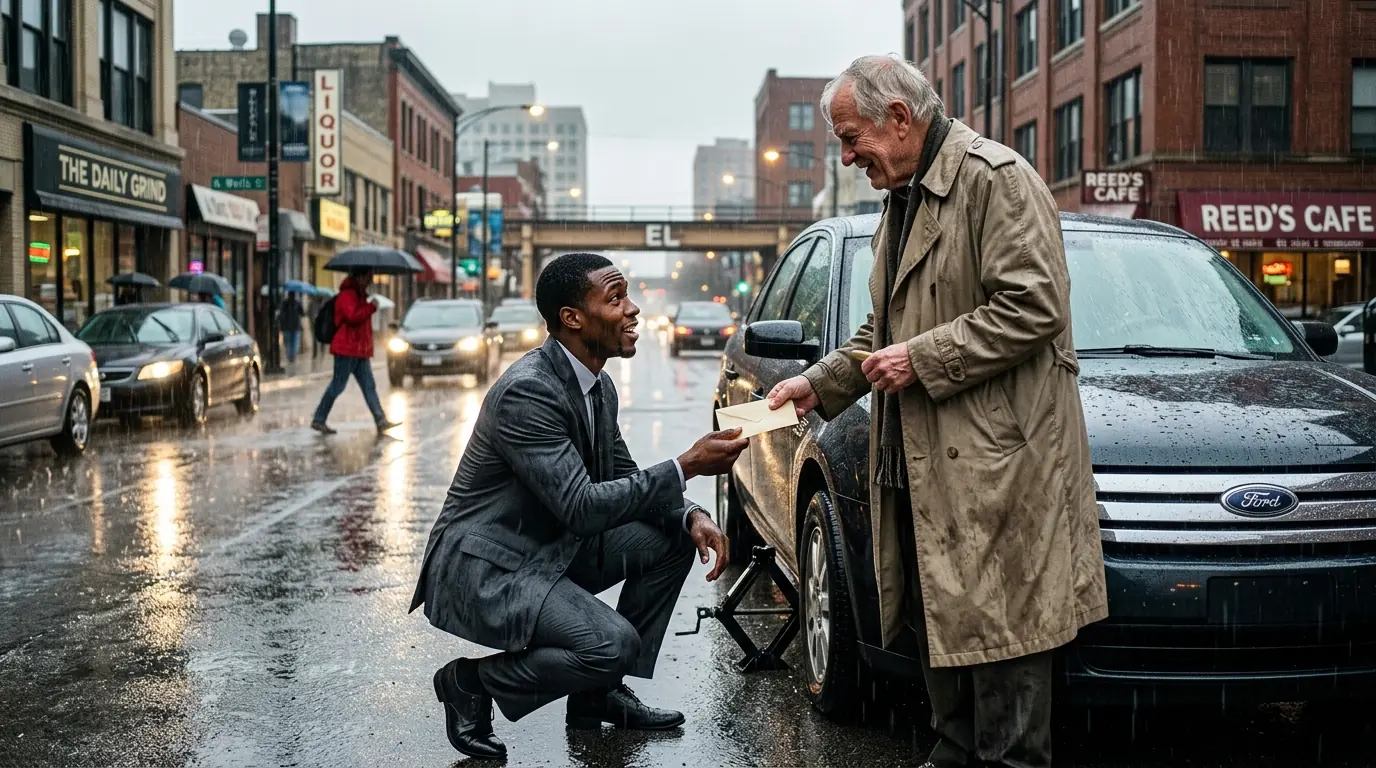
Marcus was halfway there when he noticed the car. A black sedan sat angled by the curb, hazard lights blinking, one tire flat to the rim. Next to it stood an older white man, maybe in his 60s, gray hair plastered to his forehead. He was crouched low, trying to fit a jack under the car, his hands shaking. Every few seconds, the handle slipped, clattering against the wet pavement. No one stopped. People glanced, then kept walking. Marcus slowed. The office tower loomed just ahead, glimmering through the downpour. His watch said 8:44. The interview was at 9. He hesitated. The man's suit jacket was soaked through. He looked miserable, defeated. Marcus thought of his mother's voice that morning: "You help people not when it's easy, but when it's right." He set his briefcase on a dry patch of steps and jogged toward the car.
"Sir, you okay?" The man looked up, blinking water from his eyes. "Flat tire, jack slipping. My driver's gone for help." Marcus crouched beside him. "You've got a spare in the trunk. I can't. These old hands don't want to cooperate." Marcus took the jack. "Let me try." The man shook his head. "You'll ruin your suit." "It's already ruined," Marcus said with a short laugh. "Pop the trunk."
The rain came harder. Marcus laid his jacket on the curb and knelt on it to keep from slipping. He worked the jack steady, loosened the lug nuts in a pattern his uncle had drilled into him back in Southbridge. His fingers were slick, but his movements were sure. "You done this before?" the man said. "My uncle runs an auto shop," Marcus said, grunting as he lifted the wheel free. "Taught me not to strip a lug nut if I valued my knuckles." The man chuckled, watching. "Good lesson." They worked in silence for a while, just the sound of rain and the metallic click of tools. When Marcus tightened the last nut, the man stepped closer.
"What's your name?" he asked. "Marcus Reed," Marcus replied. "You're a good man. I wish I could repay you somehow." Marcus brushed water from his face. "No need, just glad to help." "You sure? You look like you were on your way somewhere important." Marcus hesitated, wiping his hands on his soaked pants. "Interview. Big one." The man frowned. "Go, don't let me keep you." Marcus shook his head. "Can't leave a job half done." He gave the tire one last spin, tightened the last bolt. "All set." The man straightened, rubbing his wrist. "You saved me from a disaster. Let me give you a ride at least." Marcus hesitated. "If it's not out of your way, get in."
The car rolled through flooded streets. Marcus sat stiff in the back seat, trying not to drip all over the leather. He could see the time on the dashboard: 8:59. His chest tightened. "You said Whitmore and Blake?" the man asked. "Yes, sir. I know the place." They pulled up to the front steps just after 9. Marcus grabbed his briefcase and reached for the door handle. "Thank you, sir. Really?" The man leaned forward from the driver's seat. "I won't forget this, Marcus." Marcus gave a quick nod and stepped out into the rain.
 Inside the lobby, the world changed again: quiet, polished, dry. The air smelled of coffee and cologne. People in pressed suits walked briskly, their shoes tapping on marble. Marcus caught a glimpse of himself in a mirrored column, hair flat, collar wilted, pant legs dark with rain. He swallowed hard and approached the security desk. "Marcus Reed, I have a 9:00 interview with the finance team." The guard glanced at his computer. "You're late. They've already started the first round." Marcus's throat tightened. "Please, it's only a few minutes. There was an emergency." "14th floor," the guard said, tapping his badge printer. "Can't promise they'll still see you." "Thank you," Marcus said quietly.
He rode the elevator up, feeling every floor like another chance slipping away. When the doors opened, a young woman at a reception desk looked up. "Mr. Reed." "Yes, I'm sorry," she said, her voice gentle but final. "Mr. Callaway just started with the next candidate. His schedule's packed." Marcus nodded slowly. "I understand. Could you give him my resume?" "Please." "Of course," she took it carefully, still damp, and smiled faintly. "You came a long way, didn't you?" "Feels like it," Marcus said. He turned to leave, the echo of his wet shoes loud against the carpet.
Outside, the storm was thinning. The clouds still hung heavy, but the light was changing, softening. Marcus stood under the building's awning and watched the cars crawl through puddles. His suit clung to him. The cufflinks glinted faintly in the weak light. For a long moment, he didn't move. Then he breathed out slowly. "You did what was right. That has to count for something." He turned toward the train station, his steps splashing quietly on the wet sidewalk.
Back home, Denise looked up as the door opened. "Marcus stepped in, water still dripping from his cuffs." "Oh, baby," she said, voice full of both worry and sympathy. "Didn't go well?" He sat down his briefcase and sat at the table. "I was late, helped a man with a flat tire, got there 9:18, they'd moved on." Denise poured him a cup of coffee, set it down in front of him. "You did right," she said simply. "I lost my chance, Ma." She smiled softly. "Maybe not. Maybe you just can't see the whole picture yet." He rubbed his eyes, tired and disappointed. But under the ache, there was something steadier, a quiet knowledge that he'd done what he could. Outside, the rain eased into drizzle, tapping gently against the window. One door closed, he thought. But maybe that's not the end of the story.
And for the first time all morning, Marcus smiled. The next morning broke with a thin, pale light that seemed to stretch through the blinds as if testing the room. The rain had stopped, but the city still smelled of it: wet pavement, iron, and the faint sweetness of soaked leaves. Marcus sat at the kitchen table in his undershirt, a coffee going cold beside him. The navy suit hung by the window, rumpled and drying on its hanger like a flag that had weathered something serious. His mother hummed quietly while she sorted laundry. She didn't press him to talk, though her glances said she wanted to. He finally spoke. "Feels like I ran the whole city for nothing." Denise looked up, smiled softly. "You didn't run for nothing. You ran towards someone who needed you." Marcus rubbed his face, weary. "That doesn't pay bills." "No, it doesn't," she said. "But it keeps you human. And sometimes, baby, that's worth more than any paycheck."
He didn't answer. He wanted to believe her, but the bitterness stuck. The job had been his chance to climb out, to prove something to himself, to the world that looked past him too easily. He took a long breath and stood. "I'm going to head down to the shop. Uncle Terry needs help changing oil on those delivery vans. Keeps my hands busy." Denise nodded. "Take your time, Marcus. The world's not done with you yet."
The shop sat on the corner of Ashland and 48, a low cinder block building with peeling blue paint and the smell of oil that never left your clothes. Marcus had spent half his teenage years there, turning wrenches, learning patience, learning that machines don't care who you are, they just need a steady hand. "Look who's back from Wall Street," Uncle Terry called as Marcus walked in, wiping grease off his hands with a rag. "You bring that fancy job with you?" Marcus gave a small grin. "Not this time." Terry raised an eyebrow. "You were the best worker I had. Their loss," he gestured to an old Ford on the lift. "Help me with this tire, huh? Lug nuts are rusted on."
As they worked, the clang of tools and the low murmur of blues music filled the air. Marcus found the rhythm of it comforting. "No pressure, no judgment, just work. You'll get another shot," Terry said. After a while, people notice good hearts, even if it takes him a while. Marcus tightened the last nut and looked at his uncle. "You really think that matters in the city?" Terry grinned. "Everywhere matters. You just got to keep showing up the same man you are here."
That afternoon, Marcus took the bus home. The sky was clearing, streaks of sunlight breaking through the gray. He leaned his head against the window, eyes following the people on the sidewalks: kids splashing through puddles, a man helping his wife out of a cab, a delivery driver hauling boxes up wet steps. Life moved on. It always did.
Back in his apartment, the phone buzzed on the counter. Unknown number. He frowned, picked it up. "Mr. Reed?" a woman's voice said. "This is Natalie Quinn from Whitmore and Blake. Mr. Whitmore would like to meet with you this afternoon if you're available." Marcus straightened in his chair. "Mr. Whitmore, the CEO." "Yes, sir. His office is on the executive floor. 3:00. If that works, I'll be there." Marcus said, trying to keep his voice steady. "Excellent. Security will have your name." When the call ended, he sat there for a long moment, staring at the phone. Then he laughed. A quick, unbelieving sound. "What in the world just happened?" Denise peeked around the corner. "Good news." "You could say that," he said. "They want me back, the CEO himself." Her face broke into a smile. "See? Told you the world wasn't done with you."
Marcus stood in front of the mirror again, this time pressing his shirt collar smooth, shining his shoes until the leather caught the afternoon light. The suit looked better now that it had dried. The cufflinks gleamed faintly. Little hands clasped together. He rode the train into the city, the same route as before, but the world felt different, cleaner, brighter, almost forgiving. At the tower, security handed him a pass labeled executive access. The guard, who had scolded him the day before, nodded politely this time. "Good luck, Mr. Reed." Marcus smiled. "Thank you."
The elevator ride was long and silent as the numbers climbed. His reflection swayed slightly in the brushed metal. "You earned this one way or another," he told himself. When the doors opened, he stepped into a space that looked more like a sky than an office, windows from floor to ceiling, sunlight pouring across glass tables and silver fixtures. A woman approached holding a tablet. "Mr. Reed, Mr. Whitmore is expecting you." "Thank you," Marcus said. She led him through a hall lined with photographs: old black-and-white shots of the company's founders standing beside chalkboards full of numbers. At the end of the hall stood a wide office with a view of Lake Michigan, silver-blue under the afternoon sun.
A man sat with his back to the door, gray hair bright against the light. Marcus stopped, recognition dawning like a slow tide. "Come in, Marcus," the man said, turning his chair. It was him, the man from the street, the one with the flat tire for a heartbeat. Neither spoke. Then Whitmore smiled. "I thought we should talk under better circumstances." Marcus blinked, still processing. "Sir, I—I didn't realize." "I know," Whitmore said gently. "That's the point. You didn't help me because of who I was." Marcus took a cautious step forward. "I was just doing what anyone would have done." Whitmore chuckled. "Not anyone. I stood on that curb for 15 minutes before you came along. You were the only one who stopped."
Marcus looked down, unsure how to respond. Whitmore leaned back in his chair. "I read your resume. It impressed me, but I'll be honest. So did the fact that you showed up late yesterday, soaking wet, because you helped a stranger. That told me everything I needed to know." The words hit Marcus like a wave. "I didn't expect this," he said quietly. "I imagine not, but I believe in hiring people, not just paper," Whitmore said. "So, here's my offer. I don't want you as another analyst. I want you as my special assistant. You'll learn everything from the inside: how decisions are made, how people are treated. I think you'll handle both well."
Marcus stared, stunned. Whitmore smiled. "What do you say?" Marcus swallowed hard. "I say yes, sir. I'd be honored." Whitmore stood and extended a hand. Marcus shook it, the firm grip sealing something far more meaningful than a job. As he left the building later, the sky was clear. The city sparkled with a washed-clean light, and for the first time in a long time, Marcus felt not just lucky, but seen.
He got off the train in Southbridge just as the sun began to drop. The streets glowed orange. Kids played stickball by the curb and the smell of dinners drifted from open windows. He walked home slow, briefcase swinging lightly at his side. Denise met him at the door, eyes searching his face. "Well," Marcus grinned. "Turns out the man I helped runs the company." Her hand flew to her chest. "You're kidding." "No, ma'am. He offered me a better job than I even applied for." She let out a laugh that turned into a tearful chuckle. "See, I told you kindness doesn't go to waste." Marcus hugged her, holding on a little longer than usual. "You were right, Ma. You always are."
Outside, the first stars were appearing, faint but certain. Marcus looked at them through the window, cufflinks glinting in the lamplight. He thought of his grandfather, his uncle, the people who'd shown him what hard work and decency looked like. "You help people, not when it's easy, but when it's right," he heard again. And for the first time, he believed that maybe doing right had a way of finding its own way back.
The morning light over Southbridge was clean and clear, the kind that made the world look briefly forgiving. Marcus sat on the edge of his bed, tying his shoes. The apartment was quiet except for the sound of his mother in the kitchen humming the same hymn she always hummed when her heart was light. Today would be his first full week at Whitmore and Blake. It still didn't feel real. The polished office, the view that stretched over the lake, the title special assistant printed under his name on the door plate outside his cubicle. Every morning when he walked through the lobby and the guards greeted him with a nod, something inside him stirred. Part disbelief, part gratitude, he checked his reflection one last time. The navy suit pressed clean, the silver cufflinks shining. He ran a finger over them and smiled.
Downtown was already awake when Marcus stepped out of the train station. Delivery trucks honked, people hurried, and sunlight bounced off the wet streets from last night's rain. As he crossed the plaza toward the building, he saw a woman struggling with a cart stacked high with coffee boxes. The wheels caught on a curb, tipping slightly. "Need a hand?" Marcus asked. The woman looked up, surprised, then nodded. "Oh, thank you. These things have a mind of their own." He steadied the cart and lifted it over the step. "There you go." "Appreciate it," she said. Marcus smiled and kept walking. Just a small thing, a moment, but it made him think of that morning again. The storm, the broken tire, the choice he'd made. He felt that same quiet satisfaction now, like something inside him had settled into place.
Inside the office, Natalie Quinn greeted him at the reception desk with her usual warm smile. "Morning, Mr. Reed. Mr. Whitmore is expecting you at 9 sharp." Marcus nodded. "Thank you." He rode the elevator to the top floor. Each time the doors opened, he felt that same mixture of humility and purpose. When he reached the executive floor, the air itself felt different, quieter, more deliberate, as if people here measured their words like currency. Whitmore's office door stood half open. Marcus knocked lightly. "Come in," Whitmore said. The older man was at his desk, glasses perched low on his nose as he studied a folder of reports. He looked up and smiled. "Good morning, Marcus. Have a seat." Marcus sat. "Morning, sir." Whitmore leaned back, stretching. "I'll tell you something about this business," he began. "You can teach numbers, you can teach policy, but you can't teach conscience. That's what separates the good from the great." Marcus nodded, listening. Whitmore continued, "You've got that, Marcus. You showed it before you ever walked through these doors, but now I want you to see how it fits into the world. You're stepping into the world of money, pressure, and people who don't always stop to change tires." Marcus smiled faintly. "I'm ready to learn."
The next few weeks unfolded in steady rhythm. Marcus shadowed Whitmore through meetings, presentations, and long afternoons of negotiations. He took notes, organized briefs, fetched coffee, and quietly observed how people spoke when they thought power was watching. One afternoon in the conference room, a junior analyst made an error in a report. The room went tense. The man's face flushed red as others murmured and corrected him. Marcus watched Whitmore's eyes, calm, steady, and before he knew it, he heard himself speaking. "Excuse me," Marcus said gently. "We all miss things sometimes. What matters is we fix them. He's already spotted it. That's a win, isn't it?" The room went silent for a heartbeat. Then Whitmore nodded slowly. "That's right, Marcus. Thank you."
Afterward, as the meeting broke up, the analyst, a young man named Luis, came over. "Thanks for that," he said quietly. "I thought I was done for." Marcus smiled. "Happens to everyone. You did good catching it yourself." As Luis left, Whitmore turned to Marcus. "You see what I mean about conscience?" Marcus nodded. "I think I do."
Days passed and Marcus began to notice the smaller details. The receptionist who stayed late without complaint, the janitor who always smiled even when no one noticed him, the accountant who ate lunch alone every day. He started greeting them by name, asking how they were. It didn't take long before smiles followed him down the hallway.
But the real test came one gray Tuesday morning. Whitmore had a flight to New York for a board meeting. Marcus was to review a series of investment proposals in his absence—a stack of polished reports from the acquisition team. As he read through them, one caught his attention. The numbers looked right. But the deeper he read, the more uneasy he felt. It was a deal that promised high returns by buying out a struggling nursing home chain on the south side—the kind of place that looked after folks like his mother's friends, people who'd worked hard all their lives. He leaned back, heart tightening. The plan would streamline costs, which meant layoffs, closures, and higher fees. Profitable, sure, but cruel. He sat there, tapping a pen against the folder. Do you stay quiet? It's not your place, he thought. Or do you say something?
Finally, he gathered the file and walked to Natalie's desk. "Can I run something by you?" he asked. She looked up. "Of course." He explained the deal, his concerns, the gut feeling that it was wrong. She listened carefully, then said, "You're not wrong, Marcus. But raising it could ruffle feathers. It's not exactly your role yet." He nodded, uncertain. "I just don't want us to make a profit off people's hardship." She smiled faintly. "You sound like him, Mr. Whitmore." Marcus glanced toward Whitmore's empty office. "Then I guess I'll take the risk." Later that day, he sent a concise memo to Whitmore summarizing his concerns. He didn't expect a reply before the flight landed, but less than an hour later, an email came through. Good catch, Marcus. You're right. We'll review this one more closely. Never be afraid to speak up for what's right.
Marcus read it twice, then leaned back in his chair. Relief and pride mixed in him, quiet but deep. That evening, as he left the building, the sun was setting low behind the skyline. The light filtered through the glass towers like warm honey. He walked toward the train, coat slung over his shoulder, when he saw a familiar face by the curb. Luis, the analyst, waiting with an umbrella in hand. "Hey, Marcus," Luis called. "Headed home?" "Yeah," Marcus said. "Come on, I'll walk you to the station. You've been my good luck charm lately." Marcus laughed. "I'll take the credit." They walked together, trading stories about their families, neighborhoods, and hopes. For the first time, Marcus realized how his small choices—a word in a meeting, a hand with a cart, a moment of courage—were rippling outward, touching lives in ways he didn't plan, but quietly hoped for.
As they reached the station, Luis said, "You know, people talk about you around the office. They say you make it feel different." "Nicer!" Marcus smiled, almost embarrassed. "Just trying to do what's right." Luis nodded. "Well, keep doing it. The rest of us notice."
That night, Marcus sat by his window again. The city lights shimmered, and the breeze carried the distant hum of traffic. His mother was asleep in her chair, the TV low and flickering. He looked at the cufflinks glinting in the lamp light. Small, steady, silver hands clasped together. "You help people, not when it's easy, but when it's right," he heard again. He smiled to himself, realizing the truth of it now more than ever. Kindness wasn't just one act in a storm. It was how you walked through every day afterward, holding the world together, one small gesture at a time. And Marcus Reed, son of Southbridge, sat there in the quiet glow of his own peace, ready to keep doing just that.
The months that followed rolled by like calm water, steady, sure, and marked by small, meaningful ripples. The storm that had once soaked Marcus's suit was long behind him. Yet in quiet moments, he still thought about it. Sometimes on his way to work, when the city was half awake and the sidewalks glistened from overnight rain, he'd catch the faint smell of wet asphalt and smile. That morning, a light breeze swept across the plaza as he walked into the Whitmore and Blake Tower. The same security guard who had once scolded him for being late now greeted him by name. "Morning, Mr. Reed," the guard said. "Morning, Clarence," Marcus replied with a nod.
The rhythm of the place had changed. It wasn't that Marcus had changed the company, but something in his presence—steady, respectful, human—had softened the edges. People smiled more. They held doors. They remembered each other's names. Whitmore had begun easing into semi-retirement. He still came in most days, but he relied on Marcus to handle more meetings, manage projects, and mentor younger employees.
One afternoon, the older man invited Marcus into his office. "Sit down," he said, motioning toward the chair across from his desk. Marcus took a seat. Whitmore leaned back, his hands folded loosely. "You remember the day we met?" Marcus smiled. "Hard to forget. You had a flat tire, and I was supposed to be in your lobby ten minutes later." Whitmore chuckled softly. "I remember thinking how ridiculous I must have looked, soaked to the bone in that rain, but what I really remember is how calm you were. You didn't rush. You did the job right." Marcus shrugged lightly. "My uncle taught me. If you're going to help, do it like it matters." Whitmore nodded, his eyes kind. "It does matter, Marcus. More than most people realize. This company's changing. The next generation coming in needs to see leadership that isn't just sharp, it's decent. You've shown that here." The words landed gently, but they carried weight. Marcus looked down at his hands, then back up. "I just try to do what my mama raised me to do. Treat people right." Whitmore smiled. "Keep doing that. The rest will follow."
That weekend, Marcus went back to Southbridge to visit his uncle's auto shop. The air smelled of motor oil and summer rain. A few kids from the neighborhood were hanging around, watching Terry work on a car with its hood propped open. Marcus stepped inside, rolling up his sleeves. "You boys want to learn something?" They turned surprised. Terry grinned. "Well, look who’s here. Mr. Bigshot executive." Marcus laughed. "Still changing tires." "Uncle T. Just fancier ones now." He picked up a jack, motioning for the kids to gather close. "All right. First thing: never put your hands where they can get crushed. Always keep steady ground. You take your time, and you respect the tools." The boys nodded, watching his hands. The lesson went on: how to check tire pressure, how to line up lug nuts, how to keep your head steady when things went wrong.
Afterward, one of the kids, a wiry boy named Darnell, asked, "Why are you doing this? You got a big job now?" Marcus smiled, wiping his hands on a rag. "Because someone once showed me how to do it, and because the world gets better when we pass the good stuff along." Darnell nodded, thoughtful.
That night, Marcus sat outside on his mother's porch. Fireflies flickered over the yard, and the air was soft with the smell of cut grass. Denise came out with two glasses of sweet tea and handed one to him. "You're looking at peace, aren't you?" she said. He smiled. "Feels like it. Been a long time since I did." She looked at him for a long moment. "Your granddaddy would be proud. You turned one hard morning into something beautiful." Marcus turned the cufflinks at his wrists, feeling the cool metal under his fingertips. The engraving—two hands clasped—caught the porch light. "I think he's been with me every step," Marcus said quietly. Denise nodded. "That's how love works, baby. You keep doing right by people, and that love never leaves you."
Weeks later, back in the city, a small moment closed the circle. Marcus was leaving work when he saw a young man outside the building, soaked to the skin under a sudden burst of rain. The man clutched a folder to his chest, eyes darting nervously toward the revolving doors. He looked lost, desperate, the way Marcus himself once had. Marcus hesitated only a second, then stepped forward. "Hey, you okay?" The man blinked at him. "I've got an interview up there. 9:00, but my train, my cab, I'm already late." Marcus smiled softly. "Come with me." He led the young man inside, waved to Clarence at the desk. "He's with me." The guard nodded, printing a badge. Marcus turned to the man. "Take a deep breath. Don't rush. Go do your best. That's all anyone can ask." The young man nodded, his shoulders easing. "Thank you, sir." As he hurried toward the elevators, Marcus watched him go. The scene was so familiar it made his chest ache with quiet gratitude. Whitmore's voice echoed in his mind: You can teach numbers, but you can't teach conscience.
He smiled, then stepped out into the soft drizzle, walking toward the train. That night, Marcus stopped by his uncle's shop again. The air was filled with laughter. The neighborhood kids had set up an old radio and were listening to soul music while they worked on a battered old sedan. Marcus stood watching them for a moment, feeling a deep warmth rise inside him. "Got something to fix?" Terry asked from under the hood. Marcus shook his head. "Nah, just checking in." Terry grinned. "Looks like you've been fixing things plenty lately." Marcus laughed quietly. "Guess I have." He stayed until dusk, then walked home.
As the city lights came on, Marcus sat at his desk, opened his notebook, and wrote a few lines—something he'd started doing since that stormy morning long ago. Kindness isn't a job. It's a way of walking through the world. It's the bridge between where you are and who you could be. He closed the notebook, turned off the lamp, and looked out at the skyline. The night was calm, the air washed clean. Somewhere far below, cars moved like quiet stars. Marcus Reed smiled. Not because he had won, but because he had understood. He'd learned that helping others didn't just change the moment; it changed the man. And that was enough.