On a dusty back road deep in the forgotten South, a 12-year-old black boy with a gift for fixing machines struggles to survive with his grandmother. As he rides his old bike along the empty road, he spots a broken-down SUV. Without hesitation, he steps in to help the man fix his car and rides off. What Malik doesn't know is that the man is a wealthy CEO and that small act will change his life forever.
The red dirt road stretched on and on, cutting through the southern countryside like a scar. The air was thick with heat and dust, making the pine trees along the roadside look faded, like ghosts of a better time. Wooden shacks leaned against the wind, their tin roofs rusted, their windows boarded up or cracked. Here, on the edge of forgotten America, the world didn't move fast. It barely moved at all. People around here kept to themselves. The few that passed by in beat-up trucks or old sedans gave quick, cautious looks to anything that didn't belong. And some things, some people, never really belonged, no matter how long they lived here. The black folks, like always, got the worst of it. Eyes followed them at the gas station. Whispers trailed them at the grocery store. Out here the lines were drawn, invisible, maybe, but clear as day if you knew where to look.
Down by the roadside, crouched beside a pile of rusted metal and broken appliances, was a boy the world barely noticed. His name was Malik. He was 12 years old, though most would guess younger on account of his small, skinny frame. His skin was dark, smooth, but hardened by the southern sun. His black hair curled tight to his head, and his big brown eyes held a sharpness most grown men didn't have. He wore a faded gray t-shirt, two sizes too big, and ripped jeans patched at the knees. His sneakers were mismatched, one blue, one brown, both barely holding together with frayed laces. Malik wasn't like the other kids from town. He didn't have video games or brand-new bikes. What he had was an old canvas bag full of tools, a sharp mind, and a stubborn dream.
He lived with his grandmother in a sagging wooden house at the end of a dirt path where the floorboards creaked louder than the television and the roof leaked when it rained. Most folks didn't come around their place unless it was to complain about the grass being too high or to look down their noses. The kids from the better streets called Malik names: Junkyard boy, grease monkey, sometimes worse. But Malik didn't care. Let them talk. Machines didn't care about the color of your skin. Machines didn't lie. They didn't cross the street when you walked by. They didn't look through you like you weren't there. Machines broke down, but they could be fixed. And fixing things, that was what Malik did best.
As he sorted through the pile of discarded metal, his hands worked fast and steady, pulling apart wires and gears, his fingers stained with oil and determination. In his mind, he wasn't standing on the side of a forgotten country road. He was building his future, one scrap at a time. He dreamed of opening his own repair shop one day, a real one with clean floors, shining tools, and his name up front in bold letters: Malik's Auto and Machine Repair. Not charity, not pity, just skill, pure and simple. But dreams were easy. Life out here wasn't. And Malik had no idea that just around the bend, fate was about to come rolling his way.
Inside a sleek, expensive SUV with a flat tire and a driver who thought he already knew everything about boys like Malik, the buzz of cicadas filled the heavy air as Malik pedaled his old bike along the dusty road. The dry red dirt crunching under the tires with every bump. The sun pressed down from above, turning the world into a faded postcard of heat and silence. He was heading home, bag of scrap metal strapped to the handlebars, when something up ahead made him slow down. At first, it was just a glint, a flash of chrome where it didn't belong. As he got closer, his eyes narrowed. Parked awkwardly along the side of the road was a sleek black SUV, the kind of car that didn't belong anywhere near this part of town. The sunlight gleamed off its polished hood, the tinted windows reflecting nothing but trees and sky. Malik's eyes dropped lower, spotting the problem immediately: a flat tire, rear passenger side sagging under the weight of the expensive machine.
For a second, he almost kept riding. Fancy car, city folks, not his business, but curiosity tugged at him stronger than caution. And then he saw the man: tall, broad-shouldered, dressed in a crisp gray suit that looked painfully out of place on this back road. The man stood near the front of the SUV, phone in hand, pacing in short, frustrated steps. His face was sharp, strong jaw, lines of stress carved into his skin like they'd been there a long time. His neatly combed brown hair glistened with sweat, though he was trying hard to keep that polished, controlled look city men always seem to have.
Malik slowed his bike to a stop, propping one foot on the ground, watching quietly. The man lifted his phone higher, frustration darkening his features. "Damn thing, no signal," he muttered, tapping the screen like that would magically summon a cell tower from the pines. His voice was tight, educated, with that sharp northern edge Malik had heard before, the kind that made folks from down here feel small without them even saying much. Malik cleared his throat lightly and stepped closer, still holding the handlebars. "Flat tire," he offered simply, eyes flicking to the SUV and back to the man.
The man turned, startled for half a second before his expression hardened into something colder, measured, guarded. His eyes swept Malik head to toe: the old beat-up bike, the bag of junk strapped across the handlebars, the faded torn clothes, the dark skin. Malik knew that look. He'd seen it his whole life. It wasn't fear exactly. It was dismissal, suspicion dressed up in expensive cologne and a Rolex. "I can see that," the man replied, voice clipped, eyes narrowing. He took a step toward the SUV, angling his body between Malik and the car, subtle but clear. "Stay back."
Malik shrugged, not moving. "Ain't no cell service out here," he added, glancing around at the endless stretch of trees. "You'll be waiting a long while for a tow truck." The man exhaled sharply, eyes flicking to his phone again, as if hoping it might prove Malik wrong. It didn't. The little no-service icon stared back at him, indifferent.
For a moment, neither spoke. The road was quiet except for the cicadas and the distant creek of a porch swing somewhere in the trees. Malik's gaze drifted back to the flat tire, calculating it was a clean puncture. Small, but enough to leave him stranded. Expensive car, nice rims, but the man clearly didn't know a lug wrench from a crowbar.
"I can fix it," Malik offered, voice calm, steady. The man's eyes snapped back to him, skeptical, his lips pressed into a thin line as he studied the boy again. "I don't think so," he said coolly, the unspoken words hanging thick in the air. "You fix my car out here? Not likely." Malik felt his jaw tighten. He wasn't surprised, but the sting still landed. His fingers flexed on the handlebars, grease-stained and rough from years of tinkering with junk. People always looked at him that way, like he didn't belong, like he wasn't capable.
"Suit yourself," Malik replied, voice dry as the dirt beneath them. He pushed his bike forward, slowly rolling past the SUV. But as he passed, he let his eyes linger on the tire, then the sleek, unfamiliar logos on the car's grill. It wasn't just expensive, it was top of the line, way too fancy for these roads. He was barely a few feet ahead when the man's voice called after him, reluctant, clipped with pride, but tinged with frustration.
"Wait." Malik stopped, turning slightly, one brow raised. The man sighed, glancing at his useless phone, then back at Malik. "You really know how to fix it?" Malik didn't smile. He didn't need to. His eyes said enough.
"I know machines," he replied simply, walking his bike back toward the SUV.
The man hesitated for a breath, then stepped aside, hands on his hips, watching like a hawk. "Don't scratch the rims," he warned under his breath.
Malik crouched by the tire, already pulling tools from the worn canvas bag strapped to his bike. They weren't shiny or new. Most were rusty, salvaged from old junk piles, but they worked. His hands moved with quiet confidence, fingers nimble as he loosened bolts and inspected the damage. Above him, the man hovered, arms crossed, eyes darting between Malik and the car like he was still deciding whether to trust him or chase him off. Malik ignored him. Let the man doubt. Let him assume. Malik had done this a hundred times. Maybe not on a fancy car like this, but a tire was a tire.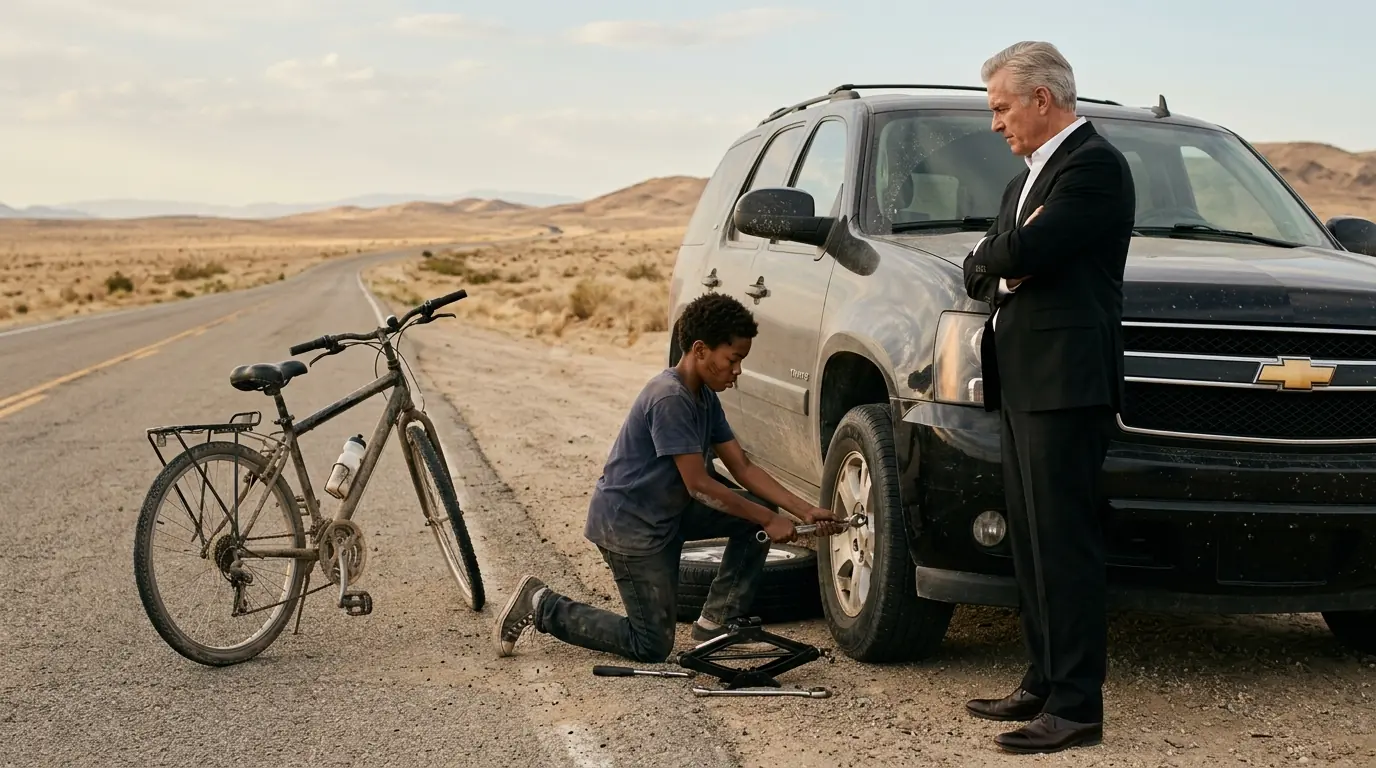
Malik was just about to push off on his bike when the man's voice stopped him again, this time softer, carrying something unexpected beneath the sharp city edge. A pause, a consideration.
"Hold up, kid." Malik glanced back, one eyebrow raised, the sunlight catching the faint sheen of sweat on his forehead. The man had straightened his tie, adjusted his cuffs, but the crispness of his suit couldn't hide the shift in his expression. It wasn't just polite now. It wasn't the wary, dismissive look Malik had seen when he first rolled up. It was curiosity tangled with calculation, as if the man was replaying everything that had just happened in his head and coming to a different conclusion than he expected.
Slowly, the man reached into the inside pocket of his blazer and pulled out a small, sleek business card. He held it between two fingers, the edges perfectly cut, the clean white surface catching the afternoon sun like glass. On the front, bold black letters stamped a name Malik didn't recognize, but would remember for the rest of his life.
The man took a step forward, extending the card toward Malik. "Take it," he said simply. Malik hesitated, the muscles in his shoulders stiff, unsure if this was some kind of joke or test. Business cards weren't for kids like him. Business cards belonged to folks with offices, clean shoes, bank accounts that didn't bounce. Slowly, cautiously, he reached out and plucked the card from the man's fingers. It was heavier than he expected, the material thick and smooth beneath his calloused thumb. His eyes skimmed over the name printed in sharp professional type: Nathaniel Carter, CEO, Orion Dynamics. Malik blinked, reading it again. The words felt strange and distant, like they belonged to another world entirely.
Nathaniel watched him closely, reading every flicker of confusion, skepticism, and guarded hope crossing the boy's face. He didn't rush. He let Malik process it. Let the silence stretch just enough before he spoke again.
"I wasn't supposed to be out here," Nathaniel admitted, glancing down the empty road, the faintest smile touching the corner of his mouth. Company trip, looking at potential land for a project, but I got turned around, ended up on this lovely stretch of nowhere. His tone was dry, but there was no condescension now, only quiet honesty.
Malik kept his eyes on the card, his thumb running along the edge. Orion Dynamics. It sounded fancy, important, definitely expensive.
"So, you're like some rich car guy?" Malik asked, tilting his head.
Nathaniel chuckled under his breath, the sound low and surprisingly genuine. "Tech, actually. Software, renewable energy, robotics." He paused, watching the way Malik's expression shifted at the last word. And yeah, we sell some expensive cars, too.
Malik's brows knitted together, curiosity sparking despite himself. The words "robotics" and "energy" weren't part of his everyday vocabulary, but they stirred something—the same part of him that loved taking apart broken radios, rewiring old lawnmower engines, figuring out how things ticked. Nathaniel caught that spark in the boy's eyes and nodded faintly, as if confirming his own quiet thought.
"You've got talent," he said, his voice level. "Matter of fact. Real talent. Not a lot of kids your age could have patched that tire the way you did. Definitely not with the tools you had."
Malik shrugged, uncomfortable with the compliment, but unable to hide the faint swell of pride beneath his chest. "Ain't much else to do around here," he mumbled. "You figure stuff out or you don't."
Nathaniel's eyes softened, his jaw tightening briefly in thought. "Listen, Malik," the man's voice dropped lower, more serious now. The polished corporate cadence giving way to something real. "I know what it's like growing up where nobody expects anything from you. Where folks look at you, your address, your skin, and that's all they see." His eyes flicked briefly to Malik's dark arms, the worn clothes, the old bike. He wasn't dancing around it. Malik respected that.
"But you—you got skill, you got potential, and I got resources." Malik's heart skipped slightly, cautious walls going up as fast as the flicker of hope tried to push through.
"What you mean, resources?"
Nathaniel gestured to the card still resting in Malik's hand. "That's not just a piece of paper. That's a door. Maybe not today. Maybe not tomorrow. But if you ever decide you're ready to walk through it, you call me. You tell me you want to learn more about engineering, about real machines." His lips twitched faintly, the kind that build futures.
Malik's eyes darted between the card and Nathaniel's face, suspicion wrestling with quiet disbelief. It felt too good, too clean, too unlikely. People like Nathaniel Carter didn't show up on dusty backroads handing out hope to kids like him. But here he was, and the card in his hand: solid, real.
"Folks don't usually mean what they say out here," Malik said carefully, watching him.
Nathaniel didn't flinch. "I'm not most folks."
For a long moment, neither spoke. The wind rustled through the trees, carrying the scent of pine and dry earth. A bird called somewhere in the distance, breaking the silence. Malik studied the man, weighing every word, every expression, every possibility that this was all just talk. But there was something steady in Nathaniel's eyes. Something he couldn't quite explain, but maybe, just maybe, believe.
Finally, Malik tucked the card into the back pocket of his jeans, eyes never leaving Nathaniel's. "We'll see," he said simply.
"We will," Nathaniel agreed. Malik turned to his bike again, gripping the handlebars, preparing to head off down the dirt road, the sun low on the horizon. As he pushed off, the card pressed lightly against his hip, a quiet reminder that for once, maybe the world wasn't completely done noticing him.
The days passed, slow and heavy, like they always did in that forgotten corner of Georgia. The red dirt road stretched quiet and empty outside Malik's house, the hum of cicadas filling the sticky air. Life went back to what it always was: the peeling walls of the sagging wooden house, the groan of the old floorboards, the creak of Malik's rusted bike as he rode back and forth from junkyards and roadside ditches, hunting for scraps. The business card stayed tucked away in the back pocket of his jeans, at first edges worn soft from his fingers tracing over it when no one was looking. Some nights he'd pull it out, hold it under the faint glow of the porch light, reading the bold letters over and over like they might change if he stared long enough. But reality, hard and familiar, always settled back in. People like Nathaniel Carter didn't come back. Not for kids like Malik. That was just how the world worked.
So when the sleek black SUV rolled up the dirt road four days later, kicking up dust and sunlight, Malik thought for sure he was seeing things. He stood frozen on the front steps, a rusted wrench still in his hand as the car came to a slow stop at the edge of the patchy yard. The engine purred low, too smooth for this neighborhood, too clean for this place that the world forgot.
The driver's side door opened, and there he was: Nathaniel Carter, crisp and composed, even in the sweltering heat, his tailored shirt sleeves rolled up, sunglasses in hand, that same calm, unreadable look in his eyes. But it wasn't just him. From the passenger side, a woman in smart business clothes stepped out, carrying a slim folder, her heels sinking slightly into the soft dirt.
Malik's heart skipped, confusion twisting tight in his chest as his grandmother stepped onto the porch behind him, wiping her hands on a faded dish towel, her sharp eyes narrowing at the scene. Nathaniel approached slowly, pausing by the broken wooden fence, his gaze scanning the small house, the crumbling porch, the patched-up roof. His eyes softened, but he didn't look away like most folks did. He looked straight at Malik.
"Told you I'd be back," Nathaniel said, his voice low, carrying across the space like it belonged there. Malik swallowed hard, his fingers tightening around the wrench. "Didn't figure you meant it," he admitted, wary, but unable to keep the hope from flickering in his voice.
Nathaniel nodded, his expression serious but not unkind. "Most people don't," he agreed. "But I'm not most people, and you're not most kids."
He glanced toward the house, then back to Malik's grandmother, offering a polite nod. "Mind if I come up?"
The old woman studied him for a long moment, sharp as barbed wire, the kind of look born from years of watching empty promises float by like dust in the wind. Finally, with a small, cautious gesture, she stepped aside. Nathaniel climbed the porch steps, the boards creaking faintly beneath his polished shoes. The woman with the folder followed, quiet, professional, observing everything.
Malik watched them both, his heart thutting loud in his ears, that card burning against his leg like a brand.
"I meant what I said," Nathaniel continued, pulling a folded sheet of paper from his pocket, setting it gently on the rickety table beside the old rocking chair. "I see potential when it hits me in the face, and trust me, kid, you've got it."
He opened the folder, sliding the papers out. "This. It's a start. Scholarship application for a technical prep program we sponsor in Atlanta. Covers tuition, equipment, even transportation. It's not charity, it's investment."
Malik's eyes widened, the words spinning in his head like loose gears. His grandmother stepped closer, squinting at the papers, her lips pressed thin, but her eyes betraying something fragile: cautious hope.
"And your family?" Nathaniel added, nodding toward the house, toward the patched roof and the worn steps.
"We got programs for that too. Repairs, assistance. You earned this, Malik. Not because I pity you, but because I seen your work. Because you got a mind that shouldn't be wasting away fixing junk in a yard."
The world tilted slightly under Malik's feet. For a second, all the doubts clawed their way up. The whispers in town, the closed doors, the looks that told him he didn't belong didn't matter. But standing there watching Nathaniel Carter, a man from another world entirely, offering more than words, offering a real way out, Malik let himself believe. Just a little.
"What's the catch?" Malik asked finally, voice low but steady.
Nathaniel smiled faintly, shaking his head. "The catch? You work hard. You show up. You prove every single person who ever doubted you dead wrong." He held Malik's gaze. No condescension. No false promises. "Think you can handle that?"
For the first time in a long while, Malik smiled. Small, quiet, but real. His grandmother's hand settled gently on his shoulder, her silence saying more than words ever could. Malik nodded once. The edges of the business card still pressed against his leg. The future suddenly closer than it had ever been. The dust stirred around them as the sun dipped lower, casting long shadows across the yard, across the road, across the stretch of forgotten land, where, for the first time, Malik dared to believe his dream didn't have to stay buried beneath broken engines and red dirt. Maybe, just maybe, the road ahead led somewhere after all.
On a dusty back road deep in the forgotten South, a 12-year-old black boy with a gift for fixing machines struggles to survive with his grandmother. As he rides his old bike along the empty road, he spots a broken-down SUV. Without hesitation, he steps in to help the man fix his car and rides off. What Malik doesn't know is that the man is a wealthy CEO and that small act will change his life forever.
The red dirt road stretched on and on, cutting through the southern countryside like a scar. The air was thick with heat and dust, making the pine trees along the roadside look faded, like ghosts of a better time. Wooden shacks leaned against the wind, their tin roofs rusted, their windows boarded up or cracked. Here, on the edge of forgotten America, the world didn't move fast. It barely moved at all. People around here kept to themselves. The few that passed by in beat-up trucks or old sedans gave quick, cautious looks to anything that didn't belong. And some things, some people, never really belonged, no matter how long they lived here. The black folks, like always, got the worst of it. Eyes followed them at the gas station. Whispers trailed them at the grocery store. Out here the lines were drawn, invisible, maybe, but clear as day if you knew where to look.
Down by the roadside, crouched beside a pile of rusted metal and broken appliances, was a boy the world barely noticed. His name was Malik. He was 12 years old, though most would guess younger on account of his small, skinny frame. His skin was dark, smooth, but hardened by the southern sun. His black hair curled tight to his head, and his big brown eyes held a sharpness most grown men didn't have. He wore a faded gray t-shirt, two sizes too big, and ripped jeans patched at the knees. His sneakers were mismatched, one blue, one brown, both barely holding together with frayed laces. Malik wasn't like the other kids from town. He didn't have video games or brand-new bikes. What he had was an old canvas bag full of tools, a sharp mind, and a stubborn dream.
He lived with his grandmother in a sagging wooden house at the end of a dirt path where the floorboards creaked louder than the television and the roof leaked when it rained. Most folks didn't come around their place unless it was to complain about the grass being too high or to look down their noses. The kids from the better streets called Malik names: Junkyard boy, grease monkey, sometimes worse. But Malik didn't care. Let them talk. Machines didn't care about the color of your skin. Machines didn't lie. They didn't cross the street when you walked by. They didn't look through you like you weren't there. Machines broke down, but they could be fixed. And fixing things, that was what Malik did best.
As he sorted through the pile of discarded metal, his hands worked fast and steady, pulling apart wires and gears, his fingers stained with oil and determination. In his mind, he wasn't standing on the side of a forgotten country road. He was building his future, one scrap at a time. He dreamed of opening his own repair shop one day, a real one with clean floors, shining tools, and his name up front in bold letters: Malik's Auto and Machine Repair. Not charity, not pity, just skill, pure and simple. But dreams were easy. Life out here wasn't. And Malik had no idea that just around the bend, fate was about to come rolling his way.
Inside a sleek, expensive SUV with a flat tire and a driver who thought he already knew everything about boys like Malik, the buzz of cicadas filled the heavy air as Malik pedaled his old bike along the dusty road. The dry red dirt crunching under the tires with every bump. The sun pressed down from above, turning the world into a faded postcard of heat and silence. He was heading home, bag of scrap metal strapped to the handlebars, when something up ahead made him slow down. At first, it was just a glint, a flash of chrome where it didn't belong. As he got closer, his eyes narrowed. Parked awkwardly along the side of the road was a sleek black SUV, the kind of car that didn't belong anywhere near this part of town. The sunlight gleamed off its polished hood, the tinted windows reflecting nothing but trees and sky. Malik's eyes dropped lower, spotting the problem immediately: a flat tire, rear passenger side sagging under the weight of the expensive machine.
For a second, he almost kept riding. Fancy car, city folks, not his business, but curiosity tugged at him stronger than caution. And then he saw the man: tall, broad-shouldered, dressed in a crisp gray suit that looked painfully out of place on this back road. The man stood near the front of the SUV, phone in hand, pacing in short, frustrated steps. His face was sharp, strong jaw, lines of stress carved into his skin like they'd been there a long time. His neatly combed brown hair glistened with sweat, though he was trying hard to keep that polished, controlled look city men always seem to have.
Malik slowed his bike to a stop, propping one foot on the ground, watching quietly. The man lifted his phone higher, frustration darkening his features. "Damn thing, no signal," he muttered, tapping the screen like that would magically summon a cell tower from the pines. His voice was tight, educated, with that sharp northern edge Malik had heard before, the kind that made folks from down here feel small without them even saying much. Malik cleared his throat lightly and stepped closer, still holding the handlebars. "Flat tire," he offered simply, eyes flicking to the SUV and back to the man.
The man turned, startled for half a second before his expression hardened into something colder, measured, guarded. His eyes swept Malik head to toe: the old beat-up bike, the bag of junk strapped across the handlebars, the faded torn clothes, the dark skin. Malik knew that look. He'd seen it his whole life. It wasn't fear exactly. It was dismissal, suspicion dressed up in expensive cologne and a Rolex. "I can see that," the man replied, voice clipped, eyes narrowing. He took a step toward the SUV, angling his body between Malik and the car, subtle but clear. "Stay back."
Malik shrugged, not moving. "Ain't no cell service out here," he added, glancing around at the endless stretch of trees. "You'll be waiting a long while for a tow truck." The man exhaled sharply, eyes flicking to his phone again, as if hoping it might prove Malik wrong. It didn't. The little no-service icon stared back at him, indifferent.
For a moment, neither spoke. The road was quiet except for the cicadas and the distant creek of a porch swing somewhere in the trees. Malik's gaze drifted back to the flat tire, calculating it was a clean puncture. Small, but enough to leave him stranded. Expensive car, nice rims, but the man clearly didn't know a lug wrench from a crowbar.
"I can fix it," Malik offered, voice calm, steady. The man's eyes snapped back to him, skeptical, his lips pressed into a thin line as he studied the boy again. "I don't think so," he said coolly, the unspoken words hanging thick in the air. "You fix my car out here? Not likely." Malik felt his jaw tighten. He wasn't surprised, but the sting still landed. His fingers flexed on the handlebars, grease-stained and rough from years of tinkering with junk. People always looked at him that way, like he didn't belong, like he wasn't capable.
"Suit yourself," Malik replied, voice dry as the dirt beneath them. He pushed his bike forward, slowly rolling past the SUV. But as he passed, he let his eyes linger on the tire, then the sleek, unfamiliar logos on the car's grill. It wasn't just expensive, it was top of the line, way too fancy for these roads. He was barely a few feet ahead when the man's voice called after him, reluctant, clipped with pride, but tinged with frustration.
"Wait." Malik stopped, turning slightly, one brow raised. The man sighed, glancing at his useless phone, then back at Malik. "You really know how to fix it?" Malik didn't smile. He didn't need to. His eyes said enough.
"I know machines," he replied simply, walking his bike back toward the SUV.
The man hesitated for a breath, then stepped aside, hands on his hips, watching like a hawk. "Don't scratch the rims," he warned under his breath.
Malik crouched by the tire, already pulling tools from the worn canvas bag strapped to his bike. They weren't shiny or new. Most were rusty, salvaged from old junk piles, but they worked. His hands moved with quiet confidence, fingers nimble as he loosened bolts and inspected the damage. Above him, the man hovered, arms crossed, eyes darting between Malik and the car like he was still deciding whether to trust him or chase him off. Malik ignored him. Let the man doubt. Let him assume. Malik had done this a hundred times. Maybe not on a fancy car like this, but a tire was a tire.
As Malik worked, his mind wandered for a moment. Who was this guy? What was someone like him doing way out here? No tourists came this way. No business folks either. Malik's eyes flicked to the driver's door. The window rolled down just enough to reveal a sleek leather briefcase sitting on the passenger seat, a silver logo shining faintly in the sunlight. The man caught Malik's glance and stiffened, his posture tightening.
"Don't get any ideas," he warned, voice low, almost defensive.
Malik didn't look up. "Ain't that kind of kid," he replied coolly, hand still working the tools. The man didn't respond, but his silence said enough. Within minutes, Malik had patched the puncture as best as possible with the tools he had, enough to get the car moving enough to prove his point. He straightened, wiping his hands on his jeans, eyes meeting the man's.
"Should hold till you find a real repair shop," Malik said, voice even. "Ain't pretty, but it'll get you down the road."
The man looked from Malik to the tire, then back again. His eyes softened just a fraction as the realization settled in. Maybe this kid wasn't what he expected after all. The man crouched down beside the SUV, his shadow stretching long across the sunbaked dirt as he examined the patched tire. He ran his fingers along the edge, inspecting Malik's work with the same sharp critical gaze he probably used in boardrooms and high-rise meetings. Malik stood nearby, arms crossed over his chest, tools dangling loosely from his hand, watching silently.
The boy's face was unreadable, but his eyes, dark, steady, unwavering, held a quiet confidence that unsettled the man more than he cared to admit. It wasn't supposed to be like this. A 12-year-old barefoot mechanic with mismatched shoes and oil-stained fingers fixing a six-figure car in the middle of nowhere.
"How… How do you even know how to do that?" he asked finally, his voice carrying that same tight, skeptical edge, though softer now, curiosity creeping in where dismissal had been.
Malik shrugged one shoulder, casually wiping his hands on the back of his jeans. "Ain't hard, just machines. They tell you what’s wrong if you listen close enough." His eyes flicked toward the SUV with the faintest hint of a smile. "This one? She was crying for help before you even got stuck."
The man huffed, a short, humorless breath escaping him. He glanced down the long stretch of empty road, then back at Malik.
"You live around here about two miles that way?"
Malik nodded toward the winding dirt path that disappeared into the trees. "With my grandma?" The man's eyes narrowed slightly, reading between the lines. No father mentioned, no mother, just a kid and an elderly woman out in a forgotten pocket of the South where the street signs were faded and opportunity dried up faster than the summer rain. He shoved his hands into the pockets of his slacks, rocking back on his heels.
So when the sleek black SUV rolled up the dirt road four days later, kicking up dust and sunlight, Malik thought for sure he was seeing things. He stood frozen on the front steps, a rusted wrench still in his hand as the car came to a slow stop at the edge of the patchy yard. The engine purred low, too smooth for this neighborhood, too clean for this place that the world forgot.
The driver's side door opened, and there he was: Nathaniel Carter, crisp and composed, even in the sweltering heat, his tailored shirt sleeves rolled up, sunglasses in hand, that same calm, unreadable look in his eyes. But it wasn't just him. From the passenger side, a woman in smart business clothes stepped out, carrying a slim folder, her heels sinking slightly into the soft dirt.
Malik's heart skipped, confusion twisting tight in his chest as his grandmother stepped onto the porch behind him, wiping her hands on a faded dish towel, her sharp eyes narrowing at the scene. Nathaniel approached slowly, pausing by the broken wooden fence, his gaze scanning the small house, the crumbling porch, the patched-up roof. His eyes softened, but he didn't look away like most folks did. He looked straight at Malik.
"Told you I'd be back," Nathaniel said, his voice low, carrying across the space like it belonged there. Malik swallowed hard, his fingers tightening around the wrench. "Didn't figure you meant it," he admitted, wary, but unable to keep the hope from flickering in his voice.
Nathaniel nodded, his expression serious but not unkind. "Most people don't," he agreed. "But I'm not most people, and you're not most kids."
He glanced toward the house, then back to Malik's grandmother, offering a polite nod. "Mind if I come up?"
The old woman studied him for a long moment, sharp as barbed wire, the kind of look born from years of watching empty promises float by like dust in the wind. Finally, with a small, cautious gesture, she stepped aside. Nathaniel climbed the porch steps, the boards creaking faintly beneath his polished shoes. The woman with the folder followed, quiet, professional, observing everything.
Malik watched them both, his heart thutting loud in his ears, that card burning against his leg like a brand.
"I meant what I said," Nathaniel continued, pulling a folded sheet of paper from his pocket, setting it gently on the rickety table beside the old rocking chair. "I see potential when it hits me in the face, and trust me, kid, you've got it."
He opened the folder, sliding the papers out. "This. It's a start. Scholarship application for a technical prep program we sponsor in Atlanta. Covers tuition, equipment, even transportation. It's not charity, it's investment."
Malik's eyes widened, the words spinning in his head like loose gears. His grandmother stepped closer, squinting at the papers, her lips pressed thin, but her eyes betraying something fragile: cautious hope.
"And your family?" Nathaniel added, nodding toward the house, toward the patched roof and the worn steps.
"We got programs for that too. Repairs, assistance. You earned this, Malik. Not because I pity you, but because I seen your work. Because you got a mind that shouldn't be wasting away fixing junk in a yard."
The world tilted slightly under Malik's feet. For a second, all the doubts clawed their way up. The whispers in town, the closed doors, the looks that told him he didn't belong didn't matter. But standing there watching Nathaniel Carter, a man from another world entirely, offering more than words, offering a real way out, Malik let himself believe. Just a little.
"What's the catch?" Malik asked finally, voice low but steady.
Nathaniel smiled faintly, shaking his head. "The catch? You work hard. You show up. You prove every single person who ever doubted you dead wrong." He held Malik's gaze. No condescension. No false promises. "Think you can handle that?"
For the first time in a long while, Malik smiled. Small, quiet, but real. His grandmother's hand settled gently on his shoulder, her silence saying more than words ever could. Malik nodded once. The edges of the business card still pressed against his leg. The future suddenly closer than it had ever been. The dust stirred around them as the sun dipped lower, casting long shadows across the yard, across the road, across the stretch of forgotten land, where, for the first time, Malik dared to believe his dream didn't have to stay buried beneath broken engines and red dirt. Maybe, just maybe, the road ahead led somewhere after all.