A man worth $80 billion, who could buy the entire city block, walks into a greasy diner wearing a thrift store jacket with a hole in the elbow. He sits in a torn vinyl booth and orders the cheapest thing on the menu: two eggs and a black coffee. The waitress, drowning in medical debt and working a double shift, looks at him not with disgust, but with a simple, tired kindness. But when a wealthy customer tries to humiliate the poor man, her reaction sets in motion a chain of events that will change their lives and the entire city forever. This isn't just a story about a rich man in disguise. It's about what happens when true character is finally seen.
The air in the 90th-floor boardroom of Marcus Global Holdings was so sterile it felt vacuum-sealed. Darius Marcus, a Black man whose net worth fluctuated with the global markets but always remained north of $80 billion, stared out the floor-to-ceiling window. Below him, Chicago sprawled like a circuit board, a complex map of lights and lives he owned but did not understand. His dark reflection in the glass was sharp and commanding, a silhouette of power.
"The optics are bad, Darius," Vincent Porter, his COO and lifelong rival, said, his voice smooth and sharp. "The Tribune column this morning called you the hermit king of Chicago. They're painting you as disconnected, a dragon sitting on a pile of gold, completely detached from the people who actually use our products and live in our buildings."
Darius didn't turn. "The Tribune is a tabloid, Vincent. I don't care about optics. I care about the Q4 projections, and the board cares about the stock price, which is tied to public perception."
"Vincent countered, leaning forward. "They see you in your tower, approving acquisitions and closures, but never seeing the faces of the people affected. This new urban renewal project, it's displacing thousands. We need positive PR. What do you suggest?"
"I go kiss a few babies at a shelter opening."
Darius scoffed, finally turning. His suit was a dark, severe gray, costing more than the average car, perfectly tailored to his broad shoulders.
Vincent smiled, a predator's glint in his eye. "No, something more immersive. I make you a wager, Darius. A challenge, if you will."
"I don't make wagers."
"Then consider it a vital piece of market research. For one week, seven days, you live like them. No access to your accounts, your cars, your name. We'll give you a room at a hostel in the warehouse district, a burner phone, $300 in cash. That's it. See if the hermit king can survive among the commoners."
Darius was about to dismiss the idea as absurd, a childish stunt. But he saw the look on Vincent's face, a look of smug certainty that he couldn't do it, that he was in fact too soft, too removed, too royal to handle reality. The challenge wasn't about PR. It was about Vincent testing his nerve.
"Fine," Darius said, his voice dangerously low. "One week. But when I return, Vincent, that urban renewal project's over-budget committee, you're leading it personally from the ground."
Vincent's smile faltered, but he nodded. "Done."
Two days later, Darius Marcus was gone. In his place was D, a man who looked like he'd been chewed up and spit out by the city. His disguise was painfully simple: a worn flannel shirt from a thrift store, jeans faded at the knees, and a pair of scuffed work boots. He hadn't shaved in two days, and the gray stubble peppered across his dark brown skin made him look less like a billionaire and more like a man one step away from sleeping on the subway. His usually meticulously groomed hair was now covered by a worn baseball cap.
The $300 was vanishing faster than he'd anticipated. The hostile room was a cramped, noisy box that smelled of mildew. For 48 hours, he had walked the streets, invisible. People didn't just ignore him; they looked through him. His power, his name, his sheer presence—it was all gone, stripped away by a cheap flannel shirt. He was just another Black man struggling to get by, someone the city had trained itself not to see. He was hungry. Not the polite, "I should schedule lunch" hunger he was used to, but a gnawing, hollow ache in his gut. He had $40 left to last him five more days.
He found himself standing outside the Silver Spoon Diner. It was a relic, a long narrow eatery wedged between a pawn shop and a laundromat. The sign flickered, the 'e' in Spoon buzzing erratically. The windows were steamy, hiding the inside. He smelled grease, stale coffee, and the sharp tang of industrial bleach. He pushed the door open. A small bell tinkled. The diner was real. It was everything his boardroom was not. The vinyl on the booths was cracked, revealing yellow foam. The floor was worn checkerboard tile. A long counter stretched down one side, where a few tired-looking men nursed coffee mugs. In the air was the sound of sizzling, the clatter of plates, and a low, static-filled radio playing a forgotten '80s song.
He slid into a booth by the window. The seat was cold. He felt a dozen eyes flick to him, assess him, and dismiss him. He was just another piece of the worn-out scenery.
A moment later, a waitress appeared. She looked exhausted. Her dark hair was pulled back in a severe ponytail, and there were faint purple smudges under her eyes, but her uniform, a light blue dress with a white apron, was impeccably clean. Her name tag, pinned slightly crookedly, read, "Maya."
"Coffee?" she asked. Her voice wasn't cheerful or bubbly; it was flat, professional, and utterly tired.
"Please, Black," D said. His own voice sounded rough to his ears.
She returned instantly, a heavy, chipped brown mug in one hand and a coffee pot in the other. She poured without a word, slid a plastic-wrapped menu onto the table, and moved on to the next booth. D watched her. She moved with an efficiency that was almost hypnotic: clearing plates, refilling coffees, taking an order from a construction crew—all with a minimum of motion and zero wasted energy.
He opened the menu. The prices were from another era. He scanned for the cheapest possible item that qualified as a meal. He found it under "All Day Basics": two eggs, any style, no sides. $3.50.
When Maya returned, her notepad ready, he didn't meet her eyes. He just pointed at the menu. "I'll just have the two eggs, sunny side up, and the coffee."
He braced himself. He expected a sigh, an eye roll, a look of pity or contempt. He was, after all, taking up a valuable booth for a $3.50 order. Maya simply wrote it down. "Coming right up," she said in that same flat, professional tone. She turned, clipped the order to the rotating wheel for the cook, and went back to the coffee pot.
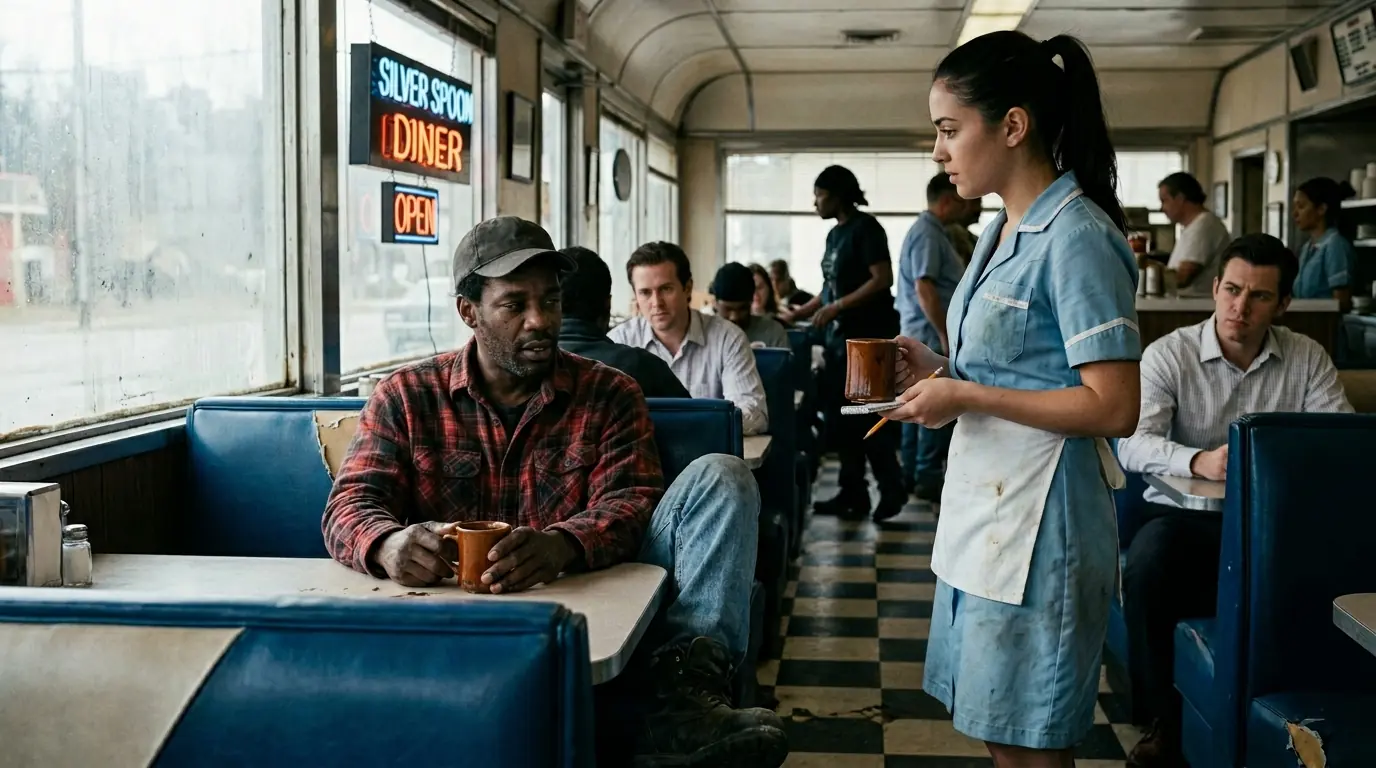 Darius Marcus watched her go. She hadn't judged him. She hadn't smirked. She hadn't done anything at all. She had simply treated him like a customer. In his current state, it felt like an act of profound dignity. He wrapped his cold hands around the warm, bitter coffee mug, and for the first time in a week, felt a strange, unfamiliar flicker of human warmth.
D sat nursing his coffee, waiting for his meager breakfast. The diner was filling up with the morning rush. The noise level rose—a symphony of clattering forks, gruff morning greetings, and the relentless sizzle from the kitchen. Maya moved through it all like a shark: all speed and efficiency. Her face a mask of neutral politeness.
The bell on the door tinkled again, but this time it was followed by a wave of loud, obnoxious laughter. A man and a woman strolled in, demanding attention. The man was in his late 30s, wearing a suit that was just a little too shiny and a watch that was clearly a status symbol. His hair was slicked back, and he carried himself with the unearned arrogance of a mid-level salesman who'd just closed a deal. The woman with him, Amber, was draped in labels; her perfume cut through the smell of bacon grease.
"Tyler, my man," the man boomed, spotting the diner's owner, Rick, a perpetually stressed man in his 50s behind the cash register. "Table for two, the best one you got."
Rick just sighed and pointed with his pen. "Morning, Tyler. Booth in the back is clean."
"No, we'll take this one," Tyler declared, gesturing to the booth directly across from D. He and Amber slid in, and Maya was there a second later, water glasses in hand.
"Hi, folks. What can I get you?"
Tyler didn't even look at her. He was busy trying to impress Amber.
"Yeah, yeah, coffee. And I want the lumberjack slam, extra bacon, and tell the cook not to burn it like last time."
She scribbled. "What did you want, babe?"
"The avocado toast."
"Pathetic."
"I want the healthy start omelette with a side of fruit," Amber said, snapping her menu shut.
"Right," Maya said, scribbling. "Two coffees, one lumberjack, extra bacon, one healthy start."
Just as she was about to turn away, the cook slapped a plate on the pass-through window. "Order up."
"Too sunny," Maya grabbed the plate. It was small, white, and held only two perfectly cooked, glistening, sunny-side-up eggs. She walked it over to D's table and set it down gently.
"Here you are, sir," she said.
D murmured, "Thank you."
It was this simple, quiet exchange that seemed to infuriate Tyler. He watched with a sneer as D picked up his fork.
"Seriously," Tyler said, his voice loud enough to carry across the diner.
D froze, fork halfway to the plate. Maya paused, her body tensing.
"Excuse me?" D asked.
"I said seriously," Tyler repeated, gesturing with his thumb. "You come into a diner, take up a whole booth, and order two eggs."
"Just two eggs? What, you saving up for the toast?" Amber giggled.
D felt a hot flush of shame and anger creep up his neck, warming his brown skin. In his world, insults were delivered with silken-voiced precision in boardrooms, not blared across a diner. He had no protocol for this.
"I just wanted some eggs," D said, his voice small.
"Yeah, well, some of us are here to eat a real breakfast, pal," Tyler sneered. "People like you are bad for business, just taking up space. Rick ought to have a minimum charge."
Before D could even process the humiliation, Maya stepped directly between the two booths. She wasn’t looking at D. Her gaze was locked firmly on Tyler.
"Sir," she said, her voice no longer flat. "It was cold. Cold and hard as steel. We don't have a minimum charge. All our customers are welcome here, regardless of what they order."
Tyler looked taken aback, then annoyed.
"Hey, I'm just saying it's pathetic."
"No," Maya said, her voice dropping lower, forcing Tyler and Amber to lean in to hear her. "What's pathetic is a grown man needing to insult a stranger to feel big in front of his date. He's a paying customer the same as you. Now, I've got your order. Is there anything else I can get for you?"
The way she said "anything else" made it clear it was a dismissal, not an offer. Tyler's face turned blotchy red. He was used to being the loudest person in the room.
"Why are you sticking up for him? He's a bum. Look at him."
"I'm sticking up for my customer," Maya retorted, unblinking. "And I'm asking you, as my other customer, to please be respectful of everyone else in this diner, or I can ask Rick to find you a different table, perhaps one by the kitchen door."
The threat was clear. Amber actually recoiled, looking embarrassed. Tyler, seeing he'd lost the power in the exchange, just scoffed and waved his hand.
"Whatever, fine. Just get me my coffee, sweetheart. And don't spit in it."
"I would never do that," Maya said, her professional mask sliding back into place. "Your coffee will be right out." She turned and walked away.
The entire interaction had taken less than 90 seconds. D stared down at his two eggs. He felt shaken. He, Darius Marcus, had just been defended by a waitress he'd never met. She hadn't done it for a tip. She clearly didn’t expect one from him. She hadn't done it because she knew him. She had done it because it was the right thing to do. It was a principle.
He watched her as she went back to work, pouring coffee for Tyler and Amber as if nothing had happened. She was efficient. She was tired. And in that moment, she was the most impressive person Darius Marcus had met in a decade.
He ate his eggs slowly. They were just eggs, but they tasted like a revelation. He looked at the waitress again. Really? Looked at her. Maya. He wouldn’t forget that name.
When he was done, he left $20 on the table for his $3.50 meal and $2 coffee. He walked out before she could see it, the little bell tinkling behind him. He had a lot to think about.
Darius's week on the streets was supposed to be a challenge of survival. It was rapidly becoming an education. He couldn't get the diner or the waitress out of his head. He returned the next day and the day after that. He became, for the first time in his life, a regular. He sat in the same booth, always ordering the same thing: black coffee. Sometimes he'd add a slice of dry toast. He was D, the quiet man in the corner, and he blended into the worn wallpaper. From this vantage point, he began to see the diner not just as a place to eat, a line item on a budget sheet, but as an organism.
Rick, the owner, was the stressed, anxious heart. Jake, the cook, was the fiery lungs. Maya was the circulatory system, moving everywhere, delivering what was needed, keeping everything alive.
Darius watched her. He saw her patience. He saw her help. Mr. Johnson, an elderly man with shaky hands, read the specials printed on the whiteboard. She didn’t just read them. She'd lean in close and say, "The meatloaf's real good today, Mr. Johnson. Jake made it fresh this morning, not from yesterday." He saw her handle a young mother whose toddler was having a full-blown tantrum, screaming and throwing crayons. Maya didn’t scowl. She walked over, knelt, and offered the child a small cup with a Maraschino cherry and a straw. "This is a special fireman's drink," she'd said, distracting the boy instantly. The mother looked at her with tears of gratitude.
But it was during the lulls, the quiet mid-afternoon hours, that D learned the most. He’d sit for hours on one coffee, and Maya, accepting him as part of the furniture, would work on other things.
He saw her behind the counter, her back to the diner with a massive, heavy textbook open. He squinted. It wasn't a community college pamphlet. It was advanced corporate finance.
One afternoon, he saw her on the payphone by the restrooms, her back rigid. He could only hear her side of the conversation, her voice low and tense.
"Mom, please don’t argue with me," she whispered, her hand cupped around the receiver. "You have to get the prescription refilled. No, I don’t care what Dr. Williams said about the cost, because we’ll figure it out. I’ll figure it out. No, my shifts are fine. Rick is giving me an extra one on Saturday. Yes, I’m eating. I’m fine."
She hung up the phone and leaned her forehead against the wall for a full 10 seconds. Her eyes were closed. D saw her take one deep, shuddering breath, composing herself. Then she pushed off the wall, smoothed her apron, and walked back out to the floor, her professional mask firmly in place.
"More coffee, Mr. Johnson?"
The pieces clicked into place. The exhaustion, the corporate finance textbook, the desperate need for extra shifts. She wasn’t just a waitress. She was a caregiver, a student, and a provider, all wrapped in one tired twenty-something body.
Later that same day, D was paying for his $2 coffee at the register. Rick was ringing him up. Maya was on her way out, her shift over. She had swapped her uniform for jeans and a hoodie, and a heavy backpack was slung over one shoulder.
"See you tomorrow, Rick," she said.
"Hold up, Maya," Rick said, finishing with D. "Got a minute?"
She sighed, shifting the weight of the backpack. "Yeah, what's up?"
Rick lowered his voice. "The bank loan—they denied it. The final appeal. They said our profit-to-debt ratio isn't viable. They're calling the note."
Maya's face went white. It was a paler, more terrified look than he'd seen on her yet.
"What? What does that mean? Calling the note?"
"It means we have 30 days," Rick said, his voice cracking. "30 days to pay the whole balloon payment. $50,000."
"$50,000?" Maya's voice was barely a squeak.
"Rick, that's it. It's this whole block," Rick said, gesturing vaguely. "Taxes have tripled. This new developer, this MGH company, has been buying up everything. They're squeezing us out. The bank knows the land is worth more than the diner. They'd rather we default so they can sell the lot to the developers."
D’s blood ran cold. MGH—Marcus Global Holdings. His urban renewal project. The diner wasn’t just failing. His own company was the one holding the gun to its head. The bank wasn’t an independent actor. Marcus Global likely owned the bank's debt, or was the developer colluding with the bank.
Rick rubbed his face. "I… I don't know what to do. I've got nothing left to leverage."
Maya stared at the floor, the heavy finance textbook in her bag seeming like a cruel joke. She looked up, her eyes hard. "No, we fight. We'll do a fundraiser—a 'Save the Silver Spoon' night. We'll call the Tribune."
"A fundraiser for $50,000?" Rick said, defeated. "We'd be lucky to make five."
"It's better than nothing, Rick. We have to try." She turned and practically ran out the door, the bell tinkling violently.
D stood by the register, his $2 coffee completely forgotten. He was no longer an observer. He was a participant. His experiment, his stupid, arrogant wager with Vincent, had just collided with reality. And the reality was Maya, her sick mother, her finance textbook, and the $50,000 note his own company was responsible for.
He left the diner, walking past the pawn shop and the laundromat. He was Darius Marcus, the hermit king, and he had just discovered that his kingdom was built on the ruins of places like the Silver Spoon and on the backs of people like Maya.
The next day, the atmosphere in the diner was thick with a toxic, silent dread. The regulars, like Mr. Johnson and the construction crew, could feel it. Rick wasn’t just stressed; he looked broken. Maya was working on pure vibrating nervous energy. She was still polite, still efficient, but her smile was brittle, painted on.
D sat in his usual booth, nursing his coffee. He felt like a spy, a traitor in their midst. He knew their fate, and he knew he was the architect of it. Around 11:00 a.m., the bell tinkled. This time, it wasn’t a customer. A man in a sharp $1,000 suit walked in. He was all sleek lines and polished surfaces—a stark modern blade in the soft, worn-out diner. He held a leather portfolio.
D recognized the type instantly. He employed thousands of them. This was a shark. The man ignored the “please wait to be seated” sign and walked directly to the counter where Rick was counting receipts.
"Richard Turner?" the man asked, his voice smooth but carrying implicit condescension.
"That's me," Rick said, looking up, wary.
"Scott Anderson," the man said, not offering a hand, but placing a business card on the counter. "I'm with the urban redevelopment division of Marcus Global Holdings."
D’s stomach tightened. This was one of Vincent’s men. Maya, who was refilling the sugar caddies, froze, her head snapped up.
"I think you know why I’m here," Anderson said, opening his portfolio. The bank's note. "As you know, they've called it."
"You… you bought our debt?" Rick stammered.
"We did," Anderson said with a dismissive little smile. "It simplifies things. Now you have two options. Option A: you pay the $50,000 plus our acquisition fees within—" He checked his watch, "48 hours. Or option B, which I strongly recommend." He slid a sheath of papers across the counter. "You sign this. It transfers the deed to MGH. We forgive the debt, and as a gesture of goodwill, we’ll give you $5,000 for relocation expenses. You’ll be out by the first of the month."
"$5,000?" Rick’s voice was a choked whisper. "This place is worth ten times that. My equipment alone…"
"Your equipment is 20 years old, Mr. Turner. Your goodwill is nonexistent. Your books are a disaster. We’re not buying your diner; we’re buying the dirt it sits on. The $5,000 is a gift."
"I take it," Rick said.
This was when Maya moved. She put the sugar caddies down with a sharp clack and walked right up to Anderson. D had seen her face down Tyler. This was different. This was not a bully. This was an executioner.
"You can't do this," she said, her voice shaking but full of fury.
Anderson finally turned his gaze to her. He looked her up and down—the apron, the sensible shoes, the ponytail—and dismissed her. "I don’t believe I’m speaking with you, sweetheart."
Her name is Maya, D said, his voice startling himself. It was quiet, but it cut through the diner.
Anderson, Rick, and Maya all turned to look at him. D, the bum in the corner booth.
Anderson raised a perfectly plucked eyebrow. "I beg your pardon?"
"I said her name is Maya," D repeated, standing up slowly. He suddenly felt the shabbiness of his clothes, the itch of his stubble against his dark skin.
"And she asked you a question," D continued. "How can you do this?"
Anderson let out a short, surprised laugh. "Who are you?"
"The local color," D said.
"Sit down, old man. This is business. It’s above your pay grade."
"He’s a customer," Maya snapped, her attention returning to Anderson. "And he’s right. This is Rick’s life. My life. Jake’s. You’re throwing people out on the street for… for what?"
"Another glass tower? Another bank? It’s called progress, little girl," Anderson said, his patience gone. "This entire block is being leveled. We’re building a new mixed-use commercial center. It’s going to bring real jobs, not this." He waved a hand at the diner. "This place is a relic. It’s time to let it die."
"It’s not a relic. It’s a home," Maya shot back. "Mr. Johnson has been eating here every day for 30 years. Those men," she pointed to the construction crew, "have nowhere else to go for a hot lunch they can afford. You’re not just tearing down a building; you’re tearing down a community."
"That is a very sweet, very naive sentiment," Anderson said, turning back to Rick. "But it doesn’t pay the bills. Rick, the clock is ticking. You have 48 hours to decide. The $5,000 offer is only good for today. If I walk out that door, it’s gone. Tomorrow, we just take the building."
Rick looked at the papers, his hands shaking. He looked at Maya, his eyes full of defeat. He looked at Jake, who was standing motionless in the kitchen window, a spatula in his hand.
"Get out," Rick whispered.
"What?" Anderson said.
"Get out of my diner," Rick said louder this time. He pushed the papers back across the counter. "Get out."
Anderson stared, genuinely shocked. He’d expected a broken man. He got one, but one with a last spark of defiance. He slowly, deliberately gathered his papers.
"Very well," Anderson said, his voice frigid. "You’ve made a terrible, terrible mistake. We will begin foreclosure proceedings immediately. You, your cook, and your little attack waitress here will be on the street by Monday. Have a nice day."
He turned on his heel and walked out, the bell tinkling mockingly behind him. The diner was dead silent.
Maya stood frozen, her chest heaving. Rick slumped onto a stool, put his head in his hands, and for the first time began to openly weep. D sat back down in his booth. He felt a cold, precise rage he hadn’t felt in years. This wasn’t business. This was a mugging. And Scott Anderson, his employee, had just threatened a good man and insulted the one person who had shown D any kindness. Vincent's urban renewal project wasn’t just bad optics. It was rotten to the core. His experiment was over. It was time for Darius Marcus to come back.
The rest of the day was a blur of quiet despair. The Silver Spoon Diner felt like a funeral home. Mr. Johnson came in, saw Rick’s face, and wordlessly ate his meatloaf. The construction crew was subdued. Maya moved like a ghost, her face pale, her textbook completely forgotten. D stayed. He couldn’t leave. He ordered another coffee and another. He watched Maya mechanically wipe down the counter, her eyes red and puffy.
He finally stood and walked over to her.
"Maya."
She looked up, startled.
"Oh, D. Sorry. You need something?"
"I heard what that man said about everything." She gave a bitter, sharp laugh.
"Yeah, well, progress, right? The little guys always get crushed." She slammed a salt shaker down.
"I… I just… I don’t know what to do. I read that textbook every night—corporate finance. I’m trying to learn their language, how to build something. And they just… they just take it with a piece of paper. What would you do?" D asked, his voice low. "What if you could do something? If you had, I don’t know, power, money, what would you do?"
Maya stopped wiping. She leaned on the counter, staring at the worn floor.
"I… I’d save this place. Not just for me, for Rick. He gave me a job when no one else would. When my mom first got sick, he let me study here. He’s… he’s a good man. He doesn’t deserve this." She looked around the diner. "It’s not just Rick. It’s Mr. Johnson. It’s Jake. He’s got two kids. This… this isn’t just a balance sheet. That’s what they don’t get. That’s what… that vulture Anderson doesn’t get. It’s a place—a real place."
Finally, she looked at him, her eyes searching his.
"What’s your dream, D? If you’re not just here, what would you do?"
The question caught him off guard. No one had asked him that in 30 years.
"I… I’m not sure," he said, and it was the most honest thing he’d said all week. "I think I’d want to build something that lasts, something that matters more than a stock ticker."
She gave him a small, sad smile. "Yeah, sounds nice."
Suddenly, the diner door swung open and the bell rang violently. In strode Tyler, the arrogant salesman from the other day. He was alone this time, and he looked annoyed.
Tyler stormed in, his face a mask of self-righteous fury.
"I knew it!" he shouted, pointing a finger at Maya. "Rick, I just spoke to my lawyer. You cannot refuse service to me. I’m filing a suit against this whole dump for—"
His voice died. He saw the men in suits. He saw Vincent Porter. He saw D—the bum now wearing a $20,000 suit, his dark skin glowing with power and authority—looking at him with the cold indifference of a god.
"Tyler," Darius said, his voice dangerously pleasant. "What a surprise."
Tyler froze. "I… who? What? You work for Precision Sales, don’t you?"
Darius asked, "Yes, I’m their top associate. Were…"
Darius corrected him. "Precision Sales has a $50 million annual contract supplying office equipment to Marcus Global’s entire North American portfolio, a contract which as of about thirty seconds ago is under full and immediate review."
Vincent Porter’s head snapped up. "Darius, we can’t. Their pricing is locked in."
"We can," Darius said. "I will not have my company associated with any firm that employs bullies. Tyler, you came in here time and again and harassed a man you believed was poor and defenseless. You insulted a woman who was just trying to do her job. Your behavior was, to use your own word, pathetic. You can tell your boss that Darius Marcus pulled the contract personally. You might want to update your resume."
Tyler's face was a grotesque mask of horror. He opened his mouth, but no sound came out. He just turned and stumbled back out the door, a broken man. The karma was instant. It was total.
Darius turned back to the room. He looked at Rick, who was now clutching the void-marked paper like a winning lottery ticket.
"Rick, your diner needs work," Darius said. "The booths are torn. The sign is flickering. My new division's second act will be to fund a full top-to-bottom renovation of the Silver Spoon. Whatever you need, no strings, no loan. Consider it back pay for the education you all gave me."
Rick just nodded, tears flowing freely. "Thank you, Mr. Marcus. Thank you."
Months later, the Silver Spoon Diner was gleaming. It had new vinyl booths in the same classic blue, a new non-flickering neon sign, and a polished floor, but the charm was the same. Jake was still in the kitchen. Rick was at the register laughing. Mr. Johnson was in his usual booth. The bell tinkled.
Darius Marcus walked in wearing a casual sweater, not a suit, his warm brown skin catching the afternoon light.
"Afternoon, Darius," Rick grinned.
"Rick," Darius nodded. He slid into his old booth. A moment later, Maya approached. She was dressed in a sharp blazer and dark jeans, holding a tablet. She looked transformed—confident, rested, and vibrant.
"You're late for our meeting," she said, a playful smile on her lips.
"I know," Darius said. "I was reviewing the Precision Sales fallout. Their stock dropped 30%. They fired Tyler."
"Good," Maya said. She sat across from him, opening her tablet. "Now, about the community project in the warehouse district. I’ve identified three businesses just like this one being squeezed by the new urban renewal group on that side of town."
"You’re enjoying this," he observed.
"I’m good at it," she corrected. "Mom’s new doctor is amazing, by the way."
"Thank you. I’m glad." There was a comfortable working silence.
Finally, Maya looked up from her tablet. "Can I… can I get you anything?"
Darius Marcus looked at his new colleague, his partner in this new venture. He looked at the diner he had almost destroyed and had instead saved. He smiled.
"You know," he said, "I’ll have two eggs, sunny side up, and a black coffee."
Maya's smile widened. She didn’t even write it down.
What they just saw wasn’t just about a rich man learning a lesson. It was about the incredible quiet power of dignity. Maya didn’t know a billionaire was watching. She defended D because it was the right thing to do. She stood up to that bully, Tyler, and the corporate vulture, Anderson—not because she thought she would win, but because her integrity was not for sale.
This story shows us that character isn’t who you are when the boss is watching. It’s who you are when you think no one is. True value isn’t in a bank account. It’s in how you treat the person who can do nothing for you.