They thought I was asleep, but I overheard everything: the plan, the lawyer, and the fake will. Thank God I had already transferred the $190 million. My name is Elellanor May Whitfield, and I have lived on this land in Texas for over eight decades. That afternoon, my eyes were closed, but my hearing has never failed me.
And what I heard in those next minutes burned itself into my mind so deep I could feel each word like a nail driven into old wood. "Old witch is asleep again; I wish she'd just die in her sleep," Melissa's voice said, sharp enough to cut glass and dripping with the kind of spite only someone who's never lifted a finger for you can muster. Daniel, my own flesh and blood, didn't even hesitate before adding his poison. "All she has to do is sign this paper and we can finally move her into a nursing home," he muttered. "The 199 million from selling the land will be ours."
There was a third voice I didn't recognize at first, smooth, calculated, and the kind of voice that always sounds like it's smiling even when it's not. At that moment, I didn't know his name, nor did I care. He was just another stranger in my living room whispering poison into my son's ear. "We'll make a new will," the stranger said in a low murmur. "We'll write it so she leaves everything to you both."
"She'll never notice because she won't read it carefully." Melissa gave a short, cruel laugh and said, "Oh, please, she thinks the internet is some kind of farm tool." "If she sees her name, she'll sign." I stayed perfectly still, rocking gently, the wood creaking just enough to mask my breathing. My eyes were barely open, just enough to see Melissa lean over the coffee table, flipping through a folder.
She pointed to a page and tapped her manicured nail against it. "Here's where she'll sign." "We'll keep the rest covered so she doesn't get confused." "All she has to do is put her name here, and by the time she realizes what she's done, it'll be too late." Daniel gave a low chuckle and said, "We can finally renovate the house in Houston and get the pool put in."
"You know, she's never even used a pool in her life." "Imagine dying without knowing what that's like." The stranger, who I later learned was their lawyer, smoothed his tie. "Once the sale goes through, we'll wire the funds directly into your account." "By then, she'll be settled into care, and you won't have to deal with her anymore."
Melissa's voice turned syrupy, almost sweet. "We'll make sure she has the cheapest room in the place." "There is no sense wasting money on comfort she won't appreciate." "Honestly, Dan, she's been living off us for too long." Living off them—that part made my fingers curl tightly under the quilt.
This was me, who paid off their mortgage when the bank was weeks away from taking the house. This was me, who ran the farm while Daniel chased one failed business venture after another. This was me, who put food on their table when Melissa's organic groceries were too expensive. Melissa's tone snapped back to sharp. "She's just a relic," she said coldly.
"This land is worth more without her on it." "Once it's sold, we can finally move on." The rocking chair creaked as I leaned back just slightly, letting the motion disguise the tension in my shoulders. I could hear the ice clink in their glasses as they toasted to their future, a future they thought was already theirs. The lawyer's voice came again, steady and smug.
"I've done this before, and she won't know until it's done." "And even then, what can she do?" "It'll be legal on paper." Melissa let out a satisfied sigh and said, "Perfect." "And then we can finally live the life we deserve."
"No more old woman cluttering up the living room with her ancient furniture and that ridiculous rocking chair." That rocking chair—my husband's hands had smoothed its arms over hours of patient work back before Melissa was even born. She saw it as clutter, but to me, it was the heart of this home. I kept my eyes closed, the picture of an old woman drifting in and out of sleep. But inside, I was as awake as I had ever been in my life.
Every word they spoke was a spark, and I felt the old fire inside me start to grow. Melissa leaned in close to Daniel, her perfume clawing in the warm air. "Tomorrow morning we do it." "She signs, we drive her to that place in Dallas, and by next week the land is on the market." Daniel clinked his glass against hers and said, "To our new life."
They laughed together, convinced they were already holding the winning hand. But the truth was, I had made my move long before this conversation, and they had no idea they were the ones already losing. When I was younger, before my hair turned silver and my hands carried the lines of every season on this land, I thought family loyalty meant something. I believed that if you poured your life into a place, if you worked until your back ached and your palms blistered, those who benefited from it would remember. I learned over time that some people remember only the parts that suit them and rewrite the rest to cast you as the villain.
The first time I saw the look in Daniel's eyes that told me he no longer saw me as his mother, but as an obstacle, was the year a large oil company came calling. A representative in a sharp suit and polished boots drove up our dirt road and made his pitch. He offered millions of dollars for the drilling rights to our ranch. I listened politely, asked my questions, and then told him no. It was not an easy decision, but I had seen what drilling had done to the land in other parts of Texas.
I saw the poisoned water, the dead cattle, and the way the soil never healed. This ranch wasn't just property; it was a living thing, and I wasn't going to sell it for them to bleed dry. Daniel did not see it that way. He stormed into my kitchen that evening, his face red and his voice raised so loud the neighbors could have heard. "You just ruined our chance to change our lives," he screamed.
"We could have been rich, Mom." He slammed his fist on the table, rattling the plates. "You're too stubborn to see you're standing in the way of our future." To him, I hadn't protected the land; I had destroyed his one shot at a better life. Then came the fight over the old oak tree.
It stood in the front yard, its branches so wide they shaded half the house in summer. My husband used to say it was older than Texas itself, a witness to everything we had been through. Melissa wanted it gone. She said the roots were ruining the lawn and that she needed more space to park the oversized SUV she'd convinced Daniel to buy. I told her no.
That tree had stood for over a century, and it would stand until nature decided otherwise. Her reaction was instant and venomous. "You're just being difficult because you hate me," she snapped. "You're stuck in the past, clinging to some ugly, old, useless thing just to spite me." I didn't bother explaining that my reasons had nothing to do with her and everything to do with preserving a piece of our history.
She wouldn't have heard me anyway. The worst insult, though, came wrapped in something that was supposed to be a gift. When my granddaughter turned five, I stayed up for weeks after chores were done, stitching her a doll from fabric I'd saved over the years. I used bits of her father's old shirts and pieces from my own dresses. It wasn't fancy, but it was made with love in every stitch.
When I handed it to her at the party, Melissa took one look, wrinkled her nose, and tossed it into the kitchen trash. "We don't need this kind of country junk cluttering the house," she said loudly, making sure the other parents heard. My granddaughter looked at me confused, as if she'd done something wrong by holding it. That one cut deep. They've always told people I never helped them.
But 15 years ago, I sold the only piece of jewelry I truly valued—my wedding ring. It was a simple gold band worn smooth by decades on my hand, and the last physical link I had to my late husband. I sold it quietly, without a word to anyone, and paid off the rest of the mortgage before the bank could take the house. I didn't do it for thanks, but hearing them later tell friends that Mom never really contributed was a kind of betrayal I hadn't expected. And then there was the restaurant idea.
Daniel was convinced he could turn a run-down building in town into a high-end steakhouse. He came to me asking to mortgage the land for the loan. I'd run the numbers myself, knew the margins in that business, and knew the debts he already had. It would have been an absolute disaster. When I told him no, he accused me of jealousy.
"You just don't want me to succeed," he spat. "You want me stuck here under your thumb forever." He didn't see that I was trying to save him from drowning before he even stepped into the water. Each of these moments, taken alone, might seem small—an argument here, an insult there. But over the years, they built a picture in their minds of me as the enemy.
I was not the woman who raised him, nor the grandmother who baked pies for birthdays and stayed up late sewing Halloween costumes. To them, I was just some stubborn, bitter old woman standing between them and the life they thought they deserved. What they never understood was that every "no" I ever gave them was a shield, not for me, but for them. And when they decided that shield was a wall to be torn down, they stopped seeing me as family at all. When my husband passed, the house went quiet in a way I had never known.
His boots no longer sat by the door. His laughter no longer filled the kitchen, and the evenings felt endless without the sound of him strumming his old guitar. Grief is a strange thing; it sharpens some senses and dulls others. In my case, it sharpened the one that had kept this family afloat for decades—my instinct for survival. Not long after the funeral, I went through our papers and deeds the same way I had done every January for years.
That was when I remembered the parcel of land in New Mexico. My husband had inherited it from his uncle, but we'd never done much with it. It was too far from home, too dry for farming, and not worth selling for peanuts. But times had changed. Energy companies were looking west for wind power, and the gusts in that part of New Mexico could knock a grown man off his feet.
I reached out quietly, with no one the wiser. A month later, I was sitting across from a man in a crisp suit from a wind energy firm. He made an offer I could hardly believe: $19 million for the rights to build their turbines there. I didn't blink. I shook his hand, signed the papers, and walked away knowing I had just bought myself a kind of freedom most people never taste.
But money in a single lump is like meat left out in the sun; it draws flies fast. So I split it. A portion went into a small organic farm cooperative in Vermont run by a friend from my college days. It was a place where the soil was rich and the people were richer in heart. Another portion went into stocks from companies I had researched for months, focusing on clean energy, battery technology, and sustainable agriculture.
The rest I sent quietly to a bank in Oregon, one with no ties to Texas, under accounts that would never make the local gossip rounds. I lived exactly as I always had, cooking my meals, tending the garden, and mending my clothes instead of buying new ones. I let them believe I was still barely scraping by. Their underestimation was my armor. Then came the decision that would be the final nail in their coffin, though they didn't know it yet.
One late autumn afternoon, I drove into town, went to the notary's office, and signed the transfer of this Texas land to the Natural Heritage Conservancy. It was an airtight gift with no takebacks and no loopholes. The conservancy would keep the land untouched, preserving the oak, the pasture, and the creek where Daniel used to fish when he was a boy. The paperwork was signed, stamped, sealed, and tucked safely away. I told no one—not my neighbors, not the preacher, not even the friends I still spoke to on the phone now and then.
The fewer who knew, the stronger the blow would be when the truth came out. For the next few years, I endured their sighs when I couldn't pay for new curtains. I endured their eye rolls when I brought vegetables from my garden instead of store-bought pies to Sunday dinners. I let Melissa brag to her friends that they'd inherit the whole place soon enough, smiling quietly when she thought I wasn't listening. I let Daniel talk about when they would sell the ranch as if I were already in the ground.
I never once corrected them. I never once hinted at what I had done because timing, I've learned, is everything. And if you want a knife to land deep, you have to wait until the other person leans in. The deed sat locked in my desk drawer beneath my husband's old fishing license and a bundle of letters he had written me in our courting days. Every so often, I would open that drawer and look at the official stamp, the conservancy's name in bold print, and I would feel that old oak tree standing a little taller in the yard.
They thought they were circling me like vultures, waiting for me to drop so they could feast. They didn't realize the feast had been packed up and sent out of state years ago, and all they'd be left with was the tablecloth. That night, the house felt colder, though the heater hummed in the background. I had settled into my creaky old rocking chair earlier in the evening, the one by the window that looked out onto the oak tree. But my back had begun to ache, so I moved to the couch in the living room, pulling a quilt over my legs.
I let my eyes droop just enough to give the impression I had drifted off. They came in through the kitchen door: Daniel, Melissa, and the man I had seen before but never spoken to directly. Later, I would learn his name was Carter, their lawyer. They didn't lower their voices much because they didn't think they had to. Melissa's tone was sharp, the kind that cuts through the quiet like glass breaking.
"Tomorrow, she signs this will," she said, flipping a folder open on the coffee table. I heard the papers slap against the wood. "Then I make the call to the nursing home." "By next week, your dear mother will be someone else's problem." Daniel's voice followed, low and eager.
"Once that's done, we sell the land, split the money, and finally live like we should have years ago." "No more of her nonsense, no more guilt trips." "We move forward like she never existed." I felt my stomach twist, not from shock, but from the cold confirmation of what I had known for a long time. They weren't waiting for me to pass; they were planning to shove me out of the way while I still breathed.
Melissa gave a little cruel laugh then, the kind I'd heard when she was showing off to her friends. I heard the faint clink of the cabinet door opening, but I kept my eyes shut. Whatever she was doing, I knew it would not be done with kindness. My hands tightened beneath the quilt until my knuckles ached. Carter cleared his throat then, his voice like a snake sliding through the room.
"We'll need her to sign in front of me so it looks legitimate." "She's old, so she won't read every page." "We'll slip in the clause that transfers the property to you both with no problem." Daniel chuckled and said, "She trusts me enough to sign anything." "She still thinks I'm that boy who used to fix the fence for her."
"She doesn't see how much I've grown past all this." I could almost hear the dismissive gesture he must have made toward the house, the land, and the life that had raised him. I stayed still, breathing slow, my eyelids lowered. Every word they spoke was like the scrape of a blade against stone—sharpening, ready to strike. But they thought I was asleep, harmless, and powerless.
Melissa stepped closer, and for a moment I felt her shadow cross my face. "Tomorrow," she said almost in a whisper, "we take everything and she won't even see it coming." But I did see it coming. I had seen it for years, and tomorrow they would be the ones blindsided. The morning sunlight streamed through the kitchen windows, spilling across the table where a neat stack of papers waited beside a pen.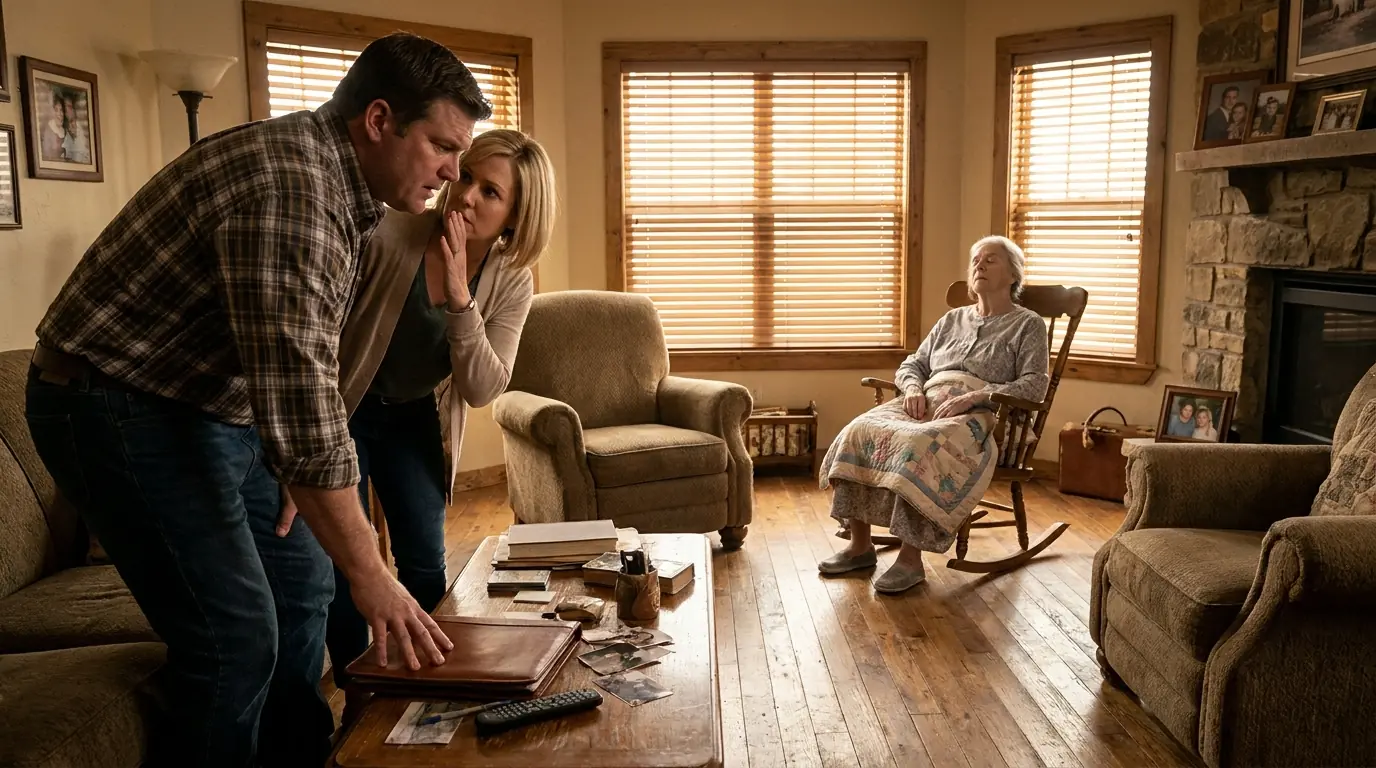
Melissa had gone out of her way to set the scene with a pot of coffee, a plate of biscuits, and a forced smile plastered on her face. Daniel stood behind her, arms crossed, looking more like a guard than a son. Carter, the lawyer, sat at the far end of the table with his briefcase open, his eyes darting between the three of us. He was clearly trying to appear casual, but his fingers drummed against the leather as if he were counting down the seconds until I signed. Melissa slid the papers toward me.
"It's simple, really," she said in that sugar-dipped voice she used when she wanted something. "Just a formality; sign here and we can all move on without any more stress." Daniel added, "It's for the best, Mom." "This way, everything's in order with no confusion later." I looked down at the thick stack, the bold black title across the top reading, "Last Will and Testament."
I let my eyes skim the first few lines, which contained nothing but the standard language. They knew I wouldn't bother to read through it in my old age. They thought they had me cornered—a feeble woman, too tired to argue, too trusting to suspect. I straightened in my chair, resting my hands on the table. "That's a nice offer," I said evenly, "but I'm afraid you're too late."
Melissa's smile faltered as she asked, "Too late for what?" I reached down into my worn leather bag and pulled out a single envelope, the kind that bore weight far beyond its paper. I laid it gently in the center of the table, then pushed it forward so Carter could see. He leaned in, his eyes narrowing at the seal and the official notary stamp. The moment he read the heading, the color drained from his face.
"This," I said, my voice steady, "is the signed, notarized deed of gift for the property." "As of last week, this land belongs to the Natural Heritage Conservancy." "It does not belong to me, and certainly not to you." Melissa's jaw dropped. Daniel blinked, then leaned forward as if getting closer would somehow change the words printed in bold.
Outside, a gust of wind rattled the windowpanes, as if the land itself had something to say about my decision. Melissa's fingers twitched on the table like she was trying to grab at something that had already slipped through her hands. "You... you gave it away?" Daniel's voice cracked. I allowed myself the smallest smile. "Yes, to something worth far more than greed."
Melissa's hands flew to the papers in front of me. "But the money..." she stammered. I cut in, "The money was never yours to take." "Long before this little family meeting, years before either of you thought to circle me like vultures, I had already made my own plans." "I sold a separate parcel of land years ago in New Mexico for $19 million."
"That money has been long invested, spread out far from Texas." "You were fighting over something that was never even here." Carter cleared his throat, gathering the fraudulent will and slipping it back into his briefcase without meeting my eyes. The man looked like he'd just been told the jury was back with a guilty verdict. Melissa's face was pale now, her hands clenching the edge of the table as she stammered, "You can't just..."
"I can," I said softly, "and I did." Daniel's face had gone red, a vein in his temple throbbing. For once, he didn't seem to have any words. I let the silence stretch until it became unbearable, then rose from my chair. "You should have been careful what you plotted in my house," I said, looking at each of them in turn.
"Because sometimes the person you think is asleep is wide awake." And with that, I tucked the envelope back into my bag and left them sitting there, surrounded by the bitter taste of a plan undone. By the next morning, the ripple had already turned into a tidal wave. Word spread fast in a small Texas town, but when that word carried a $19 million sting and the scent of betrayal, it spread like wildfire. The investors, the ones Daniel and Melissa had been bragging to for weeks, were the first to pull out.
One curt phone call from their representative was all it took. "Given recent developments," the voice on the line had said, "we will not be proceeding with the purchase or development; we wish you the best." It was the kind of "best" that meant you were completely finished. By noon, my phone, the one I rarely used, began to buzz with calls from people I hadn't spoken to in years. Some were neighbors who'd heard the gossip, while others were old friends who had seen my name in the headlines.
The Texas Chronicle ran the story first, splashing my photograph across the front page with the headline: "82-year-old woman outsmarts family's attempted land grab." The article laid it all out: the secret plan, the fake will, and the last-minute property transfer to the Natural Heritage Conservancy. They didn't hold back on naming Daniel and Melissa either, noting their attempt to defraud an elderly relative and their subsequent public humiliation. But what the paper didn't need to spell out, the internet gladly supplied. Someone leaked the security camera footage from my living room.
The grainy black and white video showed Melissa laughing cruelly, tossing my handmade gift into the trash. It caught her leaning over to Daniel and saying something that, even without audio, looked incredibly ugly. Then came the clear shot of her taking my wedding photograph from the cabinet and smashing it on the floor. Within hours, the clip was absolutely everywhere on Facebook, Instagram, and TikTok. People slowed it down, zoomed in, and added detailed captions to the footage.
The comment section filled with strangers defending me and tearing into her, calling her heartless, trash in heels, and the poster child for greed. The fallout came incredibly quick. At the Sunday service, Pastor Williams pulled me aside with a gentle, reassuring hand on my arm. "You should know," he said quietly, "they won't be allowed to participate in any church events for the time being due to too much unpleasantness." The grocery store where Melissa used to put her cart on credit told her point-blank they weren't extending it anymore.
At the coffee shop, the barista who had once fawned over Daniel pretended not to hear his order. Even the people they'd counted as friends completely stopped returning their calls. By the end of the week, the two of them were like ghosts in their own town—visible but entirely unwelcome. Every time they walked into a room, conversations stopped immediately. People stared, whispered, shook their heads, and through it all, I kept to my quiet routines.
I enjoyed my morning coffee on the porch and spent my evenings peacefully in the garden. I did not do this out of malice, but because I knew that the less I reacted, the more their shame would fester. It turned out you didn't need to raise your voice to ruin someone completely. Sometimes all you had to do was let the absolute truth be heard. A year can change a lot, but for Daniel and Melissa, it had been nothing but a slow, grinding collapse.
The tax investigation had started quietly, just a letter in the mail from the state revenue department. But when the auditors uncovered their creative bookkeeping and undeclared side deals, it snowballed rapidly. The government seized their house first, then the luxury SUV, and then the smaller sedan Melissa used for her errands. Bank accounts were frozen, and their credit cards were repeatedly declined. Even the cheap jewelry Melissa had bragged about was boxed up and taken away as non-essential assets.
They ended up in a dim, musty, one-room rental on the outskirts of town. It was the kind of place where the walls smelled heavily of mildew and the neighbors argued loud enough for the whole block to hear. But even that miserable living situation proved too much for them to sustain. Two months later, the landlord shoved a harsh eviction notice under their door for non-payment. By the time I saw them again, they were down to the clothes on their backs and a hand-painted cardboard sign that read, "Anything helps."
It was a gray Texas afternoon with rain coming down in steady sheets. I was driving back from the feed store when I passed the coffee shop. This was the same one where years ago Melissa had sat at the front window, bragging to anyone who'd listen about the soon-to-be million-dollar home she and Daniel were buying. Now they were huddled miserably under the awning, soaked completely to the bone. Daniel's hair was plastered to his forehead, and Melissa's mascara was running in dark streaks down her face.
Her eyes were fixed on the ground, but his darted up just long enough to meet mine. As I slowed the truck, I stepped out into the rain, my boots splashing in the shallow puddles as I walked toward them. Melissa's face twisted as pride and desperation warred openly in her expression. Reaching into my coat pocket, I pulled out a single $10 bill and held it out to her. She hesitated, but the look in my eyes told her it wasn't an offer she could safely refuse.
I placed it gently in her cold, wet hand. "Enough to buy something for dinner tonight," I said quietly, "and don't waste any more of Texas's oxygen." Her jaw tightened, but she said absolutely nothing back to me. Daniel shifted uncomfortably beside her, his shoulders hunched tight like a man trying to disappear completely. For a brief moment, I thought about every Sunday dinner, every Christmas morning, and every sacrifice that had led us to this rainy corner.
And then I realized they had chosen this difficult road one single lie at a time. I turned around and walked back toward my truck. That's when a man coming out of the coffee shop stopped me in my tracks. He was middle-aged with kind eyes and a knowing smile. "Excuse me, ma'am," he said, "aren't you the one who saved that conservation land last year?"
I met his gaze for a moment, then simply smiled. "Just doing my part," I said, and climbed back into the cab. As I drove away, the heavy rain blurred my rearview mirror. But I could still make out the two of them sitting there in silence, clutching that $10 bill as if it were the last thing they had left in the world. And maybe in that precise moment, it truly was.
The seasons rolled over Texas like a quilt being turned in the night. One morning I woke to find frost on the garden gate, and by afternoon the sun had warmed the soil enough for planting collard greens. Life, I realized, is a lot like a Texas winter—sometimes biting, sometimes gentle, but always moving forward whether you're ready or not. It had been nearly a year since that rainy afternoon outside the coffee shop. Daniel and Melissa had long since left town, chasing rumors of work in another state, and no one had seen them since.
People still whispered about what Elellanor did, and every so often a stranger would stop me in the hardware store to thank me for protecting the land. I genuinely liked the quiet now. My days were slow and full, spent taking morning walks past the fence line, tending the chickens, and spending afternoons reading on the porch swing. I let the wind comb through my hair as I rested. I thought my story was mostly written, but life, as I've learned, sometimes slips in an extra chapter when you least expect it.
It started on a random Tuesday at the feed store. I was bent over a stack of seed catalogs when I heard a distinctive voice behind me. It was deep and steady, the kind of voice that made you think of old country songs played on vinyl. "Excuse me, ma'am," it said, "do you know if this brand of feed is any good for layers?" I turned around and found myself looking into the bluest eyes I'd seen since my youth.
The man was tall, weathered by sun and wind, wearing a straw hat that looked older than some of the clerks in the store. He held a bag of chicken feed in one hand and a pair of work gloves in the other. "Depends," I said, straightening up completely. "How spoiled are your hens?" That clever remark made him laugh a warm, unhurried laugh that seemed to come from somewhere deep inside him.
"Spoiled enough to think they run the place," he said. His name was Henry Callahan. He'd grown up a county over, served 30 years as a park ranger, and had recently moved back to the area to take care of the old family homestead. We ended up talking about soil quality, predator fencing, and the best time to plant tomatoes. We chatted until the store clerk coughed politely to remind us other customers were waiting.
Over the next few weeks, I started seeing Henry in all sorts of places: the farmers market, the post office, even out by the conservation land I'd donated. He never pushed for conversation, but he always seemed genuinely glad to see me. We'd walk a few fence lines together, pointing out birds or wildflowers, and I found myself laughing more than I had in years. One afternoon, after we'd finished fixing a bit of his pasture fence, Henry poured us both some iced tea and leaned back in his chair. "Elellanor," he said, "people in town talk about you, you know."
"They do not talk in a bad way; they talk in the kind of way they talk about someone they truly respect." "But I don't think you get the whole story." "They don't just admire what you did; they admire how quietly and decisively you did it with no one seeing it coming." I looked at him for a long, quiet moment. "Henry, when people think you're too old to matter, it's the easiest thing in the world to watch them underestimate you."
"And when the time's right, you use that underestimation like a lever." He smiled at that, the kind of smile that said he understood not just the words, but the many years behind them. We kept spending time together, some weeks significantly more than others. He'd help me repair a loose shutter, and I'd bring over fresh bread or jars of peach preserves. Sometimes we didn't do anything at all except sit under the massive oak tree behind my house and watch the light fade over the fields.
One evening, as the sky turned that impossible shade of Texas lavender, Henry spoke softly. "You know, I thought I was done looking for someone to share my days with," he admitted. "I thought I'd just keep to myself, tend the land, and call it a life." He hesitated, rubbing the brim of his hat before continuing. "But you... you make the quiet feel fuller, not emptier."
It had been decades since anyone had spoken to me in that beautiful way. My chest felt incredibly warm, like the heat from a sunlit porch after the heavy wind dies down. "Henry," I said softly, "I think I know exactly what you mean." We didn't rush anything because soulmates don't need to. They know that the absolute best things are always worth the time.
Somewhere between planting marigolds in spring and gathering pecans in the fall, I realized my home wasn't just mine anymore. It was officially ours. The people in town noticed, of course, and whispers turned into knowing smiles when they saw us at the feed store together. Pastor Williams teased us gently after Sunday service. Even the kids in the 4-H club would wave at Henry and call him a playful nickname that made him blush but secretly pleased him.
One autumn afternoon, Henry took me for a scenic drive in his old Ford truck. We ended up by the conservation land, the very acres I'd fought so hard to protect. The grasses were high and golden in the late light, and a herd of white-tailed deer grazed quietly in the distance. "Elellanor," he said, "I know this land means the absolute world to you." "I just wanted to say it means something to me now, too."
"It is not just because it's beautiful, though it is, but because it's where I learned who you truly are." I felt my throat tighten instantly. "And who's that?" I asked. He turned to look at me, his eyes perfectly steady. "A woman who knows her worth and makes sure everyone else does too, whether they like it or not."
That night, back at my place, we sat in the kitchen with the kettle whistling softly behind us. I realized something important right then. My story wasn't just about what I'd lost or even what I'd successfully reclaimed. It was about the life I was still building—not alone anymore, but with someone who saw every part of me and stayed anyway. Henry didn't replace what had been taken from me over the years, and he didn't have to.
What he gave me was something entirely different: a reminder that love, in its truest form, isn't about rescuing or fixing. It's about standing side by side, even when the storms come. Sometimes when we walk the fence line at dusk, I catch him looking at me with that same quiet admiration he had the first day we met. And I think to myself, people spend their entire lives searching for the right time or the perfect person. But the truth is, you find them when you're busy tending your own garden, minding your own business, and living your truth.
That's exactly when they show up, and that's when you realize the story isn't over. It is not over by a long shot, nor does it underscore me. And that's the absolute truth of what happened here in Texas. I did not raise my voice, I did not beg, and I did not cry. I just listened, I remembered, and when the right time came, I acted.
People mistakenly think getting older means losing your power. They completely forget that time gives you significantly more than wrinkles; it gives you patience. And patience always gives you the sharpest, most devastating kind of revenge. If you've ever been underestimated, or if you've ever been called too old, too weak, or past your prime, remember this. Silence isn't surrender—it's a strategy.