She survived a broken engagement, a ruined reputation, and years of silence. Then a duke who had never needed anything needed her. Wiltshire, March 1814. The ledger was wrong again. Margaret Forsyth had known it before she opened it, had known it the way she knew when the roof above the East passage was considering a leak, or when Cook was approaching the end of her patience.
A particular quality of dread that lived in the chest and asked nothing of the mind. She sat at her father's desk, which was now her desk, and added the column for the third time and arrived at the same number, which was not the right number, and set down her pen. Outside, the elm trees were conducting their early March performance, just green enough to suggest hope, not green enough to justify it. Margaret had stopped trusting March two years ago. March was when the solicitor had arrived with the papers.
March was when she had learned that her father's affairs, managed with enormous charm and very little rigor over the course of thirty years, had left the Forsyth household carrying debts that would require a decade of careful work to retire. She had been twenty-two. Her sister Louisa had been sixteen. Their mother had taken to her room for six weeks and emerged, blinking, to find that Margaret had already spoken to the solicitor, the banker, the tenants, and Cook, and had arranged, without fanfare, for the household to continue. That had been the first lesson.
Competence, Margaret had discovered, was not rewarded with admiration; it was rewarded with more to be competent about. The second lesson had come eleven months later in the form of Mr. Charles Oldwick. She did not think about Mr. Oldwick often. She had trained herself out of it with the same methodical patience she applied to the ledgers, identifying the thought, refusing to follow it, and returning her attention to what was real, present, and required action. But March had a way of undoing that discipline.
March smelled like the particular afternoon he had come to call, the windows open to the first warm air of the year, the parlor full of watery light, and her mother flushed with something very like triumph. He had been handsome. He was still handsome, presumably, wherever he was. He had been kind and funny in a quiet way, and he had looked at Margaret as though she were the only person in any room he had ever entered. For four months, she had allowed herself, carefully and cautiously, to believe it.
Then his mother had come to call, alone, without him. It was a social visit, ostensibly. Tea was served, pleasantries were exchanged, and then Mrs. Oldwick spoke in a tone of such perfect courtesy that it took Margaret a full ten seconds to understand what was being said. She had explained that Charles was, of course, very fond of Miss Forsyth, very fond indeed, but that the family had certain hopes for his future. She noted that a young woman in Miss Forsyth's particular circumstances—she had paused there with a smile that meant everything the pause contained—perhaps ought to set her sights a little closer to home.
Margaret had poured more tea. She had said nothing that could be repeated unfavorably. She had waited until Mrs. Oldwick left, and then she had sat very still in the parlor for perhaps twenty minutes before going back to the ledgers. Charles had not come himself. He had written a letter of such elaborate, agonized apology that it managed to say almost nothing at all.
She had read it once, understood it completely, and fed it to the kitchen fire. The word that followed her afterward was "unsuitable." She did not know who had said it first, but by the time it reached her, it had already been repeated enough to have the quality of established fact. That had been the second lesson, and Margaret, who was nothing if not a quick study, had learned it thoroughly. The world had a place for her, and it was not the place she had briefly and foolishly imagined. She picked up her pen and returned to the ledger.
The letter from her mother arrived on a Tuesday, which was already unpromising. Her mother wrote on Tuesdays when she had something she knew Margaret would object to, reasoning, not incorrectly, that the middle of the week softened resistance. "My dear Margaret," it began, "Louisa is in excellent spirits and her complexion has quite recovered from the cold she took in January. Mrs. Holt says she has never seen a girl better suited to a London season, and I am inclined to agree, though, of course, you know best in these matters." This was her mother's method: to agree that Margaret knew best, and then to explain what Margaret would therefore certainly agree to.
"I have written to your aunt in Portman Street, and she is more than happy to have us for the season. It will cost very little. Louisa has her new white muslin, which wants only a ribbon, and I shall wear the gray silk, which is perfectly respectable. You will need something, of course, but I am sure you have something suitable already put by." Margaret read this twice. Her mother believed that wardrobes replenished themselves through a process of optimistic inattention.
"It is Louisa's best chance, Margaret," the letter continued, and here Margaret's objections began to dissolve because this was true. Louisa was twenty, with her mother's prettiness and, thank God, rather more of her father's sense. She was good-natured, warm, genuinely well-read, and she deserved a season. She deserved the chance Margaret had not properly had, had not properly taken, or perhaps had not been permitted to keep. Margaret folded the letter and looked out the window at the elm trees.
London, then. She would balance the ledger before she left, she would leave detailed instructions for the steward, she would pack one good evening dress and the gray wool that was almost respectable, and she would take Louisa to London for the season. This was not for herself; she was quite clear on that point. She was twenty-four with a damaged reputation, no fortune, and seven years of household management to recommend her, none of which were qualities that London particularly rewarded. She was going for Louisa.
She had learned her lessons, and she was not going to unlearn them. She first encountered the Duke of Windham at a concert she was not enjoying. It was the third week of the season. Louisa had been to four balls, two card evenings, and a breakfast that had inexplicably lasted until four in the afternoon, and she was flourishing. Margaret had attended everything, positioning herself in the reliable geography of the chaperone, near the wall within sight of her charge, holding a glass of something she never finished, and finding the whole enterprise less disagreeable than she'd expected.
The concert was at Lady Ashton's house in Grosvenor Square, which was large enough to absorb two hundred guests without effort. The musicians were accomplished, and the program was Handel, which Margaret genuinely liked. She had secured a chair slightly apart from the main cluster of chaperones, where she could hear the music without being required to discuss it, and had been quietly content for the better part of an hour. Then the door opened during the second movement, and there was a small rustle of attention—the particular rustle that meant someone significant had arrived. Margaret did not look up immediately.
She was listening to the oboe, which was doing something precise and lovely in the upper register, and she saw no reason to interrupt it for a late arrival. She heard the whispers around her: "Windham, that is Windham. I did not know he was in town." She registered, in the abstract way one registers distant weather, that this was apparently of consequence. She looked up when the oboe paused. He was taller than she'd expected from a duke, which was a foolish thought, since dukes came in all sizes and she had no reason to have expected anything in particular.
He was dark-haired, perhaps thirty or a little more, with the kind of face that looked as though it had made a decision some years ago to stop being surprised by things and had largely succeeded. He was scanning the room in a way that was not quite polite—not rude, exactly, but searching, with a specific quality of purpose that suggested he was looking for something rather than simply taking in the company. His gaze reached Margaret's corner and stopped. She was looking directly at him, which was also not quite polite, and she recognized that a fraction of a second too late to do anything about it. So she held his gaze, evenly and without particular expression, for the two seconds it took him to look away and take his seat.
The oboe resumed, and Margaret returned her attention to it. She did not think about him again until the interval, when Lady Ashton's daughter appeared at her elbow in a flutter of ivory silk. She said, entirely unprompted, "Is it not extraordinary that the Duke of Windham has come? He is almost never in town before May. Some say he prefers his estate, and some say," she lowered her voice conspiratorially, "that he finds the season tedious." "That makes two of us," Margaret said pleasantly.
Miss Ashton laughed, surprised. "You are very droll, Miss Forsyth." Margaret smiled and said nothing further, and Miss Ashton moved on, and the second half of the concert began. The Duke of Windham was four rows ahead and slightly to the left, and Margaret did not look at the back of his head at all, or not more than twice. The oboe did not deserve the competition. He found her at the interval of Lady Pemberton's rout nine days later, which was either coincidence or something that required more careful examination.
Margaret was standing near the window of the second drawing room, not hiding, precisely, but occupying a space that required some effort to reach between a large arrangement of hothouse flowers and a small table of untouched refreshments. Louisa was visible across the room, laughing at something a perfectly acceptable young man had said, which meant Margaret could breathe for five minutes. "Miss Forsyth." She turned around. He was closer than she'd expected.
People of his rank generally maintained a larger perimeter, enforced by the unconscious deference of everyone around them, but he had apparently walked through that perimeter without noticing it existed. "Your Grace," she said, keeping her voice level because there was no other sensible option. "You were at Lady Ashton's concert," he said, stating it as a fact rather than a question. "I was." "You were listening to the oboe."
She looked at him more carefully. "Most people were listening to the oboe, Your Grace. That was broadly the occasion." "Most people," he said, "were listening to each other." This was accurate, but Margaret did not say so because agreeing too readily with a man who had just introduced himself by commenting on her listening habits seemed imprudent. "Are you acquainted with my family, Your Grace? I confess I am not certain how..."
"I am not," he said. "I asked Lady Pemberton your name." A pause followed. Margaret processed this information with the care it deserved. He had asked Lady Pemberton her name, not Louisa's name—Louisa, who was in the first flush of her season and genuinely lovely and precisely the sort of girl dukes were supposed to notice. "How thorough of you," she said.
Something shifted at the corner of his mouth—not quite a smile, but the suggestion of one held in reserve. "You were the only person in the room who did not look up when I arrived." "I was listening to the oboe." "Yes," he said, "that is why I asked." Margaret studied him carefully.
He was perfectly composed, possessing the practiced ease of a man who had been the most important person in every room he'd entered since the age of probably twelve. But there was something underneath it that was neither performance nor condescension; he was genuinely curious about her. She could not quite account for it, and things she could not account for made her cautious. "I am here as a chaperone, Your Grace," she said. "My sister Louisa is making her come out this season. She is the pretty one by the fireplace speaking to the young man in the blue coat."
"I see her," he said without looking. "She is also considerably better company than I am," Margaret said. "She laughs at things because she finds them funny, not because the situation requires it. She is genuinely good, and I recommend her to your attention." "Miss Forsyth," he said, and something about the way he said it—not unkindly but with precision, as though her name were a thing he was learning the weight of—made her stop. "I did not come to this window to be redirected."
The hothouse flowers were very fragrant. The noise of the rout pressed in around them, two hundred people and their attendant ambitions, and Margaret was acutely aware that anyone looking toward this window would see her speaking privately with the Duke of Windham. This was exactly the kind of thing that got noticed, discussed, and distorted. "I am aware of that," she said. "I am also aware that I am a woman of no particular fortune or standing who has already had one public disappointment in the matter of a gentleman's attention. You will forgive me if I am not in the habit of assuming the best."
He was quiet for a moment. "Who disappointed you?" "That is not a question I intend to answer." "No," he agreed, "I suppose it isn't." He looked at her directly, without the usual performance of not quite looking that men of his rank employed with women they found interesting. "Will you be at the Hartley ball on Thursday?"
"I expect so. Louisa has been promised a dance." "Then I will see you there, Miss Forsyth." He inclined his head correctly, showing the precise degree required by the difference in their positions, and walked back into the press of the rout. He was absorbed by it immediately because rooms rearranged themselves around him without his appearing to notice. Margaret stood by the hothouse flowers for a moment longer than she needed to.
Then she located Louisa across the room, confirmed that the young man in the blue coat was still behaving himself, and went to find somewhere to sit down. She did not think about the way he had said her name, refusing to do so. She had learned her lessons, and she was not going to unlearn them for a duke who had asked Lady Pemberton her name and then walked across a drawing room with the calm certainty of a man who had never been refused anything in his life. Although, she made herself stop right there.
The Hartley ball was everything a London ball in April aspired to be: overcrowded, overwarm, and possessed of a quartet that played with more enthusiasm than precision. Margaret arrived with Louisa and their mother, who had dressed for the occasion in the gray silk and a headdress of uncertain ambition. She had spent the carriage ride explaining that she had it on very good authority that Lord Hartley's nephew was not yet engaged. "He's not here for Lord Hartley's nephew," Margaret said. "One never knows," her mother said, with the optimism of a woman who had spent twenty years declining to know things that inconvenienced her.
Louisa caught Margaret's eye and did not smile because she was a person of tact as well as good nature. The ballroom was on the first floor, and Margaret took up her position near the east wall with the comfortable efficiency of someone who had mapped the available chaperone territory and made her selection. The musicians were attempting a cotillion, and the floor was already full. Louisa was collected almost immediately by a young Mr. Davenport, who had danced with her twice at the Pemberton rout and whose intentions, if not yet declared, were at least clearly directional.
Margaret watched the floor. She was good at this part—the watching, the assessment, the quiet calculation of who was dancing with whom and whether it signified. She had spent her childhood reading rooms and her adulthood reading ledgers. People were, in her experience, not entirely different. She did not look for him, or rather she looked for him in exactly the way she would look for any potentially complicating element of the evening.
She gave him the same attention she gave to the punch bowl's location relative to her mother, or the presence of Mrs. Oldwick should that lady appear. This was practical vigilance, nothing more. He appeared at her elbow at twenty minutes past ten o'clock. "Miss Forsyth." The name again landed with that particular weight.
She had noticed at the Pemberton rout that he said it differently than other people did. Most people said Miss Forsyth as a form of address, a social label, the verbal equivalent of a visiting card. He said it as though he was paying attention to it. "Your Grace." She did not turn around immediately. She finished observing the measure of the cotillion, confirmed that Louisa was in good hands, and then turned to face him.
"You did come, then." "I said I would." "Men frequently say things." "I am aware," he said. "I try not to be one of them." She studied him again because he consistently invited study and did not seem discomfited by it.
Most men of his rank were accustomed to being looked at but not examined, but the duke appeared to welcome the distinction. He was in dark evening clothes simply cut without the elaborate decoration some of his contemporaries favored. He was a man who had apparently decided that his own presence was sufficient ornament, which Margaret privately conceded was not an unreasonable assessment. "Are you going to ask me to dance?" she said. "Would you accept if I did?"
"No." "Why not?" She looked at him steadily. "Because I am here as a chaperone, and because dancing with a duke is precisely the sort of thing that becomes a topic of conversation, and because I do not want to be a topic of conversation." "But you already are one," he said. "You have been seen speaking with me twice; that is sufficient."
Margaret breathed once slowly. "Then the damage is done, and there is no need to compound it with a dance." "The damage," he repeated. Something crossed his face—not hurt, for he was too composed for that—but something that registered the word with more attention than she had expected. "Is that how you think of it?" "That is how the world thinks of it. My thinking is largely irrelevant to the outcome."
He was quiet for a moment. Around them, the cotillion spun, the candles guttered in the draft of the dancers' movement, and someone somewhere was laughing too loudly. "Will you walk with me?" he said. "There is a room beyond the card tables that is marginally less audible." "I cannot leave the ballroom."
"Louisa is with Davenport, who appears devoted. Your mother is in conversation with Lady Fitch, which will occupy her for at least half an hour. The card room is visible from the doors. You would be absent from this wall for perhaps ten minutes." She looked at him. "You have been watching us."
"I arrived twenty minutes ago," he said. "I have been learning the terrain." "Why?" He met her eyes. "Because I wanted to speak with you without an audience, and because I was fairly certain you would not make it easy, and because," he paused, the smallest pause, "I find that I would like to understand you, Miss Forsyth, and this wall is not conducive to it."
The musicians launched into a reel, and the volume increased accordingly. "Ten minutes," Margaret said, "and the doors remain in view." The room beyond the card tables was, as he had promised, quieter. It appeared to be a small library with three walls of books, two chairs, and a lamp. Someone had abandoned a glass of port on the mantelpiece.
Margaret stood near the door. The duke stood near the window, which was a respectful distance, and she gave him credit for it. "You said you were not in the habit of assuming the best," he said. "What happened?" "I told you I wouldn't answer that." "You did. I'm asking again."
He held her look steadily, not out of prurience, but out of a deeper need. "I'm asking because you are, quite deliberately and with considerable skill, telling me who you are before I can form my own opinion, and I would like to understand whether the story you are telling is the accurate one." Margaret was quiet for a moment as the distant reel played outside. "There was a man," she said. "He paid me a great deal of attention for four months. Then his mother explained to him that I was not suitable. He agreed with her, and the word followed me."
"What word?" "Unsuitable." He said nothing for a beat, then muttered, "He was a fool." "He was a son," Margaret said. "With a mother. It is not a category that requires particular intelligence to inhabit."
Something that was genuinely a smile appeared briefly, and she found that it changed the whole arrangement of his face. It made him look younger, less certain, and considerably more dangerous. "And now," he said, "when a man pays you attention, you assume the same outcome." "I assume a rational outcome based on available evidence." "I am not that man."
"You are a duke," she said. "He was the son of a comfortable country family. The logic that applied to him applies to you with rather more force, not less. Your mother's opinion of what constitutes suitable will not be more flexible than his; it will be more rigid." He looked at her for a long moment. "You have already decided how this ends."
"I have simply read the story before." She said it without rancor, not bitterly, just factually, the way she would state a column total. "I do not blame you for your interest, Your Grace. I am not, I hope, so without vanity as to be entirely surprised by it, but I am also not going to perform hope I do not feel, or permit an attachment to form that will reflect badly on us both when it comes to nothing." "When?" he said. "Yes."
"Not if." "No." He turned to look at the window, which showed him nothing but his own reflection and the room behind him. Margaret watched him—the line of his jaw and the deliberate stillness of his hands. He was, she thought, a man accustomed to being a certainty in other people's calculations.
Being placed firmly in the column of probable losses was something he had not expected. "I have been looking for you since November," he said to the window. She went very still. "I beg your pardon?" He turned back.
"I was in Wiltshire in November. My friend Cavendish has a house near Marlborough. There was a village, and I rode through it on a Thursday, I believe. There was a woman outside an apothecary shop arguing very quietly and with enormous precision with a man who appeared to be a solicitor." Margaret remembered this perfectly.
The solicitor had been attempting to charge her for a consultation she had not requested on a matter pertaining to a debt she had already settled. He possessed a confidence that suggested he believed she would not have read the relevant documents, but she had read them, and he had eventually agreed with her terms. "You were on a gray horse," she said before she could stop herself. Something in his face changed. "You saw me." "You rode past; I did not think anything of it."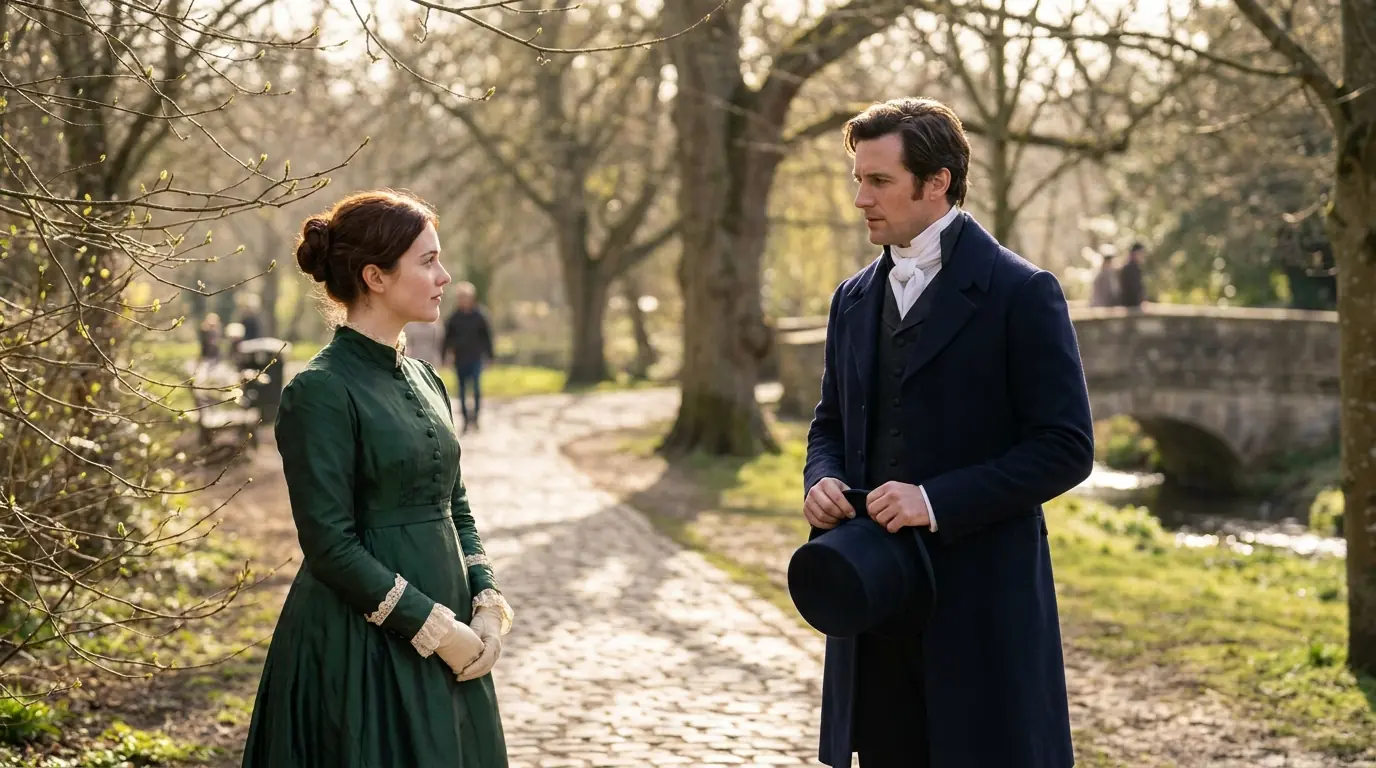
"I thought," he said carefully, "a great deal of it. I asked Cavendish who you were, but he didn't know. I asked the innkeeper in the village, and he knew the family name, but not yours. I wrote to the local magistrate on a pretext." He said this last with the equanimity of a man who understood it was slightly absurd and had made peace with that.
"I found that Miss Forsyth of Forsyth House, Wiltshire, would likely be in London for the spring season. So, I came to London in March, which I do not ordinarily do." The room was very quiet, and Margaret was acutely aware of her own breathing. "You came to London," she said slowly, "in March because of a woman you saw for thirty seconds outside an apothecary shop." "Because of a woman," he said, "who was winning an argument with a solicitor without raising her voice in a village where no one was watching her do it."
"Yes." She looked at him for a long moment. She was aware of the danger of this—the particular and specific danger of a highly flattering story told by an attractive man in a small library. The door was in sight, but so was his face, and his face was doing something she had not expected and could not quite categorize. "That is," she said carefully, "an extraordinary thing to tell a woman you have met twice."
"I am aware. I considered telling you something more gradual and sensible." He paused. "I decided against it on the grounds that you appear to be someone who can detect sensible fabrication at some distance." She almost laughed, stopping herself only barely. "Your Grace."
"James," he said. Then, as though catching himself, "My name is James. You don't have to use it. I simply..." He stopped. "I said I would not be one of those men who says things he doesn't mean. I am attempting to be consistent."
Margaret studied the middle distance for a moment. The sound of the reel penetrated faintly through the walls. Someone was clapping on the beat with more vigor than rhythm. "You have ten minutes," she said at last. "You have used seven of them."
"Then I will use the remaining three carefully." He looked at her directly. "I am not asking you for anything tonight. I am not asking you to believe in an outcome. I am asking only that you allow me, in whatever capacity your propriety and your caution will permit, to be someone you have actually met rather than the category you have assigned me to."
It was, she acknowledged privately, an intelligent thing to ask. It was also an intelligent way to ask it, calibrated to her precise resistance, which suggested he had listened to everything she'd said with unusual attention. "That is a reasonable request," she said. "Thank you." "Do not mistake it for more than it is."
"I won't," he said. And then, with the ghost of that dangerous smile, "Miss Forsyth." She turned and walked back toward the ballroom. She did not let herself think about how he had said it. He was careful after that—careful in a way that Margaret had not expected from a duke, which perhaps said more about her assumptions regarding dukes than about him.
He did not pursue her aggressively. He appeared at the Carrington breakfast, at the Fitch card evening, and at the concert in Hanover Square with a regularity that was clearly purposeful, but he did not engineer private conversation. He was correct, he was present, and he was patient in the way of someone who has made a decision and is waiting for the other party to make theirs. He danced with Louisa at the Carrington breakfast, which surprised Margaret so thoroughly that she forgot for a moment to be watchful.
It was a country dance—easy, cheerful, with nothing significant in the choosing—but he danced with her as though she were a person he was pleased to meet. He asked her questions she answered with obvious delight, making her laugh twice in the first minute. When the dance ended, he brought her back to Margaret with a small bow. "Your sister tells me you taught her to read music," he said. "She exaggerates my contribution," Margaret said.
"She says," he continued, "that you used to play for two hours every evening before." "Before?" The word had a precise weight in the Forsyth household: "before" meant before the solicitor, before the ledgers, and before everything that had rearranged itself. Margaret had not played in two years. The pianoforte in the Forsyth drawing room was slightly out of tune and served primarily as a surface on which to place correspondence.
"She talks too much," Margaret said lightly. Louisa, who had moved away with the cheerful tact of someone who understood exactly what she was doing, had moved out of earshot. "Do you miss it?" he asked. "One misses a great many things," she kept her tone easy. "One continues regardless."
He looked at her for a moment. "That is not an answer." "No," she agreed, "it isn't." He did not press it further. That was the thing she was beginning to understand about him: he pressed exactly as far as she permitted and stopped at the line she drew.
He did this not because he was indifferent to what lay beyond it, but because he was determined to wait until she moved the line herself. It was either very perceptive or very tactical, and she had not yet determined which. Both, possibly. It was Louisa who told her about Charles Oldwick.
They were dressing for the Sefton ball, Margaret in the green silk that was her best dress and her most reliable armor, and Louisa in white with roses at the hem that their mother had stitched on herself over four determined evenings. Louisa had been doing Margaret's hair, which she was better at, and had paused in a way that Margaret recognized as the prelude to something she was steeling herself to say. "Mr. Oldwick is in town," Louisa told the mirror. Margaret was quiet for a moment before replying, "I see."
"I saw him this morning in the park. He was with his cousin, and he asked after you." "Did he?" "He seemed," Louisa chose her words with the care of someone who loved her sister and was not entirely certain how those words would be received, "he seemed as though he regretted things." "He always seemed that way," Margaret said.
"He is a man of considerable feeling and limited resolve. They go together sometimes." Louisa resumed pinning her hair. In the mirror, her expression was the one she wore when she had more to say and was deciding whether to say it. "He may be at the Sefton ball." "Then I shall be civil," Margaret watched her own face in the glass. "I am always civil."
"I know." Louisa set in the last pin. "I just thought you should know before you arrived." "Thank you." She paused. "Louisa." "Yes?"
"The Duke of Windham will also likely be at the Sefton ball." A beat of silence passed between them. "Yes," Louisa said with extraordinary neutrality. "I expect he might." "I am aware of what you are doing when you move away from conversations."
Louisa met her eyes in the mirror. Her expression was entirely innocent in the way expressions are when their owner has decided that innocence is the safest available policy. "I am simply allowing you space to speak." "You are allowing him space to speak to me." "I have no opinion on the matter," Louisa said and smiled, and the matter was closed, though neither of them believed it truly was.
The Sefton ball was magnificent in the way that only houses with unlimited firewood could achieve in April. Every room was lit and warm, and every surface reflected candlelight—the kind of gathering that made London feel briefly like the place its inhabitants had always believed it to be. Charles Oldwick found Margaret in the first thirty minutes. She had seen him across the room before he reached her, registering his presence with the precise emotional weather of someone who has spent a year deciding how they feel about a thing and has arrived at something like peace, but does not entirely trust that peace under direct examination.
He was exactly as she remembered: a kind face and a good coat. He carried the particular quality of unhappiness that sits on people who have made one significant choice badly and have not yet found a way to stop noticing it. "Miss Forsyth," he said. "Mr. Oldwick." She was civil, having promised herself she would be, and she kept that promise.
"You are well, I hope." "Very well, and yourself?" This was the part where he was supposed to say he was well, the subject would change, and they would find their way to a comfortable nothing. Instead, he said, "No, actually, I'm not particularly well. I have not been well for some time."
Margaret looked at him. "Mr. Oldwick." "I know," he said quickly. "I know that I have no... I am not here to cause you difficulty. I only wanted to..." He stopped, for he was not, she remembered, a man who was fluent in the things that mattered.
"I wanted to say that I am sorry. Properly, not in a letter." "You were," she said gently, "very sorry in the letter." "The letter was cowardice. This is..." He looked at her with an honesty that was painful to observe because it was genuine and because it was simply too late. "I should not have let her decide for me."
Margaret held his look steadily. "No," she agreed, "you should not have." He absorbed this admission. "Is there..." He stopped again. "Is there any possibility at all of...?" "No," she said kindly but clearly. "I do not think there is."
He nodded, having expected this response but coming anyway because he needed to demonstrate something to himself. She respected that in the abstract. "Is it...?" He glanced across the room, and she knew without looking exactly where his glance landed. "Windham." She did not answer. "He was watching you," Charles said, "from the moment you entered."
Margaret said with great composure, "Good evening, Mr. Oldwick." He inclined his head. "Good evening, Miss Forsyth. I am glad you are well." He walked away, and she watched him go with a feeling that was neither grief nor relief, but something in between—the sensation of a chapter that had been suspended for a year arriving quietly at its last page.
She turned around. The Duke of Windham was not watching her now; he was in conversation with Lord Sefton across the room, looking composed and attentive. But as she turned, as though he had some peripheral awareness calibrated specifically to her movements, he glanced toward her. "Miss Forsyth." He didn't say it aloud from thirty feet away, but she heard it anyway in the particular register he had made her learn to listen for. She looked at him for a single moment, then looked away.
The Dowager Duchess of Windham arrived in London on the fourteenth of April, which Margaret knew because Louisa mentioned it. She had heard it from Miss Ashton, who had it from her mother, who moved through London's social information quickly and completely, touching everything. "People say she is formidable," Louisa said at breakfast. "People say that about any woman who knows her own mind," Margaret said and poured the tea.
"People say she has very particular views about who is suitable for Windham," Louisa looked at her plate. "Those were the exact words, I believe: very particular views about suitability." The word landed precisely where it always landed. Margaret set down the teapot. "That is," she said with a composure she had spent two years building to exactly this load-bearing specification, "a very predictable development."
"Margaret." "It changes nothing. There was nothing to change." Louisa looked at her with the expression she wore when she believed Margaret was being a particular kind of stupid but loved her too much to say so in plain words. "He has been to every event where we have been for five weeks." "He is a sociable man."
"He is famously not a sociable man. Lady Ashton says he attended more events this April than in the previous two seasons combined." "Lady Ashton's mother collects information with the thoroughness of a bailiff," Margaret said. "I do not necessarily credit every conclusion she draws from it." "And yet..." "And yet nothing."
Margaret rose and gathered the breakfast things because motion was useful and the conversation was becoming one she did not wish to finish. "He is a duke. His mother has very particular views about suitability. I have been down this road before, and I know exactly where it ends. I am not..." She stopped and set down the cups. "I am not going to let it end there again."
Louisa was quiet for a moment, then asked, "What if it doesn't end the same way?" "It always ends the same way." "Margaret, he rode to London in March for you." "He told you that?" "He told me," Louisa said simply, "when he danced with me at the Carrington breakfast. He told me that he found you in November, that he had been looking forward to the season ever since, and that he hoped I would think well of him."
She paused. "He asked my good opinion. He didn't have to do that." Margaret stood with the cups in her hands and said nothing. "He asked your good opinion of himself?" she said at last. "Yes." "Yes." She set the cups down and walked to the window.
It was the same instinct that took her to windows at home in Wiltshire—the habit of looking out when she needed to think clearly. The street below was its ordinary London self: a coal cart, two women with baskets, and a boy running for no visible reason with pure joy. "He should not have told you that," she said finally. "I think," Louisa said behind her, "that he wanted me to tell you."
She wished to call on you, if you are willing. What would you like me to say to that?" "I would like you to say what you actually think," he said, "not what is diplomatic." Margaret considered it for a moment. "I think she is a woman who has spent forty years being careful about the right things for the wrong reasons, or the wrong things for the right reasons, and the two have become difficult for her to separate." "I think she said what she said at Lady Fitch's because she was afraid, not because she was cruel, and there is a difference worth preserving."
She paused. "I think I would like to meet her again on those terms." He looked at her in a way she was beginning to recognize, showing the true feeling underneath that he didn't often permit to reach the surface. "You are," he said, "extremely good." "I am practical," she said.
"Your mother is a fixed point. I would rather find an honest accommodation with a fixed point than spend years in conflict with one." "Most people," he said, "would not have reached that conclusion this quickly." "Most people," she returned, "have not been balancing their household accounts against difficult fixed points since the age of twenty-two." This time he laughed fully, without his usual restraint.
It was the laugh of a man genuinely surprised by something who had decided to stop pretending he wasn't. It was a very good laugh—warm, direct, and completely without performance. "There is something else," he said when he had recovered. He reached into his coat and produced a slim, green-bound volume whose spine was legible from where she sat. She looked at it: a collection of keyboard sonatas by Clementi.
"Louisa told me," he said, "that the pianoforte at Forsyth House is slightly out of tune, that you haven't played in two years, and that you used to play for two hours every evening." Margaret looked at the book, then at him. "I cannot tune the pianoforte in Wiltshire from London," he said, "but when you go home—and you will go home because the estate needs you—I thought perhaps you might take something back with you."
He set the book on the low table between them. She looked at it for a long moment, taking note of the green cover, the name on the spine, and the absolute simplicity of the gesture. It was not diamonds or a grand declaration, but a small green book placed on a table by a man who had been paying close attention. "This is not," she said carefully, "an appropriate gift from an acquaintance." "No," he agreed.
She picked it up. "It is an appropriate gift from something else." "Yes." She turned it in her hands. The pages were new, unread, and crisp. She opened to the first sonata and looked at the notation, which was clear and well-printed, feeling the specific ache of something she thought she had closed forever. "Thank you," she said.
He said nothing. She looked up, and he was watching her with an open look—not the duke or the strategist, but just a man watching a woman hold a small green book and feel its weight. He was simply glad. The Dowager came on Thursday, arriving with one companion and without announcement, which was the prerogative of her rank. Margaret received her in the front parlor with tea and the composure she had relied upon as her most durable possession.
They were alone within five minutes. Margaret's mother had been encouraged gently to visit her friend in the next street, and Louisa had an arrangement with Miss Ashton that had been carefully planned. The Dowager sat down and looked around the room. She did not look with the assessing eye of someone cataloging deficiencies, but with a specific quality of attention that Margaret recognized as genuine curiosity. She looked at the furniture, the modest carpet, the small watercolor above the mantelpiece, and the writing desk in the corner with the papers on it.
She did not say a word about any of it. "My son tells me," she said at last, "that you understood why I said what I said at Lady Fitch's." "I thought I might," Margaret said. "He told you about his father." "He told me what he chose to tell me." The Dowager was quiet for a moment.
"He is not his father," she said. "I know that; I have known it for years. But knowing a thing and trusting it are, as you may have discovered, not always the same." She looked at Margaret with a frank examination. "I was afraid he would choose someone for the wrong reason—for softness, convenience, or the path of least difficulty. He has not chosen that."
"No," Margaret said. "I don't imagine I represent the path of least difficulty." A corner of the Dowager's mouth moved. "You represent, in fact, the path of most difficulty. You come with debts, an estate, a family, a damaged reputation, and no fortune, along with an entirely unsettling habit of saying exactly what you think at the precise moment one hopes you will say something easier." "Shall I apologize for that?"
"Absolutely not," she looked at her steadily. "I apologize," she said, "for what I said at Lady Fitch's. It was said in fear, not in considered judgment, and it caused you harm. I'm sorry for it." Margaret held her look securely. "I accept that," she said, "and I will tell you what I told your son: I think you are a woman who has been reconciling two different truths for a very long time, and that the reconciliation has not always succeeded. I would rather understand that than pretend it doesn't exist."
The Dowager was silent for a moment as something private passed through her face. "James said you were the cleverest woman he had met since his grandmother." "You mentioned that." "She would have liked you," the Dowager said. "She was not comfortable either." Margaret smiled a real smile that appeared less frequently but meant considerably more.
"I take that as a very high compliment." "It is offered as one." The Dowager set down her cup. "He has been alone for a long time," she said more quietly, "not for want of options, but for want of the right one. I see now that I was in some danger of being the obstacle to the very thing I claimed to want for him." "We are all in danger of that from time to time," Margaret said.
The Dowager looked at her for a long moment, then rose. Margaret rose too, and they were of equal height, which was somehow appropriate. "I will not interfere," the Dowager said simply, and Margaret believed her. "I would not ask that," Margaret said, "only that you mean the same thing in both rooms." A pause followed. "I will endeavor to."
They shook hands, not with gloved formality, but with the direct clasp of two women who understood each other and were deciding to proceed on that basis. The duke called the following morning and asked Margaret to walk with him in the park. It was a clear day—the kind April produces as an apology for March—with direct sunlight, a light wind, and trees completely committed to being green. They walked for some time without a particular agenda.
He told her about Windham Hall, the estate in Yorkshire, the north-facing library he preferred in summer, and the home farm that was beginning to justify itself. She told him about the drainage situation in the north field, which had been occupying her correspondence for a fortnight, and about the 73-year-old tenant in the east cottage who had mostly wrong but occasionally useful insights about crop rotation. He listened without waiting for his turn to speak. "You will go back in June," he said. "The estate needs me in June; the hay must be got in correctly or the winter is difficult."
"I know," he said without complaint. "I will come to Wiltshire in July if I may. I have things in the north to settle in June." She looked at him. "You are proposing a schedule." "I am proposing," he said with perfect equanimity, "that two people who have established obligations to their respective estates arrange to manage those obligations while also managing this." "This?" she asked.
"Yes." "You are very practical for a duke." "I learned from an impractical father," he said, "and I have recently been spending time with an extremely practical woman. It has been instructive." She smiled, and he absorbed the real expression with close attention. "I want to ask you something," he said, "and I want you to answer it honestly, not carefully."
"Those are not always different things." "With you, they sometimes are." She conceded this point. "Ask then." He stopped walking at the edge of the path near the elms where the light filtered through the leaves. He turned to face her, looking more like himself than he had at any point prior—less the duke, less the composed surface, and just a man of thirty-four who had made a definitive decision.
"Do you want this?" he asked. "Not whether it is possible, sensible, well-matched, or likely to succeed. Do you want it?" Margaret looked at him, thinking about November when she had won an argument no one was watching outside the apothecary shop. She thought about March, the wrong ledger, and the hopeful trees. She thought about five weeks of drawing rooms, the small library at the Hartley ball, and the green book of sonatas.
She thought about what it felt like to be decided on—not settled for or selected from available options, but decided on by someone who had crossed three counties to find her exactly as she was. He valued her for managing her debts, her staff, and her difficult tenants without performing a softness she didn't feel. "Yes," she said, "I want it." He looked at her for a moment, then said simply, "Margaret."
It was just her name without ceremony, the way he had said Miss Forsyth weeks ago, then differently, and now like this. It was something he had kept careful and was no longer required to guard. "James," she said, her utterance of his name being in its way everything. He asked her father's question formally and correctly to her mother two days later, which her mother received with a composure that lasted approximately four seconds before dissolving entirely.
He asked Margaret herself in the garden of her aunt's house in Portman Street in the early evening when the light was gentle on the new leaves. He did it with no audience and no ceremony, displaying the simple directness she understood as his most characteristic quality. She said yes without a hint of hesitation. She had been less careful for eleven days and found that she was still standing. They were married in September at the church closest to Forsyth House, which was small, old, and entirely full.
Louisa cried, their mother cried, and the Dowager Duchess sat in the front pew on the Windham side with a very particular kind of stillness. It was the stillness of a woman feeling something she has decided it is all right to feel. Charles Oldwick sent a very handsome gift and a note that said simply, "I am glad," and Margaret believed him. The north field drainage had been sorted by August, the hay had come in well, and the pianoforte had been tuned in July by a man from the village sent by a party in Yorkshire.
Margaret had sat down at it that evening and played for two hours the Clementi sonatas, which she knew from memory because the hands remember what the mind has set aside. She played with the window open to the summer evening and the elm trees outside fully, entirely, and unapologetically green. On the morning of the wedding, while Margaret was dressing and Louisa was doing her hair, their mother came into the room and stood in the doorway. "I always thought," her mother said at last, "that what you needed was someone who could see you."
Margaret met her eyes in the glass. "Yes." "I don't mean your qualities," her mother moved into the room and smoothed an invisible wrinkle from the sleeve of the dress. "I mean you—the whole of it. The ledgers, the north field, the way you are when you have been reading something difficult, and the way you still love the oboe. I thought it might not be possible, but I am very glad it turns out to have been."
Margaret took her mother's hand and held it for a moment without speaking. Then Louisa set in the last pin, and the light came through the window of Forsyth House for the last morning Margaret would spend in it as a Forsyth. It was precisely, completely enough. He was waiting for her at the church door—not inside, but directly at the door in the September morning, which had arranged itself into clear skies and pristine light.
"You're outside," she said. "I wanted to see you arrive," he said simply, without apology. She looked at him, and he looked at her. They were two careful people who had spent five weeks negotiating the precise terms of being less careful, and they had arrived here at a September morning and a small stone church, chosen deliberately by both of them. "Shall we go in?" she asked, and he offered his arm as she took it.