At 58, after 33 years of marriage, Ruth Macklin walked out of a courtroom with a cardboard box, a rusted pickup truck, and the deed to her father's gas station on a mountain road. It was the only asset her husband's lawyers hadn't bothered to fight for. Dennis kept the house, the savings, and the woman he'd been seeing for years. Ruth drove four hours into the Blue Ridge Mountains with $200 in her checking account.
The station had been closed since her father died. His reading glasses still sat on the counter beside a half-finished crossword puzzle. She'd come to sell the place and move on, but when she pried open the panel behind the register, she found something Earl Macklin had spent 40 years quietly building. It was something the entire valley remembered, even if his own daughter never knew.
The courtroom had smelled like floor polish and stale air. Ruth had sat in a wooden chair while a judge read settlement terms into a microphone that made his voice sound like it was coming through a tin can. Dennis wasn't there; he'd sent his attorney, a man named Felton, in a charcoal suit who kept checking his watch. Some men take your house, some men take your name, but Dennis Macklin took 33 years and called it a fair split.
Ruth signed where Felton pointed. Four signatures, two initials, and her marriage was a stack of documents in a manila folder. The attorney slid a single sheet across the table to present the asset schedule. The Briar Creek property, vehicles, retirement accounts, and investment portfolio remained with Mr. Macklin for the terms of the agreement. You retain the Ford pickup, personal effects, and the real property located at Route 11, Goshen County.
Goshen County
The real property was what they called her father's gas station, a building she hadn't seen in over a decade on a mountain road she barely remembered how to find. Dennis's lawyers had appraised it at $14,000 and let her keep it without argument, a rounding error on his balance sheet. Ruth picked up the cardboard box from under the table. Inside were the things Dennis had left on the kitchen counter for her to collect. A jewelry box her mother had given her, a photo album from Connie's childhood, and a coffee mug that said world's best mom with a chip on the rim were all she had left.
Thirty-three years of marriage and this is what fit in a single box. She walked to the parking lot and set the box in the bed of the truck. The Ford was a 2006 model with 160,000 miles, a cracked dashboard, and a passenger door that stuck. Dennis had bought it for the landscaper who quit after two weeks. It sat in their driveway for years until Ruth started using it for errands.
When the divorce was final, Dennis told his lawyer she could keep it. Ruth sat behind the wheel for a long time. She had nowhere to go. The house on Briar Creek was Dennis's now, officially, though it had stopped being hers long before the papers were signed. She had no apartment, no job, and no friends who weren't really Dennis's friends.
There was only $211 in a checking account that would soon have only her name on it. She pulled the deed from the folder on the passenger seat. The paper was old, creased from being stored in a file cabinet at the county clerk's office. Macklin Gas and Service, Route 11, Goshen County was deeded to Ruth Ann Macklin for the last will and testament of Earl Robert Macklin, deceased. Her father had left her the station when he died 12 years ago.
She'd driven down for the funeral, spent three days sorting through his things, then locked the door and never went back. Dennis said the property wasn't worth the taxes, and Ruth hadn't argued. She never argued with Dennis about money, about decisions, or about anything. That was the deal, though nobody ever said it out loud. For 33 years, Ruth simply agreed to his terms.
Route 11
Ruth turned the key in the ignition. The engine caught on the third try, coughing before settling into a rough idle. She pulled out of the courthouse parking lot and pointed the truck south toward the mountains. The drive took four hours.
Interstate gave way to two-lane highway, which gave way to county road, which gave way to Route 11, a ribbon of cracked asphalt that climbed into the Blue Ridge through tunnels of oak and hickory. The trees were just beginning to turn, with edges of gold and copper bleeding through the green. Ruth cracked the window and let the mountain air fill the cab. It smelled like damp leaves and wood smoke, and underneath that, something older, rock and soil and time.
She remembered this road from summers as a girl. Her mother would drop her at the station in June and pick her up in August. She spent two months with Earl, learning to pump gas and make change and check oil levels. He taught her to read a tire tread, to listen to an engine and hear what was wrong. She could change a fan belt by the time she was 12.
Dennis found that amusing when they first dated. Later, he found it embarrassing, a real estate developer's wife who knew her way around a carburetor. He never said she should stop, but he just stopped asking about it. Eventually she stopped doing it the way you stop doing anything when the person closest to you pretends it doesn't exist.
Route 11 climbed higher, the trees thickening around the road. Ruth passed a few houses, a church with a gravel parking lot, and a general store with a closed sign. Then the road curved around a granite outcrop, and there it was: Macklin Gas and Service. The station was smaller than she remembered, a single-story cinder block building with a flat roof and two gas pump islands out front.
The pumps were locked and rusted, their price displays frozen on numbers from another decade. Kudzu had crawled over the south wall and was reaching for the roof. The sign above the door, hand-painted by Earl himself, had faded to ghosts of letters. One of the front windows had a crack running corner to corner, sealed with duct tape that had long since dried and curled. But the building was standing and the walls were solid.
The Secret Chamber
The door, when Ruth tried it, was locked tight. She fished through the cardboard box until she found the ring of keys from the manila folder. The second key fit the front door, resisting before turning with a gritty click. Inside, the air was still and thick with dust. Late afternoon light filtered through the dirty windows, casting pale rectangles across the concrete floor.
A wooden counter ran along the back wall. Behind it, a pegboard hung with hooks that once held snack bags and road maps. The cash register, an old mechanical one with actual buttons, sat in the center of the counter, its drawer slightly open. Beside the register, exactly where he'd left them, sat Earl's wire-rimmed reading glasses, one temple slightly bent. Next to them, a folded newspaper opened to the crossword puzzle showed 27 across filled in with his careful block letters while 28 across was blank.
Ruth picked up the glasses and held them. The lenses were dusty but unbroken. She cleaned them with the hem of her shirt, a reflex from childhood when she used to hand them back to him after he'd misplaced them for the third time in an afternoon. She set them back on the counter and looked around.
The station was one large room with the counter dividing the front from a small stockroom in back. To the right, a door led to the repair bay, a two-car garage attached to the main building. To the left, a narrow staircase climbed to the apartment above, where Earl had lived for the last 20 years of his life after Ruth's mother passed. Ruth climbed the stairs to inspect the living quarters.
The apartment was cramped but intact. It had a bed with a bare mattress, a dresser, and a small kitchen with a two-burner stove and a refrigerator that hummed faintly when she plugged it in. The bathroom had a stand-up shower and a medicine cabinet still stocked with Earl's toothbrush and a bottle of aspirin that had expired eight years ago. She opened the single window above the bed.
Mountain air rushed in, pushing out the staleness. From up here, she could see Route 11 curving down the mountain, and beyond it, ridgelines layered in blue and gray, fading into the distance. Ruth sat on the mattress as the springs creaked under her weight. She was 58 years old, sitting in her dead father's apartment above a closed gas station on a road nobody used anymore, with $200 and a cardboard box and no plan.
She didn't cry because she'd done her crying weeks ago. She had wept alone in the guest bedroom of the house on Briar Creek while Dennis slept in the master suite with the door locked. The crying was finished. What she felt now was quieter than grief, emptier. She went back downstairs as the light was fading.
The station felt different in the dimness, less abandoned and more waiting. She walked behind the counter and ran her hand along its surface, feeling the grooves and scratches from decades of use. Her fingers found a seam in the wood paneling below the register, not a crack, but a seam, straight and deliberate. Ruth knelt down to get a closer look.
The panel was about two feet square, fitted flush against the wall but not nailed. She worked her fingernails into the edge and pulled it forward. It came away with a dry scrape, revealing a shallow cavity in the wall. Inside lay a leather journal, thick and soft-covered, held closed with a rubber band, alongside a metal lockbox and a bundle of envelopes bound with kitchen twine.
Ruth's hands trembled as she lifted the journal out. The leather was worn smooth at the edges, darkened where fingers had gripped it thousands of times. She slid off the rubber band and opened it to the first page. Earl's handwriting, small, neat, slanting slightly to the right, was dated September 14th, 1981.
The first entry stated that he lent Tom Hendricks $200 for the electric bill. His wife was due in March and they couldn't afford to lose heat. He told Tom to pay when he could, knowing he won't be able to, but noting that was all right. Ruth turned the page to find more records.
Another entry described fixing Carol Dunbar's transmission. He charged her $30 for parts and nothing for labor because she was raising three kids alone since Ray left. The oldest kid had helped Earl sweep the bay while Carol waited, and Earl noted he was a good, quiet kid. Page after page, the entries continued with names, amounts, and reasons.
Every loan, every free repair, and every bag of groceries slipped into someone's truck while they weren't looking was documented. Spanning decades, hundreds of entries in Earl's careful hand formed a secret ledger of kindness. Ruth sat on the floor behind the counter, reading by the last light coming through the windows. Earl had kept a running account of every family in the valley, tracking their needs rather than their debts.
He noted when children were born, when someone lost a job, and when a roof needed patching. He tracked the loans some people paid back and quietly forgave the ones they couldn't. She opened the lockbox next. Inside was $412 in small bills, a set of keys she didn't recognize, and a folded document that turned out to be the original deed to the property passed down from Earl's father.
The envelopes were harder to open, and her hands shook as she untied the twine. There were eight of them, each addressed in different handwriting, all to Earl. They were thank you notes from local families. One was from a woman named Linda whose family would have lost their farm without Earl's help. Another came from a man named Curtis who said Earl's $50 loan got him through the worst month of his life.
These simple letters, written on notebook paper and the backs of receipts, expressed gratitude for acts of generosity that Earl had never spoken about, not even to his own daughter. Ruth kept reading as the journal entries grew more recent, the handwriting shakier. The last quarter of the book covered the final years of Earl's life when the station was slowing down and fewer cars stopped on Route 11. But even then, Earl was still lending, still fixing, and still helping out.
The amounts got smaller, but the needs didn't decrease. Then Ruth found an entry dated three years before Earl died that contained her own name. Her father wrote that Ruth had called today and sounded tired. He noted that her husband was spending again on a new car and a new suit, always needing something new.
He wrote that she said she was fine, but he knew she was not fine. He could hear it in her voice, the way she talked around things instead of about them. He remarked that she got that from him, stubborn like her mother. He expressed a deep wish that she would come home.
He wished she would let him teach her to change oil again, drink strong coffee, and sit on the porch to watch the trucks go by. But he knew she wouldn't come back yet, maybe not ever. He concluded by writing that he just hoped she knew the door was open. Ruth closed the journal and pressed it against her chest.
The station was dark now, and through the window she could see stars appearing above the ridgeline. The mountain was utterly quiet with no traffic, no neighbors, and no television murmuring through walls. She sat on the floor of her father's gas station holding the record of a life lived in service to others. She understood for the first time that Earl Macklin hadn't just been pumping gas for 40 years.
He had been holding an entire valley together with his bare hands, one small kindness at a time, without saying a word to anyone. The station was dark, Ruth was alone, and the crossword puzzle on the counter was still unfinished. But somewhere between the last page of the journal and the first star above the ridge, a new thought took shape. She was not going to sell this place.
The First Morning
Ruth woke to birdsong and the smell of dust. Pale morning light came through the apartment window, landing on the bare mattress where she'd slept in her clothes. For a moment she didn't know where she was until the ceiling came into focus, water-stained and low. She remembered everything that had transpired.
She washed her face in the bathroom sink and brushed her teeth with her finger and some of Earl's expired toothpaste. In the small kitchen she found a can of coffee in the cabinet, still sealed with a plastic lid. She smelled it, finding it stale but not entirely ruined. The two-burner stove worked on the second try, so she heated water in a dented saucepan because there was no kettle.
She carried her coffee downstairs and walked the property. The repair bay was in better shape than the main building. Earl had built it himself in the seventies, poured the concrete floor, and hung the doors. It featured two bays, one with a hydraulic lift that was probably still functional.
His tools hung on a pegboard that covered the entire back wall, organized by size and type. Each one was carefully outlined in black marker so you'd know if something was missing. There were wrenches, sockets, screwdrivers, and pliers. The rubber grip on his favorite ratchet was worn smooth from use.
Everything was dusty but completely intact. Earl took care of his tools the way other men took care of their cars. Ruth ran her hand along the workbench until her fingers found a specific groove. She had carved it into the wood when she was nine, dragging a flathead screwdriver while Earl wasn't looking.
He had found it the next day and simply shook his head. He had told her that now the bench had character. In the corner of the bay stood a green metal filing cabinet, the heavy four-drawer kind. She tried the top drawer, but it was locked tight.
She went back to the lockbox and tried the keys she'd found. The smallest one, brass and flat, opened every single drawer. Inside were folders, dozens of them, organized alphabetically by family name. Each one contained handwritten notes in Earl's careful script.
These were follow-ups and progress reports on the people he'd helped over the years. The file for Tom Hendricks noted that he paid back $50 in June, and his baby girl was healthy at 7 pounds 4 ounces, named Rose after his mother. Earl added a note not to mention the rest of the debt. Carol Dunbar's folder stated that her oldest child got into community college, so Earl gave her $200 for books.
When she tried to refuse, he quietly left it in the glove box of her car. Jim Sutter's file noted that his roof held through the winter because Earl patched the south side himself in October. Jim didn't know, believing the landlord had finally fixed it. Ruth sat on a milk crate and read folder after folder.
Earl hadn't just lent money; he had tracked the lives of these families for decades. He checked in without them knowing, fixing things they couldn't afford to fix. A man who database-tracked his neighbors had spent his life making sure they didn't fall through the cracks. She was still reading when she heard tires on gravel.
Hank and Jesse
Through the bay door she saw an old Chevy truck pulling up to the station. A man climbed out, heavy-set and slow, wearing a plaid flannel shirt and a cap with a feed store logo. He stood in front of the building, hands on his hips, staring at the cracked windows and the kudzu-covered wall. Ruth stepped out of the bay to greet him.
"Morning," she called out. The man turned around. His face was deeply lined, sun-darkened with white stubble along his jaw. He squinted at her for a long moment before his expression changed. His eyes widened and he took off his cap in recognition.
He identified her as Earl's girl, Ruth Macklin, and introduced himself as Hank Dawson. He extended a rough, thick-fingered hand, explaining that he lived two miles down the mountain and played cards with her daddy every Thursday. Ruth remembered him bringing corn from his garden. Hank grinned and said he still did, though there was nobody left to bring it to.
He looked at the station, then back at Ruth, asking what brought her up here since no one had been around since Earl passed. Ruth considered how to answer, knowing she could have deflected with something polite and vague. Instead, she chose to tell the truth. She explained that her husband divorced her, kept the house, and left her with only this station.
Hank nodded slowly without offering empty sympathy or asking prying questions. He walked back to his truck and returned with a thermos and two ceramic mugs. He poured the coffee, telling her she'd need a good brew instead of whatever ancient can she found in Earl's cabinet. They sat on overturned buckets on the cracked concrete apron.
They drank Hank's coffee, which was strong and hot and better than anything Ruth had tasted in months. Ruth asked him to tell her about her father, specifically the things he never shared. Hank sipped his coffee, studying the mountains. He described Earl as a complicated man in a simple way who worked hard, kept his head down, and couldn't stand to see someone struggle.
Ruth mentioned finding his journal behind the counter detailing every loan and free repair. Hank shook his head and smiled, calling him a stubborn fool who never told a living soul what he was doing. Hank only knew because he caught Earl loading groceries into the Sutter family's truck at midnight, claiming he was just reorganizing inventory into their backseat.
Ruth laughed, which surprised her because she couldn't remember the last time she'd laughed so suddenly and unguardedly. Hank continued, stating that Earl never turned away a soul who needed help, believing it was cheaper than church and did more good. He noted that folks around the valley still talked about how their lights stayed on or their cars ran because of Earl.
Ruth asked why her father never told her any of this. Hank looked at her and explained that Earl didn't think it was anything special. He believed it was just what you did when you lived somewhere and had two hands and a set of wrenches. He didn't think it needed a name, a medal, or a conversation.
They sat in silence for a while as a truck passed on Route 11. The driver lifted two fingers from the steering wheel in a traditional mountain greeting. Hank quietly added that Earl Macklin died owing nothing to anyone and being owed by everyone, which was the richest a man could be.
Hank left mid-morning with a promise to come back the next day with lumber for the porch railing. Ruth spent the rest of the morning sweeping the main room and washing the windows with newspaper and vinegar. She scrubbed the counter until the wood grain showed through decades of grime. She unstacked the shelves behind the counter and wiped each one clean.
At noon, a woman Ruth didn't recognize pulled up in a minivan and left a casserole on the front step. The attached note simply read, "Welcome home, Earl's daughter." Mountain news traveled fast without any wires. By afternoon, three more people had stopped by the property.
An elderly man left a stack of firewood by the side of the building. A couple brought cleaning supplies in a plastic bin. A teenage girl dropped off a bag of groceries, waved shyly, and drove away before Ruth could thank her. Each one left the same message in different words: Earl helped us once, and we're glad you're here.
Ruth carried the groceries upstairs and put them away. She made a sandwich and ate it standing at the apartment window, looking down at the gas pumps. They were rusted and locked, meaning that getting them working again would cost money she didn't possess. But the repair bay was functional, the tools were all there, and she knew her way around an engine.
She went back downstairs and spent the afternoon testing the hydraulic lift and checking the air compressor. Her hands seamlessly remembered the weight of a socket wrench and the resistance of a rusted bolt. Late in the afternoon, she heard an engine struggling on the road. A white pickup truck limped toward the station, steam rising from under the hood.
It rolled to a stop 20 yards past the building, and a young man climbed out. He was maybe 23, lean and sunburned, wearing a gray T-shirt with grease stains on the front. His jeans were torn at the knee, and his boots were work-worn. He popped the hood and stared at the engine.
Ruth walked over and asked if it was the radiator. The young man looked up, explaining that the upper hose blew. He added that he had a spare hose in the bed but lacked tools. "I've got tools," Ruth said, nodding toward the repair bay. "Pull it in if it'll make it that far."
He looked at her, then at the station, showing the hesitation of a person used to being turned away. He offered to pay for the bay time, but Ruth insisted she didn't ask for money and told him to pull it in. His name was Jesse Rowan. He drove the truck into the bay and had the old hose off in six minutes.
Ruth found a replacement in Earl's stockroom that was close enough to work with a couple of extra clamps. She watched Jesse install it, noting that his hands moved with quick, precise confidence. She asked where he learned to wrench, and he explained that his grandmother's boyfriend had a shop in Boone where he spent his summers.
He added that he hadn't worked in a shop since because the last three places didn't work out. Ruth didn't ask why, as she could see enough in his face to understand his struggle. He was young, had no family support, and was likely sleeping in his truck. He was exactly the kind of person Earl would have noticed immediately.
"I'm reopening this station," she said, the words coming out before she'd fully decided they were true. "I need someone who can turn a wrench." Jesse looked at her steadily, noting that she didn't know him. Ruth countered that she knew he replaced that hose faster than most mechanics with twice his experience, which was enough for today.
He didn't say yes or no right away. He poured coolant into the radiator, started the engine, and listened to it run. Satisfied, he closed the hood and wiped his hands on a rag from the workbench. He told her he'd think about it, and Ruth invited him to come back tomorrow, promising she'd have coffee on.
Jesse drove off down Route 11 while Ruth watched his taillights disappear around the curve. She went back inside to finish reading the remaining letters. Most were thank you notes from local families, but the last envelope was completely different. It was sealed and addressed in Earl's handwriting to her.
Ruth opened the envelope and pulled out two sheets of yellow legal paper. Her father wrote that if she was reading this, she had found her way back, just as he always knew she would. He explained that he wrote the letter on a Tuesday in October when business was slow. He wanted her to know that the station wasn't worth much on paper, but it meant everything to the people who depended on it.
He wrote that he documented everything because he wanted someone to know what this place meant, hoping that someone would be her. He revealed that he had known about Dennis for a long time, stating that a father sees what a father sees. He described Dennis as a man who measures everything in dollars, thinking that equals value.
Earl expressed hope that learning the difference wouldn't cost her too much. He stated the station was hers because she was the only person he trusted to understand its true purpose. He urged her not to sell it and to keep the coffee on, as that mattered more than she thought.
Ruth folded the paper carefully and slid it back into the envelope. She set it on the counter beside his reading glasses and the unfinished crossword puzzle. Outside, the last light drained from the sky, and the stars came out in their thousands. Ruth locked the front door, climbed the stairs, and lay down on the bare mattress, finally knowing exactly what she was going to do next.
Rebuilding Together
Jesse's truck pulled into the lot at 7:00 the next morning. Ruth was already downstairs sweeping the front apron with a broom. He climbed out, stood for a moment looking at the building, and walked over. "Coffee's on," Ruth said. "You said it would be," he replied.
She handed him a mug, and he drank without asking what was in it. He offered to work a week to see how it goes, and Ruth agreed. She had made a checklist on the back of an old receipt detailing broken windows, the porch railing, gutters, kudzu, water damage, and the pump islands. Jesse studied the list and asked if she planned to rebuild the whole place.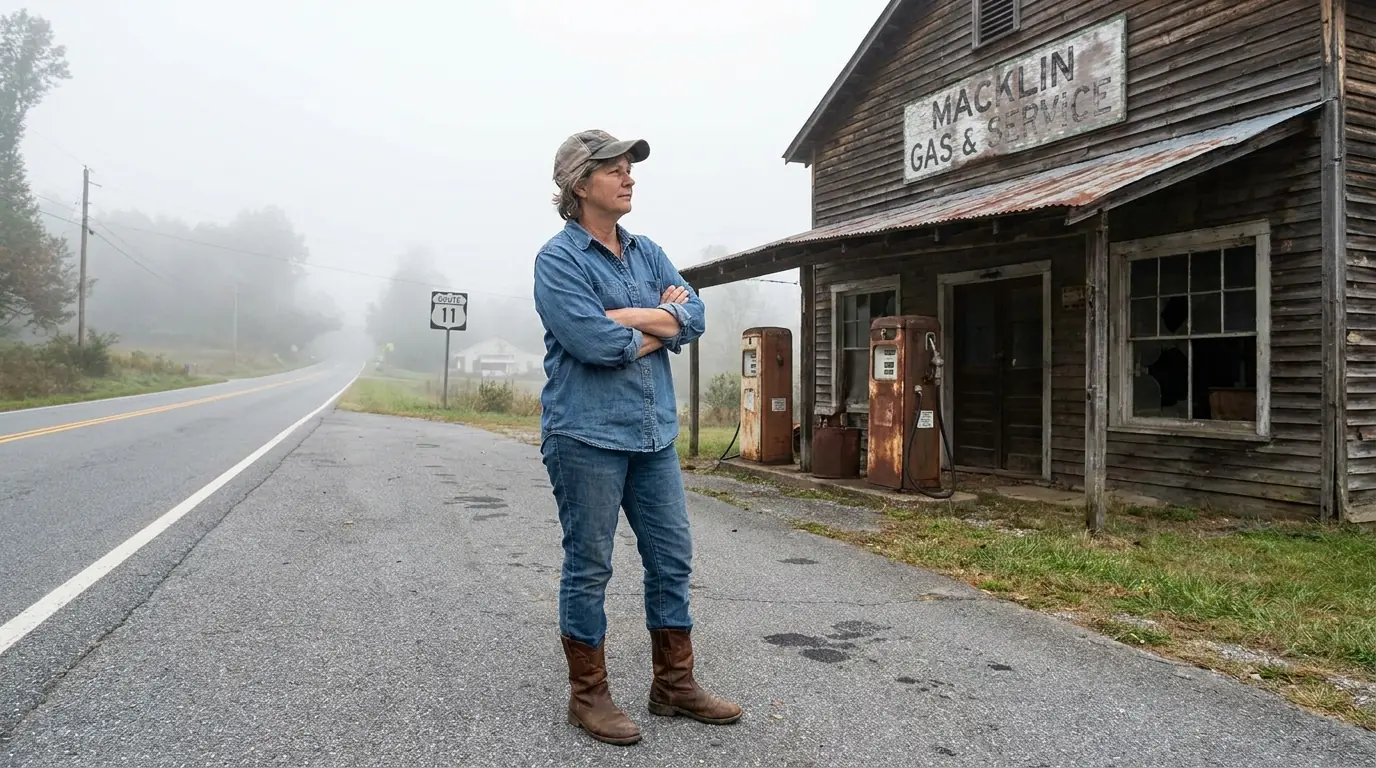
Ruth replied that she just wanted to fix the parts that were falling down. He almost smiled, which was the closest thing to one Ruth had seen from him yet. They divided the work without any further discussion. Jesse took the repair bay to test the compressor and bleed the hydraulic lines, while Ruth tackled the main building.
She pulled the kudzu off the south wall by hand, filling a wheelbarrow until the pile was taller than she was. The vine had worked deep into the mortar, making it slow, stubborn work that left her hands raw by noon. Hank showed up at 9:00 with a truck bed full of lumber and a large toolbox. He parked, climbed out, and surveyed the front porch with his arms crossed.
He noted that the railing was rotten and promised to have it fixed by lunch. True to his word, he finished the task by 11:30. Ruth brought him water and watched him test the new railing, leaning his full weight against it. The fresh-cut pine looked pale and clean against the weathered porch floor.
Hank remarked that Earl would have used cedar, but added that Earl could actually afford cedar. Hank grinned and muttered that pine would do just fine. That became the established rhythm of those first days. Ruth and Jesse worked from sunrise until dark, and Hank appeared most mornings with materials and experience.
Hank consistently refused to be paid. Ruth tried once, but he looked at her as if she had insulted him. He reminded her that Earl had helped him reshingle his roof back in '98, working for three days without taking a dime. Earl had told him he could buy him a steak when he won the lottery.
Hank hammered a nail into the porch step and noted that since he never won the lottery, this repair work was the steak. Jesse replaced the cracked front window and caulked the frames on the rest of the building. Ruth painted the door and window trim dark green, using a matching can she found in the stockroom. Jesse got the furnace running after two afternoons of cleaning out bird nests and replacing a corroded ignition switch.
He told Ruth that the furnace should have been condemned a long time ago, but noted it was stubborn. "Runs in the family," she replied. The pumps remained their largest obstacle because the underground tanks needed inspection and the equipment was outdated.
Ruth called every fuel company within 50 miles, but most hung up immediately due to the remote location. The fourth company she contacted was run by a man named Grady. Grady recognized her name, stating that Earl had kept his trucks running when he was just starting out without charging full price. Grady explained that Earl believed a man trying to build something shouldn't be punished for it.
Grady sent a crew out the following week to inspect the tanks, flush the lines, and install new pump heads. Ruth signed a fuel contract with terms she could barely manage if enough cars stopped. It was a massive gamble, but everything about this endeavor was a gamble.
The first customer arrived on a Thursday. An older woman in a white sedan pulled up to the pump island, rolled down her window, and asked if they were open. "We are," Ruth replied. The woman got out slowly, holding the car door for balance.
She looked at the station, then at Ruth, and her eyes filled with tears. She shared that she used to come here every week when Earl was alive because he always checked her tires for free. She pressed a hand to her mouth, admitting she didn't expect anyone to be here. Ruth filled her tank and checked her tires.
When the woman reached for her wallet to pay for the tire check, Ruth waved her off. The woman looked at her quietly and noted that her daddy used to do the exact same thing with the exact same wave.
The Growth of the Station
After that encounter, customers began to arrive steadily. They weren't numerous, but they were consistent—local residents who remembered the station from Earl's days. They came for gas and stayed to chat on the porch. Ruth bought a proper coffee maker with the last of the lockbox money and set it on a table just inside the front door.
Hank told her she was going to burn through a pound of coffee a week, but Ruth noted Earl went through two. Hank smiled and remarked that Earl had more visitors, to which Ruth replied, "Give it time." Soon, the community responded. A man drove 45 minutes each way just to get his oil changed by Ruth instead of going to a local shop.
A woman brought her teenage son to meet Ruth because she wanted him to know what Earl had done for their family. An elderly couple came just to sit on the porch, drink coffee, and recount the time Earl fixed their truck on Christmas Eve. He had refused payment because it was a holiday, claiming there was nothing to charge for.
Jesse settled into the repair bay with impressive focus, arriving before Ruth came downstairs each morning. He kept the tools immaculately clean, returning each one to its outlined spot on the pegboard. When he encountered an unfamiliar issue, he admitted it honestly, and when he knew the fix, he worked with quiet confidence.
Ruth paid him from the fuel sales and repair fees. It wasn't a large amount, but he never complained. Ruth noticed him stretching his back beside the lift one afternoon and told him he needed a mattress for the spare room upstairs. Jesse looked at her and stated he was fine sleeping in his truck.
Ruth insisted that nobody is fine sleeping in a truck and told him to take the room. He was quiet for a moment before nodding and returning to his work. Ruth found a mattress at a yard sale that weekend for $15, and Jesse carried it upstairs without a word.
Ruth ran the station exactly the way she believed Earl would have. When a man came in with a screaming fan belt and his wallet out, she charged him only for the part and nothing for labor. When a worried young mother pulled up with an empty tank, Ruth filled it and told her to pay when she could. When an elderly couple needed brake pads, Ruth quoted them half price and covered the difference herself.
She wasn't trying to be generous; she was simply trying to be useful. She recognized that Earl had understood the difference better than anyone. One evening, while sitting on the porch with Hank, Ruth admitted she didn't come back to save the place, but rather because she had nowhere else to go. Hank sipped his coffee and noted that the saving part usually happens on its own.
Dennis Strikes Back
The legal letter arrived on a Tuesday, three weeks after the station reopened. It was printed on heavy white stock from Felton and Associates. Ruth opened it at the counter next to her father's reading glasses. She read it multiple times, deciphering the dense legal jargon to find the troubling meaning underneath.
Dennis was filing a motion to include the gas station in the marital asset division. His lawyers claimed Ruth had failed to disclose the property's true value during their initial settlement. They cited a planned state highway expansion that would significantly increase the land's assessment. They wanted the court to reopen the case to award Dennis a share or force a sale.
Ruth set the letter down with steady hands, though her stomach twisted. She read it a third time, looking for a loophole, but found none. She realized hiring a lawyer would cost money she simply didn't have, as the station's current earnings barely covered the fuel contract and Jesse's modest wages.
That night, her daughter Connie called. They hadn't spoken in over a week, and their conversations had become brief and guarded. "Mom, I heard about the lawyer's letter," Connie said. "How?" "Dad told me."
Dennis was already building his case and lining up allies, framing Ruth as unreasonable. He built houses, portfolios, and arguments for a living, and he excelled at all of them. "He says the property is worth more than what was declared because of a highway coming through," Connie explained. "There's always a highway coming through somewhere, Connie. Doesn't mean it's coming here."
"Mom, listen to me. If the property is worth something, why not sell? Take the money, get an apartment, and start over properly." "I'm not selling." "Why not?" "In this case, it isn't about money."
Connie went quiet, her slow breathing indicating she was holding back her emotions. "Mom, I'm worried about you. You're living in a building that should probably be condemned, working a gas pump, and now Dad is taking you to court. How is any of this okay?" "Jesse fixed the furnace. The building is fine."
"Who is Jesse?" "He works here." "You hired someone with what money?" "Connie, I'm handling it." "That's what you always say, and then Dad handles it."
The words hit harder than Connie likely intended, and Ruth closed her eyes in response. She could have countered that Dennis had only ever handled his own comfort, and that his "handling" was just a euphemism for control. She knew Connie had grown up inside Dennis's curated version of reality, but she chose not to argue. "I love you," Ruth said simply. "I'll call you this weekend."
She hung up and sat in the dark station as the mountains stood black against the starlit sky. She got up and brewed a fresh pot of coffee because that was what her father would do: keep the light on and wait for morning.
Dennis arrived three days later in a deep, smooth, and expensive silver SUV. Ruth stepped out of the bay and watched the luxury vehicle pull up to the pump island. Dennis climbed out, looking trim and tanned at 61 in a navy polo and pressed khakis. He put on his sunglasses and studied the station, assessing the building's physical structure. "Ruth," he said. "Dennis."
He walked toward her with his hands in his pockets, taking his time. Jesse remained visible inside the open bay door, while Hank had left an hour prior. "Nice little project," Dennis remarked, looking at the fresh paint and the rehung sign. "Your father's place. I think I drove out here once when we were dating." "You didn't come to talk about my father."
Dennis removed his sunglasses to study her, calculating the fastest way to get what he wanted. "I came because I thought we could talk before the lawyers make this ugly," he said. "The property is undervalued, Ruth. That highway expansion is going to pass within a mile of here, making this land worth ten times its appraisal." "And you want your share."
"I want what's fair." "Fair"—the word Dennis used the way other men used a handshake. It sounded reasonable until one analyzed the underlying terms.
"You got the house," Ruth countered. "The savings, the retirement accounts. You got everything except a gas station your own lawyers called a teardown, and now you want that, too." "I want what the court should have considered. If the property appreciates, you'd be profiting from an asset that should have been divided." "This property was my father's. He left it to me in his will; it was never part of our marriage." "That's for the court to decide."
Ruth looked at him standing in front of Earl's station in clothes that cost more than her monthly fuel bill. "You're right, Dennis. It is worth something—just not the kind of something you understand."
He stared at her as his rehearsed script fell apart. He had driven four hours expecting the passive Ruth he remembered—the one who signed where directed because agreeing was easier than fighting. That version of Ruth was gone.
"I'll see you in court," Dennis said. He put his sunglasses back on, walked to his SUV, and pulled out of the lot as the gravel popped under his tires. Ruth watched him disappear around the curve before heading inside.
Jesse was standing at the workbench holding a socket wrench. "That's your ex-husband?" "That's him." "He always like that?" "He wasn't always, and that's what makes it hard." Jesse set the wrench down and asked if she was going to be all right.
Ruth looked at the letter on the counter next to Earl's glasses. "I don't have a lawyer, and I don't have money for one. So, I honestly don't know."
She locked up the station and climbed the stairs to the apartment. She lay on the mattress and stared at the ceiling, drawing strength from the families in Earl's journal who had faced adversity with far less. Earl had always known what to do next, and though Ruth didn't, she was determined not to leave.
The Lawyer and the Connection
Ruth was behind the counter the next morning when Hank walked in. The legal letter remained right where she'd left it, and Hank noted that Dennis had been by yesterday. "Mountain news," Ruth remarked. "Fastest thing in the valley."
Hank poured some coffee and settled onto the stool. "What's he want?" "The station, or his share of it. His lawyers think the property is undervalued because of the rumored highway expansion." Hank set his mug down, stating they'd been talking about that highway for as long as he could remember, but noted that wouldn't stop a lawyer from billing hours over it.
"I can barely afford the coffee." Hank was quiet for a moment before offering a solution. He told her about a retired attorney living in Barton who had moved up from Richmond years ago. He explained that when the attorney's daughter was sick and needed an uncovered surgery, Earl secretly paid the $3,200 out of the station's earnings.
Ruth listened intently as Hank explained that the attorney eventually found out because people in the valley always do. Hank believed that if Ruth reached out as Earl's daughter, the attorney would come to her aid immediately.
Hank called her that afternoon, and the attorney arrived the next morning in a gray sedan. She was in her late 60s, tall and straight-backed, carrying a leather briefcase. Ruth met her on the porch, and the woman firmly shook her hand, confirming she was Earl's daughter. They sat at the counter to review the legal letter.
The attorney read it slowly with professional calm. When she finished, she set her glasses down next to Earl's and declared it a nuisance claim designed to pressure Ruth into folding because she couldn't afford to fight. Ruth asked if Dennis could win, and the attorney stated firmly that he couldn't if the property was never considered marital asset.
She asked if the station was ever in both names, and Ruth confirmed it belonged solely to Earl until he passed it to her. The attorney asked if they ever used, improved, or paid taxes on the property jointly during the marriage. Ruth explained that Dennis had never set foot there until three days ago, and admitted she had let the small tax notices pile up out of neglect.
"That's actually helpful," the attorney said. "If neither of you maintained, improved, or used the property during the marriage, it stays separate, meaning your ex-husband has no claim." She dismissed the highway expansion argument as speculative future value, noting the defense would need to prove value was hidden during the divorce. Ruth pointed out that Dennis's own lawyers had appraised and dismissed it.
"Then that's their problem, not yours," the attorney concluded. She stood up and requested the original deed and inheritance documents. Ruth led her to the green filing cabinet in the repair bay to locate the files.
They searched the drawers methodically. Ruth located the original deed in a manila envelope labeled "Property" in her father's handwriting. It contained the 1971 deed transferring the land to Earl Robert Macklin, along with a copy of his notarized will leaving the property solely to Ruth.
The attorney held the documents up to the light. "This is clean. The property passed from your grandfather to your father, and from your father to you. It was never jointly held or commingled with marital funds." She set the papers down and assured Ruth that the motion would be dismissed.
"You're sure?" "I practiced law for a long time before I retired. I'm sure." Ruth leaned against the workbench as the intense tension finally left her shoulders.
"What do I owe you?" Ruth asked. The attorney looked at her steadily, reminding her that Earl had paid for her daughter's surgery without ever asking for anything or revealing his identity. She picked up her briefcase and stated gently, "There's nothing you owe me, Ruth. This one was paid for a long time ago."
She left her card on the counter and drove away while Ruth watched from the porch. Later that afternoon, Jesse was working in the bay reorganizing the filing cabinet when his movements suddenly stopped. Ruth was wiping the front windows and noticed the sudden weight of the silence. She walked to the bay door.
Jesse was sitting on the milk crate with an open folder on his lap, staring blankly at the contents. "Jesse?" He didn't look up, so Ruth walked over to his side. The folder was explicitly labeled "Rowan" in Earl's handwriting.
Inside lay a single sheet of paper with a handwritten note from her father:
"Clara Rowan surgery refund: $3,200 heart valve replacement, August 1994. Sent through the doctor's office as an anonymous donation. Don't let her know where it came from."
Jesse's hands were physically shaking. He closed the folder against his knees and explained tightly that his grandmother had heart surgery when he was a baby. She had always told him that an anonymous donor paid for it, but she was never able to identify the person despite searching for the rest of her life.
He looked up at Ruth and noted that his grandmother always said that anonymous donor was the reason their entire family existed. Ruth sat on the concrete floor beside him in supportive silence. "I didn't know she'd ever been to this station," Jesse said. "She lived in Boone, 40 miles from here." "Earl drove to Boone sometimes," Ruth recalled. "He told me he was visiting a friend."
Jesse folded the page carefully and replaced it in the folder, looking up at Earl's tools on the pegboard. He noted that Earl never even met him or knew he would exist, yet his entire family was here because a gas station owner decided to pay for a stranger's surgery. "That's who he was," Ruth said softly.
Jesse nodded, returned the folder to the cabinet, and silently went back to work. Ruth noticed that he stayed later than usual that night. When he cleaned Earl's tools before locking up the shop, he handled each piece with deep care and respect.
Connie's Shift
Connie arrived on a Saturday with her nine-year-old boy and six-year-old girl. They climbed out of the rental car, looking at the gravel lot and the mountains with wide eyes. "This is where your great-grandpa Earl worked," Connie explained to them. The boy studied the building and noted it was small, but Ruth answered from the doorway, "Big enough."
She took them inside to see the counter, the reading glasses, and the crossword puzzle. She let them hold the brass key to the filing cabinet and ring up an imaginary sale on the mechanical cash register. Then she led them into the repair bay where Jesse was working. He slid out from under a truck and politely greeted the children.
Ruth showed them the pegboard with the tool outlines and let the boy check the tire pressure on a truck parked inside. She explained how to use the gauge, and the boy successfully read the number 32. "Perfect," Ruth told him. "You just did your first tire check."
The boy grinned, mirroring the exact expression Ruth had held at his age in that very bay. Connie watched from the door, her face reflecting recognition rather than her previous worry. That evening, after the children fell asleep upstairs, Ruth and Connie sat together on the porch. "I was wrong," Connie admitted. "About what?" "All of it. This place, you... Dad."
Ruth didn't push, allowing her daughter to arrive at the truth naturally. "He called me last week," Connie shared. "Sounded quieter. Asked about you." "What did you tell him?"
"The truth. That you're doing better than anyone expected and the station is running well. I told him you turned into someone he never imagined you could be, and I added that it's because he never tried to imagine it." Ruth reached over and squeezed her daughter's hand. "He wasn't a bad man, Connie. He just measured the wrong things."
Hank came by the next morning with a framed, slightly faded photograph he had found in his garage. It showed Earl and a young Ruth standing in front of a shining, freshly painted station. Ruth was around six, wearing overalls and a wide grin, while Earl stood behind her with a hand on her shoulder. Hank noted Earl always called it the best picture he ever took because it showed exactly who they were supposed to be.
Ruth hung the photograph on the wall next to Earl's reading glasses. The days settled into a productive routine: Ruth opened the station early, Jesse worked the bay, and customers arrived consistently. It wasn't a wealthy life, but it was useful, and Ruth understood that usefulness was its own kind of community wealth.
Late one afternoon, a dusty minivan pulled into the lot. A young woman climbed out looking overwhelmed, while three children sat in the backseat. She asked for gas, and Ruth filled the tank, topped off the fluids, and aired up a low tire without asking. When the pump clicked off, the woman frantically searched her purse to count her change.
"Pay it next time you're through," Ruth said gently. The woman looked up in disbelief, stating she couldn't just take it. "Sure you can. I'll be here," Ruth replied. The woman asked why she would do this, and Ruth smiled, stating her father used to say the exact same thing.
The woman drove away with a full tank and a story she would carry forever. Ruth watched the minivan disappear around the curve before heading inside to close up for the evening. She turned off the lights, cleaned Earl's reading glasses one last time, and locked the front door. Through the glass, the hand-painted sign glowed reliably against the darkening sky, and Ruth walked upstairs knowing she was just getting started.