On a freezing night, a poor young woman sat by the fire trying to keep warm when suddenly she heard cries for help outside.
At first, she didn’t want to open the door, but when she saw a man covered in snow and a sick-looking child clinging to his side, her heart just couldn’t turn them away. She brought them inside, gave them food and shelter from the storm.
What she didn’t know was that this desperate stranger was a billionaire and that one act of kindness would change her life forever.
The wind howled like a wounded animal against the windows of the small house on Maple Ridge Road. Then came a sudden frantic pounding on the door, sharp, desperate, echoing through the tiny cabin. Keisha froze.
The fire poker slipped slightly in her trembling hands as she turned toward the noise. Her heart thudded so hard she could feel it in her throat. The pounding came again, louder this time, faster, more urgent.
“Please,” a man’s voice shouted over the storm. “Please, my daughter needs help. She’s sick.” The sound of a deep male voice sent a jolt of panic through her chest. She took a step back, clutching the poker tighter, eyes locked on the door as if it might burst open at any second. For a moment, all she could hear was the storm, the wind tearing at the shutters, the snow hissing against the glass.
Then through the frosted windowpane, a dark shape moved. A man, broad-shouldered, hunched over something smaller. Keisha’s breath came fast and shallow. Her mind flashed back to that night a year ago. Another knock, another stranger with a story about a broken-down car. She’d opened the door then. By morning, her grandmother’s jewelry box and her hidden cash were gone.
The police had done nothing. The insurance had done worse. She’d sworn she would never make that mistake again. But then, a sound. A weak rattling cough from outside. A child’s cough. Keisha’s grip on the poker loosened just slightly. Her pulse still raced, but her fear began to twist into something else: dread, compassion, indecision. She moved closer to the door, peering through the frost again.
The man shifted, and this time she could see the little girl clearly, limp in his arms, her face pale even through the blur of glass. “Please,” the man’s voice cracked, raw and pleading. “She’s burning up. I don’t know what to do.” Keisha stood there, heart hammering, torn between every instinct screaming don’t open that door and the voice of her grandmother whispering from years ago, “Baby, when someone needs help and you can give it, you give it. Don’t let fear make you small.”
Her hand shook as she reached for the deadbolt. Every rational thought begged her to walk away, but something deeper, something human, wouldn’t let her. With one deep breath, she turned the lock and opened the door. The cold hit her like a wall. The man stumbled forward, snow clinging to his hair and jacket, his lips cracked from the freezing wind.
“Thank you,” he gasped. “Thank you so much.”
“Get inside before we both freeze,” Keisha said, stepping back but keeping the poker between them. He carried the child to the couch by the fire, moving slowly, carefully. The girl’s skin was flushed with fever, her breathing shallow. Keisha locked the door behind them, never taking her eyes off the stranger.
“What’s your name?” she demanded.
“Ray,” he said, voice hoarse. “Ray Thompson, and this is my daughter Zara.”
“Well, Ray Thompson, you better not make me regret this. Sit there, don’t touch anything, and don’t even think about moving unless I say so. I’ve got my phone right here, and I will call the police.”
Ray nodded, too exhausted to argue. “I understand. I’m not here to cause trouble. I just need my daughter to be warm and safe.” He peeled off his wet jacket and wrapped it around Zara, who whimpered softly in her sleep. His movements were careful, paternal, focused entirely on the child.
Keisha watched them for a long moment, studying Ray’s face, looking for signs of deception or danger. The fire crackled in the silence. Finally, she made a decision. “I’ve got towels,” she said, though she didn’t lower the poker. “Stay there.” She backed toward the linen closet, never taking her eyes off Ray. She grabbed an armful of towels with one hand, keeping the poker ready in the other.
When she returned, she placed them on the arm of the couch, still out of reach. “Take them, slowly.” Ray reached for the towels, moving deliberately.
“Thank you. I know this is hard for you. I know you’re taking a risk. You don’t know anything about me,” Keisha said sharply. But something in his acknowledgment of her fear made her shoulders relax slightly. Just slightly.
“I can heat up some soup,” she said. “That’s all I’m offering.”
“That’s more than enough,” Ray said quietly, beginning to dry Zara’s hair with gentle hands. “You don’t know what this means.”
Keisha didn’t respond. She returned to the kitchen, but positioned herself where she could still see them. She pulled out a can of chicken noodle soup, dumping it into a pot on the stove. As she stirred, she kept glancing back. Ray was drying Zara’s hair with careful, gentle motions, murmuring to her in a voice too soft to hear. The tenderness in his movements reminded Keisha of her own father, gone now for five years.
She shook the memory away and focused on the soup, but her grip on the spoon was less tight now. Her breathing had slowed. She was still afraid, but it was a different kind of fear now.
Not the fear of immediate danger, but the fear of being wrong, of being hurt again, of having her trust betrayed. But as she watched Ray tend to his daughter with such obvious love, she thought maybe, just maybe, she’d made the right choice.
The power had been out for three hours. The only light came from the fireplace and two emergency candles Keisha had placed on the coffee table. Zara sipped the soup slowly, her small hands wrapped around the mug.
Ray helped her, holding the cup steady when her hands shook. Keisha sat across the room, the poker now leaning against her chair rather than in her hands, but still within reach, still watching.
“Why were you out in this storm?” she asked finally. “The weather service has been warning about this for days.” Ray looked up, his face drawn. “Zara’s grandmother lives in Riverside. That’s about forty-five miles from here, other side of the county. She’s been sick, heart problems, and Zara wanted to see her before—” He trailed off, glancing at his daughter. “Before things got worse. I thought we could make it before the storm hit. The forecast said it wouldn’t start until evening. I was wrong.”
Keisha studied him. There was something in his eyes, something heavy and sad that went beyond tonight’s trouble. “What about Zara’s mother?” she asked, then immediately regretted it.
“It’s all right,” Ray said. “She passed away two years ago, cancer. It’s just been the two of us since then.” Keisha felt something soften inside her chest. “I’m sorry,” she said, and meant it. “I lost my father five years back, heart attack. Still doesn’t feel real sometimes.” Ray nodded slowly.
“Zara’s strong, stronger than me sometimes, but nights like this, when she’s sick and scared, I feel like I’m failing her, like I should be able to protect her from everything, you know.”
“You’re not failing her,” Keisha said firmly, and realized she’d leaned forward, her defensive posture relaxing. “You’re here. You’re trying. That’s what matters. That’s what they remember.”
“What did your father do?” Ray asked.
“Maintenance at Jefferson Elementary. Fixed everything that broke, which was pretty much everything in a 40-year-old building.” She smiled slightly at the memory. He used to say that keeping things working was the most important job there was, that people could teach and learn because he made sure the heat worked and the roof didn’t leak.
“He sounds like a good man.”
“He was.” Keisha’s voice was soft now. “He taught me to be useful, to help when I could, to not turn away from people who needed something.” They fell into silence, but it was different now, less tense, more like two people sharing space rather than adversaries watching each other.
Zara finished her soup and curled up against her father’s side, her breathing evening out as sleep took her. Ray stroked her hair, his movements automatic, soothing. Keisha stood and walked to the back room. This time she didn’t take the poker with her. She returned with a thick quilt, one of the few nice things she owned.
It had been her grandmother’s, made by hand with patches of fabric from old dresses and shirts, each piece telling a story. “Here,” she said, holding it out. Ray looked at the quilt, then at her. His eyes widened slightly. “This is beautiful. This is handmade. I can’t.”
“She needs to stay warm,” Keisha interrupted, “and it’s cold tonight. Really cold. Take it.” Ray accepted the quilt, standing carefully so as not to disturb Zara. His hand brushed Keisha’s as he took it, and for a moment, their eyes met. Something unspoken passed between them, an understanding that went beyond words.
“Thank you,” he said, “for everything. I know this is hard for you. I know you’re taking a risk letting strangers into your home. I saw your face when you opened that door. You were terrified.” Keisha looked away, uncomfortable with being seen so clearly. “Just get through the night. We’ll figure out tomorrow when it comes.”
She settled into the armchair, pulling a throw blanket over herself. She was still determined to stay awake, to keep watch, but as the hours passed and the fire burned low, exhaustion crept over her.
Keisha woke to the smell of coffee and the soft clatter of dishes. For a moment, she was disoriented, forgetting where she was. Then memory flooded back: the storm, the stranger, the child.
She sat up quickly, her neck stiff from sleeping in the chair. Morning light filtered through the windows, gray and weak, but present.
The storm had passed, but the world outside was white and silent. In the kitchen, Ray stood by the stove, carefully pouring water into her old coffee maker. Zara was still asleep on the couch, the quilt pulled up to her chin, her breathing easier now.
“What are you doing?” Keisha asked, her voice rough with sleep. Ray turned, startled.
“I’m sorry. I didn’t mean to overstep. I just thought, after everything you did, I could at least make coffee. And I washed the dishes from last night, folded the towels. Seemed like the least I could do.”
Keisha rubbed her face, feeling the vulnerability of having slept in front of a stranger. But the house was intact, nothing seemed disturbed. Ray had clearly been up for a while and had done nothing but help.
“How do you even know where I keep the coffee?” she asked.
“I looked in the obvious places,” Ray admitted. “Cabinet above the coffee maker seemed like a good guess. I was quiet. I didn’t want to wake you. You looked like you needed the rest.” Keisha walked to the window and looked out.
The world was completely transformed. Snow covered everything in thick drifts, at least two feet deep. The road was buried, no sign of where pavement ended and field began.
“ We’re snowed in,” she said, her stomach sinking. “Completely. The county won’t plow these back roads until the main routes are clear. That could be late today or tomorrow.” Ray’s face fell.
“I’m so sorry. I didn’t mean to trap you here with us for another day.”
“It’s not your fault,” Keisha said, though frustration edged her voice. “Mother nature doesn’t ask permission. It’s just how it is.” She accepted the cup of coffee Ray handed her and took a sip. It was exactly how she liked it, strong with just a hint of sugar.
“I noticed last night,” Ray said with a small smile. “You put a tiny bit of sugar in your soup. Figured you might like your coffee the same way. My wife used to do that, too. Said it took the edge off without making it sweet.” The mention of his wife hung in the air for a moment, then Keisha nodded. She was right, it did.
They sat in awkward silence for a moment, then Zara stirred, coughing softly. Both adults turned to her immediately. Keisha walked over and pressed the back of her hand to Zara’s forehead. The girl was still warm, but the fever had broken during the night. That was good.
Zara stirred, blinking up at her with glassy, confused eyes. For a moment, she tensed, the way a child might when waking in an unfamiliar place. Her gaze darted around the room, landing on her father first. “It’s okay, sweetheart,” the man said softly, reaching for her hand. “You’re safe. We’re inside now.” Only then did Zara’s small body relax.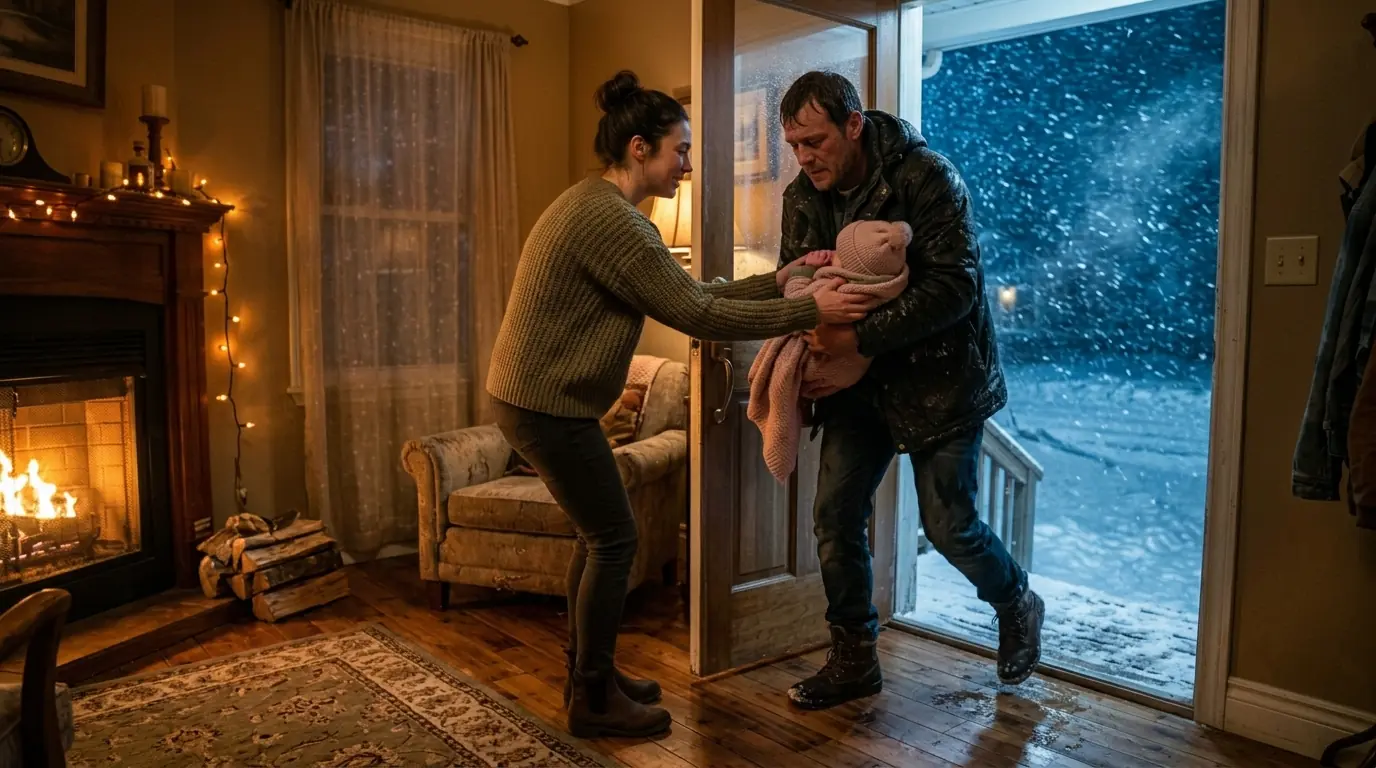
She turned her eyes to Keisha, hesitant but curious. “How are you feeling, sweetheart?” Keisha asked gently, crouching beside the couch. Zara’s voice was raspy when she spoke. “Thirsty and my throat hurts.”
“I’ll get you some water,” Keisha said at once. “And I think I have a little honey. That’ll help it feel better.” She moved to the kitchen and returned with a glass of water and a spoonful of golden honey. Zara took them both carefully, still watching Keisha as if trying to decide whether to trust her.
“You’re being very brave,” Keisha said softly. “I know it hurts.”
Zara swallowed, wincing slightly. “My mama used to give me honey when I was sick,” she whispered. “It tastes like she’s here.” The words hit Keisha in the chest. She looked toward the man. His eyes were bright with unspilled tears. “Your mama sounds like she was smart,” Keisha said gently. “Honey’s one of the best remedies there is. You’ll feel better soon.”
As the day wore on, they settled into an unexpected rhythm. The initial fear and tension had dissolved, replaced by a strange domesticity. Ray insisted on helping, and Keisha found herself accepting, even grateful.
The way he handled the axe spoke of experience, of physical work done before. When he came back inside, she had questions in her eyes.
“My father worked construction,” Ray explained, as if reading her thoughts. “I spent summers on job sites learning to use tools. He said every man should know how to work with his hands, no matter what else he did with his life.”
When a draft started coming through the back door, Ray found tools in her shed and sealed the gap with weatherstripping she didn’t even know she had. He fixed a loose hinge on the bedroom door that had been bothering her months, tightened the wobbly handle on the kitchen cabinet, even noticed that one of the porch steps was rotting and made a temporary repair.
“You’re handy,” Keisha observed, watching him work.
“Had to be,” Ray said, not looking up from the hinge he was tightening. “Growing up, we couldn’t afford to call someone every time something broke. My father taught me to fix things myself, said it was a valuable skill, being able to make do with what you have. That knowledge didn’t need a bank account.”
Keisha made a simple lunch, grilled cheese sandwiches and tomato soup from another can. It wasn’t much, but it was warm and filling. Zara ate slowly, her appetite returning. By afternoon, she was sitting up, asking for her backpack.
“I have my art supplies,” she told Keisha shyly. “Do you want to see?”
Keisha sat down beside her on the couch. “I’d love to.” Zara pulled out a small sketchbook and colored pencils. She flipped through pages of drawings—flowers, animals, houses, portraits. Each one showed real talent, real observation. Some were simple child’s drawings, but others had a sophistication that surprised Keisha.
“These are wonderful,” Keisha said honestly. “You’ve got a gift, child, a real gift.”
Zara beamed, her face lighting up despite her lingering illness.
“My mama used to draw with me. She said art helps us see the world better.”
“Your mama was right about that, too,” Keisha said.
Zara turned to a blank page and began to draw. Keisha watched as the picture took shape, the girl’s tongue sticking out slightly in concentration—a small house in the snow, a woman at the door, surrounded by golden light, a man and a child outside, their faces upturned toward that light, toward hope.
“That’s you,” Zara said, pointing to the woman. “You let us in when we were cold. You saved us.” Keisha felt her throat tighten.
Zara tore the page out carefully and handed it to her. “You can keep it as a thank you. Dad says we should always thank people who help us, not just with words, but with actions. This is my action.”
Keisha accepted the drawing, studying it. In Zara’s simple lines, she saw something she hadn’t felt in a long time: purpose, being needed, making a difference.
“I’ll treasure this,” she said softly, meaning every word.
That night, just as they were finishing dinner of scrambled eggs, toast, and the last of some frozen vegetables Keisha had found, the wind picked up again. Keisha looked out the window and cursed under her breath.
“What’s wrong?” Ray asked, immediately alert.
“Second wave,” she said, watching the snow begin to fall again. “Weather service mentioned it might happen. This could add another 12 to 18 inches on top of what we already got. We could be stuck here another full day, maybe even two.”
Ray closed his eyes, taking a deep breath. “I need to call my mother-in-law. She’ll be worried sick, and I need to check in with work.”
“Phone’s in the kitchen,” Keisha said, “but the signal’s been spotty all day. Might take a few tries.” Ray tried four times before getting through to his mother-in-law. Keisha could hear his side of the conversation, reassuring, apologetic, gentle.
“No, Mama Rita, we’re safe. Yes, she’s much better. I know, I know, the roads are completely blocked. A kind woman took us in. Yes, I’ll tell her. We’ll get there as soon as we can. I love you, too.”
When he hung up, he looked exhausted but relieved. “She’s upset but grateful we’re somewhere safe. Her condition is stable for now, so that’s good. But she really wants to see Zara.”
He tried calling work next, but the signal kept dropping. After the third attempt, he gave up with a frustrated sigh. “They’re going to think I just disappeared.”
“They’ll understand when you explain,” Keisha said. “It’s a natural disaster. People have to understand that.”
The night stretched long again. Around 8:00, Zara’s fever returned, spiking suddenly. Keisha moved into action without thinking, her home health aid training kicking in automatically. She prepared cool compresses, monitoring the child’s temperature with a thermometer from her bathroom cabinet.
She made ginger tea with honey, cooled it to barely warm, and helped Zara sip it slowly. She dampened washcloths with lukewarm water, changing them frequently as they warmed against Zara’s skin, and she sang soft songs her grandmother had sung to her, old spirituals about crossing rivers and finding rest, about morning coming after the longest night.
Ray watched from across the room, his expression a mixture of gratitude and something else—pain maybe, or memory.
“You’re good at this,” he said quietly when Zara finally dozed off again. “Taking care of people.”
Keisha shrugged, rinsing out another washcloth. “I worked as a home health aid for eight years before the company downsized, took care of elderly folks mostly, but you learn what works, how to bring comfort when you can’t bring a cure, how to be present with someone’s pain. It’s more than that.”
Ray insisted, “You care, really care. That’s rare. In my experience, most people do the minimum required. You do what’s needed, even if it’s hard.”
Keisha didn’t know how to respond. She focused on Zara, adjusting the compress on her forehead. The girl’s breathing was easier now, her sleep deeper. By midnight, Zara’s fever broke again. She fell into a more peaceful sleep, her small hand curled against her cheek.
Keisha sagged with relief, suddenly aware of how tired she was, how much tension she’d been holding.
“Thank you,” Ray said quietly. “I don’t know what I would have done without you tonight. Watching her suffer and not being able to fix it, it’s the worst feeling in the world.”
“You would have managed,” Keisha said. “Parents always do. They find a way because they have to.”
“Maybe,” Ray said, “but I’m grateful I didn’t have to find out alone. I’m grateful you were here.”
They sat together by the fire, the silence comfortable now. Outside, the wind howled and snow fell, but inside, the small house felt safe, protected.