A retired rancher lived alone for years until five Apache women begged for shelter on his ranch. The land stretched quiet in every direction, empty fields broken only by scrub brush and the long wooden fence line that ran alongside the property. The air was cold enough to numb fingers, and the sky had already turned deep blue, leaving only a thin line of dying orange along the distant hills. Nothing moved except a few loose strands of hay by the barn door and the slow shift of horses settling for the night. The rancher, Walter Hail, stood near the corral gate with his gloves still on, a rope over one shoulder, and a dull ache in his back from a long day.
He had spent his daylight hours repairing fence posts, checking trough water, and cutting firewood. No one else had done those jobs for ten years. He didn't rush through anything, working the same way every day because routine kept things steady and quiet. To him, quiet meant nothing could surprise him the way life once had. He rubbed his thumb across the edge of his glove and looked out toward the hills, seeing no smoke from town, no riders, and no noise except the low whinny of a horse adjusting itself.
It felt safe enough, safe in the only way this land ever was. He reached for the cabin door, his boots creaking on the porch boards, and stepped inside. The cabin was small but solid, featuring a stove in the corner with an iron kettle on top and a table with two chairs, though one hadn't been touched in years. A coat hung on a wooden peg by the door, and the place smelled of old firewood and leather. He poured himself coffee from a tin pot he'd reheated for the third time that day.
The cup burned his fingers slightly, but he held it anyway, liking the sting that reminded him he was still here and still real. Walter wasn't hiding from the world; he was simply done with it. Once a cavalry tracker in border country, he left after watching enough death and fear to last a lifetime. His wife passed four winters later from illness, and whatever part of him that still cared for noise and company went with her. These days, he worked, slept, and tried not to think about who he used to be.
He didn't want to be a soldier again, nor did he want neighbors or conversation. He wanted quiet work and a roof that didn't leak. He lifted the cup halfway to his lips before the horses outside shifted suddenly, their hooves scraping the ground in a nervous burst. His hands stilled as a tense moment passed in the darkness. Then he heard movement where there shouldn't be any, a sound that was not animal, but too controlled and slow.
It was the unmistakable sound of human footsteps in the dirt. His heartbeat tightened and his jaw clenched as he set his cup down on the table. He grabbed the repeating rifle leaning near the door and stepped back outside, his breath fogging instantly in the cold. Every muscle was tense, just like they used to be when he expected an ambush in enemy territory. He scanned the yard, finding the fences intact, the corral still shut, and the horses alert with their ears pointed toward the barn.
Then shadows moved along the barn wall, and his thumb brushed the rifle lever out of habit. He stepped down two porch steps, his boots landing heavy in the frozen dirt. Suddenly, figures stepped into the lantern light spilling from his cabin window, causing his breath to pause in his chest. Five Apache women stood there, thin from travel, with worn and torn dresses, dusty beads, and hair tangled from the wind. They looked like they had walked farther than a horse should carry anyone.
Their breathing was uneven, their shoulders sagged, and one woman held her ribs while another leaned on her sister. The youngest looked barely eighteen, her arms wrapped tight around herself like she expected someone to strike her at any moment. Walter kept the rifle lowered but ready, making no yelling or sudden moves. He had learned long ago that panic killed faster than bullets, so his mind moved steadily as he scanned them. He saw no weapons, no men nearby, and knew they were neither scouts nor raiders.
They looked scared, exhausted, and desperate—things he recognized well from his time in the war. But this situation was completely different, as these were people running from something, not toward it. The oldest woman stepped forward one pace, keeping her hands visible without raising them. "We walk long," she said, her voice strained. "We look for safe place. We need rest." Her English was clear enough, and her eyes did not plead, bracing instead as though she expected refusal or violence more than help.
Walter knew that look, having worn it once himself when arriving in towns where a uniform bought suspicion instead of shelter. He could have told them to move on, and it would have been an easy thing to do. Most men out here wouldn't have opened the door, let alone offered a place to sleep, since Apache women traveling alone usually meant danger was close behind. But he also saw their cracked lips, torn moccasins, shaking legs, and faces marked with fear that had gone on too long. He felt a tight pull in his chest he hadn't felt in years, something like memory trying to become guilt.
He swallowed hard before speaking to them. "Barn's clean," he said quietly. "Water at the door. Hay in the loft." For a moment, none of them moved, not out of disrespect, but out of sheer disbelief. Then they nodded slowly, tired and grateful in a very quiet way. They didn't thank him directly, as their pride wouldn't let them.
Instead, they supported one another and walked toward the barn with no noise or wasted movement. They were just five people trying to stay upright after an impossible journey. Walter stayed on the porch, his rifle lowered, his eyes tracking them until the barn door shut behind their tired bodies. The horses settled again, and the wind picked up a little, pushing the cold into his coat collar. He breathed out and realized his engineering palms were damp with sweat from fear or something close to it.
He returned inside, and the cabin felt smaller suddenly, like the world had moved closer to him than he liked. He set the rifle down but didn't walk away from it. He sat at the table and stared at his coffee, his hand shaking slightly when he picked it up. It wasn't from age, but from nerves, as he wasn't used to anyone crossing his land at night. The quiet life had numbed him, and this sudden change rattled him more than he wanted to admit.
But under the worry sat something else, an uneasy feeling that he didn't have a word for yet. He listened to the faint rustle of hay from the barn, noting there was no crying or begging, just breathing and shifting bodies trying to rest. He leaned back, staring at the dark ceiling, and thought about the years he had spent telling himself he owed nothing to anyone. Tonight, that statement felt less true than it used to. He did not know why they came or what danger followed them, but he had made a choice, and choices had weight.
Tomorrow would be different because tonight had happened. For the first time in a long time, Walter Hail did not know if quiet would return here again, or if he even wanted it to. Morning arrived without warning, with pale light slipping through the cabin shutters as if testing whether it was welcome. Walter woke before the full sun, matching his old habit, but his moment of stillness felt entirely different today. For ten years, silence had greeted him at dawn, but today he heard the horses outside shifting and, beneath that, faint movement from the barn.
It wasn't loud, but it was enough to remind him the world had entered his land overnight. He sat on the edge of his bed, his boots waiting and his coat on the chair. His chest felt tight, not from work, but from the unknown of the five strangers resting on his property. These were five lives he didn't understand or trust yet. He rubbed his face once, let out a slow breath, and forced his body upright because routine kept his mind steady.
He pulled on his coat and stepped outside into the sharp morning cold. Frost clung to the grass beside the porch, and the sky was clear, washed in a gray-blue before sunrise. He walked toward the barn without hurry, his boots crunching the frozen dirt. Halfway there, he paused when he noticed the loft door was cracked open. A pale stream of smoke floated from a small fire pit dug just outside the barn door.
They had made a cook fire that was controlled, careful, and not reckless. Someone had thought ahead, and he stood there a moment, studying the quiet shapes moving near the barn. Four women crouched close to the low flame, warming their hands. The youngest sat leaning against the barn wall, rubbing her ankle with careful fingers. The one who had held her ribs last night moved slowly, holding herself stiffly as if pain had woken with her as well.
The fifth woman noticed him first. She stood near the water bucket, dipping a small rag inside and wringing it out. When she raised her head, her eyes locked with his—sharp, alert, and guarded. She wasn't afraid the way the others were; she was watchful, ready to judge whether his help was real or temporary. Walter nodded once, and she didn't look away, returning instead to washing a shallow scrape on another woman's arm with steady, practiced movements.
Questions pushed into his mind one after another, the very ones people would ask if they sat in the dirt beside him. Who were these women, and where had they come from? Were soldiers chasing them, or perhaps settlers, or their own people? Were they hurt worse than they let on, and would trouble arrive right behind them? He didn't ask any of it out loud because he wasn't ready to talk that much, but the questions remained.
"You cook?" he asked instead, keeping his voice level and nodding toward the pot set over the coals. He didn't smell beans or meat, only hot water and a scrap of dry corn. The oldest woman answered without lifting her face fully. "We boil corn. You have food. We not take without asking." Walter's jaw flexed, for he didn't like strangers guessing his mind, but she wasn't wrong.
He had food, they didn't, and they made do with almost nothing. That told him as much about them as any story might. People who wanted handouts acted differently, while people used to hardship stayed humble around the fire. He knelt by the bank of the barn door and checked the horse feed trough, finding it full, though the water bucket was nearly empty. They hadn't wasted anything, showing cautious and controlled behavior that served as a good sign.
"You can cook in the cabin if you need," he said. "Stove's warmer." The youngest woman flinched like she wasn't sure he meant it. The one with the limp shifted weight on her unsteady leg. The older woman gave him a long look, trying to understand him the same way he tried to understand her. Trust didn't land all at once; it walked slowly like a healing wound.
"We stay here," she answered quietly. "Barn's safe." He didn't argue with her choice. He stood, lifted the water bucket, and carried it to the well. On the walk back, he thought about the piece of truth the night hadn't given him. They wouldn't wander this far unless danger chased them.
Last night, they looked like they expected the world to shut doors in their faces. This morning, they looked like they expected the world to follow them here and finish what hurt them. He set the filled bucket down beside them and asked if they needed anything else. The woman with the braid, the one who had watched him closest, stopped her cleaning and looked at him again. She didn't thank him or soften, but something shifted in her eyes, showing acknowledgment instead of fear.
"We help," she said. "We work if we stay." Walter didn't blink at her offer. Offers of help mattered, as people who meant to take didn't volunteer their labor. He noted her willingness and nodded once. "Fences need checking. Wood needs splitting."
The women exchanged glances that showed readiness rather than dread or complaint. Work made sense to them, and it felt safer than waiting around. He respected that attitude more than he expected to. He walked toward the woodpile, and a moment later, he heard footsteps behind him. The woman with the braid was following him, quiet as a shadow.
She didn't speak, just waited while he rolled logs off the stack. Her posture was straight despite her exhaustion, and her fingers curled into fists, ready for the effort. "You know how to split wood?" he asked. She took the axe from him without hesitation and tested its weight with a capable grip. She swung, and the blade sank clean and true into the timber.
She didn't look at him afterward, just reached for another log, breathing steadily despite her tired arms. Walter didn't smile, but something loosened in his chest. He pulled his gloves on and stacked the split wood beside her. Back at the barn, three of the other women headed toward the fence line with ropes and a bucket, the oldest guiding them. The youngest stayed by the fire, her ankles stiff, stirring the corn slowly.
Walter's thoughts moved slower now as he realized the truth. They weren't helpless, and they weren't here to hide; they were rebuilding themselves one chore at a time. Whether he planned it or not, his land had become part of that fight. He didn't know their names or their story yet, but he knew turning them away now was impossible. Leaving people to freeze and starve would pull him back toward the kind of man he chose never to be again.
His routine had changed, his quiet now had company, and the ranch wasn't just his anymore. He lifted another log, set it upright, and swung the axe. The impact echoed across the yard while the fire crackled behind them and the horses shifted in the corral. The frost began to melt in patches under the climbing sun. Nothing dramatic happened—no speeches, no overflow of gratitude, only work side by side that built trust one steady breath at a time.
Walter didn't look at the woman beside him again, but he felt her presence like another heartbeat in the quiet morning air. This wasn't a rescue; it was survival shared. In the harsh, unforgiving land of the West, that meant more than any promise spoken out loud. The sun climbed slowly, warming the frost into mud and bringing dust alive across the ranch yard. By mid-morning, smoke from the women's small fire drifted steadily, and the woodpile by the wall had doubled.
Work settled into its own rhythm—not loud, not rushed, just effort, breath, and dirt under their fingernails. Walter wiped sweat from his forehead with his sleeve and set another log upright. The woman with the braid lifted the freshly split pieces and stacked them without speaking. Her movements were careful and precise, showing she worked like someone who had done far harder tasks before. He caught himself glancing at her sometimes, appreciating the quiet way she scanned the land every few minutes.
She checked the ridgeline, the road, and the treeline behind the barn. Someone running from danger didn't stop watching the shadows. That brought the heavy questions back to his mind. How long had they been held in that camp, and did they escape alone or did others fail to make it this far? He didn't ask yet, knowing answers were coming whether he was ready or not.
He finished his last swing and set the axe down. As he walked toward the barn for rope and nails, he saw movement on the ridge above the property. His body reacted first: muscles tight, breath locked, and hand ready to reach for the rifle inside the cabin door. It was just a lone dust cloud at first, then a horse and a lone rider approaching slowly from the northeast. The approach was too direct to be a coincidence, so he kept his face still and forced his voice steady.
"Someone's coming," he announced. The women stopped at once as the youngest dropped her ladle. The oldest woman put an arm out, instinctively shielding the injured one beside her, while the shy one stepped behind the fence boards. The one with the limp grabbed the younger girl's wrist tightly. Only the braided woman stayed perfectly still, her eyes locking onto the rider at the exact same second Walter's did.
Fear didn't hit her face first; anger did. Walter walked to his cabin door without rushing or looking back at them. Inside, he lifted his rifle off the wall hooks and checked the chamber out of habit. His heartbeat rose, but remained controlled, as he had lived through too many tense mornings to panic now. He stepped back outside and nodded to the women, telling them to stay behind the barn and not run.
They understood without him explaining that running looked like an admission of guilt. They disappeared around the barn in seconds, their feet moving fast but completely quiet. Only the braided woman paused long enough to look at him once, her eyes reading him to see if he would betray them. He stared back steadily, and she moved. The rider grew closer, his coat dusty, his saddle worn, and a rifle strapped to his back.
He was neither military nor a townsman, and not someone Walter recognized. The man slowed near the fence, his hat low over his eyes, scanning the property like someone expecting trouble. Walter stepped forward, rifle down but visible, his posture calm and shoulders squared. The rider nodded once in greeting, but didn't smile. "Morning," the stranger said.
Walter's jaw tightened. "Morning. You run this land?" "Been here a long time," Walter replied. The stranger looked around again, measuring the absence of noise, the fresh split wood, and the smoke from a fire too small for one man. His gaze paused on the barn door a second too long, noting the signs of activity. "Looks like you have company," the rider noted.
Walter didn't react to the statement. "Wild animals sometimes wander near." "Didn't look like animals," the stranger replied. Silence rolled between them like a cold wind. Walter lowered his rifle slightly, enough to show calm, but not friendliness. "You looking for someone?" he asked.
The rider wiped dirt from his glove before answering. "Town sheriff says a group of Apache women ran from a holding camp three days north." "Said soldiers were supposed to transfer them, but they slipped, and the town ain't too happy about it." Walter felt heat creep up the back of his neck at the mention of a holding camp. He knew what that meant: detention, displacement, and forced movement—the same kind of place he once guarded in uniform before walking away in disgust.
His jaw clenched hard as the rider studied him. "You seen anyone come through here?" Walter held the man's stare, his heart kicking once as a heavy decision formed. He could hand them over and return to his comfortable silence, or he could do what he walked away from the army to do: stand where others fell. "No," he said, his voice flat and sure. "Nothing here but stock and fence work."
The rider's eyes narrowed like a blade pressed into soft ground. "You sure?" "If someone passed near my land, I'd remember," Walter answered. Another silence followed, the kind that tested a man's spine. Finally, the rider nodded and mentioned that the sheriff pays coin for word if he sees anything. Walter didn't respond, and the rider turned his horse slowly and suspiciously.
After a moment, he kicked the horse into a trot and moved toward the hill until dust swallowed him completely. Only then did Walter let his breath out and ease his grip on the rifle. He turned slowly toward the barn, where the women stood just behind the corner where he told them to wait. All five stood with sharp eyes and tight chests, ready to run or fight. They had been listening to every word, meaning they had heard the danger and seen him choose.
The braided woman stepped forward, her throat moving as she swallowed. She didn't thank him or smile, but her voice was low, steady, and respectful. "You lie for us," she stated. Walter shrugged once, his expression flat. "I told him what needed saying." "You risk trouble." "I've seen worse trouble," Walter replied.
Her eyes softened, not with weakness, but with recognition. She had known men who turned their backs, but she had also just seen a man who refused to betray them. One of the younger women whispered something in Apache, her voice shaking faintly, and the oldest woman placed a comforting hand on her cheek. They weren't used to safety or being believed. Walter cleared his throat and asked if they were all right to keep working.
The braided woman nodded. "We work. We stay hidden if riders come." Walter set the rifle aside and reached for the next log. "Good." They returned to their tasks slowly at first, still checking the ridge with shoulders tight from leftover fear. But they worked because work meant life kept moving forward.
Walter swung the axe again, splitting the wood clean as his pulse steadied. The women moved across the yard, looking stronger now than they were last night. The ranch didn't feel like one man's isolated world anymore; it felt like a place where people gathered because they had nowhere else to stand. Safety wasn't promised, and trouble would return eventually. He knew that now, but something buried beneath years of silence had shifted upright like a man rising from the dust.
He wasn't just surviving alone anymore; he had chosen a side, and for the first time in years, he didn't regret it. By late afternoon, the land had settled back into its usual rhythm. The rider was gone, his dust trail long faded, but tension remained in the air like a held breath. Walter walked the fence line beside the pasture, a hammer at his hip and a coil of wire slung over his shoulder. Behind him, two of the women followed with posts and tools, their steps steady.
They worked without a single complaint, even though exhaustion sat in their eyes like a shadow they had carried for miles. He tested a loosened board, pressed weight against it, nodded once, then hammered the nail firm. The sound of iron striking wood echoed in the open field. The women waited until he stepped aside, then lifted a new post into place with practiced precision. He noticed the way they moved together without speaking, communicating with glances.
People didn't gain that kind of wordless coordination unless they had been running and surviving together through deep hardship. The same questions crept into his mind again, the ones any listener would wonder about. How long had they been held in that camp, and did they escape alone or did others fail to make it this far? Were they expecting more to follow, or worse, someone to drag them back? Walter hammered another nail and forced the questions down, knowing they would answer in time when they trusted him.
If he pushed too soon, trust would crack like thin glass, and he knew patience mattered more than force. When a fence section stood secure, he nodded. "That'll hold." The older woman beside him, lines of fatigue around her mouth but pride holding her posture straight, gave a brief nod. "Good fence," she said. "Strong."
The youngest girl, who limped, leaned against the post to ease the pressure on her ankle. Walter's brows drew slightly inward as he realized he hadn't asked how she was hurt. He didn't like ignoring wounds, especially after years of seeing what infection could do. "You twisted it running?" he asked quietly. She hesitated, glancing at the older woman for permission before speaking in a whisper.
"Soldier horse kicked camp. Still walk, just slow." Walter didn't comment because he didn't trust his voice not to carry his brewing anger. The idea of soldiers causing injuries to civilians put heat behind his eyes. He breathed slowly instead and promised they would wrap it tonight with cloth and salve. The girl's eyes widened in surprise, as if she hadn't expected help from anyone not tied to her by blood.
She gave a stiff, grateful nod as they headed back toward the barn. Evening pulled across the sky, chickens clucked near the coop, and the wind picked up again. The smell of woodsmoke drifted from the cabin chimney, and he saw the braided woman setting small logs near the door. She looked up when he approached, checking his face for any signs of regret or change. He gave a short nod toward the cabin and promised to bring a bandage.
Her eyes softened just barely in silent recognition. Inside, Walter washed his hands, grabbed a roll of cloth, a tin of salve, and a kettle of warm water. He stepped back outside, noting that one of the women had already boiled corn again. Their food supply was running thin, answering another unstated question about how long his stores could last with five extra mouths. Walter had secretly counted his sacks of flour, beans, dried pork, coffee, and potatoes earlier.
There was enough for one man for many months, which meant it would be tight but manageable for six people. If winter pinched too hard, he knew he would find a way to make it through. He knelt in the dirt beside the injured young woman and carefully lifted her skirt just above the ankle. It was a strictly necessary movement to inspect the purple and yellow bruising on the swollen joint. She hissed once when he pressed around the bone, confirming it was badly strained but not broken.
He worked slowly with steady hands, wrapping the cloth snugly and dabbing salve over the injury. The girl kept her face turned away, but her breathing eased as the secure pressure settled. When he finished, the braided woman handed him a small leather tie to secure the bandage. Their fingers brushed for half a second in a brief, solid moment of silent agreement. Trust was being earned inch by inch while the oldest woman watched from a distance, her shoulders finally easing.
Up until now, she had still expected danger, but now she saw his kindness was genuine. When he stood, the braided woman finally spoke, noting they had traveled two weeks over a hard road with little food. Walter nodded once, not prying for more information. "Tomorrow we talk about what comes next," he said. The women glanced between one another, waiting to see if his promise of safety extended beyond one night.
His tone held something firm enough to lean on without making empty promises. Night settled hard, turning colder than the one before as stars stretched wide overhead. Walter stood on the porch with his rifle resting against the post, watching the treeline with a prepared jaw. If trouble came, it wouldn't find him unaware. Suddenly, he heard soft, light laughter near the barn that carried a hint of real relief.
Even grief-softened hearts could still laugh when warmth returned to them. He sipped his coffee and scanned the dark horizon, realizing the ranch no longer felt empty. It felt like something in motion, alive, and worth guarding again. He hadn't planned to protect anyone, yet here he was. As the cold wind tugged at his coat, he knew he would stand between them and danger without hesitation.
Choosing shelter over cruelty mattered more than peace bought by turning away. The quiet life he built now had company, and he didn't mind it as much as he thought he would. Dawn broke without color, just a cold light easing across the plains and slipping through the barn slats. Walter woke before it fully settled, maintaining his old habit as he pulled on his boots. He paused when a sound carried from outside, featuring soft voices and low conversation instead of fear.
It surprised him enough that he listened a moment before opening the door. The women were already moving and working without rushing or hiding. The older one gathered firewood into neat stacks behind the cabin, while the shy one cleaned the cook area. The girl with the bandaged ankle sorted beans from a woven pouch while sitting on a blanket near the barn entrance. The braided woman, whose eyes always took stock of the land first, already had the horses brushed and watered.
Her hand moved slowly across a mare's neck as steam lifted from its breath in the cold morning air. Walter stood on the porch longer than needed, watching them without making his presence known. They weren't waiting for permission or looking for thanks. They were making themselves useful, showing they intended to stay with dignity rather than pity. It answered another question about whether they were simply hiding or building something new.
They were building quietly and carefully with a discipline forged by necessity. Walter stepped down, his boots crunching the frost as the braided woman turned and nodded once. He nodded back, establishing a silent morning greeting that felt steadier than words. "Coffee's on," he said. "We come after feed horse," she replied.
"You're up early." "Not safe to sleep long when hunted," she added, presenting it as a fact rather than drama. It was the closest she had come to explaining their situation, and it confirmed what they all felt. Walter gave a short nod and told her they were safe here. It wasn't a promise carved in stone yet, but it wasn't a lie either.
Her stare held his for a moment longer, reading both his doubt and his conviction. Then she returned to brushing the horse while he went inside to pour coffee into six metal cups. He set them on the porch rail and ladled hot water into a pot of soaked oats. It was simple food, but it was enough to sustain them. When they gathered around, they didn't crowd, moving slowly and remaining respectful of his space.
They waited for him to sit first, a detail showing that survival had taught them to read power before comfort. Walter sat, they followed, and they ate in silence at first. It was a shared quiet between people learning each other's weight in the world. The youngest girl held her cup with two hands, treating the warmth itself like safety. The shy one glanced at the cabin walls as if studying its shape and memorizing a place not meant to be temporary.
Finally, Walter asked what had happened to their camp. The movement stopped, and a held breath passed across the five bodies without him pressing further. He didn't stare at them like an interrogation, choosing instead to wait patiently. The older woman answered slowly, keeping her eyes fixed on her cup. "Men came. Soldiers say we move again, farther to a new place."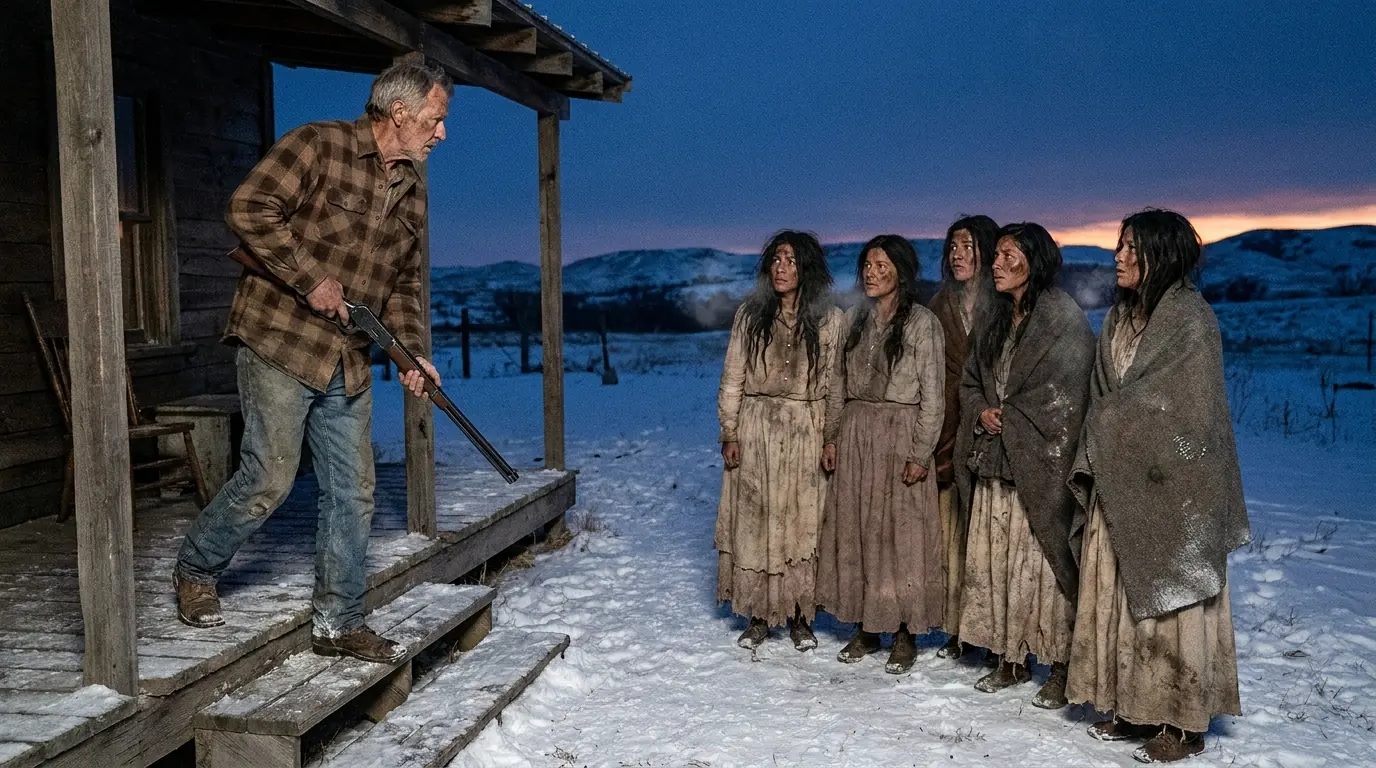
"Already lost family before, so the women left only to run in the night." The silence that followed was heavy with unspoken names and places burned from memory. The braided woman added that men had chased them for two days. She tapped her fingers once on the wood railing like she was marking time. "We lose them near the river, but we think they will follow again soon."
It filled another gap for anyone wondering why they chose this specific ranch. She explained they just kept moving until they saw his fire and horses in the night, hoping for safe land. "Could have been the wrong land," Walter noted. She looked him in the eye, knowing it wasn't. He didn't answer, choosing instead to swallow his coffee slowly as the heat rolled through his chest.
He knew he didn't deserve trust so easily, but they had given it anyway by arriving with nothing left. He stood up and announced they would finish the fence today and check the well pump. "If winter hits early, we need water ready," he added, including them in the chores without needing to explicitly say they could stay. Before he turned away, the braided woman finally offered her name.
"My name Adalie," she said quietly, explaining it meant a clear path. Walter blinked, caught completely off guard by the personal introduction. The name was a token of trust laid down gently like a stone on steady ground. He nodded once and introduced himself as Walter Hail. The shy woman spoke next, barely audible, identifying herself as Nollie.
The older woman introduced herself as Chala, with a hint of humor hiding in her tired eyes. Finally, the youngest spoke up in a fragile but strong voice, calling herself Mina. They had names and existed as real people before the fear took over. "Good," Walter said, clearing his throat. "Names are good."
Adalie watched him with a slight tilt of her head and asked if he had a wife. It was a simple observation because he always set six cups but slept alone. He stiffened, his breath catching slightly before he admitted he did, a long time ago. "You loved her," Adalie said as a statement of truth. "Yes," he replied.
"Her spirit sees you still," she added. Walter paused mid-breath, for he didn't believe in spirits anymore, but hearing it didn't hurt. The words settled quietly inside him next to a grief that had turned into something softer and heavier over the years. "We work," Chala said, shifting the mood before it broke open into sadness. Walter nodded in agreement, and they rose together to move the day forward.
Something major had changed through the shared names, truths, losses, and decided labor. The ranch was no longer a place waiting to be left behind; it was turning into something fragile and real. As Walter lifted the hammer, Adalie walked beside him, scanning the horizon for threats while he checked the boards for cracks. One thing became clear: he was no longer living just for quiet, but was living among the living again.
The next day rose under a thin winter sun that brightened the land without warming it. Frost still clung to the trough edges, and the ground held a stiff crunch under his boots. Walter stepped out first, his coat collar high, sweeping the ridgelines out of pure habit. His awareness was sharper and his steps quieter as he guarded the lives behind him. The cabin door creaked, and Adalie walked out carrying two cups of steaming coffee.
She offered him one without a word, and he accepted it, their fingers brushing against the warm tin. The exchange lasted only a second, but it felt like a deliberate, mutual start to the day. The ranch had changed noticeably, with chickens clucking louder and horses standing alert but calm. Mina and Nollie sorted feed in the barn, and laughter sometimes flickered through the morning like a thin flame. They were building a life here instead of just hiding out.
Walter drank slowly and noted they should get the roof patched before the coming snow. Adalie nodded. "We help. There's a ladder in the shed and nails in the toolbox. I bring it." She walked off steady and sure without waiting for permission. Walter watched her quiet confidence, noting the way she chose each step with a straight back and lifted chin.
When she disappeared behind the barn, Walter noticed Chala and Sonnie kneeling near the ground. They were turning the soil with sticks and bare hands, prompting him to walk over and ask what they were doing. Sonnie held up a handful of tiny speckled corn kernels and a small pouch of dried herbs, stating they were planting food for the winter. Walter blinked, realizing he had not planted anything since his wife passed away.
He had kept his shelves stocked and his cattle fat, planning only for a lonely man's survival. But these women were already planning for a real future. Chala copper-brushed dirt from her fingers and asked for seeds, beans, and squash to stretch their food. Her tone wasn't begging, but rather capability looking for tools, so Walter nodded and pointed toward the root cellar.
She grinned faintly, an entry of quick and surprising warmth, noting that now they would not starve. Walter stiffened slightly at the bluntness, but he respected the poetic truth of hunger. By midday, repairs were fully underway as Walter hammered new shingles. Adalie handed boards up from the ladder, steadying it with one hand and bracing the railing below.
Mina practiced walking without favoring her injured ankle, taking slow steps across the yard and touching fences for balance. Nollie swept dust and loose hay into a pile, each stroke focused on clearing away the past. Sonnie and Chala dug soil beds near the cabin foundation, shaping neat rows despite their numb fingers. Adalie glanced up and asked why he had left the soldiers, trying to understand the man who stood between them and danger.
Walter paused mid-nail as the wind tapped his coat, staring out across the land. The locked memories of border patrols, dust storms, and people herded like animals breathed again. "I saw things," he finally said. "Things I won't do again." Adalie did not push further, choosing instead to reach up another board.
"Then you're not like the men who came after us." "No," he said. "I'm not that man anymore." "Good," she replied firmly. "We not run from here then." Walter blinked, noting she had not asked if they could stay, but had simply decided it.
Somehow, he found himself relieved by her certainty. Suddenly, a sharp and frightened shout cracked across the yard from Mina, who was pointing toward the ridge. Walter's boot hit the roof edge hard as he pivoted to see a rider approaching fast on a straight path. He barked a command, and the women moved quickly with a discipline forged from survival.
Sonnie pulled Mina to shelter, Nollie ducked behind the barn, and Chala grabbed a butchering knife. Adalie didn't run away; she moved toward Walter, standing just beneath the ladder in case he needed to get down fast. Walter slid off the roof in two strides, his rifle in his grip before his boots hit the ground. His pulse pounded with pure calculation rather than fear.
The rider slowed near the fence, and when his face came into focus, Walter's muscles eased slightly. It was Tom Brewer, the nearest neighbor from five miles west—a man of few words who was loyal to his own survival first. Tom raised a hand, noting the smoke and admitting he thought there was fire trouble. Walter kept his voice calm, explaining he was just clearing brush.
Tom's eyes slid to the barn, noticing the quick movement of someone disappearing behind the hay bales. "You got help out here?" he frowned. Walter held his ground steadily. "Working hands for a spell." "Hard to find good labor these days," Tom noted.
"People move through," Walter replied. "Sometimes they stay a while." Tom leaned slightly forward in his saddle and asked if he had heard about the Apache girls who ran from Fort Spencer. He noted the town was wound up and that some men were riding around looking to earn favor by turning them in. His tone suggested he didn't like the hunt, but wouldn't fight it either, adding that he trusted Walter would say if he saw anything.
Walter's fingers tightened on the rifle. "Nothing here but chores." Tom studied him a moment too long while the horses behind the barn shifted. Adalie stayed frozen, watching intensely rather than cowering or running. Finally, Tom exhaled, told him to watch himself because winter brings more than cold, and rode off.
He checked the treeline once before disappearing beyond the ridge. Silence returned, and Walter didn't relax until the dust fully settled. Adalie stepped out first, approaching Walter without shaking or sagging. "You protect us again," she said quietly. "I protected peace on my land," Walter shook his head.
"No," she corrected softly. "You protect us." His throat felt tight, and he didn't answer her. Sonnie approached next, heavy with guilt, stating they didn't mean to bring trouble. Walter looked at them all—five women who had rebuilt more in two days than he had in years.
They worked his soil, fed his stock, and shared his fire without draining his world. "You didn't bring trouble," he said finally. "The world brought it to you. I just won't help it along." Adalie's eyes softened with respect. The day quieted again as work resumed its natural rhythm.
But Walter knew a truth now as sure as winter's breath: this layout was not temporary. Next time someone rode through, he would not stand alone on that porch, and the women knew it too. In the stillness after danger passed, they were no longer simply surviving; they were defending the ranch together. The ridge stayed quiet for the rest of the day with no riders or dust trails.
But everyone felt the underlying tension, a reminder that the world outside the fence had not forgotten them. Late afternoon clouds stretched heavily in the west, thick, gray, and crawling slow like a warning. Walter looked up at them, his eyes narrowing. "Storm coming. Snow, maybe tonight." Adalie followed his gaze.
"We prepare fast." They moved without fear this time, driven by pure purpose. Sonnie and Chala covered the soil beds with canvas sheets weighted by stones. Nollie gathered buckets to store inside the barn, and Mina tied dried herbs from the eaves. Adalie carried water barrels close to the cabin wall, her hands steady though the wind started to bite.
Walter split the last log and stacked it high under the porch awning. Winter didn't care who you were or what chased you; cold punished everyone the same. Walter stepped inside the cabin and unlocked a cedar trunk near the wall. Inside lay two revolvers, extra cartridges, an old cavalry knife, and a spare rifle.
He hadn't opened it since the day his wife died, having promised himself he would never be that man again. Adalie stepped in behind him quietly without asking permission. She watched him lift one revolver, check the cylinder, and set it on the table. Her voice came soft but sure. "You keep weapons hidden because you feared you might use them again."
Walter paused as she noted he had fought before under orders, carrying a heavy weight. He closed the trunk and stated he didn't want to fight anymore. She stepped closer, her warmth feeling real in the cold cabin. "Wanting peace is not weakness," she said. "But sometimes peace needs strong hands."
He held her gaze, thinking of his years of absolute stillness. Here she was, telling him that stillness could break if needed, but he didn't answer. Wind hit the window, and snowflakes tapped the glass for the first time as night fell fast. They ate stew together inside the cabin, the bowls warm and the fire crackling.
Calm replaced laughter, creating a secure and unafraid kind of quiet. The women sat close to one another, their shoulders touching lightly. Walter sat at the table with his boots heavy on the floor and his coat drying near the stove. Outside, the snow thickened and the wind rose, prompting Chala to secure the rattling barn door with rope.
Mina checked the horses one last time before bed. Adalie stood near the door, watching the storm as if reading threats inside the snowflakes. Walter joined her, and their shoulders brushed without either of them flinching. "You lost more than a wife," she said quietly. "You lost your place in the world."
"I made my world small," he answered. "Easier that way." "You made it lonely, too," she added. He exhaled through his nose and remarked that he figured that was the price. She turned to him and stated that he did not have to pay that loan anymore.
The words landed heavier than the snow outside, simple and true. He didn't reply, but his chest loosened like a door opening inside him. Later, while everyone settled under blankets, Walter walked the yard with a lantern in hand. Snow fell hard, coating the fence rails and horse backs as his footsteps sank in white.
The cold stung his cheeks, but he wasn't walking to feel alone anymore. He was walking to protect a shared home. Halfway across the yard, something caught his eye: a shadow near the treeline that was too still to be a branch. His blood jumped as he lowered the lantern, squinting into the blur of snow.
The shadow didn't move, freezing when he looked in its direction. He turned his head just enough to speak toward the barn doorway behind him. "Adalie, stay inside. Tell the others to keep the lights low." Her voice answered steadily, asking if he saw someone.
"Not sure," he replied, telling her to stay with them when she offered to come out. A moment passed as he heard her breathe in the dark. "We do not leave you alone," she whispered back. Even though she did not step out, the sentence pressed warmth against the cold night.
Walter stayed facing the ridge with his rifle in hand, his breath slow and pulse sharp. The snow thickened, and the shadow vanished or melted into the storm. He stood there until the cold bit deep through his coat. Then he exhaled, forcing the tension down for the night. Danger would wait outside the fences for now, but tomorrow would bring answers.
He returned to the cabin and shut the door to find Adalie searching his face. Without speaking, he set the rifle near the door, and she nodded once. They sat near the fire while the storm howled outside, their shoulders almost touching. They had lived through enough fear to know that peace was not just a quiet night.
Peace was watching the storm with someone sitting beside you, knowing you won't face it alone. Snow piled through the night, burying fence posts and softening every sharp line on the land. By morning, the ranch looked like it had been swallowed by winter. The sky hung dark gray, promising more snowfall to come.
Walter stepped outside first, his boots sinking deep as his breath clouded. The world felt slow and muffled, as if sound itself had frozen in the air. Inside the barn, the women stirred with low voices and careful movements. Adalie came out second, blankets around her shoulders and hair braided tight against the cold.
She walked beside Walter without a word as they looked out over the white covered pasture. The hills remained completely invisible behind the falling flakes. Walter brush-cleared snow from the top rail and noted they would need to shovel paths. "We need to bring more hay inside and cut ice off the trough so horses can drink," he added.
Adalie nodded, her expression calm but alert. "We work fast. Snow not stopped long." They split tasks without needing to discuss any details. Walter and Adalie shoveled a clean path from the barn to the cabin. Sonnie and Chala hauled hay bales inside, while Nollie checked the barn loft roof.
Mina gathered blankets and jars of dried herbs, taking inventory like a woman who understood shortages well. By mid-morning, the windows glowed warmly and the tools hung dry. They had beaten the first edge of the storm. Inside the cabin, Walter poured hot water over coffee grounds, filling the room with steam.
The women gathered near the stove, warming their hands and drying their skirts, tired but unbroken. Walter sat with them this time instead of remaining apart. His presence meant something now, a fact he felt and they did too. Adalie looked at him across the small table, noting he watched a shadow on the ridge last night.
Walter nodded and admitted it could have been a branch or someone checking from a distance. "You think soldiers find trail again?" she asked as he stared at the fogged window glass. "If they do, it'll be as soon as the snow clears, and if that happens, we stand," he said. The room went quiet with deep consideration rather than fear.
"We run long time. We tired of running," Chala spoke next. Sonnie nodded, noting it was better to hold ground than lose feet in the snow. Mina squeezed her blanket tighter but lifted her chin, declaring they would not go back. Walter understood that this ranch had officially become their line in the snow.
If anyone came to drag them away, they wouldn't leave quietly, and Walter wouldn't stand aside. "We'll need more food before the snow deepens, so I'll ride into town in a day or two," he said. At that statement, every woman stiffened from the memory of what waited in towns. They remembered suspicious stares, hands reaching for rifles, and whispers turning to threats.
Adalie watched him carefully and asked if he was going alone. "Yes," he replied, resting his hands on the table. "I buy supplies. I don't mention you." "You return?" her voice carried hard-earned realism. People left, promises changed, and kindness faded under pressure out here.
Walter held her stare. "I come back." Her shoulders eased just enough to be noticed as he added that this land wasn't just his anymore. Adalie's eyes softened in acknowledgment of a truth neither could undo. They spent the afternoon preparing for his trip.
Walter cleaned his saddle, checked every rifle cartridge, and packed dried meat. Adalie sharpened knives and checked rope ties, while Sonnie and Chala sewed thicker wraps for Mina's ankle. Nollie boiled potatoes, portioning food into jars like she had done a hundred times before. Outside, the world stayed white and still.
That evening, they ate together again, sharing a simple, hot stew. Walter sat nearest the door out of sheer habit, while Adalie sat across from him. She angled toward him, watching both his face and the outside shadows at once. Mina asked the question that had been floating unspoken among them: "What if you not come back?"
Walter didn't answer right away because loss had followed them too long to pretend it didn't exist. "If something happens to me, you take the horses and ride north," he said steadily. "There's a path through the mountains no patrol uses that leads to Cheyenne land, and they won't turn you away." Sonnie stiffened at the thought of leaving the ranch.
"Only if you have to," Walter looked around the warm shelter. "I don't plan to fail you." Adalie studied him, then gave a small nod to accept the unspoken pact. Later, as night wrapped the ranch again, Walter stood outside near the porch. His rifle leaned against his leg as the snow crunched under his boots.
Footsteps approached quietly behind him as Adalie stood at his side with a blanket. "You protect place like heart," she said softly. His jaw tightened. "Never thought I would again." "You did not break," she replied. "You rested. Now you stand."
Walter watched his breath travel into the cold air and disappear. "Feels different standing with someone." Adalie stayed close, her shoulder near his to share her warmth. A lantern glowed behind them in the cabin window, soft and steady. Tomorrow he would ride to town into danger and watching eyes.
But tonight, nobody ran, nobody hid, and nobody feared the quiet. They faced winter together, and the ranch was officially a place to return to. The morning Walter rode into town, snow crunched deep beneath his horse's hooves. The cold pushed at his face hard enough to bring tears to his eyes under the sharp blue sky.
Back at the ranch, smoke curled from the cabin stove as the women watched him leave. They didn't wave, knowing that goodbye wasn't always final here anymore. Walter kept his rifle holstered but ready as he rode with purpose. He reached the frozen creek crossing near Sable Ridge by noon.
A few wagons sat outside the general store where townsfolk walked bundled in coats. He tied his horse to the post, pushed open the store door, and stepped inside. Warmth hit him first, followed by an immediate silence as every head turned. He wasn't usually the center of attention, but today their stares held suspicion.
Word traveled fast, and soldiers searching for missing women was a story people chewed on. They only needed a rumor and the comfort of a shared enemy to form an opinion. Walter forced his shoulders to relax. "Need flour, beans, salt, coffee, and lamp oil." The storekeeper, a heavy man with white whiskers, nodded slowly.
"Stocking up for the storm. Winter don't care who's ready," Walter noted. The same rider from before watched him closely from a seat near the stove. His gaze tracked Walter's hands, his expression half curious and half accusing. The sheriff walked in then, shaking snow off his boots at the door.
His coat was brushed with frost, and his badge caught the firelight. "Morning, Hail," he said in a voice that was too calm. Walter nodded in response. "Sheriff." "Got word soldiers are still looking for those runaways, and the camp commander is steamed," the sheriff noted.
He leaned forward slightly. "You sure you ain't seen anyone pass near your place? New snow's good for catching tracks." Walter kept his jaw tight. "I keep to myself. Track what I need to." "Just checking in," the sheriff said, his eyes narrowing. "You don't want trouble finding you because of someone else's mistakes."
"I don't plan to bring trouble anywhere," Walter said, speaking the truth with an intentional direction. After a stretch of silence, the sheriff nodded once, stepped back, and left the store. The storekeeper finished packing the supplies, and Walter paid him before loading his horse. He rode out without looking back, feeling eyes on his spine until the wind swallowed the sound of the town.
He stayed alert on the ride home, but found no shadows or tracking threats behind him. When he reached the ridge above his ranch near sunset, he saw the smoke rising in steady streams. The cabin windows glowed warm, causing him to let out the breath he'd been holding for miles. The gate opened before he reached it as Nollie pulled the latch and Chala stepped beside her.
Their eyes searched his face first, then the supplies, and finally the road behind him. "You came back," Mina said, her voice small but sure. Walter dismounted and replied, "Told you I would." Adalie approached over the crunching snow, relief sitting in her eyes like a steady fire.
Walter handed her the coffee sack, their fingers touching to speak an unspoken truth. The world outside hadn't taken him; he chose to return. "Any trouble?" she asked. "Questions, but no riders followed," he said. Sonnie nodded slowly. "Then we stay."
They carried the supplies inside, lit more lamps, filled water buckets, and prepared a fresh stew. Outside, the snow softened the world like a clean page waiting for new words. Inside, the cabin felt fuller than it ever had, with low voices, close chairs, and steaming bowls. Walter sat at the table, and Adalie sat directly beside him instead of across.
The others settled near the stove, their cheeks turning pink from the welcome warmth. Mina rested her wrapped ankle, Nollie braided furs into a sleeve, and Chala sliced a fresh loaf of bread. Sonnie stirred the stew while humming low, a sound slowly returning after years of heavy silence. Walter looked around and saw real people building a life here, not just temporary guests or burdens.
They chose this place the same way he chose not to turn away. "You protect us from the world, but you also bring us back into life," Adalie said quietly. Walter met her eyes. "You brought life here first." She nodded once slowly. "Then we build it together."
Outside, the snow faded under the night sky as a cold wind brushed the solid walls. Inside, the warmth held strong, bringing the final answers they all needed. They would not leave, the soldiers would not take them, and the town would not decide their fate. This ranch had become a concrete truth earned in silence, built in labor, and strengthened in danger.
Walter Hail had chosen to stand again, and Adalie and the others had chosen to stop running. They weren't hiding anymore; they were completely home. When the night deepened, Walter stepped outside one more time out of pure habit. The snow reflected the moonlight across the quiet land as Adalie joined him with her blanket.
He looked at the horizon and announced that tomorrow they would start fencing the north field. She nodded. "We plant more crops. Build smokehouse." He exhaled slowly and steadily. "It'll be a good year."
"It will," she said. "Leaning on the fact that we stay." Walter felt the old ache and empty quiet replace themselves with the comfort of belonging. This was a story about choosing life and staying for it, as the ranch now held breath, warmth, footsteps, laughter, and hope.