In late summer of 1981, a tractor and implement auction took place in Harlan County, Nebraska. The gravel yard was about the size of two football fields, filled with rows of old iron lined up in the dust. Tractors, balers, plows, hay rakes, and disc harrows stood waiting, some older than the men walking between them. The air smelled of diesel, cut hay, and coffee going cold in Styrofoam cups. It was a place where deals were made with a nod and a handshake, and where a man’s reputation either walked in with him or didn’t walk in at all.
Just before 8:00 on a Wednesday morning, a borrowed Chevy pickup with a dent in the left rear fender pulled into that yard. Out stepped a 15-year-old girl named Margaret "Maggie" Holloway. She had driven herself 18 miles alone on nothing but a learner's permit, with no adult riding shotgun to vouch for her. In the breast pocket of her work shirt, she carried a tobacco tin containing $380, mostly in fives, tens, and ones. This money was saved over two years of detasseling corn, mowing lawns, and helping neighbors bale hay.
Folded into a manila envelope under her arm, she carried a handwritten parts list. There were 71 registered bidders that morning, mostly men who had been trading iron since Eisenhower was in the White House. These men had weathered faces, calloused hands, and seed caps pulled low. They knew each other by first name, by the trucks they drove, and by the farms their fathers had run before them. Onlookers scattered around the edges of the yard, leaning on tailgates, chewing toothpicks, and nursing coffee for entertainment.
At a country auction, sometimes the best show is watching somebody make a fool of themselves. When a 15-year-old girl walked into that yard alone with a steno pad, a flashlight, and a mechanic's gauge clipped to her belt loop, most men thought the entertainment had arrived. However, Maggie was not putting on a show; she was working. She walked the preview rows slow and methodical, just like the serious buyers. She stopped at a tractor, climbed up on the drawbar, shone her Rayovac flashlight into the engine bay, and took notes.
She avoided the pretty machines with fresh paint or new tires, focusing instead on the ones everyone else had walked past. Sixty-two-year-old Earl Vickers, an implement dealer out of Alma, Nebraska, had been buying and selling old iron for 35 years. Everyone in Harlan County knew Earl, and Earl knew everyone. Standing near the registration table, Earl watched Maggie walk the rows and turned to the man next to him. He remarked that she looked like somebody's daughter pretending at farming, likely sent by her father to hold a spot.
He did not say it to be cruel, but rather with the amusement one has for a child playing dress-up. In his world, there was no other explanation, as 15-year-old girls simply did not come to equipment auctions alone with tobacco tins full of cash. While Earl was shaking his head and making quiet jokes, Maggie found her way to lot number 22. Lot 22 was a 1951 Massey Harris 44, its red paint faded pink from 30 summers of Nebraska sun. Its rear tires were cracked but still holding air, and the hood was dented from an old impact.
The front end of the tractor was visibly crooked, sitting at an angle that could be seen from across the yard. To any experienced farmer, this lean indicated that the tractor had been in a wreck, hitting a stump or a ditch hard enough to bend the axle. A bent axle on a 1951 Massey meant it was merely a parts tractor, destined to be stripped for its engine and sheet metal. Every man who walked past lot 22 looked at it for about four seconds and moved on. Maggie, however, stood in front of lot 22 for 26 minutes and walked around it three times.
She got down on her hands and knees in the gravel to look underneath. Using a folding carpenter's rule, she measured the deflection at the front wheel hub and wrote it down. She climbed up on the seat, turned the steering wheel through its full travel, and recorded her observations. She checked the compression on all four cylinders with her gauge, noting those numbers as well. Then she stood back, closed her steno pad, slid it into her back pocket, and walked over to the registration table.
She slid her tobacco tin across the table to the clerk. The clerk counted out the registration deposit, paused to check her birth date, looked up at Maggie, and looked back at the form. Without saying a word, the clerk handed her a numbered paddle and wrote her name down as bidder number 48. From across the yard, Earl Vickers watched the transaction and shook his head once more. He told the man next to him that the poor girl was about to spend her daddy's money on a lawn ornament.
Earl was a good, smart man who had been right about many things, but on this morning, he was about to be wrong. To understand how wrong he was, one must know where Maggie Holloway came from and what she had been taught. Her story actually started 14 years earlier in a shop on a gravel road in Franklin County. Her grandmother on her father's side, Vera Holloway, had been farming wheat and grain sorghum on 160 acres for 37 years. Vera had come onto that land as a young bride in 1942 and buried her husband there in the winter of 1962.
From that winter forward, Vera ran the whole operation by herself without any hired help. When her husband died, she was 44 years old with a mortgage, a combine needing a new clutch, and a leaking barn roof in October. Rather than selling the farm to take a town job, she decided to keep going. She quickly confirmed that the nearest implement dealer over in Hastings was not going to take her seriously. In the spring of 1963, she took a grain drill problem to the counter, and the man promised to send someone when they had time.
Days passed, then weeks, and nobody ever came to help her. Vera drove back, heard the same excuse, and returned home to make herself a promise at her kitchen table. She decided to learn to fix her own equipment by purchasing service manuals and parts catalogs. She even figured out how to get on the mailing list for dealer bulletins from Massey Harris, John Deere, and Allis-Chalmers. Before long, her shop file cabinet was full of manufacturer papers detailing known defects, recommended repairs, and torque specifications.
Vera taught herself one repair at a time over four years until she could handle anything the farm needed. Starting in 1973 when Maggie was seven years old, Vera began bringing her out to the shop. Instead of lecturing her, Vera would simply hand her tools and ask her to hold things or shine the light. Maggie spent years at her grandmother's elbow, watching carburetors come apart on sheets of newspaper spread across the workbench. She watched Vera pull engine heads and lay out bolts carefully so they would return to their original holes.
She listened to her grandmother explain the distinct sounds of a tired bearing versus one that was about to fail. By the time Maggie was 11, she was doing compression checks on her own. By 12, she was rebuilding carburetors start to finish, and by 13, she was adjusting valve lash on a straight-four Continental engine. Vera Holloway died of cancer in the winter of 1979 after a fast five-month illness. She left 13-year-old Maggie her 1947 oak tool chest, her detailed shop logs going back to 1963, and the contents of the steel file cabinet.
A note accompanying the bequest contained just two words: "Use them." For the next 20 months, Maggie did exactly that, focusing her efforts entirely on her grandmother's machine. She chose to master the 1951 Massey Harris 44 that Vera had owned since 1952 and kept running for 27 years. She learned that single machine cover to cover, studying every bolt, bushing, bearing, and quirk. In the fall of 1980, Maggie opened a three-page service circular that Massey Harris had mailed to dealers in the spring of 1954.
The circular described a defect in the steering spindle bushings on the 1950 and 1951 Massey Harris 44 models. The bushings were made of a soft material that wore unevenly after 15 or 20 years of use. When this happened, the front axle would settle at a lean, making the front end look crooked. The document noted that this cant looked identical to the damage caused by a bent axle from a collision. No mechanic could tell the difference from the outside without measuring underneath, but it was actually just a $14 bushing.
The circular specified a lateral deflection of 4 and 1/2 inches at the wheel hub, plus or minus a 16th. If a measurement matched that number, it indicated a worn bushing rather than accident damage. Repairing it required three hours of bench work and $14 in parts. Maggie read that circular twice. On that late summer Wednesday morning, she got down in the gravel and measured the deflection at the hub of lot 22, finding it to be exactly 4 and 1/2 inches on the nose.
The 71 registered bidders were reasoning from general experience, which told them a crooked front end meant a bent axle. Because general experience is usually right, they all dismissed lot 22 as a parts tractor. Maggie, however, was reasoning from a specific piece of manufacturer paper printed in 1954. While the other men knew a lot of things a little bit, Maggie knew one thing all the way to the bottom. At 9:30 in the morning, the auctioneer climbed onto his platform and began his fast, rhythmic chant.
The crowd responded with paddles and nods as the ring men tracked the bids. Lot one, a hay rake, went for $95; lot two, a grain drill, went for $520; lot three, a Farmall H, fetched $380. The fast pace continued through balers, plows, cultivators, and wagons as the ring men chalked numbers on the equipment. Maggie stood near the back of the crowd with her paddle at her side and her tobacco tin in her shirt. She refrained from bidding on the early lots, even passing on a nice John Deere B that sold for $220.
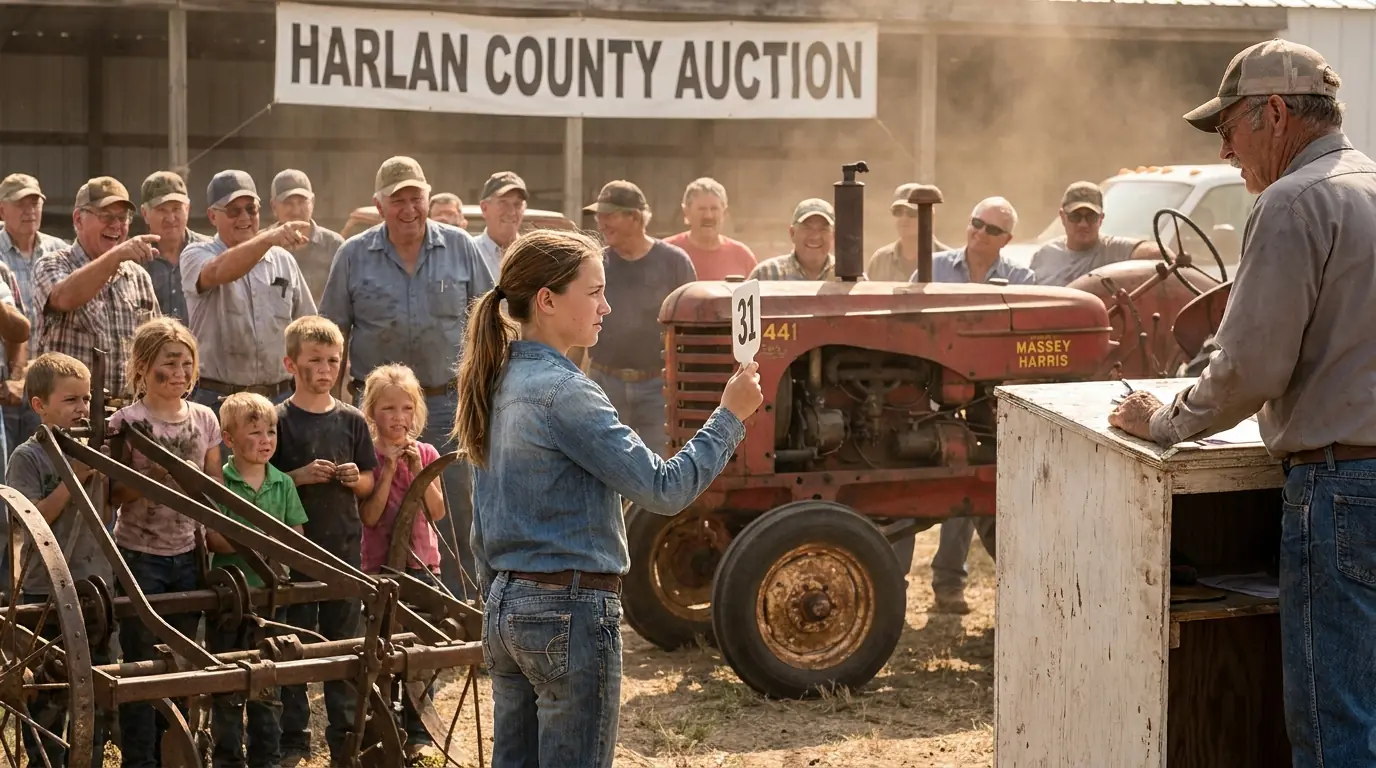
At around 10:15, the auctioneer called lot 22. Two ring men pushed the Massey Harris 44 out into the open by hand with the transmission in neutral. The auctioneer read the clipboard description, noting the compromised front end and selling it as-is with no warranty. He opened the bidding at $175, but the yard remained completely silent. He lowered the starting bid to $125, then to $90, until a salvage buyer from Kearney finally bid $95.
Maggie Holloway then raised her paddle slowly and deliberately, bidding $105. The salvage buyer countered with $115, Maggie answered with $125, and the bidding quickly climbed to $145. Earl Vickers noticed the steady cadence of Maggie's paddle and turned around to watch. The salvage buyer bid $155 and paused to calculate the value of the engine, sheet metal, and scrap. Having passed his financial ceiling of $150, the buyer shook his head, and the auctioneer brought down the gavel.
Maggie owned the tractor for $155, leaving her with $225 in her tobacco tin. As she came out of the side office after signing the paperwork, Earl Vickers was waiting for her in the gravel. He gently told her that he hated to see her lose money on a tractor with a bent axle that would only serve as a lawn ornament. Maggie looked up at him and calmly explained that it was a steering spindle bushing problem, not a bent axle. She cited the March 1954 Massey Harris service circular detailing the specific 4 and 1/2-inch lateral deflection.
Earl Vickers stared at her and asked what it would cost to fix it. Maggie replied that it would take $14 in parts and about three hours of bench work. A dozen weathered men drifted over, overheard her answer, and instantly recalibrated their assumptions. When Earl asked where she had learned this, Maggie credited her grandmother, Vera Holloway. Earl smiled, recalling that he had sold Vera a baler in 1968 and remembered her as his toughest customer who made him drop the price twice and throw in the belts.
The 62-year-old dealer stuck out his hand and shook Maggie's hand right there in the gravel. This handshake represented an acknowledgment from a veteran to a young girl who had just taught him something about his own trade. The following Sunday, Maggie borrowed a neighbor's flatbed trailer to haul the Massey Harris 18 miles back to her shop. She set the tractor up on jack stands in the main bay and referenced her steno pad measurements. The extraction went exactly as the circular described as she pulled the wheels, hubs, and worn bushings.
She pressed the new bushings in using a borrowed arbor press at a neighbor's shop, paying two dollars for its use. She reassembled the front end and torqued every bolt to the specifications recorded in her grandmother's 1957 shop log. The entire repair took two hours and 50 minutes. It cost $13.20 for parts because one of the budgeted bushings did not need replacing. In early September, she fired up the Massey Harris 44 and drove it straight and true down the gravel lane.
In October, she sold the repaired tractor to a farmer near Orleans, Nebraska, for $525. Her total investment was $170.20, yielding a net profit of $354.80. The story of Vera's granddaughter buying the crooked Massey for a song and fixing it quickly spread across the county. It was discussed over coffee at the co-op, on church pews, at the feed store, and across farm fences. By Christmas of 1981, local farmers were driving up her gravel lane seeking help with their broken balers, combines, and old tractors.
They would knock on her shop door, and she would come out wiping her hands on a rag and tell them to leave it for a week. In March of 1982, Earl Vickers drove up the lane with a proposition to split the profits on a 1947 Allis-Chalmers WD that needed repair. They struck a partnership in the yard with a simple handshake. By her high school graduation in May of 1984, Maggie had repaired and resold 11 pieces of equipment. She accumulated $2,140 in her savings account and built a five-county reputation as an expert tracker of old iron issues.
She skipped college, and in 1989, at the age of 23, she hung a sign reading "Holloway Agricultural Repair" at the end of her lane. Within 12 years, she was serving clients across five counties without ever spending a single cent on advertising. In April of 1996, a 77-year-old retiring Earl Vickers drove up her gravel lane one last time. They stood in the yard talking about the old days, the auctions, the men who had passed, and Vera. At the end of the visit, Earl shook her hand a third time, holding it a second longer.
He confessed that he had initially suspected she just got lucky at the auction and had only shaken her hand out of respect for Vera. He admitted he had felt bad about that assumption for 15 years. Maggie replied that she was simply lucky her grandmother kept the circulars, but Earl noted she was lucky she actually read them. That was the last time they saw each other before Earl passed away in the fall of 1998. Maggie attended his funeral in Alma, sitting quietly in the back of the church.
Holloway Agricultural Repair remains active on that gravel lane in Franklin County today. The service literature now fills 51 binders and two full filing cabinets to preserve every circular saved by Vera and added by Maggie. In the middle of the main bay, right where the afternoon light falls from the south window, sits the 1947 oak tool chest. Its drawers still slide smooth, their handles worn dark by two generations of working hands. On top of the chest, a yellowed paper remains taped down, bearing two words in careful handwriting: "Use them."