Reed Holston guided the tired mule team down the main stretch of Redstone Crossing with the same slow steadiness he used for every job that kept his ranch from collapsing. His coat was dusted the color of the road. His beard needed trimming again, but he hadn't bothered in weeks, and his eyes, washed out gray from years of sun and squinting, moved over storefronts, men, and horses without any need to linger because he didn't come to town to look at people. He came for salt, coffee, lamp oil, nails, and a new whetstone because the old one had cracked clean through. He told himself that was all, in and out, with no delays.
The last time he had stayed in town past sundown, some drunk brought up the war, the dead, and the part Reed played as a Union scout. Reed had stopped talking and left because there was nothing to say that could make any of it different. His wife had been dead ten years, buried on a hill behind the cabin with a simple cross and a stone he turned over with his own hands. The ranch was half alive, sometimes less than that, but it was still standing. That was his mission now: keep it standing, keep the fence rails mended, keep himself fed, and keep the days moving in a straight line.
He would have gone straight to the general store if not for the noise coming off the old livery yard. Men gathered close, some laughing, some spitting, and some standing with that empty attention that comes when there's nothing to do and cruelty passes the time. Reed didn't slow because he wanted to, but because the path narrowed with bodies and because he heard the words "auction," "last one left," and "worthless." His hands tightened just a touch on the reins before he set the brake and stepped down. He saw her at once.
She was chained to a rough-hewn post, her wrists red and bruised from iron. She stood upright—not stiff, not slumped, just upright with her chin level. Her eyes were clear and focused on nothing in front of her, like she had learned it was safer to look through men than at them. Her dress was torn deerskin with fringe that had once been carefully placed, with beads and feathers still hanging in some spots. The neckline was ripped down so far it exposed the top of her chest and the curve of her cleavage.
There was no attempt to cover it because there was no extra cloth and because modesty hadn't protected her from anything. Her skin held the color of the country she came from, a sun-warmed copper, and the muscles along her bare arms and calves showed a life of work, walking, and not breaking. She was young, maybe twenty-four, with long, black, tangled hair. Parts of it were braided, while parts of it had been pulled loose by days of wind and handling. Men had been jeering her, which he could see in the set of their mouths and the careless way they leaned in.
She hadn't reacted or given them anything at all. "She ain't spoke a word," a man near Reed said, not looking at him, just announcing it to anyone listening. "Three days. Others sold quick. Not her. Wouldn't kneel. Wouldn't cry. Just stands there." He spat, adding that folks said she was cursed, stubborn, or both.
Reed's jaw worked once, but he didn't answer as he stepped closer. His boots sank a fraction into the dry soil. The woman's eyes shifted finally and landed on him. There was no plea there, no hope, no friendliness, and no relief. It was just a read of him, fast and exact, the way a person checks for a threat and decides what to do next.
He knew the look because he had worn it after the war. He still wore it some mornings when he woke and had to remember there was nothing chasing him anymore but memory. He knew he could leave, buy his nails and coffee, go home, and pretend he hadn't seen her. He could mend fence rails, oil his lantern, and sit by the fire thinking about nothing in particular until Sunday, when he would walk up to the grave and tell his wife nothing had changed. But he also knew that if he left, she would still be there when the sun went down.
Some man with less patience and less restraint would eventually line his pocket with coins and have ideas in his head, making the outcome certain. Reed reached inside his coat, his fingers finding the folded bills and a few coins he had counted twice that morning. He stepped up to the man who seemed to be handling the trade and asked, "How much?" his voice low from disuse. The man blinked, surprised both that Reed spoke and that anyone was interested. He named a number that was less than what Reed had in his hand, but more than the woman was worth to him after three days of not selling.
Reed didn't haggle and put the money straight into the man's palm. The man shrugged, satisfied with getting something for nothing, and bent down to unlock the chains. When asked if he wanted a bill of sale, Reed simply answered, "No." The chains fell, and the weight left her wrists, but she didn't rub them. She didn't move until Reed turned away.
Then she stepped forward because standing there wasn't safer than following, and because every choice left to her was a bad one, though some were worse. Reed didn't touch her, guide her, or say anything at all. He walked back to the wagon and climbed up. She climbed in after him and sat on the plank seat, her hands resting in her lap and her shoulders steady. She glanced at the coat he wore, then looked away.
He noticed the cold coming in from the north and realized how her torn dress would handle it. He took off his coat and held it toward her. She stared at it, then at him, and finally she took it, but didn't put it on, choosing instead to hold it over her legs. They left Redstone Crossing with the sound of boots and laughter fading behind them. Nobody followed them, and the mule team moved on the road in a rhythm Reed knew by heart, with neither of them saying a thing for miles.
Reed's mind kept circling back to his land, what needed repairing, how much feed was left, the broken hinge on the chicken coop door, and the way winter would close in fast this year if the sky stayed dark. He glanced once at her wrists, noting the skin was raw. He watched her glance toward the horizon and then down at her hands, keeping her face perfectly still. He wondered how long she had been moving through the world keeping her face still like that. Her name, as he would learn later, was Awanada.
She had been taken in a raid and dragged through miles of scrub and rock. She was stripped of language by men who laughed when she didn't answer, and left unsold because pride does not bend for the sake of anyone's comfort. Her mission now, if the word could even fit, was to stay alive without giving up the last of what made her feel like herself. She would not kneel, she would not beg, and she would not say please to men who had no mercy to offer. Survival without bending was the thin, unbroken line in her head.
Reed's mission had been simple for years: keep the ranch breathing, keep himself useful enough to justify another day, and keep his dead wife remembered without letting the grave swallow the rest of his years. Buying this Apache woman hadn't been in that plan, and he wasn't sure what it meant now that he had. But he knew he hadn't brought her home to own her. He knew the cabin had room for another bed, and he knew the silence in that place had gotten too heavy to carry much longer. Dusk laid a flat orange light over his land when they finally arrived.
The fence line leaned, the pasture grass was thin, and the barn door stuck if he didn't lift it just right. He pulled the wagon to a stop near the well and climbed down. She waited, watching his hands, studying what he did and how he moved. He offered a hand to help her down, but she looked at it, didn't take it, and stepped down entirely on her own. Her bare feet hit the packed dirt, and a flash of pain crossed her eyes when the ground bit at the raw spots, but then it was gone again.
He opened the cabin door and stepped aside, letting her go first so she could see the space before he moved into it. The cabin was one room with a short wall built half across it to suggest separation. It contained a wood stove that needed a new seal, a table he had built himself with uneven legs, and two beds. There was his bed, and a smaller one he had made when his wife got sick and couldn't climb in and out of the higher frame. He gestured toward that smaller bed and told her it was hers if she wanted it.
He didn't say anything about the door staying unlocked or locked, nor did he mention chores or where she could and couldn't go. He didn't draw rules because he didn't know yet what she needed, and he wasn't going to pretend ownership gave him the right to decide it. She stood completely still, taking everything in. She noted the stove, the bed, the small shelf against the far wall with a folded shirt and a basin, and the window with a nailed-down shutter. The space smelled of wood smoke, oil, and the faint trace of a woman's soap that lingered on things Reed hadn't thrown away.
Her eyes stopped for a second on a ring that lay on the table, not worn, but carefully kept. Reed followed her gaze, then looked away, sliding the ring into his pocket without comment. "I'll make food," he said. "You can wash. Basin's there. Water's clean." He ladled stew into two bowls, thick with beans and the last of the summer squash.
He set one bowl near her bed and one on the table for himself. He didn't sit across from her, giving her space to decide where she wanted to eat. She chose the floor by the fire, sitting cross-legged with his coat across her lap and her eyes on the flames. He sat at the table as the room held two people in a silence that wasn't hostile, only heavy with new facts. Reed ate slowly, listening to the scrape of her spoon against the tin.
He thought about the next morning, about animals to feed, fences to check, and wood to split. He thought about whether she would want to help or prefer to be left alone entirely. He thought about the men in Redstone and how quick they had been to label her useless when what they really meant was that she wouldn't pretend to be less than she was. When the bowls were empty, he took them, washed them, and set them to dry. He laid an extra blanket on the end of her bed and a second one on the chair nearby in case she didn't want to sleep in the bed at all.
He pulled a rough plank and a stack of old feed sacks from against the wall, measuring the space with his eyes. He started planning where to build a proper divider in the morning so she would have privacy without needing to ask. He didn't say it out loud, but just noted the measurements in his head. Night settled over the ranch without ceremony as he banked the fire and blew out the lamp. The cabin sank into a low orange glow.
She lay on the small bed with her eyes wide open. He lay on his larger one, staring up at the roof beams he had cut himself, counting the knots the way he always did when sleep didn't come. He heard her breath even out, but it didn't deepen, meaning she wasn't sleeping either. Both of them were listening to the stove, to the night outside, and to each other's quiet presence. Reed thought of the grave on the hill and how he would walk up there on Sunday, stand with his hat in his hands, and tell his wife the truth.
He would tell her that he brought someone home because leaving her there felt like leaving his wife behind, and he couldn't do that again. He felt the old guilt rise and settle, but he let it sit without pushing it away or letting it rule him. Awanada stared at the ceiling and tried to slow her heart because the sound of a door shutting in darkness still transported her back to places she didn't want to remember. The smell of a strange man's space still made her hands twitch, ready to fight. Yet, there had been no hand on her arm, no order, and no threat.
He had given her a bed, a coat, and absolute silence. She decided to stay awake long enough to hear if he moved toward her, but he didn't. Hours passed as the fire settled into glowing coals and the cold pressed hard at the walls. Neither of them slept, but neither of them left. In the morning, they would work, and though they didn't know it yet, the work would become their language.
For now, surviving the first night under the same roof without fear or demand was enough. That was the start, and that was the mission on both sides: stay, do no harm, make the space livable, and see if trust could exist without being forced into existence. The next morning broke cold. Reed woke to the sound of the wind pushing against the wooden walls and the faint pop of cooling embers in the stove. He turned his head just slightly and saw Awanada curled on her side on the small bed across the room.
Reed's old coat was tucked tightly around her knees. Her eyes were shut, not deeply asleep, but resting. The faintest furrow in her brow told him enough: she had stayed awake most of the night, just like him. He sat up, his joints aching the way they did every morning now. The floor was freezing under his bare feet as he moved quietly, not out of courtesy, but because noise had long ago stopped being necessary in his life.
He dressed, pulled on his boots, stoked the fire, and put water on to boil. When he stepped outside, the air bit deep with a dry, high-country cold. The sky was clear, and the pasture stretched toward the hills in a brittle line of yellowed grass and rusted fence posts. He fed the mules a cracked bucket of oats, fed the hens, and checked the lean-to where a busted hinge still needed mending. Everything was right where he had left it: quiet, tired, and in need of repair.
But there was another set of footprints in the dirt now, smaller and barefoot. When he returned to the cabin, Awanada was awake, sitting upright with her legs pulled in close and her long hair curtaining part of her face. The coat still covered her, but the torn dress underneath showed more than it hid. Reed glanced once, then looked away, not out of discomfort, but respect. She didn't try to cover herself, hadn't moved from the cot, and hadn't touched anything.
Her hands were folded quietly in her lap. "I made coffee," he said, setting a tin cup near her bed. "No sugar." She looked at the cup but didn't reach for it right away. He didn't press her, sitting down at the table with his own cup and taking a sip while wincing slightly at the heat.
He needed to say something, though he wasn't sure what. She hadn't spoken a single word since the auction, and he didn't even know if she spoke English. He doubted she was fluent, if she spoke it at all. But there were things she needed to know, even without a shared language. "I'll be fixing the fence line today," he said.
"Got a section down up past the north trail, and after that, the chicken coop needs a new hinge." "There's tools outside if you know them." She said nothing, only blinking once slowly in response. "You can stay here if you want, or come. Your choice." He didn't tell her she was free because he didn't know if she'd believe him.
Freedom was a word too many men used before doing the exact opposite of what they promised. He just laid the facts down as plainly as he could. She eventually stood up slowly, stretching her legs with a quiet stiffness that said she was used to sitting too long in one position. Her bare feet touched the floor with hesitation, and Reed noted the deep redness on her soles. He crossed to a shelf and pulled out a pair of worn moccasins.
They were too small for him, kept from when his wife had once tried to learn leatherwork, and he laid them by the edge of her bed. "They might fit," he said. "If not, I'll fix them." She looked down at them, then up at him, and though she didn't thank him, she gave the faintest nod. It was enough.
He went out and started working on his chores. By the time he was halfway to the north fence line, she was walking behind him, wrapped in the coat with the moccasins on her feet and her hair braided back. She didn't ask what to do, choosing instead to watch him work. She observed the way he drove the post deeper, tied the wire, and reset the support beams. After maybe an hour, without a word, she picked up a second post and began helping.
Her hands were rough and capable, showing she had done this kind of labor before. They worked steadily without speaking as the wind carried dust around their boots. He handed her a mallet when hers cracked, and she didn't smile or look grateful, just accepting it and keeping up her swing. When they rested, he poured water into a shared canteen and held it out. She drank carefully, then gave it back to him.
That afternoon, they returned to the cabin area. Reed chopped wood behind the barn while Awanada knelt near the chicken coop, inspecting the broken hinge. She disappeared for a moment and came back with wire and a rusted nail, fixing it entirely herself. He didn't say anything, just watching her go inside quietly and deliberately. She didn't eat much that night, just a few bites of salted pork and a biscuit.
She ate slowly, chewing like she had to remind herself to do it. Her eyes didn't stray far from him, never looking suspicious, but completely aware. Reed cleared the table and lit the oil lamp. He took out wood and nails and started measuring the space near the cot. She sat nearby, arms wrapped around her knees, silent as he hammered slowly.
She finally spoke, her voice soft and cracked from disuse. "Why?" He paused his work. She asked again, firmer this time: "Why'd you take me?" He set the hammer down and looked at her, his eyes tired but steady. "Because no one else should have," he said, "and because I had room."
She stared at him for a moment, then lowered her gaze. "I don't want to be owned," she said. "You're not." "Not a wife." "No."
"Not a slave." "No." She nodded once, sharp and final. That was the deal, and it was enough for now. Later that night, Reed sat by the fire, slowly cleaning an old bridle.
Awanada moved toward the stove, placed a blanket near it, and lay down directly on the floor instead of the cot. When he looked at her, she said nothing, just staring up at the ceiling. He left her be, understanding she didn't trust the bed yet. Trust would take time, and he knew that. He didn't expect her to feel safe here, only hoping she'd learn she didn't have to run anymore.
Outside, coyotes howled in the distance. Inside, the warmth of the fire spread slowly across the floorboards. Reed looked over once before turning in for the night. Her eyes were still wide open, watching the dark beams above. She wasn't exactly afraid, just completely alert, and she hadn't run away.
That was something positive. Tomorrow would come, and so would the next day. If she stayed, he'd build the divider higher, fix the roof over the shed, and make another cut of wood. If she left, he wouldn't stop her. But she hadn't left, and he hadn't asked her to.
That was exactly where they stood: not family, not strangers, but something in between. They were not bound by words or paper, but by the fact that neither one of them had walked away. Not yet, and maybe not ever. Morning came with frost heavily edging the windows. The fire had died down to a low heat, but the cabin still held some of yesterday's warmth.
Reed stirred early as always, sliding out of bed in practiced silence. When he glanced across the room, he saw her still on the floor beside the stove. She was curled under the blanket, one hand tucked beneath her head and the other resting lightly over her chest. Her breathing was perfectly even, and her eyes were closed. He dressed and stepped outside to start the morning chores.
A layer of ice had formed over the water trough, thin but solid enough to need breaking. He used the heel of his boot, then filled two buckets to bring inside. There was a familiar rhythm to the morning: tending to the animals, splitting kindling, and checking that nothing had gone wrong overnight. Reed moved through it with the same deliberateness he always had. Only now, he was aware of her presence in a way that tugged slightly at each thought.
She wasn't a burden or a distraction, just a completely new shape in his old life. He came back inside to find her already up and standing by the window. Her arms were crossed, and she was still wrapped tightly in the coat he'd given her. She didn't startle when he entered, but her body went a little tenser, like she didn't trust any room not to shift beneath her. He set the buckets down near the basin.
"There's hot water on the stove," he said, keeping his voice low. "If you want to wash up proper." She didn't answer, just nodding once and stepping away. He turned his back to give her privacy. While she cleaned herself slowly and cautiously using the warm water and a scrap of cloth, he busied himself with the stove.
He fried leftover salt pork and ground fresh coffee beans. When she finished, she returned the basin to its place and moved back to the far wall. He noticed she had cleaned her face and arms, and her hair was damp and brushed back. Her cheeks were red from scrubbing, but her shoulders were noticeably less rigid. They ate at the table this time, not speaking, but not avoiding each other either.
She watched him between bites, her eyes moving over the lines of his face, the way he held his fork, and how methodically he chewed. He noticed, but said absolutely nothing. Afterward, he pointed out toward the barn. "I'll be clearing the south pen," he said. "The snow's coming early this year."
"I'll come," she said, surprising him. Her voice was firmer than before—not strong or warm, but entirely sure. He didn't argue with her and simply pulled on his coat, handing her a pair of work gloves. She accepted them without expression. They spent most of the day in the yard behind the barn where broken wood and old fencing had been piled in disuse.
Reed hadn't gotten around to sorting it the year before. Now, he and Awanada moved the scrap timber together. She hauled what she could, her hands still raw but steady. He caught her grimacing a few times, but he never heard a single complaint. At midday, they sat on a log and shared a piece of dried meat and bread.
The wind had picked up, so she pulled the coat tighter around her shoulders. He studied the sky before speaking. "You ever work a ranch before?" he asked finally. She was slow to respond, then noted that her father had sheep instead of cattle, but confirmed she worked. Reed nodded and muttered that he could tell.
She glanced at him, then back down at her hands. "Why do you live alone?" Reed shifted slightly. The question didn't sting; it just came from farther away than he'd expected. "My wife died a long time ago." Awanada's face didn't change, but her eyes dropped to the dirt.
"You had children?" "No." She nodded like she understood something unspoken, as if that simple detail explained everything. After a moment, she shared that they sold her because she wouldn't obey and wasn't quiet enough. He didn't answer, just watching her face carefully.
There was no tear in her voice and no pity in the telling. She wasn't looking for sympathy, just saying what needed to be said so it wouldn't rot inside her. He looked at her and said, "You don't have to be quiet here." She looked back at him, long and hard. "Even if I speak against you?" she asked.
He met her gaze evenly. "You can say what you need." That night, she slept on the cot instead of the floor. He noticed when he rose to bank the fire before bed that she had pulled the blankets tight to her chest. Her arm was curled comfortably under her cheek.
She looked more at peace than she had any night prior. He didn't mention it the next morning or bring it up at all, but he left a folded shirt by her bed. It was soft cotton, something his wife had once sewn for herself but never wore. Awanada picked it up, held it to her chest, then laid it aside. That day, she helped him mend the chicken pen.
She collected the eggs and swept the cabin when he went out to the pasture. Later, as dusk came, she stood at the threshold of the cabin, staring toward the western hills. He came up behind her quietly. "You looking for something?" he asked. She answered without looking back, noting that sometimes she thought she'd see someone, like her sister or a scout.
She added that it was something from before, but it never comes. "I looked too," Reed said. "Every Sunday." She turned then, her brows drawn slightly for her. He didn't answer out loud, just nodding in response.
They stood there in the doorway together as the sun dipped low. Side by side, they stood without touching or speaking further. But something deep had shifted between them. They were no longer two strangers under the same roof, but two people beginning to share a quiet life. In town, they'd called her unsellable, but here, she was learning to be seen.
And he, Reed Holston, the man who hadn't spoken more than five words a day for ten years, was learning that staying didn't have to mean staying buried in the past. The following days unfolded without incident, but something had changed between them, subtle as it was. The silence was still there, but it had softened noticeably. Awanada no longer kept her back to him when she moved through the cabin. She no longer flinched when he came in from the yard.
Reed noticed how she began tidying without being asked, stacking firewood, sweeping out the corners, and brushing down the mule's coat. She didn't act like a guest or a servant, but simply moved like someone who had decided for now to stay. The shirt he'd left by her bed was being worn now, loosely over her torn dress. The sleeves were too long, and the fabric hung low over her curves, but she didn't seem to mind. It covered her more than before, though her deerskin dress still peeked from underneath.
The deerskin was worn and frayed, especially at the neckline. The rip across her chest hadn't been repaired. When she bent forward, the fabric parted slightly, exposing the warm curve of her cleavage. Reed caught himself looking once, just once, then immediately forced his gaze to the floor. She didn't seem to notice, or maybe she did and simply didn't care anymore.
The tension between them wasn't desire, but something slower and weightier. It came from sharing space without force, from surviving together in silence. On Thursday, she followed him out to the far field where the fencing needed mending. The sun was harsh that day, and she worked with sleeves rolled up, sweat trailing down the line of her throat. He offered her water, and she drank without hesitation.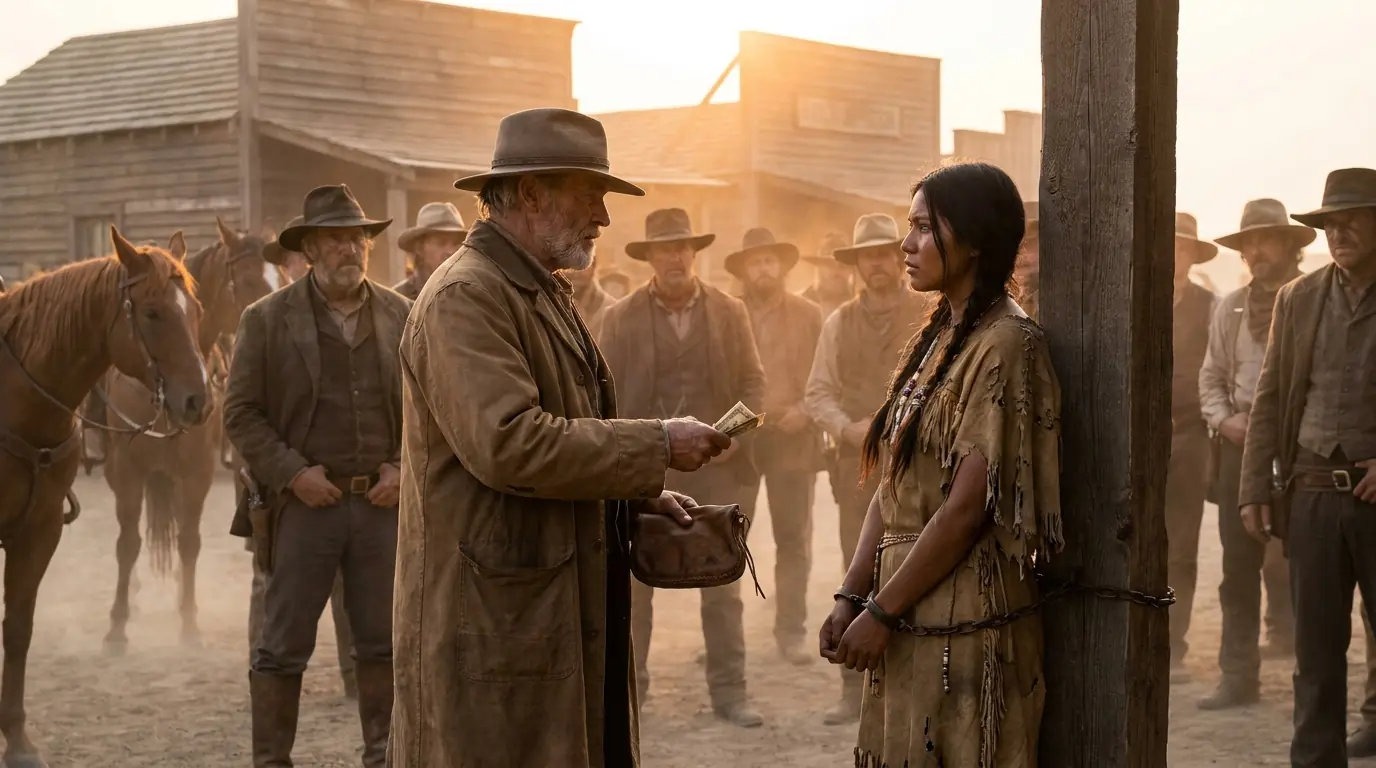
Then they kept working steadily. Midway through the afternoon, she asked something that caught him completely off guard. "What happened to her?" her voice was quiet but clear. "Your wife." Reed didn't answer right away.
He kept tying wire to the post, then leaned back against the fence and wiped his brow. "Fever," he said finally. "Got sick one spring, didn't get better. She lasted six days." "Buried her behind the cabin." Awanada looked toward the treeline.
"No children?" "No, no family. None that stayed." She nodded slowly, like that made total sense to her. "Same," she added. They stood in the field as the wind rustled the grass around them, the sun shifting lower in the sky.
Reed asked, "Your tribe? They think you're dead?" She didn't answer for a long time, then noted maybe they did, or they wished they did. "I was supposed to marry someone. I refused." "They said I dishonor my father, and after the raid, no one came looking."
That was all she said, and it was enough. When they returned to the cabin that evening, Awanada washed at the basin while Reed lit the lamp and stirred the stew. He watched her in the glass reflection, her long hair loose now and her collarbone visible through the open shirt. He noted the scars and marks that told quiet stories he didn't ask to hear. Her body was strong, but no longer tightly guarded.
There was still war in her, but it wasn't directed against him anymore. After dinner, she sat by the fire, cross-legged, her eyes half-lidded in deep thought. He sat in the chair behind her, his hands working slowly on a broken strap of leather. The fire crackled softly as a long time passed before she spoke again. "I don't know what I am here," she said.
She continued in a low voice, noting she was not a wife, not a slave, and not part of a tribe. "I wake up, I work, I eat, but I don't know what I'm becoming." He set the leather down and leaned forward, placing his elbows on his knees. "You're someone who's still standing," he said. "That's more than most."
She turned toward him, her expression unreadable. "And you? Where are you now?" He thought about it carefully. "Tired, but trying." The corner of her mouth twitched into almost a smile.
Almost. Later, as the fire burned down and the shadows stretched longer across the floor, she moved closer to him. She didn't move quickly or directly, but with clear purpose. She sat beside his chair on the floor, near enough that their knees nearly touched. Reed didn't move away, his heart beating slowly but heavily.
She placed her hand over his rough palm, pressing against his calloused knuckles. He looked down at their joined hands, then up at her. She didn't speak, and he didn't pull away. That night, she slept on the cot again. But before she lay down, she reached out and touched his arm as he passed by.
It was just a small touch, a silent thank you, or perhaps something else entirely. Reed lay awake longer than usual, listening to the absolute quiet of the cabin and the steady breathing across the room. He didn't know what they were becoming, only that the silence between them no longer felt hollow. It felt like the start of something that didn't need a name yet. For the first time in a decade, he didn't visit the grave the next morning.
He stayed inside, and so did she. The snow came earlier than expected, beginning as a thin flurry just before dawn. Fine white dust brushed against the window glass. By midday, it thickened into a slow, steady fall that blanketed the ridgelines and softened the edges of the pasture. Reed stood on the porch, arms crossed, watching it coat the fence posts.
It was quiet and still, the kind of quiet that pressed into your chest. Inside the cabin, Awanada stirred the fire, her shirt sleeves rolled up and her hair braided tight down her back. She moved differently now—still alert and guarded, but not like she was waiting for something to break. She moved like she truly lived there. Reed came in, stomping the snow off his boots.
She handed him a warm cup of broth without a word, and he nodded, grateful. Their routines had settled into a steady rhythm. He still rose early and took care of the livestock. She cleaned, mended, prepared meals when she felt like it, and joined him in the fields when the weather allowed. Something unspoken had begun to shift between them.
Neither of them had said it out loud, but the touches were more frequent now. A hand brushed against a shoulder when passing, or a quiet moment occurred at the table when their eyes stayed locked a little too long. It wasn't romantic in the way stories usually tell it. It was quieter, slower, and completely earned. That evening, as the storm thickened, Awanada pulled her bedding closer to the fire.
She wore the same patched deerskin dress beneath Reed's shirt. The shirt gaped slightly at the chest now that the buttons were worn. The heat from the fire had made her skin flush faintly, and the curve of her neckline was visible in the lamplight. Reed noticed, but not with hunger. It was something closer to sorrow, like looking at something that deserved better than it had ever been given.
"I never asked where you learned to mend fences," he said suddenly. Awanada glanced up. "My grandfather taught me. He said if you could fix a fence, you could keep anything alive. Livestock, people." Reed nodded, then took a sip from his cup.
After a moment, she asked why he never went to town, not even for church. He shrugged slightly. "There's nothing there for me. Town doesn't change." "I did," she tilted her head. "People talk about you."
"They say you went mad after the war." He set the cup down. "I came back with less than I left with. That's not madness. That's math." Awanada didn't smile, but she understood him completely.
She moved closer to the fire as the lamp flickered low. She sat near his feet now, her legs tucked beneath her, using one hand on the floor to steady herself. "I used to think silence was punishment," she said quietly. "After I was taken, they didn't speak to me unless it was a command. I stopped speaking too; it was easier."
Reed looked down at her, his voice low. "Here, silence isn't punishment. It's peace." She looked back at him for a long time, then nodded slowly. That night, she stood before the stove, waiting for the coals to settle. Reed sat behind her, rubbing his palms together from the chill.
She turned to him and took a step closer, then another. He didn't move, just watching her safely. She reached out and placed a hand on his chest, flat and warm, right over the place where his heartbeat lived. Her eyes didn't ask for anything; they just looked. Reed's voice was barely above a whisper.
"Are you sure?" She nodded. "I stayed." With that, she leaned in, pressing her lips softly to his. It wasn't long or heated, just real, present, and a clear choice. Reed didn't pull her in further or lead the interaction.
He let her decide everything. She pulled back after a moment and stepped away, heading back to the cot. She didn't say good night. He sat there long after the fire settled, his chest tight. It wasn't from desire, but from something much heavier.
He felt that for the first time in years, he might not be alone anymore, and that she might finally feel the same. By morning, the snow covered everything in sight. But inside the cabin, something had warmed, and neither of them would name it yet. Both of them had stopped looking at the door. By the second week of snow, the road into Redstone was iced over and completely impassable.
The ranch became its own world, white, still, and sealed off. Reed kept the fire burning through the day, hauling and chopping wood twice daily. Awanada swept, boiled broth, patched torn blankets, and mended leather straps by the window. The storm outside howlowed like a voice trying to call them back to a life neither of them missed. Inside, they moved around each other without the old stiffness.
They didn't speak much, but when they did, the words came easier. Reed didn't ask her about the men who had taken her. Awanada didn't ask what Reed had done during the war. They shared everything but the pain that had come before, because that didn't need explaining. She still slept in the cot, but each night she placed it closer to the fire and closer to his own bed.
She didn't say why, and he didn't ask. When the fire crackled low at night and her hand dangled over the edge, she no longer pulled it back if his hand brushed hers. One evening, the lamp burned low and the snow fell thick outside. Reed was at the table sharpening his knife. Awanada sat across from him, running her fingers down a line of old cotton cloth she'd salvaged.
Her shirt hung loose, exposing the curve of her chest through the torn dress beneath it. He didn't look away this time, and she didn't hide from him. Her voice broke the silence. "Was she beautiful? Your wife." Reed blinked once.
"Yes, but not like people mean when they say that." Awanada tilted her head, waiting for him to explain. "She was quiet, strong, and didn't need anything from anyone, but she stayed anyway." Awanada looked down at the table. "You still think about her."
"Every Sunday," he said. "But lately less like I'm holding on, more like I'm letting her rest." A long pause followed. She stood up, moved toward the fire, and knelt to stoke it. Her shirt fell open slightly with the movement.
When she turned back, her eyes stayed on him longer than usual. "I've been thinking," she said. "If I asked to stay, not just for winter, but longer, what would you say?" Reed set the knife down. "I'd say you already are."
That answer seemed to settle something profound between them. She didn't speak again, simply moving back across the room to sit beside him instead of across from whom. She rested her hand on his leg, her fingers light and unsure. He covered it with his own hand. That night, they didn't say good night.
When the lamp was turned down and the fire glowed low, she stepped over to his bed. No words were spoken as her hand rested against his chest again, this time with more certainty. He sat up and met her eyes. "You don't owe me anything," he said quietly. She shook her head once and replied, "I know."
He moved over, pulled back the blanket, and she slid beside him carefully and slowly. Her skin was warm and soft against the rough wool. They lay there shoulder-to-shoulder, remaining silent for a long time. Neither of them moved. Then she turned toward him, placed her hand on his jaw, and kissed him longer this time.
He kissed her back carefully, like touching something half-broken that had been repaired too many times. Their bodies pressed together beneath the blanket, close but unhurried. She let her hand move to his chest, and he let his drift to her waist. Their breathing deepened when he touched her collarbone and traced downward. He paused to give her space to say no, but she didn't.
What followed was not rushed or desperate; it was slow, steady, and quiet. Awanada moved first, letting her shirt fall to let his hands find the warmth beneath. Her curves pressed against his chest, her breath filled his ear, and his hands remained firm but careful. He was as steady as everything else he'd ever built. When they came together, it was not an act of possession, but a mutual return.
These were two people who had been taken apart by life, choosing for once not to run away. Her body curled against his, her breathing becoming deep and even afterward. He held her until she fell asleep, his arms wrapped around her bare back while the fire still glowed at their feet. It was the first night neither of them had dreamt of the past. There was only what might come next.
Morning light slipped through the frost-glazed windowpanes, casting a cold glow across the cabin's wooden floorboards. The fire had burned down to a faint orange pulse in the hearth, and the snow outside stretched in soft drifts over every surface. Inside, Reed lay awake. Awanada's body pressed lightly against his side, her dark hair spilling over his shoulder. She was breathing softly, her cheek against his chest and the blanket drawn up to her waist.
Her hand rested on his ribs, unmoving and familiar. It was the first morning in years that Reed didn't rise immediately with the sun. He stayed completely still, present, and grounded. Her warmth beside him felt like something truly earned. Eventually, she stirred.
She didn't speak at first, only shifting her head slightly to look up at him with an open, calm expression. There was no embarrassment in her eyes and no hesitation. Reed met her gaze with a quiet nod, his hand gently moving to the back of her shoulder to rest there. "You didn't leave," she murmured, her voice husky from sleep. "Didn't plan to," he said.
She looked away for a moment, thinking deeply. "No man I've known ever stayed after they got what they wanted," she said. "I'm not like those men." "I know." They sat up slowly as the cold air bit at their skin.
She slipped her shirt back on and tied the bottom over her hips. The torn deerskin dress beneath it still clung in places, the fringe frayed and the neckline gaping, but she didn't adjust it. Reed dressed quietly. There was no awkwardness between them and no need to define what had happened. It had been real, mutual, and wanted, which was enough.
Over breakfast, Awanada asked, "Do you ever think about leaving this place?" Reed paused with his spoon halfway to his mouth. "I used to. Not anymore." "Because of me?" He met her eyes.
"Because of what I found when I stopped running." She sat back slightly. "I used to believe I'd have to go back, that it was wrong to want something else." "Do you still believe that?" Her response took a moment.
"No, not now." Later that day, while Reed repaired a broken axle on the wagon, Awanada remained inside and cleaned the shelves. She hummed softly to herself in a language he didn't recognize. Her presence was no longer quiet in the same fearful or distant way it had been before. It was deliberate and deeply rooted.
She filled the space differently now, without asking or apologizing. Reed walked in and paused in the doorway, watching her stand on tiptoe to reach the top shelf. The shirt pulled tight across her back, her hair braided down to the middle of her spine. She turned slightly, and her eyes caught his. "You're staring," she said with a hint of a smile.
"Just looking," he replied. That night, they didn't speak much. But after the fire was lit, Awanada took a slow walk around the cabin, her bare feet making soft prints across the wooden floor. She moved toward the table, opened the drawer, and found the small ring Reed had once kept hidden. It was his late wife's ring.
She held it in her palm, then turned to face him. "I saw this before," she said. "You kept it." He nodded. "I didn't know why for a long time."
"Do you now?" "I think I was waiting for it to mean something again." She walked over slowly and placed the ring on the table in front of him, her voice steady. "I'm not her." "I know."
"I won't replace her." "You're not supposed to." Silence fell over the cabin again. Awanada looked down, then back up. "Then what would it mean now?"
Reed took the ring, stood up, and moved around the table. He didn't kneel or ask a formal question. He just held the ring out, open in his palm. Awanada's eyes filled with something close to shock, but it wasn't fear. It was pure weight, the weight of being chosen, not taken.
She didn't cry and she didn't speak. She simply reached forward, slid her fingers into his hand, and let them close around the ring. That night, she slept in his bed again, but this time she didn't lie at the edge. She curled right into his chest, her leg hooked around his and her arm resting over his heart. Outside, the snow had begun to melt a little.
A faint drip came from the eaves, serving as the first sign of spring. They didn't talk about marriage yet, but she stayed, and so did he. The snow softened into slush by the third week of March, revealing patches of earth that hadn't seen light in months. The fields were muddy, and the barn roof still carried weight from the last storm. But the air smelled different now—less like ash, and more like wet dirt and thawing roots.
Spring was near. Inside the cabin, Reed woke to find Awanada already dressed. She was crouched near the hearth, coaxing the fire into a steady flame. The shirt she wore was his, slightly too large with the sleeves rolled to the elbows. Beneath it, the familiar deerskin dress still clung around her hips, mended now with bits of cloth and sinew.
She didn't look back when she noticed him stir, simply stating that the coffee was almost ready. He sat up slowly, rubbing the stiffness from his neck. "You sleep a little? You cold?" "Not with you beside me." That quiet reply sat between them for a moment, sounding heavier than it was.
After breakfast, Reed went out to check the fence line. Awanada joined him without needing to be asked. They worked in silence, side by side, setting posts and re-tightening the sagging wire. She moved with purpose, her hands calloused now from the months of labor. Reed had started giving her more of the tools, not because he needed her help, but because she used them well.
At one point, she paused with her hands on her knees, then stood up slowly. "My monthly didn't come this week," she said. "I'm late. I've counted twice." He stepped closer, slow and careful. "You think...?"
"I don't know yet." Her voice wasn't afraid; it was measured and real. "But if I am, are you ready for that?" Reed exhaled once deeply. He didn't answer right away, looking out toward the land where the trees were starting to bud.
Then he looked back at her strong arms, her steady jaw, and her quiet gaze that didn't flinch anymore. "I never thought it would happen," he said. "Not again, not this late, not after everything. But if it's you, then yes, I'm ready." She didn't smile, but her shoulders eased completely.
Then she leaned in, pressing her forehead gently against his chest. He placed his hand on the back of her head and held her there for a long while, letting the moment settle inside both of them. That evening, as the wind rose and the clouds gathered again, Awanada stood at the window, watching the trees sway. Reed brought in firewood.
When he entered, she turned to him and spoke plainly. "If I carry your child, I want them to have a name and a home. I want to belong here." "You do," he said. "You already do." "But I mean fully," she replied.
"Not as someone rescued, not as a guest, but as your wife." He set the firewood down and crossed the room. He didn't wait for ceremony, taking the ring from the shelf where it had rested and handing it to her. "You sure?" She nodded.
"Yes." He slipped it onto her finger. Her hands trembled slightly. "Then you're my wife," he said. "Not by law, but by choice. Mine and yours."
That night they lay together without any urgency. They undressed slowly, not out of nervousness, but clear intention. She let the shirt slide off her shoulders as her warm, curved body met his without resistance. Their breathing matched perfectly. Her hands found his skin with total ease.
When they came together, it was quiet like before, but this time with a shared purpose. There was no past in the room now, only the present and the firelight flickering on their joined bodies. There was only the promise of what came next. Afterward, she rested with her cheek against his chest while he stroked her hair. She whispered that if it was a boy, they should name him after his father.
Reed smiled faintly at the suggestion. "And if it's a girl," Awanada replied, "we let her name herself." He kissed her forehead, slow and deliberate. Then they lay still, listening to the wind move through the trees as if the land outside was starting to breathe again. So were they.
The sun returned slow and golden in April, casting long, warm beams through the thinning clouds. Mud gave way to soft soil, and the snowline retreated into the hills. Reed stood by the edge of the field, leaning on a post he'd set years ago. He watched as Awanada crouched by the fresh sprigs of spring onion she'd planted along the fence. Her belly wasn't showing yet, just a hint of fullness, a still and quiet possibility.
But her movements had changed, for she moved with more care and intention now. She touched the soil like it meant something much more to her. She glanced up at him, shielding her eyes from the sun. "You're staring again." He smiled faintly.
"I know." They hadn't gone back to Redstone Crossing since winter because there was no need. The ranch had what it needed, and what it didn't have, they learned to live without. Awanada had mended her own dress with care, piece by piece, patching the neckline and the seams with old linen Reed offered her. It still hung low on her chest, snug against her full figure, but it no longer looked torn or forgotten.
It looked completely like hers. The cabin had changed too, as a second shelf had gone up by the table for her things. A cradle, half-carved and unfinished, sat near the hearth. A divider now split the far end of the room where she had once slept separately. It wasn't needed anymore, but they left it there out of respect for what once was.
Reed still visited the grave behind the cabin, but not every Sunday now. He went without guilt, going only when it felt right. Awanada had joined him once. She didn't speak at the graveside, just kneeling beside him and laying down a single white stone. That was all.
"I think," she said one morning while washing her hands in the basin, "when the baby comes, we should bury the old ring there." Reed paused, drying his hands on a cloth. She nodded, noting it wasn't the end of something, but because it gave them this life. He thought about that, then agreed. "We'll do it together."
Around the second week of April, a rider from Redstone arrived with supplies. He was a younger man, new to the route and unsure of Reed's reputation. The rider tied off his horse awkwardly and approached the cabin while Reed stood on the porch. Awanada was inside, unseen, but she heard every single word. "Brought what you ordered: tobacco, flour, needle packs, salt," the rider said.
He glanced around, then added cautiously, "You still living out here alone?" Reed didn't answer right away. "No," he said. The rider squinted in confusion. "You got some help?"
Reed stepped forward slightly. "I've got a wife." The rider looked surprised, not mocking, just genuinely curious. "Oh. Huh. Well, town still got folks talking about that Apache woman from the sale last fall."
"Some said you took her in." Reed's eyes stayed steady. "I didn't take her. She chose to stay." The rider shifted his weight awkwardly, then nodded and left the packages near the porch.
"Well, sounds like she's lucky." "No," Reed said simply. "I am." The rider nodded again, a little more respectfully this time, and turned to leave. That night, after dinner, Awanada sat cross-legged on the floor, sharpening one of Reed's old knives.
The firelight danced across her bare arms, her collarbone visible through the open neckline of her narrow deerskin dress. Reed sat nearby, watching her with quiet ease. "You think folks will always talk?" she asked. "Maybe," he said, "but it won't change anything." "I don't care what they say," she added.
"I know." She set the knife aside and reached for his hand. He took it, letting their fingers intertwine. "Will you tell me about her?" Awanada asked after a long silence. "Your wife."
Reed nodded. "Her name was Clare. She was small, always cold, and she liked things tidy. She laughed loud, louder than anyone expected." Awanada smiled.
"She sounds nothing like me." "No," he said, "but she stayed. So do you." She rested her head on his shoulder. "Do you love me the same way?"
He thought about it honestly. "No, I love you the way I didn't think I'd be allowed to again." Awanada didn't reply, just kissing his jaw and leaning into him. That night, she placed the ring in a folded scrap of linen and set it in a carved box near the cradle. Reed watched her from the bed, understanding without needing any explanation.
The ring's journey was complete. It didn't mean forgetting, but rather making room. Spring came in full the next morning. Birds were nesting near the eaves, the mule was braying from the pen, and a soft fog lifted off the hills. Awanada stepped onto the porch with one hand resting low on her belly, the other shielding her eyes from the sun.
Reed joined her, wrapping an arm around her waist. She leaned against him. "You still think this ranch has a future?" she asked. He nodded. "Because you're in it."
They stood in the light, facing the open land together. There was no more silence that needed to be broken. No more past left to bury, and no more question of whether they belonged. They had stayed, and in doing so, they had built something no storm, no man, and no memory could take away.
They had built a home, a family, and a true future. For the first time in both their lives, they were not surviving anymore. They were living together for good.