The rain came down hard that Tuesday night. The kind of cold, needle-thin rain that finds the gaps in your collar and works its way down your spine before you even realize it’s there. The streets of Mil Haven were quiet by 8:00, the kind of quiet that settles over working neighborhoods when the last shift ends, and people go home to warm kitchens and tired sofas. Inside a small diner on the corner of Bracket Street and Elmore Avenue, the windows had fogged over from the heat of soup pots and the breath of a dozen customers. The light inside was yellow and imperfect, the kind that makes everything look a little more honest than it really is.
At a corner booth, a man named Daniel Merritt sat across from his 7-year-old daughter. She was drawing shapes in the condensation on the window with one finger, whispering the names of what she made—a horse, a house, a sun—while her bowl of tomato soup cooled in front of her. Daniel watched her and felt the particular warmth that comes from small, uncomplicated things. Then the door opened. A girl stepped inside, 17, maybe 18.
She wore a wool coat that had clearly cost more than Daniel earned in two weeks, dark camel, fitted with brass buttons down the front, but the coat was streaked with mud along the hem. Her dark hair was damp and tangled. Her hands, searching the air in front of her, found the door frame and held it. In her right hand was a white cane. She stood in the entrance of the diner with water dripping from her hair.
Turning her head slowly from side to side as if listening to the room, she took one step forward, then another. The cane swept the floor in careful arcs. She stopped in the middle of the diner. Every pair of eyes in the room was on her. She turned her face pale, very still. Beautiful in the way that exhausted people sometimes are toward the general direction of the nearest booth.
Her lips parted. She seemed to be building toward something, gathering something. Her voice, when it came, was barely above a whisper, but in the sudden silence of the diner, every word carried. "Can I come home with you?" The question hung in the air, a child’s question from a girl who was almost not a child anymore. No one moved. No one said anything. Then, from the corner booth, Daniel Merritt set down his coffee cup, looked at the girl with the white cane standing alone in the middle of the diner, and said something that made her burst into tears right there in front of everyone.
No one in that room knew it yet—not Daniel, not his daughter Lily, not the other diners who would spend the next several months quietly regretting the things they almost said that night. No one knew that the girl standing there, shaking in a muddy camel coat, was the only daughter of the most powerful man in the city. Daniel Merritt was 34 years old, and he had spent the last 11 of those years working with his hands. He was a mechanic, had been since his early 20s, when a guidance counselor had asked what he was good at, and Daniel had said fixing things without a moment’s hesitation.
The counselor had nodded slowly, the way adults nod when they are filing something away and not truly listening. But Daniel had meant it. He had always been able to look at a broken thing—an engine, a toaster, a bicycle wheel—and understand almost immediately what was wrong with it and what it needed. He worked at a garage called Mil Haven Auto on the south end of town. He wasn’t the owner. He wasn’t even the senior mechanic. He was the man who showed up first in the morning, who knew every car that came through the door by feel as much as by sight.
He ate his lunch standing up because sitting down felt like stopping. His co-workers liked him. His customers trusted him. He charged fairly. He never pretended something needed fixing when it didn’t. He didn’t make a lot of money. He made enough. He had made it work since the day his wife Caroline had left—not dramatically, not in the middle of a fight, but quietly, with a kind of resolute sadness that had told him the decision had been made long before she said the words out loud.
Lily had been 3 years old. She didn’t remember her mother leaving. She remembered her mother—sometimes a smell, a song, a particular way. Someone laughed, but she didn’t remember the leaving. Daniel had decided early on that this was probably a mercy. He had rebuilt their life around the two of them. The apartment on Crestwood Lane was small: two bedrooms, a kitchen where you had to turn sideways to open the refrigerator, a living room that served as Lily’s art studio, Daniel’s reading corner, and occasionally a place to fold laundry. It was the kind of apartment people apologized for when guests came over. Daniel had stopped apologizing for it years ago. It was theirs. It was clean. It was full of Lily’s drawings.
Tuesday nights were their night out. Not every Tuesday, only when there was a little extra at the end of the week. They would walk down to May’s Diner on Bracket Street, which was not fancy by any measure, but which had the best tomato soup in the city, and a cook named Gerald, who always slipped Lily an extra piece of cornbread. When Daniel wasn’t looking, they would sit in their corner booth and talk about everything—Lily’s second-grade class, the cars Daniel had worked on that week, what animals they would be if they were animals, which superpower was most useful on a rainy day. These dinners mattered to Daniel in a way that was difficult to explain.
He was not a man who talked easily about what things meant to him. But if you had asked him what he was most proud of in his life, he would not have said his work or his reliability or the fact that he had kept things together after Caroline left. He would have said these Tuesday nights. He would have said, "Lily, that particular Tuesday," Lily was drawing a horse in the window condensation and telling Daniel about a boy in her class named Tobias who had brought a live frog to school in his jacket pocket. "And then what happened?" Daniel asked. "It jumped on Mrs. Ellison’s desk," Lily said with the gravity of someone reporting a natural disaster. "Right on her pencil cup?" "The frog?" Lily confirmed.
Daniel looked at his daughter, her straight brown hair, her serious eyes, her soup spoon held in her fist like a small scepter, and felt the particular texture of the happiness he had built for them. It was not the happiness of abundance. It was the happiness of enough, of precisely enough. Then the door of May’s Diner opened, and the cold came in with it. She didn’t make a dramatic entrance. That was the thing Daniel would think about later—how little drama there was in her actual arrival, how she came through the door like something the rain had simply decided to bring inside.
He noticed the cane first, white, collapsible, held loosely in a hand that knew exactly how to hold it. Then the coat—that expensive, mud-streaked coat that told a complicated story in two details. Then her face, which was turned slightly upward in that particular way that blind people sometimes hold their heads as if listening for something the rest of the room couldn’t hear. She was young, maybe 17. Her hair was dark and soaked through, plastered in strands against her cheek and neck. Her shoes, leather flats, also expensive, also wrong for rain, were soaked through as well. She stood just inside the door and did not move.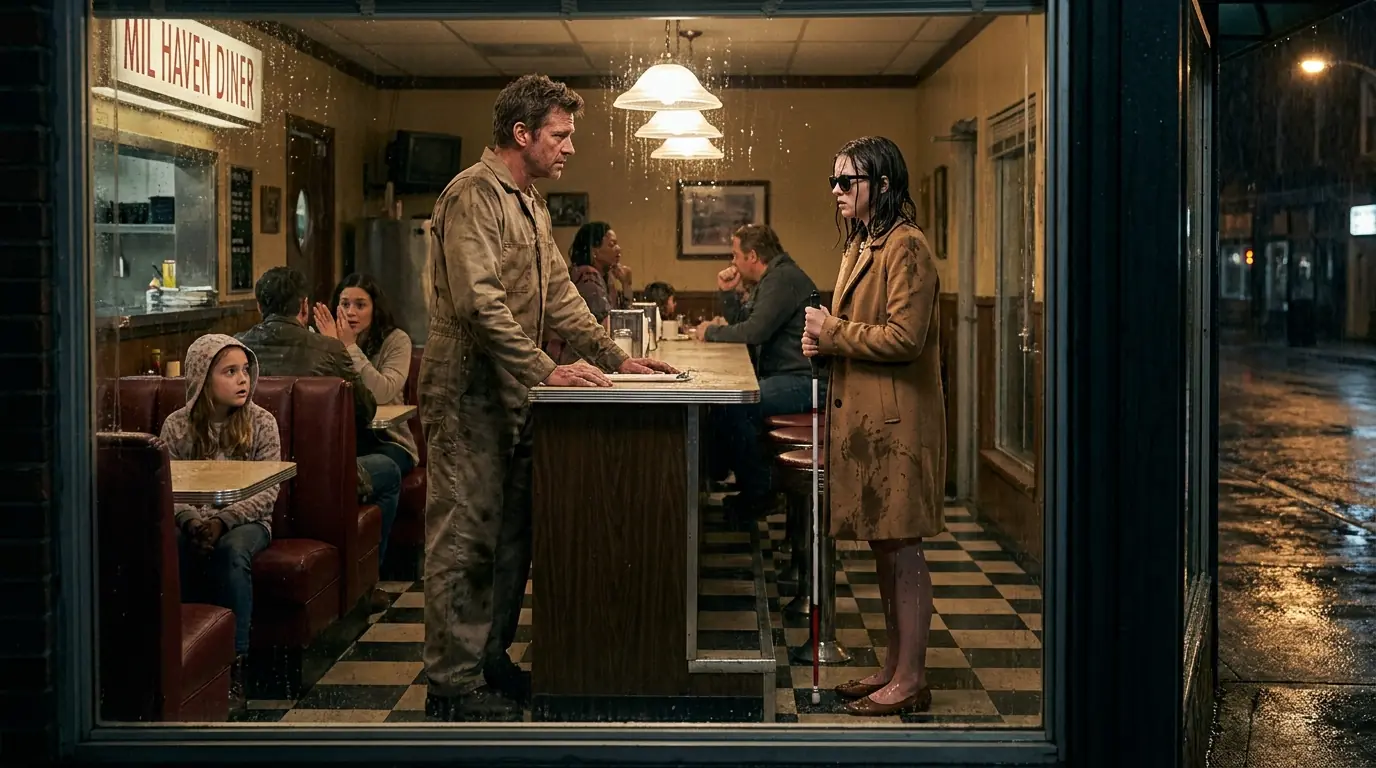
Daniel watched her take in the room with her ears. He could see the slight tilt of her head as someone scraped a fork across a plate. The small flinch when a man at the counter laughed too loudly. She took one step, another. The cane swept the floor in short practiced arcs. She navigated the first two tables without incident. Her path was uneven, uncertain in a way that said she was working from sound and instinct rather than any familiarity with the space. She stopped about six feet from Daniel’s booth. Her head turned in his direction. Daniel was very still.
Her hands were trembling slightly—not from cold, or not only from cold. The shake was finer than that, more interior. It was the shake of someone who had been frightened for a long time and had been holding the fear in so long it had started to leak out at the edges. She seemed to be making a decision. Then she took the remaining steps toward his table with the sudden resolution of someone who has decided to jump before they can talk themselves out of it. She stood there in front of him, in front of him and Lily both, and her face up close was very young, very pale, and had been crying recently.
He could see that, though she had been trying not to. Her lips moved once without sound. Then, "Can I come home with you?" The diner went quiet the way rooms do when something unexpected arrives in them—not the silence of shock, but the silence of collective breath-holding, of people pausing what they’re doing to take in new information. Daniel heard it begin almost immediately—the whisper at the counter, a heavy-set man in a work jacket leaning toward his friend: "Does she think this is some kind of…" The quick disapproving hiss of a woman two tables over. The scrape of a stool as the man at the counter turned more fully to look.
The girl heard it too. He could see it in her face—the way her chin dropped slightly, the way color came into her cheeks despite the cold pour of the rest of her skin. She said in a smaller voice, as if she was already preparing to take the question back, "I’m sorry. I know how that sounds. I got lost. My phone is dead. I don’t… I don’t know where I am." Her voice broke slightly on the last word. She pressed her lips together hard.
The man at the counter said, not quietly, "She’s running a scam. Don’t fall for it." The woman two tables over, someone should call. May herself came out from behind the counter, drying her hands on her apron, her expression somewhere between concern and the particular weariness of a small business owner who has seen every variety of difficult situation. The girl stood perfectly still in the middle of all this. She didn’t try to argue with any of it. She just stood there with her cane, her muddy, expensive coat, her trembling hands, and her wet hair.
She looked like a person who had used up the last of their courage just asking the question. Daniel had been watching her face. He watched it during the man’s comment about scams. He watched it during the woman’s whisper. He watched it while May stood at the counter deciding what to do. He had fixed enough broken things in his life to know when something was broken and when something was just unfamiliar. The girl in front of him was not broken. She was frightened, exhausted, and standing in a strange room full of people who had immediately decided the worst about her. She was holding herself together through what appeared to be pure stubbornness.
He also knew from years of working with his hands, listening to engines before touching them, that you could usually tell the truth of something by the details, by the small things that didn’t perform. The girl’s coat was expensive, yes, but the mud on it was real mud—the specific gray-brown mud of the drainage ditch that ran along the east side of Elmore Avenue, the kind you got on yourself if you had been walking along an unfamiliar road in the dark and had gone slightly off the path. Her shoes were soaked through from the outside in, not dried and rewet. Her hair was tangled the way hair gets when you’ve been out in wind and rain for several hours, not just a few minutes. The cane had a worn rubber tip. None of it performed.
He looked at Lily. Lily had stopped drawing on the window. She was watching the girl with the particular clear focus that children bring to things that adults are busy complicating. Her expression was simple, unclouded. She leaned across the table and whispered to Daniel, "Dad, she’s scared." Three words. Lily’s full assessment. Daniel looked at his daughter for a moment. He thought, as he sometimes did in small moments that didn’t announce themselves, that she was a better person than he was, and that his primary job was not to ruin that.
He slid out of the booth. He stood up and faced the girl with the white cane. She had heard him move. Her head had turned toward him. She was waiting with a kind of braced stillness, like someone who expects to be told to leave and has already started deciding how to leave with dignity intact. He said, "What’s your name?" She hesitated. "Sophia." "Sophia," he repeated. "I’m Daniel." "And this is Lily." He gestured automatically toward his daughter, then remembered. "She’s seven. She’s sitting in the booth behind me. She’s the one who’s been making squeaky noises on the window for the last ten minutes from the booth. That was art," Lily said with dignity.
Something moved across Sophia’s face—not quite a smile, the memory of one. "How long have you been walking?" Daniel asked. She stopped, pressed her lips together. "Since… around 4, I think. I’m not sure of the time." It was quarter past 8. Daniel did the math quietly. "And you don’t have a way to call anyone. My phone died around 6. I kept walking because I thought I was close to somewhere I recognized. But I think I went the wrong way. I think I went the wrong way a long time ago." Her jaw tightened slightly. "I should have stopped sooner. I know that."
"No," Daniel said. "You should have stopped exactly when you stopped." He reached back into the booth and picked up his jacket from the seat. He held it out toward her. "Put this on. You’re shaking." She reached out her hand, found the jacket, and pulled it around her shoulders. It was large on her. It smelled like motor oil and the cedar block Daniel kept in his coat closet. Behind him, he heard the man at the counter make a sound of disgust. He didn’t turn around. He said, "Of course, you can come home with us."
Sophia’s face changed. It was not a slow change. It was sudden, the way a window breaks all at once along lines that had been forming invisibly for hours. Her hand found the edge of the booth and held it. Her cane clattered against the table leg. Her shoulders came up and then came all the way down, and the breath she let out was ragged at the edges. She was crying before she could stop it. She turned her face sideways as if she could hide it from a room she couldn’t see. The diner was very quiet.
Lily climbed out of the booth, walked to Sophia’s side, and took her hand. She didn’t say anything. She just held on. The rain had led up to a drizzle by the time they reached Crestwood Lane. Sophia walked between Daniel and Lily, one hand on Lily’s shoulder, her cane working the sidewalk ahead of her. Daniel had offered his arm, and she had declined with polite firmness. "I’m okay, thank you." But she had let Lily hold her hand without argument.
The house was a ground-floor apartment in a narrow two-story building with aluminum siding that had faded from white to the color of old newspaper. There was a small concrete porch with a single chair on it, a wind chime made from old keys that Daniel had hung there when Lily was four because she liked the sound. The light above the door was yellow and slightly too bright for the fitting. Daniel unlocked the door and held it open. Sophia stepped inside. She stood in the hallway and tilted her head, doing the same thing she had done in the diner, listening to the dimensions of the space. She touched the wall with her free hand—plaster slightly uneven in texture, the small bump of a light switch.
"There’s a coat rack on your right," Daniel said. "About three feet. The floor is clear. I try to keep it clear. Lily leaves her shoes here sometimes." He glanced at Lily, who looked unreasonably innocent. "Thank you," Sophia said, "for telling me." She moved her hand along the wall and found the coat rack. She hung his jacket up on it carefully, as if returning something borrowed. "Come in and sit down," Daniel said. "I’ll get you something warm."
The living room was small, a sofa that had seen better decades, covered with a wool blanket in dark red. A low coffee table scattered with Lily’s drawings, bookshelves made from planks, and painted bricks along the far wall that had been holding for three years without incident. A lamp in the corner cast a warm sideways light. Sophia sat on the sofa. She held her cane across her knees with both hands upright, like a queen holding a scepter in a portrait. Lily sat next to her and immediately began telling her about the frog.
Daniel went to the kitchen. He heated water, made tea—the good tea, chamomile that he bought at the pharmacy once a month and rationed carefully because Lily liked it too. He found the spare towel, the large soft blue one, and brought it out first. "For your hair," he said, placing it gently in Sophia’s hands. She pressed it to her face for a moment, just a moment, long enough for Daniel to pretend he hadn’t noticed. "We have soup left," he said. "And I can make eggs or toast or both." Sophia lowered the towel. "You don’t have to." "I know," Daniel said. "What do you want?" A pause, as if the question was unusual.
"Toast," she said. "Please, if it’s not too much trouble." "It’s toast," Daniel said. "I’ll make eggs from the sofa," Lily said. "He makes really good eggs." Sophia turned toward Lily’s voice, that not-quite smile again, but closer this time. "Does he?" "He does this thing with butter," Lily said with deep seriousness. "It’s a whole thing."
Daniel made eggs. He made toast. He brought out the last of the apple butter that his neighbor, Mrs. Garfield, had given them three weeks ago, because apple butter on toast in a cold house in November seemed like exactly the right thing. He made tea for himself and Lily as well. And they sat the three of them at the small kitchen table, the window above the sink dark with rain, the overhead light yellow and warm. They talked, not about anything large. Lily described her classroom hamster, whose name was officially Captain and unofficially The Destroyer due to incidents with the supply cabinet.