It was the autumn of 1977, and in the crisp Nebraska air that smelled of dust and diesel, Diane Mercer stood alone in a crowd of men. She was 27 years old, a fact the wind seemed determined to etch onto her face. The auctioneer's voice was a rhythmic, hypnotic drone, a sound that had been the background music to her entire life. But today it sounded like a judgment. The men around her, farmers with hands like worn leather and faces mapped with the lines of sun and worry, shifted their weight from one boot to another.
They were a collective, a brotherhood of the soil, and she was an outsider in her own world. The divorce papers were still a fresh wound, signed and filed, and with them, Mark had taken the future they had planned and left her with the past he had wanted to escape. She was left with 900 acres of good bottom land, a farmhouse that needed paint, and an operating note at the bank that felt like a physical weight on her shoulders. It wasn't the gleaming new tractors or the promising young livestock that brought everyone to a standstill, but the opposite. The auctioneer, a man named Henderson who could sell a sick calf to a veterinarian, finally moved to the last row, the place where hope went to die.
"All right, gentlemen," he boomed, his voice losing some of its polish, "Lot 342, a Massey Ferguson 760 combine, as is, where is." A low chuckle rippled through the crowd because the machine was a carcass. It sat slumped on its massive tires, one of which was flat and withered. Its red paint was faded to a dull, sun-bleached pink, peeling away in leprous patches to reveal rust the color of dried blood. The auger was bent at an awkward angle, like a broken limb, and a dark, greasy stain wept from the engine block onto the dirt below.
It was a monument to failure, a machine that had clearly given up the ghost in the middle of some long-forgotten harvest. "What's the story on that thing, Henderson?" a voice called out from the crowd. "Engine seized up tighter than a banker's fist," the auctioneer replied, getting another laugh. "Owner said it just quit on him, probably threw a rod clean through the block." "We're selling it for scrap value, boys; what am I bid for this fine piece of future razor blades, who'll give me $500 to start it off?"
Silence followed, as not even the scrappers, who usually hovered at the edges of these events like vultures, made a move. Five hundred dollars was too much to haul it away. The men looked at it with a kind of pitying contempt, knowing this machine and its story. It was too big, too complex, and when it broke, it broke for good. It was a money pit, and in 1977, with commodity prices flat and fuel costs rising, nobody had money for pits.
"All right, 300 then; $300, someone take it off our hands," Henderson pleaded, his showmanship failing him. More silence followed as the men started turning away, their interest gone, already thinking about the coffee and pie waiting in the church basement. Then a clear voice cut through the murmuring: "$100." Every head turned as the sound was so unexpected and out of place that it took a moment for them to locate the source. It was Diane Mercer, standing with her arms crossed, her chin held high, and her expression unreadable.
The men stared, first in disbelief, then with a dawning, patronizing amusement, and a few of them smiled openly. It was one thing for the Mercer girl to show up at an auction, but it was another thing entirely for her to bid on the biggest piece of junk in the county. They saw a grieving woman, abandoned and adrift, making a foolish, emotional gesture born of desperation. Henderson, the auctioneer, recovered first since he knew her situation and was related by marriage to Mr. Thompson, the bank president who held Diane's note. "I have a bid of $100 from the young lady," he said, a smirk playing on his lips.
"One hundred dollars, do I hear 150, 125, come on, boys, the tires are worth that." No one moved, refusing to bid against her because it would have been cruel, like taking a toy from a child. This was her folly, and they would let her have it. The laughter was quiet now, replaced by whispers and shaking heads. They were murmuring about Mark, about how he'd been smart to get out when he did, and how this farm would swallow her whole.
"Sold!" Henderson's gavel cracked like a gunshot. "For $100 to Diane Mercer." She didn't smile or react at all, simply walking to the clerk's table, opening her worn purse, and pulling out a small velvet-covered box. Inside was her wedding ring, a simple gold band with a modest diamond, the last relic of a broken promise. She handed it to the clerk's wife, a woman she'd known her whole life.
"This should cover it and the hauling," Diane said, her voice steady. The woman looked from the ring to Diane's face, her eyes full of a terrible, suffocating pity. Diane ignored it, signed the paperwork, took her receipt, and walked away from the whispers toward the rusting hulk that was now hers. She had traded the symbol of her failed past for a broken future. In that moment, she was the loneliest person in the entire state of Nebraska.
The men gathered in that dusty yard had been trading machinery since before she was a thought, and they believed they knew exactly what they were seeing in her. They saw a woman unmoored by grief making a desperate and illogical purchase, foreseeing the end of the Mercer farm as a story they would tell for years. What they didn't see, what they couldn't possibly understand, was that Diane wasn't looking at that combine with her own eyes, but through her father's. Her father, Daniel Mercer, had been a different kind of farmer, a quiet man who understood that the land was only half the equation. The other half was the iron.
He believed debt was a cage, and the surest way to stay out of it was to be your own mechanic, your own welder, and your own master of the machines that worked the soil. He had passed away two years before the divorce, leaving Diane with the land and a legacy far more valuable than acreage. He had left her his knowledge, painstakingly recorded in a series of thick leather-bound journals stored in his workshop. That workshop was her sanctuary, smelling of oil, metal, and cold coffee—a scent that was more comforting to her than any perfume. While Mark had been spending money on new pickups and talking about leveraging their assets to get bigger, Diane had been spending her evenings in that shop, absorbing her father's life's work.
The journals were not diaries, but bibles of machinery. Each one was dedicated to a specific model of tractor, planter, or combine. Inside, in his neat, blocky handwriting, were wiring diagrams, torque specifications, and handwritten notes on common failures and their fixes. He had documented every repair, every frustration, and every breakthrough. Before the auction, driven by a desperate hunch, she had pulled out the volume labeled Massey Ferguson 700 series.
She'd spent a week of sleepless nights pouring over the pages, and there, on page 87, she found a chapter titled "Perkins V8 diesel, catastrophic pressure loss." Her father had written in his clear, concise prose that the Perkins in the 760 had a design flaw. A small hydraulic filter screen inside the sump can clog with debris, causing the oil pump to starve. When it does, the engine loses all pressure instantly and seizes, sounding and feeling exactly like a thrown rod. Most will condemn the entire engine as a five-thousand-dollar mistake.
Below, he had drawn a simple diagram showing the fix: drop the pan, clean the ten-dollar screen, and check the main bearings for scoring. Ninety percent of the time, the engine is fine because it shuts down before it can destroy itself, making the sound of the failure its saving grace. That was the secret and the knowledge the crowd didn't have. They saw a dead engine, while she saw a clogged screen; they saw a five-ton paperweight, while she saw a harvest. It was a massive gamble, as her father could have been wrong, and this particular machine could be the one in ten that had truly destroyed itself.
However, it was the only chance she had. The custom harvesting crews charged a fortune, and the old, smaller combine she had was on its last legs and far too small for 900 acres. Buying a new one was an impossibility because the bank wouldn't extend her another dollar, a fact Mr. Thompson had made perfectly clear. He had called her into his office the week after Mark left, a room designed to intimidate with dark wood paneling and a desk the size of a small car. Mr. Thompson, a man whose hands had never touched soil, sat behind it, steepling his fingers.
He spoke to her in a soft, condescending tone, as if explaining a complex financial concept to a child. "Diane," he'd begun, "we need to be realistic about your situation, as you're a young woman, alone." "This is a big operation, and a corporate buyer has made a very generous offer on your land." "It is enough to clear the bank's note and leave you with a nice nest egg to start over, perhaps in town." "This is my home, Mr. Thompson," she had replied, her voice quiet but firm, adding, "My father built this farm."
"Your father was a good man," he replied, his words smooth and practiced. "But he farmed in a different era, and the modern world requires scale, capital, and a man's hand, if you'll forgive my saying so." "The bank's position is that the farm, under its current management, is a high-risk asset." The phrase "current management" was like a slap, as he was directly telling her she was going to fail. She had walked out of that office with a cold fire burning in her gut.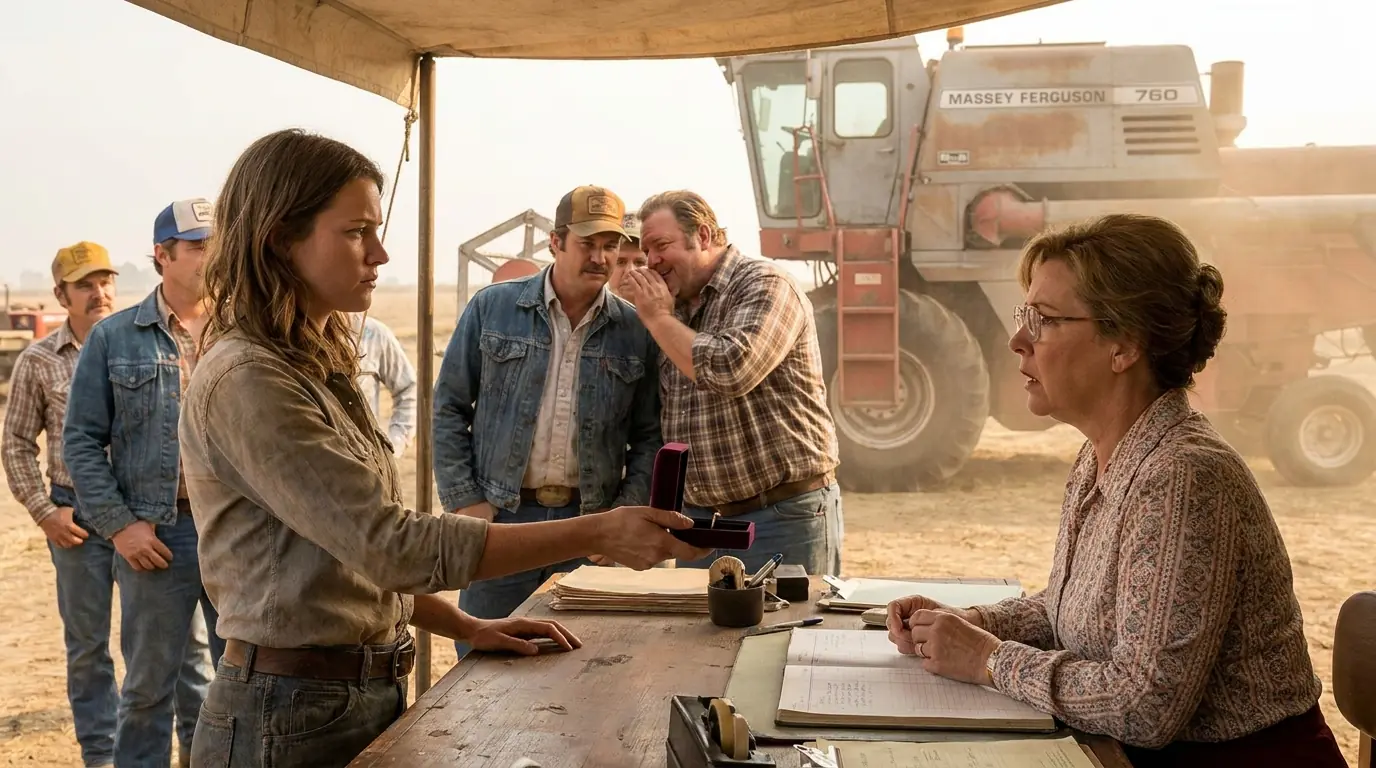
She would not sell, she would not run, and she would not be the sad story they all expected her to be. That broken combine was her declaration of war, and the subsequent two years were a master class in patience and pain. The winter of 1977 was brutal, with snowdrifts piling up against the workshop doors as Diane waged her solitary battle. She drained the oil, which was a black, sludgy mess, and dropped the massive engine pan. It was just as her father's journal described, for the filter screen was almost completely blocked with a thick, gritty paste.
Hope, fierce and sharp, surged through her. She spent a week cleaning every part, her hands raw and aching while the cold seeped into her bones. She checked the bearings and found them smooth and unscored, proving her father had been right. Getting the engine back together was another ordeal altogether. She learned to use a torque wrench, to read a micrometer, and to set valve lash.
She lived on coffee and sandwiches, often falling asleep on a pile of greasy rags, only to wake up with the cold dawn and start again. There were moments of profound doubt along the way. One night, a head gasket refused to seal, and she threw a wrench across the concrete floor, the clang echoing in the cavernous space. She sat down, covered in grease and despair, and cried. The weight of it all—the farm, the debt, the loneliness, and the crushing expectations of her failure—pressed down on her.
She thought about Mr. Thompson's offer of a new life and an easy way out. Then her eyes fell on the journal lying open on the workbench, where her father's steady handwriting seemed to look back at her. "Patience," he had written in the margin of one page, "the machine will tell you what's wrong, but you have to be quiet enough to listen." She took a deep breath, picked up the wrench, and went back to work. Meanwhile, the whispers from the community continued.
Men at the co-op would stop talking when she walked in. They saw her buying filters and oil, but they never saw progress. "Still tinkering with that old relic," they'd say to each other, shaking their heads, adding, "She ought to just cut her losses." Their pity was a constant grinding abrasive against her resolve, but she learned to ignore it. Their world was one of bank loans and dealership mechanics.
Her world had become the pages of her father's journals and the cold, hard logic of steel. The first sign of success finally came in the spring of 1978. After weeks of work, she turned the key. The engine cranked, slow and groaning at first, then it caught. A plume of blue smoke billowed out of the straight pipe, and the Perkins V8 roared to life.
The sound was deafening and beautiful, a symphony of controlled explosions that shook the very foundations of the workshop. It was the sound of her own survival. She stood there grinning, tears of joy and exhaustion streaming down her dirty face. That harvest was her first victory. While her neighbors paid top dollar for custom cutters, Diane rode high in the cab of her Massey Ferguson 760, the machine humming beneath her.
It wasn't pretty, as the cab was hot, the radio was broken, and a dozen small things went wrong, but it worked. She brought in all 900 acres of corn and soybeans herself. When she sold the grain, she didn't just make the payment to the bank, but paid extra on the principal. It was a small dent, but it was hers. She had earned it not with credit, but with her own two hands and her father's mind.
Year by year, she chipped away at the debt. She lived frugally, pouring every spare dollar back into the farm. She learned to weld, patching the auger herself. She rebuilt the hydraulic systems, replaced the belts, and kept the machine in perfect running order. The farm began to reflect her discipline.
The fences were mended, the farmhouse got a fresh coat of paint, and the fields were clean and well-tended. The whispers of the community slowly changed from pity to a grudging respect. They saw the crops coming in, they saw the farm thriving, and though they didn't understand how she was doing it, they couldn't deny the results. Then, in the early 1980s, the world changed. The economy faltered, interest rates soared to unimaginable heights, and the bottom fell out of the commodity markets.
The Great American farm crisis had begun. It was a slow, creeping plague. Farmers who had been lauded as savvy businessmen for leveraging their assets were suddenly drowning in debt. The shiny new four-wheel drive tractors and massive combines bought with money borrowed at 7% now carried interest rates of 18, 20, even 22%. It was a death sentence.
The shiny new four-wheel drive tractors and massive combines bought with money borrowed at 7% now carried interest rates of 18, 20, even 22%. It was a death sentence. The very things that had made her an object of pity—her frugality, her refusal to take on new debt, and her reliance on old, paid-for machinery—suddenly became her salvation. Her neighbors, the same men who had laughed at her auction purchase, were losing everything. Their farms, held in their families for generations, were going up on the auction block, sold on the same courthouse steps where they had once stood and judged her.
The community was gripped by a quiet terror. It was a storm, just as her father had said, and while their grand houses built on credit were being swept away, Diane was safe in the small, sturdy shelter she had built for herself. Her lean operation, born of necessity, was immune to the sickness of easy credit. She was 30 years old now and the land was almost hers, free and clear. The work had been hard, carving fine lines around her eyes and putting a strength in her hands that belied her slender frame.
She was no longer the Mercer girl. She was Diane Mercer, a farmer, a survivor. She had proven them all wrong, not by shouting but through the quiet, undeniable eloquence of a well-run farm. One afternoon in the late summer of 1981, a dusty pickup truck she hadn't seen in years pulled into her driveway. It was Mark, and he looked diminished, as the city life he had craved had not been kind to him.
He was thinner and his eyes carried the weary look of a man who had been defeated. He got out of the truck and stood awkwardly by the fence looking at the place he had abandoned. He looked at the neat fields, the painted barn, and at the Massey Ferguson combine which sat gleaming in the sun. It was not a relic of failure but a testament to her triumph. Diane walked out onto the porch wiping her hands on a rag, feeling no anger, no bitterness, only a strange, quiet sense of finality.
They stood in silence for a long moment, the only sound the buzzing of insects in the late summer heat. "The place looks good, Diane," he finally said, his voice raspy. "I keep it up," she replied simply. He gestured with his head toward the combine. "You ever get that thing running?" he asked. "She runs fine," she answered.
"They all said you were crazy; I thought you were crazy." He looked at her then, really looked at her, and for the first time he saw the woman she had become: strong, capable, whole. "I was wrong," he said, the words coming out in a rush. "About everything, about this place, about you, and I was a coward who ran because I was scared of this." He swept his hand out, indicating the vastness of the land, the weight of the responsibility.
"And you stayed, you faced it, and I just had to come and tell you that; I'm sorry." It was the acknowledgment she never knew she needed. It wasn't about forgiveness or reconciliation, but about closing a door, gently and firmly. It was the final whisper of the skeptical crowd, this time not in mockery, but in apology. "I know," she said.
In those two words, there was a universe of meaning: she knew he was wrong, she knew she was right, she knew she survived, and she knew who she was. He nodded, got back in his truck, and drove away, disappearing in a cloud of dust down the road he had taken four years earlier. Diane stood on the porch and watched him go. She didn't feel triumph, only a quiet peace, as she had not set out to prove anyone wrong, but only to prove to herself that she could survive. The bank no longer called.
Mr. Thompson now greeted her with a respectful nod when she saw him in town. The neighbors who were left, the ones who had managed to hold on, now came to her for advice, asking how she kept her old equipment running so well. Later that evening, she walked out to the workshop, her father's journals still sitting on the bench where she had left them. She picked one up, the leather cool and smooth beneath her fingers. She had done more than just save a farm—she had taken her father's legacy of wisdom and made it her own.
The men at the auction had seen a broken machine and a broken woman, but they were wrong. The machine wasn't broken, it was just misunderstood, and the woman was never broken at all. She was just beginning. The land remembered the care she gave it, the iron remembered the hands that healed it, and she, Diane Mercer, remembered the most important lesson of all. True ownership comes not from a bank note, but from knowledge, from patience, and from the quiet courage to stand alone and trust in what you know, even when the whole world is laughing.