"Far too clever for a husband," her father announced. Lawrence Pell, standing close enough to hear, disagreed, though it would take him the better part of a season to admit it. The Harwich Ball began as all the best disasters do, with a compliment. Sir Edmund Croft delivered it to his daughter at precisely half past nine, in the entrance hall of Lord Harwich's Grosvenor Square townhouse, within easy hearing of six people he had not noticed, and one he would later wish had been anywhere else on Earth.
"My dear," Sir Edmund said, patting Thomasine's gloved hand with the fond exasperation of a man who had long since made his peace with the inexplicable, "you are far too clever for a husband." Thomasine smiled. She did not blush, did not stiffen, and did not cast her eyes downward in the manner the remark might have invited. "I know," she said simply, and walked into the ballroom.
Lawrence Pell, standing three feet to Sir Edmund's left with a glass of wine he had not yet touched, watched her go. He was there because Lord Harwich owed him a considerable sum, and had invited him to this ball as a gesture of goodwill that cost nothing and settled less. Lawrence had attended because Lord Harwich's goodwill was, for the moment, worth cultivating. He was 31 years old, the son of a Sheffield ironmonger who had died leaving more debts than assets.
He had spent the last decade turning a modest talent for figures and an immodest talent for patience into a position that made men like Lord Harwich seek him out. He was not quite a gentleman, and he was not quite in trade. He existed in the careful middle ground that London's financial world had carved out for men who were useful enough to invite, but not quite respectable enough to seat at the top of the table. He was accustomed to being underestimated, and he had made considerable money from it.
He watched Thomasine Croft cross the ballroom floor and noted three things in rapid succession: that she moved as though she had decided where she was going before she arrived, that two separate groups of people turned to greet her with what looked like genuine pleasure rather than social obligation, and that she was performing. He was certain of this last point. A woman whose father announced her cleverness in public hallways was a woman whose cleverness had been deployed long and strategically as the feature most likely to set her apart. In a marriage market that prized accomplishment, unusual intelligence was merely another accomplishment.
The trick was making it look effortless, and Miss Croft had clearly been practicing. Lawrence set down his wine and followed the general movement of the room toward the dancing. He did not intend to speak to her. He intended to speak to Harwich, extract a vague assurance about the repayment schedule, and leave before the supper interval.
He had papers to review in the morning and a meeting at 10:00 with a man who was considering whether to trust him with the management of a mill in Derbyshire. He did not have time for balls, for dancing, or for women who had perfected the performance of their own minds. He lasted forty minutes before circumstance arranged otherwise. The arrangement was specifically a conversation about Adam Smith.
Thomasine was standing near the east wall with a woman Lawrence recognized as Mrs. Penelope Marsh, a widow of 35 with a sharp tongue and a sharper eye, who had once told Lawrence to his face that she found him refreshing precisely because he had no pretensions to charm. He had liked her immediately. She was speaking to Thomasine and to a young man Lawrence did not know, and as he passed within range of the group, he caught the tail of the exchange.
"But Smith's argument only holds if one accepts that self-interest and social benefit naturally converge," Thomasine was saying, "which is a very convenient assumption for those whose self-interest happens to align with the general order." "It is not an assumption," the young man said, "it is an observed mechanism." "It is an observed mechanism in the market Smith chose to observe; he was not, I think, visiting textile mills."
"Miss Croft," said Mrs. Marsh, catching Lawrence's eye with the expression of a woman who had spotted reinforcements, "you must meet Mr. Pell. He is, I believe, in a position to speak to the practical realities of commerce rather more directly than Lord Fenwick." Lord Fenwick, the young man, turned with the faint displeasure of someone who had been winning an argument and did not welcome interruption. Lawrence nodded to him, then to Thomasine. "Mr. Pell," she said.
Her tone was perfectly civil, and her eyes assessed him in approximately two seconds. "Miss Croft, Mrs. Marsh tells me you manage Lord Harwich's affairs, among others. Then perhaps you can settle a point. Is self-interest a sufficient engine for public good, or does Smith's model require conditions that trade in practice rarely provides?"
Lawrence looked at her. She was waiting for his answer with the particular attention of someone who actually wanted to hear it, which was either genuine intellectual curiosity or a very good performance of the same. "Smith's model," he said, "requires competition. Where competition exists, self-interest tends toward efficiency. Where it does not, it tends toward monopoly."
"The question is not whether the engine works; it is who controls the road." A pause followed. "That," said Thomasine, "is a practical answer." She said practical the way some people said adequate—technically a compliment, but not entirely one.
"I find practical answers useful," Lawrence said, "as they tend to be correct." "They tend to be sufficient," she countered, "which is not always the same thing." Lord Fenwick, sensing that he had ceased to be part of this exchange, excused himself with the dignity of a man who had decided to lose gracefully. Mrs. Marsh watched him go with satisfaction.
"You were saying," Lawrence prompted. "I was saying that Smith's framework, whatever its elegance, describes a world in which the participants begin on a reasonably equal footing. They do not, and a model that ignores its own starting conditions is not practical; it is merely convenient." "And what would you propose instead?" Lawrence asked.
"I would propose acknowledging the starting conditions before celebrating the mechanism." "That is not a counterargument; that is a preliminary." Her chin lifted barely. "Then consider it a preliminary; the argument follows from it." "I look forward to hearing it."
He meant it as a dismissal, but she took it as a promise. "Then you shall," she said. Mrs. Marsh, who had been watching this exchange with the expression of someone watching a very good tennis match, smiled at Lawrence as Thomasine was drawn away by a young woman in pale yellow who had appeared at her elbow with some urgency. "Well," said Mrs. Marsh.
"She is articulate," Lawrence said. "She is considerably more than that, and you know it." "She is performing." Mrs. Marsh looked at him with the patience of a woman who had lived long enough to recognize a wrong impression being formed in real time. "Is she?"
"The father announces her cleverness in the entrance hall, and she enters quoting political economy at a ball; it is a strategy, Mrs. Marsh." "A strategy for what?" "For distinction, and for securing a husband of sufficient intellectual vanity to find it attractive." Mrs. Marsh considered this for a moment. "Mr. Pell," she said pleasantly, "you are occasionally very stupid for an intelligent man."
She moved away to greet someone across the room. Lawrence stood where he was, watching Thomasine Croft across the ballroom, and felt the irritating certainty that he was right. The young woman in pale yellow was Miss Clara Reeve, Thomasine's closest friend since the age of 14. Her urgent business was a whispered report of considerable social interest.
"Lord Fenwick," Clara murmured, steering Thomasine toward a gap between a potted palm and the refreshment table, "has spoken to your father." "About what?" "About you, Thomasine. He has spoken to your father about you in the way that gentlemen speak to fathers."
Thomasine absorbed this information. "When?" "Yesterday afternoon, apparently. Your father said nothing?" "My father," Thomasine said, accepting a glass of lemonade from a passing footman, "said many things this evening, but that particular thing was not among them."
"Are you not alarmed?" "I'm curious. Lord Fenwick is 24 and believes Adam Smith requires no qualification whatsoever. I find that more alarming than the prospect of a formal offer." "You cannot simply argue men out of proposing to you, Thomasine." "I have been remarkably successful at it thus far."
Clara pressed her lips together in the expression she reserved for conversations in which Thomasine was being deliberately obtuse. "He is perfectly pleasant, he has an income, and he is not, as far as anyone knows, a scoundrel." "He is perfectly pleasant," Thomasine agreed. "I have no objection to Lord Fenwick; I simply have no interest in marrying him."
"You have no interest in marrying anyone." "That is not quite true." She glanced across the room. The man Pell was speaking to Lord Harwich now, and his back was to her, but she had the impression he was choosing not to look in her direction rather than simply not looking. There was a difference, and she had learned over several seasons to tell the difference.
"I have no interest in marrying for the reasons society considers sufficient." "What reasons do you consider sufficient?" Thomasine looked at her friend. "Being actually known, being found interesting rather than accomplished, being chosen because someone cannot imagine doing otherwise, not because the numbers add up and the connections are convenient."
Clara was quiet for a moment. "That is a very high standard." "It is a practical one," Thomasine said, "given the alternative." There it was again—that word. She used it deliberately, but she felt the edge of the evening's earlier exchange as she said it.
Practical—the man had said it like a virtue, and she had said it back like a challenge. She was not entirely sure which of them had meant it more sincerely. Lord Harwich was telling Lawrence about his plans for a shooting party in October. Lawrence was listening with half his attention and noting with the other half that Thomasine Croft had a habit he had not expected: she listened.
She did not listen in the manner of a woman performing attention—the slight forward tilt, the carefully arranged expression of interest. She listened the way people listened when they were actually thinking. When her friend spoke, Thomasine's gaze went slightly unfocused. When she responded, she answered what had been said, not what she had expected to be said.
It was not a performance he could easily account for. He filed it away and turned his full attention back to Lord Harwich, who had moved from shooting parties to the parlor state of his east wing roof. Lawrence calculated that Harwich would not raise the matter of the outstanding sum this evening. He never did at balls.
He raised it at his club on Tuesdays in the apologetic tones of a man who considered debt a form of correspondence rather than an obligation. Lawrence had three more Tuesdays of patience left, and he had noted the date. He did not look at Thomasine Croft again before he left the ball. He was quite deliberate about this.
He had formed his opinion: she was clever, quick, probably well-read, and engaged in the project of making herself the most interesting woman in any room she entered. It was not an unattractive project, but it was simply not one he had any reason to involve himself in. He collected his coat and his hat and walked out into the Grosvenor Square night. The word practical followed him home, wearing her voice.
The bookshop on Piccadilly was Hatchards, and Thomasine was there on a Tuesday morning, which was, she reflected afterward, precisely the sort of coincidence that would have been more satisfying if it had been arranged. It was not arranged. She was there because she was always there on Tuesdays. She came for the new philosophical periodicals, for the proprietor's recommendations, and for the particular pleasure of an hour spent in a place where her purpose required no justification.
Lawrence Pell was there because Sir William Crane, who managed a portfolio of properties in the north and had agreed to consider retaining Lawrence's services, had mentioned the previous week that he could be found at Hatchards on Tuesday mornings. Sir William was not there. His note, which arrived at Lawrence's rooms that morning, explained that he had been called to Surrey unexpectedly and would be grateful if Lawrence could collect a volume he had ordered. The volume was a recent edition of Malthus.
Lawrence collected it from the proprietor, turned from the counter, and found himself three feet from Thomasine Croft. She was reading—not browsing, but reading. She had a volume open in her hands and was standing with the stillness of someone who had genuinely forgotten where they were. "Miss Croft," he said.
She looked up. There was a moment of what he could only describe as reassembly, the return from wherever the book had taken her to the specific fact of a Hatchards Tuesday morning. "Mr. Pell." He nodded toward the volume. "Anything worth recommending?"
She glanced at the book as though she had only just remembered she was holding it. "Wollstonecraft, though I suspect you've read her." "I have not." She looked at him with interest that she did not bother to conceal. "You find political economy worth your time, but not political philosophy?"
"I find what is immediately useful worth my time. Political philosophy is generally argued by people with sufficient security to indulge abstraction." "And you do not have that security?" "I have made it my business not to need it." She closed the Wollstonecraft and tilted her head, studying him with the directness that had unsettled him at Harwick's ball.
"That is not what I asked." He held her gaze. "No. I did not for many years have that security. I read what would help me, and Wollstonecraft would not have helped me."
"She might have helped you understand the people you were dealing with." "I understood them perfectly well; I simply did not sympathize with all of them." The corner of her mouth moved, not quite a smile. "Neither did she."
He found unexpectedly that he wanted to continue this conversation. He also found this wanting inconvenient. "What did you make of the Smith discussion," he said, "when you had time to reflect on it?" "I made the same thing of it I made in the moment. The framework is elegant, the assumptions are optimistic, and the combination is dangerous when taken as gospel."
"And what would you substitute?" "I would not substitute; I would add. Observation of actual conditions, and acknowledgement of what the model cannot account for." She replaced the Wollstonecraft on its shelf with the care of someone returning something borrowed. "What you said about competition was correct, incidentally."
He had not expected that. "You are telling me I was right?" "I am telling you that one of your points was sound; it is not the same as telling you that you were right. You were also somewhat dismissive." "Of your argument?"
"Of the possibility that my argument had merit. You answered the surface of what I said rather than the substance." This was also correct. He had done exactly that, and he had known it as he did it because engaging the substance would have required taking her seriously, and taking her seriously would have required revising a judgment he had already made. "I will endeavor," he said, "to address the substance."
"I shall hold you to that." She took her leave with a small nod and moved toward the periodicals at the back of the shop. Lawrence stood for a moment with the Malthus under his arm, examining the conversation he had just had, which had not gone at all as he would have predicted. She had conceded a point freely, without the arch qualification he had expected.
She had also told him plainly that he had been dismissive. Both things were more honest than performance required. He filed this away, too, next to the listening. The dinner was at the Grenvilles on a Thursday in mid-May, the sort of gathering that Mrs. Grenville assembled with the precision of a general and the apparent artlessness of a woman who simply enjoyed feeding people.
There were twelve at the table. Thomasine was placed between a retired admiral who had strong opinions about the blockade and a clergyman who had stronger ones about the admiral. Lawrence was across the table and four seats to the left, which placed him squarely in her eyeline when she looked toward the center of the arrangement. She did not intend to look toward the center of the arrangement, but she looked toward it anyway.
He was speaking to Mrs. Grenville about the east wing of Harwick's house. Mrs. Grenville, who had an architectural interest, was asking specific questions, and Lawrence was answering them with more knowledge than Thomasine would have anticipated from a man of business. He knew the names of the masons, and he knew the cost of Kentish ragstone versus Portland. He spoke about it not as someone who had been told these things, but as someone who had stood in a half-repaired east wing and looked at the wall.
She found this unexpectedly interesting. The admiral to her left delivered a comprehensive assessment of the Danish situation. Thomasine attended to it with her full intelligence and approximately half her attention. Across the table, Lawrence caught her eye.
He had clearly just said something that had made Mrs. Grenville laugh, and the laughter had shifted his face into an expression she had not seen at Harwick's—easier, less deliberate. Then he looked at her, and the ease did not entirely disappear, which surprised her. She looked back at the admiral. When the women withdrew after supper, Clara found her immediately.
"He keeps looking at you," Clara said in the low, rapid voice she used for information she considered urgent. "The admiral looks at everyone; it is the nature of surveillance." "Not the admiral—Pell. He has been looking at you all evening."
"He looks at everything in a room, as he is a man who calculates." "He calculates you rather more than he calculates Mrs. Grenville's centerpiece." Thomasine smoothed her glove. "He thinks I am performing." "How do you know what he thinks?"
"Because it is what most men of practical disposition think when they encounter a woman who argues Smith at a ball. They assume there must be a strategy behind it—something being aimed at something." Clara considered this. "And is there?" "The strategy," Thomasine said, "is that I find it genuinely interesting, which is apparently very difficult to believe."
When the men rejoined them, Lawrence crossed the drawing room and stopped beside her with the directness of a man who had decided to do something and was doing it. "You were going to make an argument," he said, "at Harwick's—the preliminary that the argument followed from." She turned to face him. "You remembered that." "I said I looked forward to hearing it."
"You said it as a dismissal." "I know." A brief pause followed. "I'm not dismissing it now." She studied him.
The ease she had seen at dinner was still there somewhat. He was not comfortable, and she had the impression he was rarely entirely comfortable in rooms like this. But he was present, and his attention was specific and unperformed. "Very well," she said, "the argument is this."
"Smith assumes that the individual seeking his own advantage operates within a market of others doing the same with broadly equivalent information and access. The moment information or access is unequal, the mechanism breaks—not degrades, but breaks. The efficient outcome never arrives because the competition was never genuine." "Which means..."
"Which means that a practical model of commerce requires, as its first condition, an account of how information is distributed, which is a political question before it is an economic one." He was quiet for a moment. "That is not an unreasonable argument." "It is a correct argument."
The corner of his mouth moved. "It is a well-made argument. Whether it is correct depends on the empirical question of how consistently markets fail to provide equivalent information—consistently enough to matter. Consistently enough to change the model, or consistently enough to refine it." She opened her mouth, then closed it.
"That," she said, "is a better question than I expected." "I occasionally ask better questions than expected." "And you occasionally answer them, too." She held his gaze.
"It is when you decide in advance that no better question is needed that you become unreliable." He did not flinch. "That is a fair assessment." "I know."
She turned to answer a remark from Mrs. Marsh, and Lawrence did not attempt to reclaim her attention. He moved to the other side of the room where he stood for some minutes in conversation with the clergyman. Thomasine, attending to Mrs. Marsh with every courtesy she possessed, was aware of where he was in the room without looking at him. This was new, as she was not accustomed to being aware of where a man was without looking at him.
She filed the feeling away as inconvenient and attended to Mrs. Marsh. Lord Fenwick called in Welbeck Street on a Friday morning. He was punctual, pleasant, and brought violets, which was either a charming impulse or a researched gesture. Thomasine had not been able to decide which, and it mattered to her more than it probably should have.
Sir Edmund received him in the drawing room with the warmth of a man who understood what a morning call of this specific character signified and was not displeased by it. He excused himself after 15 minutes with the transparent tact of a father who wished to allow a conversation to proceed. Lord Fenwick sat forward in his chair with the posture of a man who had prepared something and was about to deliver it. "Miss Croft," he said, "I hope you will allow me to speak plainly."
"I prefer it," she said. "I have found our conversations this season at Harwick's and at the Grenvilles to be of unusual quality. You argue well, and you are not easily flattered into agreement. I find that..." He searched for the word. "...admirable."
"That is generous, Lord Fenwick." "It is honest." He looked at her directly. "I should like very much to continue such conversations in a more permanent capacity." He did not say wife, as he was too well-bred to say it plainly, but it was in the room waiting.
Thomasine looked at him. He was genuinely pleasant, and he had a good mind, if an undeveloped one. He would, she thought, be kind. He would also, within a year of marriage, begin to find her exhausting, and she would know it, and they would negotiate a careful distance from each other that would be civil and hollow and last 40 years.
"Lord Fenwick," she said, "I am honored, truly. And I think well of you; I want that to be clear." He stilled. "But I cannot accept your offer." "Not because there is any deficiency in you, but because what you admire in me is not what I wish to be admired for."
"You admire that I argue well, but I want to be with someone who argues back; that is a different thing." A long pause ensued. "I would argue back." "You would," she said gently, "yield, eventually, to keep the peace, and I would know it, and neither of us would be happy."
He sat with this for a moment. She watched him process it with the slightly painful respect of someone receiving a diagnosis that is accurate even if it is not what they wanted to hear. "You are very certain," he said at last. "About this, yes."
He rose, collected his hat, and said with the dignity that she had always thought was his best quality, "I hope you find what you're looking for, Miss Croft." "I hope so too," she said. She saw him out herself.
In the entrance hall, she passed her father, who had clearly not been as far away as he had appeared to be. Sir Edmund looked at her, at the door, and at the retreating figure of Lord Fenwick beyond the glass. "Well," he said. "Yes," she said.
"He was perfectly adequate." "He was." She straightened the hall table's single vase, which did not need straightening. "I don't want adequate."
Sir Edmund made a sound—not quite a sigh, not quite an expression of defeat—that he had been making for the last three seasons. "My dear," he said, "you are far too clever for a husband." "So you've said." She kissed his cheek. "I find I am not yet convinced."
She went upstairs. It was only later, reviewing the morning, that she realized this was the first time she had not simply agreed with him. Thomasine had not anticipated that refusing Lord Fenwick in Welbeck Street would be insufficient. She had not anticipated that he would try again.
He did not try in private; he tried at the Castleford Assembly, a subscription ball with a full house—the kind of gathering where the acoustics of the room carried a whisper to the furthest corner if the whisper was interesting enough. Lord Fenwick had arrived with evident purpose. He had requested a second dance, which Thomasine had granted on the reasonable assumption that a second dance was a social gesture and not a renewed campaign.
It was, she understood as the set ended and he guided her toward the edge of the floor, a renewed campaign. "I have thought carefully," he said quietly, "about what you said in Welbeck Street." "Lord Fenwick..." "You said you wanted someone who argued back." He turned to face her, and his expression was genuinely earnest. "I can do that."
"I have been thinking about your point regarding Smith and information distribution. I think you are wrong." She blinked. This was not what she had expected. "Tell me why," she said.
"Because you are assuming that information asymmetry is structural rather than contingent. In a sufficiently competitive market, the incentive to correct information asymmetry is itself a market force. Transparency is profitable; therefore, the mechanism can, in theory, correct itself." "In theory," she said, "which is where your preliminary lies, too."
She looked at him. He was not wrong about this; he had gone away, thought about it, and returned with a rebuttal. That was, in fact, what she had said she wanted. And she still could not imagine it—not because he was insufficient, but because he was made of good intentions that would, over time, calcify into expectation, and she could see the whole shape of the future too clearly to pretend she could not.
"Lord Fenwick," she said, and her voice was gentle, "your argument is better than your first; I mean that sincerely, but it does not change my answer." The room was paying attention now, though not obviously. Backs were mostly turned, and conversations continued, but the particular quality of attention that a London ball concentrated on anything interesting had shifted toward them. Thomasine was aware of it without looking for it.
"I see," he said. "I am sorry," she said, "I am genuinely sorry." "I know you are." He held himself with the dignity that she had noticed before, that she respected thoroughly. "I shall not press further." "Thank you."
He bowed, and she inclined her head. He walked away toward the card room, and the room breathed again. Thomasine stood where she was for a moment. Then she walked to the side of the room where Mrs. Marsh was standing, because Mrs. Marsh was the person she most wanted to be near when she had just done something that was right and also cost something.
"That was admirably handled," said Mrs. Marsh. "It was necessary." "It was both." Mrs. Marsh touched her arm briefly and asked, "How are you?" "Perfectly well."
She was, but she was also aware that across the room Lawrence Pell was standing near the window that looked onto the square, and that he had watched the entire exchange. She did not look at him. She accepted a glass of wine from a footman and attended to Mrs. Marsh. "He was a perfectly good prospect," Mrs. Marsh observed in the neutral tone she used when she was not being neutral.
"He was." "And you declined him with the composure of a woman who had decided some time ago." "I declined him the first time in Welbeck Street; tonight was his second attempt." "Ah." Mrs. Marsh was quiet a moment. "Then you were kinder than the situation required."
"He deserved kindness, as he is a good man." "Most of them are. The question is always whether good is sufficient." Thomasine looked at her friend. "It never has been for me." "No," Mrs. Marsh agreed, "I know."
Across the room, she did not look at Lawrence Pell, but she knew with the specific certainty that had been building for three weeks that he was looking at her. The Castleford Assembly ended at midnight. Lawrence had not intended to stay past eleven. He had stayed because the evening had become, without his permission, interesting.
He stood in the carriage queue on the pavement outside and reviewed what he had seen. She had declined Fenwick the first time in private, from what Mrs. Marsh had let fall in the days since the Grenville dinner. She had declined him again tonight in the open, with every opportunity to soften it into ambiguity, and she had not taken that opportunity. She had been clear, kind, and definite.
He had watched her face during the exchange. She had not been performing composure; she had composure, which was a different thing entirely. She had looked at Fenwick with the attention of someone who was genuinely sorry to cause pain and genuinely unable to do otherwise. It was not the face of a woman securing the most advantageous outcome.
It was the face of a woman who had decided what she wanted and was paying the social cost of it without complaint. He stood in the cold May night and dismantled piece by piece the conclusion he had reached in Lord Harwich's entrance hall. She was not performing. She was—and he could find no more precise word—herself.
The cleverness was not deployed; it was simply present, like height or eye color, and she had long since stopped managing the fact of it. The carriage arrived, and he got in. He looked out the window at the lit fronts of the Castleford building and thought about the word practical in her voice, what she had meant by it, and whether he had heard it correctly. He did not think he had.
The gossip reached him on a Wednesday. It came from Harwick's secretary, a young man named Foster who occasionally passed Lawrence information he had not asked for in the manner of someone who believed information to be the currency of advancement. It was usually harmless, but this time it was not. The information was this: a woman named Mrs. Delacourt had been heard at two separate gatherings in the previous week suggesting that Miss Croft's repeated refusals of eligible gentlemen indicated an existing attachment.
It was an existing private, and therefore improper, attachment to a man who had not been named but was described with arch vagueness as not of her station. It was not a ruinous rumor. It was the kind that worked slowly, that attached itself to a name and colored every subsequent observation. "Miss Croft refuses Fenwick. Perhaps because she is saving herself. Miss Croft argues with a man of business at balls. Perhaps now we understand why."
It would not destroy her, but it would change the air around her, making the next season harder and the one after that. Lawrence sat with this for a morning. He did not know Miss Croft well, having spoken to her four times at length. He had no claim on her, no standing, and no reason to involve himself.
He also knew Mrs. Delacourt, who sat on three of the same charitable committees as Lady Harwich, and who was susceptible to the opinion of people she considered important. And he knew Lady Harwich, whose opinion Mrs. Delacourt considered very important indeed. It was a matter of fifteen minutes and one well-placed conversation. Lady Hardwick was fond of him in the way that aristocrats were fond of useful men—warmly and contingently.
He called in Berkeley Square on a Thursday morning, conducted the business he had come to conduct, and in the final five minutes of the visit mentioned with perfect casualness that he had heard a curious story about a Miss Croft. He believed Lady Hardwick might be in a position to set the record straight, as she was well acquainted with the family and would naturally know that there was nothing to the report whatsoever. Lady Hardwick, who did not like Mrs. Delacourt and did like the Croft family, set the record straight with the efficiency of a woman who had spent thirty years managing the social architecture of two counties.
She did it at her own Thursday morning gathering in the hearing of eight women who would have the information distributed to every relevant drawing room within 48 hours. Lawrence walked home from Berkeley Square without having mentioned his name in the matter at any point. He told no one he had done it. He wrote two letters, reviewed a set of accounts, and attended to the rest of his day.
He did not examine why he had done it. He filed that too away in the drawer he was running out of room for. Mrs. Marsh found Thomasine in the lending library on Saturday afternoon. She was there, she said, entirely by coincidence.
Thomasine, who knew Mrs. Marsh had never done anything entirely by coincidence in her adult life, accepted this and waited. "There was a story circulating," Mrs. Marsh said, settling herself beside Thomasine at the reading table, "about you." "What kind of story?" Thomasine asked, setting down her periodical.
"The tedious kind. Mrs. Delacourt suggested you had a private attachment to an unspecified person below your station. It would have been nothing ruinous, but it would have been tiresome." "Would have been?" "Lady Hardwick corrected it thoroughly at her Thursday gathering."
Mrs. Marsh smoothed her glove. "She did so with what I can only describe as unprompted enthusiasm, which was surprising, as Lady Hardwick does not typically concern herself with other people's daughters unless someone she values has given her a reason to." Thomasine looked at her. "You think someone put her up to it?"
"I think someone mentioned the matter to her in terms she found compelling. Lady Hardwick does not correct rumors on principle; she corrects them when she has been persuaded it is worth her time." Mrs. Marsh paused. "Mr. Pell called in Berkeley Square on Thursday morning."
The library was quiet. The afternoon light came through high windows onto the reading table between them. "You don't know that he said anything," Thomasine said. "No. I am assembling a theory from available evidence, which you of all people cannot object to as a method."
Thomasine sat with this thought. Lawrence Pell had sat across from her at the Grenvilles, argued Smith, said practical like a declaration of faith, and watched her with increasing honesty across three separate rooms. He had called in Berkeley Square on Thursday, and Lady Hardwick had corrected a damaging story on Thursday afternoon. She thought about the drawer of things she had been filing.
It was, she realized, considerably fuller than she had acknowledged. "If it was him," she said slowly, "he said nothing about it." "He would not," Mrs. Marsh said, "that is rather the point." Thomasine picked up her portfolio, then put it down again.
"Mrs. Marsh, what do you make of him?" Mrs. Marsh considered this with the seriousness it deserved. "I think he is a man who decided young that the world was not going to give him anything and has arranged himself accordingly, which is admirable and also, I suspect, somewhat lonely." "He does not seem lonely."
"No, he seems contained, which is not the same thing." She rose, smoothing her skirts. "I will tell you what I told him at Harwick's: he is occasionally very stupid for an intelligent man, but I do not think the stupidity is permanent." She left.
Thomasine sat in the lending library with the afternoon light on the table before her. She thought about a man who had corrected a rumor about her without telling her, doing it with such precision that she had not even known to be grateful. He had stood across every room she had been in for the past month, looking at her in the way people looked when they were trying not to. The word practical rose in her mind in his voice, and it sounded different from how she had heard it before.
She was not sure what to do with that. She was also, she realized, not entirely sure she wanted to file it away. She did not seek him out, as that was important to her. She was not a woman who sought men out—not because propriety forbade it, since propriety forbade a great many things she did without particular anxiety, but because seeking implied wanting, and wanting implied that the wanting mattered, and she had not yet decided how much this one did.
What she did was attend Mrs. Greenway's Tuesday musical, which she attended every third week regardless. Lawrence Pell happened to be present because Mrs. Greenway's husband had retained him the previous autumn, and Mrs. Greenway had the social instinct to keep useful men within her orbit. Thomasine arrived at half past seven. She was shown into the drawing room and saw him across it, standing beside the pianoforte with the posture of a man who was genuinely listening to the young woman currently playing a Clementi sonata.
She made no effort to be on the far side of the room from him. This was new, and she acknowledged it to herself without ceremony. She had for the past several weeks been managing distance, choosing seats, angling conversations, and attending to other people with slightly more concentration than those other people entirely merited. She had been doing it so automatically that she had not noticed doing it, but she noticed now that she was not doing it.
She accepted a chair near the window. The Clementi ended to warm applause. The young woman at the pianoforte looked up, flushed and pleased, and Mrs. Greenway announced a short interval before the next piece. Lawrence crossed the room.
He did it without the hesitation she had come to expect—the slight recalibration before approach, the social machinery of a man navigating a drawing room in which he was not entirely certain of his place. He crossed the room as though he had simply decided to, and the decision required no further examination. "Miss Croft." "Mr. Pell."
He took the chair beside her without asking whether it was taken. It was not, and they both knew it was not, and the not asking was a small thing that was not small. "Clementi," she said, "adequately played." "More than adequately; she has very good rhythm."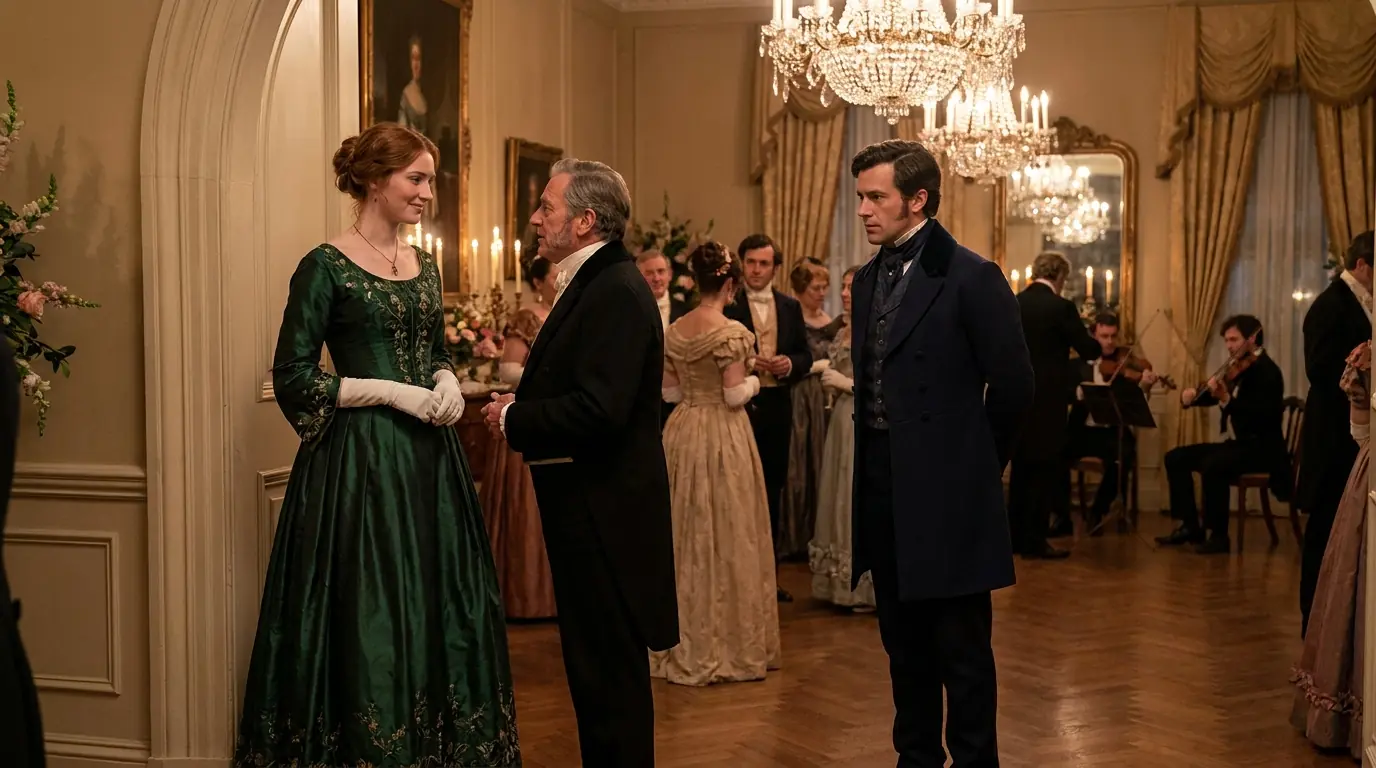
"She rushes the second movement." Thomasine turned to look at him. "You know the piece." "My mother played it—badly but often," he said without weight, offering a fact rather than a sentiment for inspection. "You don't speak of her."
"I don't, generally, as she died when I was 12." He looked at the empty pianoforte stool. "She would have been pleased by this room, because she liked rooms with good curtains." Thomasine looked at the curtains, which were very good, deep green silk well hung. "These are excellent curtains."
"They are." The corner of his mouth moved. She had strong opinions about curtains and very few other domestic matters, as it was a specific passion. "My father," Thomasine said, "has strong opinions about hats." "He cannot abide a hat with excessive trimming, as he considers it a moral failure."
"In the hat or the wearer?" "He has not been entirely clear on this point." He smiled then, fully—not the controlled, almost-smile she had seen before. It changed his face considerably, exactly as she had suspected it would. "Mr. Pell," she said before she had entirely decided to say it, "I understand you called in Berkeley Square recently."
The smile did not disappear; it adjusted, becoming more careful. "I call in Berkeley Square with some regularity," he said, "as Lord Hardwick's affairs require it." "On Thursday the 15th." "Possibly."
"Lady Hardwick corrected a rumor about me on Thursday the 15th in the afternoon, with what several people described as unusual thoroughness." He looked at the pianoforte. "Lady Hardwick is a thorough woman." "She is, and she is also not a woman who involves herself in other people's difficulties without prompting."
There was a pause. The room moved around them with conversations, the clink of tea things, and Mrs. Greenway directing a footman. "Miss Croft," he said, "if Lady Hardwick chose to correct a piece of malicious nonsense, I think the credit belongs to her good judgment and not to any conversation she may or may not have had beforehand." "That is a very carefully worded non-denial."
He looked at her then, directly. "Yes," he said, "it is." She held his gaze, and he did not look away. For the first time since Harwick's ball, she understood the looking. It was not assessment, not dismissal, and not the calculating inventory she had previously attributed to him.
He was watching her because he found her genuinely difficult to look away from, and he had stopped pretending otherwise this evening. The knowledge of it settled in her chest, warm and slightly alarming. "Thank you," she said simply, without the armor of irony that she kept close for moments that mattered too much. He nodded once, but he did not say it was nothing.
They both knew it was not nothing, and he was, whatever else he was, an honest man. The next piece began. They sat beside each other through a Haydn variation and a short German song, and they did not speak. The not speaking was the most comfortable silence she had spent in another person's company in years.
Clara came to Welbeck Street on Wednesday morning with the expression she wore when she had decided something was urgent and had prepared her argument in advance. "You like him," she said before she had fully entered the sitting room. Thomasine looked up from her writing desk. "Good morning, Clara." "Don't 'good morning' me."
"You sat beside him for the entire second half of Mrs. Greenway's musical, and Mrs. Greenway told Mrs. Petrie, who told me that you were talking and then not talking in the way that is considerably more interesting than the talking." "Mrs. Greenway has a gift for observation." "Thomasine." She set down her pen. "He is interesting," she said, "and he is also not what I thought he was."
"What did you think he was?" "Someone who found me ridiculous." Clara sat down across from her. "And now?" "Now I think he found me alarming, which is different."
She looked at the letter she had been composing—a response to a philosophical journal that had published a piece on Malthusian theory with which she had several disagreements. "He did something kind without telling me, or telling anyone; that is a particular kind of character." "It is the good kind," Clara said. "I know."
She picked up her pen again, then put it down. "He is also a man of business without family connections or title, and I am a baronet's daughter, and the world has opinions about that combination." "Do you have opinions about it?" "I have the opinion that it is a practical consideration."
Clara looked at her for a long moment. "You said 'practical' the way you say it when you're using it as a weapon." Thomasine opened her mouth, then closed it. "Perhaps." "He uses it, too, you know," Clara noted. "Mrs. Marsh told me as though it answers everything."
"It answers a great deal." "It answers nothing about how you feel when you sit beside him in a room and don't speak." Thomasine looked at her friend. Clara, who had married at twenty and loved her husband with a straightforward happiness that Thomasine had always admired and never quite understood, was watching her with patience.
"No," Thomasine said, "it doesn't answer that." They met three more times in the following fortnight. Once at the park, he was walking, she was walking, and they fell into step without negotiating it. Once at a morning call at Mrs. Marsh's, where they argued about Malthus for twenty minutes, and Mrs. Marsh watched with undisguised pleasure.
Once at a card party where neither of them played cards, they stood near the fireplace and talked about Sheffield. He had grown up there in a house behind a tanner's yard with a father who smelled of iron and a mother who was dying of something no doctor named clearly until she was nearly gone. He told her this without drama, as he told her most things—as information, as fact, and as the material of a life that had led somewhere specific. "When did you come to London?" she asked.
They were standing near the fireplace at the Forsyth card party, and the card players were loud enough that their conversation was essentially private. "At 19, with eleven pounds and an introduction to a man who needed someone to keep his accounts in order." He watched the card table. "The introduction was from my father's last employer, who wrote it the week before my father died."
"I have never been certain whether he felt guilt or genuine confidence in me." "Does it matter?" "It mattered then, but it doesn't now." He paused. "I learned the accounts in six weeks, and I learned everything else the employer knew in eight months; after that, I found people who knew more and arranged to be useful to them."
"You are entirely self-constructed," she said. "Yes." "That must be both satisfying and exhausting." He looked at her. "It is both, simultaneously."
A brief pause followed. "How did you become what you are?" "My father's library," she said simply. "He is not an intellectual man, but he had an intellectual grandfather who left an extraordinary collection, and no one in the family thought to move it out of the Welbeck Street house." "I was 12 when I found it, and by 15, I had read everything in it twice."
"And no one objected?" "My mother died when I was eight. My father objected in principle but was inconsistent in practice; he would remind me periodically that cleverness was unbecoming and then leave me alone in the library for three days." She looked at the fire. "I think he was proud, actually, but he simply had no language for being proud of a daughter who read Locke at breakfast."
"Too clever for a husband." She turned to look at him. He was looking at her steadily—the look she had learned to read now that was not calculation and had never been dismissal. "He says it as a limitation," she said, "but I have never understood why it should be." "It frightens people," he said, "as a woman who is fully formed before she is claimed removes a certain narrative."
"The one in which she is completed by the marriage?" "Yes." "That narrative," Thomasine said, "has always seemed to me to be primarily convenient for the person doing the completing." "Practical," he said.
She looked at him sharply. He said it with a dry precision that was unmistakably deliberate, offering the word back in the tone she had first used it three months ago when she had made it sound like a verdict on insufficient imagination. "Don't," she said, but she was already almost smiling. "I'm not," he said, "I mean it sincerely this time."
"The narrative is practical for the man, but it costs the woman the self she built before he arrived." She studied him. "You are saying that as a criticism of the narrative, not of me." "Yes." "That is a significant revision of your initial position."
"I know." "You thought I was performing." "I know." "You thought the library and the Smith and the arguing was a strategy for securing a husband of sufficient intellectual vanity."
"Yes." "And now?" He looked at the fire. "Now I think you are the most genuinely formed person I have met in ten years of London rooms, and that you have never needed to perform anything, and that I was an idiot."
The card party continued around them. Someone at the table laughed loudly at something, and a footman passed with a tray. Thomasine looked at Lawrence Pell standing in the firelight—this self-made, self-contained, occasionally very stupid, intelligent man—and felt the full force of revising her own first impression simultaneously. "And you were an idiot," she agreed, "so was I."
"What did you think I was?" "Someone who found me ridiculous—who saw the cleverness and the arguing and concluded I was absurd." "Never," he said, and the word was very quiet and very certain. "No, I understand that now."
She looked at him a moment longer. "We were both wrong about each other at the same time, which is at least symmetrical." "Practical," he said. This time it was a joke they shared rather than a word they contested, and she laughed.
He watched her laugh with the specific attention of someone who had been waiting for something without knowing he was waiting. A hand almost reached, but not quite. The card party moved around them, and someone called for more wine. The moment folded itself away.
Thomasine smoothed her glove. Lawrence looked at the fire. Neither of them said anything further, as they did not need to, and they both knew it. The knowing was its own kind of communication.
The business crisis arrived on a Thursday without warning in the form of a letter from Derbyshire. The mill. The man who had agreed in principle to retain Lawrence's services, a Mr. Octavius Brand, who had made his money in textiles before textiles had quite made the money he'd expected, had reconsidered. It was not because Lawrence was inadequate, but because Brand's eldest son, who had recently returned from a year on the continent, had strong opinions about the management of the family's affairs and stronger opinions about the class of men his father associated with professionally.
The letter was polite, but it was also final. Lawrence sat with it in his rooms above Fenchurch Street and did the arithmetic. The Brand account was not, in itself, ruinous to lose, but it was the chain of it. Brand spoke to Forsyth, Forsyth spoke to three others, and the question being asked in those conversations was not whether Lawrence was competent, but whether he was the kind of man one ought to be seen engaging.
It was the kind of question whose answer depended entirely on who else was engaging him. He needed, in plain terms, to acquire a client whose name would end the conversation—someone of sufficient standing that the Brand son's opinions would read as personal taste rather than social judgment. He had been building toward this for three years, and he had three such clients in prospect. All three would require, he now saw clearly, a version of himself that was unencumbered.
He needed to present himself as a man whose personal circumstances were as ordered and unremarkable as his professional ones—a man without complications. He thought about Thomasine Croft. The thought arrived, as her thoughts tended to arrive, fully formed and slightly inconvenient. She was a baronet's daughter, a woman of evident accomplishment and intelligence, a woman who argued Wollstonecraft in bookshops and declined eligible lords with the composure of someone who had somewhere better to be.
She was a woman who did not need his protection, his position, or his carefully constructed respectability. He realized that if anyone made the connection, she would become a complication his clients' families would notice and judge. It was not because she was unworthy, but because the world's opinion of him was still precarious enough that anything unusual attached to his name would be remarked upon, and anything remarked upon would cost him. He was, he told himself, being practical.
He put the letter away, wrote three letters to three prospective clients, and attended to his work. He told himself that distance was necessary, and he told himself this for four days with the consistency of a man who does not entirely believe what he is telling himself, but has decided to act as though he does. On the fifth day, he attended a small gathering at the Forsythes and was careful, for the first time in two months, to be on the far side of the room from Thomasine Croft. She noticed.
He knew she noticed because she did not look at him once, maintaining the specific deliberateness of someone who had decided not to and was enforcing the decision. It was the mirror of what he had done for weeks before he had stopped doing it. He had recognized the strategy because he had used it himself. He took his leave early without speaking to her.
On the pavement outside the Forsythes' house, he stood in the cold night and understood with perfect clarity that he was doing something he would regret. He did it anyway. May had turned to June. London was at its fullest and most relentless, with invitations arriving daily, mornings given to calls, afternoons to parks, and evenings to the sustained performance of enjoying oneself.
Thomasine moved through it with her customary efficiency and felt beneath the efficiency an irritation she did not immediately name. It took her until the second week of June to name it: the irritation was hurt. She was not accustomed to being hurt by men who pulled back, because she was not accustomed to letting them close enough for the pulling back to register. She was accustomed to managed distance, polite half-engagement, and the pleasant circling of men who found her interesting until they found her more interesting than was comfortable.
This was different. He had stopped pretending he wasn't watching her; she had seen it and had known what it meant, and then, with no explanation, the distance had returned. It was not the early distance of a man who had decided she was performing, but the cold, deliberate distance of a man who had decided something else entirely—something she had not been part of deciding. She picked up her wit like a garment she had put down, wearing it well, just as she had been doing since she was 15.
At the Holbrooks' dinner, she held a table's worth of conversation about the current state of political philosophy for the better part of an hour. At Lady Martindale's musical evening, she debated the merits of modern Italian opera with a degree of sharpness that made Mrs. Marsh look at her twice. At the Forsythes' rout, she was brilliant, composed, and entirely armored, and several people said afterward that Miss Croft was in particularly fine form this season. She was in particularly fine form because she had decided that fine form was all she would offer anyone.
Mrs. Marsh found her on a Tuesday—not at the library this time, but at a morning call at mutual friends' in Portman Square. She waited until the room had rearranged itself into separate conversations before sitting beside her. "You are doing it again," Mrs. Marsh said. "I am attending a morning call." "You are performing."
"For the first time in months," Thomasine kept her voice low. "It does not suit you; it never did, but it suits you less now because I have seen what you look like when you are not doing it." Thomasine looked at the arrangement of flowers on the table before them. They were very good flowers from a hostess who spent carefully on such things.
"He withdrew," she said quietly, flatly. "I know." "Without explanation." "I know." "I had not..." She stopped. "I was not even certain what I wanted, but I had let myself consider it, and that was..." She chose the word carefully. "...not comfortable to discover about myself."
"No, it rarely is." Mrs. Marsh was quiet a moment. "May I tell you something I know about Lawrence Pell that I did not tell you before, because I was not certain it was mine to tell?" Thomasine looked at her. "He has been very careful for a very long time about what he allows to be associated with his name—not from vanity, but from necessity."
"His position was genuinely precarious when he was building it. He has survived on competence and on the willingness of a small number of people to vouch for his character. Any irregularity or complication would have been used against him." She paused. "He is not a man who withdraws because he has lost interest; he is a man who withdraws because he has calculated that he cannot afford the cost of not withdrawing."
Thomasine turned this over in her mind. "He is protecting his position, protecting everything he built, which is not nothing; he built it from nothing." "I know." She did know, having listened to him describe it in Mrs. Forsyth's drawing room in the firelight, and she had understood that every piece of it had been assembled by hand. "But I am not a complication."
"He thinks you might be seen as one. A baronet's daughter who argues philosophy and declines lords is conspicuous." Mrs. Marsh chose her words: "In the circles he is trying to enter, conspicuous can be costly. He is afraid that being associated with you will invite scrutiny he cannot afford." "He is wrong."
"Yes, he is." She folded her hands in her lap. "He is a man who has spent ten years calculating risk, and he has miscalculated this one." Thomasine sat with this. The morning call continued around them, the flowers were very good, and outside the window, Portman Square was bright with the early June sun.
"Penelope," she said, using the name she rarely used, "do I want him to understand this, or do I simply want him to have behaved differently?" Mrs. Marsh looked at her with the expression of someone who respects a well-asked question. "That," she said, "is something only you can answer."
The man who helped Lawrence understand his miscalculation was not someone he would have chosen for the role. It was his solicitor, a dry, clever man named Purcell, who had managed Lawrence's legal affairs for seven years and who said what he thought with the impartiality of someone who charged by the hour, regardless of feelings. They were reviewing a draft agreement on a Thursday afternoon with the window open. Purcell set down the document and looked at him. "You seem distracted," Purcell said.
"I am not." "You have read the third clause twice without comment, and you always comment on the third clause." Lawrence looked at the third clause. It was, as usual, in need of amendment, so he amended it and handed it back. "The Brand account," Purcell noted.
"It is settled; I have replaced it." "I know, as I prepared the agreements." He sorted the papers without looking up. "I also know you have spent the last three weeks attending fewer social engagements than you have in any comparable period in the past two years, which, for a man whose social engagements are a professional necessity, is either illness or avoidance." Lawrence looked at him. "You track my social engagements?"
"I track your professional development, which is the same thing." He set the papers aside. "You are avoiding something or someone, and you are doing it because you have decided it is necessary for your position, and you are miserable about it, which is how I know it is the wrong decision."
"I know that you have never been miserable about a correct decision. You are extremely good at correct decisions and make them without discomfort. When you are miserable, you have made the wrong one and are attempting to justify it to yourself." Lawrence sat with this for a moment. It was, he reflected, the disadvantage of employing people who were smarter than was strictly necessary.
"Brand withdrew because of his son," he explained. "The son's objection was social, and that objection will be made by others." "It will be made by idiots," Purcell said, "and you have never, in seven years, managed your affairs around the opinions of idiots." "You have managed them around the opinions of intelligent men who respect competence."
"Those men will not care about the particular attachment you are avoiding if that attachment is as respectable as I assume it to be." "She is a baronet's daughter." "Then she is entirely respectable, and the concern is imaginary." Purcell picked up his pen. "May we return to the fourth clause?"
Lawrence looked out the window. The street below was busy with carriages, a man with a barrow, and two women with a child between them. He had, he understood, spent the last three weeks being afraid. He had dressed the fear in practicality, given it the language of professional calculation, and allowed it to make decisions. It was the one form of cowardice he had not previously indulged, and it was worse than he had anticipated.
"Purcell," he said. "Hm?" "If I have behaved badly toward someone and wish to correct it, what is the appropriate first step?" "In law or in life?" "In life."
"Go and say so," Purcell replied, not looking up from the document. "The appropriate first step is always to go and say so." He went to Welbeck Street on a Friday morning with no appointment and no agreed pretext. He had the address, which Mrs. Marsh had given him two days previous when he had explained himself to her with more candor than he had expected to manage. She had given it to him with the expression of someone who had been waiting for him to catch up for some time.
The footman took his card. He waited in the entrance hall and looked at the hall table where a single vase held late spring flowers. He thought about Thomasine telling him that her father objected in principle to her reading but was inconsistent in practice, and the fondness in her voice when she said it. He thought about how she had shown him repeatedly and without guile who she actually was, and how he had taken three months to see it clearly and then, having seen it, had flinched.
He was not a man who flinched; it was the wrong word. He was a man who calculated, and he had calculated wrongly, making the cost not professional but personal and far more significant. The footman returned, announcing that Miss Croft would receive him in the sitting room. She was at the writing desk when he entered, and she rose not immediately, but without excessive delay.
She was composed, which he had expected. She was also, he saw, not performing composure; she was simply feeling it and wearing it, which was different, and he had learned to tell the difference. "Mr. Pell," she said formally. Her tone was not cold, but formal. "Miss Croft." He remained standing until she indicated the chair across from the desk, and then he sat.
"I owe you an explanation." "You owe me nothing," she said, "as we have no formal agreement of any kind." "I know, but I am offering one nonetheless." She looked at him and said nothing.
"I received news in May," he said, "that one of my prospective clients had withdrawn." "The reason was social rather than professional, as the client's son took exception to the kind of man he wished his father to engage." "The timing coincided with..." He stopped. "...with my understanding of what I had been doing in your company for the previous months, and I made a calculation."
"You decided I was a complication." "I decided you might be seen as one by people whose opinion I was still trying to cultivate." He held her gaze. "I was wrong both factually and morally." "I was wrong about the risk you represented, which was not real, and I was wrong to make that calculation without telling you."
"Which was a significant lack of courtesy." She was quiet for a moment. "It was." "Yes." "You let me think I had been mistaken about you again."
"That I had..." She stopped, then spoke with the plainness of someone who has decided that honesty is the only available currency. "...I had let my guard down deliberately, and that is not easy for me." "And then you withdrew and I had no explanation, so I concluded that my judgment was catastrophically poor." "My judgment," he corrected, "was poor, not yours."
"That is not entirely comforting." "No, I know." He looked at his hands briefly. "I am not, as a rule, reckless, and I have never permitted myself to be." "Everything I have, I built by being careful, and I applied that carefulness to you and to what I was beginning to feel."
"And it was entirely the wrong instrument for the purpose." The sitting room was quiet. Outside, Welbeck Street went about its morning business. Through the window, she could see the movement of people and carriages in the pale June light. "What are you beginning to feel?" she asked.
She said it quietly and with the specific courage of someone who is asking a question whose answer they are afraid to want. He looked at her directly. "That you are the most interesting person I have encountered in ten years of London," he said. "That I have thought about you every day since Harwick's ball, which I did not immediately understand and eventually could not avoid."
"That I find your arguments, even when wrong, more worth having than most people's agreements." He paused. "That I have missed your company very specifically—not the idea of it, but the actual specific texture of talking to you." Thomasine sat with this confession. The word practical rose in her—the word they had been arguing over and returning to since the beginning.
For the first time, she understood what it had actually meant, and how every time she had used it as a wall. "I told myself," she said slowly, "that my concern about you was practical." "That the question of what the world thought of the connection was a reasonable consideration." "I told myself that when you withdrew..." She looked at him. "...it was not practical; it was fear."
"Of what?" "Of having been seen," she replied, "of having allowed myself to be known and then losing the person who had known me." She said it plainly, as she had learned in this sitting room and others to say difficult things. "That is a different kind of vulnerability than I am accustomed to." "I know."
He did know, having spent ten years being thoroughly defended, only to find in the past months that the defenses had a door he hadn't known was there. "We have been very stupid," she said, "both of us simultaneously, which is at least, practically speaking..." She looked at him sharply.
He said it with the specific, deliberate weight of a man returning a word they both knew, and she felt the whole history of it. The first evening, the insult that wasn't, the Hatchards argument, the Grenville fireplace, and the card party in the firelight rose in her as something recognizable and right. "Mr. Pell," she said. "Miss Croft." "Lawrence."
A pause followed. He looked at her with an expression she had never seen on him before—not the careful almost-smile, not the controlled assessment, and not even the unguarded firelight of the card party. It was something entirely open. "Thomasine," he said.
Hearing her name in his voice in this room after everything was the most intimate thing that had happened between them. It was more intimate than anything that had almost happened at the card party or the musical. She held the moment for a beat, then said, "I believe you owe me an argument." "About Smith?" "About any of it; you have been absent from the conversation for three weeks, and I have accumulated several points."
"I look forward to hearing them." "I know you do." She looked at him steadily. "I want you to know that I am not the complication you feared." "My father is a baronet who cannot object to a man of genuine accomplishment."
"The world will form its opinions, as it always does, but the world's opinion of you is already better than you think it is." "It will be better still when you stop treating yourself as a provisional case." He was quiet for a moment. "Mrs. Marsh told you about my position." "Mrs. Marsh told me enough, and I observed the rest," she said, tilting her head.
"You built everything you have from eleven pounds and an introduction from a dying man's employer." "The people who matter know that, and the people who do not know it are not whose opinion you should be managing." He looked at her for a long moment. "That is a practical argument." "It is a correct one, which is not always the same thing."
She paused and added, "Though in this case it happens to be both." He smiled—the full smile, the one that completely changed his face. "It does happen." "So occasionally," she said. She rose, crossed to the window, and looked out at Welbeck Street in the morning light. "Lawrence, stay for tea." He stayed.
He proposed on a Wednesday evening in the first week of July in the Welbeck Street sitting room, without a prepared speech and without roses. He had, in the weeks since their Friday conversation, become a regular caller. He was regular enough that Sir Edmund had begun to receive him with the comfortable manner he reserved for men he had decided to like, which was its own form of permission. Thomasine was reading when he arrived.
She had developed the habit, since he had stopped pulling away, of not setting her book down when he was announced. He had developed the habit of sitting down and waiting while she finished her paragraph. It was a domestic comfort she had not anticipated and could not now imagine doing without. She finished the paragraph and looked up.
He was watching her with the open expression that she had come to understand was his actual face—the one that lived beneath his careful professional composure. "Thomasine," he said. "You are going to say something significant," she noted, "as your shoulders do a particular thing." "My shoulders do not do a particular thing." "They straighten very slightly when you have decided something." She closed the book. "Well?"
He looked at her steadily. "I am not going to construct an argument for this." "I have thought about whether an argument would be better, and I have decided it would not." "You would dismantle it." "Almost certainly."
"So I will simply say: I want to spend the rest of my life arguing with you about Smith and Wollstonecraft and curtains, and the precise meaning of words neither of us will ever entirely agree on." "I want to be in rooms with you and watch you listen to things and think." "I want to be the person who is allowed to know you, and whom you are allowed to know in return." He paused. "I love you."
"I have loved you since the Forsyth card party, and probably before, and I have been quite extraordinarily slow to say so." Thomasine sat with this for a moment. The evening light was long and gold through the sitting room window. "You were slow," she agreed, "and so was I." "We were efficient about it."
"Simultaneously stupid, which is at least symmetrical," she said. "Yes." She looked at him. "Lawrence, I have never wanted what was offered to me; I have wanted what was real and rare and worth the cost of being known." "You are all three."
She paused. "Yes." "I haven't asked yet." "You were getting to it." "Thomasine..." "Yes," she said, "I will marry you."
He was quiet for a moment, then he laughed a low and genuine laugh—the laugh she had heard perhaps four times and collected like evidence. "Practical of you," he said. "Entirely," she said, "I've been waiting for someone worth being practical about." He crossed to her, and she stood up.
They were two feet apart, then one, and then he took her hand and she let him. The letting was the most deliberate thing she had done in three years of London seasons. "So, your father..." he said. "Will pretend to be stern and be secretly pleased," she answered. "He has told me I am too clever for a husband so many times that he has been composing the speech for what happens when one arrives."
She looked up at him. "He likes you." "I know; he told me last Tuesday that I had a good head for figures and an even better one for not being intimidated by people who think they are more important than they are." He paused. "I believe it was meant as a compliment." "From my father, it is the highest possible compliment."
Then I am enormously honored. She looked at him—this man who had come to London with eleven pounds and an introduction, and had built himself a life by being patient and competent and occasionally catastrophically wrong about the people who mattered most. "The word," she said, "between us—I want to know what it means now." He understood. "Practical?" "Yes."
He considered it with the seriousness she had always, from the very beginning, liked in him. "It means real—not comfortable necessarily, not safe, but real and specific and chosen with full knowledge of the cost." He looked at her. "Which is what I am choosing." "And what I am choosing," she said.
"Then we agree." "Finally," she said, "after all this time, we agree on what the word means." He brought her hand to his lips. It was a formal gesture and an entirely unperformed one, and she felt it through the whole length of herself.
They were married in September in the church on Welbeck Street that Thomasine had attended since childhood, in a ceremony that Sir Edmund described afterward as unnecessarily brief and entirely correct. Mrs. Marsh sat in the second row and permitted herself an expression of satisfaction she would deny in public for the rest of her life. Clara wept with the uncomplicated happiness of someone who had never doubted the outcome, only the timeline. Lord Fenwick sent a handsome gift and a genuinely warm note which Thomasine read twice and kept. Lawrence wore his best coat.
He looked, Clara told Mrs. Marsh afterward, like a man who had arrived somewhere he had been trying to get to for a long time and was not yet entirely certain he was allowed to stay. He was allowed, and he stayed. The following year, on a Tuesday morning in October, Thomasine was at her writing desk in the house in Fenchurch Street—not precisely fashionable, but light-filled, well-curtained, and large enough for the library she had been assembling since the day they moved in. She had a manuscript half-finished to her left, a letter from a philosophical journal to her right, and a pot of very good tea at her elbow.
She was noticeably with child, which she had by October stopped noticing except when she stood too quickly or when the Tuesday morning light came through the east window at a particular angle and illuminated the shape of her own reflection in the glass. Lawrence came in at half past ten, later than usual, shedding his coat. "Purcell sends his regards," he said, "and his opinion that the new clause in the Whitmore agreement is excellent." "He would not normally say so, so I think we should frame it." "We should not frame a contract clause."
"Purcell would find it amusing." "Purcell would find it appropriate, which is different." She set down her pen. "How was the meeting?" "Successful," he said with the flat satisfaction of a man for whom success had been a long time coming and still felt remarkable. "Whitmore retained us formally, signed this morning."
Whitmore was the name she had heard for eight months—the name that meant the conversation was over, the position was settled, and the question of whether Lawrence Pell was the kind of man one engaged had been answered conclusively in one direction. "Lawrence," she said. "Yes?" "Come and sit down."
He came and sat in the chair across from the desk—the chair she had come to think of as his, worn now at the arm where he rested his left elbow when he was reading or thinking. He looked at her across the desk, and she looked at him. "You did it," she said. "We did it," he said without fuss. "You told me in this room that my position was better than I thought it was; I did not believe you, but you were right."
"I am frequently right." "I know." He looked at her with the open expression that was, still after a year of marriage, the face she loved most of all his faces. "Are you well? You look tired." "I am entirely well, and I am also tired; both are true."
"Can they be both?" "Practical question." "Genuine one." She smiled at him, and he smiled back. Outside the Fenchurch Street window, London went about its business with carriages and footsteps and the cry of a man selling something nobody was buying.
Inside, the fire was lit, the tea was good, and the manuscript was half-finished and would be done by Christmas. The woman who had never been looking for a husband was sitting across from the one she had found. "Tell me," she said, "when you've reviewed the Whitmore agreement, I have thoughts on the third clause." "You always have thoughts on the third clause." "Because the third clause is always wrong."
"It is not always wrong." "It is frequently wrong in a correctable direction." She picked up her pen. "That is practically the same thing." He laughed, she wrote, the fire burned, and October moved across the window. Two people who had expected nothing had found everything.