The ballroom glittered with crystal light and quiet laughter, the kind that hid more than it revealed. Champagne flutes clinked between forced smiles, and conversations moved in careful circles around the people who mattered. In the far corner stood a woman in a deep navy dress, her arms folded against the chill of being unseen. Whispers passed her like wind around a stone. Then a tall, silent man in a charcoal suit set down his glass, crossed the polished floor, stopped in front of her, and extended his hand.
The entire room turned, and everything changed. The Whitman Tower rose 42 floors above the river, and on the top floor, the annual gala of Whitman and Pierce Financial moved through its rituals like a well-rehearsed play. Every detail had been measured precisely. The string quartet kept the music low enough to allow conversation. The waiters circled with practiced quietness, balancing trays of champagne and cold canapés.
Beneath the chandeliers, the senior partners stood in tight clusters, smiling at the right moments, laughing at the right jokes, and watching everyone who entered the room. Adrian Cole stood near one of the tall windows, a glass of water in his hand, listening more than speaking. At 38, he had been the firm's chief financial officer for 3 years, which was long enough to know how this kind of room worked. The men around him spoke about quarterly margins and a recent acquisition in Boston, but he kept glancing toward the entrance, watching how the crowd parted and reformed each time someone new walked in. He had attended six of these galas, but he had never enjoyed one.
A colleague named Marcus Reed clapped him on the shoulder and made some remark about the new policy proposal, but Adrian only nodded. He had a way of listening that gave the impression of full attention while his mind moved elsewhere. He had grown up the kind of boy who watched first and spoke later, and the habit had survived well into adulthood. People often described him as reserved, while a few less generously called him cold. Neither label bothered him.
He had learned long before tonight that silence was the cheapest form of safety. Across the ballroom, the elevator opened and a woman stepped out alone. She was in a navy dress, simple and almost severe, and her dark hair was pulled back in a way that suggested she had not spent long deciding on her appearance. She stopped at the threshold of the room, scanning faces, and Adrian saw the exact moment she realized that no one was waiting for her. Her shoulders shifted slightly, making the small adjustment a body makes when it decides to keep walking anyway.
Her name was Sophie Bennett, and she had been with the firm's marketing division for almost 6 years. Adrian had seen her in meetings before. He remembered her as steady, articulate, and the kind of person who spoke last yet said the most useful thing. He also remembered from a brief mention by his assistant the previous month that her divorce had been finalized in early autumn. The whisper had moved through the building the same as all such rumors, and now, watching her walk into the room, he could see that the whisper had arrived before her.
Sophie made her way toward the bar, and Adrian noticed how the small clusters of people around her adjusted. A woman from her own department, Megan Hart, half turned her back. A senior account director named Daniel Foster offered the briefest nod and immediately returned to his conversation. Two younger associates exchanged a glance Adrian could easily read from across the room. None of it was loud.
None of it was cruel in a way anyone could openly be accused of. It was the quieter cruelty of people choosing very deliberately not to see her. Sophie ordered a sparkling water, took it from the bartender with a polite smile, and stepped toward an empty space along the wall. She did not look at her phone, nor did she pretend to read the menu of cocktails. She simply stood there, her back almost touching the paneling, holding her glass with both hands as if it were the only object in the room she was certain of.
Adrian had grown used to seeing the architecture of these parties, especially the unspoken hierarchy that decided who was approached and who was avoided. He had not expected tonight to feel anything sharp about it, as he was not a man given to sharp feelings in public. But something about the steady manner in which Sophie absorbed the cold air around her without flinching or leaving struck him in a place he had not been struck in a long time. He recognized the posture instantly. It belonged to someone who had learned to be alone without breaking, and that recognition was deeply uncomfortable.
He moved a few steps along the window, partly to keep her in his line of sight and partly to escape Marcus, who had begun a long anecdote about his second house in Connecticut. Adrian listened with half an ear and watched the room do its quiet work. A senior partner's wife, Victoria Lang, glanced at Sophie, leaned toward her companion, and whispered something behind a raised glass. The companion laughed. Sophie heard it, or perhaps sensed it, and her chin lifted by a fraction.
She did not look toward them, as she did not need to. The thing that精神 (disturbed) Adrian most was how ordinary it all was. No one was shouting, and no one was insulting her directly to her face. The exclusion was so smooth and well practiced that it could easily be denied by every person performing it. If asked, each of them would say they simply had not noticed her, had not had the chance to say hello, or had been caught up in another conversation.
And each of them would be lying without ever quite knowing they were lying. Adrian set his water glass down on a side table. He thought about his own position in the firm, about the careful image he had built over more than a decade, and about the dozens of small choices that had shaped how the senior partners saw him. He was known as steady, reliable, and not a man who made scenes or attached himself to controversy. Tonight, he had been planning to do what he always did at these galas, which was to stay an hour, speak to the right four people, and leave before the music shifted to something louder.
He glanced at Sophie again. She had finished half her sparkling water. Her eyes moved across the room without settling, in the manner of someone quietly deciding how much longer they could endure being there. He estimated she would leave within 15 minutes. He estimated with the same cold accuracy that no one would notice her departure.
The choice presented itself to him as a clean equation. He could finish the evening exactly as planned, nod to Marcus, exchange a sentence with the managing partner, and walk out into the cold night air with his reputation intact. Or he could cross the floor in full view of every person in the room and speak to a woman whom the room had decided not to see. The first option cost him absolutely nothing. The second would cost him something he could not yet measure.
He thought of his own life, of the years that had taught him what it felt like to walk into rooms where no one was waiting for him. He thought of the small, accumulated weight of being treated as if he were not entirely there. He had not expected the gala to ask him a real question, but it had asked one. Standing by the window, with his hand still warm from the glass, he knew the answer he had already chosen, even before he allowed himself to admit it.
He took a slow breath, adjusted the cuff of his jacket, and stepped away from the window. Marcus said something behind him, perhaps asking a question, but Adrian did not turn around. He moved through the crowd at an unhurried pace, the kind of pace a man uses when he does not want his decision to look like a conscious decision. He passed Daniel Foster, who glanced up with mild curiosity. He passed Victoria Lang, who tracked him with sharper interest.
He passed two of the younger associates, who fell completely silent as he went by. Sophie did not see him at first, as she was watching the band or pretending to. When she sensed someone approaching, she straightened slightly, bracing for a polite excuse to leave. Then she saw who it was, and her expression flickered with surprise, caution, and something else underneath that she hid almost immediately. Adrian stopped a respectful distance away from her.
He did not smile in the wide, performative manner the rest of the room smiled. He simply met her eyes and spoke in a low, even register, using a voice that had nothing to prove. "I don't think we've been properly introduced tonight," he said. "Adrian Cole. I work in finance." Sophie studied him for a moment before answering.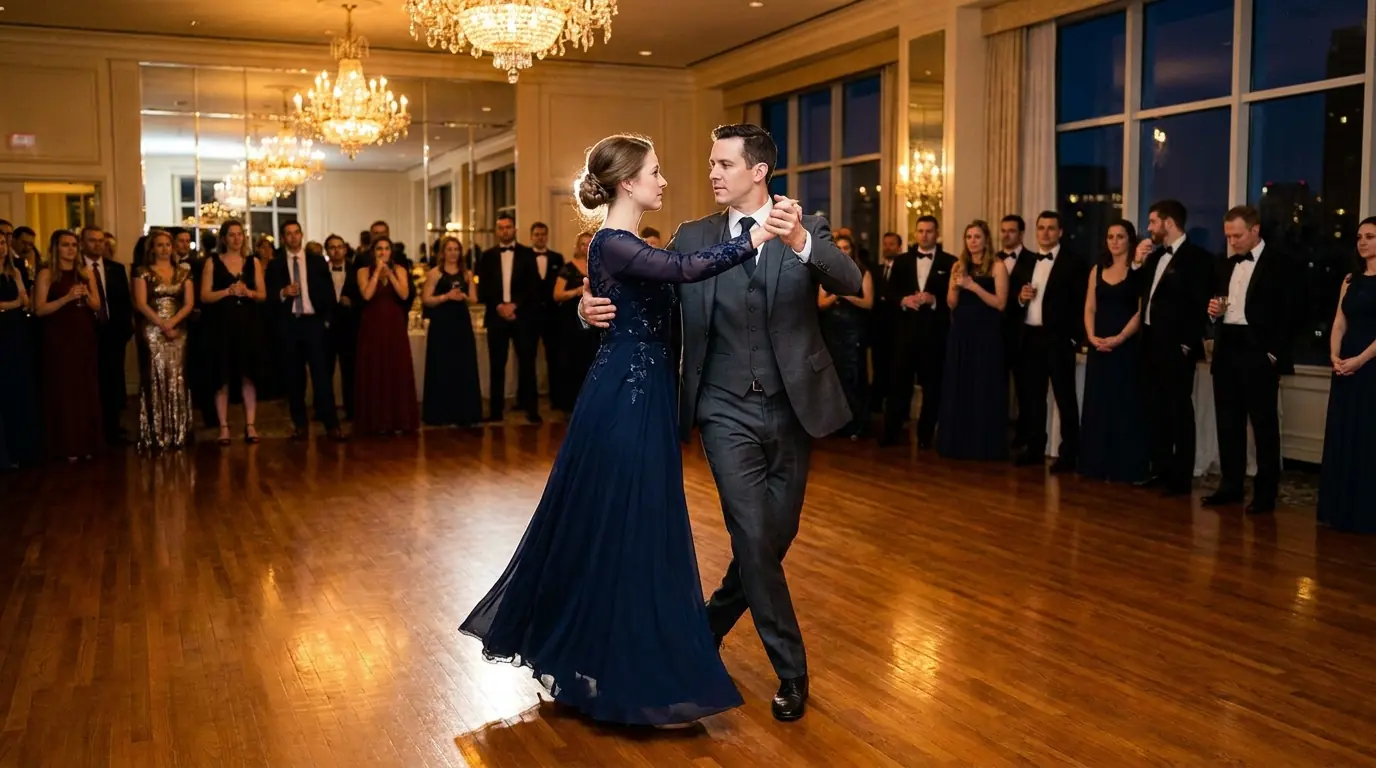
He could see her checking his face for the small signs that always preceded condescension: the tightness at the corners of the mouth, or the rehearsed warmth that hid pity. She did not seem to find them. Her shoulders eased by a fraction. "Sophie Bennett," she said. "Marketing." "I know," Adrian replied, and he let the words sit without further explanation.
Around them, the room was already noticing the interaction. Conversations did not stop, but they shifted in tone like a current shifting when something solid drops into the water. He felt the eyes on his back, which he had fully expected. He had stepped away from his safe corner, and he knew that corner would not be there when he returned. He looked at Sophie, at the careful grip on her glass, and at the steadiness she had not surrendered even after an hour of being unseen.
Whatever happened next, he understood it would not be a small thing. It would not be a private kindness. It would be witnessed, weighed, and remembered by everyone present. And he had already made his choice. He set his hand lightly against the edge of the small table beside them and prepared to ask her the question that would change the temperature of the entire room.
The string quartet shifted into something slower, a piece with a long opening line that gave the room permission to lower its voice. Adrian heard the change before he registered it, and he understood that the moment had arrived earlier than he had planned. "They've started the dance set," he said, keeping his tone factual, almost dry. "I'd like to ask you a question, and I'd like you to feel free to say no." Sophie watched him with the same careful attention she had used at the bar, weighing each word as it came.
Her grip on the glass loosened slightly, then tightened again, as if she had not yet decided which response to prepare. She did not answer. So, he continued, "Would you join me on the floor for a moment?" She did not move. Adrian could see the calculation behind her eyes, the small, painful arithmetic of someone who had been treated as a problem for so long that kindness itself had become suspect.
Around them, the texture of the room had changed significantly. The conversations nearest to them had thinned out. A waiter slowed his pace as he passed, then continued on his way. "Mr. Cole," Sophie said quietly, "I don't think this is a good idea." "Adrian," he replied, "and I'd like to hear why before I accept that statement."
She set her glass on the side table with deliberate care, choosing her words thoughtfully. Her voice stayed low, audible only to him. "Because half this room has been waiting to see what I'd do tonight," she said, "and the other half has been waiting to see what someone like you would do near someone like me." Adrian considered her answer carefully. He did not contest it because she was entirely right, and pretending otherwise would have insulted her intelligence.
He simply nodded once in the same understated manner he used when an analyst presented a difficult financial truth. "That's accurate," he said, "I've thought about it, and I'm asking anyway." Across the floor, near a column draped in soft white fabric, Victoria Lang leaned toward her husband and said something that did not need to be overheard. Daniel Foster lifted his glass to his lips without drinking and watched the two of them over the rim. Megan Hart had stopped moving entirely.
Sophie noticed all of it. Adrian could see her counting the eyes on her, and he saw a small, familiar instinct rise within her. It was the impulse to make herself smaller, to slip out through one of the side doors, and let the evening close over her absence. He had watched her hold that impulse off for nearly an hour. He understood that he was asking her to hold it off again, this time in front of more people and with louder consequences.
"If you walk out there with me," she warned, "tomorrow morning your name will be in three different conversations you won't be in the room for." "I know," he said, "and mine will be in five." "I know that, too." She studied him a moment longer. Whatever she found in his face must have been steady enough, because she straightened, lifted her chin a fraction, and gave him the smallest nod.
"All right," she said, "one song." He offered his hand. She took it, and the warmth of her palm against his was the first warm thing he had felt in the room all night. They walked toward the dance floor together, looking neither hurried nor hesitant. Adrian did not look at Marcus, who had finally fallen silent, nor did he look at the senior partner near the bar, who had stopped speaking mid-sentence.
He kept his pace even and his eyes ahead, because he understood that the moment they appeared rushed or apologetic, the entire performance would collapse into something the room could devour. The polished floor reflected the chandeliers above them in long, blurred ribbons of light. A few couples were already dancing, mostly senior executives and their spouses, and the couples nearest the edge drifted aside almost instinctively as Adrian and Sophie reached the open space. He turned to face her, set one hand at a respectful distance from her waist, and let her decide where to place her own. "I'm not very good at this," she said, almost to herself.
"Neither am I," he replied, "so we'll keep it simple." They began to move. The quartet had settled into a slow waltz, the kind that did not demand anything dramatic, only steadiness. Adrian counted the time in his head with the same quiet precision he gave to figures on a balance sheet, and the rhythm gave him something to hold on to. Sophie's shoulders, which had been carrying the weight of the entire evening, eased by a small but visible degree.
For perhaps 30 seconds, the rest of the room did not exist. Then it returned all at once with a low pressure he felt against the back of his neck. He could see in the long mirror behind the bar the shape of the gala rearranging itself around them. Heads turned. A senior partner named James Whitcomb, the firm's managing director, had stepped to the edge of his cluster and was watching them with a still unreadable expression.
Beside him, Victoria Lang had brought one hand to her collarbone, a gesture she used when she wanted to be observed reacting to something dramatic. "They're staring," Sophie murmured. "Yes." "You're going to regret this." "I considered that," Adrian said, "and I decided it wasn't a good enough reason."
She looked up at him then, properly, for the first time since they had stepped onto the floor. Her eyes were brown, steady, and tired in a way that had nothing to do with the late hour. He saw the woman who had sat through six years of meetings and earned her place by being better than the room required. He saw the woman who had walked in alone tonight, knowing exactly what would be waiting for her. "Why?" she asked very softly, "Why are you doing this?"
Adrian thought about how to answer her. The honest version was longer than the song would allow, and he was not a man who unloaded long answers in public. He chose the shortest version that was still entirely true. "Because no one should have to stand against a wall for an hour and pretend they don't notice," he said, "and because I noticed." She did not reply.
Her hand at his shoulder shifted slightly, as if she had to adjust her grip on something heavier than she had expected. The song was halfway through when the first interruption arrived. Marcus Reed, his earlier ease replaced by a thin professional smile, drifted to the edge of the floor and caught Adrian's eye. He did not approach; he simply stood there holding a fresh glass of wine with the patience of a man who intended to be seen waiting. Adrian turned them gently so that his back was to Marcus, making the movement subtle enough that Sophie did not have to acknowledge it.
She felt it, though. He could tell from how her breath shortened. "Your friend wants a word," she said. "He'll wait." "He won't be the only one."
"He still won't be the most important conversation in this room tonight." The song reached its final phrase. Adrian slowed their movement so the last steps could land exactly on the music's last note. When the quartet drew its bow across the closing chord, he did not immediately let go of her hand. He guided her instead off the floor toward the quieter side of the room, where a row of tall windows looked out over the river and the lights of the bridge beyond.
It was there, in that brief corridor of relative privacy, that the second wave reached them. Daniel Foster appeared at Adrian's elbow with the practiced casualness of a man delivering a message he had been instructed to make sound informal. "Adrian," he said with a smile that did not move past his cheeks, "do you have a moment? James would like a quick word at the bar." Adrian looked at him for a long second before responding. "I'll be there in a few minutes."
"He suggested now." "And I'm suggesting a few minutes." The smile on Daniel's face flickered. He gave a small, formal nod and withdrew from the space. Sophie was already gathering herself.
Adrian could see the shift, the way her composure tightened back into the defensive armor she had walked in with. Her eyes went to the far side of the room toward the elevators, and he understood what she was going to say before she said it. "I should go," she said, "this is going to get worse for you, and I'm not going to be the reason." "You're not the reason," Adrian replied, "whatever this becomes, it was already there before tonight, and you only made it visible." She shook her head, and her voice dropped lower.
"You don't understand, as I've been through this kind of room before." "They'll twist it." "By Monday, there will be a version of tonight that has nothing to do with what actually happened, and I won't be in any position to correct it." "Neither will you." He did not argue because the part of him that ran balance sheets knew she was entirely right.
Instead, he said the only thing he had left: "Stay, Adrian. One more song. After that, if you want to leave, I'll walk you to the elevator myself." She looked at him, and for a moment, he thought she was actually going to agree to stay. Then a small group near the bar shifted, James Whitcomb's profile became visible, and Sophie's expression immediately closed. She stepped back from him, slowly retreating from a fire that had begun to throw dangerous sparks. "I'm sorry," she said, "I really am."
She turned and walked directly toward the elevators. Adrian did not follow her. He stood alone at the edge of the dance floor, his hand still half raised from where hers had just been, and he felt the room watching him with a new, sharper interest. Somewhere behind him, the quartet had begun another piece, a slower one, and a few couples drifted out to dance. For perhaps 10 seconds, he did not move.
To anyone observing, he looked like a man who had misjudged a moment and was now paying for it in public. He could feel the interpretation forming in real time around him, the small, decisive way a story sets in a room when no one bothers to correct it. Marcus was approaching him from one direction. Daniel was returning from the other. James Whitcomb had turned fully toward him at the bar.
Adrian lowered his hand. He looked once toward the elevators, where Sophie had already disappeared around the corner of the corridor, and he understood with the same cold clarity he had felt at the window an hour earlier that the evening had reached the point where doing nothing would cost him more than doing something. He let the next song begin without him, and he started to walk. Adrian walked away from the crowd. He did not walk toward Marcus, Daniel, or James Whitcomb at the bar.
He walked in the direction Sophie had gone, maintaining the same unhurried pace he had used crossing the floor an hour earlier. Marcus called his name once, low enough not to carry, but Adrian did not turn around. Daniel stepped directly into his path with a careful professional smile, and Adrian moved around him without breaking stride. "Adrian," Daniel said, "James is waiting." "Then he'll wait a little longer."
He left the ballroom through the wide double doors that led to the corridor, and the noise of the gala thinned behind him into something muted and far away. The hallway was carpeted in deep gray, lit by recessed bulbs that gave the walls the look of a hotel after midnight. At the far end, near the bank of elevators, Sophie had stopped. She was standing with one hand against the wall, her head down, catching her breath before pressing the call button. She heard his approach before she saw him.
When she turned, her expression was already prepared for someone she did not want to face. Her arms folded tightly across her chest, but she did not move toward the elevator buttons. "Adrian, please," she said. "One minute," he replied. "If after one minute you still want to leave, I won't keep you, and I'll press the button myself."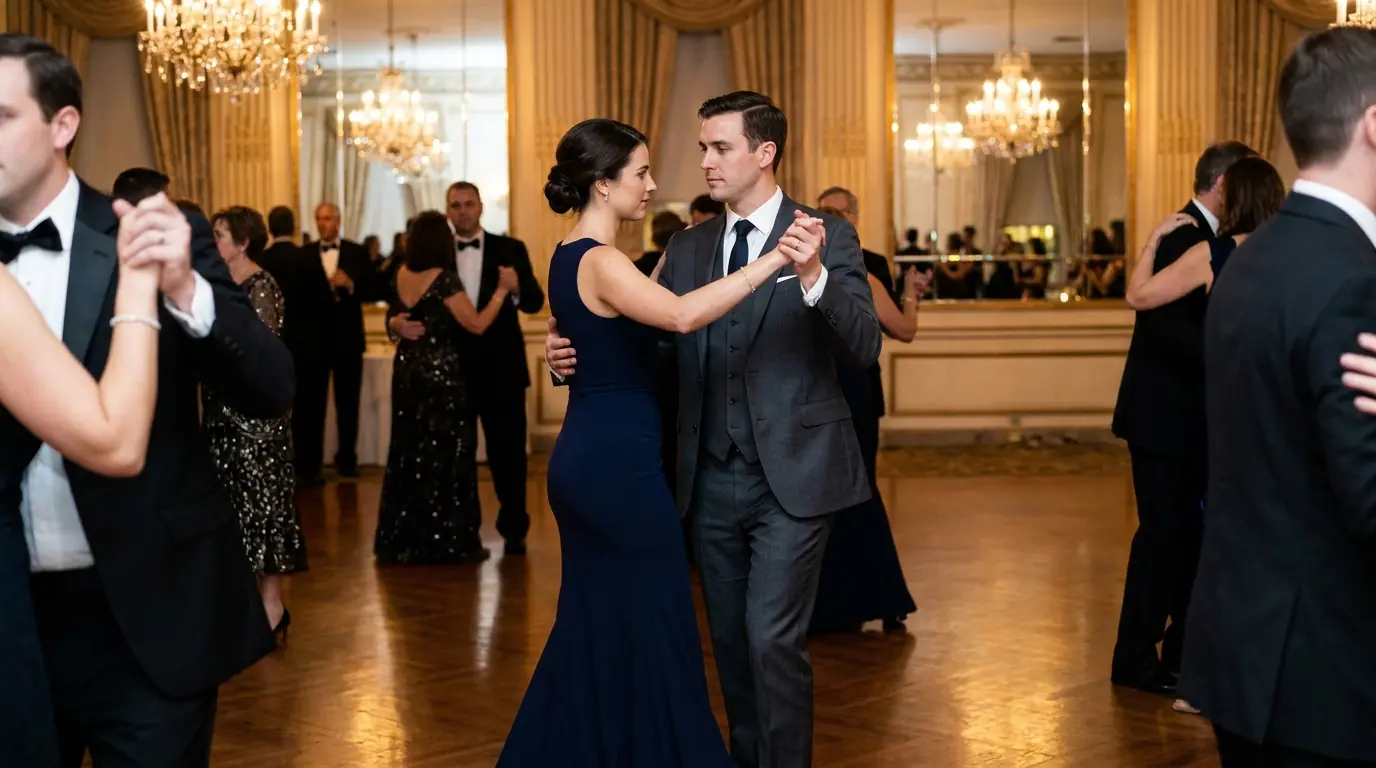
She held herself the same as she had at the bar—upright, contained, as if any softening would break something she had spent the entire evening assembling. The corridor between them felt much longer than it actually was, and the soft hum of the building's ventilation filled the space neither of them was filling with words. "I was married for nine years," Sophie said before he could begin speaking. Her voice was low and almost flat, but it was the first time she had let any of her true emotion show. "I was the wife at every one of these parties."
"I knew where to stand, I knew who to laugh with, I knew which questions to ask the partners' wives, and I knew which subjects to avoid." "I was very good at it." Adrian did not interrupt her. "Then six months ago I stopped being someone's wife, and the same women who used to ask after my weekend stopped meeting my eyes in the elevator." "The same men who used to refill my glass started forgetting I was even in the room."
"It wasn't personal, and that is the worst part of it." "They didn't decide to dislike me; they just decided I wasn't useful anymore." She breathed in once slowly, and her shoulders settled into something Adrian recognized too well: the bearing of someone who had learned to stand against absence the way other people stand against harsh weather. "So when you walked across that floor tonight," she continued, "I didn't think you were being kind." "I thought you were being careless."
"And I thought tomorrow you would understand in a very specific and detailed way the cost of being careless near someone like me." Adrian listened to her the entire way through. He did not look at his watch, did not glance toward the corridor, and did not let his face arrange itself into anything that would have made her feel observed rather than heard. When she was finished, he allowed her words to fully settle before he answered. "I'm going to tell you something," he said, "and I'd like you to take it the way I mean it, not the way the room would translate it."
She gave a small, tired nod. "I have spent a long time in rooms like that one, so I know exactly how they work." "I know who gets seen and who doesn't." "I know the cost of standing too close to the wrong person, and I have until tonight paid that cost by staying in the safest part of every room I walked into." "I've made a career of being careful, which is not something I'm proud of; it's just true."
He kept his voice completely level, maintaining the steady delivery of a man stating a position he had already verified. "What I saw tonight wasn't a difficult woman, it wasn't a complication, and it wasn't a problem the firm has to manage." "I saw a colleague who has done good work for 6 years standing alone against a wall while a room full of people who have done less work pretended she wasn't there." "And I'm not willing to be one of those people anymore." Sophie's eyes shone, but she did not let any tears fall.
She held his gaze the way a climber holds a safety rope. "You don't know me," she said. "No," he agreed. "But I know what I watched for an hour, and I know what I'm not willing to keep watching." A distant elevator chimed somewhere down the hall on another floor.
Neither of them looked toward it. "If you walk back in there with me," Adrian said, "I'm not going to stand near you because I feel sorry for you." "I'm going to stand near you because there is no good reason for any of those people to treat you the way they have, and the only way that ends is if someone refuses to participate." "I would like to be that person, with your permission." Sophie did not answer right away.
Her arms slowly unfolded. She looked past him down the corridor in the direction of the ballroom, and her expression went through something Adrian did not try to name on her behalf. "One song," she said finally, using the exact same words she had used the first time, except that her voice had lost its brittle edge. "One song," he agreed. They walked back together at an even, deliberate pace.
When they reentered the ballroom, the temperature of the room shifted in a way that was almost physical. Conversations thinned out for the second time that evening. Marcus, who had retreated near the bar, set his glass down and watched them cross the floor with an expression that was no longer hostile, only thoughtful, as though he were rearranging something in his own mind. Daniel did not approach them. James Whitcomb, the managing director, observed them without expression and then, very deliberately, turned back to the woman he had been speaking to and resumed his conversation.
It was a small gesture, but in a room like this, it was not small at all. The quartet was nearly through a slow piece. Adrian led Sophie to the same place on the floor they had occupied earlier and turned to face her. This time, she did not wait for him to extend his hand. She stepped into the frame the way someone steps into a doorway they have fully decided to walk through.
They began to move. The music carried them through its last full passage, and Adrian felt the difference at once. The first dance had been a question, but this one was an answer. Sophie's shoulders did not lift defensively toward her ears. Her grip at his arm was steady and almost casual.
She did not check the room over his shoulder. She did not count the eyes fixed on her. Whatever she had been carrying when she walked in, she was carrying less of it now, and he could feel the difference in the simple weight of her hand. Around them, the room adjusted itself. Victoria Lang turned away first, drawn into a conversation across her own circle.
Megan Hart, after a long and complicated look, said something to the woman beside her and walked toward the bar. Two of the younger associates exchanged a glance that Adrian thought was no longer about Sophie at all, but about themselves and the version of the evening they were going to remember. Even Marcus, standing apart now with his glass refilled, lifted his chin in something that was not quite a greeting and not quite an apology, but closer to the second than the first. The judgment did not vanish, but it softened in the way a current softens when something solid stops resisting it and starts moving with it. "I owe you an apology," Sophie said quietly near the end of the song.
"For what?" "For thinking the worst of you in the corridor." "You weren't wrong to," Adrian said, "you were just wrong about me specifically." She made a sound that was almost a laugh, which was the first he had heard from her all night. It was small, tired, and entirely real.
The quartet drew its bow across the closing chord. The other couples drifted slowly toward the edges of the floor. Adrian let his hand slide gently from her waist and stepped back, and Sophie did not move away from him afterward. She simply stood where she was in the open light of the chandeliers in the center of a room that had decided for one night, at least, that it could not quite write the story it had wanted to write. They did not stay much longer.
There was no reason to. The point had been made not in words, but in the simple public fact that a woman the room had tried to erase was standing at the very center of it with someone beside her, and that the two of them were not in a hurry. Adrian collected her coat himself. He did not ask a waiter to do it.
He walked to the coat check, gave both ticket stubs, and helped Sophie into the long charcoal wool of her coat with the same practical care he gave to everything else in his life. At the elevator, James Whitcomb caught his eye from across the room. Adrian held the look for a measured second and gave a single small nod, the kind of nod a man gives when he has not asked permission and does not need it. James returned the nod more slowly and looked away. The elevator opened.
They stepped inside. The doors closed on the noise of the gala, on the chandeliers, and on the clusters of people who would by Monday morning have begun to rewrite what they had seen. Inside the small mirrored box of the elevator, the silence was not heavy. It was the silence of two people who had stopped performing and had not yet decided what came next. "I'm not going to thank you," Sophie said as the floors counted down.
"I wasn't expecting you to; I just wanted you to know." "Noted." When the doors opened on the lobby, the autumn air came in cool and sharp from the open street beyond. Adrian gestured toward the door and they stepped out together onto the wide stone steps of the Whitman Tower. He did not put a hand at her back.
He did not offer her his arm. He walked beside her half a step behind, matching her pace without crowding it. At the curb, a black car was waiting. Sophie stopped. She turned to him, and in the light from the streetlamps, her face looked younger than it had under the chandeliers—less guarded and less rehearsed.
"I don't know what tomorrow is going to look like," she said. "Neither do I," Adrian replied, "but I'd like to find out without the chandeliers." Her mouth lifted just a little on one side. It was not quite a smile; it was something quieter and steadier, and it stayed. "Good night, Adrian." "Good night, Sophie."
She got into the car. The door closed. The car pulled into the slow river of late traffic and disappeared around the corner. Adrian stood on the steps for a long moment, his hands in his coat pockets, watching the spot where her car had been. Then he turned up his collar against the evening chill and walked toward his own vehicle.
People are rarely excluded because they have done something wrong. Most often, they are excluded because the room around them has decided that a kind of silence is easier than a kind of honesty. The silence costs nothing to the people who keep it, but it costs everything to the person standing alone against the wall. It takes very little to break that silence, such as a name spoken at the right moment, a hand offered without conditions, or a choice made in front of witnesses to see another person clearly and refuse to look away.
Kindness, the real kind, is not soft. It is not weakness. It is the steady willingness to step into the center of a room and tell the truth about what you see, even when the room would rather you didn't. A single act of that kind of courage will not change every room, but it will change one. And that is usually enough.