The sky over Route 9 had turned the color of a bruise by 5:00, and Caleb Hayes knew he should have been home an hour ago.
He wasn't the kind of man who ignored bad weather.
At 34, with a 7-year-old daughter waiting at home and no one else in the world to take care of her, he had learned to respect things that were bigger than him.
Thunder, debt, grief, the particular silence that filled a house where a mother used to sing.
Sophie's mother had been gone two years now.
Not dead, just gone.
Gone in the way that left no grave to visit and no explanation a child could understand.
Caleb had stopped trying to explain it and started focusing on the only thing that mattered, being enough, being everything.
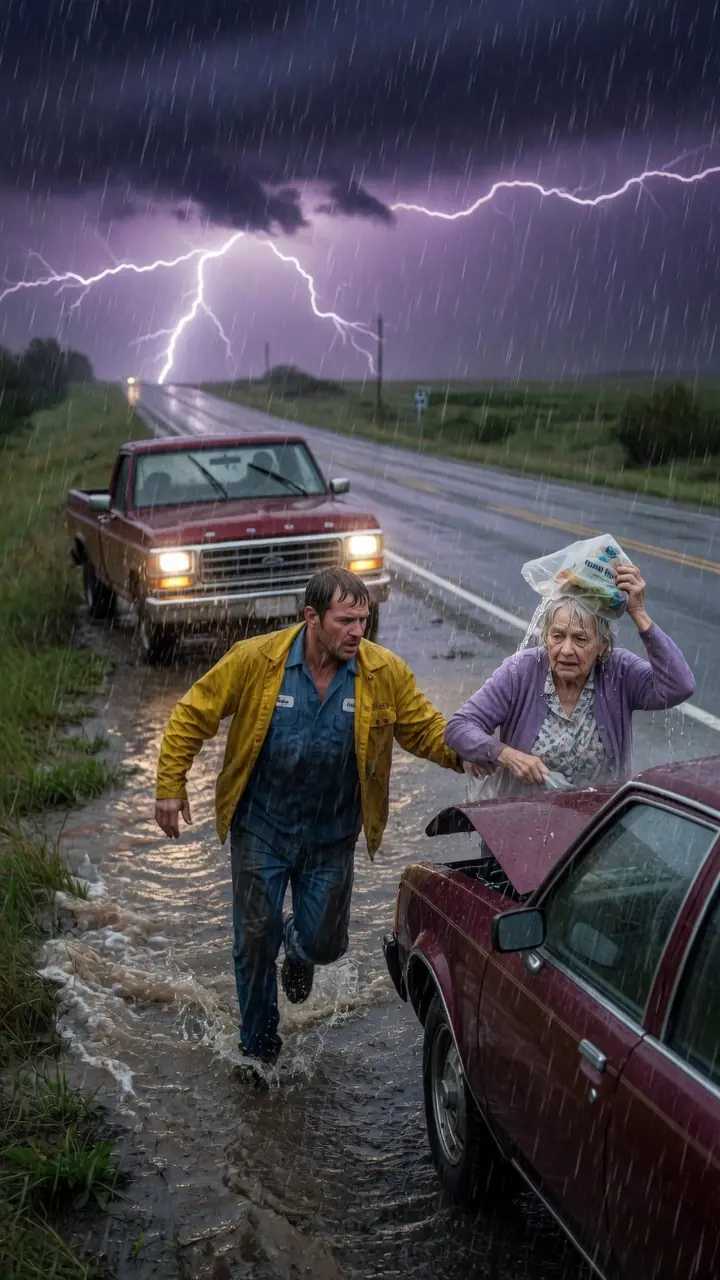
He was almost to the exit when the rain started in earnest, not falling, but attacking, hammering the windshield of his old pickup truck with the fury of something personal.
He clicked his wipers to high and leaned forward, squinting at the white lines disappearing beneath sheets of water.
That's when he saw her.
A figure on the shoulder of the highway, small, hunched, standing beside a car with its hood raised, holding what looked like a plastic bag over her head in a gesture so futile it almost broke his heart.
Caleb pulled over without thinking.
He was that kind of man.
He grabbed the rain jacket from behind his seat, the good one, the one Sophie had given him last Father's Day with her allowance money, and sprinted through the downpour toward the figure.
Up close, she was older than he'd expected.
Seventy, maybe more.
White hair plastered to her temples, eyes the color of storm clouds, sharp and entirely unafraid.
"Ma'am," he shouted over the thunder, "you okay?"
She looked at him the way old people sometimes look at the young, with a patience that has survived many storms.
"Battery died," she said. "And my phone went with it."
"Come on."
He draped his jacket over her shoulders.
"Get in my truck. I'll call a tow."
She didn't argue.
She walked with dignity, not hurry, as if the rain were beneath her concern.
When she was settled in the passenger seat, steam rising gently from her wet clothes, she looked around his truck at the crayon drawing taped to the dashboard, the small pink sneaker wedged under the seat, the child's book of animal riddles on the center console, and she smiled.
"You have a little one," she said.
"Sophie. She's seven."
He was already on the phone with the tow service.
"They'll be here in forty minutes. I can wait with you or—"
"You should go home to your daughter."
Her voice was firm, but warm.
"The tow will come. I'll be fine."
"I'm not leaving you here alone in a storm."
She looked at him again, that long measuring look.
"No," she said quietly.
"I don't suppose you are."
They waited together.
She told him her name was Eleanor.
She didn't offer a last name, and something in her manner told him she was accustomed to not needing one.
They talked about Sophie, about the ridiculous plot of the animal riddle book, about the way storms smelled different depending on the season.
When the tow truck finally arrived, Eleanor pressed his jacket back into his hands and held them for a moment.
"You're a good man, Caleb Hayes," she said.
She hadn't asked his name.
He hadn't given it.
He drove home through the dying storm, shaken in a way he couldn't name, and told himself he'd imagined it.
Sophie was asleep by 8:00.
Caleb was washing dishes, the quiet, meditative work of a man who had learned to find peace in small routines, when he heard them.
Not thunder.
Engines.
Motorcycle engines.
Plural.
Growing louder.
Slowing.
Stopping.
Right outside his house.
He counted headlights through the kitchen window.
Seven.
Eight.
More arriving.
The rumble settled into a low, throating idle that he felt in his chest and then cut out one by one until silence pressed against the house like a held breath.
He stood very still.
Caleb Hayes was not a fearful man by nature, but he was a practical one.
He lived on the edge of Millhaven, a small town of 11,000 people where the biggest events were the county fair and the occasional bar fight.
Men like him, quiet, ordinary, fatherless in the ways that mattered, did not attract attention from motorcycle clubs.
Except apparently tonight.
He checked that Sophie's bedroom door was shut, then walked to his front door and opened it before they could knock.
There were eleven of them on his porch and front lawn.
Big men, most of them.
Leather vests heavy with patches.
Faces that had seen weather and worse.
They stood with a stillness that was somehow more intimidating than movement.
The stillness of people who had nothing to prove and knew it.
The man at the front was the largest.
Silver-haired.
Broad through the shoulders.
With hands like sledgehammers and eyes like a judge.
His vest patch read PRESIDENT.
His face gave nothing away.
For a moment nobody spoke.
Then he said:
"You the man who helped our mother?"
Eleanor May Roark arrived at his garage on a Thursday, driven by the red-bearded man, whose name Caleb learned was Finn, in a car that was emphatically not a motorcycle.
"My sons think I'm too old to ride," she told Caleb, settling into the chair he offered with the air of a woman who accepts comfort without considering it a concession.
"How many sons?" he asked.
"Nine."
She said it the way other people say three.
"Biological and chosen. The Iron Reapers are not all blood, Mr. Hayes, but they're all mine."
Caleb thought about that.
A woman who had built a family of nine men, large and fearless and loyal, who rode through storms to find a stranger just because she'd asked him to.
"Eleanor," he said, "how did you know my name?"
She looked at him with those storm-colored eyes.
"Your registration in your truck. Sophie Hayes, it said on the drawing taped to your dashboard. That was your daughter's name. Caleb, it said on your work jacket. Hayes on the mail in the cup holder."
A pause.
"I'm old, not unobservant."
"You told Donahue you remembered my license plate."
"I did."
She smiled slightly.
"I remembered everything."
She folded her hands in her lap.
"You have good hands. The kind that work hard and hold gently. I noticed."
He didn't know what to say to that.
"I wanted to come myself," she said, "to thank you properly. Not in a storm. Not surrounded by nine enormous men who make even simple conversations feel like negotiations."
She smiled.
"It wasn't kindness," he said.
"It was just right."
"Yes."
Eleanor looked at him steadily.
"That's exactly what makes it kindness."
What Caleb didn't tell anyone, not Dana, not his neighbor, not Eleanor, was what the night had opened in him.
He had spent two years being contained, practical, focused.
Sophie needed a father who didn't fall apart, so he hadn't.
He got up every morning and went to bed every night, and in between he did what needed doing, and he told himself that was enough, that purpose was the same as peace.
But something about Eleanor, alone on the highway, unbothered, entirely herself, had cracked something open.
And something about Donahue's eleven men arriving in force just to say thank you had made him understand that loyalty didn't require blood.
And something about Sophie standing in the hallway in her dinosaur pajamas offering apple juice to strangers without a shadow of fear, that had undone him completely.
Because he realized she was not afraid because he had never shown her that the world required fear.
And he had not shown her fear because somewhere inside him, beneath the grief and the practical daily business of survival, he still believed the world was capable of this.
Of men riding through storms for their mother.
Of strangers stopping on highways.
Of apple juice extended to the unfamiliar.
He had not lost that belief.
He had only misplaced it.
He found it again in the week that followed.
In the small ways Millhaven softened around him.
In the Iron Reapers, who did not make a show of their gratitude, but simply let it be known quietly through the channels of reputation and loyalty that Caleb Hayes was a man worth knowing.
In Finn, the red-bearded one, who stopped by the garage once just to check the oil on his bike and stayed to talk for two hours about engines and daughters and the way grief moves through a man if he lets it.
Finn had lost someone too.
His wife, four years back.
He had two kids, both teenagers now.
"It gets different," Finn told him.
"Not better. Not easier. But different."
"You learn to carry it so it doesn't crush you."
"You build the muscles for it."
"Is that what the club does for you?" Caleb asked.
Finn thought about it.
"The club reminds me I don't have to carry it alone."
A small smile.
"That's enough."
Sophie, with the uncanny perception of children who are loved and paying attention, noticed the change in her father.
"Daddy," she said one evening while he was braiding her hair, "do you think the bikers are our friends now?"
"I think some of them might be," he said carefully.
"I think Donahue's lonely," she said.
Caleb's hands paused.
"Why do you think that?"
"Because when he looked at me, his eyes went sad."
She considered.
"Like you look at pictures of Mama."
"Like something's missing and you remember it all at once."
He resumed braiding.
His throat was tight.
"Donahue's mother lives far away and he misses her."
"Oh."
Sophie was quiet for a moment.
"That makes sense."
"I'd miss Eleanor too if she was my grandmother."
"You've met her once."
"She brought me those lemon cookies," Sophie said, as if this settled the question of grandmotherhood entirely.
Caleb laughed.
The real kind.
The kind that came from somewhere undefended.
A month after the storm, Eleanor invited them both to Sunday dinner.
The Iron Reapers clubhouse was nothing like what Caleb had imagined.
It was a large converted farmhouse on the edge of the county, loud with voices and smelling of wood smoke and roasted meat.
Children ran through the yard.
Women talked over each other in the kitchen.
Men sat on the porch and argued about motorcycles with the passionate specificity of people who love something.
Eleanor met them at the door.
Sophie walked straight to her and held out Gerald the rabbit.
"I brought Gerald," Sophie said, "in case you were lonely."
Eleanor took the rabbit with both hands.
She looked at it for a moment.
Then she looked at Caleb.
Her storm-colored eyes were very bright.
"Come inside," she said.
"Both of you."
Dinner was loud and warm and ridiculous.
Three of the nine men argued about whether Sophie's joke—
*"Why don't scientists trust atoms? Because they make up everything."*
—was funnier than Finn's joke, which wasn't even a joke, just a story about a raccoon that had gotten into the clubhouse refrigerator.
Sophie ate three servings of Eleanor's pot roast and announced afterward that it was the best food she had ever eaten, which made Eleanor press her lips together in the way of a woman successfully hiding her pride.
Donahue sat at the head of the table and said very little.
But he watched.
He watched Caleb help Sophie cut her meat without being asked.
He watched Caleb laugh at something Finn said.
He watched Sophie crawl onto Eleanor's lap an hour after dinner and fall asleep there, Gerald tucked under her chin, while Eleanor read to her from a book she'd found on the shelf.
At the end of the night, when a sleeping Sophie was gently settled in the back of Caleb's truck and the other men had drifted inside, Donahue walked with him to the driveway.
"She likes it here," Donahue said.
"She likes people," Caleb replied.
"She's not like me in that way."
"She's exactly like you," Donahue said.
"You just haven't noticed."
Caleb looked at him.
"A man who stops for strangers in storms likes people."
Donahue said it simply.
"He just shows it differently."
He held out his hand.
"You're welcome here. Both of you. Whenever you want."
Caleb shook it.
"Thank you."
Donahue's grip tightened briefly.
"No," he said.
"Thank you."
Six months later, Caleb Hayes' garage was the most trusted in three counties.
Not because of advertising.
Not because of luck.
But because a word passed through a network of loyalty had the weight of iron.
Sophie had decided that Finn's daughter, Maya, was her best friend.
Maya was fourteen, which Sophie found impressively old.
Maya, in turn, found Sophie's complete lack of self-consciousness about anything to be the most refreshing thing she had encountered in years.
Eleanor came for lunch every second Thursday.
She had strong opinions about pie crust and louder opinions about child-rearing.
And she had taken to leaving small things in Sophie's room—a shell, a photograph of mountains, a tiny carved wooden horse—without comment or explanation.
Sophie collected them on her windowsill like a museum of a person she was still discovering.
Caleb did not join the Iron Reapers.
That wasn't his road.
But he was known to them and they to him.
And when a man from the club needed engine work done with discretion, he did it.
And when Caleb's truck broke down forty miles from home one winter night, three riders arrived before the tow truck did.
That's how it worked.
Not fanfare.
Not ceremony.
Just presence when it mattered.
A year to the day after the storm, Caleb found a photograph in the glove compartment.
A Polaroid still slightly damp at the edges from where it had sat against the truck's interior in a rainy season.
It showed a woman and a small girl laughing, rain-soaked, holding matching pink umbrellas on what looked like a pier.
"Who is this?" Sophie asked.
Caleb looked at it for a long moment.
"That's you and Mama. Before."
Sophie studied it.
"We look happy."
"You were."
She turned it over.
On the back, in a child's handwriting she didn't recognize as her own, were four words:
**We have each other.**
She handed it back to her father.
He looked at the words and then at her and understood that she had found it for him.
That she had wanted him to see it.
"We do," he said.
Sophie nodded, satisfied, as if a question had been answered.
She picked up Gerald from the seat beside her, tucked him under her arm, and looked out the window at the long road ahead.
"Daddy," she said, "do you think we'll stop for anyone today?"
He looked out at the highway.
Wide and ordinary.
Full of the possibility of strangers.
"If they need us," he said.
Sophie smiled.
"Good."
They drove on.
One act of kindness costs nothing, but to those who receive it, it can become everything.
This story reminds us that true courage is not found in strength or size, but in the willingness to stop in the rain, in the dark, in the middle of our own busy lives for someone who needs us.
Caleb Hayes did not stop because he expected reward or recognition.
He stopped because it was right.
And in doing so, he opened a door he didn't know was there.
To community.
To healing.
To the kind of chosen family that loyalty builds across every boundary we think divides us.
Sophie teaches us something equally powerful.
The children who are raised in love do not inherit fear.
They inherit openness.
The Iron Reapers remind us that strength, when it serves others, becomes honor.
And Eleanor, in her quiet certainty, shows us that dignity is not diminished by need, and that the people who change our lives rarely announce themselves.
They just stand, rain-soaked on the shoulder of the road, waiting to see what kind of person you are.
Where every road leads to something worth becoming.