At seventy-six years old, Walter Bennett still wore a bow tie to work.
It was navy blue, slightly faded at the edges, and tied by hand every morning in the small bathroom mirror above his sink. His fingers were not as steady as they used to be, and some mornings the knot came out crooked, but Walter always fixed it before leaving.
A waiter, he believed, should look like he cared.
Even if the diner had cracked red booths.
Even if the coffee machine hissed like an old radiator.
Even if the floor tiles were worn smooth from forty years of footsteps.
Even if the tips were smaller now and the customers fewer.
Walter still buttoned his white shirt, pulled on his black vest, tied his navy bow tie, and walked three blocks through downtown Fairmont, Pennsylvania, to open the front door of Rosie’s Diner.
The diner did not belong to him, not officially.
It had belonged to his wife, Rose.
She had bought it in 1979 with money from her mother, two small loans, and a stubborn belief that a town needed one place where anyone could sit down and be treated like somebody.
Walter had been the waiter from the beginning.
Rose cooked. Walter served.
She made meatloaf, pancakes, chicken soup, biscuits, pot roast, apple pie, and the best grilled cheese in the county. Walter carried plates, refilled coffee, remembered names, remembered orders, and made lonely people feel expected.
For thirty-eight years, they ran the place together.
Then Rose got sick.
At first, she tried to keep cooking, even when her hands trembled. Then she moved to the register. Then she sat in the corner booth and told Walter what he was doing wrong.
“You’re pouring too much coffee, Walt.”
“That man asked for rye toast, not white.”
“Don’t let Mrs. Hanley leave without her pie.”
Even near the end, Rose was still running the diner with her eyes.
After she passed, Walter could not bring himself to sell it.
The sign still said Rosie’s Diner in red letters above the front window. Her recipe cards still sat in a metal box behind the counter. Her old apron still hung on the hook near the kitchen door.
Walter told people he kept working because bills did not pay themselves.
That was partly true.
But mostly, he kept working because the diner was the last place where Rose still felt nearby.
Every morning at 5:30, he unlocked the front door.
Every night at 9:00, he turned off the neon sign.
Between those hours, he served anyone who came in.
Truck drivers.
Factory workers.
Nurses.
College students.
Old men who ordered one coffee and sat for two hours.
Mothers with children.
Couples arguing quietly over fries.
People passing through town who would forget the diner by sunrise.
Walter served them all the same way.
With a clean cup, a steady voice, and the dignity Rose had insisted on.
“Everyone who sits at our counter deserves to feel welcome,” she used to say.
Walter had never forgotten.
One rainy November evening, just after 7:00, the diner was nearly empty.
Rain streaked the front windows, turning the lights of Main Street into blurry gold and red ribbons. The dinner rush had come and gone. A young couple sat in the back booth sharing fries. Mr. Cole, a retired mechanic, drank coffee at the counter and read yesterday’s newspaper as if the news might improve overnight.
Walter stood behind the counter, drying mugs.
In the kitchen, Maria Sanchez, the diner’s part-time cook, flipped the last burger on the grill. Maria was fifty-two, quick-tempered, kind-hearted, and forever telling Walter he needed to sit down before his knees gave out.
“You are not twenty-five,” she called through the kitchen window.
Walter glanced at her. “I was never twenty-five. I was born responsible.”
Maria snorted. “You were born stubborn.”
“That too.”
The bell above the front door jingled.
Walter looked up.
A boy stepped inside.
He was small, maybe ten years old, though his thin face made it hard to tell. His brown hair was damp from the rain and stuck to his forehead in uneven pieces. His gray hoodie was too light for the cold weather, the sleeves stretched over his hands. His jeans were wet at the cuffs, and one sneaker had a piece of silver tape wrapped around the side.
He did not move past the door.
He stood there dripping on the mat, eyes scanning the diner the way a frightened animal might scan a room for exits.
Walter noticed three things immediately.
The boy had no coat.
He had no adult with him.
And he was staring at the plates of food like he was trying not to.
The young couple in the back booth glanced over, then looked away. Mr. Cole lowered his newspaper slightly.
Walter set the mug down.
“Evening,” he said gently.
The boy flinched at the sound.
“I’m not staying,” the boy said quickly. “I just wanted to ask…”
His voice trailed off.
Walter waited.
Rushing a scared child was like pulling at a knot. It only made everything tighter.
The boy swallowed. “Do you have any food you’re throwing out?”
The diner went quiet.
Mr. Cole looked down at his coffee.
The young couple stared at their basket of fries.
Walter walked around the counter slowly, careful not to tower over the boy.
“What’s your name?” he asked.
The boy’s shoulders tensed. “Noah.”
“Noah,” Walter repeated. “I’m Walter.”
“I don’t have money.”
“I didn’t ask if you did.”
“I can take anything old. Like scraps. I won’t make a mess.”
Something tightened behind Walter’s ribs.
Scraps.
He hated that word coming from a child.
Rose would have hated it too.
Walter glanced toward the kitchen window. Maria’s face was tight, but she gave the smallest nod.
Walter turned back to Noah.
“We don’t serve scraps here,” he said.
The boy’s face fell.
He reached for the door. “Okay. Sorry.”
Walter stepped closer, not blocking him, just near enough to stop the moment from ending wrong.
“We serve meals,” Walter said.
Noah froze.
Walter nodded toward a booth by the front window. “You hungry?”
The boy looked suspicious, hopeful, and ashamed all at once.
“I can’t pay,” he repeated.
Walter held up one hand. “You already said that.”
“I don’t want trouble.”
“Neither do I. So sit down before you catch pneumonia on my floor.”
Noah blinked.
It was not exactly a joke, but it was close enough.
Slowly, he walked to the booth.
He slid into the seat as if he expected someone to yell at him for touching it. Water dripped from his sleeves onto the red vinyl. He folded his hands in his lap and stared down.
Walter grabbed a clean towel from behind the counter and brought it over.
“Here,” he said. “Dry your hair a little.”
Noah took it with both hands.
“Thank you.”
Walter pulled a menu from the holder, then stopped himself.
The boy did not need choices. Choices were hard when hunger was loud.
“How does grilled cheese and tomato soup sound?” Walter asked.
Noah’s eyes lifted.
“Real grilled cheese?”
Walter smiled. “I don’t know any fake kind.”
“With cheese inside?”
“That is usually how we do it.”
Noah looked down quickly, embarrassed by his own question.
“Yes,” he whispered. “That sounds good.”
“Milk or water?”
“Water is fine.”
“Milk it is.”
Before Noah could protest, Walter walked to the kitchen window.
Maria was already reaching for bread.
“Make it big,” Walter said quietly.
Maria gave him a look. “Do I look like a person who makes small grilled cheese for hungry children?”
“No, ma’am.”
“And soup?”
“Big bowl.”
“I heard him.”
Walter poured a glass of milk and added a straw because children, even hungry ones, should have small comforts. Then he placed a napkin, silverware, and the milk on Noah’s table.
Noah stared at the straw.
Walter pretended not to notice.
A few minutes later, Maria slid the plate through the kitchen window.
The grilled cheese was cut diagonally, the bread golden and crisp, cheese melting at the edges. The tomato soup steamed in a wide bowl. Maria had added a handful of crackers on the side and, without saying anything, placed two chocolate chip cookies on a small plate.
Walter carried everything to the booth.
When he set the food down, Noah did not touch it.
His hands clenched under the table.
“It’s for you,” Walter said.
Noah looked at the plate like it might disappear.
Then he picked up half the sandwich.
He took one bite.
His eyes closed.
Walter turned away and busied himself wiping a nearby table, giving the boy privacy. Hunger was not something a child should have to perform in front of adults.
Noah tried to eat slowly at first.
Then the food overtook his manners.
He finished the first half of the sandwich, dipped the second half into the soup, drank half the milk, and looked startled each time he realized there was still more. He ate like someone whose body had learned to hurry before food was taken away.
Walter kept his back turned.
Mr. Cole cleared his throat at the counter.
Walter glanced at him.
The old mechanic reached into his pocket, pulled out a twenty-dollar bill, and slid it across the counter.
Walter shook his head once.
Mr. Cole looked at Noah, then back at Walter.
Walter shook his head again.
Not this way.
Not in front of the boy.
Mr. Cole understood and tucked the money under his coffee cup.
When Noah slowed down, Walter returned with a small paper bag.
Inside were two more cookies and a turkey sandwich wrapped in wax paper.
Noah looked at it.
“I didn’t order that.”
“House mistake,” Walter said.
The boy frowned. “What does that mean?”
“It means Maria made too much and I refuse to argue with her.”
From the kitchen, Maria shouted, “Smart man.”
Noah almost smiled.
Almost.
Walter sat down across from him.
Not too close. Not like an interrogation.
Just an old waiter resting his knees.
“Noah,” he said gently, “is someone waiting for you tonight?”
The boy’s face changed.
His hands tightened around the milk glass.
“No.”
“Do you have somewhere safe to sleep?”
Noah stared at the table.
The rain tapped against the window.
Walter waited.
Finally, Noah whispered, “Behind the old movie theater. There’s a covered part.”
Walter had to steady himself.
The old movie theater had been closed for twelve years. Its back entrance faced an alley where delivery trucks used to unload popcorn boxes and soda syrup. There was a small overhang there, maybe enough to keep off some rain, but not the cold.
“You sleep there?” Walter asked.
Noah shrugged.
“Sometimes.”
“How long?”
“I don’t know.”
“You don’t know?”
“A few weeks. Maybe more.”
Walter’s voice stayed calm, though anger rose inside him.
Not at Noah.
At the world.
At every locked door.
At every adult who had passed this boy and decided not to ask.
“Where are your parents?” Walter asked.
Noah’s mouth pressed into a hard line.
“My mom’s gone.”
Walter softened. “Gone how?”
The boy looked away. “She died last year.”
“I’m sorry.”
Noah nodded once.
“My dad left before that. I was staying with my mom’s boyfriend after she died, but he got tired of me.”
Walter’s hand curled on the table.
“He put you out?”
Noah’s voice became flat. “He said I wasn’t his kid.”
The words landed between them like something broken.
Walter looked toward the kitchen.
Maria had heard. Her eyes were wet.
Walter turned back to Noah.
“Do you go to school?”
“Not lately.”
“What grade?”
“Fifth.”
“What’s your last name?”
Noah hesitated.
Walter knew that look. A child calculating whether a name could be used against him.
“You’re not in trouble,” Walter said.
“Parker,” Noah whispered. “Noah Parker.”
Walter nodded.
“Well, Noah Parker, here’s what we’re going to do.”
Noah immediately stiffened.
Walter leaned back slightly, making his voice gentler.
“Tonight, you are not sleeping behind the movie theater.”
“I don’t want police.”
“I didn’t say police.”
“I don’t want foster people.”
Walter paused.
He was not foolish. He knew there were rules. He knew children alone on the street needed more than soup and sympathy. But he also knew fear could make a child run before help arrived.
“No one is dragging you anywhere tonight,” Walter said. “But we do need to find you a safe place.”
Noah shook his head. “I’m fine.”
“No, son,” Walter said softly. “You’re not.”
The word son escaped before he could stop it.
Noah stared at him.
Walter looked down for a second.
He and Rose had never had children. Not for lack of wanting. There had been doctors, prayers, quiet disappointments, and one small room in their apartment above the diner that Rose had painted pale yellow before they stopped talking about possibilities.
Years later, Rose used that room for storage.
But Walter had never stopped hearing the silence inside it.
He cleared his throat.
“There’s an apartment upstairs,” Walter said.
Noah frowned.
“Above the diner?”
“Yes. I live there.”
“You live here?”
“I do.”
“Is that allowed?”
Walter smiled faintly. “I certainly hope so. I’ve been doing it for forty years.”
Noah glanced toward the door.
Walter continued carefully. “There’s a couch. It’s old, but it’s dry. You can sleep there tonight. In the morning, we’ll talk to someone who knows how to help properly. But tonight, you’ll be warm.”
Noah shook his head. “I can’t.”
“Why not?”
“Because people don’t just do that.”
Walter looked at him for a long moment.
Then he said, “Some do.”
Noah’s face tightened like he wanted to believe that and hated himself for wanting it.
“I won’t steal anything,” he said.
“I know.”
“I can work. I can wash dishes.”
“You can sleep.”
“I don’t need—”
“Noah.”
The boy stopped.
Walter’s voice was not harsh, but it carried the firmness of a man who had served thousands of people and knew when an order needed to be repeated.
“You came into my diner asking for food from the trash. I gave you dinner. That means for tonight, you are my customer. And customers at Rosie’s Diner do not sleep in alleys.”
Noah blinked quickly.
A tear slipped down his cheek before he could wipe it away.
He looked furious with himself for crying.
Walter reached for the napkin holder and slid it across the table.
Noah took one and pressed it hard against his face.
“I’m sorry,” he whispered.
Walter’s own throat tightened.
“Don’t ever apologize for being tired.”
After closing, Walter locked the front door while Maria packed a small bag from the kitchen.
“Soup, bread, boiled eggs, apples,” she said.
Walter looked at the bag. “Maria, he already ate.”
“And tomorrow he wakes up hungry again.”
Walter did not argue.
Maria came around the counter and stood in front of Noah. She was not tall, but she had the presence of someone you did not ignore.
“You listen to Mr. Walter,” she said.
Noah nodded.
“And if he burns toast in the morning, you come get me.”
Walter frowned. “I do not burn toast.”
Maria gave Noah a serious look. “He burns toast.”
For the first time, Noah smiled.
It was small and quick, but it was there.
Walter led him through the back hallway and up the narrow stairs to the apartment.
The place was modest and clean. A small living room with a brown couch, a round kitchen table, an old television, shelves of books, and framed photographs of Rose everywhere. Rose laughing behind the counter. Rose holding a pie. Rose and Walter standing outside the diner the day they opened it.
Noah paused at one photo.
“Is that your wife?”
Walter nodded. “Rose.”
“Is she dead?”
Children asked honest questions because they had not yet learned to decorate pain.
“Yes,” Walter said. “Six years now.”
Noah looked at the picture. “She looks nice.”
“She was.”
Walter found clean towels, an old sweatshirt, and sweatpants that had belonged to him years ago. They were too big for Noah, but warm. He let the boy shower, then made up the couch with blankets.
When Noah came out, his wet hair clean and his face less gray, he looked even younger.
Walter handed him a pillow.
“You need anything?”
Noah shook his head.
“You sure?”
A pause.
“Can I keep the light on?”
Walter’s heart cracked quietly.
“Of course.”
He left the small lamp beside the couch glowing.
That night, Walter barely slept.
He lay in his bedroom listening for sounds from the living room. Once, around 2:00, he heard Noah sit up sharply from a bad dream. Walter walked to the doorway but did not enter.
“You all right?” he asked softly.
Noah’s breathing was fast.
“Yeah.”
“You’re safe.”
Noah did not answer.
But after a while, he lay back down.
In the morning, Walter made pancakes.
He did not burn the toast because he did not make toast.
Noah ate three pancakes, two eggs, and an apple. Then Walter called a woman named Linda Carver, a retired social worker who had been a regular customer for twenty years.
Linda arrived at the diner before opening, wearing a purple coat and a face that knew how to be kind without being weak.
Noah almost ran when he realized who she was.
Walter sat beside him in the booth.
“No one is taking you without explaining things,” Walter said.
Linda nodded. “That’s right. I’m here to help figure out what’s safest. You get to know what’s happening.”
Noah stared at her with distrust.
Linda did not seem offended. She had probably been distrusted by many children who had good reason.
Over the next few days, the story came out piece by piece.
Noah’s mother, April Parker, had died of pneumonia the previous winter after delaying treatment because she had no insurance and did not want to miss work. Her boyfriend, Travis, had let Noah stay for a while, mostly because the apartment lease was in April’s name and there were benefits still arriving. When those stopped, so did his patience.
One night, after an argument, Travis told Noah to leave.
Noah did.
No school counselor had seen him in weeks. No relative had claimed him. His mother’s sister lived in Arizona but had not been reached yet. There were systems for children like Noah, but systems moved slowly, especially when a child was afraid and invisible.
Walter listened to all of it with a quiet face.
Inside, he felt something old and fierce waking up.
For the next two weeks, Noah stayed with an emergency foster family during the nights, but every afternoon after school, he came to Rosie’s Diner.
Walter made sure of it.
The diner became Noah’s steady place.
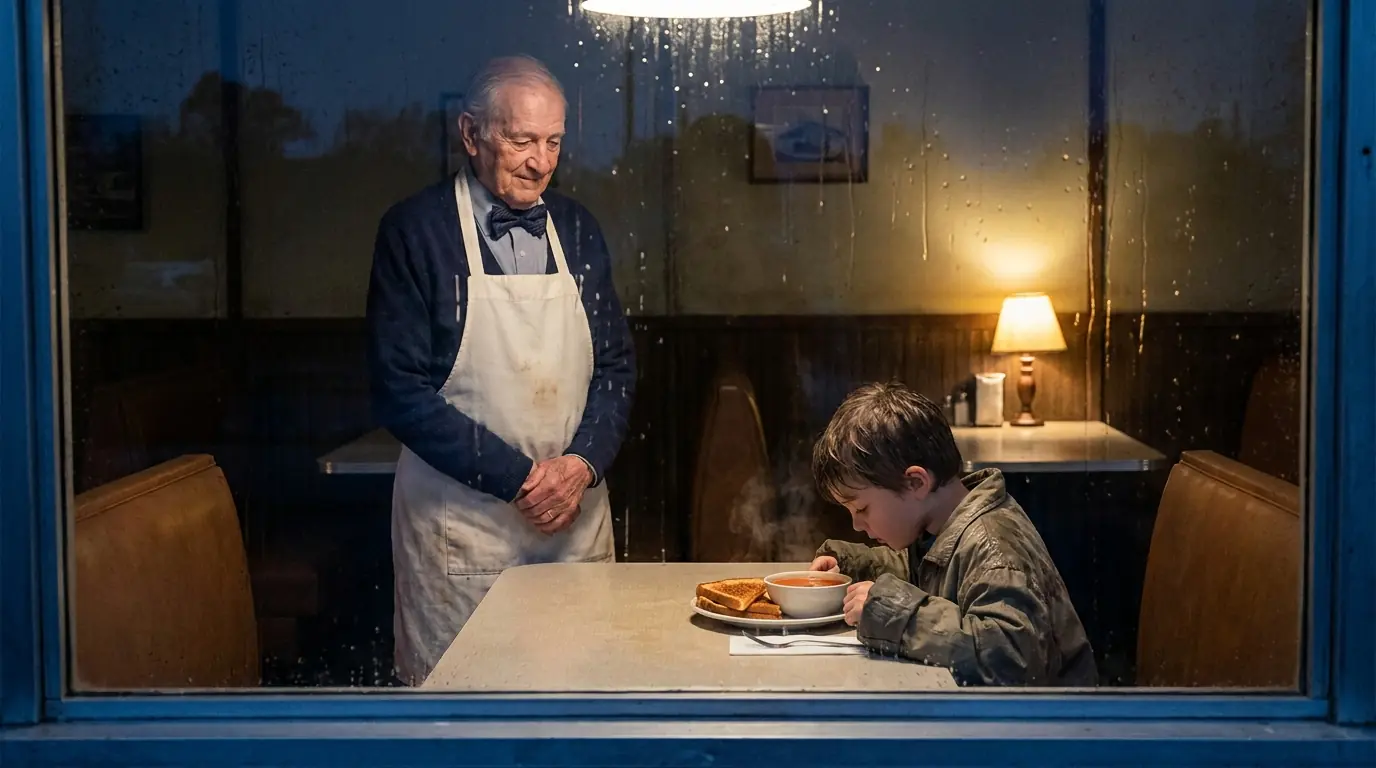
He did homework in the corner booth.
Maria fed him with the seriousness of a military officer.
Linda checked on him.
Mr. Cole taught him how to fix the loose leg on table six.
Customers began to notice, though Walter discouraged gossip with one sharp look.
Noah helped refill napkin holders. He lined up sugar packets. He wiped menus. Walter gave him small tasks and called them “work,” because he understood the boy needed dignity as much as food.
On Fridays, Walter paid him five dollars.
Noah protested the first time.
“I didn’t do enough.”
Walter held out the bill. “In this establishment, workers get paid.”
“I’m a worker?”
“You are when you organize ketchup bottles better than I do.”
Noah took the money like it was a certificate.
Weeks turned into months.
Noah’s aunt in Arizona was eventually found, but she was sick, overwhelmed, and unable to take him. After several hearings, meetings, and long conversations, Noah was placed with a local foster couple, Ben and Diane Miller, who lived twenty minutes outside town.
They were good people.
Steady people.
They gave Noah his own room, drove him to school, and never made promises they could not keep.
But Noah still came to the diner.
At first three times a week.
Then every Saturday.
Then during summer break, almost every day.
Walter never said it out loud, but he counted the hours until the bell over the door rang and Noah walked in.
The boy grew.
His shoulders widened. His hair darkened. His eyes became less watchful. He laughed more easily, though sometimes sadness still found him in quiet moments.
Walter taught him how to carry three plates on one arm.
Maria taught him how to make soup.
Mr. Cole taught him how to change oil in the diner’s delivery van.
Linda taught him how to fill out school forms.
Diane Miller taught him how to accept birthday presents without looking guilty.
Ben Miller taught him how to throw a baseball in the yard.
But Walter taught him how to serve people.
Not just food.
People.
He taught Noah to notice when an old customer wanted conversation and when they wanted silence.
He taught him never to make someone feel poor for ordering the cheapest thing.
He taught him that coffee refills were sometimes less about coffee and more about being remembered.
He taught him that a diner was not a room with tables.
It was a promise.
“You treat a hungry person like they’re a guest,” Walter told him one afternoon while showing him how to polish silverware. “Not a problem.”
Noah nodded.
“Even if they can’t pay?”
“Especially then.”
At fourteen, Noah began working officially at Rosie’s Diner on weekends.
Walter insisted he follow every labor rule, every school requirement, every permission form. Noah wore a black apron and, to his embarrassment, a small navy bow tie Walter gave him.
“I look ridiculous,” Noah said.
Walter adjusted the knot. “You look employed.”
“I look like a tiny magician.”
Maria laughed so hard she dropped a spoon.
Customers loved him.
Noah was quiet at first, then funny, then quick with names. He remembered who liked extra pickles, who hated onions, who needed decaf, who tipped in coins, who had lost a spouse and needed a little extra patience on Sundays.
He had learned hunger.
So he recognized other kinds of emptiness too.
When he was sixteen, he found a little girl crying outside the diner because her mother’s card had declined at the pharmacy next door. Noah came inside, took his own tip money from the jar, and bought the medicine before Walter even knew what had happened.
When Walter found out, he stood in the kitchen doorway, watching Noah pretend it was nothing.
“You did good,” Walter said.
Noah shrugged. “She needed help.”
Walter looked at him with quiet pride.
“Yes,” he said. “She did.”
The years moved faster than Walter wanted.
Noah graduated high school with honors.
Walter sat in the front row beside Ben, Diane, Maria, Linda, and Mr. Cole, wearing his best suit and the navy bow tie. When Noah crossed the stage, Walter clapped until his palms hurt.
After the ceremony, Noah found him in the crowd.
He was taller than Walter now.
“Did I do okay?” Noah asked, trying to sound casual.
Walter looked at the diploma in his hand.
“You did more than okay.”
Noah swallowed. “I put Rosie’s on my college essay.”
Walter blinked. “You did?”
Noah nodded. “I wrote about the night you fed me.”
Walter looked away.
He did not like to think of Noah wet, hungry, and asking for scraps.
But Noah continued.
“I wrote that I learned what dignity was from an old waiter in a diner.”
Walter’s eyes stung.
“You shouldn’t call people old in college essays.”
Noah laughed, then hugged him.
Walter held on longer than he meant to.
Noah went to college in Pittsburgh to study hospitality management and business. He wanted to learn how restaurants survived, why some failed, how food businesses could help communities instead of only taking from them.
Walter missed him terribly.
He never admitted it.
Every Sunday evening, Noah called.
Sometimes from his dorm room. Sometimes from a noisy campus hallway. Sometimes while walking back from work at a restaurant where he waited tables to help cover expenses.
“How’s the diner?” Noah always asked.
“Standing.”
“How’s Maria?”
“Bossy.”
“How are you?”
Walter usually answered, “Standing.”
Noah would sigh. “That is not a medical update.”
“I’m not a medical report.”
“Walter.”
“Noah.”
They argued like family because by then they were.
After college, Noah took a job in Chicago with a restaurant group. Then another in Philadelphia. He learned fine dining, payroll, food sourcing, training, leases, insurance, and the brutal mathematics of keeping doors open when everything cost more than it used to.
Walter was proud.
He was also lonelier.
The diner had changed.
Fairmont had changed.
The old factory closed, taking hundreds of lunch customers with it. The highway exit was redesigned, sending traffic away from Main Street. Younger people moved out. Chain restaurants appeared near the shopping center. Rosie’s Diner still had loyal customers, but loyalty did not always pay electric bills.
Walter kept working.
At seventy-nine, his knees ached so badly he sometimes gripped the counter until the pain passed.
At eighty, he stopped taking evening shifts unless Maria was there.
At eighty-one, he dropped a tray of plates because his right hand cramped suddenly. The crash startled everyone in the diner.
Noah drove in that weekend after Maria called him.
Walter was furious.
“I am not an emergency,” he said as Noah entered the diner.
Noah looked at the broken plate still sitting in the trash bin.
“You’re stubborn in multiple states now,” he said.
“I have always been consistent.”
Noah studied him.
Walter hated that look. It was the look adults used when they were about to say something reasonable and upsetting.
“You need help,” Noah said.
“I have help.”
“You need more.”
“I need customers.”
Noah looked around the diner.
The red booths were faded. The counter stools had cracked seats. The ceiling fan clicked. The front window sign flickered at the letter R, making Rosie’s look like osie’s whenever it rained.
Noah’s face softened.
“This place raised me,” he said.
Walter looked away. “No. People raised you.”
“This place gave the people somewhere to do it.”
Walter said nothing.
A month later, a developer made an offer on the diner building.
Walter had known it was coming. The pharmacy next door had already closed. The tailor shop across the street was empty. Someone wanted to buy the entire block and turn it into modern apartments with retail space below.
The offer was more money than Walter expected.
Enough to retire.
Enough to cover medical bills.
Enough to stop worrying.
Maria told him to consider it.
Linda told him Rose would want him safe.
Mr. Cole told him buildings were not people.
All of them were right.
And still, Walter placed the offer letter beneath the cash register and could not bring himself to sign.
One Thursday afternoon, after the lunch rush, he sat alone in the corner booth where Rose used to watch the room. Rain streaked the front window, just like the night Noah had first walked in.
The diner smelled of coffee and grilled onions.
The neon sign buzzed softly.
Walter looked at Rose’s photograph behind the counter.
“I don’t know how to let go,” he whispered.
No answer came.
Only the bell above the door.
Walter looked up.
A man in a dark overcoat stepped inside.
For one second, Walter did not recognize him. Then the man smiled, and the years disappeared.
Noah Parker stood in the doorway.
He was thirty now, tall and broad-shouldered, wearing a crisp white shirt beneath his coat. His hair was neatly combed, his face older, sharper, confident in a way that would have amazed the hungry boy he once had been.
But his eyes were the same.
Walter slowly stood.
“Noah?”
“Evening, Walter.”
“You didn’t say you were coming.”
“I know.”
Noah stepped aside.
Behind him, more people entered.
Maria.
Linda.
Mr. Cole, walking with a cane now.
Ben and Diane Miller.
The young mother whose medicine Noah had bought years ago, now with her daughter grown tall beside her.
Teachers.
Former customers.
Local business owners.
People Walter had served for decades.
Within minutes, Rosie’s Diner was full.
Walter looked around, confused and overwhelmed.
“What is this?”
Noah walked to the center of the diner.
“I need everyone’s attention for a minute,” he said.
Walter frowned. “No speeches in the diner.”
Maria called from the counter, “For once in your life, be quiet, Walt.”
Laughter rippled through the room.
Noah turned to Walter.
“I know about the offer,” he said.
Walter’s face tightened.
“Maria talks too much.”
Maria lifted both hands. “Proudly.”
Noah reached into his coat and pulled out a folder.
Walter stared at it.
“No,” he said immediately.
“You haven’t heard what it is.”
“I know that folder face. That is a life-changing folder.”
Noah smiled faintly. “Maybe.”
Walter shook his head. “I don’t want your money.”
“I know.”
“I fed you dinner. That doesn’t mean you owe me a building.”
Noah’s expression softened.
“No,” he said. “You fed me dinner. You gave me a couch. You gave me work when I needed dignity. You gave me a place to come back to when I didn’t know where I belonged.”
Walter’s throat tightened.
Noah opened the folder.
“I started a nonprofit restaurant group last year,” he said. “Community Table Initiative. We help old diners and neighborhood restaurants stay open by turning them into community-supported food spaces. Training programs, meal sponsorships, local hiring, after-school food access.”
Walter blinked.
Noah continued.
“Rosie’s Diner is becoming our first permanent home base.”
The room fell completely quiet.
Walter gripped the edge of the booth.
“What are you saying?”
“I’m saying I bought the pharmacy building next door. Not the diner. That stays yours as long as you want it. But we’re expanding into the empty space. New kitchen equipment, repaired sign, updated booths, accessible bathrooms, and a community meal fund in Rose’s name.”
Walter stared at him.
Noah’s voice grew softer.
“No child will ever have to walk into this diner asking for scraps again.”
Walter’s eyes filled before he could stop them.
“Noah…”
“And there’s more.”
Walter gave a weak laugh. “Of course there is.”
Noah turned to the crowd. “Everyone here contributed.”
Walter looked around.
Mr. Cole raised a hand.
“Don’t look at me,” the old mechanic said. “I only gave money because your coffee is still better than the gas station’s.”
Linda smiled. “The school district is partnering for after-school meals.”
Maria wiped her eyes with her apron. “I’m staying if you stop pretending you can carry soup pots.”
Ben Miller nodded. “Local contractors are donating labor.”
Diane added, “The booths are being restored, not replaced.”
The young mother stepped forward with her daughter.
“You helped us once,” she said to Walter. “Even if you didn’t know it. Noah did because you taught him how.”
Walter looked at Noah.
The old waiter who had spent his life remembering everyone suddenly felt remembered by everyone.
Noah reached into the folder and took out a small brass plaque.
He handed it to Walter.
Walter read the engraved words through blurred eyes.
ROSE BENNETT COMMUNITY TABLE
Founded in honor of the diner that fed people first and asked questions later.
Walter pressed a shaking hand over his mouth.
For years, he had feared Rose’s name would fade when the sign finally went out.
Now her name would be on every meal given freely to someone who needed it.
Noah stepped closer.
“You once told me customers at Rosie’s Diner don’t sleep in alleys,” he said.
Walter could barely breathe.
“I remember.”
“I built my whole life around that sentence.”
The room blurred.
Walter tried to speak, but no words came.
So Noah did what the boy in the gray hoodie had not dared to do years ago.
He stepped forward and hugged him first.
Walter held on.
The room applauded, but softly at first, as if everyone understood they were witnessing something too tender for noise. Then the applause grew, filling the diner, shaking the old windows, rising around Walter like warmth.
He closed his eyes.
For one moment, he could almost hear Rose laughing behind the counter.
Three months later, Rosie’s Diner reopened.
The sign had been repaired, glowing red and steady above Main Street. The old booths were still red, but freshly restored. The counter shone. The kitchen had new equipment. The pharmacy wall had been opened, creating a bright community dining room with long wooden tables where families, students, and seniors could eat together.
Walter still wore his navy bow tie.
But now he worked shorter shifts, mostly greeting customers and training young servers.
Noah moved back to Fairmont to run the Community Table Initiative from an office above the diner. Maria became head kitchen manager and declared herself “finally in charge,” though everyone knew she had always been.
Every weekday afternoon, children came after school for hot meals.
Some paid.
Some did not.
No one knew which was which.
That was Walter’s rule.
A wooden box near the register held meal cards. Customers could buy one for someone else. Local businesses sponsored tables. The school sent students who needed food, warmth, homework help, or simply a place to sit where nobody treated them like a problem.
On the first wall inside the new dining room, Noah hung an old photograph.
It showed Walter at the counter, younger then, carrying plates with Rose smiling behind him.
Beneath it was a sentence painted in careful letters:
You treat a hungry person like they’re a guest, not a problem.
Walter pretended the wall embarrassed him.
But every time he passed it, he touched the edge of the frame.
One rainy evening in November, exactly twenty years after Noah had first walked into the diner, Walter sat in the front booth by the window.
He was ninety-six now.
His hands trembled. His hair had gone white. His knees no longer allowed long shifts. But his bow tie was still navy blue, still tied by hand, though Noah helped with the knot on difficult mornings.
The diner was full.
Children laughed in the community room. Maria shouted orders in the kitchen. Linda, older but still sharp-eyed, sat with a cup of tea. Mr. Cole’s old counter stool had a small brass plate on it now, though he had passed the year before.
Noah slid into the booth across from Walter.
He wore an apron over his white shirt.
“Busy night,” Walter said.
“Good night.”
A boy near the entrance caught Walter’s attention.
He was standing just inside the door, soaked from the rain, looking uncertain.
Not as thin as Noah had been.
Not as frightened.
But hungry.
Walter saw it instantly.
So did Noah.
The boy whispered something to the young server near the host stand. The server nodded, smiled, and led him to a booth.
No questions.
No shame.
No delay.
A bowl of soup arrived within minutes.
Walter watched the boy pick up the spoon with both hands.
His eyes filled.
Noah looked at him gently.
“You okay?”
Walter nodded.
“I was thinking,” he said.
“About what?”
Walter glanced around the diner.
At the warm lights.
At the full tables.
At children eating without fear.
At Rose’s name on the wall.
At Noah, no longer a hungry boy, but a man who had turned one meal into a mission.
“I spent my life serving people,” Walter said quietly. “I thought maybe that was all I had done.”
Noah leaned forward.
“That was everything.”
Walter shook his head slightly. “No. I mean… I thought I was just carrying plates.”
Noah smiled.
“You carried people too.”
Walter looked out at the rain-streaked window.
The street beyond was dark and wet, but inside Rosie’s Diner, everything glowed.
He remembered the night Noah arrived.
A small boy by the door.
A gray hoodie.
A voice asking for food being thrown out.
Walter had thought he was giving him grilled cheese and tomato soup.
He had not known he was serving the future.
He had not known one warm meal could grow roots.
He had not known kindness, when given without making a person feel small, could come back years later with keys, blueprints, community tables, repaired signs, and a room full of children who would never have to ask for scraps.
Noah reached across the table and placed something beside Walter’s coffee cup.
It was the old navy bow tie from Noah’s first official shift at fourteen.
Walter recognized it immediately.
“I kept it,” Noah said.
Walter touched the fabric with trembling fingers.
“You looked like a tiny magician.”
Noah laughed softly. “Maria still says that.”
Walter smiled.
Then Noah said, “I want to frame it beside Rose’s picture. Is that okay?”
Walter looked at him.
“Why?”
“Because that was the day I stopped feeling like a homeless kid people were helping,” Noah said. “That was the day I felt like I belonged to something.”
Walter’s eyes filled again.
He nodded.
“Yes,” he whispered. “Frame it.”
Outside, rain fell on Main Street.
Inside, the bell above the door jingled again.
Another family came in, shaking water from their coats, and the young server greeted them warmly.
Walter watched the room move around him: coffee poured, soup served, children laughing, people making space for one another.
For the first time in years, he did not fear what would happen to the diner after he was gone.
The promise would remain.
Rose’s name would remain.
Noah would remain.
And somewhere, on some cold night in some hard year, another hungry child would step through the door and learn that the world still had tables where they were welcome.
Walter lifted his coffee cup with both hands.
Noah noticed the tremor and reached to help, but Walter gave him a look.
“I’ve got it,” he said.
Noah smiled and sat back.
Walter took a slow sip.
The coffee was too strong.
The way Rose had liked it.
He looked across the booth at Noah.
“My boy,” he said softly.
Noah’s face changed.
It was not the first time Walter had said it, but it still landed deep.
“Yes, sir?”
Walter nodded toward the dining room.
“Make sure they always get the good soup.”
Noah swallowed hard.
“I will.”
“And real grilled cheese.”
“With cheese inside,” Noah said.
Walter laughed, a quiet, weathered laugh that made Noah laugh too.
For a moment, the years folded gently.
The old waiter and the homeless boy were still there, sitting across from each other in a red booth while rain ran down the window.
Only now the boy was grown.
The old man was no longer alone.
And Rosie’s Diner, the place where one hungry child had once been treated like a guest instead of a problem, had become exactly what Rose always believed a diner should be.
A place where anyone could sit down.
A place where dignity came before the bill.
A place where kindness was served hot.
A place where the door stayed open, the coffee stayed ready, and no child ever had to ask for scraps again.