Marcus Hale was finishing his coffee when an 80-year-old woman stepped up beside his booth, her hands trembling inside her coat, her eyes never staying still for long.
“Can you tell me how to get to the police station?” she asked.
The question sounded simple, but something about the way she said it wasn't.
Marcus looked at her for a moment.
“What do you need the police for?”
She hesitated like she was deciding how much to say.
Then her voice dropped.
“My daughter.”
A pause.
“She’s still in the house.”
Marcus slowly set his cup down because now he knew this wasn’t just a question.
A thin Idaho wind scraped across Idaho Falls that afternoon, carrying the kind of cold that settled quietly into bones and stayed there.
Inside the roadside diner on Route 26, the world felt contained, warm, dim, and humming with small ordinary sounds. The low buzz of fluorescent lights overhead, the soft clink of silverware against ceramic plates, the steady rhythm of a coffee pot being refilled somewhere behind the counter. It was the kind of place that had existed long enough to become invisible to the people who passed through it every day. Faded red booths, a checkered floor worn smooth in the walking paths, windows slightly fogged from the contrast between winter air and human heat.
Gunnery Sergeant Marcus Hale sat in the far corner booth, back to the wall, where he could see both the entrance and the parking lot through the front windows without turning his head.
He was 42, tall even when seated, with a broad-shouldered frame that spoke of years spent carrying weight without complaint. His face was sharply cut, defined jawline, high cheekbones, and the thin pale scar running just above his right eyebrow, the kind that came from something fast and violent rather than accidental.
His hair was cropped short in regulation Marine style, dark brown threaded with early gray at the temples, and his eyes were a cold steady blue that rarely moved without reason.
He wore a long-sleeve olive green digital camouflage field shirt, sleeves rolled neatly to the forearms, paired with matching camo trousers and tan combat boots still dusted faintly with road salt from outside.
There was nothing flashy about him, nothing that called attention, but there was a stillness to the way he occupied space that made people instinctively lower their voices when they stood too close.
Marcus had spent nearly two decades in the United States Marine Corps, much of it attached to special operations units, where unpredictability wasn’t an exception, it was the rule. Years of deployments had carved something quiet and deliberate into him.
He wasn’t the kind of man who reacted quickly. He was the kind who noticed first, calculated second, and acted only when the outcome mattered.
At his feet, partially tucked beneath the table but not fully hidden, lay Ranger.
Ranger was a 6-year-old German Shepherd, large even for his breed, with a powerful chest and long muscular limbs built for endurance rather than speed. His coat was thick and well-kept, a rich amber base layered with a deep black saddle that darkened along his spine and faded toward his flanks.
His ears stood erect, constantly adjusting to the environment, and his eyes, sharp, intelligent, and unsettlingly focused, tracked movement in a way that suggested he was never truly at rest.
Ranger had been trained as a K9 unit partner for detection and protection work. He had seen more than most dogs ever should. Crowded streets overseas, unstable environments, long nights where silence meant survival.
Yet despite that, there was no visible aggression in him, no restless pacing or unnecessary tension.
Only control.
The kind that came from trust, discipline, and a bond forged through repetition and shared risk.
At the moment, he appeared relaxed, his head rested low, chin near his front paws, but his eyes remained open, occasionally flicking toward the door each time it opened or the bell above it chimed.
To anyone unfamiliar, he looked calm.
To Marcus, he looked attentive.
Marcus lifted his coffee, took a slow sip, and let the warmth settle briefly against the cold that had followed him in from outside.
He wasn’t thinking about anything in particular, which was, in itself, unusual.
Most days, his mind ran in layers. Past, present, contingency.
Today, for once, there was quiet.
The bell above the diner door rang.
Marcus didn’t turn immediately.
He didn’t need to.
The shift in air temperature, the subtle change in sound as the door opened, and the slight tightening in Ranger’s posture told him enough.
Someone had come in.
Then Ranger moved.
It wasn’t dramatic.
No barking.
No sudden rise.
Just a slow lift of the head, ears angling forward, eyes fixing on something near the entrance.
His body remained low, but the tension beneath his fur changed, like a wire being pulled taut just enough to carry current.
Marcus noticed that, and that alone was enough.
He set his coffee down.
A few seconds passed before the person approached.
When Marcus finally looked up, he saw her standing just at the edge of the booth, close enough to speak, far enough to retreat if needed.
Eleanor Whitaker was 80 years old, though the number didn’t fully capture what time had done to her.
She was small, barely reaching Marcus’s shoulder even standing upright. Her frame thin and fragile in a way that suggested both age and something less visible.
Wear, perhaps.
Or long-term strain.
Her gray hair was pulled back loosely into a low knot, strands escaping around her temples, catching the light in uneven silver lines.
Her skin was pale and finely wrinkled, not just with age, but with a kind of persistent tension, as if her face had spent years bracing for something that never quite ended.
She wore a heavy brown coat, the kind meant for winters harsher than this one, but it hung slightly too loose on her, as though she had lost weight recently or had never quite filled it to begin with.
Her hands were tucked halfway into the sleeves, fingers curled inward, and Marcus noticed the tremor there.
Not exaggerated.
Not theatrical.
Just a consistent subtle shaking that didn’t match the stillness she was trying to maintain.
Her eyes were what held his attention.
They were light gray, almost colorless in the diner lighting, and they moved. Not wildly, but deliberately.
A glance toward the door.
A flick toward the window.
Then back to Marcus.
Not nervous exactly.
Calculating.
Measuring distance, time, risk.
“Excuse me,” she said.
Her voice was soft but controlled.
Too controlled.
Like someone who had rehearsed the sentence before speaking it.
Marcus didn’t answer immediately.
He simply looked at her, giving her the space to continue.
“Can you tell me how to get to the police station?”
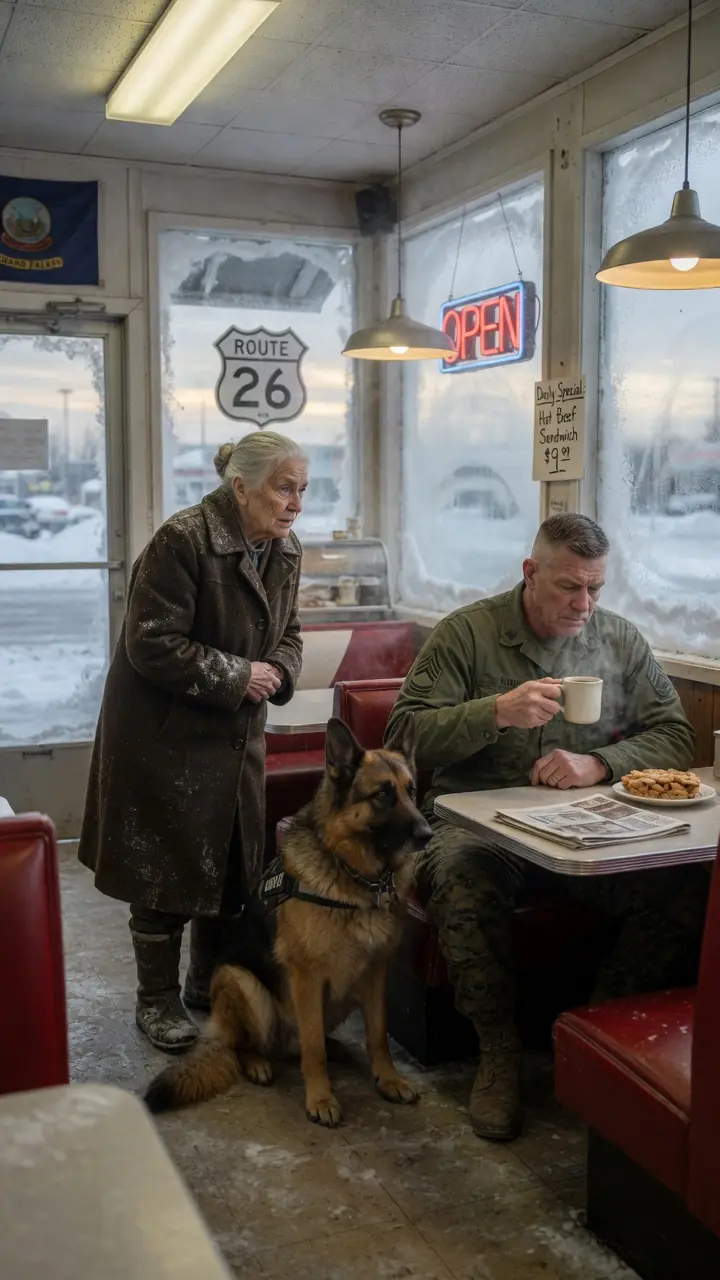
The question itself was simple.
Everything around it was not.
Marcus leaned back slightly, not enough to appear disengaged, just enough to study her more clearly.
Ranger had shifted again, still lying down, but his gaze locked onto Eleanor now, unblinking.
“What do you need the police for?” Marcus asked, his tone even, not probing, not dismissive.
Eleanor’s eyes moved again, this time toward the window.
Outside, a pickup truck rolled slowly past before disappearing down the road.
She followed it with her gaze until it was gone, then looked back at Marcus.
For a moment, she didn’t answer.
Her right hand tightened slightly inside her sleeve.
The tremor didn’t stop, but it changed.
Less random.
More restrained.
When she finally spoke, her voice dropped just a fraction.
“My daughter,” she said.
A pause, just long enough to matter.
“She’s still in the house.”
Marcus didn’t move, but something inside him shifted.
He didn’t ask another question right away.
He didn’t need to.
The sentence carried more weight than its words.
Not at home.
Not waiting.
Still in the house.
Ranger exhaled slowly, a low controlled breath, and adjusted his position without standing.
His ears remained forward.
Marcus gestured toward the seat across from him.
“Sit down,” he said.
Eleanor hesitated, not out of confusion.
Out of calculation.
Her eyes flicked once more toward the door, then to the counter, then back to Marcus.
She was deciding if staying was safer than leaving.
Marcus didn’t rush her.
“I’ll get you something warm,” he added.
That seemed to settle it.
Slowly, carefully, Eleanor slid into the booth.
But not fully.
She positioned herself at the edge of the seat, angled slightly toward the aisle, her body unconsciously maintaining a clear path to the exit.
Marcus noticed that too.
Ranger’s gaze followed her movement, then returned briefly to the door.
Marcus signaled the waitress, a middle-aged woman named Carla, short sturdy build, dark hair tied back, the kind of person who had worked in the same place long enough to read a situation without being told.
She brought hot tea without asking questions.
Eleanor wrapped both hands around the cup but didn’t drink immediately.
She was watching the window again.
Marcus leaned forward slightly, forearms resting on the table, his voice low enough that it wouldn’t carry beyond the booth.
“Tell me what’s going on.”
Eleanor swallowed.
Her grip tightened around the cup.
And for the first time since she had walked in, her composure slipped.
Just enough for the fear beneath it to show.
But she didn’t explain.
Not yet.
“You’re not going to leave, are you?”
Marcus held her gaze.
“No,” he said.
Outside, the wind picked up, rattling faintly against the diner windows.
And under the table, Ranger slowly shifted his weight forward, as if preparing for something that hadn’t happened yet, but would.
Marcus Hale didn’t interrupt her again.
Not immediately.
Because in his experience, the truth came out more clearly when it wasn’t forced.
And right now, Eleanor Whitaker wasn’t just choosing what to say.
She was deciding how much of her fear she could afford to reveal without losing control of it.
And that calculation showed in the way her fingers tightened around the ceramic cup, in the slight tension along her jaw, in the way her eyes kept drifting toward the window as if expecting something to appear there at any second.
While beneath the table, Ranger remained still, but no longer relaxed.
His head lifted, body subtly angled toward the entrance, ears tracking every shift in the room with quiet precision that only someone trained to read danger would recognize.
Eleanor finally took a sip of the tea, though it was clear she didn’t taste it.
And when she set the cup down, her hands didn’t leave it, as if the warmth anchored her in a way words could not.
“Her name is Rachel,” she said, her voice steadier now, but carrying something deeper than fear.
Something worn and exhausted.
“Rachel Whitaker. She’s forty-seven.”
She stopped, searching for a version of her daughter that still existed somewhere in memory.
“She used to laugh a lot.”
That detail lingered longer than the rest.
Not because it mattered to Marcus tactically.
Because it mattered to Eleanor emotionally.
And Marcus understood that often the difference between who someone was and who they had become told you more than any direct description ever could.
“What changed?” Marcus asked.
Not pushing.
Just guiding.
Eleanor’s eyes lowered to the table, and for a moment the diner’s background noise seemed louder.
The clatter of dishes.
The murmur of distant conversation.
The low hum of refrigeration units behind the counter.
All of it pressing in around the small space of their booth, as if reality itself was continuing on without noticing what was being said there.
“Douglas,” she said finally.
“Douglas Crane.”
The name carried weight, and Marcus noted the way she said it.
Not with anger.
With caution.
The kind people used when they had learned that even speaking about someone could have consequences.
Marcus watched her carefully.
“Who is he?”
Eleanor laughed softly.
There was no humor in it.
Just fatigue.
“The man everyone likes.”
A pause.
“The man everyone trusts.”
Another pause.
“The man who knows exactly how to make people think he’s a good person.”
Marcus didn't respond.
He simply listened.
That seemed to help.
“Douglas owns a construction company. Sponsors community events. Volunteers at church when cameras are around. Helps organize veteran fundraisers.”
She shook her head slightly.
“If you asked people about him, they'd tell you he's one of the nicest men in Idaho Falls.”
“And if you asked Rachel?” Marcus said.
Eleanor's eyes filled immediately.
“She'd tell you a different story.”
Silence settled over the booth.
Outside, snow drifted past the windows in thin white sheets.
Inside, Ranger slowly rested his head on Eleanor's knee.
The old woman looked down.
Her trembling hand moved automatically to the dog's neck.
The tension in her shoulders eased slightly.
“He never hit her at first.”
Marcus remained silent.
People often needed to say difficult things in their own order.
“It started with little things.”
Her voice had become distant now.
Like she was replaying years of memories.
“Friends he didn't like.”
“Places he didn't want her going.”
“Questions.”
“So many questions.”
She swallowed.
“At first Rachel thought it meant he cared.”
A long pause.
“Then she thought maybe she was the problem.”
Marcus had heard that before.
Far too many times.
“He checked her phone.”
“He managed the money.”
“He decided where they went.”
“He decided who visited.”
Another pause.
“And eventually he decided what she was allowed to think.”
The words hung in the air.
Heavy.
True.
Painfully familiar.
Carla stopped briefly beside the table to refill Marcus's coffee.
One look at Eleanor's face told her enough.
She quietly refilled the tea too.
Then walked away without asking questions.
Eleanor watched her leave.
“You know what the worst part is?”
Marcus looked at her.
“The worst part isn't what he does.”
A tear slipped down her cheek.
“The worst part is watching someone you love slowly disappear while they're still alive.”
Marcus said nothing.
Because there was nothing useful to say.
Eleanor wiped her eyes.
“For years I've watched my daughter become smaller.”
“She talks less.”
“She smiles less.”
“She apologizes constantly.”
A pause.
“She asks permission for things she doesn't need permission for.”
The old woman stared into her tea.
“And now she looks scared all the time.”
Ranger nudged her hand gently.
She smiled weakly.
“He doesn't like hearing about this.”
Marcus glanced at the German Shepherd.
Ranger's ears remained forward.
Focused.
Listening.
Then the bell above the diner door rang.
Eleanor froze.
Completely.
The change was immediate.
Total.
Her eyes snapped toward the entrance.
Her breathing stopped.
Even her hand tightened against Ranger's fur.
Marcus turned.
A man had entered the diner.
Mid-fifties.
Tall.
Broad build.
Expensive winter coat.
Clean-shaven.
Confident smile.
The kind of smile people trusted instantly.
He scanned the room.
Then spotted Eleanor.
And smiled wider.
Not warmly.
Possessively.
Like he'd found something that belonged to him.
Eleanor whispered one word.
“Douglas.”
Marcus looked back at her.
The fear on her face told him everything he needed to know.
And under the table, for the first time since entering the diner...
Ranger stood up.
Douglas Crane smiled as he walked toward the booth.
To everyone else in the diner, he looked perfectly normal.
Friendly.
Confident.
Respectable.
The kind of man people would trust with their house keys.
The kind of man people described as dependable.
Marcus immediately understood why this had lasted so long.
Dangerous people were easy to avoid.
Charming people were not.
“Eleanor.”
Douglas stopped beside the table.
His voice was warm.
Concerned.
Practiced.
“I've been looking everywhere for you.”
Eleanor didn't answer.
The old woman's fingers tightened against the ceramic cup.
Marcus noticed her hand shaking harder now.
Douglas noticed it too.
But his smile never changed.
Then his eyes moved to Marcus.
And finally to Ranger.
For the first time, something flickered behind the smile.
Not fear.
Assessment.
Douglas extended his hand.
“Douglas Crane.”
Marcus didn't take it immediately.
Just looked at him.
The brief pause lasted barely a second.
But Douglas noticed.
Eventually Marcus shook his hand.
“Marcus Hale.”
“Pleasure.”
Douglas released the handshake.
Then looked back toward Eleanor.
“Rachel's worried about you.”
Eleanor lowered her eyes.
Marcus caught it immediately.
The sentence sounded caring.
The reaction said otherwise.
Douglas continued.
“You left without saying anything.”
“I've been driving around trying to find you.”
Still smiling.
Still calm.
Still performing.
Marcus had met men like this before.
The words always sounded reasonable.
The control lived underneath them.
“I'm fine,” Eleanor said quietly.
Douglas nodded immediately.
“Of course you are.”
A pause.
“Let's get you home.”
Not "Would you like to go home?"
Not "Are you ready?"
Let's get you home.
A decision disguised as a suggestion.
Marcus noticed.
So did Ranger.
The German Shepherd hadn't growled.
Hadn't barked.
But he had moved.
Standing now between Douglas and the booth.
Silent.
Watching.
Douglas glanced at the dog.
Then back at Marcus.
“Beautiful Shepherd.”
“Thanks.”
“Protection dog?”
“Companion.”
That wasn't entirely true.
Douglas seemed to know it.
The smile thinned slightly.
“Rachel's expecting Eleanor.”
Eleanor finally looked up.
“No.”
The word came out soft.
Almost too soft to hear.
Douglas blinked.
“What?”
“No.”
A little stronger this time.
The smile disappeared completely.
Only for a second.
Then it returned.
“Eleanor, you're upset.”
“No.”
The old woman surprised everyone.
Including herself.
“No, Douglas.”
The diner suddenly felt quieter.
Not because people stopped talking.
Because tension has a way of making everything else disappear.
Douglas's eyes hardened.
Very briefly.
Then softened again.
“Maybe we should talk outside.”
“No.”
Another refusal.
Marcus watched the exchange carefully.
Every time Eleanor said no, Douglas became a little less convincing.
A little more irritated.
A little more real.
The mask was slipping.
Then the diner door opened again.
Everyone turned.
A woman stepped inside.
Mid-forties.
Dark winter coat.
Brown hair pulled back hastily.
Breathing hard like she'd rushed there.
Rachel.
Her eyes immediately found Eleanor.
Then Douglas.
Then Marcus.
Then Ranger.
For a moment nobody moved.
Rachel looked terrified.
Not of Marcus.
Not of the diner.
Of Douglas.
The sight hit Marcus harder than anything Eleanor had said.
Because fear that deep doesn't happen overnight.
It gets built.
Day after day.
Year after year.
Douglas turned slowly.
“Rachel.”
The warmth vanished from his voice.
Not entirely.
Just enough.
The difference was subtle.
But once heard, impossible to miss.
Rachel stopped a few feet away.
“You followed my mother?”
Douglas laughed softly.
“She's eighty years old.”
“I was worried.”
“Stop.”
The single word caught him off guard.
Rachel looked different now.
Still frightened.
But angry too.
And anger can sometimes accomplish what courage cannot.
“You're always worried.”
Silence.
Douglas stared at her.
Rachel continued.
“You're worried when I go somewhere.”
“You’re worried when I talk to people.”
“You're worried when I visit friends.”
“You're worried when my mother leaves the house.”
Her voice trembled.
But she kept going.
“And somehow all that worrying only seems to benefit you.”
Nobody spoke.
Not Marcus.
Not Eleanor.
Not Carla behind the counter.
Not the truck driver eating pie three booths away.
The room had become very still.
Douglas smiled again.
But it wasn't working anymore.
Too many people had seen behind it.
“Rachel.”
“No.”
She shook her head.
“No more.”
The words sounded small.
Yet somehow they landed like thunder.
Douglas looked around the diner.
And for the first time realized something important.
The audience wasn't on his side.
Not this time.
Because the performance only works until people notice it's a performance.
And sitting quietly beside Rachel...
Ranger suddenly stepped forward and placed himself between her and Douglas.
Not aggressively.
Not threateningly.
Just creating space.
The same way he'd done at the first meeting.
The same way he'd done instinctively.
Douglas looked down at the German Shepherd.
Then at the people watching.
Then back at Rachel.
For the first time all afternoon...
He had no control over the room.
And everyone could feel it.
Douglas looked around the diner.
For the first time in years, the room wasn't responding the way he expected.
Nobody was nodding.
Nobody was smiling.
Nobody was helping him maintain the story.
Because stories like his survive only when other people agree to participate.
And suddenly...
Nobody was participating.
Rachel could feel it too.
The realization seemed to surprise her.
For years every confrontation had happened in private.
Inside the house.
Inside the truck.
Inside carefully controlled spaces where Douglas decided what reality looked like.
This was different.
This was public.
Witnessed.
And most importantly...
Visible.
Douglas adjusted his posture.
Resetting.
Trying to recover control.
"Rachel, you're emotional."
Marcus almost smiled.
The oldest tactic in the book.
Make the other person sound unreasonable.
Then you never have to answer what they actually said.
Rachel looked at him.
Something changed in her expression.
Not confidence.
Not yet.
Recognition.
For the first time she could actually see the pattern while it was happening.
And once you see it...
It's hard to unsee.
"No."
Her voice steadied.
"I'm angry."
The correction landed harder than a shout.
Because it was accurate.
Douglas blinked.
Only once.
But Marcus noticed.
So did Ranger.
The German Shepherd remained perfectly still between them.
Like a living barrier.
Douglas looked toward Eleanor.
"Haven't I always taken care of both of you?"
Eleanor finally lifted her head.
For years she'd avoided these moments.
Years.
Because age teaches some people peace.
And teaches others exhaustion.
But watching Rachel stand there changed something.
"No."
The word came out stronger than anyone expected.
Including Eleanor.
Douglas turned.
His smile disappeared.
Completely this time.
"No?"
"No."
The old woman stood slowly.
Hands shaking.
Voice shaking.
But standing anyway.
"You take care of things that belong to you."
Silence.
"You don't take care of people."
The diner became completely quiet.
Even the kitchen staff had stopped pretending not to listen.
Douglas stared at her.
The mask was gone now.
Not dramatically.
Not with yelling.
Something colder.
More irritated.
More genuine.
"You're confused."
Eleanor laughed.
A sad laugh.
"No, Douglas."
A pause.
"I've been confused for years."
Another pause.
"Today is the first day I'm not."
The words hit Rachel visibly.
Like hearing someone open a window inside a room that had been sealed shut for a decade.
Douglas looked around again.
Searching.
For support.
For leverage.
For anything.
Instead he found thirty strangers watching.
And not a single one looked convinced.
That frightened him more than police ever could.
Because reputation was his weapon.
And he could feel it slipping.
Then the diner door opened.
Officer Layla Bennett stepped inside.
Winter air followed her.
Along with another uniformed deputy.
Nobody had called for dramatic backup.
Rachel had texted earlier.
Just in case.
The officer's eyes moved across the room.
Douglas.
Rachel.
Eleanor.
Marcus.
Ranger.
The entire situation became clear immediately.
She walked forward calmly.
"Mr. Crane."
Douglas smiled again.
Trying one last time.
"Officer."
Bennett didn't smile back.
"We need to talk."
The confidence finally cracked.
Only slightly.
But enough.
"What about?"
"Outside."
A pause.
"Now."
For several seconds nobody moved.
Then Douglas laughed softly.
The sound forced.
Artificial.
The sound of a man realizing the script had changed.
And nobody had given him the new version.
He looked toward Rachel.
Maybe expecting fear.
Maybe expecting hesitation.
Maybe expecting the woman he'd spent years controlling.
Instead he found someone different.
Still frightened.
Still shaking.
But no longer obeying.
And that was worse.
Much worse.
Because fear was never what gave Douglas power.
Compliance did.
And standing there in the diner...
He realized he'd just lost it.
Officer Bennett gestured toward the door.
Douglas hesitated.
Then finally turned and walked outside.
The deputy followed.
The door closed behind them.
Silence remained for several seconds.
Then everyone exhaled at once.
As though the entire room had been holding its breath.
Rachel sat down abruptly.
Her legs giving out beneath her.
Eleanor immediately wrapped both arms around her.
And for the first time all afternoon...
Rachel cried.
Not because Douglas was gone.
Not because police were outside.
Not because everything was suddenly fixed.
Because for the first time in nine years...
Someone had seen what was happening.
And believed her.
Across the booth, Marcus remained quiet.
Ranger walked over and gently rested his head in Rachel's lap.
She laughed through tears.
A small sound.
But real.
And Marcus noticed something important.
The fear wasn't gone.
Not even close.
But it wasn't alone anymore.
And sometimes that's where freedom starts.
Officer Bennett returned twenty minutes later.
The moment Rachel saw her expression, she knew.
This wasn't over.
Not even close.
The officer removed her gloves slowly.
Carefully.
Like someone organizing difficult news before delivering it.
Douglas had left.
Not arrested.
Not charged.
Not yet.
The law moved slower than fear.
And much slower than people wanted.
Rachel felt her stomach sink.
The old panic immediately tried to return.
The familiar voice.
The one that whispered:
*"See?"*
*"Nothing changes."*
*"He always wins."*
Officer Bennett seemed to read the thought on her face.
"He didn't win."
Rachel looked up.
"It feels like he did."
"No."
The officer pulled out a chair.
Sat down.
And leaned forward.
"Winning would've been leaving here with you."
Silence.
"Winning would've been watching you apologize."
Another pause.
"Winning would've been you staying quiet."
The words settled heavily.
Because they were true.
Rachel hadn't done any of those things.
Outside, snow continued falling.
Inside, the diner slowly returned to normal.
Customers resumed conversations.
Plates clattered.
Coffee poured.
Life moved forward.
But Rachel felt different.
Not stronger.
Not yet.
Just awake.
As if she'd spent years underwater and finally reached the surface.
That night she and Eleanor stayed at a small motel on the edge of town.
Nothing fancy.
Just clean sheets.
A heater that rattled occasionally.
And a lock Rachel controlled herself.
The first time she checked it, she felt embarrassed.
The second time, less so.
The third time, Eleanor gently touched her arm.
"You don't have to keep checking."
Rachel stared at the door.
Then quietly answered.
"I know."
But she checked once more anyway.
Because healing isn't a straight line.
It's a thousand tiny battles nobody else sees.
Across town, Douglas sat alone in his truck.
Parked outside a closed hardware store.
The dashboard lights illuminated his face.
His phone contained seventeen unsent messages.
None of them sounded right anymore.
For years he had known exactly what to say.
Exactly what pressure to apply.
Exactly which guilt to trigger.
Exactly which fear to awaken.
Now every message felt weak.
Because something had changed.
Not in Rachel.
In everyone around her.
The old isolation was gone.
And isolation had always been his greatest ally.
He deleted the messages.
One by one.
Then threw the phone onto the passenger seat.
For the first time in a long time...
Douglas felt uncertain.
The following morning Rachel woke before sunrise.
A habit she couldn't break.
The room was quiet.
Eleanor slept peacefully in the bed beside hers.
Rachel sat near the window watching darkness slowly become morning.
And that's when she noticed it.
Not outside.
Inside herself.
The future.
For years she had never thought beyond the next argument.
The next apology.
The next attempt to keep peace.
Now suddenly there was space beyond that.
Terrifying space.
Uncertain space.
But space.
A knock sounded at the door.
Rachel jumped.
Her heart instantly racing.
Then came a familiar voice.
"It's me."
Marcus.
Rachel opened the door.
Ranger immediately pushed past Marcus and entered the room like he owned the building.
The German Shepherd inspected everything.
The beds.
The bathroom.
The window.
Then finally sat beside Eleanor's bed.
Satisfied.
Marcus handed Rachel a paper bag.
Breakfast.
Coffee.
Nothing complicated.
Rachel smiled.
"Thank you."
Marcus shrugged.
"You looked like you forgot to eat yesterday."
That almost made her laugh.
Almost.
Then Marcus noticed something.
A photograph sitting beside the motel lamp.
Old.
Faded.
A younger Rachel.
Smiling.
Standing beside Eleanor years ago.
Before Douglas.
Before fear.
Before all of it.
Marcus picked it up.
Studied it.
Then looked at Rachel.
"That's you?"
Rachel nodded.
"Long time ago."
Marcus handed the picture back.
"No."
Rachel frowned.
"What?"
Marcus pointed at the photograph.
Then at her.
"That's still you."
The room became very quiet.
Because nobody had ever said that before.
Everyone always spoke about getting her back.
Finding herself again.
Returning to who she used to be.
Marcus didn't.
He acted like she had been there the entire time.
Buried.
Hidden.
But there.
Rachel looked down at the picture.
Then slowly smiled.
A real smile.
Small.
Fragile.
But real.
Ranger immediately stood and wagged his tail.
As if he'd been waiting months to see it.
And somewhere outside the motel window, the first sunlight broke through the Idaho clouds.
For the first time in years...
Rachel noticed it.
The weeks that followed were strangely quiet.
Not peaceful.
Just quiet.
And Rachel didn't trust quiet anymore.
For nine years, quiet had usually meant something was coming.
A mood.
An argument.
A punishment.
A problem she hadn't discovered yet.
So every morning she woke expecting the next thing.
And every morning...
Nothing happened.
No angry messages.
No surprise appearances.
No demands.
No accusations.
The absence felt unnatural.
Officer Bennett checked in regularly.
The investigation continued.
Statements were collected.
Records reviewed.
Witnesses interviewed.
Slow work.
Important work.
The kind that never looked dramatic from the outside.
Meanwhile, Rachel and Eleanor settled into a small rental cottage owned by a retired schoolteacher on the north side of town.
It wasn't much.
Two bedrooms.
A tiny kitchen.
A porch barely large enough for two chairs.
But it belonged to them.
That mattered.
The first evening there, Rachel stood frozen in the grocery aisle for nearly ten minutes.
Unable to choose a brand of coffee.
The realization embarrassed her.
For years Douglas had decided every purchase.
Every expense.
Every choice.
Now standing in front of twenty different bags of coffee felt overwhelming.
A simple decision.
An impossible decision.
An older woman stocking shelves eventually smiled.
"First apartment?"
Rachel laughed nervously.
"Something like that."
The woman nodded.
"You'll get used to it."
Rachel wasn't sure.
But she hoped so.
A few days later Marcus stopped by.
Not because he was checking on her.
Because Eleanor had invited him.
And because Ranger apparently believed the cottage belonged to him now.
The German Shepherd walked inside like a property inspector conducting a surprise evaluation.
Bedroom.
Kitchen.
Living room.
Back porch.
Only after examining everything did he settle near the couch.
Marcus shook his head.
"He does this everywhere."
Eleanor laughed.
"Good."
Ranger immediately wagged his tail.
Receiving approval was one of his favorite hobbies.
That afternoon they sat outside on the porch drinking coffee.
For the first time in years Rachel found herself talking about things unrelated to fear.
Books.
Travel.
Music.
The future.
The conversation felt awkward.
Like using muscles that hadn't been exercised in a decade.
But it also felt good.
Really good.
Then Marcus asked a question.
A simple one.
"What did you want to do before?"
Rachel frowned.
"Before what?"
"Before your life became about surviving."
The question caught her completely off guard.
Nobody had ever asked that.
Not once.
For several moments she couldn't answer.
Because the truth was...
She didn't know.
The old dreams felt distant.
Buried beneath years of compromise.
Then slowly something surfaced.
"I wanted to teach."
Marcus nodded.
As though she'd said something obvious.
Rachel laughed.
"That's it?"
"What?"
"You aren't surprised?"
Marcus looked genuinely confused.
"Why would I be?"
The answer stayed with her all night.
Because she realized something important.
The people around Douglas always reacted to who she had become.
Marcus kept reacting to who she might still be.
Weeks turned into months.
Spring arrived.
Snow melted.
Grass returned.
And little by little, Rachel started rebuilding.
Not dramatically.
Not all at once.
Small things.
She opened a bank account in her own name.
Signed a lease.
Took community college classes.
Started volunteering at a local literacy program.
Every step seemed tiny.
Until she looked backward.
Then the distance became obvious.
One afternoon, nearly four months after the diner, Officer Bennett pulled into the cottage driveway.
Her expression told Rachel immediately.
News.
Important news.
Rachel's stomach tightened.
Some habits remained difficult to break.
The officer walked onto the porch carrying a folder.
Then sat down.
For several seconds she said nothing.
Just looked at Rachel.
Then smiled.
A real smile.
"The district attorney filed charges."
Silence.
Rachel stared.
Not understanding.
Officer Bennett repeated it.
Slowly.
Clearly.
"The charges are official."
Eleanor covered her mouth.
Rachel couldn't move.
Couldn't speak.
Couldn't think.
Because for so long the possibility had felt imaginary.
Something other people got.
Not her.
Not this story.
Not after years of being told nobody would believe her.
Officer Bennett reached across the table.
Touched Rachel's hand.
"Someone believed you."
That was the moment.
Not the charges.
Not the investigation.
Those mattered.
But this mattered more.
The sentence.
The confirmation.
The truth finally spoken aloud.
Someone believed you.
Rachel looked away quickly.
But not quickly enough.
The tears came anyway.
And beside her, Ranger quietly rested his head against her knee.
Exactly like he had the first day.
Exactly like he always seemed to know when to do.
Outside, spring sunlight warmed the porch.
Inside, for the first time in nearly a decade...
Hope no longer felt dangerous.
It felt possible.
The charge changed everything.
Not overnight.
Not magically.
But permanently.
For years, Rachel's world had revolved around one question:
*"How do I avoid making things worse?"*
Now, for the first time, she found herself asking something different.
*"What do I want?"*
The question was surprisingly difficult.
A week after the charges were filed, she sat alone inside the community college parking lot for nearly twenty minutes.
Just sitting.
Hands on the steering wheel.
Looking at the building.
Students walked past carrying backpacks and coffee.
Laughing.
Talking.
Living ordinary lives.
Rachel watched them through the windshield.
Then almost drove away.
Twice.
Because walking into a classroom at forty-seven years old felt ridiculous.
Impossible.
Embarrassing.
She was still sitting there debating when someone knocked gently on the passenger window.
Rachel nearly jumped.
A young woman stood outside.
Early twenties.
Red backpack.
Friendly smile.
"Are you coming in?"
Rachel blinked.
"What?"
The student pointed toward the building.
"Class starts in five minutes."
Rachel laughed nervously.
"Oh."
The girl smiled.
"First day?"
Rachel nodded.
The student grinned.
"Mine too."
Then she walked away.
Just like that.
No judgment.
No surprise.
No questions.
Rachel sat there another moment.
Then opened the door.
And followed.
Sometimes courage arrives disguised as something very small.
Across town, Douglas Crane sat inside a lawyer's office.
The difference between him now and the man from the diner was becoming harder to ignore.
He looked older.
Not physically.
Emotionally.
The confidence remained.
But cracks had appeared.
The investigation continued growing.
Former employees had begun talking.
Neighbors were cooperating.
Financial records were surfacing.
Every week seemed to bring another problem.
Another witness.
Another statement.
The control he had spent years building was disappearing.
And worst of all...
He couldn't stop it.
For the first time, events were happening without his permission.
That terrified him.
Meanwhile, Rachel's life continued expanding.
One decision at a time.
One day at a time.
One step at a time.
She started helping at the literacy program three afternoons each week.
At first she simply organized books.
Then helped adults practice reading.
Then eventually began leading small sessions herself.
The first time someone thanked her for helping them learn, Rachel cried in her car afterward.
Not because she was sad.
Because she had forgotten what it felt like to matter for something good.
Months passed.
Summer arrived.
The cottage porch became their favorite place.
Eleanor filled the yard with flowers.
Marcus occasionally stopped by.
Ranger regularly stopped by.
Whether Marcus was present or not.
The German Shepherd had apparently decided he lived there part-time.
Nobody argued.
One evening Rachel sat on the porch swing watching the sunset.
The air smelled of fresh-cut grass.
Cicadas hummed somewhere beyond the fence.
Eleanor sat beside her.
Quiet.
Content.
For a while neither spoke.
Then Eleanor smiled.
"You laughed today."
Rachel looked over.
"What?"
"You laughed."
A pause.
"The old laugh."
Rachel felt emotion rise unexpectedly.
Because she knew exactly what her mother meant.
Not the polite laugh.
Not the careful laugh.
The real one.
The one Douglas had slowly erased.
The one she thought was gone forever.
Eleanor reached over and squeezed her hand.
"I missed hearing it."
Rachel looked out across the yard.
Toward the flowers.
Toward the fading sunlight.
Toward Ranger sleeping beneath the porch steps.
And suddenly she realized something.
The life she wanted wasn't waiting somewhere ahead.
It had already started.
Not when the charges were filed.
Not when she left Douglas.
Not when she met Marcus.
It started the first moment she believed she deserved better.
Everything else followed after that.
A few weeks later, Rachel received a letter.
Official.
Unexpected.
The college had accepted her application into their education program.
She read it twice.
Then three times.
Then handed it to Eleanor.
Neither said anything for several seconds.
Finally Eleanor laughed.
Then cried.
Then laughed again.
Rachel did both.
Outside, Ranger lifted his head at the sound.
Trotted onto the porch.
And immediately shoved his nose between them.
Demanding inclusion in whatever celebration was happening.
Rachel wrapped her arms around the German Shepherd.
Laughing through tears.
And for the first time in nearly ten years...
The future didn't feel frightening.
It felt exciting.
Which was something she never thought she'd feel again.
The acceptance letter stayed on the refrigerator for nearly a year.
Not because Rachel needed to see it.
Because she couldn't quite believe it was real.
Every morning she passed it.
Every morning some small part of her expected it to disappear.
The habit made Eleanor laugh.
"You know they aren't going to change their minds overnight."
Rachel smiled.
"I know."
But she still checked.
Some wounds heal slowly.
The first semester was harder than she expected.
Not the classes.
The people.
Walking into rooms filled with students half her age.
Introducing herself.
Answering questions.
Explaining why she was starting over at forty-eight.
The first few weeks felt awkward.
Then something unexpected happened.
Nobody cared.
The students cared about assignments.
Deadlines.
Exams.
Their own lives.
Rachel slowly realized she was the only person treating her age like a problem.
That realization felt strangely liberating.
By Christmas, she was earning some of the highest grades in the program.
By spring, professors were asking if she'd considered teaching full-time after graduation.
For years Rachel had lived inside a world that kept getting smaller.
Now every month seemed to make it bigger.
Meanwhile, Douglas's trial approached.
The closer it got, the quieter he became.
The confident man from the diner disappeared.
The smiling businessman vanished.
Even his attorneys struggled to keep ahead of the growing list of witnesses.
People kept coming forward.
Not because they hated him.
Because they were no longer afraid of him.
That difference mattered.
Fear had been the foundation of everything.
And foundations don't survive once people stop believing in them.
The trial began on a rainy Monday morning.
Rachel had imagined this day for months.
Feared it.
Dreamed about it.
Dreaded it.
Yet when she finally walked into the courthouse, she felt oddly calm.
Not fearless.
Just finished running.
Officer Bennett met her near the entrance.
Marcus stood farther back.
Exactly where he always preferred to be.
And beside him sat Ranger.
Officially visiting as part of a courthouse support program.
Unofficially making sure everyone behaved.
Rachel laughed when she saw him.
The German Shepherd immediately wagged his tail.
Mission accomplished.
Inside the courtroom, Douglas looked smaller than she remembered.
Not physically.
Just less important.
For years he had occupied every corner of her life.
Every decision.
Every thought.
Every fear.
Now he was simply a man sitting at a table.
Nothing more.
Nothing less.
The realization surprised her.
Because power often looks different once you stop giving it to someone.
When Rachel testified, the room felt very still.
She expected terror.
Expected panic.
Expected herself to freeze.
Instead she found something else.
Clarity.
The truth came easily.
Not because it was painless.
Because she no longer felt responsible for protecting him.
For years she'd carried both her own pain and his reputation.
Now she carried only the truth.
And the truth weighed much less.
Hours later, when she stepped down from the witness stand, she didn't look at Douglas.
She didn't need to.
That chapter had already ended.
The verdict came days later.
And when it arrived, Rachel wasn't in the courtroom.
She was teaching a literacy session.
Helping a sixty-three-year-old grandfather read a letter from his granddaughter.
Officer Bennett called afterward.
Rachel stepped outside.
Listened quietly.
Then thanked her.
Hung up.
And stood there for a long moment.
The verdict mattered.
Justice mattered.
But she realized something important.
Her life no longer depended on it.
Months earlier, the outcome would have determined everything.
Now it was simply one part of a much larger future.
That evening everyone gathered at the cottage.
Eleanor.
Marcus.
Officer Bennett.
Several friends Rachel had made during school.
And Ranger, who spent most of the evening collecting unauthorized snacks.
The sun was setting when Eleanor raised a glass.
Not dramatically.
Just enough to get everyone's attention.
"I want to say something."
The conversations quieted.
Eleanor looked toward Rachel.
Then smiled.
"When she was little, Rachel used to tell me she wanted to help people for the rest of her life."
A pause.
"I thought that dream disappeared."
Her voice softened.
"It didn't."
Rachel looked down.
Emotion rising unexpectedly.
Eleanor reached across the table.
"Took a long route getting there."
Laughter moved around the porch.
"But she's finally home."
Silence followed.
The good kind.
The kind that comes when everyone recognizes the truth.
Rachel looked around the table.
At the people who had stood beside her.
At the life she'd rebuilt.
At the future waiting ahead.
Then she looked down at Ranger.
The German Shepherd was asleep beneath the table.
One paw resting on her shoe.
Exactly as if he'd decided she wasn't allowed to leave without permission.
Rachel smiled.
Years later, when her students asked why she became a teacher, she never mentioned courtrooms.
Or investigations.
Or Douglas Crane.
Instead she told them about a cold winter afternoon.
A roadside diner.
An elderly woman asking for directions.
A stranger who stopped long enough to listen.
And a German Shepherd who noticed pain before anyone else did.
Because sometimes an entire life changes direction for the simplest reason.
Someone finally sees you.
And once that happens...
You start learning how to see yourself again.