Ten-year-old Ethan Miller did not like rainy days.
Rain made everything harder.
It made his shoes squeak because water slipped through the cracks near the toes. It made his backpack smell like wet paper. It made the cardboard patch inside his left sneaker turn soft and useless before he reached school.
Worst of all, rain made his mother’s hands hurt.
His mother, Anna Miller, cleaned rooms at the Cedar Lane Motel on the edge of Franklin, Tennessee. She left before the sun rose, wearing an old blue raincoat with one missing button and carrying a lunch she rarely ate. By the time she came home, her fingers were red from soap, bleach, and cold water.
On rainy nights, she sat at the kitchen table and rubbed her knuckles slowly, thinking Ethan did not notice.
But Ethan noticed everything.
He noticed the rent notices folded under the fruit bowl.
He noticed when his mother counted coins twice before buying milk.
He noticed when the porch light stopped working and she said, “We’ll fix it next week,” even though next week kept moving farther away.
Their house was small, old, and leaning slightly toward the road as if it were tired too. White paint peeled from the porch rails. The kitchen floor creaked near the sink. Wind came through the window frame in winter.
But it was theirs.
At least, it had been Ethan’s grandmother’s house before she died. Anna had grown up there. Ethan had taken his first steps in that living room. Every pencil mark on the doorframe showed how tall he had grown each birthday.
Ethan loved that house.
He loved the porch, even with the loose boards.
He loved the tiny backyard where his mother planted tomatoes every spring.
He loved the bedroom with glow-in-the-dark stars stuck to the ceiling, stars his father had placed there before leaving when Ethan was six.
The house was not perfect.
But it held their life.
And Ethan was old enough to understand that they were close to losing it.
His mother never said that directly.
She said things like, “We’re just a little behind.”
Or, “I’m talking to the bank.”
Or, “Don’t worry, baby. Grown-up problems are for grown-ups.”
But Ethan did worry.
Children always heard more than adults thought.
One Thursday afternoon in March, rain fell so hard that the sidewalks looked like narrow rivers. School had ended early because of a power problem in the cafeteria, and most children were picked up by parents in warm cars.
Ethan walked.
He pulled his hood low and held his backpack against his chest to keep his books dry. Cars rushed past, throwing dirty water against the curb. The sky was gray. The air smelled like wet leaves and gasoline.
He had almost reached Maple Street when he saw her.
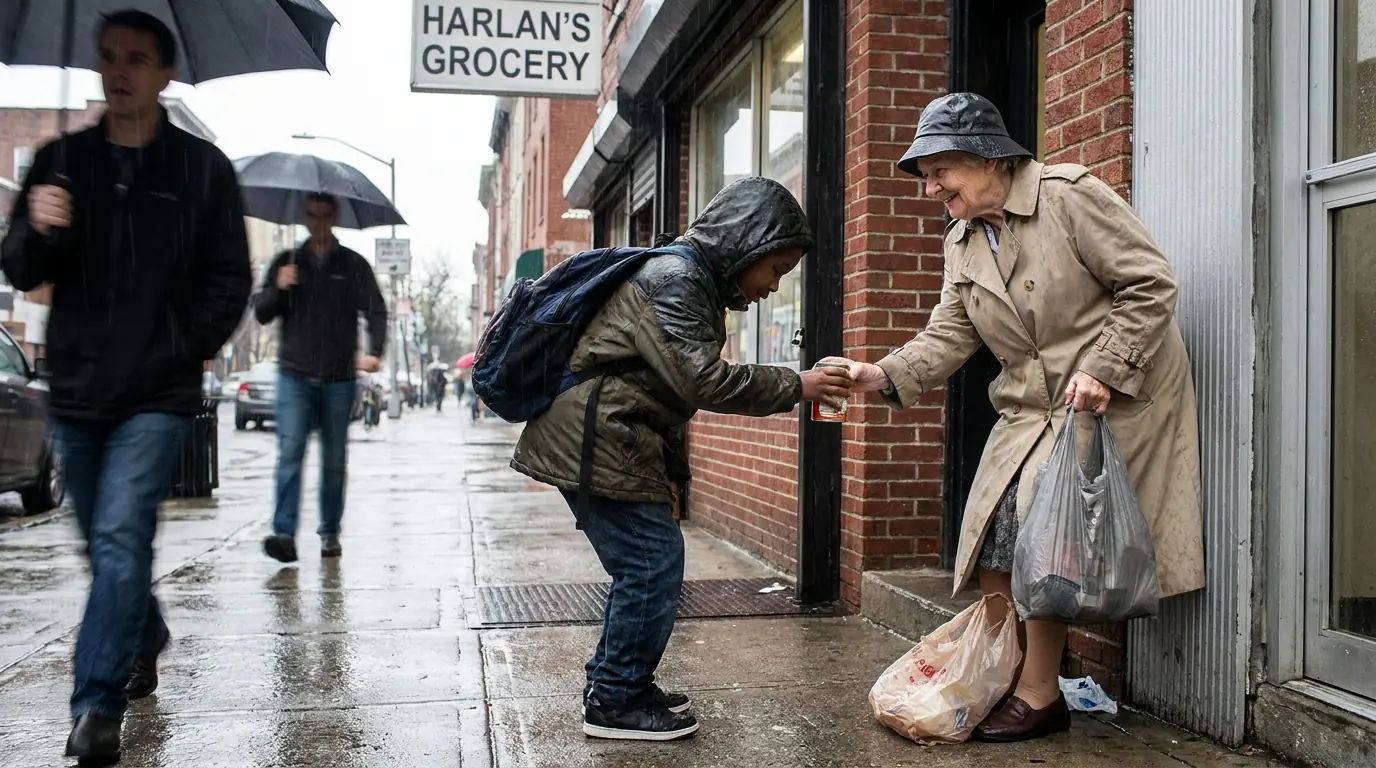
An elderly woman stood outside Harlan’s Grocery, struggling with two heavy paper bags. She was small and thin, with pale skin, silver hair tucked under a clear plastic rain bonnet, and a long beige coat that was already soaked at the hem. One bag had split slightly near the bottom, and a can of soup was beginning to slide through the tear.
People hurried past her with umbrellas.
No one stopped.
The woman tried to lift both bags at once. Her hand shook, and the torn bag sagged lower.
Ethan slowed.
He thought of his mother waiting at home.
He thought of the rain soaking his socks.
He thought of the homework in his backpack.
Then the soup can slipped out of the bag and rolled into the gutter.
The old woman gasped softly and reached for it, but her balance wobbled.
Ethan ran forward.
“Ma’am, wait!” he called.
He grabbed the can before it rolled under a parked truck.
The woman looked at him in surprise.
Rain dotted her glasses.
“Your bag is ripping,” Ethan said.
“I know.” She tried to laugh, but it came out tired. “I thought I could make it home.”
“Where do you live?”
She pointed down the street with one trembling hand. “Three blocks. The little yellow house near the church.”
Three blocks did not sound far.
In this rain, with heavy groceries, it looked impossible.
Ethan shifted his backpack higher. “I can carry one.”
The woman blinked. “Oh, no. You’ll get soaked.”
“I’m already soaked.”
“You’re just a child.”
“I’m strong enough.”
She studied him for a moment. There was pride in her face, but also exhaustion. Pride wanted to refuse. Exhaustion could not.
“All right,” she said softly. “Only if it’s not too much trouble.”
Ethan took the torn bag first. It was heavier than he expected. Cans, potatoes, a small carton of eggs, and a box of tea pressed against his arms.
He held the bottom carefully so it would not split.
“What’s your name?” the woman asked as they began walking.
“Ethan Miller.”
“I’m Margaret Holloway.”
Ethan nodded. “Nice to meet you, Mrs. Holloway.”
Her eyes softened.
“Well, aren’t you polite.”
“My mom says manners don’t cost anything.”
“That is a wise mother.”
“She is.”
They walked slowly through the rain.
Ethan shortened his steps to match hers. Twice, they stopped under awnings so Mrs. Holloway could catch her breath. She apologized each time, and each time Ethan shook his head.
“It’s okay,” he said. “We’re not racing.”
At the corner, a car splashed water near them. Ethan turned his body so the grocery bag would not get hit.
Mrs. Holloway noticed.
“You are very thoughtful for someone so young.”
Ethan shrugged. “My mom works hard. I help when I can.”
“Does she know you’re helping strangers in storms?”
“She’d want me to help you.”
Margaret Holloway said nothing for a few steps.
Then she asked, “Do you live nearby?”
“On Briar Street. The white house with the broken porch rail.”
“Oh,” she said quietly. “The Miller house.”
Ethan looked up. “You know it?”
“I have lived in this neighborhood longer than most of the trees,” Mrs. Holloway said. “I knew your grandmother a little. Rose Miller. She used to bring tomatoes to the church pantry.”
Ethan smiled despite the cold rain. “My mom says Grandma Rose grew too many.”
“She grew enough for people who had none.”
That made Ethan proud.
They reached the little yellow house near the church. A wind chime clinked softly beside the porch. The front steps were slick with rain, so Ethan climbed carefully, still holding the bottom of the torn bag.
Inside, the house smelled like lavender, old books, and something sweet baking.
A gray cat watched from the hallway but did not come closer.
Ethan set the groceries on the kitchen counter.
Mrs. Holloway placed her bag beside his and leaned one hand against the counter, breathing slowly.
“Thank you,” she said. “I truly do not know what I would have done.”
“It’s okay.”
“It is not just okay. It was kind.”
Ethan felt shy.
He looked toward the window, where rain slid down the glass in crooked lines.
“I should go. My mom will worry.”
Mrs. Holloway opened one of the grocery bags.
“Take this first.”
She held out a small package of blueberry muffins.
Ethan’s stomach tightened. He had not eaten since lunch, and lunch had been a small cheese sandwich and an apple with a bruise.
But he shook his head.
“I didn’t help for food.”
“I know,” she said gently. “That is why I can offer it.”
He hesitated.
“My mom says not to take things from people.”
“Then take it for your mother too. Tell her Margaret Holloway insisted.”
Ethan imagined his mother coming home tired, finding muffins on the kitchen table.
Slowly, he accepted the package.
“Thank you.”
Mrs. Holloway touched his shoulder lightly.
“No, Ethan Miller,” she said. “Thank you.”
He ran home through the rain, holding the muffins under his jacket.
By the time he reached Briar Street, his jeans were soaked and his hands were numb. The white house looked smaller beneath the storm, porch rail sagging, windows fogged, yard full of puddles.
But the kitchen light glowed.
That made it beautiful.
His mother was already home, which surprised him. She stood at the sink, still wearing her motel uniform, reading a letter with one hand pressed to her mouth.
“Mom?” Ethan said.
She turned quickly and folded the paper.
“You’re soaked.”
“So are you.”
“I got off early.”
“Is something wrong?”
Anna smiled too fast. “No. Just a letter.”
Ethan knew that smile.
It meant yes.
He held out the muffins. “I helped an old lady carry groceries. She gave us these.”
His mother looked at the package, then at his wet clothes.
“You did what?”
“She was stuck outside Harlan’s. Her bag ripped.”
Anna closed her eyes for one second.
Ethan could not tell whether she was angry, worried, or proud.
Then she crossed the room and pulled him into a hug, even though he was dripping water onto the floor.
“You have your grandmother’s heart,” she whispered.
“Is that good?”
“It is the best thing and the hardest thing.”
That night, they ate soup and shared two muffins. Anna saved the others for breakfast.
Ethan asked again about the letter.
His mother said, “It’s from the bank.”
His spoon froze halfway to his mouth.
“Are we losing the house?”
Anna’s face changed.
She tried to protect him from the truth, but the question had already opened the door.
“We are not losing it today,” she said carefully.
“But maybe?”
She looked down.
“I’m behind on payments. Not by much at first. But late fees grow. Interest grows. Problems grow when you don’t have enough money to stop them.”
Ethan stared at his bowl.
“How much?”
“Too much for a ten-year-old to worry about.”
“I already worry.”
Anna’s eyes filled with tears she did not let fall.
“I’m trying, Ethan.”
“I know.”
“I applied for extra shifts. I called the bank. I asked about hardship options. I’m doing everything I can.”
Ethan reached across the table and placed his small hand over hers.
“We can make anywhere feel like home,” he said, repeating her old words.
Anna looked as if the sentence broke her heart.
“Yes,” she whispered. “But I would like to keep this one.”
After that day, Ethan saw Mrs. Holloway often.
Sometimes she stood in her yard trimming dead flowers with small scissors. Sometimes she sat on her porch with tea. Sometimes Ethan helped carry her trash bin to the curb or pick up mail when the wind scattered envelopes across her walkway.
She never asked for too much.
He never waited to be asked.
Their friendship grew in tiny pieces.
A wave after school.
A glass of lemonade in summer.
A plate of cookies wrapped in foil for his mother.
An old story about the neighborhood before the highway was built.
Mrs. Holloway had been a teacher for thirty-eight years. She had taught third grade, then fifth grade, then reading support for children who struggled with words. Her husband had passed away long ago. They had never had children. Most of her family lived far away.
“I spent my life with children,” she told Ethan one afternoon as he helped her plant marigolds. “Then one day I looked around and realized I had become old in a very quiet house.”
“That sounds lonely,” Ethan said.
“It can be.”
“Then you can come to our house sometime,” he offered. “It’s not quiet. The pipes bang.”
Mrs. Holloway laughed so hard she had to wipe her eyes.
“You are a gift, Ethan Miller.”
He did not understand how he could be a gift when he owned almost nothing.
But he liked hearing it.
His mother met Mrs. Holloway properly in April, when the old woman brought over a casserole after Anna came home limping from a long shift.
“I heard from Ethan that you work too hard,” Mrs. Holloway said.
Anna gave Ethan a look.
Ethan looked innocent.
“I may have mentioned it.”
Mrs. Holloway stepped inside and looked around the Miller house with gentle eyes. She did not stare at the peeling paint or the patched curtains. She looked instead at the family photographs, the clean kitchen, the tomatoes sprouting in cans along the windowsill.
“This house still has Rose in it,” she said.
Anna’s face softened.
“You knew my mother?”
“I knew enough to admire her.”
That was the beginning of a friendship between the two women as well.
Mrs. Holloway helped Ethan with reading once a week. He was smart, but he rushed and guessed words when he felt embarrassed. She taught him to slow down, to sound things out, to stop treating mistakes like enemies.
Anna repaired a torn curtain for Mrs. Holloway.
Ethan fixed the loose hinge on her mailbox.
Mrs. Holloway showed him how to make proper tea, even though he still preferred chocolate milk.
Through spring and summer, the bank letters kept coming.
Anna tried to hide them.
Ethan kept noticing.
The final notice arrived in August.
He found his mother sitting on the back steps at dusk, the paper hanging loosely from her hand. Crickets hummed in the grass. The tomato plants leaned heavy with fruit. The sky was pink and fading.
“Mom?”
She did not turn around.
Ethan sat beside her.
For a while, neither spoke.
Then Anna said, “We have ninety days.”
His chest tightened.
“Until what?”
“Until the bank starts foreclosure.”
Ethan did not know the full meaning of the word, but he knew it was bad.
“Can Mrs. Holloway help?”
Anna turned sharply. “No.”
“I just mean maybe she knows someone.”
“No, Ethan. We are not asking her for money.”
“I didn’t say money.”
“She is an elderly woman living alone. She has been kind to us, and we will not turn that kindness into a burden.”
Ethan looked down at his hands.
“I don’t want to lose Grandma’s house.”
Anna’s face crumpled, but only for a second. Then she pulled him close.
“Neither do I.”
Mrs. Holloway found out anyway.
Not from Ethan.
Not directly.
She was at the Miller house two weeks later, dropping off a book for Ethan, when a man in a gray suit walked up the porch with a clipboard. He knocked, introduced himself as someone from the bank’s property division, and asked Anna to confirm details about the home.
Anna turned pale.
Ethan stood behind her, fists clenched.
Mrs. Holloway watched from the living room.
Her expression became very still.
The man was not cruel, but he was practiced. His words were polite and empty.
Default.
Review process.
Possible sale.
Legal timeline.
Anna answered as best she could. When he left, she stood in the doorway as if the house had tilted beneath her feet.
Mrs. Holloway stepped forward.
“Anna,” she said softly. “Why didn’t you tell me?”
Anna shook her head.
“Because it is not your problem.”
Mrs. Holloway looked around the room.
At the pencil marks on the doorframe.
At Rose Miller’s old quilt on the couch.
At Ethan, trying to be brave and failing.
Then she said, “Maybe not. But you are my neighbors. And sometimes neighbors are what keep a street from becoming only houses.”
Anna closed her eyes.
“I can’t accept money from you.”
“I did not offer money.”
Anna opened her eyes.
Mrs. Holloway straightened slightly.
“I offered concern.”
The next morning, Mrs. Holloway made phone calls.
Many phone calls.
She called a retired attorney she had taught with in Sunday school.
She called a former student who worked at a housing nonprofit in Nashville.
She called the county clerk.
She called a bank manager she remembered as a freckled boy who once cried over long division in her classroom.
Ethan did not know any of this at first.
All he knew was that Mrs. Holloway began appearing at their house with folders, forms, and a determined look that made her seem less like a fragile old woman and more like a general preparing for battle.
Anna resisted.
Mrs. Holloway ignored the resistance politely.
“You are not taking charity,” she said. “You are receiving information.”
“This is too much.”
“Nonsense. I am retired. I have time to be inconvenient.”
For the first time in weeks, Anna laughed.
It turned out the bank had made a mistake.
Not a simple mistake.
A serious one.
Several of Anna’s payments had been misapplied after the mortgage was transferred to a different servicing company. Late fees had been added incorrectly. A relief program she qualified for had never been offered, even though it should have been. The amount owed was still real, but far smaller than the frightening number in the letters.
The retired attorney helped Anna file a formal dispute.
The housing nonprofit helped her apply for assistance.
Mrs. Holloway sat beside her through every meeting, wearing her beige coat and carrying a notebook full of dates.
Ethan attended when he could.
Mostly, he listened.
He learned that adults could sound confident and still be wrong.
He learned that paperwork could hurt people if no one checked it.
He learned that one old woman with patience, memory, and a list of phone numbers could push back against something much bigger than herself.
At the final meeting with the bank, Mrs. Holloway insisted on coming.
The manager, Mr. Daniels, was in his fifties, with a careful smile and nervous hands. He recognized Mrs. Holloway immediately.
“Mrs. Holloway,” he said. “I didn’t realize you were involved.”
“You also didn’t realize Anna Miller was being charged fees she should not owe,” she replied.
His face reddened.
Anna sat very still.
Ethan sat beside her, swinging his feet under the chair because they did not quite reach the floor.
The attorney laid out the documents.
The housing advocate explained the relief program.
Mrs. Holloway opened her notebook and read dates in a voice so calm that no one could interrupt her.
By the end of the meeting, the foreclosure process was stopped.
The incorrect fees were removed.
Anna received a revised payment plan she could actually manage.
The house was safe.
Not forever without effort.
But safe.
When they stepped outside the bank, Anna covered her face and cried.
Ethan hugged her waist.
Mrs. Holloway stood nearby, blinking quickly behind her glasses.
Anna turned to her.
“I don’t know how to thank you.”
Mrs. Holloway looked down at Ethan.
“He carried my groceries through the rain,” she said. “I am only returning a bag.”
Ethan never forgot that sentence.
Years passed.
The Miller house did not become perfect, but it became stronger.
Anna replaced the porch rail with help from a neighbor. Ethan painted the steps one summer, leaving blue fingerprints near the bottom that his mother refused to cover. The tomatoes returned every year. The pencil marks on the doorframe climbed higher and higher.
Mrs. Holloway grew older.
Ethan grew taller.
Their routines changed, but their bond did not.
He visited her after school even when he became a teenager and had friends waiting. He shoveled her walkway in winter. He changed lightbulbs. He read to her when her eyes became tired. She attended his middle school awards ceremony, then his high school graduation, sitting beside Anna and clapping with both hands.
When Ethan was eighteen, he received an acceptance letter to Middle Tennessee State University.
He wanted to study social work and housing policy.
Anna cried when he told her.
Mrs. Holloway only smiled as if she had known all along.
“Why housing?” she asked him one evening on her porch.
Ethan looked across the street at his own house, where the porch light glowed softly.
“Because people shouldn’t lose their homes just because they don’t know which form to file,” he said.
Mrs. Holloway nodded.
“That sounds like something worth learning.”
“It’s expensive.”
“Most worthwhile things cost something.”
“I’ll work.”
“I know you will.”
He looked at her.
She seemed smaller than she used to, wrapped in a blue cardigan, her hands folded over a blanket. But her eyes were still bright.
“You saved our house,” he said.
“No,” she replied. “Your mother saved it by fighting. I only helped her see where to push.”
“You did more than that.”
“So did a wet little boy carrying potatoes.”
He laughed.
She smiled.
The following year, Ethan moved into a dormitory, but he came home often. Every visit included his mother, the house, and Mrs. Holloway.
During his sophomore year, Mrs. Holloway became ill.
At first, she said it was nothing.
Old people, Ethan discovered, could be as stubborn as poor mothers.
Then she fell in her kitchen.
Anna found her and called an ambulance.
Ethan drove home from college that night, speeding through rain that reminded him painfully of the day they first met.
Mrs. Holloway survived the fall, but she did not return home right away. She moved into a rehabilitation center, then later into assisted living.
Her little yellow house sat quiet near the church.
The wind chime still moved on the porch.
Ethan visited every weekend.
He brought her books, muffins, and stories from school. Sometimes she was sharp and funny. Sometimes she forgot what day it was. But she never forgot Ethan.
“My grocery boy,” she called him.
“Your favorite grocery boy,” he corrected.
“My only grocery boy.”
One winter afternoon, when Ethan was twenty-one, Mrs. Holloway handed him an envelope.
“Do not open this yet,” she said.
He frowned. “That sounds suspicious.”
“It is.”
“Should I be worried?”
“No. But you should be patient.”
“I’m not good at that.”
“I know. I taught you reading, not patience.”
He smiled and placed the envelope in his backpack.
Mrs. Holloway passed away three weeks later.
She died peacefully, according to the nurse, with a book open beside her and sunlight across her blanket.
Ethan felt as if a whole street had gone silent.
At her funeral, former students filled the church. Men and women in their thirties, forties, fifties, and even sixties came to say that Mrs. Holloway had taught them to read, to believe in themselves, to survive fifth grade, to stop being ashamed of mistakes.
Ethan stood and spoke too.
He told them about the rain.
The torn grocery bag.
The soup can rolling toward the gutter.
The little yellow house.
He told them how Mrs. Holloway saved his mother’s home, not with money, but with knowledge, persistence, and love.
By the time he finished, even the pastor was wiping his eyes.
After the funeral, Ethan remembered the envelope.
He opened it that night at the kitchen table in the Miller house.
His mother sat across from him.
The house was quiet except for the hum of the refrigerator and the soft ticking of the old wall clock.
Inside the envelope was a letter.
Dear Ethan,
If you are reading this, then I have gone ahead to wherever retired teachers are allowed to correct grammar in peace.
I want you to know something.
The day you carried my groceries through the rain, you thought you were helping an old woman get home.
You were.
But you were also giving me back something I had lost.
Purpose.
After my husband died and my classroom years ended, I felt as though I had become a closed book on a forgotten shelf. People were kind enough, but busy. They waved. They moved on.
Then you stopped.
A ten-year-old boy with wet shoes and serious eyes carried my groceries like they mattered because I mattered.
That day brought me into your life.
And your life brought me back into the world.
I helped your mother fight for your house because families should not be crushed by mistakes hidden in paperwork. But also because you reminded me that love is practical. It carries bags. It makes calls. It sits through meetings. It refuses to let people disappear.
I have left my little yellow house to the county education trust with one condition: it must be used as a neighborhood learning and resource center.
I have also asked that you be invited to help shape it when you are ready.
There is a small scholarship fund attached for your final years of study. Do not argue with a dead woman. It is impolite.
Use what you learn to carry more than groceries.
Carry people through systems that frighten them.
Carry families toward safety.
Carry forward the belief that no one should have to stand in the rain alone.
With love and pride,
Margaret Holloway
Ethan read the letter twice.
Then he lowered his head onto his folded arms and cried.
Anna came around the table and held him the way she had when he was ten.
The scholarship helped Ethan finish school.
The learning center opened two years later in Mrs. Holloway’s yellow house.
They called it The Holloway House.
It had shelves of books in the living room, computers in the dining room, and a small office where families could get help reading bills, filling out housing forms, applying for assistance, and understanding letters that looked too frightening to open.
The kitchen always had tea.
The porch always had flowers.
The wind chime stayed exactly where it had been.
Ethan worked there first as a volunteer, then as director after graduate school. Anna helped run community meals twice a month. Former students of Mrs. Holloway donated books, furniture, and time.
Children came for reading help.
Parents came with envelopes from banks, landlords, hospitals, and courts.
Elderly neighbors came because they were lonely and pretended they only wanted coffee.
No one was made to feel small.
On the wall near the entrance, Ethan hung a framed photograph of Margaret Holloway smiling on her porch. Beneath it, he placed a simple sentence:
No One Stands In The Rain Alone.
Years later, on a stormy March afternoon, Ethan stood at the window of The Holloway House and watched rain pour over Maple Street.
A boy about ten years old hurried along the sidewalk, carrying a ripped grocery bag for an elderly man whose cane tapped carefully through puddles.
Ethan smiled.
He grabbed two towels from the kitchen and opened the front door before they reached the porch.
“Come inside,” he called. “You’re both soaked.”
The boy looked nervous. “We didn’t mean to bother anyone.”
“You’re not bothering anyone,” Ethan said.
The elderly man sighed with relief as he stepped inside.
The boy held out the torn bag. “His eggs might be broken.”
“We’ll check them,” Ethan said. “And then we’ll make tea.”
The boy looked around the warm room, at the books, the flowers, the people, the photograph on the wall.
“What is this place?” he asked.
Ethan thought of rain on his face.
A soup can rolling toward the gutter.
An old woman saying, “I am only returning a bag.”
He smiled.
“This,” he said, “is a place where people help carry things.”
The boy seemed to understand more than Ethan expected.
Outside, rain kept falling.
Inside, the lights glowed softly over shelves of books, stacks of forms, and a kitchen table big enough for anyone who needed to sit down.
Ethan had once believed he was only a poor boy carrying groceries.
But Margaret Holloway had shown him that kindness did not end where the sidewalk ended.
It traveled.
It grew.
It became phone calls, letters, scholarships, safe homes, open doors, and warm rooms on rainy days.
A torn grocery bag had led to a saved house.
A saved house had led to a life’s purpose.
And a little yellow home near the church had become proof that even the smallest act of kindness could shelter people for generations.
Ethan looked at the photograph of Mrs. Holloway and whispered, “I’m still carrying it.”
Then he turned back to the boy and the old man.
“All right,” he said warmly. “Let’s see what we can save.”