He missed the bus to change a tire. He did not know he was changing his destiny, and he definitely did not know the man he saved held the power to decide whether he would ever be free again.
The rain in Chicago did not just fall that morning. It felt like it was trying to erase the city.
It came down in a cold, slate-gray sheet, turning the potholes on the South Side into dirty little lakes and making the bones of the city ache. Bo Walker stood beneath the cracked plexiglass roof of a bus shelter on 79th Street, shivering in the only suit he owned.
It was charcoal gray, bought from a thrift store, three sizes too big in the shoulders and frayed slightly at the cuffs. But Bo had steamed it in the shower until it looked almost respectable. Today was the interview. Sterling and Vance, a logistics firm downtown, was offering an entry-level apprenticeship.
To Bo, it was not just a job. It was a lifeline.
It meant rent. It meant groceries. It meant keeping his mother’s oxygen tank filled instead of watching her fight for every breath in the next room.
He checked his cheap digital Casio, the one with the cracked face.
7:42 a.m.
The Number 4 Cottage Grove bus was due in three minutes. If he missed it, the next one would not come for another twenty. And if he was late, he knew exactly what that meant. His guidance counselor had said it over and over.
Early is on time. On time is late. Late is fired before you are hired.
Bo clutched his leather portfolio tightly against his chest, trying to keep his résumé dry. He closed his eyes and pictured it all. The handshake. The calm smile. The offer letter.
Then came the screech.
It was not the bus.
It was the agonizing grind of metal on asphalt.
Bo opened his eyes and saw a vintage champagne-colored Mercedes-Benz 560SL swerve awkwardly toward the curb about fifty feet from the bus stop. Its front passenger tire was shredded, hanging from the rim like a dead snake.
The driver’s door opened, and an old white man stumbled out. He looked frail, wrapped in a trench coat that had seen better days. He fought to open a large black umbrella against the wind, but the wind snapped it inside out almost instantly.
The old man cursed, threw the broken umbrella into the gutter, and stood there soaked in the rain, staring helplessly at the ruined tire.
Bo looked down the street.
Through the mist, he saw the twin headlights of the bus.
It was coming.
“Don’t do it, Bo,” he whispered to himself. “You got somewhere to be. Somebody else will stop.”
But nobody stopped.
Cars hissed past, splashing dirty water against the old man’s trousers. The man kicked the tire weakly, then leaned against the hood, clutching his chest. Something about that defeated posture tightened Bo’s heart. He looked too much like Bo’s grandfather had looked near the end. Proud, tired, and beaten down by a world moving too fast for him.
The bus was two blocks away now.
Bo looked at the warm, dry interior waiting for him.
Then he looked at the old man.
“Damn it,” he hissed.
He stepped out of the shelter, and the rain hit him like an icy slap.
“Sir!” Bo yelled, running toward the Mercedes. “Sir, get back inside the car. You’re going to freeze.”
“I have a spare,” the man rasped. “I just cannot get the lug nuts loose. Arthritis.”
“I got it,” Bo said, dropping his portfolio onto the passenger seat to keep it dry. “Get in. Pop the trunk.”
The bus roared past them.
Bo felt the gust of wind as it rushed by, spraying mist across his back. He watched the taillights fade down the street, and his heart sank.
That was it.
He was going to be late.
“You missed your ride,” the old man said from the cracked window, not sounding especially apologetic.
“It’s fine,” Bo lied. “Pop the trunk, sir.”
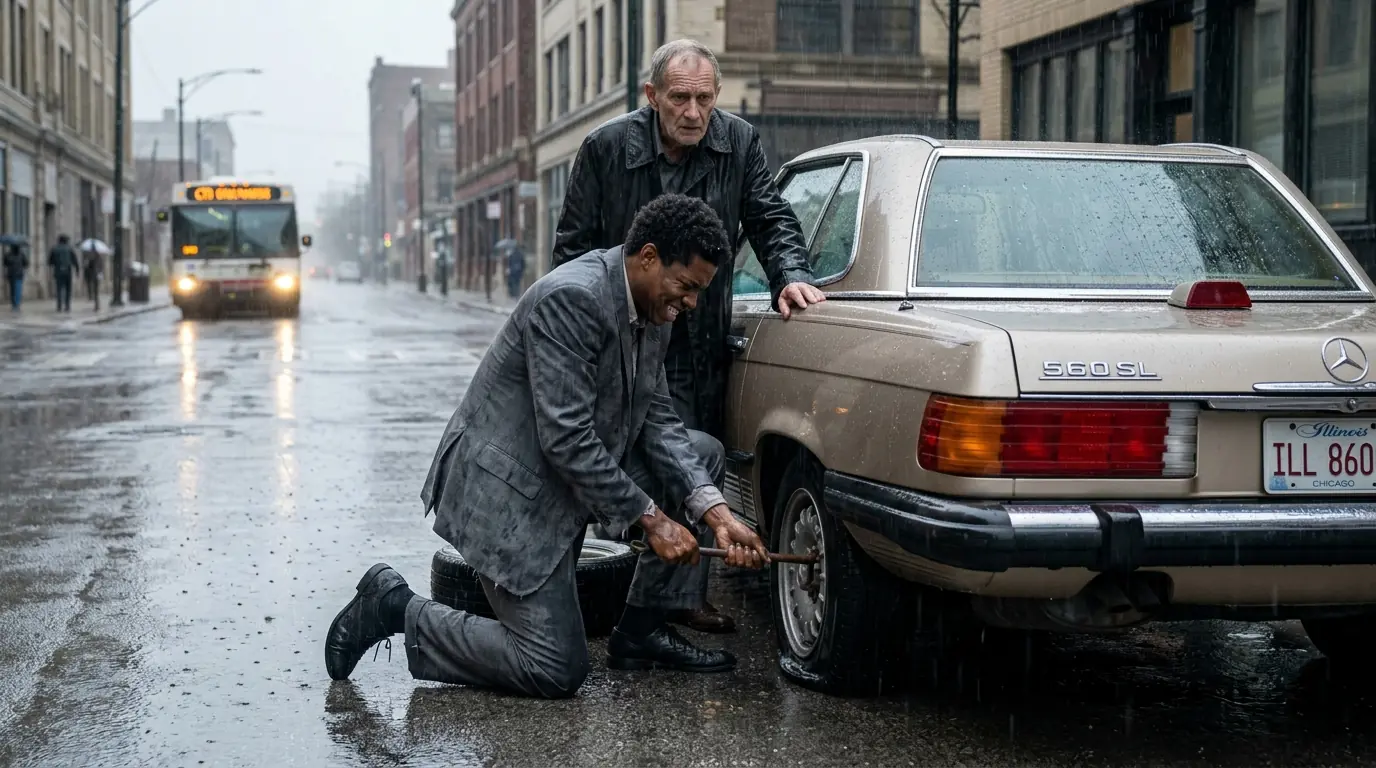
The next twenty minutes were miserable. The jack was rusted. The lug nuts were seized tight. Bo had to stomp on the tire iron, slipping in the mud and ruining the shine on his dress shoes. Grease smeared across his hands. Rain soaked through his suit jacket until it hung heavy on his shoulders.
By the time he wrestled the spare onto the hub, lowered the car, and threw the tools back into the trunk, his fingers were numb. A black streak of grease had found its way onto the collar of his white shirt.
The old man rolled down the window. He did not smile. He did not offer money. He only studied Bo with a sharp, measuring gaze.
“What’s your name, son?”
“Bo Walker.”
“Well, Bo Walker,” the man said, pulling out a handkerchief and dabbing his nose, “you possess a rare quality. Or perhaps just a foolish one. Most people would have gotten on the bus.”
“My mama raised me to stop,” Bo said, wiping rain from his face with his sleeve. “You safe to drive now?”
“I am. Name’s Felix. Felix Rhodes.”
The old man hesitated, as if he wanted to say more. Then he only nodded.
“Drive safe, Bo.”
Felix Rhodes pulled away into traffic.
Bo stood alone on the corner, wet, dirty, and twenty minutes behind schedule. He looked down at his reflection in a puddle.
He looked like a disaster.
“Hope it was worth it,” he muttered.
By the time Bo reached the towering glass building of Sterling and Vance, he was forty-five minutes late. The rain had stopped, but the damage was done. His suit was drying in stiff, wrinkled patches. His shoes squeaked across the marble lobby. The grease stain on his collar looked like a bruise against the white fabric.
The security guard gave him a pitying look and waved him through.
Bo took the elevator to the fortieth floor, his heart hammering against his ribs. He rehearsed his apology in his head.
There was an emergency. I stopped to help someone.
It sounded noble inside his mind, but he knew how it would sound to a corporate recruiter.
I have poor time management and bad priorities.
The elevator doors opened onto a quiet reception area of glass, steel, and polished silence. Behind the desk sat a receptionist who looked as if she had been printed instead of born.
“Name?” she asked without looking up.
“Bo Walker. I have a nine o’clock with Miss Holt. I know I’m late, but…”
“Have a seat.”
Bo sat on a low leather sofa. Across from him was another candidate.
Elias King.
Bo knew him from high school. Elias was everything Bo was not. Wealthy. Connected. Polished. He wore a navy suit that fit him perfectly and scrolled through his phone with bored confidence.
“Bo,” Elias said, looking up with a smirk. “Man, what happened to you? You swim here?”
“Car trouble,” Bo muttered.
“Rough,” Elias chuckled. “Lydia is a shark, man. She eats late people for breakfast. I’d just go home if I were you.”
Before Bo could answer, the heavy oak doors opened.
Lydia Holt stepped out.
She was all sharp angles. Sharp nose. Sharp bob haircut. Sharp eyes. She held her tablet like a weapon.
“Mr. King,” she said with a thin smile. “We’re ready for you.”
Then she looked at Bo.
Her smile disappeared.
Her eyes moved over his wrinkled suit, the mud on his shoes, and the grease stain on his collar. She looked at him as if he were something that had crawled onto a clean table.
“And you are?”
“Bo Walker,” he said, standing quickly. “Miss Holt, I am so sorry. There was an incident on the way here. An elderly man had a flat tire, and I…”
She did not take his hand.
“Mr. Walker, this is a logistics firm. Our entire business model is precision, timing, and reliability. You are forty-eight minutes late, and you look like you have been in a bar fight.”
“It was a flat tire,” Bo said, desperation entering his voice. “I stopped to help.”
“That is a lovely story,” Lydia said coldly. “But we are not hiring good Samaritans. We are hiring junior analysts. If you cannot manage your own commute, you certainly cannot manage our supply chains.”
“Please,” Bo said. “Just give me five minutes. I was valedictorian. I have references. I…”
“Mr. King,” Lydia said, turning her back on him. “Shall we?”
Elias stood, gave Bo a mocking little salute, and walked into the office.
The doors clicked shut.
Bo remained standing, one hand half extended, feeling humiliation burn hotter than the rain had been cold.
He had done the right thing.
And the world had punished him for it.
The fall came fast.
Two days later, Bo lost his part-time warehouse job because he had returned late from the failed interview. A week after that, an eviction notice was taped to his apartment door.
Bo sat at his kitchen table staring at the paper while his mother coughed weakly in the next room, the dry rattle of her lungs tearing at him.
Then his phone buzzed.
It was Raven Fox, a neighborhood friend who always seemed to walk the thin line between hustler and criminal.
“Yo, Bo,” Raven said. “I got a gig. Moving boxes. Fifty bucks an hour. Cash. Tonight.”
“Is it legal, Raven?”
“Does it matter? It’s boxes, man. Electronics. Overstock. Meet me at Fifth and Madison, outside the bodega. Nine o’clock.”
Bo looked toward his mother’s oxygen tank.
The gauge was in the red.
“I’ll be there,” he said.
That night, the rain returned. Neon bled across the pavement outside the bodega as Bo waited by the old pay phone in a gray hoodie and jeans.
At 8:55, a black SUV screeched around the corner.
Two men in ski masks jumped out and rushed the bodega entrance.
“Get down!” someone screamed inside.
Bo froze.
This was not moving boxes.
Before he could run, the glass door shattered. The alarm wailed. The two masked men sprinted out carrying bags of cash.
One of them wore Raven’s jacket.
“Raven!” Bo shouted.
The figure turned in panic and threw a metal lockbox toward him.
“Hold this!”
By reflex, Bo caught it.
Sirens erupted instantly.
Police cars swarmed the intersection from both sides. The masked men disappeared into the alleys, but Bo stood in the middle of the flashing red and blue lights with the stolen lockbox in his hands.
“Freeze! Drop it now!”
Bo dropped the box and fell to his knees.
“I didn’t do it!” he screamed, his face pressed against wet concrete. “I was just waiting for a friend!”
As officers handcuffed him, Bo saw someone standing in the shadows of the alley.
Elias King.
He was filming with his phone, a cruel smile lit by the glow of the screen.
That was when Bo understood.
This was not bad luck.
This was a setup.
In the holding cell, the air smelled of bleach and urine. Bo sat on the metal bench, head in his hands, until the door buzzed open and a woman in a sharp red suit walked in.
She did not look like a public defender.
She looked like an executioner.
“Bo Walker,” she said, reading from a file. “Armed robbery. Assault on a police officer. Resisting arrest. You had a busy night.”
“I didn’t do any of that,” Bo said. “I was framed.”
The woman looked up.
It was Verona Steel, the district’s most notorious prosecutor, known for her near-perfect conviction rate. She was running for district attorney, and she needed tough-on-crime headlines.
“Save it for the judge,” Verona said. “I am going to make an example of you, Mr. Walker. By the time I am done, you will be an old man before you see the sky again.”
“Wait,” Bo cried. “Who is the judge?”
Verona smiled coldly.
“You drew the short straw, kid. Judge Felix Rhodes. He hasn’t acquitted a defendant in five years.”
Bo’s blood went cold.
The name sounded familiar, but in his panic, he could not place it.
He only knew that his life was over.
Three weeks later, Bo sat at the defendant’s table in a Cook County courtroom, wearing an orange jumpsuit that smelled of industrial detergent and despair. Bail had been denied. His public defender, Arthur Gables, shuffled through papers with trembling hands and stale coffee on his breath.
“Let me do the talking,” Gables whispered. “Judge Rhodes is in a mood.”
“I didn’t do it,” Bo whispered. “You have to believe me.”
“It doesn’t matter what I believe. It matters what Steel can prove.”
“All rise.”
The side door opened, and Judge Felix Rhodes entered.
In the rain, he had looked frail.
Here, in black robes, he looked like judgment itself.
Bo stared at him.
The Mercedes.
The umbrella.
The flat tire.
It was him.
But Judge Rhodes looked right through Bo as if he were only another case number.
Verona Steel rose for her opening statement.
“Ladies and gentlemen,” she began, “we live in a city under siege. Good people are afraid to walk to the corner store because of predators. Predators like the defendant, Bo Walker.”
She pointed at him.
Bo flinched.
“The defense will tell you a sob story. They will tell you he is struggling. But the evidence tells the truth. He was caught red-handed holding stolen property while his accomplices fled. A wolf is a wolf, no matter how young.”
Arthur Gables stood, dropped a pen, and mumbled, “My client is a good kid. He was in the wrong place. We hope you see that.”
Then he sat down.
Bo closed his eyes.
The trial moved like a landslide.
The bodega owner testified that Bo had been outside holding the money box. Then Raven Fox took the stand in a cheap suit and would not look at him.
“It was Bo’s idea,” Raven lied. “He needed money. He said he knew a place we could hit.”
“Raven, tell the truth!” Bo shouted, standing up.
Judge Rhodes slammed the gavel.
“Sit down, Mr. Walker. One more outburst and I will have you removed.”
In the back row, Elias King sat watching with bored amusement. When Bo looked at him, Elias winked.
The final blow was the body camera footage.
There was Bo in the flashing lights, holding the lockbox.
He looked guilty.
The state rested.
When Judge Rhodes asked if the defense had a case, Gables lowered his head.
“No witnesses, your honor.”
Bo grabbed his arm.
“I have to testify.”
“No,” Gables whispered. “She will eat you alive.”
“I have to. Nobody else is going to tell the truth.”
Bo stood.
“Your honor, I want to take the stand.”
The courtroom went silent.
Judge Rhodes studied him for the first time.
“It is your right, Mr. Walker,” he said slowly. “Though I advise you to listen to counsel. The witness stand is a lonely place.”
“I have nothing to hide.”
Bo was sworn in.
Gables asked a few weak questions. Bo answered them honestly.
Then Verona Steel stood for cross-examination.
“Mr. Walker, you claim you were at the bodega to move boxes for fifty dollars. Is that correct?”
“Yes, ma’am.”
“You were desperate, weren’t you? You had just been fired. Before that, you were rejected from Sterling and Vance. Correct?”
“Yes.”
“A pattern of failure,” Verona said. “Why did you lose that opportunity?”
“I was late.”
“Late?” Verona laughed. “The most important interview of your life, and you were late? Why? Did you oversleep?”
“No. I missed my bus.”
“You missed your bus,” she repeated, turning to the jury. “There is the motive. A man whose life is falling apart decides to take a shortcut.”
“That is not why I missed it,” Bo said, his voice rising.
“Then why, Mr. Walker? Give us your excuse.”
“I stopped to help someone.”
Verona smiled.
“A good Samaritan. How convenient. And where is this person now? A ghost?”
“I don’t know who he was,” Bo said, looking helplessly toward the jury. “It was raining. I was at the shelter on 79th. The bus was coming. I saw a car blow a tire.”
Judge Rhodes stopped writing.
His pen hovered above the page.
“A car?” Verona said. “What kind of car?”
“A Mercedes,” Bo said. “An old one. Champagne-colored. A 560SL. I remember because my granddad used to talk about that car.”
Judge Rhodes’s head snapped up.
Verona did not notice.
“And let me guess,” she said. “You changed the tire, and the driver gave you a pot of gold?”
“No,” Bo said. “The driver was an old man. He had arthritis. He could not loosen the lug nuts. He had a big black umbrella, but the wind broke it right away. Turned it inside out.”
Judge Rhodes went pale.
“The umbrella,” he said softly. “What did he do with the umbrella?”
Verona froze.
“Your honor?”
“Answer the question, Mr. Walker.”
Bo stared at the judge, confused.
“He got mad. He threw it in the gutter. He was soaked. He looked like he was about to give up. So I missed the bus. I took off my jacket and changed the tire for him.”
Judge Rhodes removed his glasses.
Without the glare of the lenses, Bo saw the eyes clearly.
Steel gray.
The same eyes from the Mercedes.
“It was you,” Bo whispered.
The courtroom fell dead silent.
Judge Rhodes leaned forward.
“I asked your name,” he said. “You told me Bo Walker. And I told you most people would have gotten on the bus.”
Bo swallowed hard.
Judge Rhodes sat back, looking at the boy in the orange jumpsuit. The boy he had nearly helped send to prison. The boy whose job interview had been destroyed because he had stopped in the rain to help him.
And in that moment, Felix Rhodes, known across Chicago as the hangman, understood the truth.
Bo Walker was sitting in that chair because of him.
“We are taking a recess,” Rhodes said, his voice low.
“Your honor, I am in the middle of cross-examination,” Verona protested.
“I said we are taking a recess,” Rhodes roared. “Counsel, in my chambers. Now.”
The next eighteen hours changed everything.
Judge Rhodes used every connection he had to reopen what Verona Steel had refused to examine. Detective O’Connell, a veteran investigator, traced the payments between Elias King and Raven Fox. The money had been labeled as consulting fees, routed through accounts tied to the King family.
Then came the recovered text messages.
Elias King: He’s at the corner. Gray hoodie. Toss the box to him. Make sure he holds it.
Raven Fox: The cops are already here, like you said.
Elias King: They’re my father’s boys. Don’t worry. He takes the fall. Delete this thread now.
The setup was undeniable.
Raven broke quickly. He confessed that Elias had paid him to lure Bo to the bodega because Bo had been the stronger candidate for the Sterling and Vance apprenticeship. Elias had wanted him out of the way.
Then Lydia Holt was brought in. The company records showed Bo had been marked as an excellent candidate, with only one concern: tardiness. Elias’s file contained a handwritten note from Lydia herself.
Priority hire. Family friend of the board.
Under pressure, Lydia admitted the truth. Elias’s father, a major client, had leaned on the company to guarantee his son the job.
The next morning, the courtroom was packed.
Bo sat in his orange jumpsuit, exhausted and afraid.
Judge Rhodes entered, but he no longer looked like the cold hangman. He looked like a man who had wrestled with his own conscience and come back changed.
He looked straight at Verona Steel.
“Miss Steel, does the state intend to proceed?”
Verona stood, her voice barely above a whisper.
“Due to newly uncovered evidence, the state moves to strike the testimony of Raven Fox and requests leave to call a new witness. Elias King.”
A shock moved through the room.
Elias turned pale.
He was called to the stand.
The messages appeared on the courtroom screen one by one. The plan. The payment. The instruction to throw Bo the lockbox. The mention of police connections.
The jury gasped.
Judge Rhodes leaned toward the microphone.
“Mr. King, did you orchestrate this robbery to eliminate Bo Walker as competition for an entry-level job?”
Elias stared at the screen, sweating.
“I didn’t mean for it to go this far,” he whispered. “It was just a joke. I only wanted him out of the running.”
The gavel cracked.
“There is nothing funny about destroying a man’s life,” Rhodes said. “That joke nearly cost Mr. Walker ten years of his freedom.”
Lydia Holt testified next. She admitted Bo had been the better candidate. She admitted Elias had been chosen because of pressure, privilege, and family connections.
By the time it was over, the truth stood in the courtroom for everyone to see.
A good deed had made Bo late.
That lateness had cost him a job.
The lost job had pushed him into desperation.
And that desperation had made him vulnerable to a cruel setup built by jealousy, privilege, and corruption.
Judge Rhodes dismissed the jury.
“Mr. Bo Walker,” he said, his voice steady, “the charges against you are dismissed with prejudice. You are free to go.”
The bailiff removed the cuffs.
Bo stood trembling.
For the first time in weeks, he could breathe.
Judge Rhodes then turned to Elias King.
“You are remanded into custody on charges of conspiracy, obstruction of justice, and witness tampering. Bail is set at ten million dollars. Your father’s influence ends here.”
Verona Steel was referred to the State Disciplinary Commission for her misconduct. Her career in public service collapsed beneath the weight of the truth she had tried to ignore.
Lydia Holt was fired from Sterling and Vance after the scandal became public.
Raven Fox received a reduced deal for cooperating, but he carried the weight of his betrayal long after the courtroom emptied.
Then Judge Rhodes looked down at Bo, and for the first time, a small, genuine smile reached his eyes.
“Mr. Walker,” he said, “I believe you had an interview at Sterling and Vance for which you were forty-eight minutes late. I assure you, you were far more qualified than the applicant they chose.”
The gavel came down that day, but it did not sound like punishment.
It sounded like salvation.
Bo Walker did not simply walk out of that courtroom. He walked into a new life. Judge Rhodes helped sponsor his college education, and years later, Bo founded a nonprofit to help people trapped inside the legal system with no one to believe them.
Elias King learned that privilege could not protect him forever.
Verona Steel learned that ambition without conscience is just another form of corruption.
And Felix Rhodes, the judge once known as the hangman, learned that justice is not only about punishment. Sometimes, justice begins with remembering the humanity of the person standing in front of you.
Bo had thought he missed a bus that morning.
But really, he had stepped into the path of destiny.
And the single act of kindness that nearly destroyed him became the very thing that saved his life.