"You look like you wandered into the wrong place, kid. You don't belong here." Sgt. Delphine Parcher's voice carried across the training field. The trainees heard it. A few laughed, the sound sharp, brief, dying quickly against the open space. Mack Werden didn't move. He stood exactly where he was and took it without flinching, without lowering his eyes, without giving Parcher a single thing. What Sgt. Parcher did not know was that he had just picked the one man in the roster who was a third-degree black belt in karate and had spent years learning discipline more than anything else.
The mirror didn't lie. Mack Werden stood in front of it at 5:00 in the morning, buttoning his white undershirt with slow, deliberate fingers. The bedroom light was harsh and bright. Every crease in his face was visible. Every line around his eyes. He looked at himself the way a man looks at something he has been building for a long time. Not with pride, exactly. With readiness.
Behind him, on the shelf above the dresser, three national championship plaques caught the light. Gold lettering. His name over and over. He didn't look at them. He already knew what they said. He pulled on his pants, tucked in his undershirt, and stood straight. The man in the mirror looked like he meant business.
Mack had wanted to be a police officer since he was 12 years old. Not because the job was glamorous. Not because he grew up watching cop shows on television. He wanted it because of one specific Tuesday afternoon in October, 16 years ago, when his father, Jonathan Werden, a man who wore a suit to the grocery store, who carried a leather briefcase and argued cases in federal court, was pulled over on Meridian Avenue and treated like a criminal. Mack had been in the backseat. He remembered his father's hands, flat on the steering wheel, completely still, knuckles visible. Jonathan hadn't said a word out of line, hadn't raised his voice, hadn't done anything except exist in the wrong car on the wrong street at the wrong time. And the officer had spoken to him like he was nothing.
That was the day Mack understood something. Not that the system was broken. His father had been telling him that for years. What he understood, sitting in that backseat at 12 years old, was that broken things could be fixed. But only if someone was willing to get inside them.
He turned off the bedroom light. Jonathan was in the kitchen doorway when Mack came down the stairs, coffee in one hand, the other hand hanging loose at his side the way it always did when he was holding something back. Jonathan Werden was 58 years old and had spent 30 of those years fighting in courtrooms for people who had been chewed up by the very institutions that were supposed to protect them. He knew exactly what his son was walking into.
"You eat anything?" Jonathan asked.
"I'll grab something after."
Jonathan nodded slowly. He looked at Mack the way Mack had looked at the mirror, like he was calculating something. Then he said quietly, "You know what they'll see when you walk in that door?"
Mack picked up his keys from the counter.
"I know what I'll see when I walk out."
Jonathan didn't argue. That was the thing about Jonathan Werden. He knew when a man had already made up his mind. He just watched his son go, coffee warm between both hands now, standing in the kitchen doorway until the front door closed.
The drive took 22 minutes. Mack kept both hands on the wheel and the radio off. The city moved past the windows in early morning gray. Storefronts with their gates still down, streetlights still on, a delivery truck idling outside a convenience store. Everything quiet and unhurried. Mack drove like he did most things, deliberately, without wasted motion.
Precinct Nine's Academy Annex sat at the end of a long block on the east side. It was a squat brick building, old and institutional, with narrow windows and a parking lot that needed repaving. A chain-link fence ran along the left side. A flagpole stood out front with the state and city flags hanging limp in the still morning air. There was nothing welcoming about it. Mack pulled in at 6:57, three minutes early. He cut the engine and sat for a moment, scanning the lot. There were already eight or nine cars. A few trainees he didn't recognize were walking toward the entrance in small groups, talking in low voices. They wore the standard-issue training uniform, plain white T-shirts and dark navy shorts, the fabric stiff and new-looking against the morning light. It was the same kit waiting on Mack's kitchen chair when he'd packed his bag the night before. He was the only black man he could see. He noticed it the way you notice weather. Not with surprise, exactly. Just acknowledgement. A data point that told him what he already knew about where he was and what was waiting.
Mack got out of the car. He straightened himself, picked up his folder of paperwork from the passenger seat, and walked toward the entrance with his head level and his pace steady. The door was heavy. It swung shut behind him with a sound like a verdict.
The field was already bright when the trainees assembled, the morning sun cutting hard across the open ground and throwing long shadows off the tree line at the far edge. Eleven of them stood in a loose line along the near side of the field. Most of them stiff with the particular nervousness of a first morning. All of them in matching white. Shirts already showing the heat at the collar. Dark shorts uniform down the line. A few looked over when Mack crossed the field to take his place. A couple looked away quickly. He found his spot in the line. He stood straight. He waited.
Sgt. Delphine Parcher came around the corner of the Annex building like a man who had somewhere more important to be and was doing them a favor by stopping. He was a compact man, not tall, not particularly built, but he moved like someone who had never once been told to wait. 54 years old with a face that looked like it had been left out in bad weather, creased, reddish, permanently set into something between a squint and a sneer. His uniform was pressed within an inch of its life. The full navy blues of a department sergeant. Badge polished to a hard gleam in the morning sun. Radio clipped at the shoulder. Boots mirror clean against the pale dirt of the field. He looked like a man who used the uniform as a weapon before he opened his mouth. He didn't say good morning.
He walked the line slowly, hands clasped behind his back, scanning each trainee from head to foot the way a man inspects something he already expects to be disappointing. He stopped at the first trainee, a kid of about 22 with slightly scuffed shoes, and stared at the shoes for a full 5 seconds without speaking. The kid's face went red. Around them, the open field offered nowhere to look and no cover to stand behind. Everything was visible out here. That was the point.
"You shine those with a dirty sock," Parcher said. Nobody laughed. Nobody breathed. He kept moving. A grunt at the next trainee. A dismissive head shake at the one after that. He was performing and everyone in the line knew it. And no one was going to say so. The tree line stood still at the edge of the field. The sun climbed and did not care. Then he reached Mack. He stopped. The silence stretched out, more exposed somehow in the open air than it would have been between four walls.
Parcher looked Mack up and down once, slowly, like he was reading the back of a cereal box. Then he looked down at his clipboard and dragged his finger along the roster until he found the name. His finger stopped. "Werden." He let the name sit in the morning air for a moment. Then he looked up. And there was something in his eyes that wasn't confusion or curiosity. It was a decision.
"You look like you wandered onto the wrong field, son. Community center's about two blocks north." Laughter broke out immediately. Sharp, quick laughter from Brick Hamilton, a thick-necked trainee at the far end of the line, and two others close to him. Out here, it had nowhere to go. It just hung in the open air and faded. Not everyone laughed. Most of the line stayed still, eyes forward. The particular blankness of people who want no part of what they're watching, but won't say so, either. Mack didn't move. He kept his posture exactly where it was, back straight, chin level, eyes on the middle distance, fixed on tree line at the far edge of the field, steady and unchanged, the way he intended to be.
He let the laughter run its course, and when it died out into the morning quiet, he said, without any heat in his voice at all, "I appreciate the concern, Sergeant, but I checked the address twice."
The laughter stopped. Parcher's expression didn't change, not exactly, but something behind his eyes shifted. He'd expected embarrassment. He'd expected the flinch, the dropped shoulders, the red face, the mumbled apology. That was the reaction men like Parcher built their whole game around. Out here on the open ground with the sun overhead and nowhere to hide, that flinch was supposed to be inevitable. Mack had given him nothing, just a calm, clear sentence and steady eye contact. Parcher stared at him for one more second. Then he moved on down the line, but his eyes came back to Mack twice before he finished the roster. Mack noticed both times.
The morning session was classroom work. Protocols, department regulations, a 40-minute lecture on use-of-force policy that Parcher delivered like a man who found his own material exhausting. Mack took notes. He stayed focused.
The afternoon was different. They moved outside. The training field behind the annex building was wide and flat, bordered on three sides by a dense tree line that stood dark green and still against a sky that had opened up into full aggressive blue. The sun was high and direct, no clouds, no relief. And it hit the pale dirt and scrubbed grass of the field with the particular force of a day that intended to be brutal. The air smelled of dry earth and cut pine from the tree line. It was the kind of afternoon that made everything feel overexposed.
The trainees assembled in a loose formation along the near edge of the field. Their white T-shirts caught the sun immediately, already showing sweat at the collar and between the shoulder blades on the trainees who had been moving around setting up equipment. Parcher stood at the center of the field in his full navy uniform, badge glinting in the direct light, not a button undone, looking entirely unmoved by the heat. His radio crackled once and went quiet. He silenced it without looking down. He called out equipment assignments from his clipboard, turning slowly as he spoke so his voice carried to the far ends of the formation. Trainees received their gear.
When he reached Mack, he assigned him the heaviest sandbag pack in the pile, nearly 15 lb more than the standard issue. He did it without looking up from the clipboard, without explanation. "Equalizing standards," Parcher said flatly, "moving on." The run was 3 miles down the perimeter path that skirted the tree line and doubled back through the open field. The sun tracked them the whole way. No cover on the open stretch, only thin shade where the path cut close to the pines. The white shirts of the group ahead of Mack flashed in and out of the tree shadows like a scattered flock. Mack ran at a steady pace with the extra weight and finished in the top third of the group, shirt dark with sweat down the spine and across both shoulders, breathing hard but controlled.
Parcher clocked the time, wrote something on his board, and said nothing. Then he added a fourth mile, only for Mack, framed as a conditioning variance, and stood at the edge of the field with a stopwatch and his arms folded, watching from beneath the peak of his uniform cap, badge catching the afternoon sun at intervals as he shifted his weight. Mack ran the fourth mile. He didn't complain. He didn't look at Parcher when he crossed the finish line. He just slowed to a walk, controlled his breathing, and rejoined the group.
The day ended at 6:00. Trainees gathered their gear and filed out through the narrow hallway toward the parking lot. Mack was near the back of the group, moving at an easy pace. He heard the footsteps behind him a half second before it happened. Brick Hamilton hit him with a hard shoulder check as he passed. No words, no eye contact, just a deliberate collision that would have sent most people stumbling into the wall. Mack didn't stumble. He absorbed it, steadied himself in one step, and turned to watch Brick walk away down the hallway, already looking at his phone. Brick never looked back. Mack turned and walked to the exit.
Day two started the same way day one had ended. Bright lights and Parcher walking the line, but this morning the 12 trainees were moved back outside before 8:00. The field looked different in the early light, the tree line softer, the shadows long and cool across the near edge of the grass before the sun had climbed enough to burn them off. The trainees assembled in their white T-shirts and dark shorts along the edge of the cleared area, the fabric still carrying the morning chill. A few of them had their arms folded. One was blowing into his hands.
Parcher stood at the center of the field in full uniform, badge already catching what sun there was, radio on his shoulder. The navy of his shirt looked almost black in the early morning flat light. He held his clipboard in one hand and looked at the assembled trainees with the expression of a man who had already decided the day was going to disappoint him.
"Defensive tactics," he said. "You will be paired. One partner attempts a controlled takedown, the other demonstrates a counter. Resistance." He paused there just briefly. "Is encouraged." He worked through the pairings without drama, calling names and pointing. Trainees shuffled into position across the open ground. The dirt and scrubbed grass of the training field had been marked out in a loose rectangle, a makeshift mat area, flat and packed hard from use, with the tree line standing close along the far edge.
When he reached Mack's name, he stopped, looked down at the clipboard, then looked up with the thinnest version of a smile Mack had seen on a human face. "Werdin." He pointed to the far end of the marked area closest to the trees. "You're with Hamilton."
Brick Hamilton was already moving. He was built like a piece of construction equipment, wide through the shoulders, thick-necked, with hands that looked like they'd been assembled from spare parts. He rolled his neck as he walked, cracking it twice, and took his position across from Mack without making eye contact. The sun had climbed enough now to come in flat and direct off the tree line, cutting hard light across the field. Both of them squinted into it.
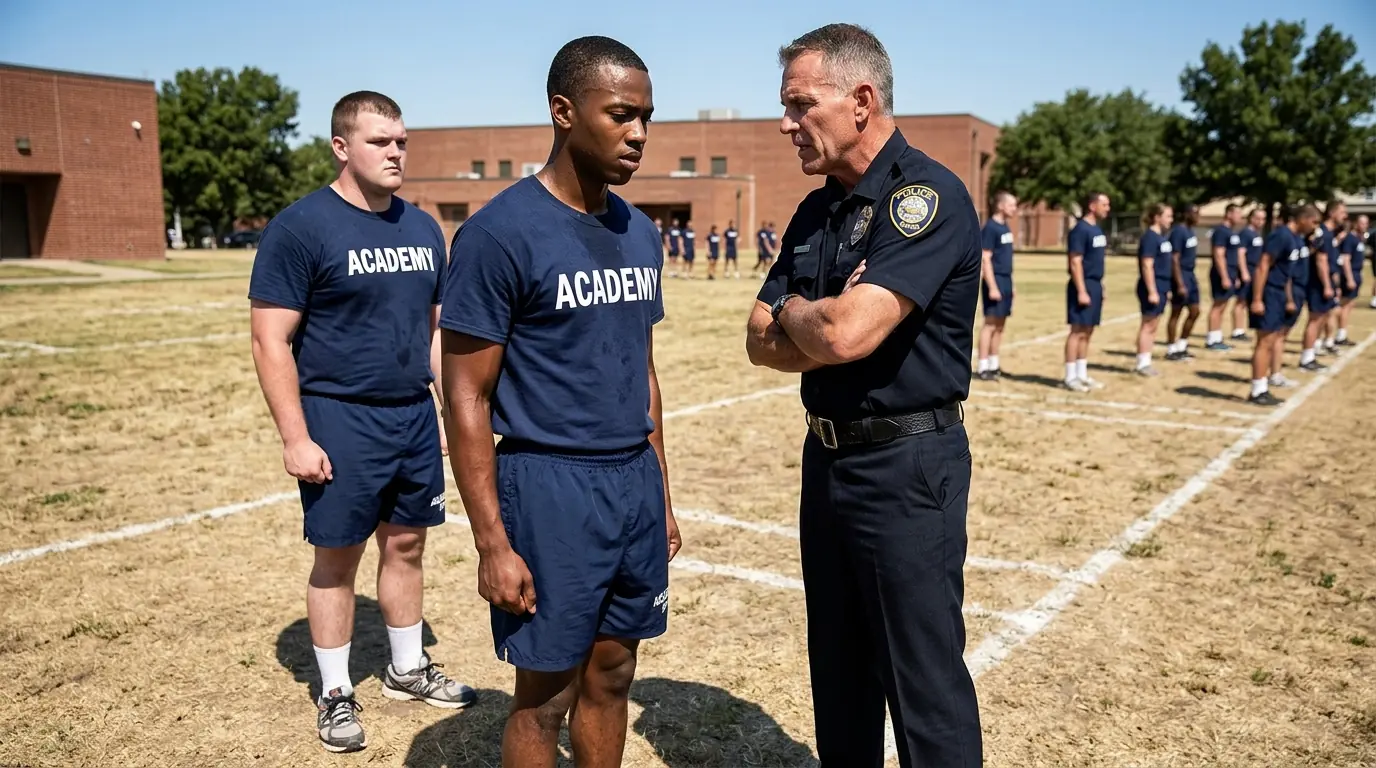 Before the drill began, Parcher walked to Brick's end of the field. He leaned in close to Brick's ear. Whatever he said was too quiet for anyone else to hear. Brick nodded once, slowly, and the corner of his mouth pulled up. Nobody else caught it. But mounted under the narrow eave of the annex building, a security camera pointed at a slight downward angle toward the training field. It caught everything.
"Begin," Parcher said. Brick came in fast, not drill fast, not training fast. He launched himself across the marked ground with his shoulder dropped like a battering ram, driving straight at Mack's chest with the kind of force that was meant to end the exercise in the first 3 seconds. Mack sidestepped. It wasn't a dramatic move. There was no spin, no leap, no sound. He simply wasn't where Brick expected him to be, and Brick's momentum carried him past. The dry grass scuffed under his boots as he stumbled forward. Brick recovered, turned, reset, came again. This time a forearm shot up toward Mack's throat, hard enough to bruise, hard enough to send a clear message about what kind of drill this actually was. Mack caught the arm at the wrist, redirected it with a small, precise rotation, and used Brick's own forward drive against him.
Brick hit the ground on his back with a sound like a heavy door slamming, dirt puffing up around him in the afternoon light. The group went quiet. A few trainees in their white shirts stood with arms at their sides, watching. The sun was fully up now, the field bleached pale and shadowless. Brick got up. His jaw was tight. He looked at Parcher once, fast, almost involuntary, and Parcher's face gave him nothing, just watching, arms folded across his navy chest, badge glinting, cap brim level in the sun.
Brick reset. The third attempt was slower, more deliberate. He came in low, going for a leg grab, a wrestler's move, hard to counter without training. Mack let him close the distance, then dropped his weight and shifted his hips in one smooth motion, redirecting Brick's grip and using the angle to bring him forward and down. Brick hit the ground again, harder this time, face-first into the packed dirt. He lay there for a moment. The field was absolutely silent. No shuffling feet. No clipboard scratching. The tree line stood motionless at the far edge. The only sound was the distant drone of a passing car somewhere behind the building. And then, nothing.
Brick pushed himself up slowly, one arm at a time. There was a red mark spreading across his left cheekbone where it had met the ground. He got to his feet and stood there, breathing through his nose, a streak of pale dirt across the front of his white T-shirt. Mack stood in the center of the field. His breathing was even. His undershirt was damp across the shoulders from the sun, from the run, from the same effort that had bent every other man in the group. But he hadn't raised his voice, hadn't thrown a single aggressive move, hadn't done anything except be exactly where Brick wasn't and used the energy that came at him to answer itself. Sixteen years of training. Every early morning, every competition, every hour on the mat. It had all lived quietly inside him waiting for a moment exactly like this one.
He turned and looked directly at Parcher. "I believe the drill is complete, sergeant." Parcher didn't move. His arms were still folded, badge steady in the afternoon light. His face was still controlled, but something behind his eyes had shifted. The same shift Mack had noticed yesterday, only deeper now, more deliberate. This was no longer casual cruelty. This was a man making a decision.
Around them, 11 trainees stood in their white shirts without speaking. Danica Opstal, third from the left, stared at Mack with wide eyes and said nothing. Nobody said anything. Somewhere in the tree line, a single bird called once sharply and went quiet.
That night, the light in Parcher’s office burned late. He sat behind his desk with a blank incident report form on the surface in front of him and a coffee going cold at his elbow. The room was small and cluttered. Filing cabinets along one wall, a framed commendation from 2009 hanging slightly crooked above the door, stacks of training binders on every flat surface. He’d been in this office for eight years. It looked like a man who had stopped trying to impress anyone a long time ago.
He picked up his pen. He wrote slowly and carefully, the way a man writes when he knows the words matter. Not a rant, not a complaint fired off in anger. Something precise. Something that would hold up. He had done this before. The phrasing came to him without much effort, like a recipe he had memorized years ago and never needed to look up again.
"Trainee Warden Mac, unauthorized and excessive use of force during controlled defensive tactics exercise. Training partner sustained injury. Conduct inconsistent with academy standards. Recommend immediate suspension pending review."
He read it back once. Then he signed it.
Mac arrived at the academy at 6:54 the next morning, day three, three minutes earlier than the day before. A junior administrator named Filson was waiting for him outside the entrance. Young, maybe 25, with the look of someone who had drawn the short straw and knew it. He was holding a manila folder and standing just far enough from the door that it was clear he didn't want to be seen doing what he was about to do.
"Mr. Warden." Filson cleared his throat. "I need to speak with you before you go inside."
Mac stopped. He looked at the folder. He looked at Filson.
"There's been a complaint filed regarding yesterday's training exercise."
Filson opened the folder and stared at it rather than at Mac. "Pending an incident review, you've been suspended from the training rotation."
"With pay?"
"Effective immediately."
The words landed flat in the cold morning air. Mac didn't raise his voice. He didn't argue. He asked one question.
"Who filed the complaint?"
Filson hesitated just long enough to answer the question without answering it.
"The review process will—"
"I understand." Mac said. He didn't go inside. There was nothing inside for him anymore. Not today.
Filson walked him, though "walked with him" was more accurate. The man couldn't look him in the eye. Back to the parking lot. The door to the building opened once during the walk and three trainees spilled out, cutting off when they saw what was happening. Danica Opstal was among them. He stopped at the top of the steps and watched Mac reach his car. He watched the longest.
Mac sat in the driver’s seat with the engine off. He didn’t call his father. Not yet. He pulled the copy of the complaint Filson had handed him from the folder and read it in full, slowly, in the morning quiet of the parking lot. It was clean. That was the first thing he noticed. No anger in the language, no exaggeration. Just the kind of measured institutional wording that looks, to someone who doesn't know better, like objectivity.
Brick Hamilton was referenced only as "training partner." Parcher's pre-drill instruction to Brick, that quiet lean that the whole field had registered and nobody had spoken about, was absent entirely.
Mac's measured, controlled response was described as an unprovoked escalation. He read it a second time. Then, he looked at the top right corner of the form, the case reference number. It was a string of letters and digits that looked like noise to most people. To Mac, something about it snagged. He pulled out his phone and opened the department’s public incident registry, a database his father had shown him years ago used primarily for civil litigation research.
He typed in the reference prefix from his complaint. Four results came back. His was the most recent. The three before it shared the same prefix code, the same form template, the same spare, clinical language. Different names, different dates spread across the last seven years. He stared at the screen for a long time. Same prefix, same structure, same author, he was almost certain.
His phone buzzed in his hand. Unknown number. A text, four words and a question mark. "They've done this before?"
"Three others before you."
"Can we talk?"
Mac looked up from the phone and stared through the windshield at the academy building. The brick face of it. The narrow windows. The flag limp on its pole. He looked back down at the text. He saved the number. And he began to type.
The diner was 12 blocks from the precinct. That had been Mac’s condition. Twelve blocks minimum. Far enough that no one from the academy would recognize a face through the window and start asking questions. Danica had agreed without hesitation, which told Mac something about how scared the man already was. Danica Opstal was 26, lean, with careful eyes that moved to the door every time it opened. He was already in the booth when Mac arrived. Back to the wall. Coffee untouched. Hands wrapped around the mug like he needed something to hold on to. He was still in his civilian clothes. He'd come straight from home, not from the academy.
Mac slid into the seat across from him. For a moment, neither of them spoke. The diner hummed around them. The clatter of plates. A television above the counter showing morning news with the volume low. The smell of bacon grease and burnt coffee. Normal sounds. Normal morning. Nothing about it matched what they were sitting down to discuss.
Danica spoke first. "I shouldn't be here," he said.
"I know." Mac said.
"Tell me anyway."
Danica didn’t have much. He was clear about that from the start. He had fragments, impressions, things he had picked up from the margins of conversations he wasn’t supposed to be part of. But, fragments, Mac had learned from his father, were how the picture started. Three trainees before Mac. All black. All formally complained against within their first two weeks under Parcher. All processed out quietly, efficiently, with no public record of dispute.
"Do you have names?" Mac asked.
Danica shook his head. "Just what I told you. And the numbers you already found."
Mac nodded. That was enough for now. He left Danica to his untouched coffee, paid for both of them at the counter, and drove home. He called his father that evening. Jonathan picked up on the second ring, which meant he'd been waiting for it.
Mac read the case reference numbers slowly and clearly, the way his father had taught him to relay information. No editorializing, no interpretation, just the facts in order. Jonathan listened without interrupting. When Mac finished, there was a brief silence that wasn’t emptiness. It was the sound of a mind already working.
"Give me until tomorrow morning," Jonathan said.
Jonathan called back at 7:42 the next morning. Mac was at the kitchen table with a notepad and a pen already in front of him. He'd been up since 6:00.
"I cross-referenced the prefix codes through the civil filing registry and the department's public complaint archive," Jonathan said. His voice had the particular quality it got when he was delivering findings. Measured, precise, no wasted words. Three prior complaints. Same form template. Same reference structure. Filed over a 7-year span.
“Names,” Mac said.
“Ryden Oliver. Filed six years ago. Processed out within three weeks. Last known address puts him out of state. No current contact information in any database I can access.” A pause. “Trevor Flaherty. Four years ago. He’s local. Listed address on the east side. Phone number attached to the record.”
Mac wrote both names. And the third?
“Kyla Delzer. Two and a half years ago. She fought it. Hired an attorney. The complaint record has a response filing attached. A formal dispute. It went nowhere, but she tried.”
Mac wrote her name. He underlined it once without thinking about it.
“That’s three documented cases,” he said. “Same sergeant. Same complaint structure. Same outcome. In seven years.”
“And those are only the ones that made it into a filing system I can access,” Jonathan added. “There may be more that were handled before any paperwork was generated.”
Mac stared at the three names on his notepad: Ryden Oliver, Trevor Flaherty, Kyla Delzer. Real people. Real careers ended or derailed before they had the chance to begin. And behind each name, the same signature at the bottom of the same kind of form: Dad.
Jonathan Werden did not send the complaint by mail. He drove it to the department’s HR division himself, parked in the visitor lot, walked through the front entrance with the document in a sealed envelope, and stood at the reception desk until a clerk signed for it and stamped the acknowledgement copy with the date and time—8:41 in the morning. He kept the stamped copy, folded it into his inside jacket pocket, and drove back to his office. He had been doing this for 30 years. He knew better than to leave a paper trail with gaps in it.
Two days passed. Mac spent them at home, suspended and barred from the building, doing what his father had taught him to do with waiting time. He organized. He built a timeline on his kitchen table using index cards and a roll of tape, placing every event in order, every name, every date, every case reference number. He read the department’s HR policy manual cover to cover, and found three separate procedures that Parcher’s complaint against him had bypassed without explanation.
On the morning of the third day, a letter arrived at Jonathan’s office by department courier. Jonathan read it standing at his desk. The complaint had been reviewed and found to be without merit. The matter was considered closed. No further action would be taken. He read it again. Then he set it down on his desk and stood very still for a moment. In 30 years of civil rights law, he had seen complaints buried in many ways, delayed, misfiled, lost in reassignment. But this letter had arrived in 48 hours. Forty-eight hours from receipt to closure with no record of a single interview conducted. No request for documentation. No contact with Mac. No contact with Jonathan. That wasn’t slowness. That wasn’t bureaucracy doing what bureaucracy does. That was a door being shut before anyone could get a foot in it.
Jonathan called Mac and told him what the letter said. Mac listened without speaking. Then he said,
“Who signed it?”
Jonathan looked at the bottom of the letter.
“HR administrator. Name’s Gavin Foss.”
Mac wrote the name on a fresh index card and added it to the table.
That afternoon, Mac drove to the east side. Ryden Oliver’s last known address was a second-floor apartment in a building with a broken buzzer panel and a landlord who answered the door in a bathrobe. He confirmed that Ryden had moved out 14 months ago. Forwarding address? He laughed like Mac had asked something funny. No forwarding address, no contact, just gone.
Trevor Flaherty answered on the third ring. His voice was careful right from the start. Not unfriendly, but measured in the way of a man who had decided in advance how far this conversation was going to go. Mac introduced himself, explained what had happened, explained what he and his father had found about the pattern of complaints. He kept it brief and factual. Silence on the line. Then,
“I hear you. I do. But I’ve got a wife and two kids and a job I can’t afford to lose. I’m done with all of it. Whatever happened happened. I moved on.”
“Trevor, I’m not doing this, man.” His voice didn’t rise. It didn’t need to. The exhaustion in it said everything. “I’m sorry about what they did to you. I really am. But I can’t go back there. I can’t.” The line went quiet.
“Okay,” Mac said. “I understand.” He meant it. That was the hardest part. He actually meant it.
He dialed Kyla Delzer last. It rang four times. He was preparing for voicemail when she picked up.
“Yes?” cautious. A woman who didn’t recognize the number and wasn’t pretending otherwise. Mac told her his name, told her what precinct, told her what Parcher had done and what his father had found. The line went quiet. Not the silence of someone who didn’t care. The silence of someone who cared very much and was deciding something important.
When she spoke, her voice was steady and clear.
“Tell me what you need.”
Mac set his phone down on the kitchen table. In front of him, the notepad with the three names sat under the index card timeline he’d been building for two days. He looked at the names for a moment. Then he picked up his pen and circled Kyla’s name.
Jonathan Werden’s law office was on the fourth floor of a building that smelled like old wood and legal paper. It was a serious room. Dark bookshelves floor to ceiling. A wide desk that had seen 30 years of hard cases. Two chairs across from it that had held a lot of people at the worst moments of their lives.
Mac had grown up coming to this office. To him, it felt like a place where the truth was taken seriously. Kyla Delzer arrived 15 minutes early. She was 34 with close-cropped natural hair and the kind of posture that came from years of military discipline. Back straight, shoulders level, chin up. She wore a dark jacket and carried nothing but her phone and her keys. She took the chair closest to the wall with her back to the bookshelf and a clear line of sight to the door. She sat with her hands folded in her lap and waited.
Mac noticed the chair she’d chosen. He understood it. He sat across from her. Jonathan took his place behind the desk. For a moment, the three of them just looked at each other. The quiet before something heavy gets put on the table.
Then Kyla said,
“How bad did they get you?”
Mac told her all of it in order. The first day, Parcher’s comment in the line, the drill on the training field, Brick, the complaint, the suspension, the buried HR filing, the letter signed by Gavin Foss that had come back in 48 hours without a single interview. Kyla listened without moving. When he finished, she was quiet for a moment. Then she said,
“Same. Almost exactly the same.”
She had been 29 when she entered the academy, former army medic, two deployments, an honorable discharge, and a criminal justice degree she’d earned online while still in service. She had wanted to be a detective, specifically a crimes-against-persons detective, the kind who worked cases nobody else wanted to touch. She had a plan. She had been working toward it for six years before she walked through the doors of Precinct 9’s Academy Annex. Parcher had started on day one the same way: the comment in the line, the dismissal dressed up as a joke, the laughter from the people around him. She hadn’t flinched either, which she now understood is what made her a target.
Two weeks in, during a firearms training exercise, Parcher filed a complaint stating that Kyla had discharged her training weapon in an unsafe manner, endangering the officers around her. Three other trainees had been standing within ten feet of her when it supposedly happened. Not one of them said it was true.
“I talked to two of them afterward,” Kyla said. “Both of them told me privately that nothing happened. That I had followed every protocol exactly right. Both of them also told me they wouldn’t put it in writing.” She paused. “I didn’t blame them then. I don’t blame them now. Parcher had eight years in that building. They had two weeks.” She fought the complaint for eight months. She hired an attorney with money she had saved over two years. She filed a formal dispute, submitted her own documentation, requested the testimony of the officers who had been present. Every request was either delayed or denied. The union’s representative met with her once in a conference room on the second floor of the precinct. He was a heavy-set man with a friendly handshake who smiled all the way through the meeting. At the end of it, he leaned back in his chair and said, almost gently,
“The union supports its officers. You’re not an officer yet.”
That was it. No appeal, no hearing, no accountability. Eight months of fighting and that was the sentence she got. Four words. Kyla finished speaking and sat very still. She wasn’t crying. She was past that. But the anger in her face was so old and so settled that it had become something else, something harder and more permanent than anger.
Mac had not moved during any of it. His phone buzzed on the edge of the desk. Danica, texting from inside the academy. He read the message and his jaw tightened. He turned the phone so Kyla could read the screen. Danica’s text said that Parcher had spent the morning on the training field telling the remaining trainees out there in the full sun, in their white shirts and dark shorts, while he stood in his pressed uniform with his arms folded, that Mac had assaulted Brick without provocation and that the department was taking action to protect the training program from people like him. It also said that Brick was walking around the facility with visible bruises on his forearm.
Kyla read the message. She looked up. “They’re building the story they need,” she said quietly.
Mac held her gaze. “Then we build ours first.”
The call came into Jonathan Werden’s office on a Tuesday afternoon. His assistant put it through with a single note. “Journalist, says it’s about Precinct 9.” Jonathan picked up the receiver the way he picked up every unexpected call, carefully, with nothing in his voice that wasn’t deliberate. “Mr. Werden.”
The voice on the other end was clear and direct. No warm-up, no small talk. “My name is Pammy Oliver. I’m an investigative journalist with the Regional Observer. I’ve been tracking Sergeant Delphine Parcher for 14 months. I think we need to talk.”
Jonathan sat forward in his chair. “Oliver,” he said slowly.
“Raiden is my brother,” she said.
“Yes.”
Pammy came to the office the following morning. She was compact, sharp-eyed, and moved like someone who was always slightly ahead of the conversation she was in. She carried a laptop bag and an accordion folder thick with printed documents, and she set both on Jonathan’s desk without being asked. Mac sat to one side, saying little, watching her work.
She had started following Parcher’s trail eight months after Raiden was processed out of the academy, when Raiden finally told her, in pieces, what had actually happened. She hadn’t gone to print immediately. She was too careful for that. Instead, she had spent 14 months building, collecting public records, cross-referencing complaint filings, identifying patterns, tracking the demographics of every trainee who had entered Parcher’s program and failed to complete it.
The numbers were not subtle. In eight years of running the training program, Parcher had filed formal complaints against nine trainees. Seven of them were black. All seven were processed out. The two white trainees who received complaints, both for documented, witnessed infractions, had been given remediation plans and completed the program. Seven to zero.
Mac looked at the number on Pammy’s printed spreadsheet for a long time.
“I have Mac’s case,” she told Jonathan. “I have the complaint, the suspension timeline, the 48-hour HR closure. I have Kyla Delzer. She agreed to be named. And I have the demographic breakdown going back eight years.” She paused. “What I don’t have is someone on the inside. Someone who can speak to what they personally witnessed.”
Jonathan looked at Mac. Mac thought about Danica, still inside the building, still showing up every morning, texting from an unknown number because he was afraid to use his own. He thought about what it would cost Danica to go on record. He thought about what it would cost him not to.
“Let me make a call,” Mac said. Danica agreed to provide a written account of what he had witnessed during the field drill, the pre-exercise exchange between Parcher and Brick, Brick’s deliberate escalation out on the open training ground, and Mac’s controlled response. He would not attach his name to it, not yet, but he would put it in writing and let Pammy use it as background sourcing. It was enough.
Pammy’s article went up on the Regional Observer’s website on a Thursday evening. It was long, over 2,000 words, carefully sourced, precise in its language, and devastating in its implications. It named Parcher. It named the seven trainees. It quoted Kyla Delzer directly. It laid out the eight-year demographic pattern in a table that required no interpretation. It did not editorialize. It did not have to.
By midnight, it had been shared 4,000 times. By the following morning, 11,000. The police chief’s office called Jonathan at 9:15. The statement came through an hour later, released simultaneously to every major outlet in the region. Sgt. Delphine Parcher would be placed on administrative leave effective immediately, pending a formal review board hearing. Trainee Brick Hamilton had been removed from the training facility. The department was committed to a full and transparent review of all related complaints.
Jonathan read the statement aloud to Mac over the phone. Mac was in his living room. He sat on the couch and listened to every word. And when Jonathan finished, he didn’t say anything immediately. He just sat there with the phone against his ear and the afternoon light coming through the window and let himself feel it. The specific, complicated relief of being believed, of having the thing you know to be true acknowledged by the people who had been pretending otherwise. It lasted about 30 seconds.
Then his father said, “It’s a good first step. First step, not the finish line.”
Mac knew that. Jonathan had been in this business too long to mistake a press release for a verdict.
“I know,” Mac said.
But when he hung up the phone, he sat quietly for another moment before he moved. For the first time in days, there was warmth somewhere in his chest.
Mac’s phone started ringing at 2:00 in the morning. He was asleep when the first call came in. He rolled over, saw his father’s name on the screen, and was sitting upright before the second ring finished. Jonathan never called at 2:00 in the morning. In 28 years, Mac could not remember a single time it had happened.
He answered, “They leaked your juvenile record.”
Jonathan’s voice was controlled, but only the way a fire is controlled when it’s still burning.
“It’s up on the Precinct Insider. Posted about 40 minutes ago.”
Mac said nothing.
“Mac?”
“I’m here.”
He was already moving to his laptop.
“What does it say?”
The Precinct Insider was a news site that called itself independent and functioned as a mouthpiece for the police union. Everyone in the city knew what it was. Everyone read it anyway. The headline took up the full width of the screen.
“Academy’s victim has history of violence.”
“Sealed records reveal assault charge.”
Mac read it once, then again. The article was short, barely 400 words, but it was surgical. It outlined the incident from 16 years ago. Mac, then 16, had been involved in a physical altercation with three older boys. He had defended himself. The aggravated assault charge had been filed, reviewed, and dropped within 60 days. The record had been sealed by court order.
Every one of those facts was in the article. Accessing a sealed juvenile record through a law enforcement database without legal cause was a federal violation. The Precinct Insider had not accessed it themselves. They didn’t have that kind of reach. Someone inside the department had pulled the record and handed it over.
Mac closed the laptop. He sat on the edge of his bed in the dark and breathed. By morning, the damage was visible and total. The review board chair issued a brief statement before 9:00.
“Given the emergence of new information and the current media environment, the hearing scheduled for the following 48 hours would be postponed indefinitely.” No new date was provided.
Jonathan called Pammy Oliver’s editor directly. The conversation was short. The editor, citing pressure from two of the paper’s largest advertisers, both of whom had documented ties to the police union, had made a decision overnight. Pammy’s article was being pulled from the site pending what the editor called independent verification. The article that had been shared 11,000 times was gone by 10:00 in the morning, replaced with a gray placeholder box and a single line about editorial review.
Pammy called Mac herself, furious and apologizing at the same time. He told her it wasn’t her fault. He meant it, but the words felt thin in his mouth.
The chief’s office released a new statement at noon. It was three sentences long. It affirmed Partch’s 22 years of exemplary service to the department. It expressed confidence in the integrity of the training program. It said nothing about the review board postponement.
“22 years of exemplary service.” Mac read those four words three times.
Kyla Delzer stopped answering texts that afternoon. Mac sent two. Neither delivered. He didn’t push. He understood. When the wall pushes back this hard, people who have already been hurt by it once don’t stay in the open. Kyla had a life, a career she had rebuilt from nothing after Partch had dismantled her first one.
Trevor Flaherty’s number was disconnected. Whether he’d changed it recently or months ago, Mac had no way of knowing.
Danica sent a single text at 3:00 in the afternoon from his unknown number. Two words and a period. “I’m sorry.”
Mac set his phone face down on the kitchen table and left it there. He was still sitting at that table when his father arrived at 6:00 without calling ahead, with two cups of coffee from the place on Meridian that Mac had liked since he was a kid.
Jonathan set one in front of him and sat down across from him and didn’t try to smooth anything over.
“They committed a federal crime to stop you,” Jonathan said.
“Accessing a sealed juvenile record without cause. That’s not a policy violation. That’s a criminal act.”
“I know.”
“Which means they’re scared.”
Mac wrapped both hands around the coffee cup. The warmth of it moved into his palms. Outside the kitchen window, the evening had gone fully dark.
“Doesn’t feel that way right now,” he said.
“No,” Jonathan said. He didn’t pretend otherwise. “It doesn’t.”
They sat together in the quiet kitchen for a long time, the notepad with the three names still on the table between them, and neither of them said anything more.
Jonathan was back at 7:00 the next morning. Mac hadn’t slept much. He’d been up since 5:00, sitting at the same kitchen table with the same notepad, running the same loop through his head. The leak, the postponed hearing, the pulled article, the chief’s statement. “22 years of exemplary service.” He had the whole thing memorized now, every piece of it. The way you memorize something that keeps you awake.
When Jonathan knocked, Mac was already at the door. His father came in carrying his leather briefcase, moving with a different quality than he’d carried the night before. Last night, Jonathan had come as a father, steady, present, not pretending the damage wasn’t real. This morning, he came as an attorney.
The briefcase hit the kitchen table with a solid sound, and Jonathan was already un-clipping it before he sat down.
“I’ve been up since 4:00,” Jonathan said. “Let me tell you what I see.”
Mac sat across from him and listened. Jonathan opened with the facts, laid out flat and clean. The leak was not just a dirty move. It was a criminal act with a specific federal statute attached to it.
“Accessing sealed juvenile records through a law enforcement database without documented legal cause violated both state privacy law and federal juvenile justice protection codes. Whoever had pulled that record had used a law enforcement login to do it, which meant there was a database access trail, a timestamp, a username, a chain of custody that led directly back to a person sitting at a computer inside the department. They handed us something,” Jonathan said. “They panicked and they handed us something they cannot take back.”
He pulled a legal pad from the briefcase, already filled with notes in his small, precise handwriting.
“I’m filing an emergency motion this morning demanding a full investigation into the source of the records access. That motion goes to the court and simultaneously to two other places.” He tapped the pad with his pen. “The state attorney general’s office and the U.S. Department of Justice Civil Rights Division.”
Mac looked at him.
“The DOJ?”
“The moment this became a federal records violation committed in the context of a civil rights complaint, it stopped being a local department matter.” Jonathan’s voice was steady and matter-of-fact, the way it got when he was certain. “They can’t bury a DOJ inquiry the way Foss buried the HR complaint. They don’t have the reach for that.”
Mac sat back in his chair. He turned this over carefully, the way his father had taught him to examine an argument, looking for the weakness before committing to it. He couldn’t find one.
“Do it,” he said.
Jonathan filed the emergency motion from his office at 9:45 that morning, while Mac sat across the desk and watched him sign the documents. The notifications to the AG’s office and the DOJ Civil Rights Division went out simultaneously by certified electronic filing, timestamped and receipted. It felt, Mac thought, like a different kind of drill.
They were back at Jonathan’s office at 3:00 in the afternoon when the phone rang. Jonathan’s assistant put the call through with a short knock on the doorframe and a look on her face that Mac couldn’t quite read. Jonathan picked up. He listened for about 10 seconds without speaking, and then he said,
“Hold on, please.” and put the call on speaker.
“Captain Morales.”
His voice gave nothing away. “My son is here with me. Please, go ahead.”
The voice on the other end was measured and deliberate, a woman who had decided exactly what she was going to say before she dialed.
“Mr. Werden, I am a captain at Precinct 9. I have been documenting Sergeant Partch’s conduct for three years. I have personnel records, cross-referenced HR filings, and 14 hours of security camera footage from inside the academy training facility.” A pause. “I have been waiting for a case that could carry the weight of what I have. I believe your son is that case. I’d like to meet.”
The office went very still. Mac leaned forward slightly, both forearms on the desk.
“14 hours. Security cameras covering the training facility, the field, the open ground, Parcher leaning close to Brick before the drill began.”
Jonathan looked at Mack across the desk. Mack gave a single nod.
“We’re available tomorrow morning,” Jonathan said into the phone. “Our office, 8:00.”
“I’ll be there,” Morales said, and the line went quiet.
Jonathan set the phone down slowly. He looked at his son. Neither of them spoke for a moment. Then Jonathan said,
“We just found the foundation.”