My son threw water on my face because I asked for bread. I just kept quiet and left the table. The next day, I canceled his card, emptied his account, and walked out of that house.
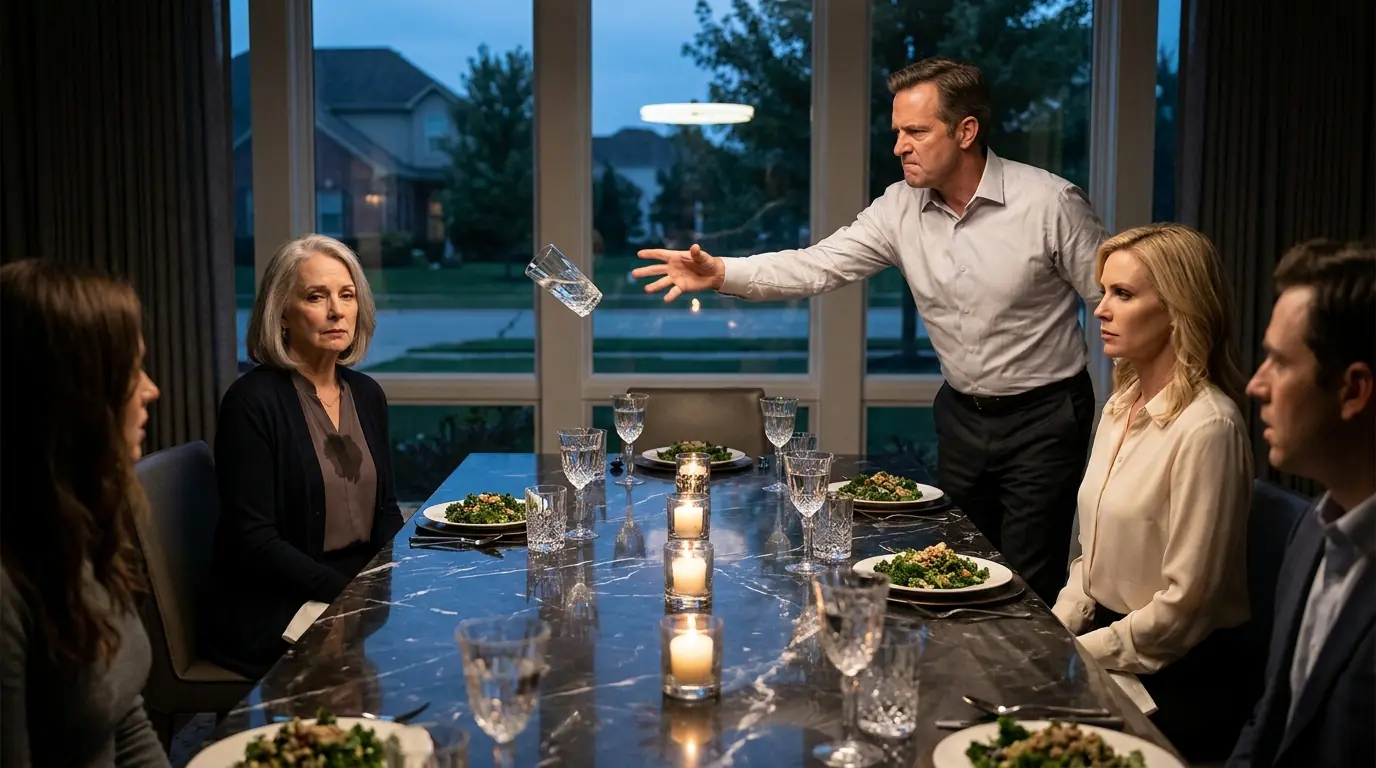
My name is Barbara Whitmore. I’m 68 years old. The dining room looked like something from a magazine: white marble floors, chrome fixtures, and a table far too long for the people sitting around it. I sat at the far end, quiet, small, almost part of the furniture. Edward sat at the head, scrolling on his phone between bites. Giselle was beside him, perfect posture, perfect hair, perfect indifference. Their two children were bent over their screens, giggling softly at something I couldn’t see.
Dinner was a bowl of kale and quinoa, dotted with pomegranate seeds and dressed with something sour. It looked beautiful, but tasted empty. The table was covered in candles and crystal, yet not a trace of warmth. I took a slow bite, pretending to enjoy it, though my stomach ached for something real, something like the dinners I used to cook when Edward was young: roast chicken, fresh bread, laughter.
I glanced up, searching the table. There was no basket of bread, no rolls, no side dish, just greens and silence. I hesitated before speaking, my voice soft and uncertain.
“Giselle,” I said, “the salad is lovely, but is there any bread? Just a small piece. I’m still feeling a bit empty.”
The sound that followed was louder than I expected. Edward’s fork hit the table with a sharp clang that echoed through the room. He stared at me, his face tightening.
“Bread?” he repeated, his tone half disbelief, half irritation. “Mom, for God’s sake, look at this table. We’re trying to eat healthy. Can’t you just eat what’s served for once?”
I blinked, startled.
“I didn’t mean to.”
He cut me off, shaking his head.
“You always have to make a scene, don’t you? You think this is your house, your menu, your rules. It’s not.”
Giselle sighed and rolled her eyes, the sound long and theatrical.
“Edward,” she murmured, “just let it go.”
But she didn’t mean it. She looked at me like I was a problem that kept resurfacing.
The children whispered something under their breath and giggled.
“I was only asking,” I tried again.
Edward stood abruptly, the chair scraping against the floor.
“You don’t like the food here. You’re not hungry. You’re just being difficult.”
He grabbed his glass of ice water, his hand trembling with anger.
“Maybe this will wake you up.”
Before I could move, the water hit me square in the chest. It was so cold it stole my breath. Ice cubes slid off my sweater, clattering against the plate and the floor. The sound filled the silence like shattered glass.
Giselle froze, her lips parted but silent. The children stopped laughing. Edward stared down at me, breathing hard. Then he dropped back into his chair and muttered, “Now, if you’ll excuse us, we’re trying to have a nice family dinner.”
I didn’t cry. I didn’t shout. I placed my napkin carefully on the table and stood. My sweater clung to my skin, heavy and wet, but my back stayed straight. As I walked toward the hallway, I heard one of the children whisper and Edward’s voice say, almost amused, “Finally, some peace and quiet.”
Downstairs, the air was cold and still. My wet shoes left faint marks on the carpet as I locked the door and leaned against it, my pulse hammering in my ears. The sting of the ice was nothing compared to the burn of humiliation.
Sitting on the edge of the bed, I peeled off my soaked sweater, my hands trembling not with fear, but with a sharp, quiet rage at how much I had allowed myself to endure. The clock on the nightstand ticked steadily, each sound reminding me something had changed.
I looked around the bare walls, the narrow bed, the small window, and finally saw the truth.
I wasn’t living there. I was being kept there.
I drew a deep breath and whispered, “No more.”
The trembling stopped. The nurse in me, calm and capable, was back. The next time Edward spoke to me like that, he wouldn’t be speaking to a victim.
I didn’t sleep that night. The basement’s cold wasn’t just in the air, it sank into my bones, stirring memories I’d tried to bury. Sitting on the edge of the bed, the hum of the furnace above reminded me of another sound, the steady beeping of heart monitors, the rhythm that had defined my 35 years as a nurse at Saint Mary’s Hospital in Chicago.
I wasn’t just a nurse. I was the head nurse, the one people turned to when panic broke loose. I ran an entire floor of surgeons and interns, managed budgets, scheduled rotations, and kept the chaos from swallowing us whole. I’d been the calm voice in rooms full of fear, the steady hands that held strangers’ lives together. My name meant something once.
Then came the night my husband died. August. April evening. The smell of rain through the open window. One moment, he was reading the paper. The next, he was gasping for air. I performed CPR on our kitchen floor until the paramedics arrived, but it wasn’t enough. He was gone before I could even say goodbye.
Edward was 15 when he came home from baseball practice to find me kneeling beside his father’s body. From that moment, I became everything: mother, father, provider. I worked every shift the hospital offered, through holidays and nights, saving every dollar. I patched my old Honda instead of replacing it, skipped vacations, and when he went to private college, I paid every bill myself. He graduated debt-free, never knowing I’d pawned my wedding ring to make the final payment.
I never remarried, never even tried. My patients became my world, and Edward became my reason for breathing. Every sacrifice felt worth it because someday, I told myself, he would see what it had cost.
Years later, when he and Giselle came to me with dreams of a big house in Naperville, I saw the same boy who used to run through our Chicago backyard barefoot, calling me from the porch. But the bank had denied their mortgage. They were short on the down payment.
“Mom,” he said, trying to sound casual, “if we just had a little help, we could get it. You’d have your own suite downstairs, close to the kids. You wouldn’t have to worry about anything ever again.”
I hesitated only once, standing in the doorway of my old brick house, the lilacs my husband planted still in bloom. That home held my life, but I told myself love mattered more than walls. So I sold it and gave Edward half the down payment.
When the new house was ready, I arrived with three boxes and hope, only to be led to my so-called suite: a cold concrete room with a tiny window and space for little more than a bed and dresser.
I remember him smiling proudly, saying, “You’ll be comfortable here, Mom.”
I smiled back and lied.
“It’s perfect.”
That night, I unpacked my uniforms, a photo of my husband, and the stethoscope I could never let go of. Above me, laughter and clinking glasses filled the house while mine stayed trapped below. I had given Edward everything: my youth, health, and home. And as I sat in that cold room, I realized the truth.
He hadn’t just forgotten my sacrifices. He had erased them.
When I first moved into Edward’s house in Naperville, I wanted to believe his promises. He called it a mother-in-law suite, a comfortable space where I could enjoy my retirement. But what I found was a small, windowless basement room that smelled faintly of damp paint. It was a storage room dressed up with a bed and a single lamp.
“It’s cozy,” Edward said proudly, hands on his hips. “You won’t have to worry about stairs.”
I smiled and said it was fine. Mothers learn early how to make lies sound gentle.
Not long after I settled in, Edward brought up money. We were in the kitchen, his perfect stainless steel world where nothing ever looked used. He stood by the counter, sipping his coffee with that easy confidence he’d always worn like armor.
“Mom,” he said, “you’ve worked your whole life. Let me handle things now. I can take care of your bills, manage your retirement, all that paperwork. It’s just easier this way.”
I frowned.
“Edward, I’ve managed my finances for decades. I’m doing fine.”
He gave me that patient smile, the one that made me feel like a confused patient instead of his mother.
“I know, Mom, but you shouldn’t have to worry about all this anymore. You can trust me.”
He paused for effect.
“It’s not just practical, it’s family.”
That last word broke my hesitation. He was my son. Trust was the one thing I’d never withheld.
A week later, I signed the papers at his bank. Every dollar I had, my life savings, my pension, the proceeds from selling my Chicago home, $1,800,000 in total, went into a joint investment portfolio under both our names. I remember feeling light afterward, foolishly relieved that I had someone to rely on.
It didn’t take long for the change to show. A brand-new silver BMW appeared in the driveway. When I asked, he waved it off.
“Work expense,” he said.
Then came a two-week family vacation to Hawaii. I stayed behind to watch the dog. When they returned, Giselle draped herself in pearl necklaces, laughing about private dinners on the beach.
“You should have come,” she said, smiling thinly.
But we both knew I hadn’t been invited.
My money, our money, he’d said, was beginning to move without me. I didn’t question it, not at first. I told myself Edward was building something, that he was taking care of me in his own way.
But then the small humiliations began.
One evening, when the chill crept into the house, I turned the thermostat up a few degrees. Ten minutes later, Edward stormed downstairs.
“Mom, what are you doing? Heat costs money. Just put on another sweater.”
Another time, Giselle noticed my prescription on the counter and sighed.
“Can’t your doctor give you the generic version? The brand name is so expensive.”
Each comment stung more than the last. I was no longer a person in their eyes, just an extra expense, a body taking up space.
Still, I stayed quiet. I folded laundry, cooked dinners, and picked the kids up from school. Every night, I told myself love meant patience.
Then came the day that shattered the illusion. I was folding towels in the hallway when I heard Edward laughing in his office, talking to a friend on the phone. His voice was bright, careless.
“Yeah, my mom’s here, too. She’s lucky. She gets to live here for free.”
“For free?”
The words hit me like a slap. I stood there, frozen, the towel slipping from my hands.
“For free?”
In the house I had helped pay for, with the money I had earned over a lifetime of sacrifice. My chest tightened until I couldn’t breathe. I wanted to walk in and correct him, to remind him whose name had written every check. But I didn’t. Instead, I listened to him laugh, my own son, mocking the woman who’d built his life from nothing.
When the call ended, I went back to my room. The air felt heavier down there, the walls closer. I sat on the edge of my narrow bed, staring at the faint light coming through the window. It flickered across the floor like the pulse of something dying.
That night, I replayed every choice that had brought me there: the long shifts, the nights spent holding strangers’ hands, the house I’d sold so he could live in comfort. I had traded 35 years of work for a basement and silence. But as I sat there, anger began to replace the shame. Not the loud, reckless kind of anger, but something colder, sharper, the kind that makes you start thinking clearly again.
Edward thought he was in control, that my money was his, that my obedience was guaranteed. He thought “for free” meant powerless. He didn’t know me as well as he believed.
That night, I promised myself one thing. I would never again ask permission to exist. And before long, he would learn exactly what that mistake would cost him.
Back in the basement, the silence felt alive, thick, humming, almost electric. I changed into a dry nightgown, the damp sweater folded neatly over the chair. My hands had stopped trembling. The shock was gone. What replaced it was precision, the same cool focus I’d once felt in emergency rooms when chaos broke loose.
The head nurse was back in charge.
I turned on the small lamp by the bed, its yellow light spilling across the concrete wall beneath the frame. I reached for the old metal lockbox I’d brought from Chicago. Its paint was scratched, its hinges stiff, but I had kept it closed all these years. Inside were the essentials of my life: birth certificates, insurance papers, photographs, and two documents that had been sleeping quietly, waiting for this moment.
The first was the investment portfolio, the one Edward had pushed me into, talking over me as he waved the pen.
“It’s just easier this way, Mom. I’ll take care of everything.”
He had said it with that familiar edge of superiority, as if experience counted for nothing once youth entered the room. I had signed, knowing he’d never read the fine print. And here it was, in plain black letters: primary account holder, Barbara Whitmore, secondary, Edward Whitmore.
The word “primary” gleamed under the light like a revelation. He had believed joint meant equal, that my money became his the moment he touched it. But legally, he was a bystander. The account, every cent of $1,800,000, was mine. One signature, and I could pull the rug out from under him completely.
The second document lay folded at the bottom of the box, the private lien. My old friend Thomas, a lawyer with more foresight than sentiment, had insisted on it years ago when I gave Edward half the down payment for this house.
“If you’re giving him that much,” Thomas had warned, “get it in writing.”
Edward had signed without looking, desperate for the money. The lien gave me full rights to reclaim my contribution with interest if I ever called in the debt.
Two signatures, two lifelines, two reminders that I was not the helpless woman he imagined. He had called me a guest. He had thrown water in my face for asking for bread. He had laughed and told people I lived here for free.
I stared at the papers, the ink steady beneath my fingers, and felt something in me click back into place. I had spent decades holding other people’s lives together. Now I would hold my own.
I locked the box again, the metal clasp snapping shut with quiet finality. For a long moment, I simply sat there, listening to the hum of the furnace and the faint footsteps overhead. My pulse had steadied, calm and deliberate. Every humiliation, every cutting word, had crystallized into clarity.
I glanced toward the small window, where moonlight touched the wall like a blade. My voice came out soft but sure.
“You don’t want to share a piece of bread,” I whispered. “Fine. I’ll take back the whole bakery.”
Then I turned off the lamp. The darkness closed in, warm and complete. Upstairs, Edward’s footsteps faded down the hall, unaware that the balance of power had already shifted.
By morning, I knew exactly what I had to do.
Monday morning was clear and cold. The air sharp with frost and coffee. I rose before dawn and dressed in my old navy suit, pressed and waiting. As I buttoned the jacket, I met my reflection in the mirror, not weak, not broken. My hands were steady, my spine straight.
The head nurse was back on duty.
When I climbed the stairs, the kitchen lights were already on. Edward sat at the counter scrolling through his phone, his tie hanging loose around his neck. Giselle stood at the espresso machine, her nails tapping impatiently on the counter. Neither of them looked up when I entered.
“I have a doctor’s appointment this morning,” I said evenly, adjusting the strap of my purse.
Edward didn’t glance up.
“Fine,” he muttered. “Just don’t be late. Giselle and I have plans, and we need you to watch the kids after school.”
I smiled faintly.
“Of course.”
I closed the door softly behind me as the low sun cast long shadows across the lawn. The drive to downtown Naperville was quiet. The city was just waking, storefronts opening, commuters with steaming coffee. I parked near the Chase office, stepped out into the crisp air, and for the first time in years, felt completely in control.
Inside, the lobby gleamed with marble and glass. Mr. Davies, my financial advisor of over 20 years, looked up from his desk as I entered. His eyes widened slightly in recognition, then softened into a polite smile.
“Mrs. Whitmore,” he said warmly. “It’s been a while. How have you been?”
“I’m well,” I replied, returning the smile. “But I need your help with something important.”
We sat in his office, sunlight reflecting off the framed certificates behind him. He waited patiently as I placed a small folder on the desk and opened it with deliberate care.
“Mr. Davies,” I said calmly, “I need to remove my son’s name from my investment portfolio, effective immediately.”
He blinked, surprised.
“Remove his name? Is there a specific reason?”
“There’s no issue,” I said gently. “Just a change in management.”
I slid the papers toward him, my signature already neat and clear.
“I am the primary account holder. He is listed as secondary.”
He nodded, reading quickly.
“Yes. That’s correct. You have full authority to make changes.”
“Good,” I continued. “Second, I want the entire balance, $1,800,000, transferred into a new revocable trust in my name only. And third, please cancel all associated joint credit and debit cards linked to this account.”
His eyebrows rose slightly, but his tone remained professional.
“Of course. That’s entirely within your rights.”
The next 45 minutes passed in near silence, broken only by the tapping of keys and the soft rustle of paper. Mr. Davies made a few calls, confirmed details, printed documents. I signed each one with steady hands. No hesitation. No doubt.
When he finally looked up, he smiled.
“It’s done,” he said simply. “The trust is active. Your funds are secure.”
I exhaled slowly, a breath I hadn’t realized I was holding.
“Thank you, Mr. Davies.”
He hesitated, studying me with quiet curiosity.
“Mrs. Whitmore,” he said softly, “whatever brought you here today, I hope it gives you peace.”
I met his gaze and smiled.
“It already has.”
When I returned home, the house was empty. The silence felt cleaner than before. Edward and Giselle were at work. The children at school.
I went downstairs, pulled out a single suitcase, and began to pack. Medicine, documents, photographs of my husband, and my best clothes. Nothing more.
From my dresser drawer, I took out a small prepaid phone I had purchased months ago, one Edward didn’t know existed. I sat on the edge of the bed and booked a one-way first-class ticket from O’Hare to Sarasota, Florida. Departure this afternoon.
When the confirmation email arrived, I placed my old smartphone, the one he had access to, on the table beside my folded house key. A clean break. No trace.
Outside, an Uber pulled into the driveway. I zipped the suitcase and looked around the small basement room one last time. It had never been a home, only a holding cell.
I opened the door and stepped into the light. The air was crisp. The sky blindingly blue.
I didn’t look back.
For the first few days after I left, the house went on pretending I was still there. Edward and Giselle probably thought I was sulking in the basement, punishing them with silence. He had never understood quiet as anything but a tactic.
“She’ll come out when she’s hungry.”
I could almost hear him saying it, laughing as he scrolled through his phone.
By Friday, they must have convinced themselves everything was back to normal. The house was spotless again. The lights bright. The table set for guests.
That night, Edward and Giselle joined two of his business friends at an expensive steakhouse downtown, the kind with polished silver, soft jazz, and prices that required confidence just to read. He liked places like that, rooms where his voice carried and people nodded when he spoke.
Dinner went smoothly enough. Expensive wine. Loud laughter. Giselle’s bracelets catching the candlelight. When the plates were cleared and the bill arrived, Edward reached into his jacket and pulled out his sleek black card, the one linked to what he called the family account. He placed it on the tray with a smile that said he’d done this a thousand times before.
The waiter disappeared for a moment. Then he returned. His polite expression tightened just slightly.
“I’m sorry, sir,” he said carefully. “This card has been declined.”
The table went quiet for a heartbeat. No one moved.
Edward laughed it off. A forced chuckle that didn’t reach his eyes.
“That’s ridiculous,” he said, already fishing for his debit card. “Try this one instead.”
The waiter nodded and left again. When he came back, his voice was gentler this time.
“I’m afraid this one’s declined as well.”
A flush crept up Edward’s neck.
“That’s impossible,” he snapped, but his voice cracked halfway through the word.
Giselle’s smile froze in place. Their friends looked away, murmuring something about bank errors. The waiter offered to bring the manager.
Edward stood abruptly.
“Excuse me a moment.”
He left the table, phone already in hand, the calm of the restaurant collapsing behind him. Outside, the night air was cold and sharp. He called the bank, pacing near the curb. His voice low and tight.
“There’s been a mistake,” he said. “My cards aren’t working.”
He waited, tapping his shoe impatiently. When the representative came on, her tone was professional but distant.
“I’m sorry, sir. I can’t provide any information. You are not listed as an account holder.”
He froze.
“What do you mean not listed? This is my account. Check the investment portfolio.”
A pause. Then her voice again, steady and final.
“That account shows a zero balance. I’m sorry, sir.”
The words hit him harder than the restaurant’s silence had. He opened his banking app with shaking hands. The screen confirmed it. The portfolio empty. The checking account empty. Every account tied to Barbara Whitmore gone.
For a long moment, he just stood there, staring at the numbers that no longer existed.
Then he ran.
He drove home too fast, his headlights cutting through the darkness. Giselle’s voice was shrill on the phone.
“Edward, what’s happening? Did something go wrong?”
When he burst through the front door, the house felt unfamiliar, quiet, echoing, hollow. He stormed down to the basement, calling my name as if I might still answer.
But the room was empty. The closet doors swung open. The hangers bare. On the small table lay two things: his house key and my old phone, screen dark and cold.
For the first time, he seemed to understand.
Upstairs, Giselle waited at the foot of the stairs, pale and trembling.
“Where is she?” she demanded. “What did you do?”
He turned toward her, face drained of color.
“It’s gone,” he said hoarsely. “All of it.”
“What do you mean?”
“All of it.”
He sank into a chair, hands gripping his hair.
“The money. The accounts. Everything. She took it.”
The silence stretched, then shattered as Giselle’s voice rose to a furious scream.
“Your money? You mean her money. What have you done, Edward?”
The walls of their perfect world cracked in that moment. The BMW payment. The mortgage. The $40,000 private school tuition. The dinners. The vacations. The image. All of it had rested on one quiet woman’s shoulders.
And she had finally stepped out from under them.
Two weeks passed before I allowed myself to think of them again. By then, the rhythm of the Gulf had replaced the echo of that basement. Mornings in Sarasota were soft sunlight spilling through the curtains, the air smelling faintly of salt and jasmine. I would sit on my balcony with coffee in hand, the water glittering below, and let the sound of waves remind me that I was free.
Back in Naperville, Edward’s world was crumbling. The mortgage payment had bounced. The BMW was gone. And the tuition bills from the kids’ private school sat unopened on the counter. Their laughter had vanished, replaced by the low hum of panic.
Giselle had begun to pace through the house like a ghost, whispering numbers under her breath, while Edward kept telling her I would come back soon. He had no idea that I was gone for good.
Then, one morning, the mail arrived. A certified envelope, heavy and official. Giselle signed for it, suspicion already flickering in her eyes. She handed it to Edward, who tore it open at the kitchen table.
Inside was a formal notice from a law firm in Sarasota, Florida. The words were clear and merciless. The lien on the house had been activated. He was ordered to repay the down payment with interest within 30 days, or the property would be seized and sold at auction.
He stared at the papers, color draining from his face.
Attached to the final page was something smaller. A folded note written in blue ink. My handwriting.
Edward,
You threw water in my face because I asked for a piece of bread. I’ve gone somewhere I can buy my own bakery. And I’ve taken my money with me.
Good luck with your bills.
Barbara.
I could almost picture the moment. Giselle’s sharp inhale. Her voice trembling with fury.
“What do you mean she’s in Florida? You said she couldn’t touch the account.”
And Edward, my brilliant, arrogant son, would stand there speechless, holding the letter that proved just how wrong he had been. The illusion of control, wealth, and superiority all gone in a single envelope.
But I didn’t feel anger anymore. I felt distance, the kind earned through pain and clarity. Sarasota had given me something that house never did: space to breathe.
The condo was bright and quiet, filled with sunlight and the gentle scent of sea air. On the table beside me sat my old lockbox, now open and organized: documents, photographs, and trust papers bearing only my name.
I wasn’t a guest anymore. I wasn’t someone’s responsibility or burden. I was a woman who had reclaimed what was hers.
I leaned back in the chair, the morning breeze brushing against my face. In the distance, a boat drifted slowly across the water, its white sail catching the light. I smiled, not out of triumph, but peace.
Freedom, I realized, doesn’t come from revenge. It comes from remembering who you are, then walking away without looking back.
I still can’t believe how far I’ve come from the cold silence of that basement to the warmth of a new sunrise by the sea. Life taught me that dignity is something you must sometimes fight quietly for, one decision at a time.