My daughter-in-law called me “sweetie” for the first time at Thanksgiving dinner three years ago. That was the moment I knew something had changed, and not in a good way. Before that, she called me Dorothy. Clean and simple. The way you address a person who has earned her own name. But somewhere between the turkey and the pie, I became “sweetie.” And I noticed my son nodding at her from across the table like she had done something right.
I am 73 years old. I taught high school English for 31 years in Columbus, Ohio. I have graded 11,000 essays, coached the debate team to state finals twice, and raised two children almost entirely on my own after my husband passed in 2003. I remember every student who ever sat in the third row by the window because that was where the difficult ones always chose to sit, and I made a point of learning their names before anyone else did.
I know who I am. I have always known.
My son is 51. He works in commercial real estate, which means he spends a great deal of time explaining to other people why their property is worth less than they think it is. He is good at that. Finding the weak points, identifying the cracks, talking someone down from what they believe to be true. I watched him become very good at it. I just never thought he would eventually practice on me.
It started small. The way these things always do. A comment here about whether I should still be driving on the highway. A question there about whether I had remembered to pay the electric bill, said in that careful, patient tone you use with someone whose memory you no longer trust. My daughter-in-law began texting my son in the middle of our lunches together. I could see her thumbs moving under the table. She thought I couldn’t see. I have spent decades watching teenagers try to hide their phones under their desks. I see everything.
Then came the conversation about my house. I live in the same house my husband and I bought in 1987. Four bedrooms, a backyard that gets good morning light, a kitchen I remodeled in 2011 because I wanted to and because I could. The neighborhood has changed around it. Values have gone up considerably, and I understand now that this is when my son began doing the math.
He brought it up casually the first time, over coffee in my own kitchen. Sitting in the chair his father used to sit in, he mentioned that the market was strong and that a house my size was a lot to manage alone. He said he had been thinking about my future. He said he wanted to make sure I was protected.
He brought it up four more times over the following year. Each time, the language shifted slightly. “A lot to manage” became “a real liability.” “Thinking about your future” became “we’ve done some research.” By the fifth conversation, he had printed documents. He had the name of a real estate attorney. He had a timeline.
I read every page he handed me. I asked several questions he could not answer. I told him I would think about it. And I meant that sincerely, though perhaps not in the way he intended.
What I thought about for a long time afterward was my granddaughter. Her name is Lily, and she is 24, and she is my son’s daughter from his first marriage. That relationship ended when Lily was nine, and in the years that followed, her mother moved twice and struggled in ways that left marks.
Lily used to take the city bus to my house on Saturdays when she was in middle school. She would let herself in with the key I had made for her, pour herself a glass of orange juice, and sit at my kitchen table doing homework until I finished my own errands and came home to find her there. She never asked for much. She asked for consistency, which is a different thing entirely, and harder to find.
When Lily was 17, she needed new winter boots, and her mother had just lost a job. I bought the boots. I didn’t mention it to my son. When she was 19 and trying to decide between two colleges, she sat at that same kitchen table, and we talked it through for four hours. I did not tell her what to decide. I helped her find her own reasoning. That is what I know how to do.
Lily became a nurse. She works long shifts at a hospital across town, and she is, by every account I have heard, exceptionally good at it. She still comes by on Saturdays sometimes, though now she brings the orange juice herself.
My son’s current wife does not like Lily. She has never said so directly. She communicates it instead through small exclusions. The family photos on the wall of their home that don’t include her. The holiday plans announced after it’s too late to adjust. The way she pronounces Lily’s name with a slight pause before it, as if the name itself requires effort. My son does not correct any of this. He stopped correcting things a long time ago.
I watched all of it. I kept teaching. I kept my house. I kept my name.
About two and a half years ago, on a Tuesday morning in February, I made an appointment with an estate attorney named Patricia Walsh. I had been referred to her by a former colleague who had gone through something similar with her own family and had come out the other side with everything intact.
Patricia was direct, thorough, and unimpressed by sentiment, which is exactly what I needed. We met four times over the course of six weeks. I answered her questions honestly. She answered mine the same way.
By the end of March, I had updated my will, established a revocable living trust, and restructured how the house was titled. I did not tell my son. I did not tell anyone except Lily, and only because she was named in it and because she deserved to know that someone had chosen her on purpose.
She cried at my kitchen table. I handed her a dish towel because I don’t keep tissues in the kitchen, and I told her to stop because she was going to make me start, and I had made a policy against that. She laughed. She drank her orange juice. She stayed until almost 9:00. And when she left, she hugged me for a long time in the doorway. And he let her.
I went back to my regular life. I drove on the highway. I paid my electric bill on time, as I have done for 50 years. I planted tomatoes in April.
Then, on a Thursday morning in late September, my phone rang. It was a woman named Carol from my insurance agency. I had been a client there for decades, since before the office had changed hands twice and the carpets had been replaced three times.
Carol has a calm, careful voice, the kind that knows how to deliver information without tipping into alarm. She told me that someone had called the agency two days prior asking about the policies on my home, asking specifically about what would happen to those policies if the property changed ownership, asking what documentation would be required.
Carol said she had not released any information. She said she wanted to let me know personally.
I thanked her. I wrote down everything she told me. I asked her to make a note of the call in my file. She said she already had.
I sat at the kitchen table for a while after I hung up. The tomatoes on the counter needed to be used. The morning light was doing what it does in late September, coming in low and gold through the window above the sink. I thought about the conversation I was about to have, and I thought about all the things I had already done, and I felt something settle in me that I can only describe as readiness.
I called my son that evening. I told him I had been thinking about the house again. I told him I thought maybe he was right, that it was a lot to manage and that I would be open to hearing more about what he had in mind. I kept my voice warm and a little tired. I have spent 31 years modulating my voice in a classroom. I know how to sound exactly as uncertain as I choose to.
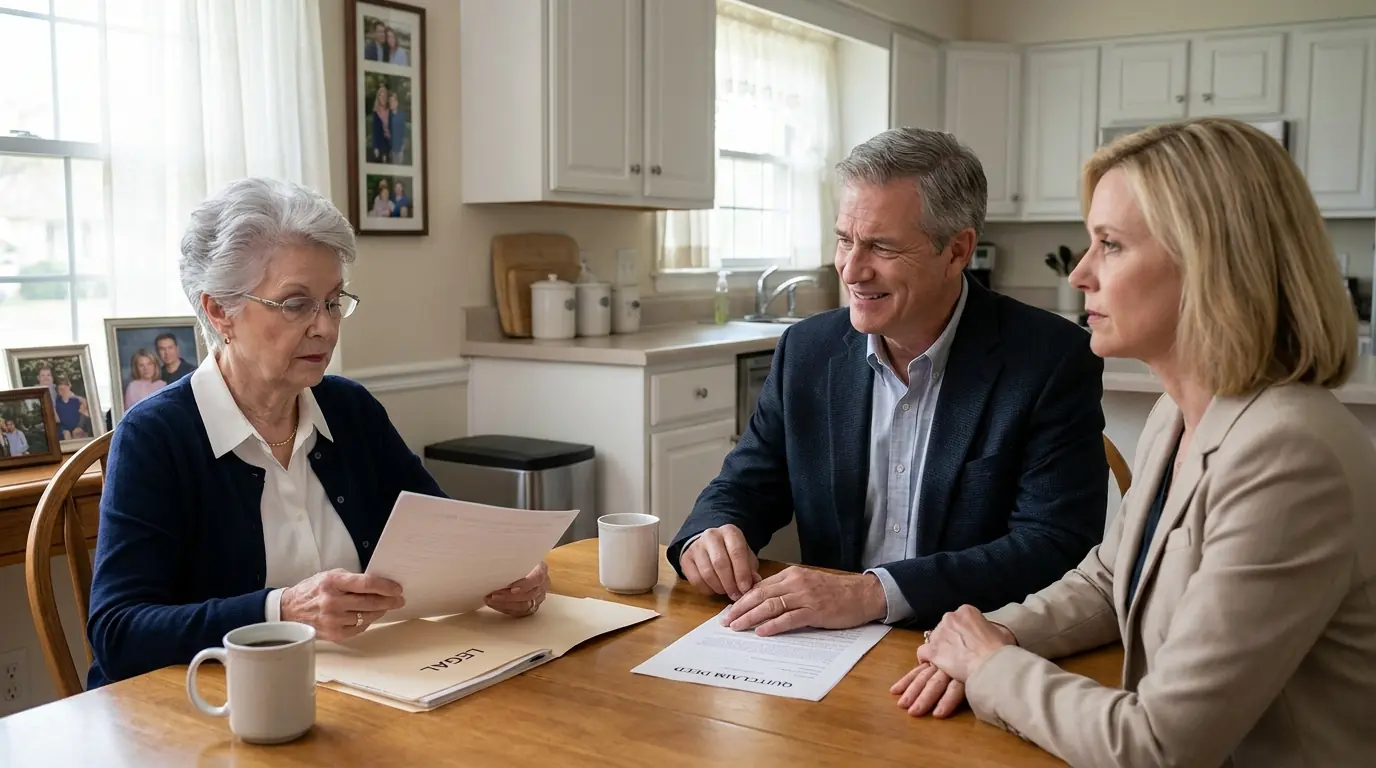
He was at my house the following Saturday with his wife and a folder of papers. They sat across from me at the kitchen table, the same table where Lily had done her homework, where my husband and I had read the Sunday paper, where I had met with Patricia Walsh and signed documents that now existed in a file at a law office across town.
My son explained that he had looked into a way to transfer the property that would protect me and simplify things. He used that word several times. Simplify. His wife nodded at measured intervals.
The folder contained a quitclaim deed with my name on it, partially filled out, and a document I did not recognize that appeared to pertain to the trust. I picked up the quitclaim deed and read it carefully from the top.
My son said I didn’t need to read the whole thing. That Patricia, and here he used the name of a different attorney, not my Patricia Walsh, had already reviewed it.
I read the whole thing. I set it down. I looked at my son across the table. Across 30 years of Saturday morning breakfasts and back-to-school shopping and hospital waiting rooms and arguments about nothing and everything. And I asked him one question.
I asked him when he had spoken with my attorney.
He said he hadn’t, that he had used his own attorney, someone who specialized in this kind of planning.
I asked which attorney had prepared the trust document in the folder because it referenced a trust in my name that I did not recognize.
There was a pause. His wife looked at the folder.
I told them I needed some time to review the paperwork, and I thanked them for coming, and I stood up.
I called Patricia Walsh from my bedroom that evening. I described the trust document. She was quiet for a moment, and then she told me, in her careful and direct way, that no one should have been able to produce a document referencing my trust without her involvement, and that what I was describing sounded like something she wanted to look at immediately.
I photographed every page and sent it to her that night.
She called me back the next morning. She used the word fraudulent. She used it more than once. She told me she was referring me to an attorney who handled elder financial abuse cases, a man named Robert Cho, and that I should call him that day.
I called him that day.
What followed were several weeks of consultations, documents, and a conversation with a detective from the financial crimes unit at the Columbus Police Department, who came to my house on a Wednesday and sat in my kitchen and took notes in a small spiral notebook while I told him everything. He was younger than I expected. He listened well. He asked good questions.
My son had, with the help of a notary who is currently under separate investigation, produced a document falsely claiming that a trust had already been established transferring the house out of my name. The quitclaim deed was designed to complete that transfer. The insurance inquiry had been the first step, confirming what was there before moving to take it.
My attorney, Robert Cho, filed a police report on my behalf. He filed a civil complaint. He sent a certified letter to my son’s attorney documenting every fraudulent element in the paperwork. He did this methodically and without drama, which I appreciated.
My son called me three days after receiving that letter. His voice was different. The careful patience was gone. He said I was making this into something it wasn’t. He said he had been trying to help me. He said things that I will not repeat here because some words, once spoken between a parent and child, change the landscape permanently, and I have no desire to document the exact geography of that damage.
I let him finish. I told him I loved him and that I hoped he would make better choices. Then I ended the call.
The criminal matter is ongoing. I am not able to discuss the specifics, and I would not if I could, because that is not the point of this story. The point is what came before: the two and a half years of watching and thinking and meeting quietly with Patricia Walsh and making decisions with a clear head and nobody else’s permission.
The house is in a trust. It is properly structured, properly documented, and Lily is named as the primary beneficiary. There is also a provision for her children if she has them and for the continuation of certain small things. The Saturday light in the kitchen. The particular kind of quiet this house has always had.
The will is updated. The insurance is properly recorded. There is a file at Robert Cho’s office, a file at Patricia Walsh’s office, and a copy of everything in a fireproof box in my bedroom closet, which I am telling you about now because knowing it exists might help someone reading this.
Lily came by last Saturday. She brought a plant for the porch. A small rosemary bush, she said, would do well in that spot. We put it in together. She didn’t stay for dinner because she had an early shift. But before she left, she sat at the kitchen table for a few minutes, and we drank the last of a pot of coffee and talked about almost nothing.
She asked me if I was okay. I told her I was better than okay. I told her that, at 73, I have learned that most of the things people try to take from you, your confidence, your independence, your right to decide what happens in your own house at your own table, can only be taken if you let the attempt surprise you.
The antidote to surprise is preparation.
I have been preparing my entire life for this and for other things.
She thought about that for a moment. Then she said it sounded like something I would have written on a whiteboard in a classroom. I told her I probably did, and that the students who needed it most were usually the ones who rolled their eyes and copied it down anyway.
She laughed, and I heard her father in that laugh. The version of him that existed before money became the lens through which he measured everything, including me. And I let myself feel that for a moment, the weight of it and the tenderness of it, before I let it go.
There is paperwork on the table by the door. It needs to go to Patricia’s office in the morning. The rosemary is on the porch. The tomatoes are finally gone for the season. The house is mine. It has always been mine. It will remain mine for as long as I am here. And when I am not, it will go where I decided it would go.
On a Tuesday morning in February, when I sat across from a woman who asked me good questions and helped me protect what I had spent a lifetime building, nobody signed anything. I did not choose to sign. Nobody simplified anything. I did not wish to have simplified. Nobody managed what I did not ask to be managed.
I still know who I am. I have always known.