I have always thought that old age was not a good time to be alive. But it is only now that I have truly realized how right I was. My name is Henry Thorndike. I’m 72, and I live in a house that no longer feels like my own.
The cold Plymouth wind beat against the windows as I sat in my chair, looking at Vivian’s picture. It’s been five years since cancer took her, but the pain of loss never fades. Every corner of our house holds memories of her: the velvet curtains she took so long to choose, the collection of porcelain figurines on the mantle, the rose garden that is now slowly falling into disrepair under my inept hands.
“You need a distraction, Father,” Elliot once said during one of his rare visits. “Why don’t you sell the house? It’s too big for one person.”
I just brushed it off at the time. Sell the house that Vivian and I had built with the money I’d saved over 20 years as a chemical engineer? A house where every detail had been thought out together? No, it was unthinkable.
Our Victorian mansion, located in the old part of Plymouth, was my pride. Three bedrooms, a spacious living room with a fireplace, a cozy library with my collection of chemistry books and Vivian’s favorite novels, a kitchen overlooking the garden, all lovingly chosen and arranged. Forty years ago, when we’d first gotten married, a house like this had seemed like a pipe dream.
I sighed and reached for the cup of tea that had cooled. My joints ached. The weather was changing. Lately, I’d been thinking more and more about what was going on with my son. Elliot had never been a particularly cordial child, more reasoning than emotional. Vivian always said he inherited my analytical mind, but not her compassionate heart. We gave him everything we could, a good education, support early in his career. Now he’s a successful financial analyst, but our relationship grew more formal every year.
That changed about three years ago when he married Regina Baxter. I remember their wedding. Lavish, lavish, lavish. Although I knew they’d gone into debt to impress Plymouth high society. Regina came from a family with a big name, but as I found out later, virtually no money. Her father had lost a fortune in a failed investment, and her mother was too accustomed to a life of luxury to adapt to her new circumstances.
“She’s from a good family, Father,” Elliot said then, as if that explained everything.
I sensed something insincere about Regina, but I kept quiet. Vivian always said I was too critical of people, and I decided to give my daughter-in-law a chance. Perhaps that was my mistake.
After the wedding, Elliot’s visits became even less frequent. Once a month if I was lucky. Always late, always feeling like he was doing an obligation rather than visiting his own father. Regina smiled her perfect smile, but her eyes remained cold as she regarded my house.
“It’s so lovely. Such a vintage style,” she said, running her finger over the antique furniture I’d inherited from my parents. “Have you ever thought of redecorating, Henry?”
“Vivian liked it that way,” I answered each time. “So did I.”
Regina only pursed her lips and glanced over at Elliot.
I overheard them talking on the terrace once when they thought I was in the library.
“This house is worth a fortune, especially with that lot,” Regina said. “Think what we could do with that kind of money.”
“Father would never agree to sell,” Elliot answered. “He’s too attached to this place.”
“He’s not getting any younger,” Regina said, a strange note of hope in her voice. “He’s going to need help sooner or later.”
I went back to the library quietly, thinking about what I’d heard. An unpleasant chill ran down my spine. Were they waiting for my infirmity or death to get the house? The thought was too painful, and I tried to put it out of my mind.
But life, as always, made its adjustments. One day in March, as I was working in the garden, trying to tidy up Vivian’s rose bushes, the world suddenly swam before my eyes. My right hand ceased to obey, and my tongue became heavy and disobedient. The last thing I remember before I passed out were the scarlet roses, so similar to the ones my wife loved.
I woke up in the hospital.
“Microstroke,” the doctor said. “Not fatal, but a wake-up call. You need to take care of yourself. Take your meds. Avoid stress.”
Elliot showed up two hours after my call, anxious and unusually attentive. He listened to the doctor, asked a few questions, and turned to me.
“Dad, you can’t be alone.”
“There’s nothing wrong with me,” I argued, though my tongue still wasn’t quite right. “I just need to take my medication.”
“No, this is serious. What if it happens again when no one’s around?”
Elliot seemed genuinely concerned, and it touched me.
“You know what? Regina and I are going to move in with you for a while. It’s a big house, and there’s plenty of room for everyone.”
“No need,” I tried to object. “You have your own life, your own apartment.”
“Which is costing us a fortune in rent.” Elliot smiled. “Believe me, it’s a smart decision for everyone. We’ll save money on rent, and you’ll be taken care of.”
Something in his tone made me wary, but I was too weak to argue. Besides, the thought of my son finally caring warmed my heart.
“Okay,” I finally gave in, “but only until I feel better.”
Elliot brightened, pulling out his cell phone.
“Regina will be thrilled. She was talking about how worried she was about you just yesterday.”
I doubted the sincerity of Regina’s concern, but I remained silent. Maybe I was wrong about her. Maybe this situation would bring us closer together.
Three days later, I was released from the hospital. Elliot met me in his brand-new Jaguar, a car too expensive for a man who complained about the high rent. But again, I remained silent.
When we pulled up to the house, I saw that a furniture moving truck was already parked in the driveway, and Regina, in an immaculate pantsuit, was greeting us at the door.
“Henry,” she exclaimed, coming over to support me, even though I could walk on my own. “We’ve been so worried. I’ve already prepared a room for you.”
“My bedroom?” I clarified, sensing something wrong.
“Oh, no!” Regina glanced at Elliot. “We decided you’d be more comfortable in the small guest room on the first floor. You won’t have to climb the stairs.”
“I’m perfectly capable of climbing stairs,” I objected. “The doctor said that moderate activity is even beneficial.”
“Dad, we’re just looking out for you.” Elliot put his hand on my shoulder. “Besides, Regina and I brought a lot of stuff. We need the space.”
I wanted to object, to say that this was my house, that the master bedroom had always been mine and Vivian’s, that it was where her things were still kept. But instead, I just nodded. I didn’t want to start an argument on the first day.
They did have a lot of stuff. In a few hours, the movers had brought so many boxes and furniture into the house that the hall and living room looked like a warehouse.
“Why do you need so much stuff?” I couldn’t stand it. “You said you were moving in temporarily.”
“We want you to be comfortable with us,” Elliot said, not looking me in the eye. “It might take a while.”
I made my way to my new room, the former guest bedroom, small and cramped. My things had already been moved in here. Clothes, some books, photos, but there was a lot missing.
“Where are the rest of my things?” I asked, coming into the kitchen, where Regina was arranging some new plates I didn’t recognize.
“We have them stacked neatly in the attic,” she said with a smile. “You don’t need everything at once, do you?”
I clenched my fists in the pockets of my robe. These people, my son and his wife, had just moved into my house and were already telling me where to sleep and what to keep in my room.
In the evening, Elliot cooked dinner. To my surprise, he turned out to be a pretty good cook. We sat around the table, Regina talking about her work as a consultant at the art gallery, Elliot discussing stocks and investments. I was silent, feeling like a guest in my own home.
“Father,” Elliot said suddenly, pouring wine into glasses. “I think we need to discuss some organizational matters.”
“Like what?” I felt a new wave of weariness.
“You see, while you’ve been in the hospital, I’ve paid some bills: electricity, water, internet, and I noticed that they are quite high.”
“I have a pension,” I replied. “I always pay my own bills.”
“Of course,” Elliot quickly agreed. “But maybe you should give me power of attorney so I can help you with your finances if you get sick again.”
That was it. I looked at my son carefully. His face expressed only concern, but his eyes avoided my gaze.
“I’ll think about it,” I answered cautiously. “But for now, I’m perfectly capable of managing my own finances.”
“Of course, Father.” Elliot smiled and raised his glass. “Cheers.”
That night, I couldn’t sleep for a long time in an unfamiliar room. The bed was uncomfortable, the mattress too soft for my back. Elliot and Regina’s muffled voices came from the wall, but I couldn’t make out the words. I lay staring at the ceiling, thinking about Vivian.
What would she say if she saw all this? I pictured her sitting on the edge of the bed with her soft smile and shrewd eyes.
But Vivian was gone, and I could feel the control of my life, of the home we loved so much, slowly slipping from my hands. And the most bitter part was that it was happening with the help of my own son.
It had been a month since the day Elliot and Regina moved into my house, a month in which I realized what the phrase “stranger amongst my own” meant. Every morning, I woke up feeling like I was in a hotel. Everything familiar, but foreign at the same time.
My small room became my only refuge. Here I kept a picture of Vivian, a few favorite books, and an antique clock I’d inherited from my father. Everything else, from my vinyl record collection to my winter clothes, was packed up and sent to the attic.
“For your own convenience, Father,” Elliot said every time I tried to object.
That morning, I woke up to the sound of a drill running. The clock read 7:30, too early for construction work. Putting on my robe, I left the room and headed toward the sound. It was coming from the library, my library, where the bookcases that Vivian and I had picked up from antique store catalogs stood.
At the doorway, I froze at what I saw. Workers in coveralls were removing my bookshelves from the walls, and others were already installing modern glass racks. My books lay in stacks on the floor.
“What’s going on here?”
My voice sounded quiet, but Regina, standing at the window with a clipboard in her hands, turned around.
“Oh, Henry, did we wake you?” She walked over to me with a guilty smile. “We wanted to finish before you got up. Surprise, surprise.”
I couldn’t believe my eyes.
“You take apart my library without my permission and call it a surprise?”
“Not tearing it down, but renovating it.” Regina gestured with her hand, pointing to the new shelves. “Those old cabinets were taking up too much space and collecting dust. You know how bad that is for your health. And the new shelving units look modern and don’t clutter up the space.”
“Where’s Elliot?” I tried to speak calmly, even though I was seething inside.
“At the office. He has an important meeting today.”
“Does he know about this update?”
“Of course he does.” Regina looked at me with surprise. “It was our idea together. He said you wouldn’t mind because it’s for your own comfort.”
I silently turned around and went back to my room. My hands were shaking with impotent rage. My son hadn’t even bothered to ask my opinion about remodeling my own library. I spent the rest of the day in my room, listening to the house being moved, drilled, rebuilt.
About three in the afternoon, I couldn’t stand it any longer and went outside. The weather was gloomy, with gray Plymouth clouds hanging over the city, but it wasn’t raining yet. I headed toward the waterfront where I often walked with Vivian. The sea breeze calmed me a little.
I sat on a bench, watching the waves crash against the stone shore, and tried to collect my thoughts. What’s going on in my house? Why am I letting them run everything as if it wasn’t my house but theirs? Why has my son changed so much?
“Henry? Henry Thorndike, is that you?”
I turned to see a familiar voice. Standing before me was Oliver Holt, an old friend and lawyer I hadn’t seen in maybe two years. Gray beard, thin-rimmed glasses, heavy tweed coat. He hadn’t changed much except for a few wrinkles.
“Oliver.” I got up to shake his hand. “What an unexpected meeting.”
“Just walking the old bones,” he grinned, taking a seat next to me. “What are you doing out on the waterfront in this weather?”
“Hiding from my own house,” I answered honestly.
“That sounds alarming.” Oliver looked at me carefully. “What’s wrong?”
I told him about the microstroke, about Elliot and Regina moving in, about how they were gradually taking control of the house. With each word, I realized more and more how absurd the situation was.
“And today, they decided to upgrade my library without asking, Oliver. In my own house?”
Oliver frowned.
“Are the deeds to the house still in your name?”
“Of course. I paid for everything myself.”
“Do they pay any kind of rent?”
I shook my head.
“Elliot offered to help with the bills, but I’m still paying for everything myself. All he says is that they’re saving money by not renting an apartment.”
“Henry.” Oliver put his hand on my shoulder. “I’m going to tell you as a lawyer and as a friend. Be careful. What you’re describing sounds like a gradual displacement of you from your own home. They’re taking advantage of your kindness and the fact that you’ve been sick recently.”
“There’s no way Elliot…” I hesitated. “He is my son.”
“And that’s why you trust him.” Oliver sighed. “I’ve seen a lot of cases of elderly people being dispossessed by close relatives. Often, it starts with health concerns and ‘we just want to help.’”
“What are you suggesting?” I felt cornered.
“Well, for starters, no powers of attorney, no property management, no bank accounts. Keep all the deeds to the house in a safe place and write down everything they do without your consent. Dates, amounts, actions.”
I nodded, feeling a chill run down my spine. Is my son really capable of this? Or am I paranoid, seeing conspiracy where there’s only concern, albeit in an unfortunate form?
“Henry, don’t think I’m trying to sow discord between you and your son,” Oliver said, as if he’d read my mind. “I’m just telling you to pay attention and call me if you need anything.”
He wrote down his new phone number. We talked a little more about old times, and then we parted ways. He for a business meeting, me for home, feeling a little more confident after the conversation.
When I returned, the library had already been updated. The new glass shelves looked foreign and cold in my Victorian home. The books were arranged, but not in the order I was used to. Scholarly books were mixed in with fiction, and some titles had disappeared altogether.
“Where are the rest of the books?” I asked Regina, who was finishing arranging some decorative knickknacks on the shelves.
“Oh, you’re back,” she smiled. “We put some of the old books away. They were in terrible condition. But don’t worry, we didn’t throw them away. Just put them away in the attic.”
“The attic? Like most of my things.”
I didn’t argue, just silently climbed the stairs to the third floor where the attic was located. The door was locked.
“Regina, where’s the key to the attic?” I asked back in the library.
“Elliot has it.” She shrugged. “He said it wasn’t safe to go up there now. Too many boxes. You could fall in. If you need anything, just say the word and we’ll get it for you.”
I remained silent again, but inside, I was seething with resentment. I had been denied access to my own things in my own house.
Elliot came back in the evening, happy and excited.
“Father, how did you like our surprise?” he asked, sitting in my favorite chair by the fireplace. “I think it’s much brighter and more modern.”
“I liked it the way it was,” I said dryly. “And I want the key to the attic.”
“Why?” His smile faded a little.
“Because my things are there, and I want access to them.”
“It’s really not safe up there, Father.” Elliot shook his head. “You better tell me what you need and I’ll find it myself.”
“I need the key,” I tried to speak firmly. “This is my house, and I have the right to go wherever I want.”
“Okay. Okay.” Elliot held up his hands in a conciliatory gesture. “I’ll give you the key tomorrow. Just promise to be careful.”
Regina called us to dinner, and the conversation broke up.
At the table, Elliot talked about his successful deal. And then he said, “By the way, Father, remember what I said about the power of attorney? I know a notary who can come right here. You won’t even have to go anywhere.”
“I’m not ready to discuss it yet,” I said, remembering Oliver’s warning.
“But it’s for your own good,” Regina interjected. “What if something happened to you? Who’s going to pay the bills, run the house?”
“I’m healthy enough to manage my own affairs.” I put my fork down. “Thank you for dinner. I think I’ll go to my room.”
In my room, I pulled the deeds to the house from the nightstand and checked to make sure everything was in order. The certificate of title, the deed, the purchase agreement, the property tax receipts, everything was in order. But Oliver’s words wouldn’t leave my mind.
Be careful, he’d said, and I was going to take his advice.
The next day, Elliot wouldn’t give me the key to the attic, saying he couldn’t find it. That night at dinner, he suddenly started talking about Regina’s family’s financial problems.
“You know, her father’s been involved in some shady deal again,” he said, ignoring his wife’s disapproving look. “Now they’re in danger of losing their last possession, the house in the suburbs.”
“I warned you that this project was a gamble.”
“Don’t talk about Papa that way,” Regina said quietly. “He’s just gullible.”
“Gullible,” Elliot snorted. “He’s irresponsible, and now his problems are becoming ours.”
“What do you mean?” I asked, sensing something wrong.
“They’re asking for financial help, of course.” Elliot looked at me as if it were obvious. “Family is family. We can’t leave them in the lurch.”
“How much are they asking for?” I tried to speak calmly.
“Quite a lot,” Elliot said evasively. “But don’t worry, we’ll manage.”
I wanted to ask where they’d get the money from, but I didn’t. Something told me I wouldn’t like the answer.
A week later, the situation in the house became even more tense. I noticed that my son and his wife were always whispering about something, silent when I appeared. My things kept disappearing from the common rooms. First, it was small things. A box of chess that Vivian and I had bought in London. Then, an antique clock from the living room. Then, some silver candlesticks. All of it, Regina said, was going into the attic, a place that had become inaccessible to me.
“We’re just clearing out space,” she explained. “Too much old stuff makes it feel cluttered.”
I noticed other changes as well. Electricity and water bills now came to Elliot’s email account.
“It’s more convenient to pay, Father.”
The letter carrier gave all the mail to Regina, who sorted it, and only a fraction of the letters reached me. Even the gardener was now coordinating all the work with Elliot, not with me.
But the most alarming signal was a conversation I overheard late one evening. I went into the kitchen to get a glass of water and heard voices coming from the study, the room that used to be mine and was now Elliot’s workplace.
“We can’t drag this out any longer,” Regina was saying. “My parents are about to lose the house. We need the money now.”
“I know.” Elliot’s voice sounded annoyed. “But my father is being stubborn with the power of attorney. Without it, we can’t put a mortgage on the house.”
Mortgage the house? My house? I froze, afraid to move lest I reveal my presence.
“What if we just sold some of his stuff?” Regina suggested it. “He has so many antiques just gathering dust in the attic.”
“It would be illegal without his signature,” Elliot replied. “We need that damn power of attorney.”
“Then we need to be more decisive,” Regina’s voice was steely. “Maybe we should talk to the doctor. If he confirms that your father is incapable of making his own decisions…”
“That’s a last resort,” Elliot interrupted her. “I’ll try to convince him again first.”
I went quietly back to my room, forgetting about the water. My hands were shaking. My heart was racing. What I’d heard stunned me. They didn’t just want control of my house. They planned to mortgage it to save Regina’s parents from financial ruin.
In the morning, I called Oliver.
“I need to see you,” I said, making sure Elliot had left for work and Regina was busy in her room. “It’s urgent.”
We agreed to meet at a small cafe near the waterfront, just far enough away from my house that I wouldn’t accidentally run into Elliot or Regina.
Oliver listened to my story without interrupting. His face grew darker and darker.
“Henry,” he said when I was done. “The situation is more serious than I thought. They may try to declare you incompetent to take control of the house.”
“But I’m perfectly competent,” I objected. “The microstroke was mild, and the doctors have confirmed that I’ve made a full recovery.”
“It doesn’t always matter.” Oliver shook his head. “If they can find a doctor who will give the right opinion anyway, you need to act fast.”
“What do you suggest?”
“First, no powers of attorney, no signatures on any documents they offer you. Second, I advise you to make copies of all important documents and keep them not at home, but, for example, at my place.”
I nodded.
“And Henry.” Oliver leaned closer. “Be prepared for the situation to escalate if they’re really desperate because of Regina’s debts. They could go to extreme measures.”
“Like what?”
“They may try to manipulate you, create guilt, isolate you from other people. They might make you feel like you want to move out. Or,” he paused, “they might try to make your health deteriorate so they can get custody.”
The words made me uncomfortable. Was my son really capable of such a thing? The same boy that Vivian and I raised with love and care.
“I don’t believe that, Elliot…” I hesitated. “I hope I’m just seeing conspiracies, too.”
Oliver smiled sadly.
“But it’s best to be safe. Keep your papers in a safe place. Make sure you’re healthy and don’t sign anything without consulting me.”
I looked at my old friend and realized he was right. Something had changed in my son. Something had broken in our relationship. And maybe it was my own fault. Too busy working, too caught up in my own projects to give my son the warmth he deserved.
But it was too late to think about that now. Right now, I needed to protect myself and my home, the last memory of Vivian.
“Thank you, Oliver.” I shook my friend’s hand. “I’ll be careful.”
As I drove back home, I could feel the determination growing inside me. I wouldn’t let them take my house, even if it meant going against my own son. I had to do it for my own sake and for Vivian’s memory.
Two weeks passed after that meeting with Oliver. Two weeks filled with petty squabbles, misunderstandings, and growing tension. I kept the deeds to the house in a locked box under my mattress. Not the most original place, but I had no other. Every day, I checked to see if they were in place, and every day, I found them untouched. At least they hadn’t come into my room.
That Sunday morning, I woke up to an unusual noise. There were clearly more people in the house than usual. Voices, footsteps, the sound of furniture being moved, all came from the hallway. I dressed leisurely, preparing myself for another surprise from Elliot and Regina. Over the past few weeks, their surprises had stopped surprising me. New curtains, the replacement of my old but comfortable furniture with modern, glossy equivalents, the rearrangement of the living room where my favorite armchair had been pushed into a corner and replaced by some clunky couch. All this happened without my consent and was usually presented as concern for my comfort and health.
When I left the room, I stopped, not believing my eyes. There were at least 10 suitcases and bags in the hall, and people I didn’t know were bustling around them. Well, not complete strangers. I recognized Regina’s parents, whom I’d seen at their wedding. Next to them stood a young man who looked a lot like Regina, apparently her brother, and a girl of about 25, presumably her sister.
“Father, there you are.” Elliot looked excited. “Let me introduce you to Regina’s family. You remember Alfred and Sheila?” Of course, he pointed to the older couple. “And this is Lawrence, Regina’s brother, and Pearl, her sister.”
I nodded, trying to hide my surprise.
“It’s good to see you again,” I said to Regina’s parents and shook hands with her brother and sister. “Suddenly, what brings you to us?”
“Oh, it’s a long story.” Alfred Baxter, Regina’s father, looked confused. A full man with thinning gray hair and a good-natured face. He seemed more confused than confident.
“You see, they’ve had some difficulties with the house,” Elliot interrupted him. “Temporary, of course. They needed a place to stay, and I suggested that they stay with us.”
“Us?” I couldn’t hide the irony.
“You have so much space.” Elliot smiled broadly, as if he hadn’t noticed my tone. “Family is supposed to help each other in times of need, right?”
I didn’t answer, pondering the situation. The fact that Elliot hadn’t asked my consent before inviting four people into my house wasn’t surprising, but his confidence that I wouldn’t object was striking.
“How long do you plan to stay?” I asked Alfred directly.
“Oh, well, uh…” he hesitated again, glancing at Elliot.
“As long as it takes, Father.” Elliot put his hand on my shoulder, squeezing it a little, a gesture that could have been mistaken for filial affection. But I sensed the warning in it. “Until their problems with the bank are resolved. I told them they could live here for free, for as long as they needed.”
“Free?” I repeated, feeling my anger boiling up inside. “That’s very generous of you, Elliot, especially since it’s my house.”
There was an awkward silence in the hall. Regina’s parents exchanged worried glances. Lawrence pretended to be very interested in the pattern on the wallpaper, and Pearl stared at her phone.
“Could we talk in private?” Elliot was still smiling, but his eyes had darkened.
“Sure.”
I headed toward the library and then turned to the Baxter family.
“If you’ll excuse us for a moment.”
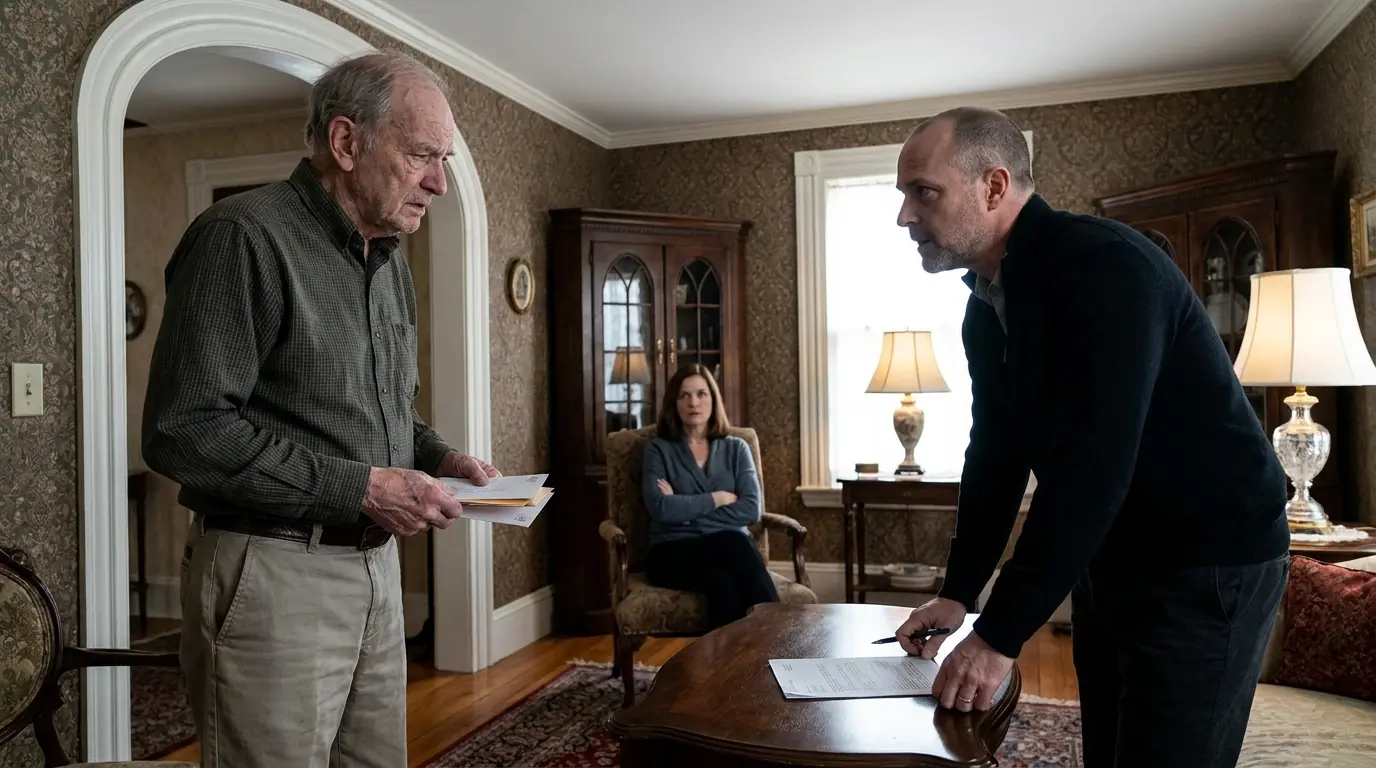
As the library door closed behind us, Elliot turned to me sharply.
“What’s your problem, Father? Can’t you see the situation they’re in?”
“My problem is that you’re inviting strangers to live in my house without consulting me,” I tried to speak calmly, though I was seething inside. “What’s more, you’re promising them free lodging as if you own the house.”
“I thought you’d be happy to help the family.” Elliot crossed his arms over his chest. “After all, they’re your family now, too.”
“They’re Regina’s family, not mine. And I don’t even know what their problem is.”
Elliot sighed as if talking to a confused child.
“I told you. Alfred invested in a bad project, and now the bank is foreclosing on their house. They just don’t have a place to live.”
“And that’s my problem. Why?”
“Because you’re my father,” Elliot raised his voice. “And because there’s plenty of room in this house. Are you suggesting we throw them out on the street?”
I shook my head.
“No, but I suggest that next time you ask my opinion before you invite people to live in my house.”
“Okay.” Elliot was suddenly quick to agree. “I admit that I should have discussed it with you first, but they’re here now. I can’t tell them to leave. Where will they live?”
I asked, realizing it was useless to argue. “There are only three bedrooms in the house, and they’re all occupied.”
“We’ve already thought of everything.” Elliot smiled, satisfied that I’d given in. “Lawrence and Alfred would sleep in the living room on the couch and cot. Sheila and Pearl will occupy the former children’s room on the second floor.”
“My former workroom, you mean?”
“It was empty anyway.” Elliot shrugged. “Look, I know it’s inconvenient, but it’s temporary, and they’ll help around the house. Cooking, cleaning. You won’t even notice they’re there.”
I doubted that, but I decided not to argue, at least for now. I needed to think about the situation and maybe consult with Oliver.
The house had been buzzing like a beehive all day. The Baxter family was settling in, unpacking, and taking up more and more space. By evening, the living room, which Alfred and Lawrence were to share, was filled with their personal belongings. The former nursery, where Sheila and Pearl were housed, was also transformed, with pictures on the walls, their rugs on the floor, and bottles of perfume and creams everywhere.
I watched the invasion, feeling more and more like a stranger in my own home. It was as if I were not the owner, but a lodger who had been allowed to stay out of favor.
I tried to stay away from the new tenants all day, but by dinner time, I had to join the company. Regina had done her best. The table was bursting with dishes I’d never seen in my house before: some exotic salads, roasted meats, elaborate desserts.
“Have a seat, Henry.” Sheila pointed to a chair at the far end of the table. Not my usual place at the head of the table, which Elliot now occupied. “How do you like our cooking? Regina and I have been working all day.”
“It smells wonderful,” I replied politely, though I was hurt by how easily I’d been relegated to a secondary role in my own house.
Dinner began with glasses of champagne as Elliot toasted to family reunion and mutual aid in times of need. Everyone supported his enthusiasm except me. I just sipped my drink, not feeling much like celebrating.
Over the meal, the conversation inevitably turned to the Baxter family’s problems.
“We’ve lost everything,” Sheila said dramatically, blotting her eyes with a napkin. “Thirty years of life, all for nothing because of one mistake.”
“It wasn’t a mistake, dear,” Alfred argued. “It was a promising project. It was just that the partner was a crook.”
“A crook I asked you to check out from the beginning,” Sheila countered. “But of course, you know best.”
“Don’t start that again,” Lawrence intervened, leaning back in his chair. He was tall, with a shallow face and careless haircut, and gave the impression of a man accustomed to an easy life. “What’s done is done. Now we’ve got to figure out how to get out of it.”
“Exactly,” Pearl said, still on the phone. Unlike her brother, she was petite, with bright makeup and a lot of bracelets on her wrists. “Maybe Uncle Harvey can help.”
“Harvey hasn’t spoken to us since I didn’t support him in the local council elections,” Alfred sighed. “And he’s not having the best of times himself.”
“It’ll be all right.” Elliot raised his glass. “We’ll help you get back on your feet, won’t we, Father?”
All eyes turned to me. I realized that I was expected to agree and perhaps offer financial assistance.
“I’m sure Elliot will do what he can,” I said evasively.
“Of course I will.” Elliot smiled, but his eyes remained cold. “By the way, while we’re on the subject of finances, Father, there’s something I wanted to discuss with you.”
I tensed, sensing something wrong.
“What is it?”
“You see, with the new tenants, the cost of the house will increase significantly. Electricity, water, heating. I thought it would be fair for you to contribute your share.”
“My share?” I couldn’t believe my ears. “For living in your own house?”
“Not the rent, the utilities,” Elliot corrected me.
“Which I’d always paid myself,” I reminded him. “From my pension.”
“Yes, but things have changed,” Regina interjected. “There’s more of us now, and the expenses have gone up. Plus, Elliot and I have taken over all the housework: cleaning, cooking, gardening. That costs money, too.”
“How much do you want me to pay?”
My voice sounded calm, though my insides were seething with indignation.
“We’ve calculated.” Elliot pulled a folded sheet of paper from his pocket. “Taking into account your room, your share of the common areas, electricity, water, and other expenses, about £600 a month would be fair.”
I looked at my son in silence. £600 was almost half my pension, for a room in the house I built and for which I was still paying property taxes.
“You’ve always valued fairness, Father,” Elliot added, seeing my reaction. “And it’s really fair. Everyone does their part.”
“And Regina’s family?” I nodded toward the Baxters. “Are they going to contribute, too?”
“I told you, they’re living rent-free.” Elliot’s voice became irritated. “They’re having a hard time.”
“And I’m the one with the easy ones?”
I put my fork down, my appetite gone.
“I’m a pensioner, Elliot. My pension isn’t that big.”
“You have savings,” Regina intervened. “Elliot said you and Vivian had a decent bank account.”
I looked at my son.
“Are you discussing my finances with her?”
“She’s my wife,” Elliot replied defiantly. “We have no secrets from each other.”
“And how long have you been planning this rent?” I could feel the bitterness rising to my throat.
“No one planned anything.” Elliot spread his hands. “It was just a situation. Regina’s family needs help, and we can’t say no. And to cover the costs, we need your help.”
“So, I have to support not only you and your wife, but her whole family.”
“No one is supporting anyone,” Lawrence interjected for the first time, showing an interest in the conversation. “We just help each other. When I get on my feet, and I shall be soon, and my new business plan is almost ready, I’ll pay you back a hundredfold.”
“Of course you will,” I muttered to myself.
But no one seemed to notice.
“So, we have a deal.” Elliot handed me a piece of paper. “£600 a month starting tomorrow.”
I took the paper and read it carefully. It wasn’t just an estimate. It was a real lease written in legal language. It stated the amount, the due date, and even the penalties for late payment. My name was put in as tenant, and Elliot’s name was put in as landlord.
“You drew up a lease on my own house?” I couldn’t believe what was happening.
“Just to be on the safe side,” Elliot shrugged. “To make it official.”
“Official?” I repeated. “And on what basis do you consider yourself a landlord?”
“Well, I run the house now,” Elliot frowned. “Paying bills, making repairs, making decisions.”
“I still own the house.”
I folded the piece of paper and put it next to my plate.
“And I’m not signing that contract.”
There was a heavy silence at the table. Sheila and Alfred exchanged worried glances. Pearl stopped typing on her phone, and Lawrence grinned frankly, as if watching an entertaining play.
“Father,” Elliot’s voice had softened, but there was a steely edge to it. “I understand that you’re upset, but let’s face it. You’re no longer capable of running this house on your own after your stroke.”
“Microstroke,” I corrected, “which was almost three months ago. I’ve made a full recovery.”
“Still, you’re not the same,” Elliot continued. “You need help with the day-to-day, and we’re willing to provide it for a reasonable fee.”
“I don’t need help,” I stood up from the table. “And I’m not paying to stay in my own house.”
“Then maybe you should consider a nursing home,” Regina’s words fell like stones. “You’ll be taken care of by professionals there.”
I looked at her, the cold, calculating woman my son had chosen to marry for some reason.
“This is my house,” I said firmly. “I built it for my family. I paid for every brick, every board, and I’m not leaving here just because you don’t have enough money to support Regina’s relatives.”
“Don’t talk about my parents like that.” Regina stood up, her face contorted with anger. “They’re decent people who were just unlucky.”
“Bad luck several times over from what you tell me.” I remained calm. “And now you want to fix their problems at my expense.”
“At our expense,” Elliot corrected. “Family is supposed to stick together.”
“Family, Elliot, is as much about rights as it is about responsibilities.” I looked him in the eye. “And respect is first and foremost.”
With those words, I left the table, leaving my dinner unfinished and my relatives puzzled. In their eyes, I saw different emotions: Regina’s anger, Elliot’s cold calculation, Alfred and Sheila’s embarrassment, Lawrence’s curiosity, and Pearl’s indifference. In not one look was there sympathy or understanding.
In my little room, I sat down on my bed and looked long out of the window at the darkening garden, the garden that Vivian loved so much. What would she say when she saw what our house had become, what our son had become?
I pulled out a box of papers from under the mattress. Everything was there. The title deed, the deed, the purchase agreement, the tax receipts. The house was mine, and no lease Elliott had drawn up could change that. I didn’t know what I was going to do next, but one thing I knew for sure was that it couldn’t go on like this. I had to make a decision, and I had to make it fast.
It was a sleepless night. I lay in my unusually small bed and listened to the house grow quiet. First, the voices in the living room where Alfred and Lawrence were settled, and then the lights in Sheila and Pearl’s room went out. Elliot and Regina were the last to quiet down. I could hear their muffled conversation from the master bedroom that had once belonged to Vivian and me.
Vivian, how I wish she was around right now. She always knew how to find a way out of the most difficult situations, calmly, with dignity, without losing her temper. Unlike me, I was always too direct, too harsh in my judgments.
“You’re like a bulldozer, Henry,” she’d say, shaking her head. “Sometimes you have to take a subtler approach.”
I closed my eyes and let the memories flood back. Vivian, young and beautiful, with her red hair gathered into a careless bun, wearing a simple dress stained with paint. We had just bought this house and started renovations. It was 1976. We’d been married for five years, and we’d finally saved enough for a down payment.
The house was in terrible condition, a dilapidated Victorian mansion that no one wanted to buy because of the amount of work needed. But Vivian fell in love with it at first sight.
“Look at those molded cornices, Henry, and the fireplace in the staircase. It’s a real treasure.”
All I could see was a leaky roof, rotten floors, and broken heating. But I couldn’t resist her enthusiasm. We bought the house and devoted the next three years to restoring it. Every evening after work, every weekend. I was a chemical engineer in a research lab. Vivian worked in publishing. Money was tight, but we were young and energetic.
When Elliot was born, the house was almost finished. I painted the nursery blue myself, and Vivian sewed the curtains and bedspread. We were so happy, a little family in our own hard-won home.
Where did we go wrong with our son’s upbringing? When did he turn into the cold, calculating man who is now trying to evict me from my own home? Could it be that I was working too hard? Or was it that Vivian and I had been too lenient, letting him get whatever he wanted? Or, conversely, too demanding, expecting him to only get great grades and accomplishments?
I sighed and rolled over onto my other side. Thinking about the past wouldn’t help solve the problem of the present. And the problem was serious. My own son and his wife were trying to take possession of my house to solve her family’s financial problems. Their plan was obvious. Get me to either sign a power of attorney to manage the property or go into a nursing home, leaving them with full authority over the house. Either way, they would gain control of the property, which was worth a decent amount of money. A Victorian mansion in a nice area of Plymouth could fetch them several hundred thousand.
I opened my eyes again. The moon was shining through the window, creating bizarre shadows on the wall. Some sound caught my attention. Footsteps in the hallway. Quiet, cautious. I tensed, listening. Someone stopped at my door. I held my breath. The doorknob turned slowly. Thankfully, I’d locked it, as I’d done every night since Elliot and Regina had moved in with me.
A pause followed, and then the footsteps moved away. My heart pounded in my chest. Who was that? What were they looking for? Could it be the deeds to the house?
I reached under the mattress and fumbled for the box. It was still there. But this incident had convinced me that I couldn’t delay. I had to call Oliver in the morning and act.
But how? What could I do to counter their plan?
I sat up on the bed and turned on the nightlight. Sleep wasn’t working anyway. Pulling out the box, I opened it and went through the documents in it: the certificate of ownership in my name, the sales contract, tax receipts from the last few years. Everything was in order, but most of the papers were yellowed from time. The house had been bought almost 50 years ago.
As I studied the documents, I remembered that there must be a copy of my will somewhere. Vivian and I had made them at the same time about 10 years ago when she showed the first signs of illness. According to the will, all of our property, including the house, was to go to Elliot upon the death of the last of us.
I went through all the papers, but I couldn’t find the will. It had to be somewhere in the house. Perhaps in the safe that stood in my former office, now Elliot’s room. It was impossible to access the safe now.
The will could be changed, though. Given the circumstances, that would be wise. If Elliot is so eager to get the house that he’s willing to kick his own father out, then maybe he doesn’t deserve an inheritance. But to change the will, I’d need a lawyer. Luckily, I had Oliver, a trusted friend and experienced professional, and I was going to go to him at the earliest opportunity.
I spent the rest of the night thinking about a plan of action. By morning, it had formed in my head. Not perfect, but the best I could come up with under the circumstances.
Getting up before everyone else, I dressed quickly and slipped out of the house. The cold morning air of Plymouth refreshed my thoughts. I headed for the nearest cafe where I could talk quietly on the phone. The clock read 7:30. A little early for a call, but the situation was critical.
To my relief, Oliver answered after the third ring.
“Henry, what’s wrong?”
His voice sounded concerned. The early call must have alerted him.
“Oliver, I need your help,” I said quietly, though there was no one in the cafe except for the sleepy barista. “The situation is complicated.”
I briefly recounted yesterday’s events. The arrival of Regina’s parents, Regina’s brother and sister, the demand for rent, the overnight visitor at my door.
“Damn it, Henry. This is serious.” Oliver didn’t hide his alarm. “They’re practically trying to get you out of your own house.”
“Exactly.” I took a sip of the coffee the barista had just brought. “That’s why I need your help. Legal help.”
“Sure,” Oliver answered without hesitation. “What do you want to do?”
“First, change the will,” I said firmly. “I don’t want Elliot to have the house when I die. Second, I need to protect my rights to the house now while I’m alive. They might try to declare me incompetent.”
“I understand.” Oliver paused, apparently thinking about the situation. “Could you come to my office today? Say 10:00.”
“Yes.” I was relieved. “Thank you, Oliver.”
“Don’t thank me. That’s what friends are for.” He paused. “And Henry, be careful. From what you’ve told me, they could go to extreme lengths.”
I got home around 8:30. The house was already awake. There were voices coming from the kitchen and the smell of frying bacon. I slipped quietly into my room, trying not to meet anyone. I needed to gather my thoughts before facing them.
Spreading the documents from the box on the bed, I selected the ones I might need today: the certificate of title, the sales contract, the bank statements confirming that I was the one paying the mortgage. I folded them all neatly into the leather folder I’d worn when I’d worked in the lab.
There was a knock at the door. I quickly tucked the rest of the papers under the mattress and opened it.
Alfred Baxter, Regina’s father, stood on the doorstep, a heavy-set man with thinning gray hair and a guilty look on his face.
“Good morning, Henry,” he said, shifting from foot to foot. “May I come in?”
I nodded, and he squeezed into the room, looking around as if assessing the surroundings.
“It’s cozy,” he said, though his voice was clearly false.
The room was small and cramped, with a minimum of furniture.
“To what do I owe this visit?” I asked bluntly, not wanting to waste time on small talk.
Alfred was even more embarrassed.
“I wanted to talk about yesterday’s incident.”
“Incident?”
“Over dinner. It was awkward.”
“Awkward is when you spill tea on the tablecloth, Alfred,” I replied dryly. “And yesterday was an attempted extortion.”
“No, no, no, no.” Alfred waved his hands. “Nobody’s extorting anything. Elliot just wanted to keep things fair. It costs money to maintain a big house.”
“And I own the house,” I interrupted him. “And I’ve always paid my own expenses. If Elliot and Regina can’t afford to support your family, that’s not my problem.”
Alfred blushed.
“Look, we’re not freeloaders. We’re just having temporary difficulties. Lawrence is about to launch a new business. Pearl is looking for work.”
“And you?” I asked. “What do you and your wife plan to do?”
“Well, uh…” he hesitated. “I’m going to take some time off and look for new investment opportunities. I have a lot of connections, you know.”
“Connections that didn’t help you keep your house,” I said.
Alfred clenched his fists.
“You don’t understand. That project was solid. It was just that the partner was a crook. It could have happened to anyone.”
“But somehow, it only happens to you.” I sighed. “Look, Alfred, I have nothing against you personally, but what’s happening now is wrong. You and your family invaded my home uninvited, and now you want me to pay for the pleasure.”
“We didn’t invade. Elliot invited us,” Alfred objected.
“Elliot has no right to do that,” I replied. “The house belongs to me.”
Alfred was silent for a moment, thinking about what I had said.
“What are you going to do?” he asked at last.
“Protect my rights,” I answered simply.
“You wouldn’t kick your own son out, would you?” There was a note of panic in his voice.
“I haven’t made up my mind,” I said, though I really knew what I was going to do. “But I’m not going to let myself become a tenant in my own house.”
Alfred nodded, hesitated for a moment, and then, without a word, left the room.
I glanced at my watch. 9:15. It was time to head over to Oliver’s.
Taking the file folder, I left the room and headed for the front door. Lawrence and Pearl were sitting in the living room. He was reading the paper. She was typing something on her laptop. Both of them looked up as I walked by.
“Going somewhere, Mr. Thorndike?” Lawrence asked with a lazy smile.
“Business,” I answered briefly.
“What business could a retired man have?”
Pearl giggled, but I ignored her question and continued toward the door.
Regina intercepted me in the hallway.
“Henry, are you leaving? I was just about to serve breakfast.”
“I’m not hungry,” I lied, though my stomach was cramping. I hadn’t eaten since last night’s dinner.
“But you need to keep up your strength,” she insisted with feigned concern, “especially at your age.”
“Thank you for your concern, Regina. But I’m perfectly capable of deciding when I eat.”
I stepped around her and grabbed the doorknob.
“When will you be back?” she kept up. “Elliot and I wanted to talk to you about something.”
“I don’t know,” I answered honestly. “Maybe by lunch.”
She was obviously going to ask something else, but I’d already opened the door and stepped outside.
The freedom, albeit temporary, felt incredibly good.
Oliver’s office was downtown in an old building overlooking the harbor. I’d gotten there by bus, savoring the simple opportunity to be away from home and all its new inhabitants.
Oliver met me in the lobby.
“Henry, glad you made it. Come on in. We don’t have much time.”
I looked at him in surprise.
“Why?”
“Because I have an appointment with the notary at 11:30,” he said, ushering me into his office. “If we want to change the will today, we have to act quickly.”
“You were always efficient.” I smiled for the first time in a long time.
In Oliver’s office, we plunged into legal matters. I showed him all the documents I brought with me and explained the situation in detail.
“So.” Oliver took off his glasses and rubbed the bridge of his nose. “Legally, the house is all yours. Elliot has no rights to it except what he would have gotten in your will when you died. He can’t charge you rent or evict you. Moreover, it is you who can evict him and everyone else if you wish.”
“That’s exactly what I plan to do,” I said firmly. “But first, we have to change the will.”
“Are you sure?” Oliver looked at me carefully. “This is your son, Henry, the only child.”
“The son who’s trying to get me out of my house,” I reminded him. “Who brought strangers into my house without my permission and now demands that I pay to live there. Who may have tried to break into my room at night to find the deeds to the house. Yes, Oliver. I’m sure of it.”
Oliver nodded.
“Good. In that case, let’s discuss how you want to dispose of your property.”
We spent the next hour drafting a new will. According to it, the house went not to Elliot, but to a charity that supported children with cancer, a charity that Vivian had helped in the last years of her life. Elliot would receive only a small fraction of my savings, enough not to contest the will, but nothing more.
At exactly 11:30, the notary arrived, an older woman with shrewd eyes and a firm handshake.
“Mr. Thorndike, I’m Eleanor Price,” the notary said. “Mr. Holt explained the situation to me. Before we begin, I need to make sure you’re acting voluntarily and fully aware of the consequences of your actions.”
“I am absolutely sure of my decision, Mrs. Price,” I answered. “And I am fully competent, as my attending physician can attest, if necessary.”
“Good,” she nodded. “In that case, let’s get started.”
We spent the next hour going through all the necessary paperwork. In addition to the new will, Oliver suggested that I sign a power of attorney in his name, not to administer the estate, but to represent me in court if Elliot tried to challenge my actions.
“It’s just a precaution,” he explained. “If they try to restrict your freedom or access to legal help, I’ll have the authority to act on your behalf.”
I agreed. It sounded reasonable.
When all the documents were signed and witnessed, Mrs. Price made copies for her records and for me.
“Copies of your new will will be kept by me and Mr. Holt,” she said. “I recommend that you keep the original in a safe place. Not at home, but in a safe deposit box, for example.”
“I can offer my safe deposit box,” Oliver interjected. “It’s safer than a safe deposit box.”
I agreed to that, too. The fewer documents left at home, the better.
“What now?” I asked when Mrs. Price had gone and Oliver and I were alone.
“Now,” Oliver leaned back in his chair, “you have to decide what you’re going to do about the uninvited guests in your house.”
“I want them gone,” I said firmly. “All of them. Regina’s family, and Elliot and his wife.”
“That’s your right,” Oliver nodded. “But we have to do it legally, so they can’t claim it later. What I suggest is that I draw up a formal eviction notice that you give to Elliot. It will specify a time limit, usually two weeks, within which they must vacate the premises.”
“And if they refuse?” I asked.
“Then we’ll go to court.” Oliver was serious. “But since you officially own the house and they have no rights to it, the court will be on your side.”
I nodded, feeling both determined and sad at the same time. I never thought I’d have to evict my own son from the house I’d built for our family. But there was no choice. Elliot had made that choice himself when he decided to turn me into a tenant in my own home.
“Okay,” I said. “Draw up the notice. In the meantime, I’m thinking… I don’t think I’ll go home right away. I’ll take a walk, think about it. I need to pull myself together before I run into them again.”
“That makes sense,” Oliver agreed. “The notice will be ready by tonight. Come by around five, and I’ll give you the paperwork.”
I stood up, feeling oddly relieved. The plan was ready. Tomorrow, I would serve Elliot with the eviction notice and begin to regain control of my home. It would probably be painful for all of us, but it was necessary.
“Thank you, Oliver.” I shook my friend’s hand. “For everything.”
“You’re welcome,” he smiled. “That’s what friends are for. And Henry,” he paused, “be careful. They might not give up so easily.”
“I will,” I promised, and walked out of the office, feeling for the first time in a long time like I was acting, not just reacting to the actions of others.
I got back to the house in the late afternoon around 8:00, when it was already dark outside. All day, I wandered around Plymouth, visiting old familiar places, eating lunch at the little cafe by the waterfront where Vivian and I liked to go. Every now and then, I checked my phone. Elliot had called three times, but I didn’t answer.
By 5:00, I’d gone to Oliver’s house to pick up the papers he’d prepared: the official eviction notice, a copy of my new will, and a few other legal papers I didn’t fully understand, but Oliver assured me I might need them.
The front door opened as soon as I put the key in. Apparently, someone had been waiting for me to return. Elliot stood on the doorstep, his face a mixture of annoyance and worry.
“Dad, where have you been? We were worried.” His voice sounded strained, and his gaze slid to the leather folder in my hand.
“Out for a walk,” I answered calmly, walking past him into the house. “I didn’t realize I had to report my movements.”
The whole family was in the living room. Regina was sitting in a chair with a book. Alfred and Sheila were talking quietly on the couch. Lawrence was reading a magazine. And Pearl was on her phone as usual. When I appeared, everyone stopped talking and looked at me.
“Henry.” Regina put the book down. “We were thinking of calling the police. You’ve never gone this long without telling us.”
“I’m a grown man, Regina.” I walked to the chair and sat down. “And this is my home. I can come and go as I please.”
“Of course,” she pursed her lips. “It’s just that after your microstroke, we’re concerned about your health.”
“That’s very touching,” I didn’t hide my sarcasm, “especially considering yesterday’s conversation about the lease.”
Elliot threw a warning glance at his wife and sat down across from me.
“I understand you’re upset. Perhaps £600 is too much. We can discuss another amount.”
“No need.” I shook my head. “I’m not going to pay rent to live in my own house. Not £600, not six.”
“But that’s fair,” Regina began.
“Whereas,” I interrupted, looking around, “I’m going away for a couple of days. I’m going to visit an old friend in Exeter.”
“You’re going away?” Elliot frowned. “Now?”
“Tomorrow morning,” I nodded. “I’ll be back in two or three days.”
“But Father, you can’t travel alone after your…”
“I’m perfectly all right,” I said. “And the decision has already been made. I’m just letting you know so you don’t panic like you did today.”
There was silence in the room. I could see Elliot and Regina exchanging glances, Alfred and Sheila watching us wearily, Lawrence smirking as if enjoying the spectacle.
“Who is this friend?” Elliot finally asked. “Do I know him?”
“I don’t think so,” I answered, not going into detail. “An old coworker.”
I wasn’t really going anywhere. It was a ruse to put their guard down and buy time for the next step in my plan. I needed them not to wait for my return, not to prepare for it.
“Well,” Elliot shrugged, trying to hide his obvious relief. “If you’re sure you can handle it. When are you leaving?”
“After breakfast.” I rose from my chair. “Now, if you don’t mind, I’m going to my room. It’s been a tiring day.”
“Of course, Father.” Elliot smiled. “Get some rest. If you need anything, just let me know.”
I nodded and headed for my room, feeling their stares on my back. I locked the door, a habit of mine now. I hid the file folder in my clothes drawer under a stack of sweaters. Not the most original place, but there was no better place in the small room.
The next morning passed quietly. I ate breakfast with everyone else, trying to act normal. Elliot and Regina were emphatically polite, as if yesterday’s conflict hadn’t happened at all. Alfred and Sheila were discussing a TV show. Lawrence was talking about his new business plan, and Pearl was complaining about the lack of decent jobs.
After breakfast, I packed a small duffel bag with a toothbrush, a razor, and a couple of changes of underwear. Sheila even offered to give me some sandwiches for the road, which I politely declined.
“Well.” I stopped at the front door with my bag in my hand. “See you in a couple days.”
“Have a safe trip, Father.” Elliot shook my hand. “Call me when you get there.”
“I will,” I lied and walked out of the house.
I did make it to the bus stop and even got on the bus heading toward the train station, just in case one of them was following me. But I got off at the next stop and headed for Oliver’s house, who lived in the next neighborhood. We agreed that I would spend the night at his place and then return home the next day with reinforcements.
I spent the evening in the company of Oliver and his wife, Margaret, who fed us a delicious dinner and tactfully didn’t ask too many questions. We talked about old times, about our youth, about Vivian. For the first time in a long time, I felt at ease and relaxed, without the constant tension that accompanied me at home.
In the morning, Oliver woke me at 7:00.
“Get up, Henry. We have to be in court by 9:00.”
I dressed quickly, and we left in Oliver’s car. He explained that he had arranged an emergency hearing for me the day before, the kind sometimes held for real estate emergencies.
“Judge Hammond is an old acquaintance of mine,” Oliver explained. “He’s agreed to give your case priority.”
We spent about two hours at the courthouse. I explained my situation in detail, provided all the deeds to the house, told him about the pressure from my son and his wife, the uninvited guests, and the demand to pay rent.
Judge Hammond, a serious man with graying temples, listened to me carefully, examined the documents, and ruled that I had every right to demand the eviction of anyone from my house, and if they refused to leave voluntarily, the sheriff could be called in to remove them.
“Given the circumstances,” the judge added, “namely the attempted psychological pressure on an elderly person to gain control of his property, I am issuing an immediate eviction order. Normally, two weeks would be given, but in this case, I am making an exception.”
I was grateful for this decision. Oliver suggested that I immediately contact the sheriff to accompany me on my return home.
“It’s standard procedure for evictions,” he explained, “especially in cases where there’s a risk of conflict.”
The sheriff’s office was in a neighboring building. There, we were met by a middle-aged woman with a short haircut and a keen eye, Sheriff Donovan. She scrutinized the court order and nodded.
“I can escort you right away, Mr. Thorndike. Or do you need time to prepare?”
“The sooner, the better,” I replied. “If I may, right now.”
On the way back to the house, I told Sheriff Donovan more about the situation: how the pressure had started, how I’d been gradually forced out of my own home, how the rent had finally been demanded.
“I often have to deal with family conflicts over real estate,” she said. “But to demand rent from your own father for his own house, that’s a new one.”
I sighed.
“For me, too.”
Just before I got home, I remembered another case I’d heard about from Oliver the day before. Checking my finances, he discovered strange transactions in my retirement account. Small amounts were regularly transferred to Elliot’s account. Oliver requested bank statements, and they confirmed that Elliot had withdrawn about £3,000 from my account in the last three months without my knowledge.
“How is that possible?” I asked at the time. “He doesn’t have access to my accounts.”
“He probably has your online banking login details,” Oliver suggested. “Or he forged your signature on some document. Either way, it’s financial fraud, and we can add that to the lawsuit.”
Now, I had not only the title deed and the eviction order, but also proof of Elliot’s financial fraud.
We pulled up to the house around 2:00 in the afternoon. I was feeling a strange mix of feelings. Determination, bitterness, anger, but also some relief that things would finally be resolved.
Sheriff Donovan rang the doorbell. Regina opened it, her face stretched in surprise at seeing me in the company of a woman in uniform.
“Henry,” she looked from me to the sheriff. “What’s going on? You’re supposed to be in Exeter.”
“May I come in?” Sheriff Donovan asked in an official tone. “I have a court order.”
Regina stepped back silently, letting us into the house.
Everyone else was in the living room, apparently just finishing dinner. At our appearance, they froze as if in a silent scene.
“Dad.” Elliot rose from the couch. “What’s wrong? Why did you come back? And who is that woman?”
“Sheriff Donovan,” she introduced herself, showing her badge. “I have a court order to evict the squatters from Mr. Henry Thorndike’s house.”
“What illegal occupants?” Elliot grinned nervously. “There must be some mistake. I’m his son. I live here.”
“Without my consent,” I interrupted him. “And what’s more, you invited strangers to live in my house, and then demanded rent from me.”
“Father, let’s discuss this privately.” Elliot glanced nervously at the sheriff. “I’m sure we can work this out as a family.”
“It’s too late, Elliot.” I shook my head. “I gave you a chance. You didn’t take it.”
I pulled the court order out of the folder and handed it to Elliot.
“According to this document, you all have to leave my house immediately. You may take your personal belongings, but all furniture and furnishings belonging to me remain in place.”
Elliot ran his eyes over the document, and his face turned pale.
“You can’t do that. I am your son.”
“The son who tried to run me out of my own house,” I reminded him. “The son who demanded money from me to live here. The son who, as it turns out, withdrew money from my retirement account without my knowledge.”
“What?” Regina turned sharply to Elliot. “You took his money?”
Elliot looked cornered.
“I was just borrowing some. I was going to pay it back.”
“£3,000 in three months is not a little.” I pulled out another document, a bank statement. “And judging by the regularity of the withdrawals, you weren’t going to pay it back.”
“I can explain.” Elliot turned to the sheriff. “It’s a misunderstanding. My father gave me verbal permission to use his account to pay the house bills.”
“That’s a lie.” I shook my head. “And I have documentation that I paid all the house bills myself until you transferred them into your name without my consent.”
Elliot’s face contorted with anger.
“You’re just an old, stubborn, selfish man. I took care of you when you were sick. I moved here to help you.”
“You moved here to take over my house,” I replied calmly. “And you used my illness as an excuse.”
Sheriff Donovan intervened.
“I suggest we all calm down. I have a court order, and I have an obligation to enforce it. You can challenge it in court, but you must leave the house now.”
Alfred Baxter, who had been watching in silence until then, stood up.
“We understand. We will leave. Sheila, Pearl, Lawrence, pack your things.”
“Where are we going?” Sheila protested. “We have no home.”
“That’s not my problem,” I said firmly. “You came here uninvited, living on my dime, and now you must leave.”
Regina turned to Elliot.
“You said it was okay, that your father was okay with it, that you had power of attorney to run the house.”
“I had power of attorney.” Elliot looked confused.
“Which I revoked.” I showed him another document. “Two weeks ago, when I realized where this was going.”
Elliot collapsed on the couch, covering his face with his hands.
“You’re destroying our family, Father. Do you realize that?”
“No, Elliot.” I shook my head. “You’re the one who destroyed our family when you decided to make me a tenant in my own house. When you brought strangers here without my consent. When you started stealing my money.”
Regina rushed upstairs, yelling over her shoulder.
“I’m packing. I don’t want to stay in this house a minute longer.”
Her parents and brother and sister followed her. Elliot remained seated on the couch, looking at the floor.
“I’ll give you three hours to pack,” I said. “Sheriff Donovan will stay here to oversee the process, and I want the keys to the attic now.”
Elliot silently pulled a bunch of keys out of his pocket and separated one.
“Here. Happy?”
I took the key, but didn’t answer. I was struggling with conflicting feelings inside me, relief that I had regained control of my life, and deep sadness that it had come to this. My son, my flesh and blood, the man Vivian and I had raised with love and care, had turned into a stranger, an enemy.
The next three hours passed in tense silence. The Baxter family fidgeted with packing. Regina flitted between rooms with tear-stained eyes. Elliot silently packed clothes and books. I sat in the living room next to Sheriff Donovan, watching the process.
“You’ll need to change the locks,” she said quietly, “so they can’t come back.”
I nodded.
“He’ll be here tonight.”
Finally, everything was packed up and taken outside. Sheriff Donovan made sure they didn’t take anything that belonged to me. Elliot was the last one out of the house, stopping on the threshold.
“You’re going to regret this, Father. When you’re alone, without help, without support. You’ll remember my words.”
“Better alone than with people who only see you as a source of money and real estate,” I said.
Elliot shook his head and walked out, slamming the door.
I was left standing in the hallway of my house, now really my house.
“Are you all right, Mr. Thorndike?” Sheriff Donovan asked, looking at me carefully.
“Yes,” I answered after a pause. “For the first time in a long time, I was really okay.”
The week after the eviction of Elliot, Regina, and her relatives had been hard, but necessary to restore order to my house. As Sheriff Donovan had advised, I called a locksmith that same evening to change all the locks. I then conducted an audit of the property. To my relief, most of the valuables were still in place. Although a few items, including silver candlesticks and antique clocks, had disappeared, that was the least of my worries.
Now, the first thing I did the next day was to go up to the attic to check what had become of my belongings that Elliot and Regina had supposedly neatly stacked there. The picture I saw was depressing. Boxes of books and records piled in disarray, some opened, their contents strewn about. My winter clothes were in bags piled in a corner. Some of my photo albums and documents were spread out on an old table. Apparently, someone had been scrutinizing them.
I spent the day in the attic sorting and organizing things, deciding what to return to the rooms and what to leave here. The work was physically demanding for someone my age, but I took my time. Every item I found, every photograph, every book brought me back to myself, to my life that they had tried to take from me.
On the third day, I called a cleaning company to completely clean the house. Five uniformed women worked for almost 12 hours, washing windows, cleaning carpets, polishing furniture. When they were done, the house looked like the one Vivian and I lived in again. Clean, cozy, full of light.
The next step was getting my bedroom back. I moved my things from the small guest room to the master bedroom where Vivian and I had spent so many years. Elliot and Regina had left their furniture there, a large modern bed, glass bedside tables, some abstract paintings on the walls. I called the movers, who took it all out to the garage and then brought in our old furniture from the attic. A dark oak bed, an antique dresser, a carved mirror.
By the end of the week, the house was almost completely restored. Of course, it no longer looked the way it had in Vivian’s day. Too much had been changed, thrown away, remodeled. But it was still my home, and I was relieved to be back to normal.
Saturday morning, as I was eating breakfast in the kitchen, the doorbell rang. I wasn’t expecting visitors, and my heart clenched uneasily. Had Elliot returned? When I looked through the peephole, I saw my son standing on the porch with a serious expression on his face.
I hesitated to open the door, but then decided that sooner or later, this conversation had to happen.
“Good morning, Father,” Elliot said when I opened the door. He looked tired, with shadows under his eyes. “May I come in? We need to talk.”
I stepped back silently, letting him into the house. We walked into the kitchen, where my half-drunk cup of coffee and uneaten toast stood on the table.
“Would you like some coffee?” I asked, being as polite as possible.
“No thanks.” Elliot sat down at the table, looking around the kitchen. “You changed the curtains.”
“I brought back the ones I had before,” I corrected, sitting down across from him. “They were stored in the attic.”
Elliot nodded, then took a deep breath as if gathering his strength.
“Dad, I came to apologize. What happened was wrong. Regina and I, we went too far.”
I remained silent, studying his face. Was it genuine remorse or just a new move in the game?
“Regina’s financial problems were more serious than we thought,” Elliot continued when he realized I wasn’t going to answer. “They owed a lot of money, and the bank was threatening not only to foreclose on the house, but to sue. We panicked and…”
“And decided to use my house and my money to solve their problems,” I finished for him.
Elliot lowered his eyes.
“Yes, it was wrong. I realize that now, especially the demand to pay rent. That was unacceptable.”
“And stealing money from my account?” I asked bluntly. “Was that wrong, too?”
“I didn’t steal.” Elliot raised his head, a familiar twinkle of resentment in his eyes. “I was borrowing. I was going to pay you back when things got better.”
“Sir, without my knowledge or consent, Elliot, that’s called stealing.”
He clenched his fists on the table.
“We were in a desperate situation, Father. You’d understand if you’d seen Regina crying every night, afraid her parents would end up on the street. I had to do something.”
“Something? Yes,” I agreed. “Like finding them temporary housing that they could afford, or helping them find a job, or applying for social assistance, but not trying to drive my own father out of his home.”
“I wasn’t trying to drive you out,” Elliot countered. “I wanted us all to live together as a family.”
“Family?” I grinned bitterly. “Family doesn’t charge my father rent to live in his own house. Family doesn’t lock his stuff in the attic. Family doesn’t steal his money.”
Elliot was silent, head down. When he spoke again, his voice sounded quiet and broken.
“You’re right. We did a terrible thing. But you’re my father, the only family I have left after Mom died. Can’t you forgive me? Give us a second chance?”
Tears glistened in his eyes. And for a moment, I saw in him the little boy Vivian and I had loved so much. My heart clenched with pain and doubt. Maybe I had really treated him too harshly.
But then I remembered all the humiliation of the past months, all the manipulation, all the lies. And I realized that the man sitting in front of me is no longer that boy. He is a grown man who consciously made a choice time after time, day after day.
“Where do you live now?” I asked, changing the subject.
“We rented a small apartment in the center,” Elliot answered. “It was expensive, but we couldn’t find anything else fast enough. Regina’s parents had gone to her aunt’s in Bristol. Lawrence was staying with friends, and Pearl had found a job in London and moved there.”
“So, you’ve all managed to find a roof over your heads,” I said, “without my help.”
Elliot didn’t say anything, probably realizing where I was going with this.
“What do you want from me now, Elliot?” I asked bluntly. “Why did you come here?”
He took a deep breath.
“I want you to forgive me. For us to be a family again. Maybe… maybe in time, Regina and I could come back. Not now, of course. But…”
“No.” I shook my head. “You’re not coming back to this house. Never.”
“But Father.” Elliot stepped forward. “You need help. You can’t live alone in a house this big after your stroke.”
“A microstroke,” I corrected, “from which I’ve made a full recovery. And I’m doing just fine on my own. And if I need help, I’ll hire a nurse or a housekeeper.”
“With what money?” Elliot blurted out, and he bit his tongue, realizing he’d said too much.
“That’s what it was.” I nodded, starting to make sense. “You’re still counting on my money, the house, the inheritance.”
“No, I’m just worried about you,” he countered, but without conviction.
“Elliot,” I looked him in the eye. “I’ve changed the will. The house will no longer pass to you when I die.”
His face turned pale.
“What? But… But to whom, then?”
“To a charity for children with cancer. The same one your mother had been helping for the last few years.”
Elliot jumped up from his chair, his face contorted with anger.
“You can’t do this. I’m your son. I’m your only child.”
“I can,” I said calmly. “And I’ve already done it. The papers are drawn up and notarized.”
“I’ll contest it,” Elliot threatened. “I’ll prove that you were incapacitated.”
“You can try,” I kept my voice low. “Just be warned. If you file a lawsuit, I’ll meet you in court for financial abuse of an elderly person. I have all the evidence of how you withdrew money from my account without my knowledge. Do you know how the courts treat cases like this?”
Elliot froze, pondering what had been said. Then he sank slowly back into his chair.
“You wouldn’t do that. You wouldn’t sue your own son.”
“You’d be surprised what I’m capable of,” I replied, “after everything that’s happened.”
There was a heavy silence in the kitchen. Elliot was staring blankly, his shoulders slumped.
“So,” I said finally, “you have a choice. Either you accept the situation as it is, and we try to rebuild some kind of relationship at a distance, with no cohabitation and no financial support from me, or you continue to fight for my property, and then we’ll meet in court. What’s it going to be?”
Elliot looked up at me, exhausted.
“There’s no third option where we just forget the whole thing?”
“No,” I shook my head. “Some things are impossible to forget.”
He was silent for a long moment. Then he said quietly, “Regina won’t go for the first option. She… She was counting on the inheritance, the house.”
“Then maybe you should wonder if you’re with the right person,” I said, “if she’s prioritizing property over family.”
“You don’t understand.” Elliot shook his head. “Her family had always been well-off until that ill-fated project of her father’s. For her, losing her status, her position, it’s the end of the world.”
“And for me, losing respect and trust in my own son is the end of the world,” I said. “But here we are, and we have to get on with our lives.”
Elliot stood up.
“I need to think. Talk it over with Regina.”
“Of course.” I stood up, too. “Just remember, if you decide to go the legal route, there will be no mercy. I have proof of your machinations, and I won’t be shy about using it.”
Elliot headed for the exit, but stopped at the door.
“You know what the sad thing is, Father? That things could have been different if you had just helped us when we asked.”
“I would have helped,” I replied, “if you’d actually asked instead of trying to trick me out of my house and money. That’s the difference, Elliot. And until you understand it, nothing is going to change between us.”
He shook his head and walked out without another word.
I closed the door behind him and walked back into the kitchen, feeling a strange emptiness inside. Not regret, no, I was sure I was right. More like sadness at the realization that some bridges had been burned forever.
It had been three months since that day. I hadn’t seen Elliot or Regina again, though he’d called a couple times. Short, awkward conversations in which we both avoided talking about the important things. I learned from mutual acquaintances that they’d sold the car and moved into a smaller apartment, and Regina had taken a job at a designer clothing store. Her family’s financial problems had apparently been solved without my help. Alfred had found a job in Bristol, and Sheila was giving French lessons.
I was slowly getting back to normal. I hired a gardener, a young lad called Ben, who helped me restore the garden. The rose bushes that Vivian had once planted began to come back to life under his caring hands. I renewed old friendships. I began to see Oliver and his wife regularly, found a couple of former lab colleagues with whom I now occasionally played chess.
In the evenings, I often sat in a chair by the fireplace with a glass of whiskey and thought about life, about Vivian, about our marriage, about raising Elliot. Where and when had things gone wrong? Was I too hard on him as a child, or was I too soft? Did I give him enough attention, or did work always come first?
I couldn’t find answers to these questions. Perhaps they just didn’t exist. Perhaps everyone makes his own choices in life, regardless of upbringing and circumstances. Elliot chose money and status, chose a woman for whom those things were more important than human relationships. And I couldn’t change his choices, only my own.
One of those evenings, as I sat by the fireplace, staring at the flames, the phone rang. I didn’t recognize the number, but I answered it.
“Mr. Thorndike?” an unfamiliar female voice asked. “My name is Sarah Miller. I’m from the Foundation for Children with Cancer. Mr. Holt told us about your intentions regarding the will.”
“Yes,” I confirmed. “The house will go to the foundation when I die.”
“That’s very generous of you,” she said. “But that’s not the only reason I’m calling. We’re starting a new program, support groups for seniors who have lost loved ones to cancer, and we need volunteers with personal experience. I was wondering if you might be…”
“Yes,” I replied before she could finish. “I’d like to help.”
A week later, I went to my first support group meeting. Six people who had lost wives, husbands, children to cancer. We sat in a circle and talked about pain, about loss, about how to move on. And for the first time in a long time, I felt that I was not alone, that there were people who really understood.
Coming home after the meeting, I stopped at the gate of my house and stared at it for a long time. A large Victorian mansion built with so much love, witness to so many happy and bitter moments. Without Vivian, without Elliot, it seemed too big for one person. But it was my home, my fortress, a place where I could be myself without pretense or manipulation.
And I realized I had no regrets.
Yes, I lost my son, perhaps forever. But I kept my self-respect, my freedom, and my dignity. And that, as it turned out, was worth more than family ties, if they were based only on greed and deceit.
I opened the gate and walked down the garden path, past the rose bushes that were beginning to green up after winter. Summer was ahead, new meetings with the support group, games of chess with friends. Life went on, not what I expected, but still full of possibilities and meaning.
And there was some truth in that, some consolation.