The man had been coming to that restaurant for years, always choosing the same table near the window, always ordering something simple, never asking for special treatment, yet quietly observing everything around him with a level of attention most people didn’t even realize existed, because to him, a restaurant was never just about food, it was about people, about the invisible systems of behavior that revealed who someone truly was when no one was paying attention, how a server placed a glass, how they responded to a mistake, how they treated someone who couldn’t give anything back, and over time, he had built a habit of noticing the smallest details, the kind most would overlook without a second thought.
That night began like any other, the warm glow of hanging lights reflecting softly against polished wooden tables, the low murmur of conversations blending into a steady rhythm, the occasional clink of cutlery adding texture to the atmosphere, and when the young waitress approached his table, she carried herself with the same polite composure expected in a place like that, her uniform neat, her posture professional, her voice calm, yet there was something beneath it all, something subtle but undeniable, a tension in the way her shoulders held themselves, a hesitation in her movements that didn’t belong in a place built on smooth service.
“Here’s your bill, sir.”
Her voice was steady, but her fingers lingered for just a fraction of a second longer than necessary as she placed the receipt down, and in that tiny pause, something unspoken passed between them, something the man didn’t fully understand yet but instinctively recognized as important, and when he lowered his eyes to glance at the bill, what he saw made everything else in the room disappear.
“I need your help. Don’t ignore me.”
The words were written in small, hurried handwriting beneath the total, barely visible unless someone was looking closely, and for a moment, the man didn’t move, his mind processing what he had just seen, the simplicity of the message making it even more urgent, because no one writes something like that without reason, and when he looked up again, searching for her, she was already gone, disappearing behind the kitchen door as if she had never been there at all.
He scanned the room again, slower this time, observing not just for her but for everything else, the staff, the interactions, the subtle tension in the air that he hadn’t noticed before, or perhaps hadn’t allowed himself to notice, and suddenly, things began to align in a way they hadn’t before, small gestures that now felt different, the way the manager moved through the floor, sharp, controlled, the way certain employees avoided eye contact, the way laughter seemed forced in some corners of the room.
Something was wrong.
He didn’t act immediately.
He finished his meal as usual, paid without drawing attention, and left quietly, but his mind didn’t leave with him, it stayed behind, turning over every detail, every movement, every possibility, and by the time he reached home, he had already decided one thing.
He would come back.
The next night, the restaurant was quieter, nearing closing time, chairs beginning to stack, lights dimmed slightly to signal the end of service, and the man took his usual seat, ordering something simple again, watching, waiting, not rushing, because whatever was happening would reveal itself in time if he paid attention.
Minutes passed.
Then, as he stood to leave, his eyes caught something near the kitchen door, slightly ajar, just enough to allow a narrow glimpse inside, and what he saw stopped him mid-step.
The waitress was sitting on a crate near the back wall, her head lowered, her shoulders shaking as she tried to suppress the sound of her crying, her hands trembling uncontrollably in her lap, and even from that distance, the marks on her face were visible, faint bruising along her cheek, a discoloration that no amount of careful lighting could fully hide.
He moved closer.
Not quickly.
Not aggressively.
Just enough to be seen.
She looked up suddenly, panic flashing across her face the moment she realized he was there.
“Please don’t tell anyone.”
Her voice was barely a whisper, fragile, almost breaking under its own weight, and for a second, it felt like she expected him to disappear, to turn away like everyone else had, to pretend he hadn’t seen anything.
He didn’t.
“I won’t.”
His tone was calm, grounded, offering something she clearly hadn’t had in a long time.
“But you need to tell me what’s happening.”
She hesitated, her eyes searching his face, measuring something she couldn’t quite define, trust or risk, safety or consequence, and for a moment, it seemed like she might refuse, might retreat back into silence, but then something shifted, something gave way, and the truth began to come out, slowly, unevenly, like something that had been held in for too long.
“He’s not just strict.”
Her voice trembled.
“He… enjoys it.”
The man didn’t interrupt.
Didn’t react outwardly.
He just listened.
“He yells at me in front of customers… even when I didn’t do anything wrong.”
She wiped her eyes quickly, as if afraid of being seen, even now.
“He makes things up… says I forgot orders… says I cost the restaurant money…”
Her voice dropped further.
“And sometimes…”
She stopped.
Her hands tightened.
“He doesn’t pay me for those shifts.”
The silence that followed was heavier than anything she had said.
“Why don’t you leave?”
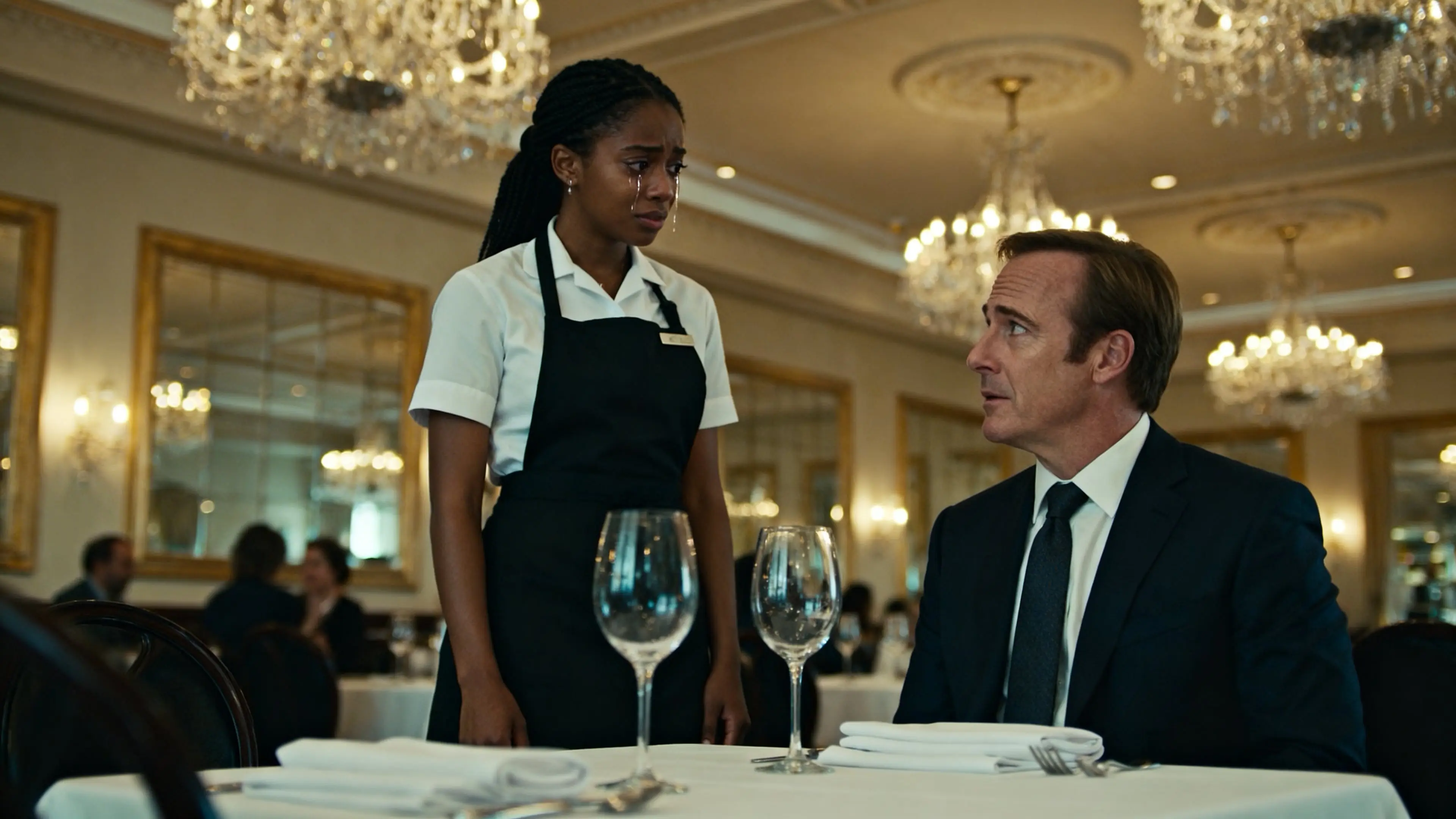
The question came gently, not as judgment, but as understanding.
She let out a small, broken laugh.
“My family depends on me.”
There it was.
The reason everything continued.
“I can’t afford to lose this job.”
The man nodded slowly, not because he agreed with the situation, but because he understood the weight behind it, and in that moment, the situation wasn’t just about one person being treated unfairly, it was about a system that allowed it to continue, a silence that protected it.
“Alright.”
He stepped back slightly.
“Then let me handle it.”
She shook her head immediately, fear returning just as quickly.
“No… you don’t understand…”
“I do.”
His voice remained calm.
“And I won’t make things worse for you.”
Days passed.
Nothing changed on the surface.
The restaurant operated as usual, customers came and went, the manager maintained his authority, sharp, controlled, unaware that something had already shifted beyond his reach, because the man didn’t act impulsively, he waited, gathered what he needed, confirmed what he already suspected, and when the time came, he didn’t return to the restaurant.
He went somewhere else.
The head office.
The manager arrived that morning expecting routine, perhaps a performance review, perhaps recognition for maintaining strict control over his staff, because in his mind, discipline meant efficiency, and fear meant results, and results justified everything.
But when he stepped into the meeting room, something felt wrong immediately.
The room was too quiet.
Too still.
And then he saw him.
Sitting at the head of the table.
The same man.
But different now.
Dressed in a tailored suit, posture relaxed yet authoritative, presence impossible to ignore.
“You…”
The manager’s voice faltered.
The man folded his hands calmly.
“You’ve seen me before.”
The manager swallowed.
“I… didn’t know…”
“That’s the problem.”
The interruption was soft.
But firm.
“You didn’t know… and you didn’t care to know.”
Silence filled the room.
The kind that forces reflection whether someone wants it or not.
“I’m the majority shareholder of this company.”
The words landed without force, but they didn’t need it.
Everything shifted instantly.
The manager’s confidence disappeared.
Replaced by something else.
“You forgot something important.”
The man stood slowly, his gaze steady.
“Even the smallest person has a limit.”
The manager’s hands trembled slightly.
“And today… yours has been reached.”
The air felt heavier.
Final.
“I didn’t mean—”
“You did.”
The words cut clean.
“You just didn’t expect consequences.”
The manager fell silent.
There was nothing left to say.
“You’re not being removed because I’m angry.”
A brief pause.
“You’re being removed because someone like you… should never lead anyone.”
No argument followed.
No defense.
Only silence.
The kind that follows truth.
Days later, the restaurant felt different, not dramatically, not loudly, but in the quiet ways that mattered most, the tension gone, the fear lifted, the staff moving with ease instead of caution, and the young waitress returned to work without the weight she had carried for so long.
When she approached his table again, her hands were steady.
“Thank you.”
He looked at her calmly.
“You don’t owe me anything.”
She shook her head softly.
“I do.”
For a moment, neither of them spoke, because some things didn’t need explanation, didn’t need to be expanded into something bigger than they were, and as he stood to leave, placing the bill neatly on the table, he glanced at the receipt one last time.
No message this time.
Because it wasn’t needed anymore.
Because sometimes, the smallest words…
are enough to change everything.