The man on my roof was named Skeet Fisk, and he had a pry bar in one hand and my side-yard camera in the other, and he was holding the camera the way you hold a fish you aren't sure is dead. I watched him do it from a parking lot in Kuna, eleven miles away, on a phone screen the size of a playing card. The footage came from the camera on my back patio, which he hadn't gotten to yet, and which he never did get to, because it was tucked up under the pergola where you'd have to know to look.
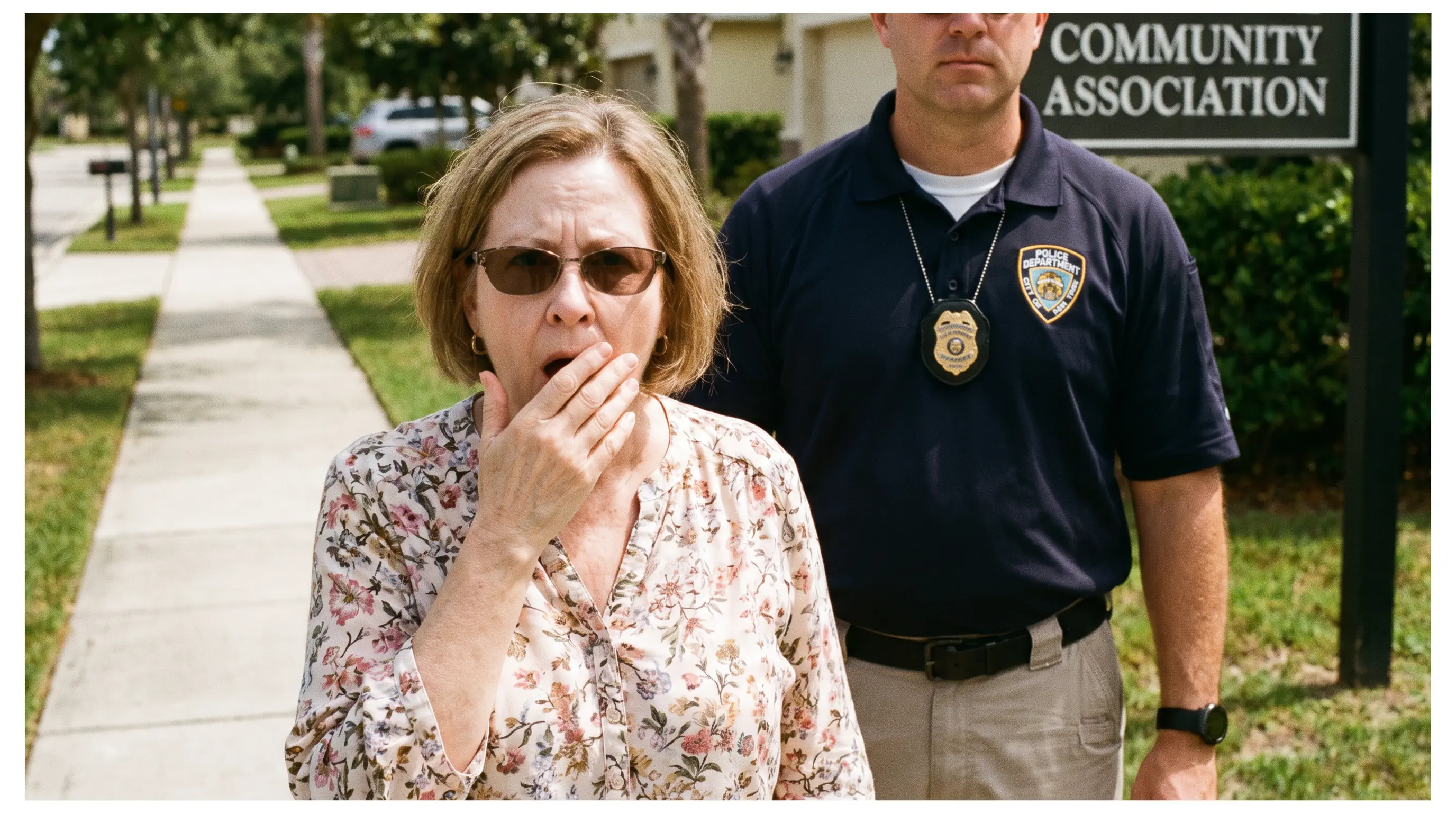
I want to start there, because that was the moment I stopped being polite. Everything before that I could explain away. A letter, a meeting, a woman crying in a clubhouse in front of forty of my neighbors. A man on my roof with a pry bar is not something you explain away. A man on my roof with a pry bar is a phone call.
But I'm getting ahead of myself, and I'm a surveyor, and surveyors don't get ahead of themselves. We start at a known point and we work outward. So here is the known point.
My name is Leland Dupuis. I'm fifty-one years old. For twenty-two years I have measured land for a living, first for the county and then for a private firm in Boise, and for the last six years for myself, under a business name my daughter came up with when she was nine: True North Survey. I set property corners. I stake out foundations so the concrete goes where the architect drew it. I settle fence disputes between people who have not spoken to each other since the Obama administration. Most of what I do comes down to a single question, asked over and over in different weather: where, exactly, is the line?
I live in Nampa, Idaho, in a subdivision called Tamarack Ridge, which has no tamaracks and no ridge. It was a sugar beet field until 2009. The developer planted Norway maples and honey locusts along the streets and named the courts after birds, so I live at 2214 Towhee Court, at the closed end of a cul-de-sac of six houses, with the irrigation canal running behind us and a view, on clear mornings, of the Owyhee Mountains going pink. I bought the house the year my marriage ended. Julia kept the place in Boise and I kept the truck and the equipment, and our daughter, Maisie, split her weeks between us, Sunday to Sunday, with a duffel bag that got lighter every year as she figured out how to keep two of everything.
Maisie is fifteen. She is going to be important to this, so I'll tell you now that she is smarter than me in every way that matters and that she was the one who set up the cameras.
I didn't want cameras. I want to be clear about that, too, because by the end of the summer a lot of people in Tamarack Ridge believed I was the kind of man who loved them, who sat up at night in a dark room scrolling through other people's lives. I am not that man. I am the kind of man who leaves his truck unlocked in his own driveway because he grew up in Grangeville, where you left the keys in the ignition so your neighbor could move it if he needed to.
In March, somebody opened the unlocked door of that truck at two in the morning and took my GNSS rover out of the back seat. If you don't know what that is, it's a satellite receiver on a pole, about the size of a dinner plate, and it is the most important tool I own. It cost eighteen thousand dollars. My insurance covered eleven. The police officer who took the report was kind about it and told me plainly that it was gone, that it was probably already in a pawn shop in Ontario, Oregon, or on a truck to somewhere farther, and that the best thing I could do was lock my doors and maybe think about a camera.