Every night, Thomas Miller traded sleep for $14 an hour because back home, a 7-year-old girl was breathing through a half-empty inhaler that he couldn’t yet afford to replace. That was his whole world, and he had made his peace with it. But on one ordinary Tuesday night, a door that should have been locked wasn’t. He pushed it open, and in the space of a single breath, he saw Evelyn Croft, the most powerful CEO in the building, shirt off, a medical pump embedded beneath her skin, dark bruising crawling across her ribs.
She turned around. Their eyes locked. Then her voice came out low and cold as steel. "Close the door. What you just saw can either make you or destroy you."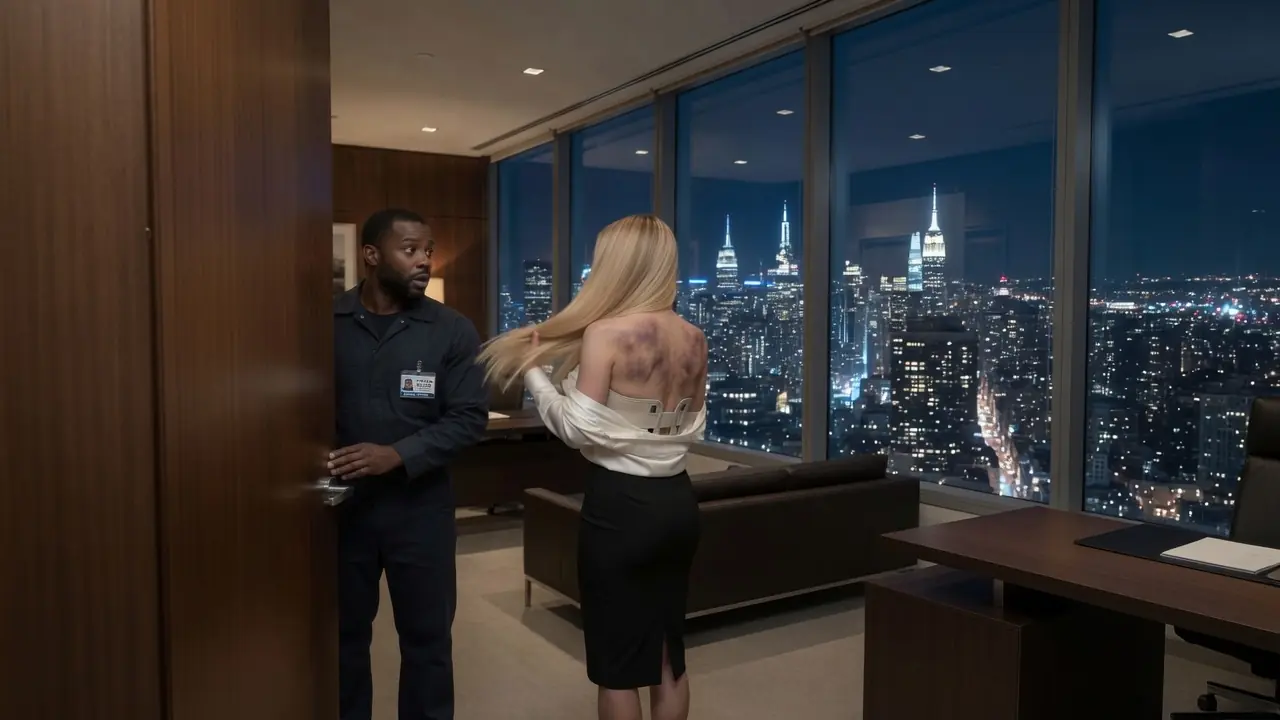
He didn’t run. And that single decision changed everything. Thomas Miller had a system. Every night he arrived at Apex Holdings at 10:45, changed into his uniform in the basement locker room, clocked in at exactly 11:00, and started on the second floor.
He worked his way up methodically, vacuuming, wiping, emptying trash, restocking paper towels floor by floor without rushing and without lingering. He had learned a long time ago that the fastest way to stay invisible was to be predictable. Predictable people didn’t get questioned. Predictable people kept their jobs.
He had been doing this for two years, and in two years, no one on the upper floors had ever learned his name. That was fine. Thomas wasn’t there to be known. He was there because his daughter, Maya, needed a new inhaler prescription every 30 days, because their landlord had raised the rent twice in 1eight months, and because the severance pay from his last job, a warehouse position that dissolved when the company restructured, had run out eight months ago.
The night shift at Apex paid $14 an hour with a small weekend differential. It wasn’t enough, but it was consistent, and consistency was the only currency Thomas had left to trade in. He thought about Maya every time he pressed the elevator button. She was seven years old, and she slept with a stuffed rabbit named Gerald that had lost one eye in the washing machine.
She liked strawberry oatmeal and hated the sound of thunder. On the nights when her asthma flared up, she would pad down the hallway in her socks and climb into his bed without saying anything, and he would lie there in the dark listening to the slight wheeze in her breathing until it evened out. Those were the nights that stayed with him through every shift. Not as sadness, exactly, but as weight.
Solid, clarifying weight that reminded him exactly why he was standing in a corridor at 2:00 in the morning holding a mop. That Tuesday started like every other Tuesday. Thomas clocked in, grabbed his cart, and took the elevator to the second floor. He worked steadily upward through the building, which was mostly empty by midnight, except for a few people in the tech division on the 12th floor who kept odd hours.
By 1:30, he had reached the 48th floor, which was as high as his assigned route normally went. The 49th and 50th floors were executive territory, glass walls, low lighting, the kind of quiet that felt deliberate, and Thomas had never been sent up there in two years of working the building. So, when his radio crackled and Ron Bridges’s voice came through asking him to cover the 50th floor because the regular crew member had called in sick, Thomas didn’t question it. He just pressed the button, rode the elevator up two more floors, and stepped out into a corridor that felt like a different building entirely.
The 50th floor was smaller than the floors below it, just a central hallway with a cluster of private offices and a large conference room with floor-to-ceiling windows overlooking the city. The carpet was darker, thicker. The air smelled faintly of something expensive. Thomas checked the list on his cart and started at the far end of the hall, moving carefully not touching anything he didn’t need to touch.
He worked through three offices without incident. The fourth door at the end of the corridor had a nameplate beside it that he didn’t look at closely. The door was slightly open, a thin band of light falling across the carpet. He knocked twice, firm and clear, the way he always did.
She had dark hair pulled up and she was in the process of pulling a blouse over her shoulders, but the movement had stopped halfway and what Thomas saw in that frozen moment was not something he was supposed to see. A small medical device sat flush against the skin just below her left shoulder blade secured with surgical tape. Running from it was a thin tube that disappeared around her side. And across her ribs, extending downward toward her waist, was a pattern of bruising deep purple-green, the kind that didn’t come from a fall or a collision.
The kind Thomas recognized from the one deployment where his unit had embedded briefly with a field medical team. The kind that came from the inside. He pulled the door shut immediately. He took one step back and stood very still in the hallway staring at the wall across from him.
He was already calculating. Not because he wanted to, but because eight years in the Marine Corps had trained him to assess situations in real time and his mind was doing it automatically. He had seen something. He had been seen seeing it or he would be the moment she turned around.
The exit was behind him. He could be back in the elevator in 12 seconds. The door opened before he finished the thought. Evelyn Croft was fully dressed.
She had moved quickly and composed herself completely in the time it took Thomas to take that one step back. And if she was rattled, there was no trace of it on her face. She was tall with sharp cheekbones and the kind of stillness that powerful people sometimes develop the ability to take up exactly the amount of space they chose to take up no more and no less. She looked at Thomas the way someone might look at a problem they had not anticipated but were not particularly afraid of.
Thomas met her eyes and did not look away. He had learned that too in a different context that looking away first communicated things you might not intend to communicate. "How long have you been in this hallway?" Evelyn asked. "I knocked twice," Thomas said. "No answer. I pushed the door open a few inches. I saw nothing. I closed the door." It wasn’t exactly true and they both understood that.
But he said it steadily without elaboration and she studied him for a long moment. "Come inside." she said. It wasn’t a request. Thomas left his cart in the hallway and followed her into the office. She gestured to the chair across from her desk and sat down herself folding her hands on the surface in front of her.
The room was orderly and largely impersonal. A few framed documents on the wall, a single photograph turned face down on the credenza. The only sign of anything unusual was a small black case on the corner of the desk that looked like it could hold medical supplies. "You work the night shift," she said. "Third floor to 48, typically. You were sent up here tonight to cover."
Thomas nodded. "What’s your name?" "Thomas Miller." Evelyn looked at him for another moment. Then she opened a drawer, removed a single sheet of paper, and set it on the desk between them. "This is a non-disclosure agreement," she said. "It’s comprehensive and it’s binding. You sign it, and what you saw tonight, which was nothing, as you said, remains nothing. Permanently." She let that settle before continuing. "In exchange, your hourly rate increases to $70 effective immediately. And your daughter, Maya, seven years old, asthma will be added to a private health insurance plan that covers her medication, her specialist visits, and any emergency care with no out-of-pocket costs."
Thomas went very still. Not from shock, exactly. From the specific sensation of someone having done their homework on him before he had time to understand that he was a subject of research. He didn’t ask how she knew about Maya.
The fact that she did was information enough about what kind of person he was dealing with. "And if I don’t sign," he said. Evelyn’s expression didn’t change. "I make one phone call tonight. By morning, your employment record contains a security violation, unauthorized access to a restricted floor, removal of sensitive materials. That record follows you. Every warehouse, every facility management company, every background check. You won’t work in this city in any capacity that requires a security clearance or bonding." She said it without cruelty, which was almost worse than if she had said it with some. "I do not want to do that, but I need you to understand that I will." Thomas looked at the paper on the desk.
He thought about Maya’s last inhaler, which was down to its final doses. He thought about the medical bill that had come in last week for the ER visit 2 months ago, the one he'd been paying off in $50 installments. He thought about the fact that he had not technically seen anything and that whatever he had seen, he had no interest in weaponizing. He thought about 11 seconds of silence, which was how long it took him to make a decision that he understood was not really a decision at all.
Thomas picked up the pen and signed the paper. Evelyn took the document back without looking at it and placed it in the drawer. Starting tomorrow night, she said, you'll continue your regular route, but two nights a week you'll come up here first. I’ll leave specific instructions.
There will be tasks, logistics, occasionally physical assistance if I require it. You will not discuss this arrangement with anyone including your supervisor. She stood, which was a signal that the conversation was over. "Do you have questions?" "One," Thomas said, standing. "What do I tell my supervisor when he notices I am spending time on floors outside my route?"
"Ron Bridges," Evelyn said. Tell him you’ve been assigned to a special facilities audit. I’ll have the paperwork in the system by tomorrow morning. Thomas nodded at once and turned toward the door. "Mr. Miller."
He turned back. Evelyn was looking at him with an expression he couldn’t quite categorize. Not warmth, but something that acknowledged briefly that what had just happened was not ordinary. "The medication plan activates in forty-eight hours," she said. "Your daughter’s prescription will be covered before the end of the week." Thomas walked back to his cart in the hallway.
He stood there for a moment, gripping the handle, looking down at the cleaning supplies arranged in their usual slots. Then he finished the floor. He emptied the trash in the corridor, wiped down the surfaces in the conference room, and took the elevator back to the 48th floor without deviating from his route. He clocked out at 6:15 in the morning and drove home in the pale gray light of early dawn.
Maya was still asleep. He checked on her from the doorway. She was curled on her side, Gerald the rabbit tucked under her arm, her breathing slow and even. Thomas sat down at the kitchen table and looked at the last inhaler on the counter, the one with maybe four days of doses left in it.
By the end of the week, he wouldn't have to count anymore. He didn’t know yet what he had agreed to. He didn’t know what Evelyn Croft's bruising meant, or how serious it was, or what it would cost him to be the one person in a nine-billion-dollar company who knew the truth about her. He only knew that he had looked at that piece of paper and made the only calculation that made sense to him, the same calculation he had been making for seven years.
Whatever it takes to keep Maya safe. He put the inhaler back on the counter. He went to bed. Outside the city was beginning to wake up, and somewhere on the 50th floor of Apex Holdings, Evelyn Croft was already at her desk, already working, already carrying whatever it was she was carrying alone as she had apparently been for a very long time.
Thomas closed his eyes and told himself he was ready for whatever came next. He was wrong, of course. But he didn’t know that yet. The first week was the hardest, not because the tasks were difficult, but because Thomas had spent two years perfecting the art of being unnoticed, and now he was being asked to operate in spaces where every detail was observed.
The 50th floor had its own rhythm, quieter than the floors below, but charged in a way that the lower floors weren’t. People up there moved with purpose and spoke in low, clipped sentences, and they looked at Thomas the way people looked at furniture they hadn't chosen but had decided to tolerate. He kept his head down. He moved when he was supposed to move and stayed still when he was supposed to stay still.
Evelyn’s instructions came in the form of typed notes left in a sealed envelope on his cart twice a week, specific, spare, written as though she had edited every unnecessary word out before printing. Tuesday medication case left credenza drawer transfer to green bag before 9:00 p.m. Do not leave the bag unattended. Thomas followed the instructions exactly and asked no questions. What surprised him was how quickly the work began to feel like a second kind of discipline, different from the military, different from the warehouse, but familiar in its structure.
There were rules, and the rules had reasons, even when the reasons weren’t explained. He understood that instinctively, and it settled something in him that had been restless since he'd left the Corps. At home, the change was slower to register, but it registered. The new insurance card arrived in the mail on a Thursday.
Thomas held it for a long moment before setting it on the kitchen counter next to Maya’s inhaler. That Friday, he took Maya to a pediatric pulmonologist on the north side of the city, not the urgent care clinic they'd been using where the wait was always two hours, and the doctors changed every visit, but an actual specialist with Maya’s full history printed on a chart. The doctor adjusted her medication, explained the new treatment plan in plain language, and scheduled a follow-up for six weeks out. Maya sat on the exam table swinging her legs, and told the doctor that Gerald the rabbit also had breathing problems.
On the drive home, Maya fell asleep in the backseat, and Thomas watched her in the rearview mirror with the specific kind of relief that doesn’t feel like happiness, so much as the sudden absence of a sound you'd stopped noticing. He told himself, "That was enough." The arrangement made sense, and he could manage it. Cleanly, keep it separate from the rest of his life, compartmentalize the way he had been trained to do.
What he didn’t account for was the evening three weeks in when he was stationed outside the 40th floor conference room Evelyn had arranged for him to be reassigned to a facilities audit role that gave him legitimate access to the executive floors, and he looked through the glass wall, and saw the meeting happening inside. There were seven people at the table, and Evelyn was at the head of it. But, Thomas wasn’t watching Evelyn. He was watching the man to her left, broad-shouldered, silver-haired, with the particular confidence of someone who had spent decades being the most important person in most rooms.
The man's name was Marcus Hale, and Thomas had seen him twice before in passing both times, surrounded by people who moved slightly faster when he was nearby. Right now, Marcus was speaking, and though Thomas couldn’t hear through the glass, he could read the room. Evelyn’s posture had shifted almost imperceptibly, the way a person's posture shifts when they’re containing something they don’t want visible. Thomas filed that observation away, and said nothing to anyone.
The second thing he hadn't accounted for was Ron Bridges. Ron was the kind of supervisor who wasn’t particularly intelligent or particularly cruel, but who paid close attention to patterns because patterns were the only management tool he had. He noticed about two weeks in that Thomas was clocking in on floors he hadn't been assigned to. The facilities audit paperwork covered it officially, but paperwork and reality were different things.
And Ron had been doing this job long enough to know when an explanation was administrative and when it was structural. He stopped Thomas one night near the service elevator on the 22nd floor and looked at him with the flat watchful expression of a man deciding whether to make something his problem. "You’re up on 50 a lot." Ron said. "Audit’s not finished." Thomas said.
Ron looked at him for a moment. "You’re not in trouble." he said finally, which was his way of indicating that Thomas might be approaching trouble if he wasn’t careful. "Just making sure you know I notice." Thomas nodded and pushed his cart toward the elevator. He understood what Ron was doing, not threatening exactly, but marking territory, establishing that he was paying attention. Thomas could work with that.
What he couldn’t do was give Ron anything more to look at, which meant he needed to be more careful about where he was visible and when. He was managing that calculation, keeping it balanced, when everything shifted on a Wednesday evening in the fifth week. He was outside the 40th floor conference room again, positioned near the service alcove, where he could be seen to be working while remaining close enough to respond if needed. The meeting inside had been running for 40 minutes.
Through the glass, Thomas could see the faces of the people at the table, seven executives, including Marcus Hale, who had the seat directly to Evelyn’s left again. Evelyn was speaking standing at the head of the table, one hand resting on the surface in front of her. Then her hand pressed flat against the table. It was a small gesture, the kind of thing no one in the room would register as significant.
But Thomas saw it the same way he had once learned to read small movements in environments where missing one could cost someone their life. The slight forward lean, the way her weight shifted to her arms, the fraction of a second where her voice almost certainly changed. He had been watching Evelyn operate for five weeks. He knew what composed looked like on her.
This wasn’t it. He picked up a folder from his cart, blank inside just paper, and walked to the conference room door. He pushed it open slowly the way service staff were supposed to, unobtrusive, unremarkable. Several people glanced up and then looked away again.
Thomas crossed the room at an unhurried pace, came around the far side of the table toward Evelyn, and set the folder down beside her as though delivering something requested. In the same motion, keeping his hand below the sight line of most of the people at the table, he placed a small white tablet in her palm. The fast-acting pain medication that Evelyn’s personal physician, Dr. Alan Reeves, had prescribed specifically for acute episodes, and that Thomas had been carrying in his breast pocket every night for three weeks, ever since Dr. Reeves had quietly walked him through the emergency protocol during a brief meeting arranged by Evelyn in the second week of their arrangement. Evelyn closed her fingers around the tablet without looking at him.
Thomas picked up an empty water glass from the table, walked to the credenza along the wall, poured a fresh glass from the pitcher there, and brought it back. He set it next to the folder and stepped back. By the time he reached the door, Evelyn was speaking again. Her voice, when it came through the gap in the door as he stepped out, was level and precise.
Thomas went back to his cart and stood in the hallway letting his heart rate come down at its own pace. That night after the meeting ended and the executives had dispersed toward the elevators, Evelyn came out of the conference room last. The hallway was empty. She walked past Thomas’s cart and for a moment he thought she was going to keep moving, but she stopped a few feet away and stood with her back to the window. "How long have you been carrying that?" she asked. "Since the third week," Thomas said. "Dr. Reeves walked me through the protocol."
Evelyn looked at him with the same expression he'd seen on her the night they first spoke, that quality of assessment, of calculating distance. But there was something slightly different in it now. "You didn’t ask me first," she said. "No," Thomas said. "There wasn’t a good time to ask." She was quiet for a moment, looking out the window at the city below them. Then she said without quite looking at him, "How long were you in the military?"
"Eight years," Thomas said. "Marines?" Evelyn turned back from the window. "I assumed you would be gone by now," she said. "Most people when they’re given an arrangement that could become inconvenient, find a way to make it inconvenient on their own timeline." Thomas looked at her steadily. "I’ve been in worse situations than this one," he said. "This one has a clear set of rules and a specific objective. That’s not something I walk away from."
Something in Evelyn’s expression shifted, not softening exactly, but reorganizing around something she hadn't expected. She didn’t respond to that directly. Instead, she said, "Marcus Hale has been asking questions about staffing on the executive floors. He'll have noticed you by now."
She said it without alarm, which Thomas understood to mean she had already considered it and had a plan. "Be more deliberate about your positioning when he’s in the building. I’ll let you know his schedule." Thomas nodded. "Ron Bridges has also noticed," he said. "Nothing critical, but he is watching the pattern." "I will have something added to the audit documentation," Evelyn said. "It will hold."
She walked back toward her office, and Thomas watched her go with the particular attention of someone who had learned to read a situation from its edges. The limp she was suppressing was slight, barely visible, the kind of thing you'd only catch if you were looking for it. He had been looking for it for five weeks. He finished his route and clocked out just after 6.
On the drive home, he thought about Marcus Hale and the way the man sat in a room like he was already imagining what it would look like rearranged. He thought about Ron Bridges and his flat, watchful eyes. He thought about Evelyn standing at the head of that table with her hand pressed flat against the surface, holding herself upright through something that had no good name in a boardroom context. Maya was awake when he got home, sitting at the kitchen table in her pajamas eating cereal, her new inhaler on the table beside the bowl where she could reach it easily.
She looked up when Thomas came in and said without preamble, Gerald had a bad night. Thomas sat down across from her and looked at the rabbit, which was propped against the fruit bowl with its one remaining eye pointed at the ceiling. "What happened?" "He could not breathe," Maya said seriously. "So I gave him some of my old inhaler, the empty one." Thomas looked at his daughter, seven years old, missing her left front tooth, hair in two uneven braids she had done herself because she had decided she was old enough and felt the weight he always carried settle into something quieter, something bearable. "That is good thinking," he said.
Maya nodded, satisfied, and went back to her cereal. Thomas got up and put the kettle on and stood at the kitchen window while the water heated, looking out at the alley behind their building, where the morning light was just starting to collect in the corners. Somewhere across town, in a building that cost more to maintain for a year than his entire block was worth, a woman was sitting at her desk already, working. Carrying something enormous, with no one to help her carry it, or at least no one until five weeks ago.
He didn’t know yet that Marcus Hale had already spoken to a man named Derek Walsh, a security guard on the overnight rotation, and that Derek had been given a specific instruction, "Watch the janitor on the audit assignment document, anything that looks unusual, and report back without involving building management." He didn’t know that Derek had already made two notes in a private log, and that one of them included Thomas’s name. He poured his coffee and sat back down across from Maya, and she told him about a dream she'd had about a dog that could speak French. And he listened, and for a little while, the 50th floor was very far away.
The Apex Holdings annual gala was held on the first Friday of November in the grand ballroom of a hotel four blocks from the main tower. 300 guests, shareholders, board members, technology partners, and a carefully selected group of financial journalists filled the room in dark suits and evening gowns, moving between cocktail tables while a string quartet played in the corner. The whole event had the quality of a performance, which was exactly what it was, a yearly demonstration that Apex Holdings was stable, profitable, and led by someone whose judgment could be trusted with $9 billion of other people’s money. Thomas had been inside the ballroom since 5:00 in the afternoon helping coordinate the logistics set up under the cover of the catering and facilities team that Evelyn’s office had contracted for the event. His position for the evening was in the far right corner of the room near the service entrance close enough to the main floor to move quickly if needed far enough from the central tables to remain unremarkable.
He wore a dark jacket that matched the catering staff and had checked the sightlines from his position to the stage three times before the first guests arrived. In the days leading up to the gala, Dr. Reeves had expanded Thomas’s emergency protocol. The oral tablet he had been carrying worked well for acute episodes in contained settings, but the gala presented different variables, a public stage, no easy cover, no way to slip a tablet discreetly if Evelyn was standing in front of 300 people. Dr. Reeves had trained him on a small auto-injector, a faster-acting option designed for exactly that kind of high-exposure situation, and Thomas had spent three evenings that week practicing the motion until it was automatic.
The injector now sat in his inside jacket pocket within reach in under 2 seconds. Evelyn had briefed him 4 days earlier. Her remarks were scheduled for the ninety-minute mark. She had taken her medication at the correct interval that afternoon, and Dr. Reeves had cleared her for the event with specific instructions about posture and duration.
Everything had been managed as carefully as it could be managed. Thomas understood from years of working in conditions where careful planning met unpredictable reality that those two things were never the same category. He watched Marcus Hale arrive at 7:12 moving through the room with the ease of a man who had attended hundreds of events exactly like this one. Marcus worked the crowd methodically, a handshake here, a murmured exchange there, but Thomas noticed that his path kept curving back toward the same point, a position near the front left of the stage with a clear view of the podium.
By the time Evelyn was introduced, Marcus was standing exactly where Thomas had expected him to be. Evelyn walked to the podium to a round of applause that was genuine, which said something about how she was perceived even among people who competed with her. She looked exactly as she always looked in public, composed, precise, projecting the particular authority that came from never appearing to need approval. She began speaking and the room settled into the attentive quiet of an audience that expected to be told something worth hearing.
Thomas watched her hands. They were resting on either side of the podium, visible to him from his position at the right angle. For the first 4 minutes, they were still. Then at the five-minute mark, the left hand moved not a gesture, but a grip.
Her fingers closed around the edge of the podium in the specific way he had learned to recognize, not for emphasis, but for support. He was already moving before the thought was fully formed. He crossed the ballroom floor at the pace of someone with a specific errand, not rushing, not hesitating, carrying a folded note card he had prepared for exactly this contingency. He approached the stage from the side, came up the two steps at the far end, and crossed toward Evelyn with the manner of a staff member delivering an urgent message.
Several people at the front tables glanced up. Marcus Hale' eyes tracked him from the moment he stepped onto the stage. Thomas reached Evelyn and leaned slightly forward as though whispering something in her ear. In the same motion, with his right hand angled away from the audience’s view, he pressed the auto-injector against the inside of her left wrist, a position Dr. Reeves had identified as optimal for speed and concealment, and administered the dose in under three seconds.
He straightened, set the note card on the podium surface, as though that had been the purpose of the interruption, and stepped back. Evelyn continued speaking without breaking the sentence she had been in the middle of. Thomas walked back down the stage steps and across the room to his position in the corner. His heart was doing something loud in his chest, but his face was doing nothing at all.
He had learned that separation a long time ago in places where the cost of letting those two things converge was too high to consider. What he hadn't seen, because he was focused on Evelyn’s hands and then on the movement across the room, was Derek Walsh standing near the rear bar with his phone angled toward the stage. Derek had been watching Thomas for three weeks, and tonight he had captured eight seconds of footage Thomas approaching the stage, leaning close to Evelyn, his right hand moving in a way that wasn’t consistent with delivering a note card. By the time Thomas was back in his corner, Derek had already sent the clip to Marcus Hale' personal number.
Marcus looked at his phone. He looked at Evelyn, who was finishing her remarks to a room that had noticed nothing. Then he looked toward the corner where Thomas stood, and for the first time in six weeks of indirect observation, the two men made direct eye contact across a crowded room. Marcus smiled very slightly and looked away.
Thomas understood what that smile meant. The call from Ron Bridges came on Monday morning at 8:43, while Thomas was asleep after his Sunday night shift. The message said to come in at 2:00 in the afternoon, rather than the usual 11:00, not unusual on its own, except that it specified the HR office on the sixth floor, rather than the facilities locker room. Thomas lay in bed for a moment after reading it, then got up, made coffee, and called Evelyn’s direct line.
She answered on the second ring, which meant she was already aware. Derek Walsh sent footage to Marcus, she said before Thomas could speak. Marcus took it to the board this morning. He’s requesting a formal review of my leadership capacity citing health concerns, and he’s using the gala incident as the trigger.
Her voice was the same as it always was, measured without excess. But Thomas had been listening to that voice for six weeks, and he heard what was underneath it, not fear, but the specific tension of someone who had planned for many contingencies and was now inside one they hadn't fully accounted for. "What does the footage show?" Thomas asked. "Enough for someone who wants to see something to see it," Evelyn said. "Not enough for a medical conclusion, but Marcus doesn’t need a medical conclusion. He needs forty-eight hours of uncertainty, and the board will do the rest for him."
She was quiet for a moment. "There's also the question of your employment. He'll push Ron to open a formal review on your access to the executive floors. If it goes to documentation, the audit paperwork covers most of it, but not all." Thomas sat at his kitchen table with his coffee and thought through the structure of what she had described.
He had been trained to look for the point of maximum leverage, not the most dramatic option, but the one that moved the most weight with the least force. He thought about the files he had handled over the past six weeks, the folders he had transported, the documents he had organized at Evelyn’s instruction. He had read the covers because situational awareness was non-negotiable, and one cover sheet had stayed with him because it referenced an internal approval that struck him as structurally inconsistent with what he understood about corporate authorization processes. "I need to ask you something," Thomas said. A contract approval I moved in week three, internal file red cover referenced a board authorization dated three years ago for an acquisition in the southwestern region.
The signature on the approval line, something about the formatting was off. The silence on the line was brief but exact. "You noticed that," Evelyn said. It wasn’t a question. "I notice things," Thomas said. "It is not something I can turn off." Evelyn told him where the file was physically located and explained that her independent legal counsel, an attorney named Patricia Gould, who operated entirely outside the company’s internal legal structure, had been aware of the irregularity for fourteen months and had been waiting for a circumstance in which surfacing it became strategically necessary.
The irregularity was a forged authorization signature on a $9 million acquisition approval buried in a subsidiary filing. Thomas listened without interrupting. "How long does Patricia need?" he asked. four hours if she has the physical file, Evelyn said. "She can have a verified report ready before end of business." "I have the HR meeting at two," Thomas said. "Can you have the file moved to Patricia before noon?" Yes. "Then call the board meeting yourself," Thomas said.
Before Marcus sets the frame, walk in with Patricia's report already verified. The board wants stable leadership, give them a reason to define stability as you, not as the person trying to replace you. A silence followed that felt different from her usual ones, not calculation, but something closer to the sensation of weight being redistributed. "You understand how groups make decisions under pressure." Evelyn said. "I understand that whoever controls the first narrative usually controls the outcome."
Thomas said. "The mechanism is the same regardless of the room." At 2:00 in the afternoon, Thomas walked into Ron Bridges’s office on the sixth floor and sat across from a man who looked like he had been given instructions he wasn’t entirely comfortable with. Ron had a folder open on the desk and the expression of someone reading from a script they hadn't written. He recited the formal language about the access review, the timeline of Thomas’s movements on the executive floors, the nature of the complaint that had been filed.
Thomas let him finish. Then he reached into his jacket and placed a single envelope on the desk, a letter on Apex Holdings letterhead signed by Evelyn Croft, confirming that Thomas Miller had been assigned to a confidential facilities and security assessment at the direct request of the CEO’s office and that his access to all executive floors during the specified period was fully authorized and documented. Thomas had been carrying it as insurance since the night he first noticed Derek Walsh watching him from a distance. Ron picked up the letter.
He read it twice. He closed the folder. "That covers it." Ron said in the tone of a man who was relieved that something was no longer his problem. Thomas collected the envelope, stood, and left.
By 4:30 that afternoon, Patricia Gould had presented her findings to the board in a closed session that Evelyn had convened under the authority of her executive charter. The documentation was precise, verified, and comprehensive. Marcus Hale had forged a board authorization signature on a $9 million acquisition approval 3 years prior. financial misconduct that, once formally documented, made his position on the board untenable, regardless of whatever motion he had planned to bring against Evelyn. Marcus Hale left the building at 5:15.
Derek Walsh’s security contract was not renewed the following week. Neither of them reappeared in the story of Apex Holdings in any meaningful way after that. Thomas didn’t hear most of this in real time. He heard it the way he heard most things about the upper floors in fragments through inference, through what Evelyn told him two days later when she called at an hour that was neither day nor night and said simply, "It is done."
He was at the kitchen table when she called. Maya was asleep down the hall. The apartment was quiet. "What happens now?" Thomas asked. "I’m going to disclose," Evelyn said, "my condition. On my terms, in a controlled format, with a treatment plan already in place and a transition structure that demonstrates stability. Patricia thinks the market response will be manageable if it’s framed correctly." A breath moved through the line. "I should have done it eight months ago. I thought hiding it was protecting the company. I think I was protecting myself." Thomas didn’t say anything to that. It didn’t need a response. "I’d like to offer you a formal position," Evelyn said, "director of executive security and logistics. It’s a real role, not a courtesy title. The responsibilities are ones you’ve already been performing." She let that settle before adding, "The compensation would allow you to move Maya to a better school district." Thomas looked down the hallway toward Maya’s room. He thought about what it had cost him to walk into this and what it had given him in return and whether those two things balanced against each other in any way that made conventional sense.
He decided they didn’t need to. Balance wasn’t really the point. The point was whether he had done what was right with what he had been given to work with. "I’ll take the position," he said. "Good," Evelyn said.
And then after a moment that carried more weight than her usual silences, "Thank you, Thomas." He had not expected her to say that. He sat with it for a long moment after she hung up in the quiet of the apartment in the particular stillness of a night that had finally stopped demanding something from him. Down the hall, Maya made a small sound in her sleep.
Not distress, just the ordinary sound of a child shifting in a dream. Thomas listened until it stopped. He stayed at that table for a while longer, not moving. Not thinking about the next problem, or the next shift, or the next bill.
Just sitting in a kitchen that was almost paid for in a life that had finally, after a very long time, begun to feel like it was pointing somewhere. A janitor had walked into a room he wasn’t supposed to enter. He had seen something he wasn’t supposed to see. And instead of running, instead of making the smaller, safer choice that most people would have made without thinking twice, he had stayed.
He had shown up. He had done the work quietly and without recognition, because that was the only kind of person he knew how to be. There's something worth holding on to in that. Not every door that opens in front of you is an accident.
Sometimes the life you’ve been building in the dark, the discipline, the patience, the refusal to abandon the people who need you, is exactly the preparation for the moment that changes everything.