Evelyn Whitmore glanced at the scratched plastic watch on Grant Holloway’s wrist and smiled in front of the entire boardroom. She asked whether a man who could not afford a decent watch was truly qualified to manage safety for a company worth tens of billions of dollars. A few executives laughed along with her. Grant said nothing, only tugging his sleeve down over the worn strap.
But when Evelyn’s father walked into the room and saw the back of that watch, every trace of color drained from his face. He gripped the edge of the table, stared at Grant, and whispered a name the Whitmore family had buried for twenty years. Grant Holloway had raised his teenage son alone for nearly four years. Ever since his wife’s illness had taken her too soon, the quiet discipline of that responsibility showed in everything he did, from the way he ironed his own shirts to the way he never once complained about a life that had not gone the way he planned.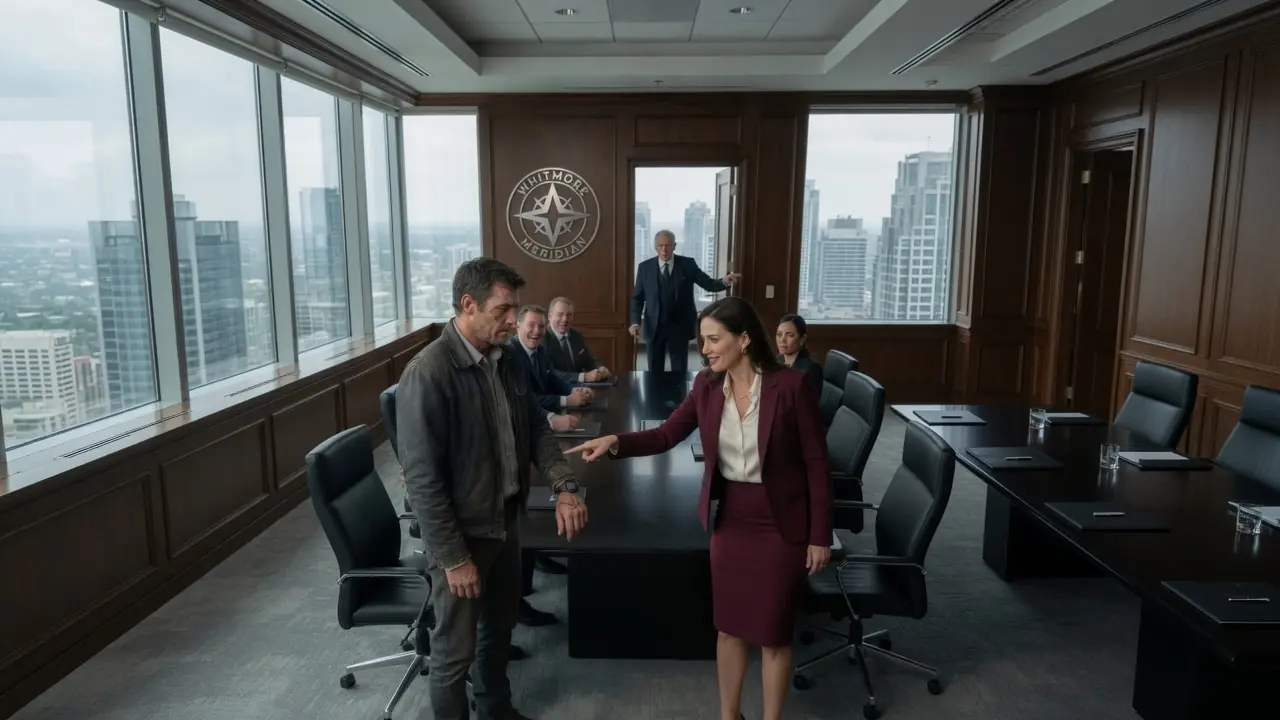
He arrived at the headquarters of Whitmore Meridian for an interview that most people in the building considered beneath their notice, a mid-level position overseeing technical safety review for the company’s newest infrastructure division. He wore a clean button-down shirt, a jacket that had seen better winters, and the same electronic watch he wore every single day of his life. Marlo Bennett had personally requested his resume after hearing how he had resolved industrial failures that engineers with far more impressive degrees could not untangle. His paperwork was unremarkable on its surface, no prestigious university, no glossy title, only years of freelance work crawling through machinery other people were afraid to touch.
During the technical portion of the interview, he found three inconsistencies in the schematics for the company’s newest system within the first ten minutes. Evelyn walked into the middle of that interview after hearing that a candidate was quietly challenging a design her operations chief, Julian Crestwood, had already approved. She assumed immediately that the stranger in the worn jacket was simply trying to make a scene for attention. Julian, sensing an opportunity, asked Grant whether he had ever managed a project worth billions of dollars in his career.
Grant answered that he had managed situations where a single wrong decision could mean hundreds of people never made it home to their families. Evelyn’s eyes drifted to the plastic watch on his wrist, and her mouth curved into a thin, amused smile. She asked whether someone who chose to wear something that looked purchased at a gas station truly understood what standards meant at Whitmore Meridian. Several directors chuckled politely and Marlo’s jaw tightened though she had no authority to stop her chief executive from speaking.
Grant did not raise his voice or defend himself with anger. He simply said that the price tag on a watch could never explain what that watch had witnessed. Evelyn ended the interview there, telling him that Whitmore needed people who could represent the caliber of the company he was applying to join. Grant rose from his chair, pulled his sleeve back down over the timepiece, and turned toward the door without another word.
At that exact moment, Thaddeus Whitmore stepped into the room for a scheduled board meeting, and the watch on Grant’s wrist let out a short, familiar chime, marking 11:47. Thaddeus spun around so quickly that his cane nearly slipped from his hand. His eyes locked on the object strapped to a stranger’s wrist. He crossed the room faster than a man of his age should have moved, staring at the back of that scratched plastic case, as though he had seen a ghost rise up in the middle of a corporate boardroom.
The entire room fell into a silence heavier than anything Evelyn had ever witnessed from her father. He asked Grant to turn the watch over so he could see the engraving clearly, his voice trembling in a way none of the executives had ever heard from the founder of Whitmore Meridian. Grant refused to remove it from his wrist, but he turned his hand so the old man could read the words scratched into the back of the case. Thaddeus recognized the crescent-shaped scar cut into the metal and the crude handcarved letters beneath it immediately.
Thaddeus swayed on his feet and had to steady himself against the conference table, his composure cracking in front of dozens of people who had never once seen him lose control. Evelyn had never witnessed her father react to anything the way he reacted to a stranger’s cheap watch, and it unsettled her more than she wanted to admit. Conrad Whitmore entered the room moments later and also caught sight of the timepiece. But where his brother turned pale, Conrad’s face turned cold and unreadable in an instant.
He declared almost too quickly that the object had to be a forgery. Grant studied Conrad the way a man studies someone he has already learned to recognize from a distance. Thaddeus asked everyone to leave the room, but Grant said this was no longer a private matter buried safely in the past. Evelyn, frustrated that an ordinary job candidate had rattled her father so badly, demanded to know what the watch actually meant.
Thaddeus said only that a man named Malcolm Holloway had once worked at the Brighton Ridge facility many years before. Conrad interrupted, describing Malcolm as a disgruntled technician who had caused a dangerous failure and then fled from responsibility for his own mistake. Grant pulled a folded copy of a current technical report from his jacket pocket and pointed to a component code buried inside it. He explained that Whitmore Meridian was preparing to repeat the exact failure that had occurred at Brighton Ridge two decades earlier.
Evelyn accused him of using ancient history as leverage against her company. Thaddeus asked how he could possibly know that specific component code. Grant pressed a small button on the side of the watch, activating a lap memory function nobody in the room expected a plastic timepiece to possess. A string of numbers appeared on the tiny display.
Numbers that had been sitting untouched inside that device for twenty years. The sequence matched exactly with the batch code of a defective component that had vanished from the factory’s official records. Conrad immediately demanded that security confiscate the watch, insisting it was stolen company property. Thaddeus raised a hand and stopped the guards before they could take a single step.
He declared that no one would touch Grant or the watch on his wrist while he still had breath in his body, and Evelyn began to understand that her father did not merely recognize this object. He feared exactly what it represented. Grant looked directly at Thaddeus and said his brother had once saved the old man’s life, and in return, the Whitmore family had let him die, branded as the guilty man. Thaddeus asked to speak with Grant privately, and Grant agreed only if Evelyn and Marlo remained in the room as witnesses.
He explained that Malcolm had been a safety technician at Brighton Ridge, a man without an advanced degree, who nonetheless understood every wire, every valve, and every backup circuit inside that aging plant better than anyone with a diploma on the wall. Malcolm had repeatedly warned about a batch of cheap switchgear supplied by a new vendor. Conrad had personally approved to save money on the timeline. Those warnings filed three separate times were downgraded and dismissed because replacing the components would have slowed production during the largest order in company history.
Malcolm had been the kind of man who stayed late without being asked, who checked a valve twice simply because something about the reading felt wrong to him, and who treated every worker on his crew like family, regardless of rank or title. He kept a small notebook of maintenance concerns long before anyone suggested he formalize his warnings into official paperwork, and colleagues remembered him walking the corridors before every shift. listening to the plant the way other men listened to music. After the incident, the official report claimed Malcolm had ignored protocol, interfered without authorization, and caused the outage himself.
He was fired within days, stripped of his benefits, and quietly blacklisted throughout the entire industry so that no comparable employer would ever hire him again. Grant, still young at the time, tried desperately to help his brother appeal the decision. But every lawyer who agreed to take the case, eventually withdrew under pressure, that nobody would explain. Malcolm never told his younger brother the full story of what happened inside that plant on the night everything fell apart.
Before he died, all he did was hand Grant the watch and speak one final instruction that took years to fully understand. He told him that when the watch chimed 11:47 in front of a member of the Whitmore family, Grant should look directly into their eyes and watch for the truth. Grant had waited a long time to understand what those words truly meant. and eventually he discovered that a new energy project inside Whitmore Meridian used a design almost identical to the failed system at Brighton Ridge.
He applied for the position legitimately, intending to warn the company from the inside before history repeated itself with new victims. Evelyn remained skeptical because Grant had no direct proof that his brother had been innocent of the accusations against him. Thaddeus admitted that Malcolm had indeed saved his life that night. Yet, he avoided answering who had actually falsified the paperwork.
Afterward, Grant sensed that Thaddeus was still protecting someone close to him, someone he could not bring himself to name aloud. Conrad returned with a company lawyer and produced an old confidentiality agreement bearing what appeared to be Malcolm’s own signature. According to that document, Malcolm had accepted full responsibility for the outage in exchange for a substantial settlement payment. Grant said flatly that his family had never received a single dollar from any such arrangement.
Marlo pulled up old payment records and discovered the settlement had been routed through an intermediary account that disappeared from the ledger within weeks. Evelyn began to question the internal systems she had trusted her entire career. A small crack was forming in the foundation she assumed was solid. Conrad accused everyone in the room of letting emotion jeopardize a project worth billions of dollars in future contracts.
Julian sided with Conrad and suggested that Grant be removed from the building immediately for causing a disruption. Thaddeus surprised everyone by halting the interview process entirely and calling an emergency board session for the following morning. Grant told him there was no time to wait until morning because the new system was scheduled to run a full-load stress test that same night without any further review. Marlo checked the schedule and confirmed his claim within minutes, her expression tightening with growing alarm.
Grant predicted with unsettling precision the exact moment the first electrical fluctuation would appear once the system reached peak load. He said it would happen at 11:47 in the evening. The same eleven minutes and forty-seven seconds frozen forever on the face of his brother’s watch. Evelyn reluctantly brought Grant to the Meridian North testing facility that night, still unwilling to trust him completely.
but unable to ignore how deeply her father had reacted to a stranger’s watch, Julian led the technical team and insisted repeatedly that the new system was entirely safe and thoroughly vetted before deployment. Grant asked to see the raw operational data instead of the polished summary reports circulated to executives. The operations staff explained that raw data access was restricted to senior leadership only. a wall Grant had expected to hit.
Evelyn granted him temporary clearance despite the visible discomfort on Julian’s face. Within minutes, Grant discovered several small fluctuations that automated smoothing software had quietly filtered out of every official report for months. He explained that a failure like this one rarely announced itself as a sudden explosion, but instead built gradually through repeated cycles that most monitoring systems were never designed to notice. The lap function on Malcolm’s old watch became the clearest illustration of that 11 minute and 47 second cycle.
A pattern etched into a plastic case decades before anyone in the room was born. Julian mocked the idea of analyzing a billion-dollar system using what he called a toy watch from a discount store. Grant simply asked for an independent simulation run using the parameters he had identified from the raw data. The results showed that after exactly eleven minutes and forty-seven seconds under high load, two backup switchgear units began responding in direct contradiction to one another.
Julian dismissed it as nothing more than simulation noise, unwilling to let a stranger’s warning override months of his own work. Conrad called Evelyn directly and pressed her to continue the full-load test regardless of the warning, reminding her how much the contract deadline mattered to the company’s future. Evelyn found herself caught between enormous financial pressure and the quiet certainty in Grant’s voice as he laid out the evidence in front of her. Grant told her plainly that he did not need her to trust him personally, only to look honestly at what the data was already showing her.
She gave the order to halt the full-load test just moments before it would have reached peak capacity. Seconds later, a backup switchgear unit tripped on its own, even though the system had already been throttled down to a safer level. There were no injuries and no visible disaster, but the evidence proved beyond doubt that the danger Grant described was entirely real. Grant pointed to the component code stamped on the failed part, a code that matched precisely with the sequence stored inside his brother’s watch.
Evelyn asked why any technician would choose to hide a component code inside a wristwatch instead of simply writing it down. Grant explained that workers at the old plant were forbidden from removing any paperwork from the facility under any circumstances. Malcolm had used the lap memory function to preserve the batch number before the official records could be altered without his knowledge. For the first time, Evelyn apologized to Grant for the way she had mocked him in front of the entire boardroom.
He told her an apology alone, could not undo twenty years of buried dishonesty, affecting people who never had the power to defend themselves. Thaddeus arrived at the testing facility not long after the failed switchgear unit tripped. When he examined the broken component with his own hands, something in his expression finally broke open. He admitted he had seen an identical part fail once before.
on the night everything went wrong at Brighton Ridge so many years earlier. Malcolm had not caused that disaster. Thaddeus finally confessed in front of everyone gathered in the room. The order to keep the system running despite every warning had come from his own younger brother, Conrad Whitmore, and no one else.
twenty years earlier, the Brighton Ridge facility had been racing to complete the largest order in the company’s entire history. Conrad, desperate to prove he deserved to eventually take over from his older brother, pushed the timeline harder than anyone thought was reasonable. Malcolm discovered that a cheap batch of switchgear units slowed dramatically whenever internal temperatures climbed past a certain threshold. He filed three separate warnings, each one downgraded by Conrad’s office before it could reach anyone with the authority to halt production.
Thaddeus made an unannounced inspection of the plant on the very night the system finally became unstable under sustained high demand. A cascading power failure trapped him inside a secondary control room just as the facility’s automatic evacuation protocol activated for everyone else. Alarms echoed through the smoke-filled corridors while emergency lighting flickered against walls slick with condensation and workers streamed past each other toward the exits in the controlled panic of a drill that had suddenly become terrifyingly real. Malcolm knew one man remained inside the danger zone and turned back against every instinct, telling him to run toward the exit with his co-workers.
He used his own watch to track the narrow window between electrical cycles, giving himself roughly twelve minutes before the backup systems would lock the corridor permanently. He found Thaddeus disoriented in the smoke-filled control room, guided him through a service corridor by memory alone, and manually overrode a secondary switch to buy them both a few extra seconds. The impact against a control panel during their escape jammed the stopwatch function forever at eleven minutes and forty-seven seconds. While riding in the ambulance afterward, a shaken Thaddeus noticed the engraving on the back of the watch and promised the young technician he would be publicly honored for his courage.
Conrad warned his brother that admitting the company had knowingly used substandard components would cost them their operating license and put thousands of jobs at immediate risk. He proposed framing the incident as an isolated act of individual misconduct, promising to quietly compensate Malcolm behind the scenes to make the injustice more bearable. Thaddeus, still recovering and desperate to protect the company he had built from nothing, agreed to delay any public acknowledgement for what he believed would only be a few days. During that brief window, Conrad rewrote internal reports, pressured Malcolm into signing a confidentiality agreement, and severed every channel of communication between the two men.
Thaddeus was told that Malcolm had accepted the settlement money and left the state to start a new life somewhere quiet. He chose to believe that comfortable version of events rather than dig deeper into a truth that would have implicated his own brother. In reality, the settlement funds were routed into a shell company Conrad controlled personally, and Malcolm never saw a single dollar of the money attached to his name. He was threatened that if he fought back publicly, the entire maintenance crew who had trusted his warnings would face criminal charges alongside him.
Malcolm chose to carry the blame silently rather than let his co-workers suffer for decisions that were never his to make. Thaddeus admitted he had never investigated deeply enough because some part of him feared exactly what he would find if he looked too closely at his own brother’s choices. Grant told him that cowardice from a powerful man could be every bit as destructive as the cruelty of the person who orchestrated the entire scheme. Evelyn listened to all of it in silence, slowly realizing the empire she now ran had been quietly built on the sacrifice of a man.
History had unfairly branded a disgrace. Thaddeus revealed that Malcolm had once mailed a package of documents directly to his private residence years after the incident, hoping the truth would finally reach him. That package vanished before it ever landed in his hands, and he had never learned who intercepted it or where it disappeared to afterward. Marlo pulled old delivery logs and discovered the signature on the receipt belonged to a junior staff member working directly out of Conrad’s office at the time.
Reese Callaway, a record specialist most executives barely acknowledged, later found an archival code proving the missing package had never actually been destroyed. Instead, it had been quietly transferred into an undisclosed storage facility buried within Whitmore Meridian’s older decommissioned property holdings. The discovery gave Grant and Evelyn their first real path toward finding proof that could not be dismissed as one man’s word against another’s. The hidden storage facility sat beneath a factory that had been shuttered for years, absent from every official asset registry the company maintained.
Evelyn requested immediate access only to learn the location technically fell under a legal division still controlled by Conrad’s office rather than her own. She began to understand for the first time that her authority as chief executive was quietly bounded by a network her own family had constructed decades before she ever took the role. Grant, Evelyn, Marlo, and Reese traveled to the facility together alongside an independent auditing team brought in to ensure nothing could be tampered with along the way. Inside, they found dozens of storage boxes connected to the old Brighton Ridge facility, some completely empty and others clearly relabeled.
At some point after the fact, Reese noticed the filing sequence broke apart entirely during the exact year the original incident had taken place. A gap too precise to be accidental. The archive stretched for what felt like an entire city block underground, rows of gray metal shelving disappeared into darkness beyond the reach of the auditor’s portable lighting.
and the air carried the particular staleness of paper that had not been touched by daylight in decades. Reese moved methodically, cross-referencing faded labels against a handheld scanner, while Marlo photographed every shelf they passed for the official record. and Evelyn found herself unexpectedly moved by the sheer scale of what her own company had chosen to bury rather than confront. Grant used the numerical sequence stored inside the watch to pinpoint the correct section, shelf, and container among hundreds of nearly identical boxes.
Inside, they discovered Malcolm’s original warning reports, a full list of the defective component batches, and internal memos bearing Conrad’s own handwriting. There was even an unsent draft of a public commendation for Malcolm that Thaddeus had written, but never released to anyone. The single most important document, however, the direct order authorizing continued operation despite the warnings, was nowhere to be found among the recovered files. Old security footage later revealed that Julian had entered this exact facility only one week before Grant’s interview even took place.
Evelyn confronted him immediately, demanding an honest explanation for why he had been there in the first place. Julian claimed Conrad had personally instructed him to inventory the archive ahead of a planned corporate restructuring effort. Evelyn suspended him on the spot without a moment of hesitation. Her patience for excuses finally exhausted.
Julian lashed out, accusing her of destroying the company over a cheap watch and the unverified story of a total stranger. Grant calmly replied that the watch had never destroyed anything on its own and that the people frightened of what it represented were the real problem in the room. Moments later, the facility’s fire suppression system triggered without warning, sending water pouring down across the shelves of fragile old documents. It was no accident, but a deliberate act of sabotage triggered remotely by someone determined to erase the evidence before it could be fully cataloged.
Grant used the backup electrical panel to manually seal off the affected section before more damage could occur. Drawing on decades of hands-on experience with exactly this kind of aging infrastructure, Evelyn and Marlo rushed to move whatever documents they could into waterproof containers positioned nearby for the audit. Reese suddenly remembered an old digital scan of the archive that had been backed up years earlier onto an offline server, rarely accessed by anyone. That scan contained a digital copy of the missing authorization order, complete with what appeared to be Conrad’s own electronic signature attached.
Conrad, when confronted, insisted the signature had been fabricated entirely, and that someone was clearly trying to frame him for decisions he never made. Thaddeus suddenly recalled that on the night of the original incident, he had personally phoned the operations office and that call would have been automatically recorded by the plant’s outdated telecommunication system. Conrad called an emergency board meeting the very next morning and formally proposed removing Evelyn from her position entirely, arguing she had placed a private family matter above the interests of every shareholder in the company. The board assembled at company headquarters where Conrad had spent months quietly building support among members loyal to the old guard he represented.
Julian, hoping to salvage his own position, testified that Evelyn had halted a critical project without sufficient justification behind her decision. Grant was portrayed to the board as a struggling single father exploiting a family tragedy in an attempt to extract a payout from the company. Conrad displayed a photograph of the plastic watch and mocked the idea that an entire corporation could be paralyzed by, in his words, a $20 piece of plastic. A handful of board members laughed quietly along with him, though Grant’s expression never changed.
Evelyn stood and admitted openly that she herself had once mocked that same watch, confusing its low price with the worth of the man wearing it. She presented the recovered evidence detailing the defective component batch and the deliberate alteration of internal safety records. Conrad argued that the documents only proved Malcolm had issued warnings, not that he had personally authorized the plant to keep running against those warnings. Thaddeus rose and publicly confirmed without hesitation that Malcolm Holloway had saved his life inside that control room twenty years earlier.
Conrad countered by forcing his older brother to admit he had known about the cover up for years and chosen silence anyway rather than risk the company’s reputation. The board’s confidence in both brothers collapsed almost simultaneously as the true scope of the deception became clear to everyone in the room. The room grew tense as members shifted uncomfortably in their seats, unwilling to meet Evelyn’s eyes as the discussion dragged toward its inevitable conclusion. Some directors whispered among themselves about legal exposure, others about the optics of siding against the founders’s brother during a moment of such visible instability, and a few simply sat with their hands folded, waiting to see which way the balance of power would tip before committing themselves publicly.
Conrad proposed removing Evelyn to stabilize the company during the unfolding crisis and after a tense vote, the board suspended her from her position by a narrow margin of two votes. Conrad assumed temporary control of daily operations and immediately ordered every internal investigation into Brighton Ridge shut down without further discussion. He privately offered Grant $5 million in exchange for the watch, a signed confidentiality agreement and a quiet departure from the city entirely. Grant refused without a second thought.
Conrad raised the offer to $10 million. Clearly certain that every man eventually had a price he would accept. Grant told him plainly that Conrad still believed a higher number could turn the truth into something for sale. Conrad ordered security to escort Grant from the building, and for a moment, it seemed the entire effort had collapsed under the weight of institutional power.
Marlo discovered that the watch could still connect to an old retrieval terminal once used in the Brighton Ridge telecommunications room, a piece of hardware nobody had touched in decades. Grant realized his brother might have stored more inside that small device than a single string of numbers meant to identify a batch of parts. The lap function, it turned out, could also hold a short digitized audio fragment pulled from an emergency call system active on the night of the accident. Evelyn, stripped of her title but unwilling to walk away, chose to accompany Grant back to the abandoned facility despite everything she stood to lose.
She admitted this might be the first decision of her entire career made without any guarantee that her power would survive it. Grant told her that might be the first time in her life she had truly earned the position she once held. The old terminal hummed and sputtered as it powered on for the first time in years, its dust-covered screen flickering weakly while Ree coaxed the connection into place with cables salvaged from a supply closet nobody had opened in ages. Grant watched the progress bar crawl forward with a stillness that betrayed nothing of what he felt inside, and Evelyn found herself holding her breath without meaning to.
When the recording buried inside the watch was finally decoded using the old equipment, a voice filled the empty control room that silenced every person present instantly. It was Conrad unmistakably ordering the facility to keep running that night and instructing his staff to place the blame entirely on Malcolm Holloway if anything went wrong. The recovered audio carried a precise timestamp, an internal system code, and an authentication marker tied to the plant’s old communications network. Details that made forgery nearly impossible to claim credibly.
Marlo brought in independent digital forensic experts to confirm the recording had not been altered or manipulated in any way. Grant resisted the urge to release the recording publicly right away, worried it might trigger panic and inadvertently harm the very workers he was trying to protect. Evelyn suggested sending the evidence simultaneously to regulatory authorities and independent board members outside Conrad’s direct influence, a sign of how far she had grown since the story began. It reflected a new kind of leadership from her, one no longer built around protecting her personal image at any cost.
Conrad attempted to erase the recording from company servers, but by then copies had already spread across several secure devices beyond his reach. Julian, realizing Conrad intended to make him the sole scapegoat for the archive sabotage, chose to cooperate fully with the ongoing investigation. He handed over internal emails detailing both the destruction of records and the continued use of the same unreliable supplier for newer projects across the company. The full board reconvened once more and this time the recording was played for every member present without exception.
No one in that room could continue pretending Malcolm Holloway had ever been responsible for what happened at Brighton Ridge. Conrad still tried to justify his actions by claiming he had only been trying to save the entire corporation from financial ruin. Grant told him plainly that he had never saved the corporation at all. He had only saved his own position by quietly destroying another man’s life.
Thaddeus stood before the board and publicly accepted responsibility for his own years of silence on the matter. He voluntarily surrendered his remaining voting rights and formally requested that Malcolm’s name be cleared in every company record still bearing his name. Conrad was removed from all positions of authority and now faces an ongoing investigation into fraud, obstruction, and the theft of settlement funds meant for someone else entirely. There was no dramatic arrest, no flashing lights, only the quiet sight of a once-feared man walking out of a boardroom filled with people who no longer feared him at all.
The board immediately asked Evelyn to resume her position as chief executive without further delay. She agreed, but only under three conditions she considered non-negotiable given everything they now understood. She demanded that every component connected to the defective batch be pulled immediately for independent testing across every active project. She insisted on creating a safety division with full independence from executive oversight, answerable only to the board and to employees directly.
She required a public restoration of Malcolm Holloway’s reputation along with fair compensation for his surviving family. Evelyn then offered Grant the newly created director position, overseeing that entire safety division. Grant declined the prestigious title without hesitation. Unwilling to trade his brother’s memory for a corner office, he agreed instead to serve as an independent adviser with the authority to report directly to both the board and the workers on the factory floor, answering to no single executive alone.
Thaddeus later asked Grant whether the company might purchase the watch to display permanently inside a corporate museum dedicated to its own history. Grant answered without hesitation that the family had already lost far too much simply because the Whitmores once believed everything in the world could be bought. Whitmore Meridian eventually released the full findings of its internal investigation, publicly acknowledging that Malcolm Holloway had saved the lives of Thaddeus and several other workers on the night of the Brighton Ridge failure. His disciplinary record was permanently erased from company files.
The settlement funds that had been stolen years earlier were finally returned to his family with accumulated interest attached. Grant chose not to spend the money on anything extravagant for himself. He kept his small repair shop running as before and used a portion of the funds to launch a training fund for safety technicians named in his brother’s honor. The shop smelled of machine oil and fresh coffee.
Its shelves lined with tools that had been sharpened and cared for over many years rather than replaced whenever something newer came along. and a faded photograph of two brothers stood propped near the register where customers could not help but notice it. Evelyn visited that shop one afternoon without an assistant, a driver, or any of the trappings that normally surrounded her public appearances. She brought an expensive luxury watch with her, intending it as a quiet apology for everything that had happened between them.
Grant looked at the gift for a long moment before gently pushing it back across the counter toward her. He explained that the real issue had never been her failure to offer him something more expensive. The real issue was that she had once believed a cheap object automatically made the person wearing it beneath her notice. Evelyn understood immediately and did not push him to accept the gift against his will.
She apologized directly for humiliating him in front of an entire room of strangers who had laughed along without knowing anything about him. Grant accepted the apology, though he told her honestly that rebuilding trust would take considerably longer than a single conversation. Thaddeus visited Malcolm’s grave together with Grant not long after the truth had fully come to light. He admitted he had spent twenty years believing the comfortable story that Malcolm had simply taken the settlement money and walked away from his old life.
Grant told him he had chosen to believe the version of events that let him avoid confronting what his own brother had truly done. Thaddeus did not attempt to defend himself against that observation. Standing quietly with his hands folded in front of him, he placed the old unreleased commendation letter at the base of the headstone, though Grant reminded him gently that a single piece of paper could never return the years his family had already lost. Still, he acknowledged that making the truth public carried real meaning for the many workers who had once been forced into silence themselves.
Grant continued setting the alarm on his brother’s watch to sound every day at 11:47, not to remain trapped in the past, but to remember a man who turned back toward danger when everyone else was already running toward the exit. The months that followed brought quiet, steady change rather than dramatic headlines as the new safety division began reviewing every active project across the company with a thoroughness that had never existed before. Workers who had once been afraid to raise concerns for fear of losing their jobs found themselves encouraged, even rewarded, for speaking up the moment something felt wrong. Grant visited several facilities personally during that stretch, walking the floors the way his brother once had, listening for the sounds that machines made when something beneath the surface had already begun to fail.
A year later, Whitmore Meridian opened a new industrial safety center named for Malcolm Holloway, welcoming engineers, workers, and the families of everyone who had once labored at the old Brighton Ridge facility. Evelyn addressed the crowd from a small stage near the entrance, refusing to frame the story as some kind of triumph for her own family’s legacy. She openly admitted that her company had once been saved by a technician who held no shares, no fancy title, and no expensive watch on his wrist. Grant stood quietly near the back of the hall, choosing not to join her on the stage, despite repeated invitations from the organizing committee.
The same worn plastic watch was still fastened to his wrist, its strap replaced once more since the events that had changed both of their lives. A young executive near him asked why he still wore something so ordinary now that it had become a genuine piece of the company’s history. Grant answered simply that his brother had worn it while doing honest work, not so it could sit behind glass for people to admire from a distance. At exactly 11:47, the familiar chime rang out clearly across the crowded hall.
The entire room fell into a brief unplanned silence as the sound settled over everyone present. Thaddeus lowered his head without a word. Evelyn looked once more at the watch she had mocked so carelessly on the very first day they met, finally understanding it was worth more than every piece of jewelry in that entire building combined. Its value had nothing to do with metal branding or what it might fetch at auction among collectors.
It held eleven minutes and forty-seven seconds of quiet, unglamorous courage that no amount of money could ever replicate. It held twenty years of silence that had cost one family everything they had, and it forced a powerful dynasty to finally reckon with a debt that no fortune on earth could ever fully repay. Grant switched off the alarm and walked back toward his shop as the crowd behind him slowly began to disperse into the evening air. People in Grey Haven still talked about him sometimes in grocery stores and diners and the quiet corners of the maintenance yard.
Not as a man who had won some grand victory over a powerful family, but simply as the man who had refused to let his brother’s name stay buried under someone else’s lie. He never became a billionaire, never accepted a corner office, and never changed the way he dressed for anyone watching. But from that day forward, no one at Whitmore Meridian ever laughed again at the sight of a cheap watch on an honest man’s wrist. And even the newest hires learned the story within their first week on the job, passed along quietly from one co-worker to another like something worth protecting.
Because sometimes the least expensive object in the room turns out to be the only thing capable of proving who lived with honor and who never