Fairy tales lie about the dress. They tell you it is spun from magic and starlight. They do not mention the smell of camphor, the sweat stains beneath the arms, or the humiliating weight of wearing coarse gray servant’s wool while standing in a room filled with silk. Nora’s day began precisely when the grandfather clock in the hall failed to strike five.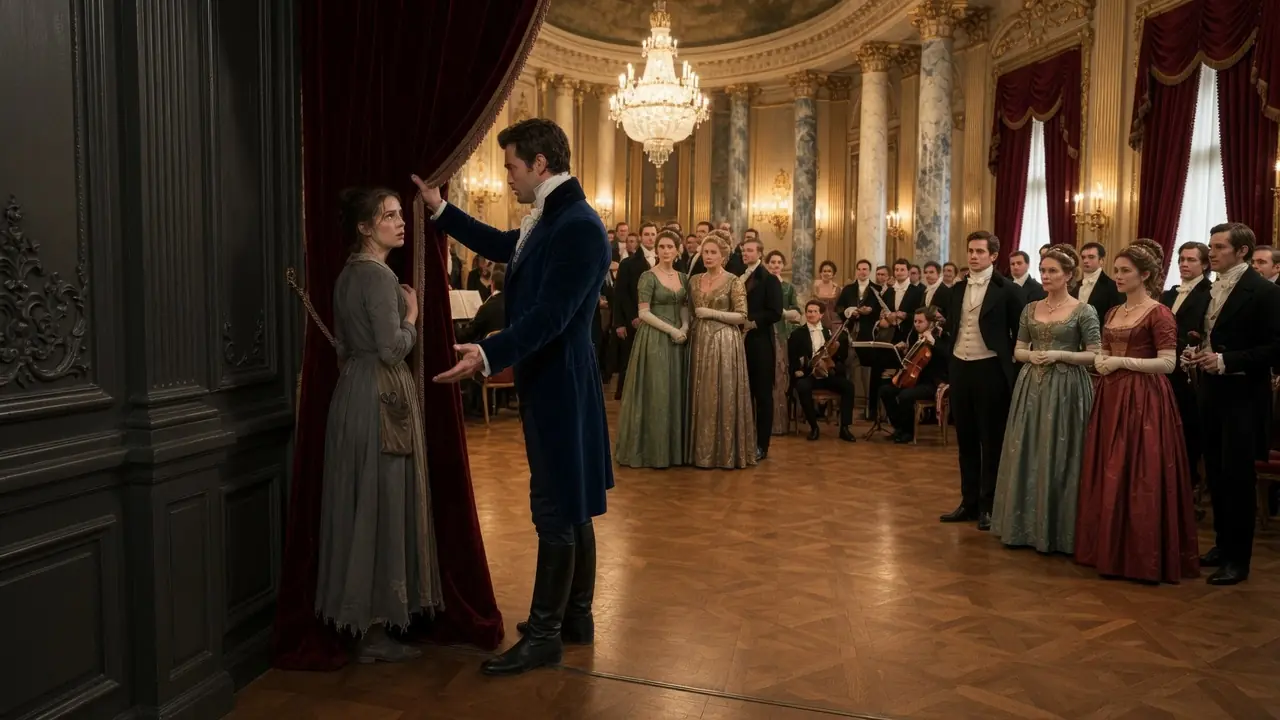
The clock had been broken for three years, its internal gears stripped and sold to a horologist in London to pay for a quarter ton of winter coal. Nora knew it was five because the cold in the attic had a particular biting texture at that hour, sharp enough to crack the ice in her washbasin. She did not sigh; sighing wasted heat. She kicked off the thin wool blanket and found the warped floorboards with her feet by memory.
She dressed in the dark. Her gown was a faded, drab gray, its hem frayed from years of dragging across unvarnished stone floors. It had belonged to a scullery maid who had quit two years earlier, and Nora had patched the elbows with scraps from an old curtain. It smelled perpetually of lye soap, old smoke, and the faint sourness of damp walls.
Downstairs, Highfield Manor was a tomb of faded grandeur. Pale rectangular ghosts remained on the walls where expensive oil paintings had once hung. Nora ignored them, carried the iron ash bucket into the drawing room, knelt on the freezing hearthstone, and began scraping out the previous day’s remnants. Soot coated her fingers and settled deep into the cracked skin around her nails.
“You missed a spot on the mantel yesterday,” a voice rasped from the doorway.
Nora did not look up. Her aunt Beatrice stood wrapped in a threadbare velvet dressing gown, holding a candle that cast harsh upward shadows over her gaunt face. Beatrice was not an evil woman. Evil required a surplus of energy and imagination she simply did not possess; she was instead desperately terrified.
The family was broke—deeply, irrecoverably broke. Nora’s father, Beatrice’s brother, had gambled away his portion, died of an apoplexy, and left sixteen-year-old Nora on Beatrice’s doorstep. Five years later, Nora was less a niece than an unpaid, uncomplaining beast of burden. No formal decision had ever been made about her place in the household. It had happened by degrees: first she helped because there was no money for another maid, then she took over the early fires, then the laundry, then the mending, until service had swallowed every other identity she possessed. Beatrice still called her family when guests were present, but below stairs Nora occupied the place of whichever servant had most recently left.
“I will see to it, Aunt,” Nora said, her voice flat and free of the theatrical misery that colored most conversations in the household.
“See that you do. And make the tea strong this morning. Cecily hardly slept.” Beatrice stepped closer, anxiously scanning the room as though a creditor might be hiding behind the moth-eaten curtains. “Tonight is the Duke’s ball. Tonight is everything. If Cecily does not secure Locksley’s attention...”
She did not finish. She did not have to. If Cecily did not marry money soon, the bank would foreclose on Highfield. They would be put into the street. Beatrice might survive by moving in with a distant, resentful cousin in Bath, while Nora would be turned out to find work as a governess—or, worse, as a factory hand.
“The green silk is pressed,” Nora said, sweeping the last ash into the bucket. “I mended the lace at the cuffs last night. It looks as good as it did when it was new.”
“It must look better than new. It must look wealthy.” Beatrice rubbed her temples. “Locksley is a stubborn beast. They say he spent ten years at sea before his brother died. A military man. He will not care for flounces, but he will care for breeding. Cecily must look flawless.”
By noon, the house had become a storm of panicked preparation. Cecily, Nora’s cousin, was a pretty girl, though anxiety pinched her features and aged her by a decade. She sat before the vanity clutching her stomach while Nora pulled a brush through her hair with ruthless efficiency.
“It is no use,” Cecily whispered, staring at her reflection. “I am going to vomit. I know I am.”
“Breathe through your nose,” Nora instructed, tugging the brush through a stubborn knot. “You are not going to vomit. You are going to smile, dance, and ask the Duke about his naval service. Men like to speak about themselves. Nod and look fascinated.”
“He is thirty-two,” Cecily moaned. “He is practically ancient, and they say he has a scar on his neck.”
Cecily met Nora’s gaze in the mirror. For a brief moment, the aristocratic veil slipped and revealed the frightened twenty-year-old beneath it. “Are you never angry, Nora, that you must remain here and scrub grates while I go?”
Nora looked at her own reflection: dull hair pulled tightly back, sallow skin from too little sunlight, and a coarse gray dress that swallowed her figure. Three years earlier, she might have cried. She might have dreamed of a secret benefactor, a hidden fortune, or some miraculous reversal of fate. But hope was a parasite; it fed upon one’s strength and left one starving. She had once imagined that someone might notice how hard she worked, that an old legal paper might reveal money held in trust, or that a benevolent relative might remember her existence. Nothing had happened. The creditors kept arriving, the coal kept disappearing, and every winter coat in the house grew thinner. Nora had survived by trading fantasy for competence.
“No,” Nora said as she secured the final pin. “Dancing in tight shoes looks exhausting. Stand up. We must get you into the corset.”
Ten miles away, Arthur Hastings, Duke of Locksley, stood in the middle of his cavernous ballroom staring at a smudge on the parquet floor. He was tall, thickly built, and broad across the shoulders from a decade spent on the pitching decks of a warship rather than reclining in velvet chairs. His dark hair was cut ruthlessly short, unfashionable among the aristocracy but practical for a man who hated sitting for a barber.
A jagged, faded scar ran from behind his left ear and disappeared beneath his collar, a souvenir from a French boarding pike. It ached whenever damp English weather rolled in. At that moment, it was throbbing.
“Mr. Finch,” Arthur called, his low, gravelly voice echoing through the empty hall.
His steward, a thin man clutching a thick leather ledger, hurried forward. “Yes, Your Grace?”
“Why does the ballroom smell like a rotting lemon?”
Finch adjusted his spectacles. “That would be the new floor wax, Your Grace. It is heavily scented with citrus oil. It is considered very fashionable in London.”
“It smells like a brothel in a fruit market.” Arthur rubbed the back of his neck. “Open every window. Let the winter air in. If I must endure three hundred people in this room tonight, I refuse to suffocate before the first waltz.”
“It will freeze the guests, Your Grace.”
“Good. Then they may leave early.”
Finch snapped the ledger shut. “Sir, I must protest. This ball is not a triviality. You have been in the country for six months since your brother’s passing. The local gentry and the London families are circling. There are whispers that you intend to let the Locksley title die with you out of sheer stubbornness.”
Arthur turned his gaze toward the enormous crystal chandelier above them. His brother Edward had bought it in Italy. Edward had been the perfect duke: charming, elegant, useless in a crisis, but brilliant at a dinner party. He had died of a sudden fever, leaving Arthur an estate drowning in debt, a crumbling political alliance, and a title he had never wanted.
Arthur had spent the last six months attacking the estate ledgers, selling bloated assets, dismissing corrupt managers, and dragging the Locksley lands back into profitability. He had worked like a dockhand. The bank accounts were now full, the tenant farms were thriving, and the house had been rescued from ruin. Arthur had discovered rents collected but never entered, repairs invoiced twice, and entire storerooms filled with objects purchased only to impress visitors. He had sold what the estate did not need, repaired what people actually used, and reduced every account to a truth that could no longer hide behind a crest. The work had earned him fear from dishonest men and loyalty from nearly everyone else.
“I am not stubborn, Finch. I am practical,” Arthur said. “I need a wife, and I am perfectly aware of my duty. I need someone capable of managing this oversized mausoleum, bearing an heir, and keeping politicians out of my study.”
“Then tonight is the perfect opportunity. Lady Sarah will attend, as will the Earl of Rutledge’s daughter. Beautiful, educated girls.”
“Porcelain dolls,” Arthur scoffed. “They speak in whispers, faint at the sight of a stray dog, and care only about the width of a silk ribbon. I spent ten years keeping men alive at sea. I want a partner with a spine, Finch, not a decoration.”
“Spines are rarely visible in a ballroom, Your Grace.”
“Then I shall have to look closely.” Arthur checked his battered brass pocket watch, its case dented by musket fire. “The musicians arrive at six. See that they are fed before they play. Hungry men play out of tune. And for God’s sake, open the windows.”
That evening, Arthur stood at the top of the grand staircase, trapped in the suffocating rigidity of formal evening clothes. The dark blue coat pinched his shoulders, and his stark white cravat felt like a slow strangulation. Below him, the foyer churned with color and noise.
Guests arrived in waves, shedding heavy cloaks to reveal blinding jewels and silks. The air thickened with roasting meat from the dining hall, cheap perfume attempting to conceal unwashed bodies, and the metallic scent of nervous sweat. Arthur descended with his face arranged in a mask of polite indifference.
He greeted local squires, bowed to dowagers, and danced the required dances. It was exactly as agonizing as he had anticipated. Lady Sarah giggled each time he spoke, regardless of what he said. A viscount’s daughter spent an entire set boasting indirectly about her father’s influence in Parliament.
By ten, Arthur felt the familiar creeping exhaustion. It was not physical; he could march thirty miles with a pack on his back. It was mental fatigue—the sheer volume of pretense in the room draining the life from him. He wanted to tear off his coat, sit beside a fire with cheap rum, and listen to silence. At sea, silence had meant danger, fog, or men waiting for cannon fire. In London society, it had become a luxury. Every conversation in the ballroom seemed designed to conceal rather than reveal, and every compliment carried the weight of a request waiting to be made.
After escaping an aggressive mother attempting to push her terrified daughter into his path, Arthur retreated toward the shadowed alcoves lining the ballroom. He needed five minutes of peace before returning to the slaughter.
The disaster in Beatrice’s carriage had occurred precisely when it struck a rut two miles from Locksley Hall. Cecily gasped and shifted violently to keep from falling. A sharp tearing sound followed, louder to Beatrice than cannon fire.
Nora, crammed onto the small rear bench, immediately dropped to her knees. She struck a match and held it close to Cecily’s dress. The green silk had split along the side seam at the waist, exposing the corset beneath.
“Ruined!” Beatrice shrieked, her hands flying to her hair. “We are ruined. Turn the carriage around. It is over.”
“Stop screaming,” Nora said sharply.
The authority in her usually quiet voice shocked both women into silence. “The tear follows the seam. It is clean.”
“We cannot repair it here,” Cecily sobbed. “It is freezing, and I cannot walk into the ball looking like a beggar.”
“You will not.” Nora reached into the deep pocket of her gray dress and withdrew a small cloth bundle. Inside were needles, heavy green thread, pins, and tiny iron scissors. She never went anywhere without them. Survival required her to expect that something would break.
“I will pin it now so you can walk inside,” she said, her fingers moving swiftly in the dim, shifting light from the carriage lantern. “Once we reach the hall, find a cloakroom or alcove. I will sew you into it.”
“You?” Beatrice stared at Nora in horror. “You cannot go inside. Look at you.”
Nora looked down. Morning ash stained the hem of her gray dress. Her boots were dull, cracked, and scuffed. She wore no corset, jewelry, or gloves, and her hair was pulled into a severe practical knot. She looked exactly like what they had made her: a drudge.
“Unless you know how to execute a blind whipstitch in fewer than four minutes, Aunt, I am going inside. I will use the servants’ entrance and find you.” Nora turned back to Cecily. “Hold still, or I shall pin the silk to your skin.”
Twenty minutes later, Nora slipped through the heavy oak servants’ door at the back of Locksley Hall. The kitchens were a battlefield of shouting cooks, clattering pans, and rushing footmen. No one looked twice at a girl in a gray dress carrying sewing tools. She belonged to the working architecture of the house.
She navigated the back passages, found the narrow hidden staircase servants used to reach the main floor, and crept upward. The transition from the dim stone corridor to the grand hall was violent. One moment, she stood amid damp walls and weak lamplight; the next, she peered from behind a heavy tapestry into a world of blinding brilliance.
Hundreds of candles burned in crystal chandeliers. Music vibrated through the floorboards. Nora spotted Cecily and Beatrice near a marble pillar, both looking close to panic. Keeping to the edges, she darted behind potted ferns and heavy draperies until she reached them.
She seized Cecily’s arm and pulled her behind the velvet curtain of a deep window alcove. “Hold your breath.”
Nora dropped to her knees on the cold parquet. There was no time for gentleness. By the thin line of light leaking around the curtain, she threaded the needle and began to sew. Her hands were stiff from the carriage ride, but muscle memory took command. The needle flashed in and out as she pulled the old silk together and locked the seam.
“Hurry,” Beatrice hissed from beyond the curtain. “People are looking.”
“Let them look,” Nora muttered around a spare pin held between her lips.
“My ribs are being crushed,” Cecily whimpered.
“Pain is temporary. A wealthy husband is permanent.” Nora drew the final stitch tight. “Done.”
She bit through the thread. “Smooth the fabric and keep your arm near the seam when you dance. It will hold, provided no one steps on the hem and you attempt nothing athletic.”
Cecily touched the repair and released a great breath. “Nora, you are a lifesaver. Truly.”
“Go,” Nora said, retreating farther into the shadows. “Before he chooses someone else.”
Beatrice and Cecily swept out from behind the curtain, instantly transforming their panic into serene aristocratic boredom. Nora remained in the alcove. The curtain concealed her from the room but left a narrow opening through which she could watch.
She sank onto a small wooden stool, probably abandoned by a footman. Now that the emergency had passed, cold and exhaustion returned. Her feet ached, and her back throbbed from scrubbing grates that morning. She would have to remain hidden for hours until Beatrice decided to leave. No one had brought a cloak for her because no one had imagined she would enter the house. She had eaten nothing since a crust of bread before dawn, and the warmth rolling through the curtain only made her more conscious of the cold still lodged in her bones. Even so, returning through the servants’ passages too soon risked missing Cecily if the repaired seam failed again.
The ballroom looked beautiful in a distant, theatrical fashion. Colors swirled, jewels glittered, and polished couples moved beneath the chandeliers. Yet Nora could not look at the spectacle without seeing its cost. She saw wax dripping from hundreds of candles, women holding their breath inside brutal corsets, and footmen standing rigid at the doors with exhaustion dulling their eyes.
She drew up her knees, wrapped her arms around them for warmth, closed her eyes, and rested her head against the cold stone wall.
“You are in my chair.”
The low, rough voice was wholly unexpected. Nora’s eyes flew open. She sprang to her feet and drew the small sewing scissors from her pocket.
A man stood at the far side of the alcove, half concealed by the opposite curtain. He was tall and dressed in impeccably tailored dark blue evening clothes that looked uncomfortable on his broad frame. He did not smile. His face was sharp and shadowed, and a pale scar ran down his neck beneath his cravat.
Nora recognized him instantly from every description, though he resembled none of the polished aristocrats she had imagined. He looked like a man who had walked off a battlefield and was severely annoyed to discover that a party awaited him.
Arthur Hastings, Duke of Locksley, stared at her frayed, ash-stained gray dress.
Nora did not scream or curtsy. She stood completely still, gripping the iron scissors until they bit into her palm.
Arthur’s gaze moved from her face to the tiny weapon. A slow breath escaped through his nose. It might have been a laugh if he had possessed the energy for one.
“If you intend to assassinate me,” he murmured, “you will require a longer blade. You may also need to stand on the stool. I am rather tall.”
Nora’s jaw tightened. She lowered the scissors and returned them to her pocket. “I am neither an assassin nor a thief, Your Grace. I was just leaving.”
“You were hiding,” he corrected as he stepped fully into the alcove and let the curtain fall closed behind him. The shrieking violins became muffled. “Given the smell of burnt sugar and panic out there, I do not blame you. Sit.”
Nora stared.
Arthur pointed at the stool. “Sit before you faint. You look as though you have not slept in a week.”
“I have no intention of fainting,” she replied, though she lowered herself slowly onto the stool. Her legs were trembling, a betrayal she hoped the shadows concealed. “And you are in danger of ruining your coat. There is soot on that wall.”
Arthur glanced behind him and deliberately leaned his shoulder against the stone. “Let it ruin. I hate this coat. It was tailored for a man who cares about the width of his lapels. I care only that the seams hold when I move.”
He studied her. Light leaking around the curtain revealed the fraying threads at her shoulder, the cheap wool, and the ash she had not managed to scrub from her knuckles.
“You are not a servant,” he said. “A servant would have curtsied and fled in terror.”
“I am a poor relation. Functionally, it is the same thing, except I must dine with my employers on Sundays.” She saw no purpose in lying. His eyes had the searching quality of a man accustomed to inspecting ship timbers for rot. “My aunt is Beatrice Gable. We reside at Highfield.”
Arthur nodded slowly. “Gable. I reviewed the bank ledgers last week. Highfield is heavily mortgaged. Three loans have been drawn against the principal acreage.”
Humiliation burned Nora’s neck, but she raised her chin. “Yes. Hence the desperation beyond this curtain. My cousin Cecily is currently trying to smile at you from across the ballroom.”
“The girl whose dress you stitched together like a field surgeon.”
Nora blinked. “You saw that?”
“I spent ten years looking for breaches in enemy hulls, Miss Gable. I notice when one woman suddenly dives behind a curtain clutching her side while another follows with a sewing kit.” He rubbed the bridge of his nose and looked profoundly tired. “Was it the seam?”
“The waistline. The silk was dry-rotted. They bought it secondhand and dyed it again, but it could not withstand the pressure from the corset.”
“And you repaired it.”
“I stabilized it. It should survive a waltz, provided no one steps on her hem.”
Arthur looked at Nora—really looked. He saw the unyielding reality in the line of her mouth, the shadows beneath her eyes, and the raw skin on her hands. There was no artifice in her, no simpering smile, calculated giggle, or perfume meant to imitate a spring garden. She smelled of lye soap, old wool, and cold air. She smelled like survival. Arthur had spent the evening surrounded by women whose hair, jewels, manners, and even laughter had been arranged for effect. Nora appeared to have arranged nothing except the stitches necessary to keep another woman’s dress from splitting. The contrast was so complete that it felt almost violent.
“You realize,” he said softly, “that half the women in that ballroom would sell their mothers for a moment alone with me in an alcove. They would be dropping handkerchiefs and pretending to swoon.”
“I do not own a handkerchief, Your Grace. If I swooned, I would strike my head on the marble and bleed on your floor. I cannot afford to replace the wax.”
For the first time all evening, Arthur smiled. It was not an aristocratic curve of the lips but a sharp, genuine flash of teeth that pulled at the scar on his neck.
“What is your name?”
“Nora.”
“Nora,” he repeated, making the name sound solid rather than delicate. “Tell me, if I walk back into that room and select a bride from the herd of shivering silk, what will become of me?”
She recognized the trap but was too tired to obey the rules of aristocratic conversation. “You will be bored to death within a fortnight. You will spend your days listening to complaints about drafts in the corridors. You will manage the estate alone because she will faint at the sight of a ledger. When the next poor harvest comes, she will cry while you decide how to feed the tenants.”
Arthur’s dark eyes locked onto hers. “Exactly.”
Beyond the curtain, the music swelled into the heavy rhythm of a waltz. It was the premier dance of the evening—the moment when the Duke was expected to enter the floor, signal his favor, and perhaps indicate his choice.
Arthur pushed away from the wall and rose to his full height, rolling his shoulders against the restrictive coat. He looked down at the woman in gray wool.
“Stand, Nora.”
She did not move. A knot of dread formed in her stomach. “Your Grace, I should return to the kitchens. If my aunt discovers me here—”
“Stand.”
The command was quiet, but it carried the unyielding authority of a captain on the quarterdeck. Nora stood and felt impossibly small beside him.
Arthur extended his bare hand, palm upward. His skin was rough, and white scars crossed his knuckles.
“What are you doing?” Nora whispered, staring at his hand as if it were a loaded pistol.
“I am going to dance the waltz, and I refuse to do it with a woman whose character will tear when her silk does.”
Panic pierced her exhaustion. “You are mad. Look at me. I am covered in ash. This dress is servant’s wool, and my boots are scuffed. If you take me into that room, you will humiliate us both. My aunt will turn me into the snow tonight.”
“Your aunt will do nothing of the sort because she owes my bank three thousand pounds. I do not care about the ash. I care about the spine beneath it.”
He stepped closer until she felt the heat of his coat. “I spent ten years watching good men die at sea. I returned to a rotting house, a mountain of debt, and a society of vultures picking at the remains. I am not looking for a decoration, Nora. I am looking for a partner—someone who knows how to hold a broken thing together.”
He did not wait for agreement. He caught her hand. His grip was warm, solid, and inescapable. Before she could brace herself, Arthur swept aside the curtain.
Light struck Nora like a physical blow. The ballroom was a blinding expanse of crystal, gold leaf, and swirling color. Three hundred faces turned toward the alcove. Their collective breath sounded like the sea drawing back before a wave.
Arthur pulled her from the shadows and onto the polished floor without hesitation. The music faltered. The first violinist dragged his bow horribly across the strings while staring, and the conductor waved frantically until the musicians recovered the rhythm.
“Look at me,” Arthur ordered as he stepped into her space. “Not at them. Look at me.”
Nora’s heart hammered against her ribs. She forced her eyes upward. His jaw was set, and his dark gaze held a fierce, protective intensity. He placed one hand firmly at her waist, the heat of his palm passing through the coarse wool, and raised her work-roughened hand in his scarred one for the entire room to see.
He stepped onto the downbeat. Nora stumbled for a fraction of a second when her heavy boot dragged against the floor wax, but Arthur’s grip never shifted. His strength carried her through the turn and concealed the mistake.
“Breathe,” he murmured.
“They are staring.”
She felt their eyes as a physical weight. Dowagers sneered. Lady Sarah whispered behind a feathered fan. Near the punch bowl, Beatrice stood completely bloodless, her mouth open in a silent scream. Cecily looked ready to faint, one hand pressed protectively over the repaired seam in her green dress.
“Let them stare,” Arthur said, turning Nora smoothly through the center of the ballroom. Every other couple had stopped, leaving a wide empty circle around them. “They stare because they do not understand what they are seeing.”
“They are seeing a scullery maid,” Nora replied bitterly, shame finally cracking her practical armor.
“They are seeing the only real thing in this room.”
Arthur did not dance like the languid young lords of London. He moved with grounded, powerful grace, his steps firm and deliberate. He forced Nora to meet his strength. After the first brutal minute of panic, survival took over. Nora had learned long ago that fear did not remove a task; it merely made the hands shake while the task was completed. She treated the dance as she would a torn seam or a failing fire. Arthur provided the pattern, and she found the rhythm inside it.
She stopped resisting him. She straightened her spine, lifted her chin, and allowed the coarse wool of her skirt to brush the fine silk of the women they passed. Her scuffed boots struck the polished floor without apology. If she was going to be ruined, she would not do it while cowering.
Arthur felt the change in her. His hand tightened at her waist, and deep approval flashed in his eyes. “There you are.”
They turned past the enormous mirrors lining the ballroom. Nora caught their reflection: the Duke of Locksley in dark blue and stark white, holding a woman in a fraying gray dress. It looked grotesque. It looked like a mistake. The gray wool absorbed the chandelier light while his evening coat reflected it cleanly. Her patched elbows and cracked boots stood beside polished buttons and immaculate linen. Every rule governing the room declared that the two figures should never have occupied the same reflection.
Then she noticed how he held her—not with pity, and not with the careless grip of a nobleman mocking a servant. He held her as if she were the anchor keeping him from drifting away.
The waltz lasted an eternity and a heartbeat. When the final chord sounded, the music died, leaving absolute silence. No one clapped. No one spoke. The rustle of a single silk skirt at the back of the room sounded like a gunshot.
Arthur did not immediately release Nora’s waist. He stood in the center of the floor, his chest rising and falling against hers, and swept the crowd with a gaze that dared anyone to speak. No one did.
Slowly, he lowered her hand and stepped back. He gave Nora a crisp formal bow—the kind he had denied the Earl of Rutledge’s daughter earlier that evening. Though her legs shook, Nora answered with a deep, precise curtsy, ignoring the pull of her patched hem against the floor.
Arthur then placed his hand at the small of her back. Another gasp moved through the room. He guided her directly through the crowd, and the guests parted like water around a stone.
He stopped before Beatrice Gable, who looked like a woman facing a firing squad. She clutched Cecily’s arm so tightly that the younger woman winced.
“Your Grace,” Beatrice stammered. “I apologize. The girl is unbalanced. She is a charity case. I shall have her removed from your sight immediately.”
Arthur’s hand left Nora’s back, and he clasped both hands behind him. “Mrs. Gable, if you ever speak of her in that manner again, I will personally call in the notes on Highfield Manor by noon tomorrow. You will be in the street before sunset.”
Beatrice made a strangled sound. Her eyes darted toward the watching guests, already calculating how quickly this disaster would spread through every drawing room in the county. Cecily, still holding the repaired seam, looked from Nora to Arthur with astonishment rather than anger. For once, no one was looking at her, and the relief beneath her shock was almost visible.
“However,” Arthur continued, his voice becoming as cold and exact as a ledger entry, “if you pack Miss Gable’s belongings—assuming she possesses anything worth keeping—and deliver them to Locksley Hall tomorrow morning, I will forgive the principal mortgage as her dowry.”
Cecily squeaked. Nora turned sharply toward him. “A dowry?”
Arthur looked down at her. The hardness left his face, revealing the exhaustion and quiet hope she had seen in the alcove. He did not kneel or recite poetry. He spoke to her as an equal.
“I have fifty thousand acres, Nora. I have a house that is too quiet, ledgers that are too long, and a world that expects me to play a game I despise.” He lowered his voice so only Nora, Beatrice, and Cecily could hear. “I do not want a fairy tale. I want a woman who knows how to survive winter. I want a woman who patches the seams when silk rots. I want you.”
Nora stared at the scar along his neck. She thought of the cold attic, the iron ash bucket, and the crushing fatigue of hoping for something better. She had believed she had killed hope in order to survive. Looking at Arthur Hastings, she realized she had not killed it. She had merely demanded that it become practical. Hope without bread, heat, or choice had always seemed cruel to her. What Arthur offered was different. It came with ledgers, keys, responsibility, and the expectation that she would answer him honestly rather than flatter him. It was the first future anyone had placed before her that required the very qualities hardship had taught her to value.
“I will not wear silk,” she said. Her voice shook, but her eyes did not. “I hate the sound it makes.”
Arthur’s mouth twitched. “Good. It is highly flammable anyway.”
“And I want my own ledger. I intend to see the estate accounts.”
Beatrice emitted a sound like a dying bird. Arthur ignored her.
“You may have the bank keys by Tuesday.”
Nora looked around the ballroom at the horrified gentry and the ruins of her aunt’s careful plans. Then she looked back at the scarred man who was offering not rescue, but partnership.
“Then I suppose I should go and pack my needles.”
A real smile broke across her tired face. Arthur offered his arm—not merely his hand, but a solid brace upon which she could lean. Nora laid her small, calloused hand upon his dark blue sleeve.
Together, without looking back at the staring crowd, they walked out of the blinding ballroom and into the quiet, sturdy halls of their future.
Fairy tales lie about the dress, but they also lie about the ending. True romance is not found in magical transformations or golden carriages. It is forged through shared survival, practical choices, and the recognition of the person who will remain beside you when the silk finally tears.