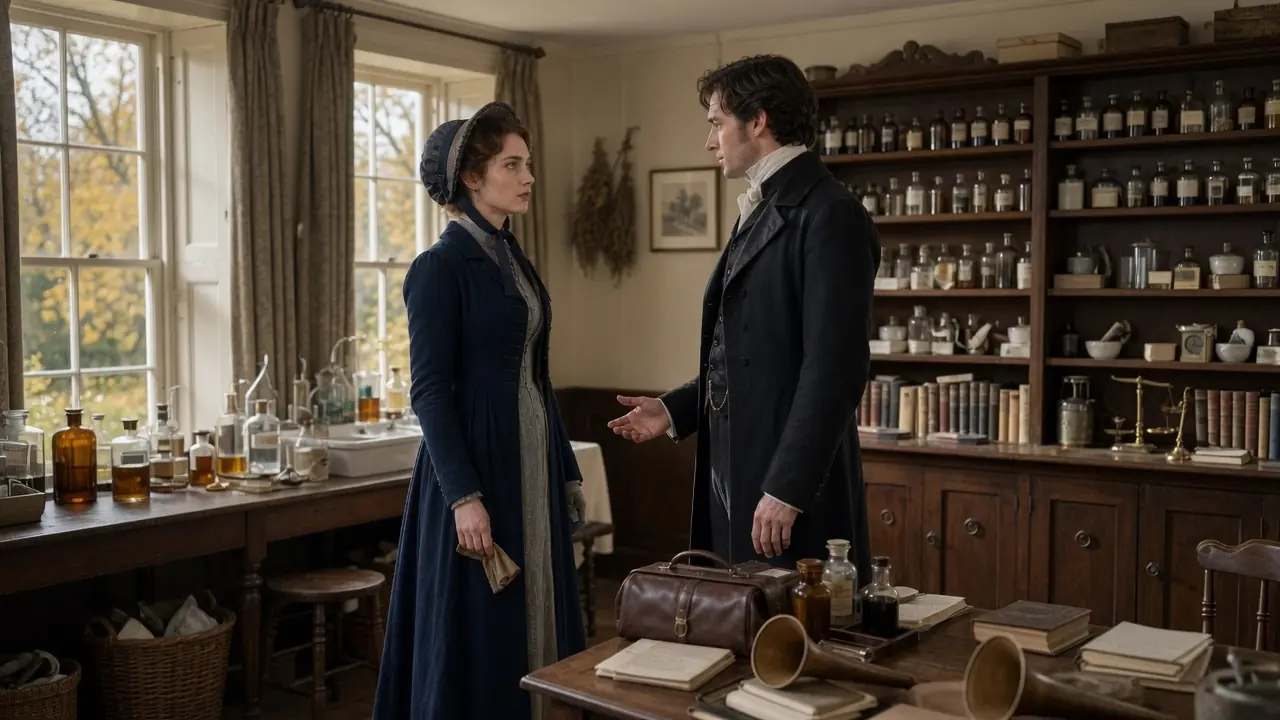
Brierfield Park, Sussex, England. Autumn settled gently over Brierfield Park, not with storm or spectacle, but with a gradual paling of the fields and a quiet thinning of the light. The great oaks along the eastern drive had begun to bronze at their edges, and the lawns, once bright with late roses, now carried the faint silver of morning mist until nearly noon. Lady Clara Linton returned from the tenant cottages just before dusk, her half boots darkened at the hem, and the cuffs of her pale blue walking pelisse faintly damp. She had insisted upon the visit, despite the chill in the air. A child in the lower meadow cottages had taken ill, and Clara, who possessed both a practical mind and a soft heart, would not be persuaded to send only broth and blankets.
Inside, the warmth of Brierfield received her at once. Footmen relieved her of gloves and bonnet. The air carried the comforting scent of beeswax polish and woodsmoke, layered faintly with rosemary from the kitchens below. "You are cold, my lady," her maid observed quietly as Clara ascended the staircase.
"I am invigorated," Clara replied with a small, composed smile. "There is a difference." At two-and-twenty, Lady Clara Linton had long since grown accustomed to turning heads without intending to. Her beauty was not of the fragile porcelain sort so admired in fashion plates, but vivid and unmistakable. Her eyes, a clear gray blue darkening towards slate when she was thoughtful, were framed by lashes deeper than her chestnut hair, which when unbound, fell in soft, luminous waves nearly to her waist.
Her complexion held a natural warmth that no powder could improve, and when she smiled, it transformed her entire countenance, revealing a quiet vitality that lingered in memory. Even now, with the day's chill still clinging to her, she was striking. But this evening a flush burned too brightly upon her cheeks, and there was a faint brightness in her gaze that did not belong to health. She lifted her fingers to her throat.
It felt warm. She dismissed the thought. Later that evening, the family dined in the smaller drawing room, as was their habit once the season had ended, and callers thinned. The polished mahogany gleamed warmly, catching the candle light in a deep honeyed sheen.
The first course was a delicate white soup scented with nutmeg, followed by roasted pheasant glazed with butter and thyme. There were carrots simmered until tender and glossed in honey, and a dish of buttered green peas bright as polished jade, freshly baked rolls, their crusts golden and crackling, was served with pale fresh butter churned that morning. Clara ate little. Her mother noticed first. "You are pale, my dear," Viscountess Linton observed, setting aside her fork. "Was the air too sharp this afternoon?"
"Only brisk," Clara replied, her tone even, though she paused briefly to steady her breath. "Mrs. Denham's boy is improved. I remained until his fever eased, and I showed her how to keep the compress cool through the night."
Her father inclined his head in approval. "Very good. Practical instruction is often better than charity alone." A faint warmth touched Clara's expression at the praise.
"I hoped you would approve." The candle light flickered gently against the fine ivory silk of her evening gown, embroidered at the hem with the faintest trailing vine in silver thread. It was one of her simpler dresses chosen for comfort. The pearls at her throat felt unusually heavy.
As the second course was removed and syllabub scented with lemon was brought forth in delicate glass cups, Clara felt a tickle rise low in her chest. She turned discreetly aside, covering her mouth with her napkin as a small cough escaped her. Her mother's gaze sharpened. Clara, it is nothing, she said at once, though her breath felt strangely tight, merely the dust of the road.
She straightened, summoning composure as she always did. There was no need for fuss, no need for alarm. She had never been prone to weakness. Yet that night, long after the house had settled into silence, and the corridors lay dim beneath their single lamps, Clara woke with a heaviness pressing upon her lungs.
She drew in a breath. It did not come as easily as it ought. She lay still, listening to the quiet of her chamber, to the faint whisper of wind beyond the curtains, to the measured ticking of the clock upon her mantel. Another breath, shallower this time.
It is only the chill, she murmured to herself in the darkness. Nothing more. But when she closed her eyes again, sleep did not return so easily. The following morning dawned pale and windless, a thin veil of cloud drawn across the sky, as though autumn meant to soften its advance.
Clara rose later than was her habit. Her maid, Sarah, noted the circumstance without comment, though she hesitated while fastening the row of small pearl buttons at the back of Clara's morning gown, a soft sprigged muslin in cream and faded blue. "You slept poorly, my lady," Sarah asked gently. "Not poorly," Clara replied, though her voice carried a faint roughness, merely restlessly.
The cough returned before noon. It was not violent, not alarming, only persistent, a tightening low in her chest that left her breath fractionally shortened after even modest exertion. She dismissed it twice before luncheon, once in the library, and once upon the staircase, studying herself discreetly against the banister, until the sensation passed. By afternoon, Viscountess Linton's composure had begun to thin.
You are warm, her mother observed, placing a cool hand against Clara's temple. Warmer than is comfortable. It is the fire, Clara answered. The air is close.
The air is perfectly temperate, her mother replied, not unkindly. You shall not visit the cottages again this week. Clara did not argue. She lacked the breath to do so without revealing the effort.
A note was dispatched to their family physician, Dr. Alcott, but the reply returned swiftly and unsatisfactorily. He had been called to Bath to attend an ailing relative, and would not return for several days. Several days, Viscountess Linton repeated, the paper trembling faintly in her hand. "It is only a cold," Clara insisted, though the words seemed to settle heavily in her lungs.
That evening, Lord Edward Markham, her betrothed since childhood and heir to the neighboring barony, arrived precisely at 6. His coat of deep claret superfine, was impeccably cut, his waistcoat embroidered in subtle gold thread, his boots polished to mirror shine. He carried with him the faint scent of bergamot and starch. London refinement carried into the country.
My dear Clara, Edward said, taking her hand briefly as she remained seated near the hearth. I am told you have been overexerting yourself. Only walking, she replied, managing a small smile. He studied her face with polite concern, though his gaze lingered scarcely a moment.
You must not risk your constitution. Spring will require all your strength. Spring, Clara echoed. For the wedding, of course, he said lightly.
My father has written regarding the settlements. We shall finalize matters before Christmas. She drew in a breath to answer and felt the now familiar resistance beneath her ribs. Edward continued, unaware.
The Markham estate accounts are in excellent order this year. It will be a comfortable beginning. The Viscountess Linton interjected gently. "Clara has not been entirely herself." Edward nodded.
Then rest is clearly required. He remained a quarter hour more, discussing arrangements with her father before taking his leave. When the door closed behind him, the drawing room seemed quieter than before. Clara leaned back against the cushions, her breath shallow but measured.
"It is only a cold," she repeated softly. Yet, as night fell once more over Brierfield Park, the cough deepened, and with it the uneasy sense that something within her chest was not inclined to retreat so easily. That night the fever declared itself. Clara woke well past midnight, her linen night rail clinging damply to her skin.
The coverlet tangled at her waist. The air in her chamber felt close, though the fire had long since burned low. She drew in a breath. It caught not sharply, not painfully, but with a troubling resistance, as though her lungs had forgotten the full measure of their task.
She shifted against the pillows and tried again, slower this time. The effort left her faintly light-headed. "It is only the chill," she whispered into the darkness, though her voice sounded distant to her own ears. A cough rose, deeper now, heavier, and she pressed her handkerchief to her lips as it passed.
When at last the spasm eased, she remained upright, unwilling to recline again, lest the weight returned to her chest. The clock upon the mantel marked the quarter hour. Another breath, shallow, she reached for the bell cord beside her bed and hesitated only a moment before pulling it. Within minutes, Sarah appeared, hastily wrapped in a shawl, the maid's eyes widened at once.
"My lady, you are burning." "I believe," Clara managed, her composure thinning at last, that I may require my mother. The household stirred swiftly after that. Viscount Linton entered in a silk wrapper, hastily belted, her expression controlled but pale. She pressed her palm to Clara's forehead, then to her own cheek as comparison.
This is no simple cold, she said quietly. Clara attempted to reassure her, but the words dissolved into another breathless cough. A servant was dispatched at once to rouse the steward, lantern light wavering along the corridor. "Dr. Alcott remains in Bath.
Viscountess Linton said more to herself than to anyone else. We cannot wait upon his return. The steward cleared his throat. There is another physician newly established in the district, my lady, Dr. Hartwell.
He attended the Greshams during the summer fever. Viscountess Linton hesitated only briefly. Send for him immediately. The name meant nothing to Clara.
She lay back against the pillows, the room wavering gently in the lamplight. The fever pulsed steadily through her limbs now a heat that did not comfort but consumed. Only until morning, she murmured, her gaze unfocused upon the bed curtains. Bramble dislikes the dark.
He must not be left in the lower meadow. The Viscountess Linton leaned closer. My dear Clara's lashes fluttered. Bramble had been her pony at 10. Chestnut and stubborn gone these many years.
For a moment her expression softened, almost childlike. He will catch a chill, she whispered faintly. Her mother's hand tightened around hers. Clara, my love, Bramble has long been stabled elsewhere.
You need not worry for him. But even as her mother spoke, Clara's next breath faltered, shorter than the last, as though the night itself had thickened around her. Outside, hooves struck the gravel drive just before dawn, the sound carrying sharply through the thinning dark. By the time the first gray light touched the eastern windows, Dr. Julian Hartwell had arrived at Brierfield Park.
Chapter 2: The New Physician
Dawn had scarcely broken when Dr. Julian Hartwell entered Brierfield Park. He descended from his horse with haste, handing the reins to a waiting groom before lifting a substantial leather medical bag from the saddle. The bag was darkened by years of careful use, its brass clasp polished but unadorned. He removed his gloves as he entered the house, revealing long, steady fingers faintly chilled from the morning air.
The fever rose sharply in the night, sir, the housekeeper informed him in a hushed tone. "How long has her breathing been affected?" Julian asked. "Since near midnight," he inclined his head once. "Thank you." The chamber he entered was warm, the air heavy with banked coals and lavender water.
Viscountess Linton rose from beside the bed at once, fatigue carefully concealed beneath dignity. "Dr. Hartwell, she said. You are most prompt. It is my duty, madam, he bowed.
May I attend to Lady Clara? Clara lay against a bank of pillows, her hair loosened from its careful arrangement and falling in luminous waves across the linen. Fever had brightened her cheeks unnaturally. Yet even in illness she was striking, her features refined, her mouth delicately shaped, her lashes casting soft shadows against her skin.
Her eyes opened as he approached. "You are the new physician," she murmured. "I am." He set his bag upon a nearby table and opened it with quiet efficiency. Small glass bottles nestled in padded compartments beside folded linen and neatly wrapped instruments.
From within he withdrew a smooth wooden tube, no longer than his hand, hollowed cleanly through its center. The housekeeper still lingering near the door, stiffened almost imperceptibly. Viscountess Linton's gaze sharpened. Doctor Julian did not look flustered.
It is an acoustic instrument, madam. It allows me to hear the lungs with greater clarity. He paused deliberately, and with greater propriety. A faint silence followed.
Clara's gaze shifted to the instrument, curiosity piercing briefly through the haze of fever. It listens," she asked, her voice thin. "It does." He stepped closer to the bed, but did not yet touch her. Lady Clara, I must place this lightly against your back to better understand the nature of your breathing.
With your permission, even in weakness, her pride stirred. "You may proceed, doctor." Only then did he move. He placed the narrow end of the instrument carefully against the linen of her night rail just below her shoulder blade, leaning slightly to listen. His expression did not alter, but his focus sharpened.
The room had fallen so still that the faint crackle of the fire seemed intrusive. "Breathe deeply if you are able," he said quietly. She obeyed. The breath shuddered midway, dissolving into a cough that bent her forward.
Instantly, calmly, he steadied her shoulder with one firm hand until the spasm eased. He listened once more, then withdrew the instrument and returned it to his bag with measured care. When he turned to her mother, his voice was composed, but firm. There is inflammation of the lungs.
It must be treated without delay, and with strict confinement to bed. Clara's eyes opened again at that. I am not, she began, pausing to draw breath, accustomed to confinement. A faint hesitation touched his expression.
There and gone before it could be named. Then you must permit me to insist, he replied. Their eyes met, hers bright with fever, his steady and unyielding. For a moment neither spoke.
Something unspoken settled between them. By midmorning the household had settled into a strained quiet. Dr. Hartwell had given his initial instructions and withdrawn briefly, allowing Clara to be attended by her mother and maid. Linens were refreshed.
A light broth was prepared below stairs. The curtains were drawn back just enough to admit the pale autumn light without chilling the room. Clara endured it all with composure. When he was readmitted, she had been propped more upright against the pillows, her hair brushed smooth, though left unbound.
A soft wrapper of ivory muslin had replaced her night rail, its sash tied with deliberate neatness, despite her mother's insistence that appearances did not matter. Appearances always mattered, Clara thought. Across the room, Dr. Hartwell stood near the writing desk, his coat removed, sleeves precisely buttoned at the wrist. Without the coat, he appeared taller still, the line of his shoulders broad beneath the crisp linen of his shirt.
His dark hair, only partially disciplined by combing, fell slightly forward as he bent over the page. The lamplight caught against the lenses of his spectacles as he wrote. There was nothing careless in him, not in the set of his mouth, nor in the steady movement of his long fingers as they guided the pen across the paper. He felt her gaze before he acknowledged it.
When he looked up, he found her watching him. Even weakened against the pillows, color high in her cheeks, she retained a beauty that had clearly followed her since girlhood, luminous rather than delicate, a beauty long admired, and perhaps too easily indulged. He returned his attention to the page at once. The faint scratch of his pen carried through the stillness more distinctly than it ought.
He crossed to his bag and withdrew a small glass vial, the liquid within a muted amber. "This is to be taken every 4 hours," he said. "It will reduce the fever and ease the strain upon your breathing." Clara regarded the vial with visible reluctance and its flavor. "Something to be endured rather than admired," he replied.
"That is not reassuring," Clara said faintly. "It is effective," he said. He measured the draft with precise attention before handing the glass to her mother. "Only as directed.
No more." When the dose had been taken and endured, Clara's strength seemed to ebb further. Her breath caught again, shallower than before. She opened her eyes, and for the first time since his arrival, something unguarded showed there. ""Doctor." The word was scarcely more than air. He stepped closer at once.
"Yes, my lady." Her hand shifted against the coverlet, uncertain, then lifted with visible effort. After the briefest hesitation, her fingers closed lightly around his. The contact stilled him. "Is it?" She struggled for air.
"Very serious." There were no tears in her eyes, only fear, bravely contained. Julian did not withdraw his hand. "It is serious enough to command my full attention," he said quietly. Her grip strengthened slightly, not in panic, only in need.
He allowed her the comfort of it. When her strength gave way, and her grasp loosened, he supported her hand gently back to the coverlet. The Viscountess Linton shifted in her chair, watching. Julian rose then, his expression once more composed.
She must not exert herself further, he said. No more speech for the present. Clara's eyes closed, not in protest, but in exhaustion. He remained a moment longer, listening to the fragile cadence of her breathing before stepping back.
Julian gave his final instructions in a low voice and closed his bag with deliberate care. "I shall return this evening," he said to Viscountess Linton. "If there is any change before then, send for me at once." She inclined her head. "You have our gratitude, doctor." He offered a brief bow and stepped from the chamber, drawing the door nearly closed behind him.
Viscount Linton stood waiting in the corridor. He had clearly been there some time. "Doctor," he said, "my lord, if you would spare me a moment," Julian stopped. The corridor was cooler than the sick room, morning light falling in pale bands across the polished floorboards.
"You are newly established in the district," the Viscount began. "I am, and your training in London, my lord, at St. Thomas's." Julian paused only briefly. I also completed a period of study in Paris. The Viscount's brows lifted slightly.
In France, yes, they are said to favor innovations. They are exacting in their methods, Julian replied evenly. For a moment, neither man spoke. My family has relied upon Dr. Alcott for near two decades.
The Viscount said, he is a man of long experience. I cannot match his years, Julian replied evenly. But I stand by my judgment. And you are confident in your judgment?
I am. The Viscount studied him. The composed bearing, the spectacles catching the light, the absence of hesitation. She is my daughter, he said at last, and not accustomed to frailty.
I have observed her strength, Julian replied. It will serve her, provided it is tempered with rest. The Viscount's jaw tightened. Tell me plainly.
Is she in danger? Julian met his gaze without evasion. She is gravely ill, but not beyond recovery. If her condition is carefully managed, and no further strain is permitted.
The words were steady, measured. Another moment passed. Finally, the Viscount inclined his head. Very well, doctor.
You shall attend her. It was not warmth, but it would suffice. Julian bowed slightly. I shall do everything within my power.
He took his leave then, the sound of his measured steps fading down the corridor, while behind the closed door, Clara's fragile breathing continued its uncertain rhythm.
Chapter 3: The Vigil
The fever rose by afternoon, not suddenly, but steadily. Clara drifted in and out of restless half-sleep, her skin hot beneath the linen, her breath uneven, too shallow, then too quick. The air of the chamber felt close despite the cracked window and the damp cloths laid carefully at her temples. Julian returned before dusk.
He removed his gloves without speaking, and set his bag upon the side table, his movements economical, familiar now to the household. The maid withdrew at once, grateful perhaps for the steadiness he carried with him. He went directly to the bedside. Her lashes fluttered, but did not open fully as he took her pulse.
It raced beneath his fingers. "Has she taken broth?" He asked quietly. "Very little," Viscountess Linton replied. She cannot keep her eyes open long enough.
Julian nodded once. He listened to her breathing, not hurriedly, not theatrically, but with exact attention. The wooden instrument rested briefly against her back. His brow drew slightly inward at what he heard.
The inflammation had not abated. He straightened. "We shall increase the interval of the compresses," he said, and another draft before midnight. The Viscountess hesitated.
"Is she worse?" "She has strength yet?" Julian answered. Later that evening, Lord Edward Markham arrived. He entered the chamber with the cautious uncertainty of a man unaccustomed to sick rooms. His coat was impeccably cut.
His cravat arranged with studied precision. As though neatness might impose order upon circumstances. My dear Clara, he said softly, though the softness felt practiced, she did not stir. Edward glanced toward Julian.
Does she know we are here? Not at present, Julian said. Edward stepped closer to the bed, then seemed to think better of it. The heat of the room unsettled him.
The faint scent of vinegar from the cooling cloths and fever was not the perfume of drawing rooms. Lord Linton told me she was unwell with an inflammation. Edward said quietly. Yes, Julian replied.
The lungs are affected. And you are confident, he pressed. Julian met his gaze without irritation. I am attentive.
It was not reassurance, but neither was it doubt. Edward shifted, adjusting his cuffs. I had hoped to speak with her regarding our wedding arrangements, he said, lowering his voice. But I suppose that must wait.
It must, Julian answered. The silence that followed was uncomfortable, but not for Julian. Edward remained only a quarter hour, then bowed and withdrew. Julian did not move from her bedside.
He adjusted the damp cloth at Clara's temple himself this time, though the maid stood ready. His fingers brushed the fine strands of hair loosened against her cheek. He moved them aside with efficient care. Her breath caught suddenly, tightening.
Julian leaned closer at once. "Easy," he murmured, though she did not hear him. He counted the interval between each breath. "Too long." He remained perfectly still, listening.
He did not leave her. The house had grown quiet. Viscountess Linton dozed in the chair near the hearth, her hand resting loosely upon its carved arm, as though even in sleep she would not relinquish her post. A maid lay lightly upon a narrow pallet just beyond the adjoining door, prepared to rise at the slightest summons.
The lamps burned low, their light softened by the drawn curtains. Beyond the windows, the October wind moved faintly through the trees. Clara's breathing altered first, gradually, but with a tightening that did not ease. Julian, who had remained beside the bed through the long hours, recognized the change at once.
The rhythm shortened, the pause between each breath lengthened, then came too quickly, as though her body had lost its measure. He rose from his chair, "My lady," she did not wake. He placed one steady hand at her shoulder and eased her more upright against the pillows, careful not to startle lungs already laboring beneath the strain. Steady now, he said quietly.
Her brow drew faintly inward. A shallow breath caught, failed, then came again, thinner than before. Her lips parted. I am so tired.
The words were scarcely more than air. Julian's jaw tightened. You must not yield, he said low and even. Do you hear me?
You must not give way. Her lashes fluttered, unfocused. Doctor, I am here, he answered at once. He spared a brief glance toward the hearth.
The Viscountess had not stirred. Another breath came, then none. For one suspended instant, the room held nothing at all. Julian felt the absence, sharp and absolute.
He shifted his hold, bracing one arm firmly behind her shoulders to keep her upright, the other steadying her at the wrist as though he might will the pulse stronger by sheer constancy. Now, he said quietly, hold fast. Her chest shuddered. Air returned in a ragged pull.
He held her there, unyielding. He counted, one breath, two, still shallow, but present. The next came easier. Gradually, almost imperceptibly, the terrible interval shortened.
Julian remained where he was, supporting her weight without shifting his hold, though the strain in his arm deepened into ache. He did not call for assistance. He did not wake her mother. At last her breathing settled into a fragile but steadier rhythm.
Only then did something within him loosen. It showed nowhere but in the brief closing of his eyes. When he opened them again, his expression was composed. He eased her carefully back against the pillows, adjusting the coverlet with precise hands.
A damp curl clung to her temple. He brushed it away before he could examine the impulse. She did not wake. Across the room, the Viscountess stirred faintly, but did not rise.
Julian resumed his seat beside the bed, and he kept watch until dawn. Dawn came without color. A thin gray light edged between the curtains, dissolving the last of the lamplight and revealing the room in muted outlines. Julian still sat beside the bed, one arm rested along the mattress edge, close enough to feel the faint stir of air each time her chest rose.
His coat lay folded over the back of the chair. The collar of his shirt was no longer immaculate, and a shadow darkened his jaw, unshaven from the night's vigil. Across the room, Viscountess Linton stirred. For a moment she stared about her in confusion.
Then recollection returned, and she rose at once. "Clara!" She crossed quickly to the bedside and bent over her daughter, her hand already seeking the warmth of her brow, the rise and fall of her breath. Clara's breathing remained shallow but steady. Julian rose as the Viscountess reached the bed.
"She is easier," he said quietly. The Viscountess pressed her hand briefly to her lips. She was worse. For a time, he replied.
The danger has lessened. The Viscountess lowered her gaze, drawing a slow, steadying breath. Clara's lashes trembled. After a long moment, her eyes opened, unfocused at first, then slowly steadying.
Her gaze found her mother. Then, after a pause shifted, it rested upon Julian. There was no recognition of the night's peril in her expression, only exhaustion and something quieter beneath it. Doctor, she whispered.
He inclined his head. My lady, her breath wavered, but did not falter. Is it morning? It is, he said.
You have done very well. Her brow knit faintly as though some fragment of the night pressed at the edge of memory. Was I troublesome? The effort of the question cost her.
Julian's answer did not hesitate. "No, the word was firm, almost gentle. "You must not attempt more speech," he added. Her eyes lingered upon him a moment longer.
Then they closed again. This time the rhythm of her breathing did not alter. Viscountess Linton exhaled slowly, her hand resting against her daughter's brow. Julian stepped back at last.
The morning light revealed more plainly the strain of the night. The stiffness in his posture, the fatigue he did not acknowledge. Viscountess Linton's gaze lingered upon him a moment longer than courtesy required. "You have our thanks, doctor," she said quietly. He inclined his head.
There was improvement toward dawn. I preferred to observe it. It was explanation enough. Outside the house had begun to stir.
Within the chamber, the danger had receded, though not entirely withdrawn. Julian reached for his coat. "I shall return before noon," he said. And for the first time since midnight, he stepped away from the bedside.
3 days later, the house no longer moved in whispers. Not loudly, never that, but with a cautious restoration of ordinary sounds. Doors closed without hesitation. Footsteps resumed their natural pace.
In the kitchen below stairs, the clatter of crockery returned in gentle measure. Upstairs, Clara remained confined to her bed. The fever had broken, but it had not relinquished her entirely. Weakness lingered in her limbs, and any attempt to sit upright left her breath thin and uneven.
The pillows had been arranged with almost architectural care to support her shoulders, and a small fire burned steadily in the grate to keep the chill from the room. Morning light fell softly across the counterpane. Clara lay propped against the pillows, a pale wrapper of cream wool drawn neatly about her. Her hair had been brushed smooth and braided loosely over one shoulder.
Even in weakness, she would not surrender to disarray. She was awake. That alone felt remarkable. A tray rested untouched upon the small table near the bed. Broth enriched with cream, a heel of toasted bread, and tea diluted almost to transparency.
She had managed only a few spoonfuls of broth before fatigue overtook her. A soft knock sounded. Mrs. Denham entered with fresh linens over her arm and a look of practice discretion. "You are improved this morning, my lady," she said warmly.
"I am present," Clara replied faintly. The maid smiled. "That is improvement enough. She moved about the room with efficient care, refreshing the basin and adjusting the curtains by a careful inch.
The doctor will attend at 11, she added. Clara's fingers tightened slightly in the coverlet. He continues to come twice daily, she asked. Yes, my lady, without fail.
There was no embellishment in the tone, merely fact. Mrs. Denham hesitated, then said almost absently. He was here again in the night, you know. Clara's gaze shifted.
In the night, a small difficulty, the maid replied. Nothing grave. Her ladyship was quite distressed and sent for him at once. She apologized most earnestly afterward.
Clara's breath thinned. Indeed. Mrs. Denham adjusted the picture on the wash stand. He said only that she was right to send for him.
The words settled quietly in the room. Clara said nothing. Mrs. Denham continued, unaware of the weight of what she added. And he did not leave until near dawn.
A pause. Clara turned her face slightly toward the window. The light there was pale, diffused, gentle. I see, she said, but she did not.
Not fully. Not yet.
Chapter 4: Convalescence
By the fourth morning, the fever had withdrawn to a dull trace beneath Clara's skin. It no longer burned, but it had left its mark. Weakness lay heavy in her limbs, and the simple act of sitting upright taxed her strength. The pillows were arranged with care behind her shoulders, and a light coverlet rested across her knees despite the modest warmth of the room.
The autumn sun reached her bed at an angle now, filtered thinly through the curtains. Dust motes drifted in the light, unhurried. The basin of vinegar had been removed. The air no longer carried the sharpness of illness. At 11 precisely, Dr. Julian Hartwell was announced.
He entered with the same composed gravity he had carried from the first night, hat removed, gloves set aside, expression measured. His coat was once again immaculate. The shadow of the previous morning had disappeared beneath careful grooming. Nothing in his appearance suggested fatigue.
"Good morning, my lady," he said. "Doctor." Her voice remained faint, though clearer than before. He approached the bedside and set his bag upon the small table. His movements were efficient, practiced.
He did not linger in unnecessary observation. "Have you taken nourishment?" He asked. I have attempted it. That is sufficient.
He took her pulse, fingers cool and steady at her wrist. His gaze rested not upon her face, but upon the measured rise and fall of her breathing. Any distress in the night? He asked.
"None that I recall." "Good." He released her wrist and adjusted one of the pillows by a careful inch, testing the angle of her shoulders. You must not attempt to sit unsupported, he said. Your strength will return more quickly if you conserve it. I am accustomed to activity, she replied quietly.
That is not in dispute, he answered. There was no severity in the tone, merely fact. A small silence followed. Clara gathered her breath with effort.
I am told, she began carefully, that you were summoned again. Two nights passed. His hands stilled only briefly before resuming their precise arrangement of instruments. "There was cause for caution," he said. "It was prudent to send for me." "My mother has since informed me that she apologized.
"She was not required to do so," Julian answered quietly. "Clara gathered her breath, and that you remained for some time," his hand paused at the clasp of his bag. "You were unsettled," he said. When the symptoms eased, I withdrew.
The explanation was measured. Professional, complete. Clara's fingers tightened faintly in the coverlet. Then I must thank you, she said.
That made him look at her. You need not, he answered. You are my patient. The words were correct, entirely correct, entirely sufficient.
Clara lowered her gaze. Even so, she said softly. I am grateful. For the briefest instant, something altered in his expression.
Not warmth, not quite, but a flicker of awareness. He did not permit to linger. "You will recover more swiftly if you conserve your strength," he said, and resumed his examination. Julian was adjusting the angle of the pillow when the door opened without ceremony.
"Ah, you are awake." Lord Edward Markham crossed the threshold with a brightness that did not belong to the sick room. Behind him a footman bore an extravagant arrangement of blooms. Roses forced into impossible fullness. Camellias white as porcelain and pale green fronds that seemed cut from a conservatory rather than an autumn garden.
The color entered the chamber before the man did. Clara blinked at the sudden saturation. Crimson against cream, polished leaves against linen. Edward," she said.
He approached at once, all eager movement and careful restraint in the same breath. His gloves were immaculate. His coat carried the faintest trace of bergamot. He bent toward her, but not so near as to disturb the careful arrangement of pillows.
"You look vastly improved," he declared. Julian straightened. "My lord," he said evenly. Markham acknowledged him with a brief nod, as though reminded only then of the physician's presence.
I am indebted to you, of course, Edward added. My future father-in-law speaks highly of your attentions. It is my duty, Julian replied. The footman placed the flowers upon the table near the hearth.
Their perfection seemed almost theatrical against the quiet of the room. Edward turned back to Clara. "I had them brought from London," he said. "The hothouses at Kew have produced marvels this season.
I thought something cheerful might be welcome. They were undeniably beautiful. They seemed almost too vivid for the quiet of the room. Clara studied them a moment.
They are very fine, she said. Edward smiled, relieved. You shall be well enough to see them in the drawing room soon, I hope. Dr. Hartwell assures me you are out of danger.
Julian did not contradict him. He gave no sign of disagreement. I must not exhaust you, Edward continued quickly. You are to be sensible. No exertion.
She had heard the sentiment before that morning. He remained only a few minutes longer, speaking of improvement, of relief, of how fortunate it was that the worst had passed. When at last he withdrew, the room seemed to resettle around his absence. The flowers remained.
Julian regarded them briefly, not critically, not approvingly, simply as fact. Then he turned back to Clara. "You are fatigued," he said. She did not deny it.
The effort of receiving visitors, even brief ones, left a tremor beneath her ribs. It was not pain, not precisely, only a thin awareness of how much breath still cost her. Julian stepped closer to the bed once more. He adjusted the cuff of her sleeve where it had fallen back from her wrist, the motion unthinking, practical.
"You have done enough for this morning," he said. His voice had lowered again to that even register which seemed designed for sick rooms, neither intimate nor distant, steady as a clock. "And the flowers," she asked, her gaze drifting toward the hearth. "They may remain," he replied, provided the windows are opened briefly this afternoon.
The scent is strong, and it was almost aggressively so, a cultivated sweetness, thick and declarative. Nothing of damp earth or fading hedgerows clung to those petals. They had not known weather. Clara studied the crimson roses, their centers so full they seemed on the verge of collapse beneath their own abundance.
They are very perfect, she murmured. Yes, he said quietly. He did not elaborate. She looked back at him.
You do not care for them. It was not accusation, merely observation. His mouth curved just slightly. They are impressive.
That is not the same thing, she said. No, he agreed. The quiet acknowledgement settled between them, light, almost imperceptible, yet distinctly shared. He checked her breathing once more, listening with careful attention as she drew in a measured breath.
The wooden instrument, cool through the linen of her gown, rested briefly against her ribs. "Draw your breath more slowly," he said quietly. There is no need to hurry. She did so at once.
It surprised her afterward how little reserve she had kept with him. When he had finished, he stepped back, but not immediately toward the door. You will be permitted to sit up longer tomorrow, he said. If there is no return of fever.
It was the if that stayed with her. And if there is, she asked, then we wait, he answered calmly. The simplicity of it steadied her more than reassurance might have done. He gathered his gloves from the side table, drawing them on with methodical precision.
Doctor, she said before she quite intended to. He paused. You read, she said. Do you not?
The question seemed to catch him fractionally off guard. I do, he answered. What do you prefer? She asked.
He considered, not to avoid the question, but to answer it exactly. History, natural philosophy. Occasionally, verse. Occasionally, she repeated.
A physician must guard against excess sentiment, he said. The faintest suggestion of dryness colored the words. And do you? She asked.
Guard against it? He repeated. Yes, she said. His gaze met hers fully, then steady and unguarded.
I endeavor to. Something in her chest shifted. Not breath, not pain, but awareness. He lowered his gaze briefly.
I shall call again this afternoon, and withdrew. The chamber felt quieter after he left than it had all afternoon. The flowers commanded attention. Their petals caught the light greedily.
Even the porcelain vase seemed brighter for their presence. Clara's mother entered not long after, her silk gown whispering softly across the carpet. "My dear," the Viscountess said, approaching the bed with measured grace. "Edward's arrangement of flowers is quite magnificent." "Yes, indeed," Clara replied.
"It was thoughtful of him," her mother continued. "Yes," Clara said, though her gaze had drifted toward the window. Her mother studied her closely. The scrutiny was affectionate, but it did not lack calculation.
"You must not sit upright so long." "Dr. Hartwell was clear." "He is rarely anything else," Clara replied. A faint pause. The Viscountess adjusted the coverlet needlessly, smoothing it over Clara's knees. "Lord Markham has been deeply concerned," she continued.
"He rode over daily during the worst of it, though he did not wish to disturb you. Clara considered this. I did not know. He remained below stairs.
Her mother clarified. Your father kept him apprised. Concern at a distance. Clara nodded.
And the doctor, her mother added lightly. He seems diligent. He is, Clara said. That is fortunate, her mother replied, her gaze lingering a moment longer than necessary.
There was nothing more said. Yet Clara felt not accusation, but watchfulness. It occurred to her then that he was not much older than Edward, and yet he seemed so. Her mother had remarked more than once upon his diligence.
Clara did not doubt that the Viscountess had observed what any woman of sense would observe, that Dr. Hartwell was young, composed, and quietly handsome. The realization did not fluster her. It settled instead a simple acknowledgement. It was strange that it had taken illness to bring him into her life.
When her mother withdrew, the afternoon stretched long and pale beyond the windows. A maid opened them briefly as instructed. The air that entered carried the scent of damp leaves and thinning sunlight. The flowers sweetness retreated, softened by something honest.
Clara closed her eyes. She did not sleep. Julian returned just past 4. The light had shifted toward amber.
Shadows gathered softly at the corners of the room. He carried no additional instruments, only his usual leather bag. You look fatigued, he observed. I am improved, she corrected gently.
That as well, he said. He examined her again, the ritual now familiar. Pulse, breath, the measured questions. When he had finished, he did not immediately close his bag.
Instead, from the inner pocket of his coat, he withdrew a slim volume bound in dark blue cloth. Clara's gaze sharpened. "I find enforced idleness intolerable," he said evenly. "It may assist in passing the time." He placed the book upon the small table within her reach.
The gilt lettering caught the fading light. "Cowper," she read softly. "You are acquainted with him." "Yes, a pause. You may find the tone agreeable," he added.
She looked up at him. "Will you read to me?" She asked. The request lingered between them. He hesitated only a fraction before drawing the chair nearer the bed.
If you wish, I do. He opened the volume with careful hands, turning past the title page. The paper whispered faintly beneath his fingers. His voice, when he began, was low and even, not theatrical, not embellished.
Each line articulated with clarity, as though he respected the words too much to ornament them. Clara listened at first to the verse, then inevitably to him. The cadence of his breathing between stanzas, the subtle pause before a line he particularly valued, the way his fingers pressed lightly at the margin to steady the page. The flower's scent lingered faintly in the background, but it no longer dominated the room.
The light dimmed gradually. At one point, she shifted, a small movement, and he stopped at once. Are you uncomfortable? No, she said.
Please continue. He resumed. It was not Edward's easy smile, nor his steady confidence, not the spring wedding everyone assumed would take place, nor the brightness of those impossible roses. Her attention had settled instead upon the sound of the poem, and the quiet voice that carried it.
When at last he closed the book, the room had grown almost dusky. "You must rest," he said softly. She should have agreed at once. Instead, she asked, "Do you read to all your patients, doctor?" The faintest curve touched his mouth.
"No." "Then I am fortunate." "You are recovering," he corrected gently. He left it there. He rose, closing the book, and placing it carefully upon the table beside her bed. "I shall return in the morning." She watched as he drew on his gloves, his movements as deliberate as ever.
"Doctor," he paused. "Yes, my lady. Thank you." He held her gaze. "You are most welcome," he said.
For a moment, she sensed the restraint beneath the formality. After he left, Clara lay very still. The flowers glowed faintly in the halflight, extravagant and immaculate. The book rested beside her hand.
She turned her face toward the window, where the last of the autumn sky thinned into evening. She found to her quiet astonishment that she was listening not for the roll of wheels upon gravel, but for measured footsteps in the corridor, and she understood dimly that something had altered, not dramatically, not irreversibly, yet undeniably.
Chapter 5: First Light
The morning was clear for the first time in a fortnight. Autumn sunlight lay across Brierfield Park in long, pale bands, catching upon the thinning leaves and turning them briefly to gold. The air beyond the windows looked cool, but no longer forbidding. For the first time since her illness began, Lady Clara Linton was permitted to sit away from her bed.
The chair had been drawn close to the tall window in her chamber, cushioned generously, and angled so that she might rest without strain. A small table stood beside it, set with a porcelain cup of weak tea, and a plate bearing a single slice of toast, spread thinly with honey. She had insisted upon being properly dressed. The wrapper had arrived only the evening before, commissioned quietly by her mother, when recovery first seemed certain.
It was fashioned of soft ivory silk, light but warm, falling in clean lines from shoulder to hem. A narrow ribbon of pale blue edged the cuffs and traced the modest square of the neckline. The color lent a faint brightness to her complexion, which though still delicate from illness, had regained its warmth. Her hair had been dressed once more, drawn back into smooth coils at her neck.
A few loose strands framed her face, softening the effect. She felt sitting there in the light, almost herself, almost. The exertion of dressing had left her faintly breathless. Her hands rested quietly in her lap as she watched the grounds below, where a groom led a bay mare across the gravel sweep. When the knock sounded at the door, she straightened instinctively.
"Dr. Hartwell, my lady," the maid announced. He entered with his usual measured composure, his dark coat immaculate despite the morning damp. He removed his gloves before stepping fully into the room. The maid occupied herself at the small table, folding fresh linen with careful hands, neither intruding nor absent.
He began as usual to offer his customary greeting. Good morning, my lady. He stopped. It was no more than the briefest pause, a fraction of a breath, but it was there.
His gaze had lifted from the bed and found her instead by the window. Clara saw the moment register. Not surprise exactly, not disapproval. Something quieter.
A recalibration. Good morning, he continued evenly. Doctor, she returned. The light reached her where she sat, tracing the line of her cheek and catching faintly in the ribbon at her sleeve.
The ivory silk seemed almost luminous against the darker wood of the chamber. "You have been ambitious," he observed. "I have been permitted," she replied. His eyes moved, assessing without intrusion the steadiness of her posture, the absence of tremor in her hands, the rise and fall of her breathing.
You are fatigued, he said, though not reprovingly. A little, she admitted, but I wish to see the grounds again. He stepped nearer the window, though not so near as to intrude upon her space. The morning is clear, he said.
It is well chosen. There was the faintest shift in his tone. Not warmer precisely, but less clinical than before. She felt it.
You disapprove, she said lightly. I do not, he answered, provided you do not mistake improvement for full strength. I should not dare. A quiet stillness settled between them.
From this vantage, he saw her differently than he had at the bedside. The pallor of fever had receded, leaving her complexion luminous rather than fragile. The gray blue of her eyes, clearer now, reflected the morning light. The curve of her mouth held steadiness, not strain.
She was no longer merely recovering. She was composed. He seemed for a moment to forget the next question he had intended to ask. It lasted no more than a heartbeat, but Clara noticed.
"You find the chair unsuitable," she asked gently. His attention returned at once. "On the contrary. It appears well chosen." A pause followed.
"You look well," he said finally. The word was careful. Selected. She felt warmth rise faintly beneath her skin.
"Not from fever this time." "Then your efforts have not been wasted," she replied. "My efforts were medical," he said. "And this," she asked, gesturing lightly toward the window. He followed her glance to the autumn light spreading across the park.
"I cannot claim credit for that," he said quietly. She smiled. The moment lingered only a second longer before he straightened and resumed his professional composure. He drew a measured breath and returned to his professional manner.
"May I examine you, my lady?" "You may." As she shifted slightly in the chair to accommodate him, she remained aware that his brief hesitation upon entering had been real. Something had changed between them, subtle, but unmistakable. When the examination was concluded, he stepped back at once, restoring the careful space propriety required. "You continue to improve," he said.
"Provided you do not exceed your strength, I expect no relapse. I shall try to be sensible," she replied. The faintest suggestion of amusement touched his expression. "Moderation will be enough." The maid continued folding linen at the small table, her presence composed and unobtrusive.
For a moment, neither of them spoke. "Clara glanced toward the book he had left the previous day. "You mentioned once that you trained in London," she said. "Was it very different from here?" He regarded her briefly, as if weighing whether the subject would fatigue her.
"It was," he answered. "The hospitals are larger, the cases more numerous, one season a week what a country practice might encounter in a season." "And did you prefer it?" She asked. I valued it, he said carefully. But preference is another matter.
She waited. He seemed accustomed to offering only what was asked, no more. The pace is relentless, he continued, there is little quiet, little familiarity. One learns efficiency quickly.
And here," she prompted. Here, he said, his gaze drifting briefly toward the window and the sweep of park beyond it, one learns, patience. "There was no criticism in the word, only thought." "You chose patience," she said. "I chose usefulness," he replied.
"There are villages within 10 mi that have never had a physician reside among them. When illness comes, they must send for one and wait sometimes longer than is wise. The answer was simple, almost matter of fact. And your family, she asked gently.
Are they in London as well? No, he said, they remain where they have always been. My father manages a modest estate some miles beyond the village. He keeps his own land and serves when required as magistrate for the district.
He spoke of it with quiet respect. "My mother manages the household," he added. "My younger brothers assist where they may. You do not speak of it as though you were eager to leave," Clara observed.
A faint warmth entered his expression then, "The most unguarded she had seen." "I was not eager to leave," he said, "but I was eager to learn." "And they approved," Clara asked. He allowed himself a brief breath that might almost have been a quiet laugh. My father declared that if I intended to exchange fields for books, I must make the books worthwhile. And have you?
She asked. I endeavor to. The steadiness of the answer struck her more than pride would have done. She studied him in the clear morning light, the dark wool of his coat, well-cut but unadorned, the linen of his cravat precise, the hands that had so often steadied her breathing now resting calmly at his sides.
You might have remained, she said, taken up the farm. Yes, but you did not. No, the word held no drama, only decision. My father's land is wellkept, he continued, it provides for those who depend upon it.
But medicine, he paused briefly. Medicine allows a man to serve beyond his own fields. Her gaze did not waver. You wished to be of consequence, she said quietly.
His eyes met hers then, direct but not challenging. I wished to be of use, he corrected. The difference, though slight, stayed with her. Outside the groom led a horse back toward the stables.
The movement caught her attention for only a moment before she looked at him again. "And Brierfield," she asked, is it patience you practice here? A trace of something, awareness perhaps, passed through his expression. Brierfield requires attentiveness, he said, as does any household of its standing.
There was no bitterness in the acknowledgement, only clarity. And does that trouble you? She asked. He considered.
No, he said at last. Illness does not observe rank, nor does recovery. The words were spoken evenly, yet they lingered. The maid set aside the folded linen and withdrew a few paces, allowing them a greater measure of privacy without quite leaving the room.
Clara rested her hands again in her lap. "It seems I owe my recovery to more than patience," she said softly. "You owe it to time," he replied. "And to you," she said.
He did not contradict her. The morning light lay between them, calm and unbroken. They had not moved, yet the distance no longer felt the same. The morning had advanced almost without their noticing.
A faint weariness had begun to gather at Clara's temples, though she would not have named it fatigue. "I have detained you longer than I ought," she said at last. "You have done no such thing," he replied, "but you have done enough for one morning." She did not argue. I believe I can manage the return to the bed.
Before he could object, she placed her hands upon the arms of the chair and rose. The movement was too swift. The room shifted, not violently, but enough. The light that had seemed steady blurred at the edges.
A thin weakness ran through her limbs. She did not stumble, but she would have. He reached her before she fully understood her miscalculation. His hand closed firmly about her forearm, not roughly, not urgently, but with decisive steadiness.
His other hand hovered near her elbow, ready but restrained. "My lady," he said quietly. The maid remained near the table, properly present and watching. Clara felt the strength in his grasp, not possessive or hesitant, but sure.
For a heartbeat, her breath lost its rhythm. I am well, she said. You will be, he answered evenly, provided you proceed more cautiously. He did not release her at once.
Her balance had already returned. She knew it. He must have known it. Yet his hand remained a moment longer, steady and warm against her sleeve.
Then, as though recollecting himself, he guided her the short distance back toward the bed. The maid stepped forward at once, adjusting the pillows as Clara lowered herself carefully onto the mattress. Once she was resting against the arranged pillows, he withdrew. "You have done enough for this morning," he said.
"That appears to be the case," she replied. The maid moved about her duties again, as though nothing out of the ordinary had occurred. "There had been nothing improper in his conduct. Yet Clara remained aware of the impression of his hand on her arm, steady and assured.
"I shall be more cautious," she said. "I would prefer it," he replied. Their eyes met once more. Neither looked away at once.
He gathered his gloves. "I shall call in the morning." Clara met his gaze. "Good day, doctor." The air seemed changed in his absence. Clara rested back against the pillows.
Her arm retained a lingering warmth. It was strange that so simple a contact should remain in her thoughts. Whether it had remained in his, she could not know.
Chapter 6: The Betrothal's Certainty
Edward arrived just before noon, bringing with him the brisk air of the gravel drive and the faint scent of polished leather. You are looking remarkably well, he declared as he entered the morning room where Clara had been permitted to sit for short intervals. Quite restored. I am improving, she said.
She wore a gown of pale dove gray muslin trimmed with narrow bands of blue silk at the sleeves, simple, but suitable for receiving visitors. Recovery had returned color to her complexion, though a trace of delicacy still lingered at her temples. Edward seemed satisfied by the sight of her sitting upright and composed. "I have spoken with your father," he continued, removing his gloves.
"There is no reason we should not look toward a spring ceremony." The word ceremony seemed to fill the room before she could answer. "So soon?" She asked gently. "Clara, you have been unwell. Nothing more," he replied with a reassuring smile.
"And the delay has been inconvenience enough already." Inconvenience. She folded her hands lightly in her lap. I had hoped, she said after a moment, once fully recovered, to resume my visits to the cottages. Mrs. Harper's youngest was still fragile when I last saw her.
Edward's expression softened, indulgent rather than concerned. "You have done more than enough of that sort of thing." "It is hardly enough," she replied. They rely upon regular attention and they shall have it, he said easily, through proper channels. She looked at him.
In a few months time, he continued, your responsibilities will be of a different order. Lady Markham cannot be forever walking muddy lanes. There was no censure in the remark, only calm authority. We shall be in London for much of the year.
In any case, your influence will be far better exercised there. Infirmaries, subscription boards, proper committees. Your name will carry weight. Influence.
Clara tried to picture it. Broad London streets, bright drawing rooms filled with guests, her name written neatly at the bottom of charitable subscriptions she had never seen with her own eyes. It was not an unpleasant vision, merely one that felt far removed from her. She could see the outline of the life he described.
She did not see herself within it at all. A knock interrupted them. Dr. Alcott was announced. He entered with the comfortable familiarity of long acquaintance.
Silver hair neatly brushed, spectacles perched low upon his nose, his expression bright with satisfaction before he had spoken a word. "Ah, Lady Clara," he said warmly. "It appears you have been in excellent hands." Clara rose politely, though Edward gestured for her to remain seated. You have been most fortunate, Dr. Alcott continued, turning kindly eyes upon her.
Hartwell has conducted your care with uncommon judgment. I have reviewed his notes, thorough, methodical, exactly as I should have wished. There was no exaggeration in the praise. Clara felt warmth rise quietly in her chest.
Edward inclined his head. Yes, indeed, he said smoothly. It is reassuring to have capable medical men in the district, particularly for the tenants. I understand he has made himself very available among them, though I suppose that is scarcely surprising, considering his father farms in the neighboring parish.
The observation was mild, the implication less so. Dr. Alcott regarded him without offense. He has, the older physician replied. And with considerable dedication, several of your father's tenants owe him more than courtesy.
Edward offered a polite smile. Devotion to the lower orders is admirable, he said lightly. In moderation, Clara's gaze shifted toward him. Dr. Alcott's expression did not change.
On the contrary, he said, it speaks well of a man who understands that good medicine does not confine itself to drawing rooms. The words were delivered without emphasis, only certainty. A faint color touched Edward's collar, though his composure remained intact. Quite, he said.
Naturally, one prefers steadiness above all. And steadiness, Dr. Alcott returned pleasantly. Is precisely what Dr. Hartwell possesses. He patted Clara's shoulder lightly.
You have done admirably, my dear, and so has he. The older physician proceeded with a brief examination, declaring himself entirely satisfied with her progress. "You have been most carefully tended," he said as he replaced his spectacles. "Dr. Hartwell's notes are thorough.
I could not have improved upon them. There was no flourish in the praise, only professional conviction." "You were fortunate," he added kindly. He gathered his instruments and took his leave soon after, satisfied and cheerful. When the door had closed behind him, Edward resumed his seat beside Clara as though the interruption had been a minor delay in practical arrangements.
"Now," he said, adjusting his gloves. "There are still a few matters to settle." Later that afternoon, Clara returned to her chamber. The light had shifted toward evening, soft and golden where it fell across the carpet. Her maid assisted her from the gray muslin gown and into a light wrapper of pale blue lawn, fastening the ties with careful efficiency.
When she was settled, and the curtains adjusted against the lowering sun, the maid withdrew at Clara's request. For the first time since morning, the house was quiet around her. The brief exertion of standing and changing left her faintly breathless, though she dismissed it as weakness soon to be overcome. She moved slowly to the window and seated herself.
Beyond the glass, the lawn stretched outward in orderly green, fading toward the line of trees that marked the edge of the estate. The world appeared calm, predictable. She tried, as she had earlier, to picture the life Edward described. London in the season, tall houses in polished rows, evenings lit by chandeliers, drawing rooms filled with measured conversation, and the murmur of polite admiration, her name listed among those who gave generously of their money, if not their time, her presence expected at charitable boards, her carriage announced at the proper hour.
It was a respectable vision, a secure one. She imagined herself seated at a long table, listening to reports of funds distributed and committees formed, her signature placed beneath causes she had not seen with her own eyes. There would be order in such a life and expectation. Her parents would be satisfied, her father relieved, her mother assured that her daughter was well established, well regarded, properly positioned.
She ought to feel grateful. The match was advantageous. Edward was steady, well-connected, attentive in his fashion. She pressed her hands lightly together in her lap.
Yet when she attempted to see herself within that future, something resisted. Not sharply, not dramatically, only a quiet tightening beneath her ribs. She thought of Mrs. Harper's cottage, the low ceiling, the faint scent of damp wool, the small figure of the child upon the narrow bed, cheeks flushed with fever. She remembered the weight of the little girl's hand in hers, warm and trusting.
There had been no committee there, no subscription list, only breath to be measured, comfort to be offered. The memory rose with unexpected clarity. In London, her concern would travel through channels. At Brierfield, it traveled through her own hands.
She looked again across the lawns. It was not that the future Edward described was unkind, only that it felt arranged in advance. Complete, as though her place within it had been decided long ago. She rested her palm against the cool glass of the window, orderly, secure, and she admitted at last, if only to herself, not meant for her. Edward remained to dine that evening.
The table was laid with deliberate care. White soup was served first in delicate porcelain bowls, followed by turbot with caper sauce and a garnish of parsley arranged with precision along the rim. The second course presented a braised sirloin of beef in claret, its sauce dark and fragrant with bay and thyme, accompanied by buttered turnips and haricots dressed lightly with cream. For dessert, there was a molded orange jelly that caught the candle light and sugared almonds offered in a shallow silver dish. Clara managed the meal with composure.
Her appetite, though not fully returned, was steady enough to satisfy her mother, who observed her daughter's improvement with visible relief. Conversation moved easily. Edward spoke of London addresses, of securing a suitable house before the season began in earnest, of acquaintances newly returned from the continent. Nothing in his manner suggested strain.
When the meal concluded, the ladies withdrew to the drawing room where coffee was served, and the fire burned low against the autumn chill. Clara sat beside her mother upon the settee, upholstered in pale green silk, listening as the Viscountess spoke of invitations yet to be answered. After a short interval, the gentleman joined them. Edward resumed his place at Clara's side.
His tone remained steady, confident, forward-looking. It was not until much later, when he rose to take his leave, and her parents had turned their attention to a discussion near the hearth, that he spoke of it. "There is one small matter I ought to mention," he said quietly, drawing on his gloves. "She looked up at him." "In light of your recent illness, my solicitor advised a modest revision to the settlements, merely as precaution." "A revision?" She asked.
In the event the marriage did not proceed due to unforeseen circumstances, he continued, "Certain financial obligations would revert accordingly. It protects both families." His voice was calm, rational. There was no discomfort in it. He spoke as one might speak of safeguards against poor harvests or travel delayed by weather.
"I see," she said. "It is of no consequence now," he added easily. "You are recovering admirably." He bent over her hand with practiced propriety, then offered his farewells to her parents. The door closed behind him.
Clara remained seated. The fire gave a soft, even crackle. Her mother's voice drifted faintly from across the room. Nothing outward had altered.
Yet something within her had settled into place. He had not spoken in fear. He had not spoken in relief. He had spoken with calm assurance.
And for the first time, she wondered whether she had ever been anything more to him than a future already calculated.
Chapter 7: A Walk in the Garden
Two days later, Clara was permitted her first walk outdoors. The morning had dawned pale but clear. A light mist clung to the lower lawns, lifting gradually beneath a late autumn sky. The air carried the faint scent of damp earth and fallen leaves, sharp, but not unkind.
Her maid settled a soft wool shawl about her shoulders before she descended the shallow steps from the terrace. Clara wore a walking dress of sage green merino, trimmed simply at the cuffs and collar, the fabric chosen more for warmth and display. Her bonnet tied neatly beneath her chin, framed her face without shadowing it. She paused at the final step.
The garden lay before her, familiar, orderly, unchanged, and yet the world felt wider than it had from behind glass. The gravel crunched faintly beneath her boots as she took her first careful steps along the path. The roses, though fading, still clung stubbornly to their stems, pale petals edged with the faintest brown. The hedges had begun to thin, revealing glimpses of the open fields beyond.
A single oak at the far boundary had surrendered nearly all its leaves, their russet shapes scattered in quiet drifts along the lawn. The air was cool in her lungs, cool and steady. She drew in a breath deeper than she had managed in weeks. There was no tightness now, no sharp reminder of frailty, only the mild awareness of a recovery still in progress.
It is good to be out again, she said. Dr. Hartwell walked at her side, leaving a careful space between them. His dark coat was buttoned neatly against the chill, his gloves held in one hand rather than worn. He glanced over the garden before replying.
"You have done well," he said, "but we shall not be too ambitious." "A faint smile touched her mouth. I had not intended to race you." "I should be at a disadvantage," he replied evenly. The maid followed several paces behind, attentive, but discreet, her presence a quiet assurance of propriety. They moved slowly along the gravel path that boarded the rose beds.
Clara kept her pace measured, aware of the doctor beside her, aware, too of the simple pleasure of walking without assistance. A breeze stirred the remaining leaves overhead. The sky above the trees appeared almost fragile in its brightness, as though the season were thinning along with it. "I had forgotten," she said after a moment, how singular the autumn light can be.
He glanced upward. It reveals more than it conceals, he said. She considered that the garden was not in full bloom now. Its colors were softened, its edges more apparent.
There was no distraction of excess. It seemed in its restraint clearer. She walked a little farther. Her breath remained steady, and for the first time since her illness, she felt not merely recovered, but restored.
The path curved toward the lower rose beds, where the gravel thinned and damp leaves had gathered in soft, deceptive layers. Clara stepped carefully. The earth beneath the leaves was uneven, disturbed by recent rain, roots pressing upward where the ground had shifted with the season. She slowed without meaning to.
The footing is uncertain here, Dr. Hartwell said. She glanced down and saw it plainly enough. He did not reach for her. He did not move closer. If you would permit," he added, extending his arm.
The gesture was simple, proper, no more than courtesy. The maid followed several paces behind, her attention upon the trailing edge of Clara's shawl, giving no sign of concern. Clara hesitated only a moment. Then she placed her hand upon his sleeve lightly.
The wool of his coat was firm and warm beneath her fingers. She felt rather than saw the briefest pause in his step, so slight it might have been nothing at all. His arm steadied almost immediately, adjusting with quiet deliberation to match her pace. They resumed their walk.
The contact was unremarkable to any distant observer, a gentleman assisting a lady across uncertain ground. Yet Clara was acutely aware of it. Not the support, the nearness, the measured rhythm of his stride beside hers, the warmth that traveled through wool and glove, the faint scent of clean linen and autumn air. Her breath remained even.
So did his. They did not speak. The garden dipped slightly before rising again toward the old stone wall at its far boundary. When the path leveled once more, she withdrew her hand.
He did not linger in the contact. He simply adjusted his sleeve as though nothing unusual had occurred. And yet something had altered. Not dramatic, not dangerous, but chosen.
They walked a few steps more in silence. The gravel softened beneath their feet as they reached the old stone wall at the edge of the garden. Beyond it, the field stretched open and pale beneath a washed autumn sky. Clara rested her gloved hand lightly against the cool surface of the stone.
"May I ask you something, doctor?" She said. "You may." She did not look at him immediately. "Do you regret it?" She asked, choosing a profession that demands so much. He was quiet for a moment.
A breeze moved across the open field beyond the wall, carrying with it the faint scent of damp soil and distant wood smoke. "It demands what it must," he said at last. "And do you regret that?" She pressed gently. He turned toward her then, not abruptly, not searchingly, simply fully.
Never when it matters. The words were spoken without emphasis. He did not elaborate. He did not look away, and she understood.
He spoke of long nights and uncertain outcomes. Of breath measured carefully in the dark, of hands steadied when others trembled. He spoke of moments when someone depended upon him. She had been one of those moments.
The realization did not startle her. It settled, quiet and certain. She thought of the village child's small hand in hers, fever warm and trusting, of the instinct that had drawn her there without hesitation, usefulness, presence, not display. Their lives were very different, yet they were guided by the same purpose.
I see, she said softly. Something passed between them then, not declaration, not promise, but recognition, and it lingered. Dr. Hartwell returned home just as the last of the daylight faded from the village street. His house stood a short distance from the surgery, modest in scale, but solidly built.
Its brick facade kept in good repair. A small brass plate beside the door bore his name plainly engraved. A light burned in the front window. Mrs. Ellison admitted him before he could knock, as though she had been listening for his step.
"You are later than expected, sir," she observed gently, taking his hat and gloves. "The weather was fair," he replied. "Lady Clara was permitted a longer walk." "Mrs. Ellison nodded, evidently satisfied by this explanation. She had served physicians before.
"I have kept supper warm," she said. "Cook has prepared lamb with barley and a dish of stewed carrots. There is bread as well. You are very good, he answered.
The dining room was small but orderly. A single lamp cast steady light across the polished wood of the table. His supper waited beneath a silver cover, steam rising faintly when he lifted it. He seated himself and ate with unhurried efficiency.
The lamb was tender, the barley seasoned simply with time. He finished the meal without haste. Outside the village had grown quiet. A cart passed once along the lane, wheels dull against packed earth.
Somewhere nearby a door closed. He set down his fork. For a moment he did not resume eating. Instead he found himself recalling the garden path, the uneven ground beneath fallen leaves, the pause before her hand had rested upon his sleeve, the brief adjustment required to steady his step.
He had not anticipated the effect of it, not the brief touch, but that she had not needed to accept his arm, and had done so anyway. He rose after finishing his meal, and crossed to the narrow window overlooking the street. The glass reflected lamplight more than darkness now. He removed his spectacles, and polished them slowly with a folded linen cloth, a habit of concentration rather than necessity.
She had asked whether he regretted it. The profession, the demands, he did not. He never had. But for the first time, he acknowledged that the answer had not been solely professional.
Tomorrow he would call as usual. He would speak as usual. He would conduct himself precisely as propriety required. The line between physician and patient remained intact.
He intended to keep it so. And yet, as he extinguished the lamp and ascended the narrow staircase, he was aware with complete clarity that something had shifted, not in circumstance, in himself.
Chapter 8: Murmurs in the Hall
The first remark was made politely. Mrs. Weatherbe of Hawthorne Grange called one mild afternoon. Her bonnet ribbons tied with careful precision and her gloves buttoned neatly at the wrist. She inquired after Clara's health with genuine interest and expressed relief at her recovery. The weather was discussed at length along with the harvest and a recent dinner in the neighboring parish.
Only as she rose to leave did her tone shift slightly. "You have been fortunate," she said to the Viscountess, lowering her voice just enough to suggest discretion. It is a comfort, of course, to have such attentive medical care so close at hand. It has been a blessing, the Viscountess replied calmly.
Indeed, though, I suppose, Mrs. Weatherbe added with a sympathetic smile. Frequent visits can invite speculation, country neighbors do notice these things. The remark was delivered lightly, almost kindly. Clara continued her stitching.
The brief pause that followed told her enough. My daughter's health required attention, the Viscountess said evenly. Dr. Hartwell has conducted himself with perfect propriety. I do not doubt it, Mrs. Weatherbe replied quickly.
Only one must think of appearances. Appearances? The word lingered after the door had closed behind their guest. The Viscountess remained standing beside the hearth, one gloved hand resting lightly against the mantel.
She did not speak at once. Clara set aside her needle work. "You think there is talk," she said, keeping her voice calm. "There is always talk," her mother replied.
"The question is whether it gathers." She crossed the room and took the chair opposite her daughter. "You are nearly recovered. It may be wise to lessen Dr. Hartwell's calls. The suggestion was practical, not unkind." Clara nodded. If you find it necessary.
Her tone did not waver, but when she returned to her chamber later, she found herself standing at the window longer than usual, listening to the ordinary sounds of the afternoon, a carriage passing distantly, a door closing somewhere below. It was not his visits that unsettled her. It was the thought of their absence. The following morning dawned bright and cool.
The drawing room windows had been opened a fraction to admit fresh air, and a small table had been laid near the hearth, with a silver chocolate pot and porcelain cups trimmed in pale blue. A tray of warm rolls rested beneath folded linen, and a dish of apricot preserves caught the light in its glass bowl. Soft-boiled eggs remained covered to keep their warmth, and thin slices of ham were arranged neatly upon a small plate. Clara sat upright upon the pale green settee, a light wool shawl about her shoulders, her recovery gown of soft ivory muslin had been newly pressed, the pale blue ribbon at her waist tied with quiet precision. She heard his step in the corridor before the door opened.
Julian Hartwell entered with his usual composure, hat removed, expression steady. My lady, doctor. Her mother received him first, inquiring after the morning's patience and remarking upon the improvement in Clara's color. His answers were brief and polite.
The examination was soon concluded. Her pulse was steady, her breathing clear. You continue to recover as expected, he said. Then I am a satisfactory patient, Clara replied lightly.
You are a diligent one, he corrected. A faint smile passed between them. The vicantesses rose after a moment. "I shall leave you to conclude," she said, moving toward the small writing desk near the window.
She did not leave the room entirely, but the distance allowed a measure of discretion. "Dr. Hartwell closed his bag." He paused a moment before speaking. "You are well enough now that I need not attend daily," he said. "It is better that I do not." The statement was calm and practical.
You are no longer in danger. A call every few days will suffice. Clara lifted her cup of chocolate, though she did not drink from it. I understand, she said.
He did not sound offended nor reluctant, only resolved. "When will you next call?" She asked. "In 3 days time," he replied. "Unless I am sent for," she gave a small nod. As you think best." He bowed slightly.
The conversation shifted at once to safer ground. The weather, the condition of the roads, the progress of another patient in the village. He took his leave with careful composure. After the door closed, the drawing room seemed strangely quiet.
The chocolate in her cup had cooled entirely, untouched. Julian did not look back as he descended the front steps of Brierfield Park. The air was brisk, carrying the clean edge of approaching winter. Gravel shifted beneath his boots as he crossed toward the lane.
His bag held securely at his side. He had done what was required. The reduction of visits was sensible, necessary. Her recovery allowed it.
He repeated the reasoning to himself as he walked. A farmer's boy waited at the surgery when he arrived, cap in hand, reporting that his mother's cough had worsened in the night. Julian listened, asked precise questions, and noted the symptoms before setting out again. The morning proceeded from one patient to the next.
A swollen ankle at the mill, a child with fever in the lower cottages, an elderly man whose breathing had grown shallow in the damp. He moved from patient to patient with practiced composure. His hands were steady, his instructions clear, his attention undivided. There was satisfaction in usefulness.
There always had been. By midday, he returned to his desk and opened his ledger, reviewing the morning's entries with deliberate care. Numbers did not waver. He drew a firm line beneath the final column.
She was a patient, nothing more. His visits had been frequent, more frequent than they ought to have been. There was no longer any need. He had permitted the illness to justify proximity.
He would not revisit it. A knock sounded at the surgery door. Julian closed the ledger and rose at once. There was work to be done.
That evening, Brierfield Park resumed its familiar order. Edward had been expected for dinner, but a note arrived in his place explaining that business in town detained him. The explanation was sensible, and no one remarked upon his absence. Dinner proceeded in good order.
A clear broth opened the meal, followed by roast chicken glazed lightly with butter and thyme, accompanied by tender carrots, and a dish of rice dressed with herbs. A baked custard scented with nutmeg was brought last, its surface lightly bronzed beneath the candle light. "He is conscientious," the Viccount observed, carving the final slice of chicken with measured precision. Too conscientious perhaps. Markham does not neglect accounts.
He has always been industrious, the Viscountess agreed, even as a boy. Clara kept her gaze upon her plate. It is fortunate, her mother continued, to have a husband attentive to such matters. Not every household is so secure.
Her father nodded. The estates will be well managed between you. That is no small thing. Between you. Clara lifted her glass of watered wine and took a measured sip.
Yes, she said. There is steadiness in him, her father added. A quality much undervalued in younger men. Steadiness.
The words settled differently now. He will make an excellent husband, the Viscountess said gently. There was no pressure in it, only certainty. Clara folded her napkin carefully upon her lap.
I do not doubt it, she replied. That was precisely the difficulty. After dinner, Clara remained in the drawing room while her mother attended to her correspondence. The lamps were trimmed.
The fire burned low and steady. A single candle burned low beside her chair, its wax pooling quietly on the brass holder. She opened a book and fixed her eyes upon the page. After several minutes she realized she had not absorbed a single line.
Footsteps sounded in the corridor beyond. Firm, measured, her hand paused against the paper. The step passed the drawing room door without pause. She exhaled slowly.
A few minutes later, the front door opened and closed again. Voices murmured in the hall. A man's tone deeper, lighter in cadence. "Edward," he entered moments later, removing his gloves. "My apologies," he said with easy composure.
The roads were slower than expected. "You are returned safely," the Viscountess replied. "That is sufficient." He crossed to Clara's side and took her hand for a moment. "You look quite restored," he said approvingly.
"Dr. Hartwell has done his work thoroughly. Yes, she said. He spoke for several minutes of accounts and improvements to be made at his estate. Spring would come quickly, he said.
There was much to prepare. Clara listened. His presence was familiar, predictable, assured. Edward remained only a short while before joining her father in the study.
Clara reopened her book. Another set of footsteps crossed the hall. Lighter this time, a servant attending to the lamps. Her attention remained fixed upon the sound. She had grown accustomed to another rhythm, a measured tread, a brief pause outside the door, the quiet knock before he entered.
3 days, he had said, unless sent for. The fire burned steadily. The house was as it always was, and yet she knew with sudden clarity that she had not been listening for Edward's step. She had been listening for Dr. Hartwell.
Chapter 9: Clearer Air
The request was made the following morning. Clara waited until Edward had arrived, and the customary greetings had been exchanged. The drawing room was bright with late autumn light, the curtains drawn back to admit what warmth the sun could offer. A small fire burned low in the grate.
Her mother observed them both with composed attentiveness. "Edward," Clara said evenly, "May I speak with you in the morning room?" The slightest pause followed. Edward smiled, faintly amused. "Of course." The Viscountess looked from Clara to Edward, a faint crease forming between her brows.
"I shall be here," she said quietly. "Edward smiled again, puzzled but untroubled. The morning room was smaller, less formal. A writing desk stood near the window, and a vase of pale chrysanthemums had been arranged upon the side table.
Edward removed his gloves as the door was left slightly ajar behind them. "I have just been speaking with your father," he said with easy satisfaction. "We agreed there is no reason to delay. If we act promptly, the wedding may be held in April, May at the latest." Clara remained standing.
So I am told. He glanced at her. I trust you are pleased. Her composure did not shift.
That is what I wished to discuss. He smiled faintly, misreading her gravity. It is only sensible, he continued. Now that you are fully recovered, there can be no advantage in postponement.
The arrangements are nearly settled. Recovered? Clara absorbed the word without reaction. She folded her hands lightly before her.
Edward, she said, it is that assumption I wish to address. His brow furrowed. Assumption. Our engagement, she said. I have considered it as it stands now, not as it has always been assumed.
His expression sharpened. It has not altered. No, she replied. It has not been examined.
A faint color rose at his collar. Your father is in full agreement, he said. My father's agreement does him credit, she answered evenly. But the decision is mine.
That gave him pause. You speak as though you mean to withdraw, he said, the ease in his voice thinning. I do, she replied. She did not look away, and for the first time since entering the room, Edward's composure faltered.
He stared at her as though she had spoken in a language not entirely familiar. You cannot be serious. I have never been more so. A brief silence settled between them.
Outside, a wagon rolled faintly along the gravel sweep, the sound distant and ordinary against the stillness of the room. This is, he stopped, recovering his composure. Clara, we have been engaged since childhood. Our families have long considered the matter settled.
Nothing has occurred to warrant so sudden a reversal. Not sudden, she said quietly. Only long unexamined. His jaw tightened slightly. "If this concerns your recent illness, you must allow for weakness of spirits.
You have been unwell. Such trials unsettled the mind." "My mind," she replied, has rarely been clearer. A deeper flush rose along his throat. "I have conducted myself with perfect propriety," he said.
"I have pressed no advantage. I have made arrangements only for our mutual benefit. I do not question your propriety. Then I do not understand.
She studied him then, not unkindly. His fair hair was precisely arranged, his coat, a deep claret superfine, fit him impeccably. He looked every inch the husband she had always been told she would have. And yet I have been grateful to you, she said.
You have offered security, stability, consideration. Those are not small things, Edward said. A faint stiffness entering his voice. No, she agreed.
They are not. Then what is lacking? The question was sincere. That more than anything steadied her.
You speak of our marriage as though it was simply the next step, she said, as though it had already been decided. That is precisely the point, Edward replied. And I find, she answered, that I do not wish it to be decided for me. He blinked.
She drew a careful breath. When I was ill, Edward, I understood for the first time how little of my life had been chosen by me. I was grateful for the care shown to me. But gratitude is not the same as affection.
His gaze sharpened. Is there another influence at work here? The question was controlled but not casual. No, she said, meeting his eyes.
There is only myself. He searched her expression, perhaps expecting hesitation. There was none. You would exchange a settled future, he said slowly, for uncertainty.
I would rather decide for myself. That answer unsettled him more than defiance would have done. You will be spoken of, he said at last. People will speculate.
They already do. And you accept that? I must live within my own decision longer than I must endure their opinion. The silence that followed was different from the earlier one.
Not disbelief now, but a quiet reckoning. At length he drew himself up slightly. I will not press you, he said. If you are certain, I will not stand in your way.
I am. He studied her for another moment, not with anger, but with something like reluctant recognition. You are altered, he said. No, she replied softly, only more certain.
For a moment, something like respect touched his expression before it disappeared. Very well, he said. I shall speak with your father. The formalities will be managed discreetly.
Thank you. He replaced his gloves with careful precision, each movement deliberate. When he reached the door, he paused. I wished you happiness, Clara.
I believe you did. He nodded once, then departed. The latch settled into place with a quiet, decisive click. Clara remained where she was, her hands still folded before her.
The room seemed unchanged, the chrysanthemums pale as ever, the morning light unwavering against the glass. And yet something within her had shifted irrevocably. For the first time since childhood, her future stood unwritten. And though the space before her was uncertain, it did not feel airless.
She drew a slow breath. It came easily. Over the next few days, the news moved quietly through the village. It was mentioned at counters and garden gates, carried a little further each time, until it was generally understood that the engagement between Lady Clara Linton and Lord Edward Markham would not proceed.
No explanation was offered, and few thought it proper to ask. Mrs. Talbot, who kept the post office and sold ribbons from a glass topped case near the counter, passed it along one afternoon to the baker's wife. The baker's wife mentioned it, not unkindly, to the curate's sister. There was curiosity, certainly, but little open speculation.
By the time it reached Mill Lane later that week, it had settled into accepted fact. At the surgery, Dr. Julian Hartwell was finishing his morning consultations. The front room smelled faintly of starch and clean linen, everything stood in its accustomed place, the morning light falling evenly across the narrow desk. "His final patient, Mrs. Pritchard, lingered longer than necessary after her son's cough had been pronounced greatly improved." "And Lady Clara, sir," she asked, adjusting her shawl.
"I trust her lady continues well." "She does," Julian replied. "Her recovery is satisfactory. Mrs. Pritchard nodded, then hesitated. It is fortunate, then, she said carefully, that there will be no strain of wedding preparations to undo your good work.
Julian's pen paused above the page. He did not look up at once. I beg your pardon. The woman flushed slightly, as though realizing she had overstepped, only that it is being said, the match is at an end.
I thought perhaps you would know. There was no malice in her voice, only curiosity. Julian set his pen down with deliberate care. I had not heard, he said.
Mrs. Pritchard gathered her gloves quickly. I am sure it is for the best, whatever the reason. Good day to you, sir. Good day.
The door closed behind her with a soft click. He remained standing by the window long afterward. Mill Lane lay quiet in the afternoon light. A cart moved slowly toward the common.
The church tower stood pale against a thinning sky. Nothing in the village appeared altered. The engagement is at an end. He had visited Brierfield Park daily for weeks.
On more than one occasion he had stayed longer than duty required. He had grown accustomed to her company. That would not go unnoticed. If Lady Clara Linton had chosen her future freely, and he believed she had, he must ensure it remained unshadowed by his presence.
There were practical alternatives. His father's estate required oversight in the winter months. Petitions and minor disputes increased as the year turned. His assistance would not be unwelcome.
London, too, always offered temporary work in larger practices. A removal need not be permanent, only for a time. The thought did not arrive in haste. It settled gradually, firming into intention.
He crossed the room and unlocked the drawer where his writing case was kept. For a moment his hand rested upon it. Then he drew it out and set it upon the desk.
Chapter 10: Open Air
The morning broke clear and pale. The sky rinsed of cloud by the night's chill. A thin brightness rested over Brierfield Park, touching the upper branches of the elms before descending slowly toward the lawns. Clara stood at her dressing table while her maid fastened the final hooks of her dark blue wool pelisse lined in quilted silk for warmth.
Beneath it she wore a high-necked walking dress of soft gray, the fabric heavier now than the muslins of summer. She drew on kid gloves and accepted her bonnet, trimmed simply, the ribbons wide enough to sit snugly beneath her chin against the cold. "You will not require the carriage, my lady," the maid asked. "No," Clara replied.
"It is brisk, but quite manageable." She took her gloves and drew them on with careful precision. Her strength had returned fully in the weeks since her illness. She felt it now in the steadiness of her breathing, in the ease with which she moved. The faint weakness that had once followed exertion had vanished.
The gravel crunched lightly beneath her boots as she crossed the drive. A groom glanced up in mild surprise, but did not question her. She offered a small nod and continued through the open gate onto the lane that led toward the village. The walk was not long, but it was sufficient to warm her.
The hedgerows were thinning as autumn deepened. A few stubborn blossoms clung to their stems, paling in the cool light. Smoke rose in faint ribbons from distant chimneys. The world felt composed, settled entirely itself.
She had walked this way many times before, to visit the tenants cottages at the edge of her father's land, to carry broth or linen, to sit beside a child flushed with fever while a mother caught a few hours rest. Edward had once remarked that such calls were unnecessary, that servants might be entrusted with them. She had not argued then. At the time she had not known how to explain what she felt.
At the bend in the lane, she paused briefly, not from fatigue, but from reflection. She had ended one future. That much was done. What remained was not uncertainty, but direction.
She resumed her pace. Mill Lane lay ahead, modest and orderly. The surgery stood midway along it, its brick frontage plain but well-kept. The brass plate beside the door caught the morning light.
Dr. Julian Hartwell. For a moment she regarded the name without moving. Then she mounted the two shallow steps and knocked. The door was opened not by Julian but by a young assistant, his fingers faintly stained with ink.
My lady, he said, startled but respectful. Dr. Hartwell is within. I shall not detain him long, she replied. She loosened her gloves as she crossed the threshold, the familiar scent of clean linen and dried herbs rising faintly about her.
From the inner room came the soft scratch of a pen. He did not yet know she was there. She knew why she had come. The scratching ceased.
A chair shifted softly against the floorboards. When Julian stepped into the outer room, he did so expecting to find a patient awaiting him. The words he had prepared did not reach his lips. Lady Clara.
Something unguarded flickered in his expression before discipline returned. He had not seen her except in illness and convalescence. In the clearer light of morning, she appeared entirely restored. You should not be out in such air, he said automatically.
The cold has sharpened. It has, she replied. I find I do not object to it. Something in that answer made him pause.
He gestured toward the chair near the hearth. Pray be seated. She removed her gloves, laying them upon the small side table before taking the offered seat. He remained standing a moment too long before drawing a chair opposite her.
You are well, he asked. I am. He studied her with professional attention, the color in her cheeks, the steadiness of her breathing, and inclined his head once more. Then, I am gratified.
A brief silence followed. It was she who broke it. I did not come to speak of my health. He grew very still.
I have ended the engagement. The words were spoken without flourish. He did not immediately respond. His hands, which had rested loosely upon his knees, tightened slightly before relaxing again.
"I see," he said at last. "You had not heard. It had been mentioned," he answered carefully. "I did not presume to credit rumor.
She lowered her gaze for a moment. It is not rumor." Another silence, thinner now, charged not with uncertainty, but with restraint. You must not suppose, he said quietly, that my attendance during your illness had any influence upon your decision. His tone was steady, not defensive, not hopeful, merely precise.
I do not, she said, nor would I have you think so. That answer held. He rose then, not abruptly, but as though the act of remaining seated had become untenable, he crossed to the desk and adjusted the placement of a paper that did not require adjustment. I am glad, he said, still facing away from her, that you did not act on my account.
She watched him a moment. And if I did, she asked gently. He closed his eyes briefly before answering. Then I am honored.
There was no triumph in his expression, only restraint. I shall be away for a time, he continued as though the information were incidental. Arrangements have been made. She felt the words before she fully understood them.
Away for some weeks, possibly longer. For what purpose? There are matters requiring attention elsewhere. He did not elaborate.
He did not need to. The air between them felt suddenly closer. "You are leaving Brierfield," she said. "It is prudent," he answered.
He did not look away, and now she understood. She rose, not in agitation, but with purpose. "Prudent," she repeated. "For whom?
For you." The answer was immediate. For your reputation, for the quiet of the village, for my comfort, she finished. His jaw tightened slightly. For your peace, he corrected. She regarded him steadily.
"You mistake me." He did not speak. "I did not end my engagement to secure my peace," she continued, nor my comfort, nor my reputation. The words were not sharp. They were clear.
I ended it because I will not spend my life in arrangements made for me by others. He remained still as though movement might fracture something fragile between them. You must not, he began. She stepped closer.
I visited the tenants long before I fell ill, she said. You know that I have sat beside children burning with fever. I have carried broth where it was needed. I have done so because I believed it mattered.
It does," he said quietly. Edward believed it unnecessary. Julian did not respond. He believed it exposure, indulgence, a habit to be relinquished once I was properly established.
A faint color rose at Julian's collar. "I have never thought it misplaced," he said. "I know." That answer settled between them. She drew a measured breath.
When I was ill, I understood something I had long refused to examine. I do not wish to preside over a life. I wish to participate in it. His gaze did not waver, and I cannot do that beside a man who would confine me to drawing rooms.
The silence that followed was not uncertain. It was charged. "You would find no such confinement from me," he said at last. "I am aware." He looked at her then, not as physician, nor as cautious observer, but fully.
You speak as though you have decided something further, he said. I have. The air between them felt sharp and clear, like the morning beyond the surgery door. I do not seek security alone, she continued, nor mere arrangement.
I seek partnership. The word lingered. Partnership, he repeated. In work, in purpose, in whatever future is made. He removed his spectacles slowly and folded them with deliberate care before setting them upon the desk.
Without them, there was nothing to soften the directness of his gaze. Lady Clara, he said, and the formality in her title gentled rather than distanced. You are the daughter of a viscount. I am the son of a country magistrate with more ambition than land.
The world will not call us equal. The world has never attended our tenants when they were ill, she replied evenly. Nor has it sat beside me when I could not draw breath. The truth of it held between them.
He stepped toward her, only a single pace. "Are you certain?" He asked. "Yes." There was no tremor in her voice. He studied her for a long moment, not searching for hesitation, but ensuring its absence.
Whatever he found there resolved something in him. "If you are certain," he said quietly, his voice low with something more vulnerable than ceremony, then I would count it the greatest honor of my life to stand beside you. It was not gallantry. It was a vow offered without hesitation.
Relief moved through her, quiet, overwhelming. "And I beside you," she answered. Not because it was expected, not because it was wise, but because in every future she could imagine, there was no place she wished to stand that was not at his side. He reached for her hand.
This time there was no careful distance, no measured restraint, only choice. He lifted her hand to his lips, not as a physician might, steady and precise, but as a man who had nearly lost his courage, and found it again in her eyes. She tightened her fingers around his. The boundaries they had drawn between propriety and longing dissolved.
Quiet as dawn, they had chosen, and in choosing one another they had chosen joy.
Epilogue
One year later, early summer lay softly over Brierfield with quiet assurance. The lawns had deepened into green. The hedgerows were thick and fragrant, and the ivy along the south facade had climbed into full leaf, casting patterned shade across the terrace stones. Lady Clara Hartwell stood beneath that shade in pale green silk embroidered with ivy, the thread catching the light when she turned.
The luncheon table had been laid beneath the open sky. Cold roast chicken glazed with herbs, new potatoes dressed in butter and parsley, tender asparagus, and loaves still warm from the ovens were arranged among cut crystal and polished silver. At the center of the table, strawberries lay heaped in a shallow silver dish. Porcelain bowls of fresh cream set close beside them.
Guests stood in agreeable clusters across the terrace and lawn. The gathering had been arranged to mark Dr. Alcott's retirement and the passing of his practice into Julian's care, a quiet acknowledgement rather than a formal ceremony. Dr. Alcott, his silver hair bright in the sun, accepted congratulations with cheerful composure. My dear friends, he was saying, one hand resting upon his cane.
It is no small comfort to retire knowing the district will be left in steady hands. He turned toward Julian, who stood beside the Viscount near the balustrade. Dr. Hartwell has served this community with uncommon diligence. I relinquish my duties without hesitation.
There was no ceremony beyond that, no formal declaration, only the quiet ascent of those who had come to trust the young physician over the course of the year. Julian inclined his head modestly. I am indebted to your example, he said. I shall endeavor to maintain it.
Clara's father regarded him thoughtfully. You have done rather more than maintain it, he replied. You have strengthened it. It was not said lightly.
Clara watched the exchange without intervening. Her father's tone held neither reluctance nor reservation now, only measured approval. The unease that had followed the broken engagement had long since settled into acceptance, and then into respect. Across the lawn, Julian's parents stood with the Viscountess near the border of newly planted lilacs.
Mrs. Hartwell listened attentively as Clara's mother described the spring planting. Mr. Hartwell, dignified and composed, surveyed the estate with a magistrate's practiced eye. They had visited often in the past year. There had been no discord, only adjustment, and then ease.
A servant approached quietly. "Dr. Hartwell," he said, "Mrs. Porter's boy has taken ill again. They ask whether you might look before evening." Julian did not hesitate.
"I shall go presently." Clara turned toward him. "I will look in after luncheon," she said. Their eyes met, not for permission, not for confirmation, but in simple accord. Dr. Alcott observed the exchange and smiled faintly.
"It appears," he murmured to Clara as he passed, "that the district has gained not one diligent caretaker, but two." Clara returned the smile. "We do what we may." The air was mild, fragrant with new grass and turned earth. A light breeze moved across the terrace, stirring the ivy leaves and lifting the ribbon at her sleeve.
Julian returned to her side once more before departing. "You have been standing too long," he said quietly. "I have not," she replied. His gaze softened.
Nevertheless, his hand rested briefly at her waist, steady, protective, without possessiveness. She laid her hand over his. The gesture was small, the meaning was not. Below the terrace, tenants' children chased one another along the gravel path, their laughter carrying upward in bright threads of sound.
Clara watched them for a moment, then glanced toward Julian. "We shall call on the Porters together tomorrow," she said. "Together," he agreed. He took her hand, easily now, without hesitation, and for a moment they stood in companionable silence, while conversation and sunlight moved around them. Early summer lay over Brierfield in settled warmth, and in that clear, generous light, the life they had chosen moved forward, deliberate, shared, and entirely their own.
The End.