The air inside the Golden Nugget Saloon hung heavy and yellow, thick with the pungent haze of cheap tobacco smoke, the sour reek of spilled whiskey, and the sharp musky scent of unwashed men. It was a Saturday night in the bustling dust-choked town of Red Creek, and the noise was a physical weight. A piano player in the corner hammered out a tiny, frantic tune that clashed with the roar of laughter and the clinking of heavy glass mugs. Laya moved through the chaos like a ghost haunting a graveyard.
Her feet ached inside her cheap leather boots, every step sticking slightly to the floorboards coated in layers of dried ale and mud tracked in from the street. She carried a tray laden with amber-filled glasses, her posture rigid, her eyes fixed on a point somewhere above the heads of the patrons. She wore the dress the saloon owner, a sweating red-faced man named Silas, demanded she wear: a garment of garish crimson silk with a neckline that dipped too low and a skirt that rustled with a cheap satin whisper. To the men in the room, she was just another fixture of the establishment, no more human than the cracked mirror behind the bar that distorted their reflections into funhouse monstrosities.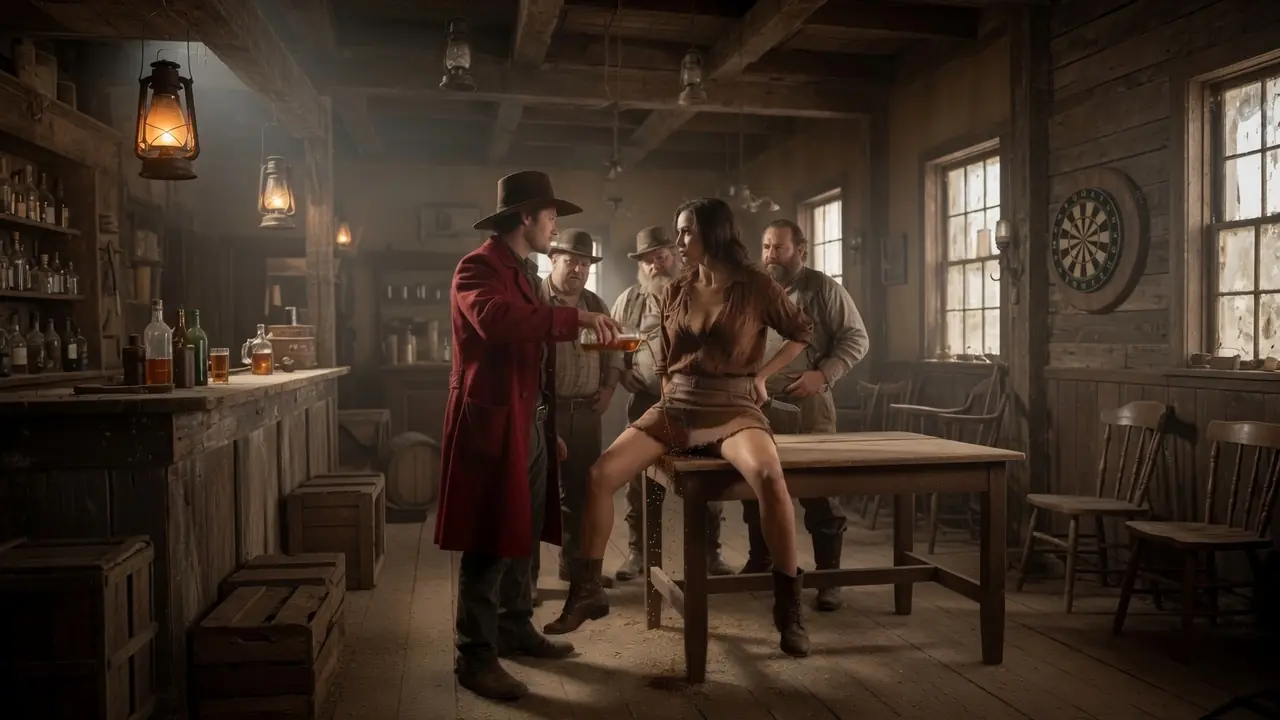
They saw the paint on her lips and the rouge on her cheeks and assumed they knew everything there was to know about her. They assumed she was for sale, or at least for rent. A heavy hand clamped onto her wrist as she passed a table of poker players. "Come here, darling," a voice slurred.
"Sit a spell. You look like you need a drink. " Laya did not flinch. She had learned long ago that flinching provoked them like a rabbit darting before a wolf.
Instead, she offered a practiced, brittle smile that did not reach her eyes. "I have work to do, Mr. Henderson," she said, her voice steady. "Silas will dock my pay if I linger. " She twisted her wrist, a subtle practiced motion that used the man’s own grease against him, and slipped free.
She moved on before he could process the rejection. Weaving between the tables with the grace of a dancer navigating a field of jagged stones. Outside the swinging batwing doors, the town of Red Creek was settling into the uneasy dark. Wagons groaned past on the main street, their axles protesting the ruts, while tumble weeds, dry and skeletal, scraped against the wooden posts of the boardwalk with a sound like bony fingers scratching for purchase.
It was 1882 and the frontier was a place where softness went to die. Laya reached the bar and set her tray down, her hands trembling imperceptibly. She kept her back to the room for a moment, staring into the cracked mirror. The woman staring back looked older than her twenty-two years.
Her eyes were shadowed, guarded, fueled by an exhaustion that went down to the marrow. Despite the whispers that trailed her like smoke, that she was a fallen woman, a harlot, a piece of saloon trash, Laya possessed a secret that was both her burden and her armor. She was untouched. She had guarded her virginity with the ferocity of a starving dog guarding a bone.
It was the only thing she owned that they had not yet taken. She slept in a room the size of a closet above the saloon. Barring the door with a heavy chair every night, she deflected offers with excuses of illness, of other appointments, of menstruation, of exhaustion. She played the game, letting them think she was available, but just not right now. Not tonight.
It was a dangerous game. Her reputation was already ruined. The town saw a saloon girl, and in their eyes, the sin was already committed. But Laya clung to the truth of it.
Her body was hers. It was the last sovereign territory she controlled. As she waited for the bartender to fill a pitcher, her mind drifted, as it often did when the noise became too much, to the days before the saloon. She remembered the creek of a different wagon, the one she had ridden in with her father.
Thomas Carol had been a man of immense charm and catastrophic judgment. Laya remembered him in snapshots of golden light, him singing an Irish ballad to the rhythm of the horse’s hooves. his laughter booming across a campfire. The way he would lift her onto his shoulders so she could see the horizon.
He was a gambler, a dreamer, a man who believed the next card would solve everything. He had brought them west with promises of a new life, a grand ranch in California where the oranges grew as big as melons. But the road had ended in a muddy town 300 miles east of here. Laya closed her eyes for a second, blocking out the saloon.
She remembered the night he did not come back. She had been 17. She had waited in their rented room at the boarding house, watching the candle burn down to a pool of wax. The knock at the door had not been his distinctive rhythmic rap, but the heavy authoritative pounding of the sheriff.
He was dead, the sheriff had said, removing his hat, shot in a card room, a dispute over an ace. Just like that, the music had stopped. There was no money. There were no friends.
The landlord had put her out on the street two days later. She had drifted, hungry and terrified, until necessity forced her through the doors of a saloon. She had traded her dignity for bread, but she had kept her soul locked away in a silver locket tucked beneath her bodice, resting against her beating heart. Inside was a small tintype of her father, smiling, forever confident, forever doomed.
"Laya, wake up! " the bartender barked, slamming a mug down. Table four is dry. Laya snapped back to the present.
She took the mug, fixed the smile back onto her face like a porcelain mask, and turned back to the room. The night wore on, grinding her down. By the time the clock on the wall chimed two in the morning, the crowd had thinned to the hardcore drinkers and the lonely souls who had nowhere else to go. Laya collected empty glasses near the back door where the air was slightly cooler.
She wiped a table, her back aching, wishing for the silence of her tiny room. "Well, now look what we have here. " The voice was wet and heavy. Laya turned to see a cowboy she knew only as unsettled trouble.
He was a drift rider passing through from Texas with eyes that looked like flat black stones and breath that smelled of rotgut whiskey and chewing tobacco. She took a step back, clutching the rag to her chest. The saloon was closed. Sir, you need to go.
I ain’t done. He grunted, stepping into her space. He was big, blocking the lantern light, casting a long shadow over her. I’ve been watching you all night, little bird, flying around, teasing everyone.
I think it is time you landed. Laya tried to sidestep him, her heart hammering a frantic rhythm against her ribs. "I am not teasing anyone. I am working. Please move.
" He moved faster than a drunk man should. his hands shooting out to grab her upper arm. He shoved her backward. Laya’s shoulders hit the rough wood of the wall, the impact knocking the breath from her lungs.
Don’t you play high and mighty with me, he snarled, leaning in close. You’re a saloon girl. We both know what you are for. I got silver.
Laya struggled, pushing against his chest, but he was like a boulder. Panic, cold and sharp, sliced through her. She had been in tight spots before, but usually she could talk her way out or wiggle free. This man was not listening.
There was a violence in him, a simmering rage that wanted to hurt as much as it wanted to take. "Let me go," she hissed, afraid to scream and draw more attention. Afraid that if she screamed, no one would come. The cowboy laughed.
A low, ugly sound. You need to be taught a lesson in manners. Suddenly, the pressure vanished. A hand large and gloved in worn leather, clamped onto the cowboy’s shoulder.
It did not jerk or shove. It simply squeezed with a crushing hydraulic pressure of a vise. The cowboy howled in surprise and pain, spinning around. Standing there was a man Laya had noticed earlier in the evening, but had not looked at closely.
He was sitting at a table in the shadows, nursing a single beer for 2 hours. He was tall, broad-shouldered, and stood with a stillness that was more terrifying than the cowboy’s aggression. "That is enough," the stranger said. His voice was low, rolling like distant thunder, lacking any inflection of anger.
It was a statement of fact. The drunk cowboy stumbled back, rubbing his shoulder, his face twisting into a sneer. Who the hell are you? This ain’t your business, Sodbuster.
The stranger did not move. He stood with his feet planted shoulder width apart, his coat swept back just enough to reveal the handle of a heavy Colt revolver at his hip. He did not draw it. He did not even rest his hand on it.
He simply let the cowboy see it and let him see the hand that hovered near it. A hand that was steady, scarred, and completely relaxed. "The girl said no," the stranger said. "And the saloon is closed.
" The drunk blinked, his whiskey addled brain trying to calculate the odds. He looked at the stranger’s face, a face carved from granite and oak, sunburned with lines of deep fatigue etched around the eyes and a thin white scar running along the line of his jaw. It was not the face of a man who fought for fun. It was the face of a man who ended fights.
The silence stretched tight as a bowstring. Laya pressed herself against the wall, her breath coming in shallow gasps. She watched the stranger’s eyes. They were gray, dark as a winter sky, and completely flat.
The drunk cowboy swallowed hard. The aggression drained out of him, replaced by the primal instinct for self-preservation. He spat on the floor, trying to regain some scrap of dignity. She ain’t worth it anyway, the drunk muttered.
He turned and stumbled toward the door, shoving his way out into the night. The batwing door swung wildly in his wake, then settled. Laya let out a shuddering breath, her knees feeling like water. She looked at the man who had saved her up close.
He was not handsome in the way the eastern dandies in their magazines were handsome. He looked worn. He looked like the land itself, rugged, enduring, and weathered. He turned to look at her, and the flatness in his eyes softened just a fraction.
"Are you all right, miss? " he asked. Laya pulled her dress up at the shoulder, her fingers trembling. I—yes, thank you.
She stepped away from the wall, feeling a sudden burning shame. She hated that he had seen her like this, cornered, weak, handled. She hated that she needed saving. "I am used to it," she lied, lifting her chin, trying to summon the mask of the hardened saloon girl. It happens.
The man frowned, a deepening of the lines on his forehead. "It should not. " He looked at her for a moment longer, his gaze feeling heavy and physical, as if he were weighing her soul. Laya felt a strange flicker in her chest, not quite fear, but a muted, confused attraction.
He was dangerous, she could tell. But he had stepped between her and the danger. "I am Eli," he said. "Eli Mercer.
" He nodded once, touching the brim of his hat. Good night, Miss Laya. Lock the door behind me. He turned and walked out, his boot heels loud on the floorboards.
Laya watched him go, shivering as the cold wind from the open door whipped dust around her ankles. She stood there for a long time, the silence of the room ringing in her ears. Over the next few weeks, the season began to turn. The relentless heat of late summer broke, replaced by a crisp, biting chill that heralded the approach of autumn.
The leaves on the cottonwoods along the creek turned brittle and gold, and the wind began to carry the scent of frost. Eli Mercer returned to town regularly for supplies. And every time he came to Red Creek, he stopped at the Golden Nugget. He never drank whiskey, only coffee or a single beer that he nursed for an hour.
He never sat at the tables with the gamblers. He took a small table near the window watching the street until Laya had a free moment to approach. He did not flirt. He did not ogle her.
He did not try to touch her hand when she set down his drink. He simply talked. "It is going to be a hard winter," he told her one Tuesday afternoon. The saloon empty, save for a sleeping drunk in the corner.
The wool on the sheep is growing thick early and the coyotes are moving closer to the house. "You have sheep? " Laya asked, wiping the table, grateful for the banal conversation. Cattle mostly, Eli corrected.
A few horses. The land is rocky, but there is water. He spoke of cattle prices dropping in Kansas City. Of the price of barbed wire, of the way the light hit the canyon walls at sunset, small ordinary things.
To anyone else, it would have been boring. To Laya, whose life was a whirlwind of noise, lies, and aggression. Eli’s slow, deliberate sentences were like rain on parched earth. She found herself watching the door on the days she knew he was coming.
When his broad silhouette appeared against the light, a knot of tension she carried in her shoulders would loosen. It was a fragile safety, illogical and tenuous, but she clung to it. But the town offered her no such grace. One afternoon, Laya went to the general store to buy a spool of thread and a packet of headache powder.
As she walked down the boardwalk, wrapping her shawl tight against the wind, she passed Mrs. Gable and Mrs. Miller, the wives of the town doctor and the banker. The women stopped their conversation abruptly. Mrs. Miller reached out and pulled her young daughter close, pressing the child’s face into her skirts as if Laya were carrying a contagious fever. Did you see the dress she wore last Sunday?
Mrs. Gable whispered loud enough for Laya to hear, walking into the Lord’s house like she belongs there. "She has no shame," Mrs. Miller hissed. Saloon trash. They say she has laid with half the county. Laya kept her eyes forward, her face burning.
She ducked her head, her shoulders stiffening, pretending she was deaf. It was a familiar humiliation, but it never stopped stinging. It cut deeper because she knew the truth of her own innocence, and she knew it did not matter. To them, her job was her soul.
She pushed open the door of the general store, the bell jingling cheerfully, mocking her mood. Eli was there standing by the counter buying a sack of flour. He turned as she entered. He had heard the women outside.
Laya saw it in the set of his jaw. He looked at her, then looked through the window at the women, his expression darkening. He said nothing to them. He was not a man to start a war with church ladies.
But when Laya approached the counter, waiting for the clerk to acknowledge her, Eli tipped his hat to her with deliberate, exaggerated respect. "Good afternoon, Miss Laya," he said, his voice carrying in the small, quiet store. The clerk, a pimply boy who usually smirked at her, straightened up at Eli’s tone. "Good afternoon, Mr. Mercer," Laya whispered, gratefulness swelling in her throat so hot it hurt.
He waited until she had made her purchase, walking out just behind her, shielding her back from the glares of the other patrons. He did not walk her all the way to the saloon. That would have caused a scandal that would only hurt her more. But he stood on the porch of the store until she was safely inside the double doors.
November arrived, gray and bleak. The wind howled down from the mountains, stripping the last leaves from the trees and driving dust through every crack in the saloon walls. Laya sat on the edge of her narrow bed in the room above the bar. She had poured out her savings onto the quilt, a small pile of silver dollars and crinkled bills.
She counted it for the third time. forty-two dollars. It was nothing. It was not enough to buy a train ticket east and set herself up in a respectable boarding house. It was not enough to buy a plot of land.
It was barely enough to keep her fed for a few months if she lost her job. She stared at the coins, despair settling in her gut like cold lead. She was 22. In ten years, she would be 32, her looks fading, her body worn out by the relentless hours.
She would die in this saloon. She would become like old Hattie, the woman who scrubbed the floors, toothless, forgotten, sleeping on a pallet in the store room. The thought made her chest constrict. She was drowning and the water was made of whiskey and dust.
Downstairs, glass shattered. A man shouted. The nightly violence was starting. Laya swept the money back into its pouch and hid it under the loose floorboard.
She checked her face in the shard of mirror on the wall, pinched her cheeks to bring back the color, and went downstairs to survive another night. Later that night, the despair broke her. A customer, a trapper smelling of uncured pelts, had grabbed her hard, bruising her waist. When she complained to Silas, the bartender, he had merely shrugged.
"Just laugh it off, Laya," Silas had grunted, wiping a glass. "They are paying customers. You are just the scenery. Don’t be so prickly. Just scenery.
" Laya had fled out the back door into the alley, gasping for air. The cold night bit at her exposed skin, but she didn’t care. She sank down onto a crate, huddled against the rough wood of the building, and pulled the silver locket from her bodice. She snapped it open.
In the moonlight, the tiny tin image of her father smiled back at her. "Why did you leave me? " she whispered, her voice cracking. "You promised we would be happy. You promised.
Laya gasped, snapping the locket shut and scrambling to wipe her eyes. She looked up, expecting the trapper, reaching for the small knife she kept in her boot. It was Eli. He stood at the mouth of the alley, a silhouette against the street lamps.
He took a step closer, his boots crunching softly on the gravel. He saw the locket in her hand, the glint of silver in the darkness. "I did not mean to intrude," he said softly. Laya sniffed, turning her face away.
"I am fine, just getting some air. " Eli looked at the locket, then at her tear streaked face. He misunderstood what he saw. He saw a young woman pining for a lost love, a sweetheart left behind in the east, or perhaps a husband dead in the war.
He sat down on a barrel a few feet away, giving her space. The wind ruffled the collar of his heavy sheepskin coat. "I have a ranch," he said suddenly. Laya blinked, confused by the non sequitur.
She looked at him. I know. You told me. It is about 20 miles north. Eli continued, staring at his hands.
It was isolated. The house is small. The roof leaks in the heavy rain. Though I am fixing it, I have three hands working for me.
But they sleep in the bunk house. It is quiet out there. Laya watched him, wiping her cheeks with the back of her hand. Why are you telling me this, Eli?
He looked up, meeting her eyes. His face was solemn, terrifyingly open in its honesty. The land is going to make me or break me in the next few years. I have a herd to build.
I have fences to mend. It is too much work for one man to manage the land and the house. He took a breath, struggling with the words. He was a man of action, not speeches.
I need someone to keep the house, to handle the accounts. I am slow with figures. To cook something that isn’t beans, to share the risk. Laya went still.
The wind whistled through the alley, tugging at her skirt. She understood what he was saying. She understood the shape of the hole in his life. "Are you offering me a job, Mr. Mercer?
" she asked quietly. "No," Eli said. He leaned forward, resting his elbows on his knees. "I am offering you a way out of here.
" He looked toward the saloon door where the sound of a drunken argument spilled out. "I am offering you marriage, Laya. " The word hung in the cold air between them. "Marriage," Eli continued.
His voice steady but low. "I know I am not a gentleman. I have scars and I am not rich. Not yet. But if you marry me, you will have my name.
It is a clean name. " the town. They will have to shut their mouths. You would have a home.
You would be safe from this, he gestured vaguely at the saloon, at the trapper inside, at the sticky floors. I would never raise a hand to you, Eli said, looking her dead in the eye. I swear that on my mother’s grave, it would be practical. We could help each other.
Laya stared at him, her heart pounding against the locket. It was a business proposal. He needed a wife. She needed a rescue.
It was unromantic, blunt, and desperate. But as she looked at him, she saw something else in his gray eyes. Beneath the stoic practicality. There was a deep, aching loneliness.
He was a man who walked into an empty house every night. He was a man who wanted someone to witness his life. And she was terrified. Marriage to a man she barely knew.
a man who carried a gun and looked like he had walked through hell. It was madness. It was trading one trap for another. What if he was cruel?
What if he drank? What if he was like her father, full of promises that turned to dust? But then she heard Silas’s voice in her head. You are just scenery.
And she looked at Eli’s hands, large, capable, resting gently on his knees. The hands that had stopped the drunk without striking a blow. I cannot give you an answer tonight, she whispered. Eli stood up.
He nodded, accepting this. He did not press her. I will be at the livery stable until noon tomorrow, he said. If you are not there, I will ride out alone.
He tipped his hat and walked away, leaving her alone in the alley with the wind and the terrifying weight of a choice. Laya did not sleep that night. She lay in her narrow bed, listening to the wind rattle the window pane. She thought of the endless cycle of the saloon.
She thought of the open prairie she had seen from the wagon years ago, the vast, terrifying, beautiful emptiness. She thought of Eli’s face, the scars, the quiet. He was a stranger, but he was a stranger who had seen her crying and offered her a home, not a proposition for an hour in a rented room. By dawn, the wind had died down.
Laya rose, washed her face in the basin, and packed her meager belongings into a single carpet bag. She put on her most modest dress, a faded blue calico, and pinned her hair up tight. She walked to the livery stable just as the sun was cresting the horizon, painting the sky in violent shades of orange and purple. Eli was there, tightening the cinch on a large bay horse.
A buckboard wagon stood ready, loaded with supplies. He froze when he saw her walking down the dusty street. He did not smile, but his shoulders relaxed as if he had been holding a heavy weight. Laya stopped a few feet from him.
Her hands were trembling so hard she had to clasp them together. "I am scared, Eli," she said, her voice small. Eli stepped closer. He took off his hat, holding it in front of him.
"I am scared too, Laya," he admitted. She looked up at him, searching his face for any sign of deceit. She found only steady resolve. I will be a good wife.
She said, I work hard. I know, he said. We will take it slow, she asked, the fear of the marriage bed rising in her throat. Eli nodded solemnly.
Slow? In all ways? You have my word. They were married an hour later by Reverend Miller, a sour-faced man with thin lips who looked at Laya with open disapproval.
He rushed through the ceremony in the dusty vestibule of the church as if he wanted to get the sin of it over with as quickly as possible. The town gossip mill was already churning. A few people had gathered outside the church, whispering behind their hands, pointing the rancher and the harlot. What a pair.
Laya felt exposed naked under their stares in her simple blue dress. She felt the urge to run, to hide, but then Eli’s hand found hers. His palm was calloused and warm, his grip firm without being crushing. He held her hand as if he were anchoring her to the earth.
He did not look at the town’s people. He looked only at the preacher, repeating the vows in a low, rumbling voice. I, Eli, take thee, Laya. When it was done, there was no kiss.
The preacher merely snapped his Bible shut and coughed. Eli led her out to the wagon. He helped her up to the high seat, his hands respectful. They rode out of Red Creek just as the town was waking up fully.
They left behind the saloon, the cracked mirror, the sticky floors, and the whispers. The wagon rattled over the hard-packed earth, the wheels turning rhythmically. The further they got from town, the quieter the world became. The noise of commerce faded, replaced by the sigh of the wind through the sagebrush and the distant yipping of coyotes.
Night fell as they rode, enveloping them in a darkness so absolute it felt like velvet. The stars came out, millions of them, cold and bright and indifferent overhead. Laya sat beside her husband, their shoulders brushing with every jolt of the wagon. She clutched her shawl tight.
The saloon was gone. Her past was receding into the dark. Ahead of her lay the open range, a small house and a life with a man who was a mystery. She felt a spike of sheer terror at the unknown.
But beneath it, fluttering like a bird in her chest, was something else. For the first time in five years, she was breathing clean air. She was free. Laya woke to the smell of cold ashes and the sound of wind searching for a way in through the chinking of the log walls.
The room was unfamiliar, bathed in the gray, watery light of dawn. Above her, rough-hewn beams traversed the ceiling like the ribs of some great wooden beast. The plaster on the walls was spiderwebbed with cracks, and the air in the room was sharp enough to sting the inside of her nose. She lay still for a moment, her heart giving a startled kick before memory settled in.
She was not in the room above the Golden Nugget. There was no piano music seeping through the floorboards, no shouting from the street below. There was only the vast, heavy silence of the open range. She turned her head.
The space beside her in the narrow iron bed was empty. The quilt pulled up neat and tight. Laya pushed herself up, clutching the blanket to her chest across the room near the blackened stone hearth. Eli lay on a pallet of buffalo hides and blankets.
He was asleep, one arm thrown over his eyes, his breathing deep and even. He had given her the bed. She watched him for a long moment, a knot of confusion and gratitude tightening in her throat. They had been married for three days, and he had not yet touched her.
It was not what she had expected. In the saloon, men were creatures of immediate grasping need. She had braced herself for a wedding night of duty of gritted teeth and staring at the ceiling until it was over. Instead, Eli had blown out the lamp, murmured a polite good night, and taken to the floor.
She slipped out of bed, her bare feet recoiling from the freezing wood floor. She moved to the window, scratching a small circle in the frost that coated the glass. The view took her breath away, not with its beauty, but with its sheer, crushing scale. The world outside was a tapestry of browns and grays, hills parched by a summer of drought, rolled away like waves in a frozen ocean.
A thin ribbon of creek water glinted silver in the distance. And beyond that, the mountains rose up, etched blue and sharp against the horizon like the jagged teeth of a saw. It was a landscape that offered no shelter. "I will start the fire," Eli’s voice rumbled.
Laya spun around, clutching her nightgown closed at the throat. Eli was sitting up, his hair tousled, his eyes heavy with sleep, but alert. He looked at her and for a second. His gaze dropped to her bare feet before snapping back to her face.
"I am sorry," Laya stammered. "I did not mean to wake you. You didn’t," he said, throwing off his blanket. He was fully dressed, save for his boots and coat, having slept in his shirt and trousers.
Cows don’t wait on the sun. He stood and moved to the wood stove, his movement stiff from the hard floor. Laya watched his broad back as he opened the iron door and began to feed kindling into the grate. "Eli," she said softly, "you do not have to sleep on the floor.
It is your bed. " He paused, a piece of wood in his hand. He did not look around. We made a deal, Laya. Slow.
I am a man of my word. The fire caught with a roar, casting dancing orange light across the room. Eli stood and faced her. The desire was there.
She could see it in the way his eyes tracked the curve of her neck, the way his hands clenched slightly at his sides, but he held it back behind a wall of iron restraint. "I will go check the horses," he said, grabbing his hat. Coffee is in the tin. He went out into the cold, leaving Laya alone with a crackling fire and a strange, aching curiosity she had never felt before.
The weeks that followed were a blur of exhaustion and discovery. Laya learned quickly that the romance of the West existed only in dime novels. The reality was dirt, blood, and wind that never stopped blowing. Her hands, once soft enough to pour drinks and shuffle cards, became red and chapped.
She hauled water from the creek, the buckets heavy enough to make her shoulders burn with fire. She hung laundry on the line, fighting to keep the sheets from being ripped away by the gusts that swept down from the peaks. She learned to wring the necks of chickens, squeezing her eyes shut the first time she did it, feeling the frantic flutter of life vanish under her fingers. She cooked for Eli and his three ranch hands.
hefty, quiet men who ate as if they had never seen food before. The biscuits were often too hard. The beans sometimes burnt, but no one complained. Despite the pain in her back and the blisters on her palms, there was a purity to the work that Laya found intoxicating.
In the saloon, her labor had been about performance, smiling when she was sad, laughing when she was disgusted. Here, the work was honest. The land did not care if she was pretty. The chickens did not care about her reputation.
If she worked, she ate. It was a simple, brutal equation that she respected. The ranch hands were a mixed lot. There was old Saul, a man with a face like a dried apple, who spoke to the horses more than the people.
There was Jim, a quiet boy of barely eighteen who blushed whenever Laya poured his coffee. And then there was Caleb. Caleb was a drifter Eli had hired for the season, a man with shifting eyes and a smile that lingered too long. He had been to Red Creek.
He knew where Eli had found his wife. It happened on a Tuesday. While Laya was scrubbing clothes in a tub near the bunk house, Caleb leaned against the fence post, picking his teeth with a straw, watching her arms work the soapy water. You got a specific way of scrubbing, Mrs. Mercer. Caleb drawled. Real vigorous.
Reckon you learned how to use your hands like that back at the Golden Nugget. Laya froze. The heat rushed to her face. She kept her eyes on the water. I learned to work hard wherever I was.
Mr. Caleb," she said, her voice tight. Caleb chuckled, a low, wet sound. "I bet you did. I heard the boys in town say you were the hardest worker they ever saw, especially after midnight.
" Laya stood up, wiping her soapy hands on her apron. She opened her mouth to tell him to leave, but the words died in her throat. The old shame, the programmed response to just take the insult, paralyzed her. Suddenly, a shadow fell over them.
Eli had come around the corner of the barn, carrying a saddle. He stopped. He had heard. The silence that descended was absolute. Even the wind seemed to hold its breath.
Eli dropped the saddle. It hit the dust with a heavy thud. He walked toward Caleb, his steps slow and deliberate. Caleb straightened up, the smirk vanishing.
"Now, boss, I was just making conversation. Get your gear," Eli said. His voice was not loud. It was terrifyingly soft. Caleb blinked.
"What? You heard me? Get your roll. You are done here.
Now hold on, Eli. " Caleb stammered, backing up over a joke. She’s just a Eli moved. It was a blur of motion.
He closed the distance and grabbed Caleb by the lapels of his coat, slamming him back against the fence post. The wood groaned under the impact. "She is my wife," Eli whispered, his face inches from Caleb’s. And if you speak one more word that isn’t goodbye, I will bury you where you stand.
Caleb went pale. He nodded frantically. Eli released him. Walk to town, Caleb.
If I see you on my land again, I won’t be talking. Caleb scrambled into the bunk house, emerging minutes later with his bed roll, and practically ran down the track toward the main road. Eli stood watching him go, his chest heaving slightly. He turned to look at Laya, his eyes dark, still swirling with violence.
"Are you all right? " he asked. Laya nodded, clutching her apron. She felt a trembling start in her knees.
She had been protected before, but never like this, never with such absolute claiming ferocity. "He should not have spoken to you that way," Eli said, picking up his saddle. ""Thank you," Laya whispered. Eli looked at her, and the anger in his face softened into something sadder.
"You don’t have to thank me for that, Laya. That is the job. " He turned and walked toward the stable. Laya watched him, feeling a sudden sharp pulse of safety that was so foreign it almost hurt.
The isolation of the ranch was a shield, but they could not hide forever. Supplies ran low, and a trip to the nearest settlement, a town called Oak Haven, larger and more respectable than Red Creek, became necessary. Laya dressed carefully for the trip. She wore her best dress, a dark blue wool that buttoned to the chin and a bonnet that shadowed her face.
She wanted to look like a rancher’s wife. She wanted to look like she belonged. But Oak Haven was a town of church steeples and painted fences, and news traveled on the telegraph wire of gossip faster than any train. They entered the general store together.
The bell jingled. The conversation inside a group of three women examining bolts of calico died instantly. Laya kept her head high, holding Eli’s arm. They moved to the counter.
The clerk, a man with spectacles and a thin mustache, looked from Eli to Laya. A smirk touched the corner of his mouth. "Help you folks? " the clerk asked.
"We need fifty pounds of flour, 10 pounds of sugar, and a case of Arbuckles’s coffee," Eli said. "And my wife needs some ribbon. " The clerk leaned on the counter. "Right, I can get that for you, Mr. Mercer.
" And for the miss, he emphasized the word miss with a pause that acted like a slap. He was denying her the title. He was telling her he knew she wasn’t a real wife. Laya stiffened. Eli’s arm under her hand turned to rock.
It is Mrs. Mercer, Eli corrected, his voice dropping an octave. Of course, the clerk said, his eyes mocking. My mistake. Hard to keep track of all the changes. As they waited for the goods, one of the women from the calico section approached.
She was older, wearing a severe black bonnet and a cross around her neck. Mrs. Mercer, is it? The woman said. Yes, Laya said, forcing a smile.
I am Mrs. Higgins. From the congregational church, the woman looked up and down, her eyes lingering on Laya’s figure. We have a prayer circle on Wednesdays. We focus on repentance.
Perhaps you would like to join. It is never too late to atone for one’s former life. Even the most soiled dove can be washed clean. Or so the good book says.
The air left Laya’s lungs. The insult was wrapped in piety, sharp as a razor blade hidden in an apple. Laya felt Eli shift beside her, ready to intervene, ready to unleash the same anger he had shown Caleb. But she squeezed his arm, stopping him.
She would not let him fight a woman for her. She would not let them see her bleed. "Thank you for the invitation, Mrs. Higgins," Laya said, her voice shaking only slightly. "But I find that hard work and a good husband are all the salvation I require at the moment.
" She turned her back on the woman. They rode back to the ranch in silence. The sky was turning a bruised purple over the mountains. Laya sat rigid on the wagon seat, staring straight ahead, her eyes burning with unshed tears.
Eli watched her, his hands loose on the reins. "They are fools, Laya," he said quietly. "It does not matter," she said, though it felt like a lie. It matters to me, Eli said.
Laya shrugged a jerky motion. I am used to it, Eli. I told you that you shouldn’t have to be," he said, and he sounded so angry, not at her, but for her, that Laya finally looked at him. He was staring at the road, his jaw set so hard a muscle feathered in his cheek.
He was hurting because she was hurting. The realization made the tears finally spill over, silent and hot on her cheeks. That evening, the house felt smaller, the silence between them heavier. They sat by the fire, the wind picking up outside, rattling the shutters.
Laya was mending one of Eli’s shirts. Eli was cleaning his rifle. The rhythmic snick-snick of the cloth through the barrel the only sound. "My father used to clean his gun like that," Laya said suddenly.
She didn’t know why she said it. "Maybe she just wanted to fill the silence. " Eli looked up. Your father Thomas," she said, a small, sad smile touching her lips.
He wasn’t a rancher, though he was a gambling man. Eli’s hands went still on the rifle. A gambler? Yes, he was.
Oh, he was a charmer. He could sing the birds out of the trees. He had a voice like warm honey. He used to sit me on his knee and tell me we were going to be royalty one day.
She laughed softly, threading a needle. He drank too much and he lost money we didn’t have. But he wasn’t bad, Eli. He just He believed in luck too much.
He loved me. I know he did. She looked at Eli, expecting him to share her wistful amusement. Instead, she saw his face had gone pale beneath the tan.
His jaw was clamped shut tight. Eli. He looked down at the gun, reassembling the chamber with quick, jerky movements. Men like that, Eli muttered, his voice rough. They leave messes for other people to clean up.
Laya felt a flash of defensiveness. He didn’t mean to. He had a good heart. A good heart doesn’t put food on the table or keep a roof over a child’s head. Eli snapped.
The sharpness of his tone startled her. She lowered the shirt. "You sound like you judge him," she said. "You did not know him.
I know the type. " Eli said. He stood up, racking the rifle on the wall hooks. I have known plenty of men who thought a smile and a song were enough to get by.
They usually end up dead or in jail. He walked to the window, staring out into the dark. His back was stiff. "I have done things, Laya,", he said, his voice dropping.
Things I am not proud of. On the trail in dark rooms and towns I don’t go back to. Laya watched him, a chill tracing her spine. What kind of things?
Survival, he said. But I am trying to live better now. I am trying to build something that lasts. He turned to her, his eyes pleading for her to understand something he couldn’t quite say.
I just I have no patience for men who gamble with lives. He looked so haunted in the firelight that Laya’s defensiveness melted. She stood and went to him, reaching out to touch his arm. He is gone, Eli.
It is just a memory. Eli looked at her hand on his sleeve, then up to her eyes. He looked as if he wanted to pull her close to bury his face in her hair, but he just nodded, stepped back, and turned away. "I’m going to check the barn," he said.
Winter arrived not with snow, but with a wind that screamed. Two nights later, a norther blew in. The temperature dropped 20 degrees in an hour. The wind slammed against the ranch house like a physical blow, shaking the timbers.
Inside, the cold was a living thing. It seeped through the floorboards and froze the water in the basin. Eli had built the fire up until the stove roared, but it wasn’t enough. He laid out his pallet on the floor as usual, piling every spare blanket he could find on top of himself.
Laya lay in the bed, shivering violently. The cold seemed to bypass her quilt, sinking into her bones. Her teeth chattered so hard her jaw ached. "Laya?
" Eli’s voice came from the dark. "I I am cold," she stammered. She heard him move. He stood up, a dark shape in the gloom.
He walked to the side of the bed. "Move over," he said. Laya hesitated, then scooted to the far side of the mattress against the wall. Eli lay down.
He was fully clothed, still wearing his wool shirt. He lay on top of the covers at first, rigid. "It is no good," he muttered. "The heat won’t hold.
" He pulled back the heavy quilt and slid underneath. Next to her, the heat radiating from him was shocking. He was like a furnace. Laya instinctively moved toward him, seeking that warmth.
Eli stiffened as her cold feet brushed his calf. Then slowly he turned on his side to face her. "Come here," he whispered. He opened his arms.
Laya moved into them. It was not sexual at first. It was survival. He wrapped his arms around her, pulling her flush against his body.
She buried her face in the rough wool of his shirt, smelling wood smoke, horse and the clean, masculine scent of him. She lay there trembling as his warmth seeped into her. But as the shivering subsided, something else took its place. She felt the heavy, steady thud of his heart against her chest.
She felt his breath stirring the hair at her temple. She felt the hardness of his body, the strength in the arms that held her. The air in the room changed. It became thick, charged with the weeks of unspoken tension, the stolen glances, the accidental touches.
Laya lifted her head in the faint red glow from the stove vents. She saw Eli watching her. His eyes were black pools of want. "Eli," she whispered.
His hand moved up, his callous thumb tracing the line of her jaw. His touch was hesitant, a question asked in silence. Are you warm? " he asked, his voice gravel.
"Yes," he didn’t move away. He stayed there, his hand cupping her face. Laya’s breath hitched. She realized with a sudden, blinding clarity that she did not want him to stop.
She did not want him to be noble anymore. She wanted to be wanted, but not like the men at the saloon who wanted a body. She wanted this specific man who had defended her honor, who worked until his hands bled, who slept on the floor to make her feel safe. She shifted, pressing her body closer to his.
Eli inhaled sharply. "Laya," he warned low. "I am only a man. I know," she whispered.
She reached up and touched his face, her fingers grazing the scar on his jaw. "I am your wife, Eli. " She leaned in and kissed him. It was a soft kiss, tentative, terrified.
She clutched his shirt, her knuckles white, half expecting him to turn rough, to become the animal she feared all men were. But Eli went still. He kissed her back with a terrifying tenderness. His lips were chapped but gentle.
He pulled back slightly, searching her eyes, checking her. "Are you sure? " he rasped. "Yes," she said.
"Please. " When he kissed her again, the restraint broke. He groaned low in his throat, his arms tightening around her, pulling her so close there was no air between them. His mouth opened on hers, hot and hungry, tasting of coffee and desperation.
It was not like the stories. It was awkward, and there was fumbling, and the bed frame creaked loudly, but it was also sacred. He moved over her, supporting his weight on his elbows so as not to crush her. He murmured her name, Laya.
Laya like a prayer against her skin. Every touch was deliberate. He treated her body not as a territory to be conquered, but as a gift he did not deserve. When the pain came, she gasped.
And he stopped instantly, freezing, his face etched with concern. "I’m sorry," he whispered. "I’m sorry. " "Don’t stop," she breathed, pulling him down.
And then there was only the fire light, the wind howling outside, and the man who held her as if she were made of glass, shattering her loneliness piece by peace. Morning broke with a sunlight that was blindingly bright, reflecting off a dusting of frost that covered the world. Laya woke first. She lay in the crook of Eli’s arm.
His heavy limbs tangled with hers. She felt sore, but it was a good soreness. She felt anchored. The shame she had carried for years.
The belief that her body was a source of trouble, a thing to be hidden, had evaporated in the night. She looked at Eli’s sleeping face, the lines of worry smoothed out. She felt a fierce, terrifying swell of love, and with it, fear. Now she had something to lose.
She slipped out of bed and dressed quickly. When she went to the kitchen to start the coffee, she moved with a new lightness. She wasn’t just the woman who kept the house anymore. She was his.
When Eli came into the kitchen twenty minutes later, he stopped in the doorway. He looked at her and his face flushed a dark red under his tan. He looked shy like a school boy. "Morning," he mumbled.
"Morning," Laya said, pouring him a mug. He took it, their fingers brushing. He caught her hand holding it for a second. He didn’t say anything poetry worthy.
He just squeezed her fingers and let go. "I’ll be in the barn," he said. But the way he looked at her before he put his hat on, as if she were the only source of heat in a frozen world, was enough. The land, however, did not care about their happiness.
Two weeks later, a late frost hit, blackening the small vegetable garden Laya had painstakingly planted. She stood over the withered tomato vines, fighting back tears. Eli found her there and simply put a hand on her shoulder. "We will plant again," he said.
Then the coyotes grew bold. One night, the howling was close, frantic, and yipping. In the morning, they found a calf torn apart near the creek. It was a financial blow.
Cattle were money, but the violence of it shook Laya. Then came the dust. It started as a brown haze on the horizon, swallowing the mountains. By noon, the sky was a bruised yellow, "Dust storm!
" Eli shouted from the yard. "Close the shutters! Wet the sheets! " Laya ran through the house, slamming windows shut, she soaked spare sheets in the water bucket and hung them over the windows and doors to catch the grit.
The storm hit with a roar like a freight train. The light vanished. The air inside the house turned thick and hazy despite their efforts. Dust tasted of copper and old earth.
It coated everything, the table, the bed, their teeth. They sat at the kitchen table for four hours, a lantern burning between them, listening to the wind try to tear the roof off. They held hands, their palms gritty with dust. When the wind finally died, they stepped outside.
The world had changed. Drifts of brown dirt were piled against the barn. The sky was a bloody, spectacular red as the sun set through the lingering haze. Eli wiped his face, leaving streaks of mud.
He looked out at his land, battered and brown. "It takes," he said softly. It takes and takes before it ever gives. Laya took his hand.
She looked at the desolate landscape. Then at her husband. Then we make it give," she said fiercely. Eli looked down at her, a smile cracking the mask of dust on his face.
"I reckon we do, Mrs. Mercer. " A week later, a buggy rattled up the drive. It was Mrs. Holloway, a widow who ran the ranch to the east. She was a large woman with hands like shovels and eyes that missed nothing.
She climbed down from her buggy before Eli could help her. "Heard you got hitched, Eli? " she boomed. About time. She turned to Laya.
And you must be the girl from town. Laya stiffened, waiting for the judgment. The saloon trash whisper. Ms. Holloway marched up to her and stuck out a hand. Sarah Holloway.
I run the double bar. It’s a hard life out here, girl. You got grit? Laya took the hand.
It was rougher than Eli’s. I am learning. Mrs. Holloway. Sarah looked her up and down. Well, you’re standing, ain’t you?
That’s half the battle. Ignore the bitties in town. They wouldn’t last a day hauling water. She stayed for coffee.
She was blunt, asking Laya directly about her past. "Is it true you worked the nugget? " Sarah asked, dunking a biscuit in her coffee. "Yes," Laya said, lifting her chin.
"I did. " Sarah nodded. "Hard work, bad hours, better than starving. That was it.
No sermon, no pity. Laya felt a weight lift. She had an ally. As the day shortened and the true winter loomed, a shadow began to grow in the house.
It was subtle at first. Eli became quieter. He would sit for long periods in the evenings, staring into the fire, his expression distant and troubled. Laya would catch him looking at the old Colt revolver hanging by the door.
He would look at it with a mixture of loathing and familiarity. One night, Laya came up behind him as he stared at the flames. "Eli, what is wrong? You have been miles away all week.
" Eli started as if waking from a dream. "Nothing, just thinking about the herd. Winter is coming. It wasn’t the herd.
Laya knew it. The connection they had built allowed her to sense his moods. " He was pulling away, walling himself off. "Is it me?
" she asked, her voice trembling. "Do you regret it? " Eli turned to her, his eyes wide. "No, never that.
" He pulled her into his lap, burying his face in her neck. He held her tight, desperate. "You are the only good thing in my life, Laya. The only clean thing.
" But he didn’t tell her what was wrong. And that silence frightened her more than the wind. The peace ended on a Tuesday morning. The sky was a slab of gray slate.
Low clouds massing over the hills, promising snow. Eli saddled his horse early. He was riding out to the north ridge to check for strays before the weather broke. Laya stood on the porch, wrapped in her shawl.
The wind whipped her skirts around her legs. "Be careful," she said. Eli leaned down from the saddle. He took her hand, his thumb brushing the gold band on her finger, a ring he had bought her in Oak Haven.
"I always come back," he said. He turned the horse and rode out. Laya watched him go, a small dark figure against the immense, indifferent landscape. She looked down at her hand, she held her father’s silver locket in her left hand, and on her right hand.
The wedding band glinted dully in the gray light. Two men, one dead, one living, one who had left her to the wolves, and one who had saved her from them. She shivered, a sudden, cold premonition passing through her like a ghost. She squeezed the locket and the ring, feeling the metal bite into her palm, caught between the shadow of the past and the terrifying, fragile hope of her future.
Winter descended on the Wyoming territory, not with the grace of falling snow, but with the violence of a clenched fist. The wind was a constant screaming presence that tore across the open plains, driving ice crystals into the wood of the ranch house until the logs seemed to groan in protest. The creek, which had trickled merrily in the autumn, was now a jagged scar of ice, requiring Eli to take an ax to it every morning just so the horses could drink. Life shrank to the perimeter of the heat thrown by the cast iron stove.
Every chore was a battle. Hauling wood meant wrapping one’s face in wool until only the eyes were visible. Fighting a gale that tried to knock a grown man off his feet. The air was so cold it burned the lungs, tasting of iron and frozen sage.
Yet inside the small house, a different kind of fire had taken hold. The isolation, which Laya had feared would suffocate her, instead became a cocoon. There was nowhere to go, no one to see, and nothing to do after the sun went down but exist together in the small, flickering circle of lantern light. The awkwardness of their early marriage had melted away, replaced by a profound, wordless reliance.
They moved around each other in the small kitchen with the ease of a single organism. Laya knew exactly when Eli would reach for the coffee pot, and she would have it ready. Eli knew when Laya’s hands were aching from the cold laundry water, and he would take them in his large, rough palms, rubbing heat back into her fingers without saying a word, And in the dark under the heavy pile of quilts. The restraint Eli had shown in the beginning finally broke.
Not with violence, but with a tidal surge of need that matched her own. It happened on a Tuesday night in late January. The wind was howling like a banshee, shaking the roof shingles. They were in bed, huddled together for warmth.
Laya lay with her back to Eli, feeling the solid, radiating heat of his chest against her spine. She turned in his arms. It was a bold move, one she never would have dared a month ago. She found his mouth in the dark.
"Eli," she whispered against his lips. He did not pull away. He groaned, a low vibration in his chest, and his arms tightened around her. Laya ran her hands over the ridges of muscle on his back, marveling at the contrast between the hardness of his body and the gentleness of his touch.
In the saloon, touch had been a transaction, something stolen or forced. Here it was a conversation. She learned the map of him, the scar on his ribs from a steer horn, the roughness of his beard against her neck, the way his breath hitched when she traced the line of his hip. She found a power in herself she had not known existed.
The power to bring this stoic, silent man to the point of unraveling. When they came together, it was a desperate, beautiful collision. It was a refuge. Outside, the world was trying to freeze them to death.
Inside, they were alive, burning, claiming victory over the empty prairie with every breath and every touch. Afterward, Eli held her, his face buried in her hair. "You are cold," he murmured, pulling the quilt up to her chin. "I am not," she answered, resting her head on his shoulder.
"I am not cold at all. But the past was a ghost that could walk through walls, no matter how thick the logs. On the evenings when the wind was too loud for sleep, they talked. Laya, feeling safe in the haven they had built, began to speak more freely of her childhood.
She found herself polishing the memories of her father. Thomas Carol, rubbing away the tarnish until he shone like a saint. She told Eli about the time Thomas had won one hundred dollars in St. Louis and bought her a silk ribbon and a bag of peppermint sticks.
She told him about the songs he sang. Irish ballads full of longing and rebellion. "He had such a laugh," Laya said, staring into the fire one evening. A half-finished quilt on her lap.
It filled up a room. He used to say that a man without a song in his heart was already dead. He would lift me up on his shoulders so I could see the parades. I felt like a giant.
She smiled at the memory, carefully editing out the smell of stale whiskey that had always accompanied those shoulder rides, and the way his hands shook when the money ran out. Eli sat opposite her, whittling a new handle for an axe. As she spoke, his knife slipped, gouging a deep, ugly scar into the pale wood. "He was a good man," Laya said softly.
"He just had bad luck. " Eli stopped whittling. He did not look up. His jaw muscle jumped, a tight knot of tension beneath the skin.
"Luck is what you make it," Eli said, his voice flat. Laya frowned, sensing the withdrawal. "Why do you always do that? Do what?
Go cold whenever I speak of him. " Eli set the wood down and looked at the fire. The flames reflected in his dark eyes, making them unreadable. I just struggle to see the virtue in a man who drags a child into saloons.
Laya, that is all. It wasn’t a saloon, Laya defended, her voice rising. It was a life. We were going somewhere.
He was going to buy land. Just like this. Eli looked at her then, the expression on his face was pained. A mixture of pity and something darker that Laya could not place.
He didn’t buy land. Laya, he died in a card room. Laya flinched. The bluntness of it stung. He was murdered, she snapped, by some coward who couldn’t take losing a hand.
Eli stood up abruptly, the chair scraping loud against the floorboards. "I need to check the stove in the bunk house," he said. The boys let it burn low last night. He walked out into the biting wind without a coat, leaving Laya alone with the fire and a sudden sharp feeling of resentment.
Why couldn’t he let her have her memories? Why did he have to be so hard even on the dead? February brought a brief deceptive thaw followed by a sky the color of a bruise. A traveling peddler’s wagon creaked up the frozen ruts of the driveway just as the first flakes of a new storm began to swirl.
The driver was an old man named Tobias. Wrapped in so many layers of fur and wool, he looked like a bear walking on its hind legs. He was blue-lipped and shaking when Eli helped him down. "Get him inside," Eli shouted to Laya.
I will stable his mules. Laya ushered the old man into the kitchen, pouring hot coffee and setting out a plate of stew. Tobias ate with trembling hands, grateful for the warmth. He was a talker, starved for company after weeks on the trail.
He brought news from the outside world, railroad expansions, Indian troubles in the north, the price of gold in Denver, and he brought papers. I use them for packing mostly. Tobias wheezed, gesturing to a bundle of newsprint tied with twine. Or for starting fireins, but some folks like to read them first.
Can I look? Laya asked, her eyes hungry for words. Help yourself, misses. While Tobias and Eli talked about the coming storm in the kitchen, Laya took the bundle to the hearth.
She untied the twine. The papers were old. a mix of gazettes from Kansas, Missouri, and Texas, some dating back months or even years. She smoothed out a crinkled sheet from a town called Abilene, dated ten years prior.
She read the advertisements for patent medicines and saddles, drinking in the descriptions of a world that felt a million miles away. Her eyes drifted to a small column on the bottom of the third page. Shooting at the Drop. The headline was unremarkable.
Violence was common news, but the name in the first sentence stopped her heart. Thomas Carol, a transient gambler known in the territory, was shot dead last Thursday night following an altercation at the Lucky Star Saloon. Laya’s hands began to shake. She brought the paper closer to the firelight, the text blurring as her pulse hammered in her ears.
Witnesses state Carol was intoxicated and brandishing a weapon. The shooter, described only as a young ranch hand passing through the region, fired one round. The stranger fled the scene immediately after the incident. Sheriff Miller has stated that while the shooting appears to have been provoked, the shooter is wanted for questioning.
Thomas Carol, her father, Laya stared at the words until they burned into her retinas. She remembered that night. She remembered the noise, the shouting, the way the sheriff had told her simply, "He’s gone, girl. " She had always imagined it as a faceless tragedy, a chaotic brawl where a stray bullet found him.
But this this was specific, a young ranch hand. The stranger fled. It wasn’t an accident. It was a killing.
And the man who did it had run away, leaving her an orphan in a hostile town. The door to the kitchen opened. Eli walked in, shaking snow from his hat. Tobias is going to sleep in the bunk house tonight.
Eli said it is too cold for He stopped. He saw Laya kneeling by the fire, the paper trembling in her hands. He saw the color, or the lack of it in her face. "Laya," she looked up.
Her eyes were wide, dark pools of shock. "Look," she whispered. She held the paper out. Eli took a step forward.
He looked down at the yellowed page. He didn’t need to read it. He saw the headline and he saw the date. His reaction was immediate and terrifying. He froze.
His entire body went rigid as if he had been struck by lightning. His shoulders tensed up toward his ears, and the breath hissed in his throat. His eyes narrowed, focusing on the paper with a look of pure, unadulterated dread. Eli, Laya said again, her voice cracking.
It is about my father. It says a ranch hand shot him. A young man, Eli stepped back as if the paper were a poisonous snake. It is just a paper, Laya, he said.
His voice was too loud, too tight. Papers get things wrong all the time. But the name Eli Thomas Carol. It is him.
Eli turned away, walking to the window, staring out at the black square of night. It was a long time ago. Laya, old trouble. It does not do any good to dig up ghosts.
Laya stood up, the paper clutching in her hand. Dig up ghosts, Eli. This says the man ran away. He killed my father and he ran.
He left me there. Eli didn’t turn around. His back was a stone wall. Men run when they are scared.
Laya, that is the way of the world. Put it in the fire. Put it in the fire. Laya looked at his back.
A cold, prickling sensation started at the base of her spine. It wasn’t just his dismissal. It was his fear. She had seen Eli face down a charging bull without blinking.
She had seen him handle a loaded gun with steady hands. He was shaking. "Eli," she said, her voice dropping to a whisper. "Why are you shaking?
I am not shaking," he snapped. "I am cold. Put the damn paper in the fire, Laya. I don’t want to hear about it.
He walked past her, heading for the bedroom, giving the paper a wide berth. Laya did not burn the paper. She folded it carefully, her fingers numb and tucked it into the pocket of her apron. She looked at the empty doorway where her husband had vanished, and for the first time since their wedding night, she felt entirely, desolately alone.
That night, the wind banged against the shutters like a fist demanding entry. Laya lay on the far edge of the bed. She could feel the heat radiating from Eli, but she did not reach for him. Eli lay on his back, staring at the ceiling.
She could hear his breathing, shallow, uneven. Eli, she whispered into the dark. He did not answer. Laya closed her eyes, tears leaking out to soak the pillowcase.
The trust that had been building between them, brick by careful brick, had developed a hairline fracture, and through that crack the cold was seeping in. The days that followed were a torment. The silence in the house was heavy, suffocating. They went through the motions of their life.
Eli chopped wood. Laya cooked. They ate breakfast and dinner facing each other. The scrape of silverware on tin plates the only conversation. The teasing was gone.
The touches in passing were gone. When Eli came in from the cold, he did not look for her smile. He went straight to the fire, washing his hands with a fervor that looked painful. The ranch hands noticed.
Old Saul watched them with narrowed eyes, chewing his tobacco slowly. Jim stopped making jokes. The tension was a physical thing, thick as smoke. Outside, the weather mirrored the rift.
The snow melted into a sea of brown mud, then froze overnight into jagged, ankle-breaking ruts. Every step was treacherous. Then the law came. It was three weeks after the peddler had left.
A rider appeared on the horizon wearing a tin badge that caught the weak winter sun. It was a U. S. Marshal, a man named Burke. He was riding a tall ran horse and leading a pack mule.
He was making the rounds, checking on reports of cattle rustling that had been plaguing the territory to the south. Eli was in the corral fixing a broken gate hinge. Laya was on the porch shaking out a rug. She stopped when she saw the badge.
Eli looked up. He didn’t smile. He took off his glove and wiped his hand on his trousers. "Morning, Marshal," Eli said.
Marshal Burke leaned on his saddle horn. He was an older man with a gray mustache and eyes that had seen everything and found most of it wanting. "Morning? " he said.
He looked at Eli, squinting slightly. "Do I know you, son? " Burke asked. Eli’s posture shifted.
He stood taller, but his hand drifted imperceptibly toward his hip, though he wasn’t wearing his gun belt. "Don’t think so, Marshal. I am Eli Mercer. Been here about four years.
" "Mercer," Burke repeated. Tasting the name, he frowned. You got a look about you. Remind me of a kid I saw down in Kansas years back.
Laya standing on the porch felt her breath catch. She stepped closer to the railing, clutching the rug. I have a common face, Eli said evenly. Maybe, Burke said.
He spat into the dust. This kid was a ranch hand, fast with a gun. Had a scrape in Abilene. 72, I think.
Or maybe 73. Eli said nothing. He stared at the marshal, his face a mask of stone. Bad business, Burke continued, watching Eli closely.
Shooting in a saloon. Self-defense. Or so the witnesses said. But the kid ran before the law could clear him. Folks remember a face like that.
Eli picked up his hammer. I was never in Abilene. Marshal. I came down from the Dakotas. Burke held his gaze for a long uncomfortable moment.
Then he shrugged. If you say so, Mr. Mercer, just checking on rustlers. You seen any branded stock that ain’t yours? No, Eli said.
Just my own. Right. Well, I’ll be moving on. The marshal turned his horse as he rode past the porch. He touched his hat to Laya. Ma’am.
Laya nodded, unable to speak. She watched him right away. Then she looked at Eli. Eli was gripping the fence post so hard his knuckles were white.
He was breathing hard, staring at the ground. The pieces slammed together in Laya’s mind with the force of a collision. Abilene, 72, ranchand saloon shooting. The young man who ran.
The clipping in her pocket felt like it weighed 100 pounds. It wasn’t a coincidence. The universe was cruel, but it wasn’t that creative. She turned and walked into the house, her legs moving mechanically.
She went to the hearth, took the folded paper from her apron pocket, and smoothed it out on the table. She waited. Eli came in at sundown. He looked exhausted, his shoulders slumped. He hung his hat on the peg and turned to the room.
He saw Laya standing by the table. She was not cooking. The fire was low. On the table in the center of the wood sat the yellowed newspaper clipping. Eli stopped.
He looked at the paper. Then at Laya’s face. Laya was trembling. Her face was pale.
Her eyes red rimmed but fierce. "Were you there? " she asked. Her voice was barely a whisper, but it cut through the silence like a knife.
Eli closed his eyes. He didn’t move. Eli, look at me. Were you in Abilene in 1872?
He opened his eyes. Yes. Did you shoot a man in a card room? Eli swallowed. Laya, please. Did you shoot him? She screamed, the sound tearing from her throat. Yes.
Eli roared back, the word exploding out of him. The silence that followed was deafening. Laya swayed. She grabbed the back of a chair to steady herself. Thomas Carol, she whispered.
That was his name. is you killed Thomas Carol. Eli took a step toward her, his hands out, palms up. I didn’t know his name.
Laya, I swear to God, he was just a man. He was drunk. He was He was my father, Laya cried. You killed my father and you ran away.
You let me rot in that town. I didn’t know, Eli pleaded, his voice cracking. I was 20 years old. Laya, I was a kid.
I was scared. Why? Laya demanded. Why did you do it? Was it over money?
Was it over a card? No, Eli shouted. He ran a hand through his hair, pacing the small room like a caged animal. It wasn’t cards.
It was Jesus. Laya, tell me, Eli stopped pacing. He looked at her, and his eyes were full of a terrible, haunting pain. "He was drunk," Eli said, his voice dropping to a jagged whisper.
"He was crazy drunk. He had a gun. He was waving it around. There was a woman, a serving girl.
He had her by the hair. He was going to kill her. Laya froze. A memory sharp and sudden pierced through her grief. The smell of tobacco.
A scream, her father’s voice slurred and angry. "And there was a child," Eli said. He looked at Laya, tears standing in his eyes. There was a little girl.
She was hiding behind a barrel near the stairs. She was crying. He waved the gun at her. He said he said he was going to send them all to hell.
Laya’s hands flew to her mouth. The barrel, the rough wood against her back. The smell of sawdust, her father’s face, red and twisted, looking at her not with love, but with a stranger’s madness. I stepped in, Eli said, his voice shaking.
I told him to put it down. He turned on me. He raised the hammer. I didn’t think.
I just drew. I fired. He fell. Eli looked at his hands as if he could still see the powder burns. I looked at the girl. She was screaming.
I I couldn’t stay. The sheriff was coming. I knew they’d hang a drifter for shooting a white man, self-defense or not. So, I ran.
He looked up at Laya. I have seen that girl’s face in my nightmares for ten years. Laya. And the first time I saw you in the Golden Nugget, I knew the eyes, but I couldn’t be sure. I didn’t want to be sure.
Laya backed away from him. She bumped into the wall, sliding down it slightly. It was me, she whispered. I was the girl. I know.
Eli said, I know that now. You. Laya gasped for air. You killed him. You saved me.
And you killed him. I had to. Eli said he would have killed you. Yla. He was gone.
The drink had him. No! " Laya screamed. "You don’t know that. He loved me.
He was pointing a 44 at your chest. " Eli yelled, the truth tearing out of him. Laya shook her head violently. The image of her father, the saint, the singer, was shattering, replaced by the monster Eli was describing.
And the worst part was she knew Eli was telling the truth. She remembered the gun. She remembered the fear. But he was still her father.
And Eli was the man who had pulled the trigger. She looked at her husband, the man who had held her through the winter, the man whose bed she shared, and she saw a killer. She saw the man who had ended her childhood with a single bullet. "I hate you," she hissed.
Eli flinched as if she had struck him. "Laya, don’t touch me. " She pushed off the wall. She felt like she was suffocating.
The room was too small. The air was too hot. She lunged for the door. Eli moved to stop her, reaching for her arm.
Laya, you can’t go out there. She spun around and slapped him. It was a hard, vicious blow that cracked through the room. Eli’s head snapped to the side.
He didn’t move to defend himself. He just stood there taking it. You stole everything. Laya screamed. You lied to me every day. You lied.
I tried to protect you. Protect me? By marrying me? By sleeping with me.
Laya grabbed the latch and threw the door open. The cold wind slammed into her, icy and shocking. But she didn’t care. She ran. She ran out into the snowcrusted yard, her boots slipping on the ice.
She didn’t have a coat. She didn’t have a shawl. She just ran away from the house, away from the warmth, away from the man who was both her savior and her destroyer. "Laya!
" Eli shouted from the porch. He ran after her, grabbing his coat from the peg as he went. Laya stumbled up the ridge, her breath tearing at her throat. The cold was instant and brutal.
It bit through her thin dress, turning her skin to ice in seconds, but the fire in her chest was hotter. She reached the top of the low ridge that overlooked the ranch. She stopped, gasping, her legs giving out. She fell to her knees in the snow.
Below her, the ranch house was a small square of yellow light in a vast, terrifying ocean of darkness. Eli stopped 10 yards behind her. He stood there holding his coat, breathing hard. He didn’t come closer.
He was terrified that if he touched her, she would shatter. "Laya," he called out, his voice lost in the wind. "Come back inside. You’ll freeze. Let me freeze.
" She screamed at the dark horizon. She wrapped her arms around herself, rocking back and forth. She looked at the moon, cold and indifferent above the mountains. She remembered her father’s song.
She remembered the gunshot. She remembered Eli’s gentle hands on her waist. She loved him. God help her.
She loved him. And she hated him with a fury that felt like it would burn the world down. She was caught between the past and the present, between the dead and the living. And as the wind whipped her hair across her face, blinding her, she realized that no matter which way she chose, she was going to lose something she couldn’t live without.
Eli stood sentinel in the dark, watching her, waiting for her to decide if he was her husband or her enemy. The distance between them was only 10 yard, but it felt like ten years, and neither of them knew how to cross it. The silence in the ranch house was louder than the wind that scraped against the log walls. It was a heavy, suffocating weight that filled every corner of the room, pressing down on Laya’s chest until it was hard to draw a breath.
She had moved her things into the small storage room off the kitchen, a cramped, windowless space usually reserved for sacks of flour and drying herbs. She slept on a narrow cot. The door bolted from the inside. She refused to look at the main bedroom, refused to look at the hearth where they had made love, refused to look at Eli.
Days bled into one another in a gray haze of numbness. Laya moved through the house like a spectre. She cooked the meals, set the table, and washed the dishes, but she did so with a mechanical chilling efficiency. She did not speak unless it was absolutely necessary.
We need more firewood, she would say, addressing the air over Eli’s shoulder. I will chop it, he would reply, his voice rough and low. That was the extent of their marriage. Eli respected her distance, but it was killing him.
Laya could see it in the way his shoulders slumped when he thought she wasn’t looking, in the new deep lines etched around his mouth. He threw himself into the work of the ranch with a terrifying intensity. He was gone before dawn, riding the fence lines until long after dark, fixing posts that were not broken, searching for cattle that were not lost. He was trying to exhaust himself.
Laya realized he was trying to work until he was too tired to think, too tired to remember the night in Abilene, too tired to see the accusation in his wife’s eyes. But late at night, when the house was dark and the wind died down, she would hear him. He sat in the main room by the dying embers of the fire, sitting in the chair where they used to talk. He sat there for hours, silent and still, keeping a vigil over the wreckage of their life.
Laya lay on her cot, staring at the rough ceiling beams, her heart churning with a poisonous mixture of grief and rage. She tried to summon the image of her father, the saint she had mourned for five years. She tried to remember his laugh, the smell of his bay rum aftershave, the way he would lift her onto the counter of a general store and buy her a peppermint stick. But the memories were tainted now, the picture Eli had painted, the drunk with the gun, the man threatening a child, had superimposed itself over her cherished recollections.
She remembered the nights in the boarding houses when Thomas would come home stumbling, his eyes glassy and strange. She remembered the arguments with dealers where he would shout until his face turned purple. She remembered the time he had left her alone in a wagon for 6 hours while he played faro. And she had been so thirsty she had licked the condensation off a metal canteen.
He had loved her. She knew that. But he had also been dangerous. He was both the warm singing father of her dreams and the unstable violent man of Eli’s nightmares.
And reconciling those two truths felt like trying to hold two opposing magnets together. The force of it tore her apart. The truth, like water, found a way to leak out. It started with a loose tongue in the bunk house.
Perhaps Jim had overheard their shouting match, or the marshal had said more than he should have in town. However it happened, The story reached Oak Haven. Laya felt the change the moment she walked into town for supplies two weeks after the revelation. The silence that fell over the street was not the usual respectful quiet.
It was sharp and predatory. She tied the buckboard in front of the general store. A group of men standing on the porch stopped talking as she approached. They watched her, their eyes sliding away when she met their gaze, smirks touching their lips.
That is the one. She heard a whisper. married the man who punched her daddy’s ticket. Laya kept her chin high, her face a mask of porcelain indifference.
She walked into the store. Inside, the atmosphere was even worse. Mrs. Higgins, the church woman who had once invited her to repent, was standing by the counter with two other women. They turned as one to look at Laya.
There was no invitation to prayer circles this time. There was only cold, hard judgment. "I need 10 pounds of coffee and a sack of sugar," Laya told the clerk, her voice steady. The clerk scurried to fetch the items, looking nervous.
"Mrs. " Higgins stepped forward. She was a tall woman with a face like a hatchet, sharp and unyielding. "You have a lot of nerves showing your face here, Mrs. Mercer," she said. Laya ignored her, counting out coins on the counter.
"I suppose it makes sense, though, Mrs. Higgins continued, her voice loud enough to carry to the back of the store. A woman of your background. You are used to doing whatever it takes to survive. Laya froze. She turned slowly to face the woman.
"What did you say, Mrs. Higgins? " smiled, a thin, cruel expression that did not reach her eyes. "I said it makes sense. You must have known who he was.
Or maybe you didn’t care. A roof over your head and a warm bed are worth forgetting a few sins, aren’t they? Even a father’s murder, I suppose, for a saloon girl. Morality is just a matter of price.
The words hit Laya like a physical blow. The room seemed to tilt. They thought she had known. They thought she was so base, so devoid of honor, that she had knowingly married her father’s killer for a meal ticket.
The injustice of it burned in her throat like bile. She wanted to scream. She wanted to claw the smug look off the woman’s face. She wanted to shout that she had loved her father, that her heart was broken, that she was the victim here.
But she saw the eyes of the other women, curious, judging, hungry for a scene. If she screamed, she gave them what they wanted. If she fought, she was just the saloon trash they believed her to be. Laya clenched her jaw so hard her teeth ached.
Her fingers dug into the silver locket hidden beneath the high collar of her dress, the metal biting into her skin. She turned back to the clerk. My sugar, please. She took her supplies and walked out of the store, her back straight as a rod.
She did not look at Mrs. Higgins. She did not look at the men on the porch. She loaded the wagon with trembling hands and drove out of town, the whispers following her like a cloud of gnats. By the time she reached the ranch, the rage had crystallized into a cold, hard resolve.
She could not stay here. She could not live in this house with the man who had killed her father. She could not live in this town where she was seen as a monster of convenience. She was trapped in a cage of other people’s sins.
Eli was not at the house. He had ridden out to the north pasture earlier that morning to check a section of fence damaged by the wind. He would not be back until sundown. Laya moved quickly.
She did not allow herself to think because if she thought, she might break down. She went to the storage room and pulled out an old canvas saddle bag. She packed two dresses, her sturdy boots, a loaf of bread, and a wedge of cheese. She took the small pouch of coins she had saved from the saloon, her running away money that she had never spent.
She went to the main bedroom for the first time in weeks. She stood in the doorway, looking at the bed where they had slept. The quilt she had mended. A sharp pain sliced through her chest, but she pushed it down.
She walked to the dresser and took the small tin type of her parents from the frame. She put it in the bag. She walked out to the barn. The ranch hands were out on the range with Eli, except for old Saul, who was dozing in the tack room.
Laya moved quietly, saddling the mare. She usually rode a sturdy bay with a white star on her forehead. She led the horse out the back way, avoiding the main yard. The sky to the west was turning a deep, bruised purple.
Heavy clouds were massing over the mountains, blotting out the afternoon sun. The air felt heavy and static, the way it always did before a bad storm. Laya looked at the sky, then at the open plain stretching toward the railroad tracks, 30 miles to the south. If she rode hard, she could make the depot by midnight.
There was a milk train that passed through at 2:00 in the morning. She could be in Denver by tomorrow. She could start over. She could change her name.
She could be someone who didn’t have a past. She mounted the horse, the leather groaning softly. She looked back at the ranch house one last time, the smoke curling from the chimney, the window where she had watched for Eli, the porch where they had stood together against the world. "I am not running from love," she whispered to herself.
the lie tasting like ash in her mouth. "I am choosing survival," she turned the horse and kicked it into a gallop, riding away from the only home she had ever known. The land was deceptive. From the porch, the plains looked flat and endless, but up close they were a treacherous maze of dry washes, hidden gopher holes, and clusters of prickly pear cactus.
Laya rode hard for the first hour, fueled by adrenaline and anger. But as the sun began to dip below the horizon, the reality of her situation set in. The wind picked up, shifting from a breeze to a gale in the span of ten minutes. It drove dust into her eyes and mouth, coating her skin in a gritty film.
The temperature plummeted. Then the sleet started. It wasn’t snow. It was ice.
Hard and stinging, driven sideways by the wind. It lashed against her face like tiny whips. The mare laid her ears back and tossed her head, fighting the bit. Laya huddled into her coat, but it was not heavy enough for this weather.
She had packed for a journey on a train, not a ride through a blizzard. Darkness fell like a curtain. There was no moon, only the heavy roiling clouds that blocked out the stars. Laya lost the trail within minutes.
The landmarks she had memorized, the split rock, the twisted oak, were swallowed by the dark. The mare stumbled, her hoof catching in a hidden rut. Laya was thrown forward, banging her chest against the saddle horn. She gasped, the wind knocked out of her.
She pulled the horse up, her hands numb on the reins. She couldn’t feel her fingers. "Where is the track? " she whispered, panic rising in her throat.
She looked around. There was nothing but blackness and the howling wind. She had misjudged the distance. The depot was still hours away, maybe more.
Thunder rolled across the plains. a low vibrating growl that shook the ground. Lightning flashed in the distance, illuminating the vast empty scrubland. She was lost, and if the storm got worse, she was going to die.
Eli rode into the ranchyard just as the first pellets of sleet began to hit the dirt. He was tired in a way that went down to his bones. He swung down from his horse, handing the reins to old Saul, who had emerged from the tack room with a lantern. "Quiet night," Saul mumbled.
Though the sky looks mean, Eli nodded. He walked up the steps to the house, dreading the silence that waited for him. He dreaded the closed door of the storage room. He dreaded the look on Laya’s face that said, "Murderer.
" He opened the door. "Laya," he called out. "Force of habit. Silence. " The fire had burned down to ash.
The house was cold. Eli frowned. He walked to the kitchen. No dinner on the stove. Laya. He went to the storage room door.
It was unlatched. He pushed it open. Empty. The cot was stripped. The canvas saddle bag that usually hung on the hook was gone. Fear.
Cold and sharp. Sliced through his exhaustion. He ran to the bedroom. Her clothes were gone from the wardrobe.
The tintype was gone from the dresser. She had left him. For a moment, Eli stood paralyzed. He had expected her to yell, to cry, maybe even to hate him forever.
But he hadn’t expected her to leave. He hadn’t thought she would brave the country alone. Then he heard the wind howl outside, rattling the shutters, the storm. He turned and ran out of the house, sprinting to the barn.
"Saul," he roared. "Which horse is missing? " Saul looked up startled. The bay mare?
Why? Eli didn’t answer. He ran to his own horse, a big black gelding named Cole, who had stamina for days. He didn’t bother to unsaddle him.
He tightened the cinch, grabbed his heavy oilskin duster, and checked his saddle bags for a flask and a rope. "She took the bay," Eli said, his voice tight. "She is heading for the railhead in this weather. " Saul’s eyes went wide.
She’ll never make it, boss. The creek is rising and the sleet is turning to ice. I know, Eli said grimly. He swung into the saddle.
If I am not back by morning, "Come looking," he ordered. He kicked the horse into a gallop, tearing out of the yard into the teeth of the storm. The storm hit in full fury an hour later. It was a chaotic, violent release of energy.
The wind shrieked like a living thing, tearing at Eli’s duster. The sleet turned to a driving, freezing rain that soaked everything instantly. Eli rode bent low over the horse’s neck, his eyes scanning the muddy ground for tracks. The rain was washing them away, but the heavy prints of the bay mare were still visible in the mud, heading south-southeast.
She was off course. She was drifting too far east toward the canyon lands where the ground was broken and treacherous. Laya! " he shouted, though the wind snatched the name from his lips the moment he spoke it. Lightning cracked overhead, a blinding, jagged fork that struck the earth less than a mile away.
The thunder was instantaneous, a deafening boom that made the ground jump ahead. In the flash of light, he saw a shape. A horse standing head down in the rain. A rider slumped forward.
"Laya! " Eli spurred his horse. The animal surged forward, mud flying. Laya’s mare had stopped.
It was spooked, shivering violently, refusing to move. Laya was clinging to the saddle horn. Her head bowed, her body shaking so hard it rattled the leathers. She heard the hoof beats and lifted her head.
Her face was white as bone, her hair plastered to her skull. When she saw him, her eyes widened, not with relief, but with a flash of defiance. "Go back! " she screamed, her voice thin and weak over the wind.
"Leave me alone! You will die out here! " Eli shouted. He pulled his horse alongside hers, reaching out.
"Give me your hand. " "No! " She tried to kick the mare, but the horse was done. It planted its feet.
"I don’t want your help. " Eli didn’t argue. He saw the blue tint of her lips. He saw the way her hands were frozen into claws on the reins.
He leaned over, grabbing her mar’s bridle to hold it steady. Then he reached out and wrapped his arm around Laya’s waist. Let go, Laya. She struggled, hitting at his arm with a frozen fist.
I hate you. I hate you. "I know," he roared back. But you are going to live to tell me about it.
He pulled her from the saddle. She was dead weight, stiff with cold. He dragged her onto his lap, holding her tight against his chest. She stopped fighting then, her energy spent and collapsed against him, sobbing dry, hacking sobs.
Eli whistled to the mare, grabbing its lead rope. He turned his horse toward a jagged ridge of rocks he had seen in the lightning flash. "We have to take cover," he shouted near her ear. They reached the rocks, a small overhang of sandstone that offered a shallow cave, just enough to get out of the direct wind and rain.
Eli slid off the horse. his legs numb. He reached up and pulled Laya down. Her legs buckled the moment they hit the ground.
He caught her, carrying her into the shelter of the overhang. It was dry there, though the cold still radiated from the stone. Eli set her down on the dirt floor. He went back, stripped the blankets from the horses, and hobbled them close to the wall where they would be somewhat protected.
He returned to the overhang. Laya was sitting with her back against the rock, her knees pulled to her chest, shivering so violently her teeth clacked together. Eli sat beside her. He opened his heavy oilskin coat and pulled her into him, wrapping the dry wool of his inner coat and the horse blankets around them both.
She tried to push him away, a weak, fluttery motion. "Don’t," she chattered. "Hush," Eli commanded. "We need the heat.
" He pulled her tight, trapping her arms against her chest, pressing his body along the length of hers. He rubbed her arms, her back, trying to generate friction. For a long time, there was only the sound of the storm raging outside, and Laya’s ragged breathing. Slowly, the violent shivering began to ease into a steady trembling.
"Why did you come? " she whispered. Her voice was raw, broken. Because you are my wife, Eli said.
"I left you," she said. "I know. " I cannot look at you without seeing it, Eli. She turned her head, her cheek resting against his wet shirt.
I see the gun. I see him falling. How do I live with that? How do I love you and hate what you did?
Eli rested his chin on the top of her head. He stared out into the rain. I have hated myself for ten years. Laya, he said quietly.
Every time I closed my eyes, I saw that room. When I saw you at the saloon, it felt like God was punishing me. And then it felt like mercy because I could help you. I could save you from the life he left you in. Laya stiffened.
"If you knew," she asked, her voice trembling with the weight of the question she had been too afraid to ask. If you knew it was him, if you knew he was my father, would you have done it? Eli went still. The wind howled.
A lonely, desolate sound. He could lie. He could tell her no. He could tell her he would have let the man live.
It would save them. It would make her forgive him. But Eli Mercer had never been good at lying. "I would have tried harder to hit his hand," Eli said, his voice aching with honesty.
I would have tried to tackle him. I would have done anything to not pull that trigger. He tightened his grip on her. But Laya, he was going to kill that woman.
And he was pointing a gun at a five-year-old girl. If I had to choose between his life and yours, he took a breath. I would pull the trigger every time. I could not let him kill you, even if it means you hate me for the rest of your life.
Laya let out a sound that was half sob, half laugh. It was a terrible, wretched sound. The honesty hung between them, brutal and undeniable. He had killed her father to save her life.
It was a debt she could never repay and a sin she could never forgive. "I wanted to die out there," she whispered. "I wanted the cold to just take it all away. " Eli buried his face in her neck.
I am glad it didn’t. The storm raged for another hour, then began to break. The thunder rolled away to the east, leaving behind a steady, cold drizzle. "We need to move," Eli said eventually.
"If we stay here, the horses will freeze. " They rode back to the ranch in silence. They rode double on Eli’s horse with the mare trailing behind. Laya sat in front of him, leaning back against his chest because she had no strength left to sit up.
His arms were around her, holding the reins, a cage of protection that she was too exhausted to fight. They reached the ranch house well after midnight. The fire was dead. Eli carried her inside.
He set her in the chair by the hearth. He moved with frantic efficiency, rebuilding the fire until it roared, stripping off Laya’s wet boots, wrapping her in dry quilts. He didn’t touch her more than necessary. He looked gray with exhaustion, his eyes hollow.
He sat in the chair opposite her, dripping wet, his head in his hands. You are safe now, he said to the floor. "When the weather clears, if you still want to go, I will take you to the train myself. I will give you the money.
You won’t have to run away. " Laya stared into the flames. The warmth was returning to her body, bringing with it the sharp return of feeling. She looked at Eli.
She saw the man who had ridden into a blizzard for her. She saw the man who had told her the truth even when it cost him everything. She remembered the moment on the planes when the lightning had flashed and she thought the cold was finally going to stop her heart. "Eli," she said.
He looked up. "When I was out there," she said, her voice steady now. When the horse stopped and I couldn’t feel my hands and I thought I was dead. I didn’t see my father’s face.
Eli watched her waiting. I saw yours. She whispered. I was angry that I was dying because I wouldn’t get to see you again. Tears spilled over her lashes.
I am furious with myself. Eli, I want to hate you. I want to leave you. But when I thought I was dying, all I wanted was for you to come and get me. Laya.
Eli stood up. He crossed the small space between them. He dropped to his knees in front of her chair. He reached for her hand.
His fingers were cold and trembling. Laya looked at his hand. The hand that had killed her father. The hand that had saved her from the drunk.
The hand that had pulled her from the snow. She reached out and took it. The contact was like a spark. Eli let out a shuddering breath, leaning his forehead against their joined hands.
"I am sorry," he whispered. "I am so sorry. " Laya leaned forward. She placed her other hand on the back of his neck, her fingers tangling in his wet hair.
She pulled him toward her, their foreheads touched. They breathed the same air, ragged and wet. "I can’t forgive you yet," she whispered. I know, but don’t you dare leave me.
She kissed him. It wasn’t gentle. It wasn’t sweet. It was a collision of grief and relief.
It tasted of salt and rain and desperation. Eli made a sound in his throat, a desperate, broken noise, and surged up, pulling her from the chair. They clung to each other as if the floor were falling away. He held her face between his hands, kissing her eyes, her cheeks, her mouth, trying to memorize the fact that she was alive.
Laya gripped his shoulders, her nails digging in, grounding herself in his solidity. It was messy. It was painful. It was not a happy ending, but it was a beginning.
They sank down onto the rug before the fire, too exhausted to move to the bed. They sat propped up against the legs of the chair, wrapped in the quilts. their limbs tangled together. Laya rested her head on his shoulder, her hand gripping his shirt.
Eli’s arm was a band of iron around her waist. Outside, the storm had passed, leaving the world frozen and silent. Inside, the storm was still raging in their hearts, a tempest of love and history that would take a lifetime to weather. But as sleep finally pulled them under, they were holding hands.
And for tonight, that was enough. Spring arrived in the territory with a reluctance that mirrored the mood in the ranch house. The snow, which had buried the plains in a suffocating white blanket for months, finally surrendered to a weak watery sun. It melted into a sea of mud that turned the roads into sucking quagmires and the corrals into swamps of muck and manure.
The creek, once a frozen scar, swelled with runoff, threatening to burst its banks. But with the mud came the green, tiny, hesitant shoots of buffalo grass pushing up through the debris of winter, promising that life, no matter how battered, would eventually return. For Laya and Eli, the thaw brought a fragile peace. They moved around each other with a tentative grace, like two people learning to dance on a floor covered in glass.
The revelation of the winter, the truth about Thomas Carol’s death, lay between them, not as a wall, but as a deep healing wound. It was painful to touch, but it was no longer infected with secrets. However, as the roads cleared, the world came back to their doorstep, and it did not come with kind intentions. The trouble arrived in the form of Cyrus Langford.
Langford was a cattle baron who owned the sprawling Triple C Ranch to the south. He was a man of immense girth and appetite with a face like a cured ham and eyes that saw everything in terms of profit and loss. He had long coveted Eli’s land, specifically the stretch of creek that never ran dry, even in the dog days of August. For years, Eli had refused Langford’s offers to buy him out.
But Langford was a patient predator, and in the scandal of Eli’s past, he saw the weakness he had been waiting for. He did not come to the ranch himself. He sent his influence ahead of him like a plague. It started with whispers in the cattle exchanges and the saloons of Oak Haven.
Langford spoke loudly over his brandy about the sanctity of the law, and the danger of allowing violent men to hold land in a civilized territory. He wondered aloud to anyone who would listen if a man who killed a father could ever truly be trusted to be a neighbor. He painted a picture of Eli not as a homesteader but as a lurking threat, a gunslinger hiding in rancher’s clothing. And he painted Laya not as a victim but as a willing accomplice, a saloon girl wife who had betted her father’s killer for a slice of land.
The effects were immediate. Eli rode out one Tuesday to trade a steer for seed corn with the McGregor brothers, neighbors he had known for three years. He returned four hours later, the steer still trailing behind his horse, his face a mask of dark fury. "They would not trade?
" Laya asked, wiping her hands on her apron as he dismounted. Eli spat into the mud. Said they had enough corn. Said they didn’t want any stock that had been handled by a man with a heavy conscience.
Laya felt a cold knot tighten in her stomach. It is Langford, isn’t it? Eli nodded, stripping the saddle from his horse with aggressive, jerky movements. He is poisoning the well.
Laya, he is using the past to choke us out. The poison spread fast. two days later, Marshal Burke rode back onto the property. He looked uncomfortable, shifting in his saddle as Eli walked out to meet him.
"I take it you are not here for coffee. " Marshal, Eli said, crossing his arms. Burke sighed, rubbing a hand over his gray mustache. I wish I was, Mercer.
But I have got letters. Letters from Abilene. Seems some folks down there have long memories. And it seems Mr. Langford has been generous enough to pay for a few telegrams to stir those memories up.
The marshal pulled a sheath of papers from his saddle bag. They are asking questions. Eli, about the shooting, about why you ran, about whether it was truly self-defense or something darker. Langford is pushing the district judge to look into it.
He says justice unfinished invites chaos. Eli stood rigid, the wind ruffling his dark hair. I told you what happened, Marshal. I know what you told me, Burke said.
And I’m inclined to believe you, but the law likes paper, son. And right now the paper looks bad. He looked past Eli to the porch where Laya stood watching, her hand clutching the railing. There is talk of a hearing.
Burke said quietly. An informal inquiry. To clear the air or to hang you. Depends on who is running it.
Laya decided she would not hide. If Langford wanted to paint her as a woman of low character, she would wear her dignity like armor. She harnessed the buggy the next day and drove into Oak Haven alone. The mud sucked at the wheels, making the journey slow and jarring.
When she arrived, the town felt different. The stairs were not just curious anymore. They were hostile. She walked into the general store, her head high, the bell jingled, and the conversation inside died instantly.
Mrs. Gable and Mrs. Higgins were at the counter. They turned to look at her. Mrs. Higgins’s eyes darted to Laya’s stomach, which was still flat, then up to her face with a sneer. I’m surprised you have the coin to shop here.
Mrs. Higgins said, her voice loud and brittle. Considering. Considering what? Laya asked, stopping in the middle of the aisle. Considering where the money comes from, Mrs. Higgins said blood money usually doesn’t spend well in decent establishments.
Laya felt the heat rise in her cheeks, but she kept her voice steady. My husband earned every cent he has working this land. Your husband, Mrs. Higgins scoffed. Blood calls to blood, I suppose.
A gambler’s daughter and a killer. It is a match made in hell. Laya walked to the counter. The clerk, a man she had never had trouble with before, refused to meet her eyes.
I need five pounds of sugar and a sack of flour. Laya said. The clerk shifted his feet. I I’m afraid I’m out of sugar. Mrs. Mercer. Laya looked at the shelf behind him.
There were three sacks clearly visible. It is right there, she said, pointing. That is spoken for. The clerk mumbled.
Mr. Langford reserved it. Laya looked at him, then at the women. She realized then that this wasn’t about sugar. It was a siege.
They were trying to starve them out socially and physically. She reached into her purse and slapped a silver dollar on the counter. The sound cracked like a gunshot. "Your sugar is for sale," she said, her voice shaking with suppressed rage.
"And my money is as good as Langford’s. If you refuse me, I will tell the marshal that you are violating the territory commerce laws. " The clerk paled. He looked at Mrs. Higgins, then at the coin.
Greed and fear warred in his face. "Finally," he grabbed a sack of sugar and slammed it on the counter. "Take it," he muttered. "But don’t expect credit.
" Laya took the sack. It felt heavy, like a stone. She walked out of the store, feeling the eyes of the town boring into her back. "Dirty money!
" she heard Mrs. Higgins whisper. Laya climbed into the buggy, her hands trembling so hard she could barely hold the reins. She didn’t cry. She was past tears.
She was furious. That night, the wind picked up again, whistling through the chinking of the logs. Eli sat at the table, a map spread out before him. "Oregon," he said, tracing a line with his finger.
Or maybe deeper into the Dakota Hills. "There is land there where no one knows us. " Laya stood by the fire, stirring a pot of beans. She slammed the spoon down.
No. Eli looked up, startled. Laya, look at what is happening. They won’t let us live. Langford has the town in his pocket.
If we stay, they will bleed us dry. "If we run," Laya said, turning to face him. We are just doing what you did ten years ago. We are proving them right. Eli flinched.
That is not fair. It is the truth, Laya argued, crossing the room to stand over him. If we leave, we are admitting guilt. We are saying that you are a murderer and I am ashamed.
"I am trying to protect you," Eli shouted, slamming his hand on the map. "I don’t want you to be the pariah of this county. I am already a pariah. " "Eli," Laya shouted back.
"I was a pariah in the saloon. I was a pariah when I was an orphan. I am done running. " She took a breath, her chest heaving.
"This is our land, Eli. We built this. We survived the winter. We survived the truth.
I will not let a fat man with a checkbook chase me off my home. Eli looked at her. He saw the fire in her eyes, the set of her jaw. He saw the girl who had survived the saloon.
Now a woman who was willing to stand against a town. He slumped back in his chair, rubbing his face. You are a stubborn woman. Laya Mercer. Laya reached out and covered his hand with hers.
I have to be. I married you, didn’t I? Langford, seeing that social pressure wasn’t enough, escalated the war. Three nights later, Eli found a mile of his northern fence cut.
50 head of cattle had wandered off into the brakes. It took him and the hands two days to round them up. Then the water trough in the main corral was found smashed. The wood splintered by sledgehammers.
Then came the fire. It happened on a moonless night in early April. The air was dry, the wind coming in gusts from the west. Laya woke to the smell of smoke, acid and sharp.
Eli, she screamed, shaking him awake. Eli was up in a second, sniffing the air. The barn. They ran out into the night. The sky was lit up with an orange glow.
The hay barn, the main storage for their winter feed and the shelter for their best horses, was burning. Flames licked up the side of the wooden structure, fueled by the dry timber and the relentless wind. The horses inside were screaming, a high, terrifying sound that tore at the heart. Get the buckets.
Eli roared to the ranch hands who were stumbling out of the bunk house. He ran toward the barn doors. Laya ran with him. The heat was intense, a physical wall that pushed them back.
Eli grabbed the heavy iron handles of the doors and threw them open. Smoke billowed out, thick and gray. "Get them out! " Eli yelled, diving into the smoke.
Laya didn’t think. She wrapped her shawl around her mouth and followed him. Inside, it was chaos. The air was filled with sparks and swirling ash.
The horses were thrashing in their stalls, eyes rolling white with terror. Laya ran to the stall of the bay mare, the horse she had tried to flee on, the horse Eli had saved. The animal was rearing, striking out with its hooves. Easy. Laya coughed, shielding her eyes. Easy, girl.
She fumbled with the latch, her fingers clumsy with fear. The fire was roaring in the loft above, sounding like a freight train. A burning timber crashed down at the far end of the aisle, sending a spray of sparks showering over them. The mare bolted forward as the gate swung open, nearly knocking Laya down.
Laya grabbed the halter, pulling the horse’s head down, guiding it toward the square of night at the door. Go. She slapped the mare’s flank. She turned back. Eli was wrestling with Apollo.
His massive black stallion. The horse was wild with fear. Backing into the corner of the stall. Eli. Laya screamed. The roof above them.
The main beam groaned, cracking under the heat. Eli let go of the stallion’s halter and grabbed a blanket, throwing it over the horse’s head. Blinded, the animal calmed for a split second. Eli grabbed the lead rope and pulled.
"Come on, you stubborn bastard. " He dragged the horse out of the stall. Laya ran to help him. Together, they guided the massive animal through the smoke choked aisle.
They burst out into the cool night air just as the roof of the barn gave way with a thunderous crash. A geyser of sparks shot up into the sky. They stumbled away from the heat, coughing, their faces blackened with soot. The stallion shook the blanket off and trotted to the safety of the corral where the other horses were huddled.
Laya bent double, hands on her knees, gasping for air. Her lungs burned. Her eyes streamed. She felt a hand on her back. Eli.
He pulled her upright. He looked at her, her hair singed, her face streaked with ash and sweat, her nightgown torn at the hem. "Are you hurt? " he rasped.
"No! " she coughed. "Just smoked. " Eli pulled her into his arms.
He held her with a ferocity that cracked her ribs. They stood there, illuminated by the burning skeleton of their barn, watching the fruit of their labor turn to ash. "It was Langford," Eli said. his voice cold as the grave.
"I know," Laya whispered. She looked up at him. His eyes were hard, but not with the desire to run. They were filled with a warrior’s resolve.
"We are not leaving," Eli said. "No," Laya agreed. "We are not. " The hearing was set for a week later.
The marshal, pressured by Langford and the town council, had no choice. It wasn’t a formal trial, but it carried the weight of one. It was an inquiry into the character and history of Eli Mercer. The meeting hall in Oak Haven was packed.
Every bench was filled. Men stood along the back walls, hats in hands. Women sat in the front rows, their faces pinched with anticipation. Langford sat in the front row looking like a toad in a silk vest, flanked by his lawyers and hired men.
Laya and Eli sat at a small table near the front. Eli wore his only suit, brushed clean but showing wear at the cuffs. Laya wore her navy wool dress, her hair pinned back severely under the table. Their hands were locked together.
Eli’s hand was cold and sweating. Laya squeezed it until her fingers ached. Marshal Burke stood at the podium. He looked tired.
"This ain’t a court of law," he announced, his voice booming. But there are questions that need answering regarding the death of Thomas Carol in Abilene in 1872 and the involvement of Mr. Mercer here. Witnesses were called a drifter named Silas who looked like he had been paid in whiskey took the stand. He claimed to remember seeing a wild-eyed kid gun down a man in cold blood.
He didn’t give the fella a chance. Silas lied, avoiding Eli’s gaze. just walked up and put a hole in him. Langford’s lawyer, a slick man from Denver, gave a speech about how the West was being tamed and how there was no room for vigilante justice or men who hid their violent pasts.
Then Eli was called. He stood up. He walked to the front of the room. He didn’t look at the crowd.
He looked at the marshal. "Mr. Mercer? " the marshal asked. Did you kill Thomas Carol?
I did, Eli said. His voice was low, carrying to the back of the room without shouting. "Why? " "He was armed.
He was drunk. He was threatening the lives of a woman and a child. Did you know him? No. Did you flee the scene? Yes.
I was young. I was afraid of the rope. I was wrong to run, but I was not wrong to shoot. Eli sat down.
There was no pleading, no emotion, just the granite facts. The room murmured. It wasn’t enough. It was his word against the shadows of the past.
Langford was smiling. Then the marshal looked at his notes. Mrs. Mercer, he said. Laya froze. She hadn’t expected to speak.
The room turned to look at her. The curiosity was palpable. the daughter of the victim, the wife of the killer. It was the kind of drama they lived for.
Laya stood up. Her knees felt like water. The silver locket against her chest felt heavy, like a millstone. She walked to the front.
She looked at the crowd. She saw Mrs. Higgins. She saw the clerk who had denied her sugar. She saw Langford looking at her with amused contempt.
And then she looked at Eli. He was watching her with terror in his eyes. He thought she might break. He thought she might save herself and damn him.
Laya took a deep breath. My father, she began, her voice trembling slightly, then finding its strength. Was Thomas Carol? The room went silent.
He was a man who loved to sing. Laya said he had a smile that could charm the sun out of the clouds. He loved me. She paused. But he was also a man who loved the bottle more than he loved his dignity.
And when he drank, the demons came out. A gasp went through the room. A daughter speaking ill of the dead was a taboo. He gambled away our money.
Laya continued, staring straight at Mrs. Higgins. He dragged me from town to town, sleeping in wagons, running from debts. I loved him, but I was afraid of him. She turned to look at the marshal.
I was there that night in Abilene. The marshal’s eyebrows shot up. You were? I was five years old.
Laya said, "I was hiding behind a barrel under the stairs. I saw my father arguing with a card dealer. I saw him pull his gun. " She closed her eyes for a second, forcing herself to see the truth, stripping away the nostalgia she had used to survive for so long.
He grabbed a serving girl by the hair. She said clearly. He put the gun to her head. She was screaming and then he saw me.
She opened her eyes. He turned the gun on me, his own daughter. He was not my father in that moment. He was a madness.
He said he was going to kill us both. The silence in the hall was absolute. Even Langford had stopped smiling. Then a young man stepped out of the shadows.
Laya said, pointing at Eli, "He didn’t know us. He didn’t know I was the man’s daughter. He only saw a child about to die. He told him to stop.
My father cocked the hammer and missed her. Mercer fired. Laya looked at Eli, her eyes filled with tears. But she did not look away. He saved my life, she whispered.
And for ten years, I hated the man who killed my father. But I did not know that the man who killed him was the only reason I was alive to hate him. She turned back to the crowd. Mr. Langford says my husband is a danger to this community.
He says he is a killer. Laya walked toward Langford. He shifted in his seat, uncomfortable under her gaze. My husband carries the guilt of that night every single day, Laya said, her voice ringing out.
He is a man who builds fences to keep things safe. He is a man who ran into a burning barn to save a horse because he cannot stand to see a living thing suffer. She looked at the town’s people. You call him a murderer.
I call him the only man in this room brave enough to do what was right, even when it cost him his soul. And I choose him today, tomorrow, and every day. She stood there, chest heaving, defying them all. Langford stood up, his face red.
This is touching. Truly, he sneered. But it is a wife’s sentiment. She is biased.
She sit down, Cyrus. Marshal Burke barked. The marshal stood up. He looked at the crowd.
I have heard enough. He said, "The testimony of the eyewitness, the victim, corroborates the claim of self-defense. " He looked at Eli. "Mr. Mercer, the law is satisfied.
The case is closed. You are free to go. " Langford sputtered. "This is an outrage.
I will write to the governor. You do that," Burke said. "But if I hear one more word about fences being cut or barns burning on the Mercer place, I will be coming to the Triple C with a warrant, and I won’t be coming for coffee. " He slammed his gavel, a heavy wooden block, onto the podium.
Dismissed, the walk out of the hall was a gauntlet, but of a different kind. The crowd parted. People did not jeer. They stared, but the contempt was gone, replaced by a stunned, begrudging respect.
They had expected a scandal. They had been given a tragedy and a testament of courage. Mrs. Higgins stood near the door. She looked at Laya.
She didn’t smile, but she nodded a stiff jerky motion. As they reached the buckboard, a woman approached. It was Mrs. Miller, the doctor’s wife, one of the women who had pulled her child away from Laya months ago. Mrs. Miller held out a small cloth wrapped bundle.
Here, she said quietly. Laya looked at it. What is this fresh bread, Mrs.? Miller said, I baked too much today.
It was a peace offering, a small crusty loaf of apology. "Thank you," Laya said, taking it. She climbed into the wagon beside Eli. Eli took the reins.
He didn’t speak until they were out of town. Away from the eyes, away from the judgment. You didn’t have to do that, he said, his voice thick. "You shamed him.
Your father, I told the truth," Laya said. She leaned her head on his shoulder. He gave me life twice, Eli. Once when I was born and once when he forced you to save me.
I can love him for the first and forgive you for the second. They rode back to the ranch as the sun began to set. The sky was a riot of gold and violet. The clouds from the spring storms retreating to the east.
When they reached the rise that overlooked their land, Eli pulled the horses to a stop. They sat there looking down. The barn was a blackened ruin. a scar on the earth.
The fences were patched. The mud was deep, but the grass was coming up. A green haze covered the hills, vibrant and new. The creek was full, singing as it rushed over the stones.
"It is a mess," Eli said, looking at the burnt barn. "It is our mess," Laya said. She reached for his hand. He took it, his grip strong and sure.
They were bone-weary. They were scarred. They had enemies who would not forget and a past that would always be there, just beneath the surface. But as Laya looked at the green shoots rising from the mud, she knew they would survive.
They had dragged the truth into the daylight, and it hadn’t burned them up. It had forged them into something harder, something unbreakable. "Let’s go home, Eli," she said. Eli clicked his tongue to the horses.
Let’s go home, wife. They rode down the hill together into the deepening twilight, ready to build again from the ashes. The seasons on the high plains did not turn gently. They broke and reformed, violent and absolute.
Summer came to the Mercer ranch with a fierce dry heat that baked the mud of spring into hardpan as solid as iron. The skeleton of the new barn rose from the ashes of the old one. The smell of fresh-cut pine slowly replacing the acrid scent of char that had lingered for months. The land was healing.
The scars of the fire were hidden beneath a surge of buffalo grass and wild rye, fed by the heavy spring reins. In the north pasture, 20 new calves wobbled on knobby legs, blinking against the harsh sunlight, their mothers watching with dark liquid eyes. For Laya and Eli, survival had shifted from a desperate, clawing battle into a steady, rhythmic endurance. The threats that had loomed so large in the winter, the law, the wrath of Cyrus Langford, the crushing weight of their own secrets had receded.
They were not gone, for nothing in the West ever truly vanished, but they had retreated into the shadows, leaving room for life to take root. Their marriage, forged in desperation and tested by fire, had settled into a deep, unspoken groove. The awkwardness of the early days was a distant memory. The polite distance they had once maintained had collapsed completely, replaced by an intimacy that was as essential to their daily lives as bread or water.
Nights in the small ranch house were no longer haunted. When the work was done and the lamp was blown out, Laya did not wait on her side of the bed. She moved to him. She had learned that her desire was not a sin to be confessed, but a language to be spoken.
One warm July night, with the windows open to catch the breeze. Laya lay with her head on Eli’s chest. Her hand moved slowly over the landscape of his skin, tracing the old white scar that ran along his jawline. "Does it hurt?
" she asked softly into the dark. Only when the rain is coming, Eli rumbled, his hand resting heavy and warm on her hip. She moved her fingers down to his chest, feeling the steady, powerful thud of his heart. It was a rhythm she knew better than her own.
"I used to be afraid of your hands," she confessed, her voice free of the shame that would have choked her a year ago. "When I first saw you in the saloon, you looked so big. I thought you would crush me. " Eli tightened his hold on her, shifting so he could press a kiss to her forehead.
I was afraid I would crush you, too, he admitted. You look like a bird made of glass. I was terrified I would break you. Laya pushed herself up on one elbow, looking down at him in the moonlight.
You didn’t break me, Eli. You built me. She leaned down and kissed him. It was a slow, claiming kiss, full of the confidence of a woman who knows she is cherished.
When his hands moved to pull her closer, there was no hesitation. Only the seamless slide of two lives that had learned to fit together perfectly. They spoke of Thomas Carol often now. The name that had once been a forbidden weapon between them had become just another part of their history, a jagged stone they had both agreed to carry.
Sometimes, usually on Sunday afternoons, when the quiet stretched out, Laya would talk about him with a wistful sadness. She would remember the way he braided her hair or the way he could shuffle a deck of cards with one hand. "He would have loved this porch," she said one evening, watching the sunset paint the clouds in bruised purples. "He always liked a view.
He would have sat here with his whiskey and told us stories about how he invented the sunset. Eli, sitting beside her, whittling a peg, did not flinch. He did not get up and leave as he once would have. He sounds like a man who needed an audience.
Eli said gently. He did. Laya laughed, though the sound had a sharp edge. He needed everyone to look at him so he didn’t have to look at himself. Then her face darkened, the anger surfacing as quickly as the fondness.
But he wouldn’t have stayed. Eli, he would have gotten bored. He would have bet the ranch on a horse race or a pair of queens. He would have lost it all.
Eli stopped whittling. He reached out and took her hand. Maybe, he said. Or maybe he would have found a reason to stop running.
We will never know. Laya. Laya looked at him. She saw the guilt that still lived in the corners of his eyes. The knowledge that his bullet was the reason they would never know.
But she also saw the love that made him sit there and listen to her mourn the man he had killed. "I’m glad he is gone," she whispered. the confession terrible and liberating and I miss him every day. It is all right to feel both," Eli said.
He pulled her hand to his lips, kissing the knuckles. "It was a benediction, an absolution for them both. The town of Oak Haven was changing, too. Or perhaps Laya was just seeing it with different eyes.
The open hostility of the spring had weathered into a kind of neutral curiosity. The story of the hearing of Laya’s testimony and the revelation of her past had given the town gossips enough fuel to last a decade. But it had also shamed the worst of them into silence. When Laya rode into town now, people nodded.
It wasn’t warm, but it was civil. The clerk at the general store made sure to have sugar in stock. One Tuesday in late August, Laya was loading supplies into the buck board when she heard a voice, "Mrs. Mercer," she turned to see Sarah Holloway striding toward her. The widow was wearing a man’s felt hat and a dress that had seen better decades, but her smile was genuine.
"Mrs. Holloway," Laya said, smiling back. "Sarah," the older woman corrected. "I told you we are past titles. I was coming out to your place tomorrow.
I have got a surplus of canning jars. Thought you might need them for the peaches. I would appreciate that, Laya said. Our trees are heavy this year.
Sarah leaned against the wagon, lowering her voice. I heard Cyrus Langford is buying land down in New Mexico, she said with a conspiratorial wink. Seems he has lost his taste for Wyoming. Or maybe he just lost his taste for fighting folks who don’t scare easy.
Laya felt a rush of relief. Is he leaving? Not entirely, but he is spending less time here. You and Eli, you stared him down.
Girl, not many do that. It wasn’t bravery. Laya said it was stubbornness. Same thing out here. Sarah laughed.
Sarah became a fixture in Laya’s life. She visited the ranch once a week, bringing practical advice on everything from curing ham to treating hoof rot. But more than that, she brought friendship. They would sit in the kitchen drinking strong coffee and talk about the things men didn’t understand.
My husband, rest his soul, was a good man, Sarah said one afternoon. But he was hard. This land makes them hard. Laya, it is like they turn into rock to survive the wind.
Eli is hard. Laya agreed. But he is soft on the inside. He tries to hide it, but I know where to look. Keep looking, Sarah advised, and keep him soft.
A man who forgets how to be gentle is no use to a woman, no matter how much land he holds. It was on a trip to town in September that the longing first hit Laya. She had finished her errands and was waiting for Eli to conclude a business deal at the bank. She wandered down the street toward the small, whitewashed schoolhouse on the edge of town.
It was recess. A dozen children were running in the yard, screaming with the high, bright energy of youth. Girls in pinafores were playing tag. Boys were wrestling in the dirt.
Laya stood by the fence, watching them. She felt a sudden physical ache in the center of her chest. It was a hollow space she hadn’t realized was there. She thought of her own childhood, the back rooms of saloons, the lonely wagon rides, the fear.
She had never played tag. She had never had a pinafore that stayed clean. She watched a little girl with blonde braids fall down and scrape her knee. The girl cried out, and immediately an older boy ran over, helped her up, and dusted off her dress.
Laya’s hand went to her stomach. She wondered what it would be like to raise a child who didn’t have to hide, to raise a child who knew that dinner was always at 6:00 and that their father would always come home. Eli walked up beside her, his boots silent in the dust. He followed her gaze to the schoolyard.
"They are loud," he commented, but his voice was soft. "They are happy," Laya said. Eli looked at her. He studied her profile, the longing in her eyes, the way her hand rested on the fence rail.
"Do you want that, Laya? " he asked. Laya turned to him. The question hung in the air, heavy and terrifying.
"I don’t know," she whispered. I’m afraid, Eli. The world is so hard. What if we are not good enough?
What if we are like my parents? Eli reached out and tucked a stray strand of hair behind her ear. You are not your mother, Laya. And I am not your father.
He looked back at the children. I can’t promise it would be easy, but I can promise that any child of ours would never have to hide behind a barrel. Laya looked at him, tears pricking her eyes. The ache in her chest began to change, turning from a hollow emptiness into a warm, terrifying hope.
The discovery came in October along with the first frost. Laya had been feeling tired for weeks, a bone-deep exhaustion that sleep didn’t cure. Then came the morning sickness, violent and sudden, she knew. She had seen enough women in the settlements to know the signs.
She waited until evening to tell him. They were eating stew by the fire. The wind was picking up outside, a reminder that winter was circling again. "Eli," she said, putting down her spoon.
He looked up, sensing the change in her tone. "What is it? Is the stew bad? " "The stew is fine.
" Laya took a breath. She reached across the table and took his hand. "We are going to need another room," she said. Eli frowned, confused.
"Another room for what? " Storage for a cradle, Laya said. Eli went still. He stared at her, his spoon hovering halfway to his mouth.
He looked at her stomach, hidden beneath her apron, then back at her eyes. "Are you Are you sure? " he whispered. "I am sure.
" Eli slowly lowered the spoon. He stood up. For a second, Laya was afraid. He looked stunned, almost stricken.
Then, he walked around the table. He pulled her up from her chair and wrapped his arms around her. He buried his face in her neck and she felt him shaking. He didn’t say anything for a long time.
When he pulled back, his eyes were wet. "A baby," he rasped. "Yes," he put his large, calloused hands on her waist, treating her suddenly as if she were made of spun sugar. "You have to rest," he said, the protective instinct kicking in instantly.
"No more hauling water. No more chopping wood. I will hire a girl from town to help. Eli. Laya laughed though she was crying too.
I am pregnant, not dying. I can still work. No. Eli said firmly. You will not lift a finger.
I will build the cradle myself. I will make it out of oak. It will be strong. He kissed her.
And in his kiss, she tasted a fierce, overwhelming determination. He was already terrified. He was already a father. The pregnancy was a journey through a landscape as hazardous as the territory itself.
Laya’s body changed, expanding and softening. She felt heavy, ungainly, but Eli looked at her with a reverence that bordered on worship. He became a tyrant of safety. If she stepped off the porch, he was there to take her elbow.
If a storm threatened, he made her stay inside the root cellar until it passed. They fought about it. I am not an invalid, Eli. Laya snapped one day when he forbade her from hanging laundry.
"Women have been having babies on this land for a thousand years without being wrapped in cotton wool. " "I am not taking chances," Eli shouted back, his fear making him loud. "I lost everything once. Laya, I am not losing you or this child because of a wet sheet.
" Laya looked at him, seeing the terror behind his anger. She softened. You won’t lose us," she said gently. "But you have to let me live. " They learned to navigate this new terrain.
Laya allowed him to pamper her, and Eli learned to trust her strength. They spent the long winter evenings planning. They debated names. They talked about the future.
"If it is a boy," Eli said. "We will teach him to ride before he can walk. And if it is a girl," Laya asked. "Then we will teach her to shoot," Eli said seriously.
"So she never needs a man to save her. " Laya smiled, touching her belly. As the months passed, the child began to move. Laya would lie in bed, and Eli would place his hand on the swell of her stomach, his face filled with wonder as he felt the kicks and turns of the life they had made.
"It is strong," he whispered one night. "Like you, like us," Laya corrected. Spring came again, bringing the time of reckoning. It was a night in late May.
A thunderstorm was rolling off the mountains, bringing heavy rain and thunder that shook the ground. Laya woke with a pain that tore a gasp from her throat. Eli was awake instantly. "It is time.
" "Yes. " He moved with the efficiency of a soldier. He lit the lamps. He stoked the fire.
He had already fetched Mrs. Holloway the day before, sensing the time was near, and she was sleeping in the spare room. Sarah took charge, bustling into the room with towels and hot water. Get out, Eli," she ordered. "You are no use here.
Boil water if you have to, but stay out from under my feet. " Eli looked at Laya, panic in his eyes. Laya gripped his hand. "Go," she whispered, sweat already beating on her forehead.
"I will be fine. " Eli went out to the main room. For the next ten hours, he paced. He walked a groove into the floorboards.
He listened to the storm outside and the sounds of pain from the bedroom. And he felt every cry like a knife in his gut. He prayed. He wasn’t a religious man, but he prayed to whatever god listened to ranchers and sinners. He offered deals, "Take me.
" He whispered to the ceiling beams, "Take the land. Just let them live. " It was the hardest night of his life. He felt helpless.
And for a man like Eli Mercer, helplessness was a special kind of hell. Then, just as the dawn was breaking gray and wet through the windows, the crying stopped. Silence stretched out, terrifying and absolute. Eli froze, his heart hammering against his ribs.
Then, a sound, a thin, high wail, a cry of indignation and life. The door opened. Sarah Holloway stood there looking tired but triumphant. You can come in now, Papa," she said.
Eli walked into the bedroom. The air smelled of iron and sweat and lavender. Laya was lying against the pillows. Her hair plastered to her face, her skin pale, but her eyes were bright in her arms wrapped in a soft flannel blanket, was a bundle.
Eli approached the bed as if he were approaching an altar. He fell to his knees beside her. Laya looked at him, exhausted, and beautiful. "It is a girl," she whispered.
Eli looked down. The baby was tiny, red-faced, and furious. She had a tuft of dark hair and fists that were already clenched, ready to fight the world. "She is perfect," Eli choked out.
He reached out a finger. The baby’s hand opened, then closed around it. Her grip was surprisingly strong. "Alice," Laya said.
"We will call her Alice. " Alice, Eli repeated. It was a soft name, a gentle name. He looked at Laya.
He saw the woman who had come to him broken, who had learned the terrible truth of his past and who had chosen him anyway. He saw the mother of his child. The chain is broken, Laya whispered, watching him. My father, he gave me fear.
You, you have given her a name. It is different now. Eli leaned his forehead against Laya’s arm, weeping silently. The guilt of Abilene was not gone.
It would never be fully gone. But it had been transmuted. The death he had caused had eventually led to this life. It was a heavy, complicated redemption, but it was redemption nonetheless.
Three weeks later, the morning broke clear and blue. The kind of western morning that made you believe the world was new. Laya stepped out onto the porch. She moved slowly, her body still recovering, but she stood straight in her arms, Alice was sleeping, oblivious to the vastness of the world around her.
The ranch stretched out before them. The new barn stood strong and red against the green hills. The cattle were grazing near the creek. The air smelled of sage and damp earth.
The door opened behind her. Eli stepped out. He didn’t speak. He simply stood behind her, his large frame shielding her from the wind.
He placed his hands on her shoulders, his thumbs rubbing gently against the tense muscles of her neck. His warmth seeped into her back, a solid, unshakable presence. Laya looked out at the horizon. She knew what lay out there.
She knew there would be droughts that turned the earth to dust. She knew there would be blizzards that killed the stock. She knew there were people who would still whisper when they walked by. Life would not be easy.
It would be a fight every single day. But as she looked down at her daughter’s sleeping face and felt her husband’s hands on her shoulders, she knew they had already won the only battle that mattered. They had faced the truth. They had walked through the fire and they had chosen love over the comfort of hate.
"Look, Alice," Laya whispered to the baby, pointing to the endless sky. "It is all yours." Eli rested his chin on the top of Laya’s head. "We are home, Laya." "Yes," she said, leaning back into him. "We are home." And in the quiet of the morning, with the wild, dangerous, beautiful land stretching out in all directions, the saloon girl and the rancher stood together, holding their future in their arms, ready for whatever the West would send them next.