It was a quiet afternoon along the long stretch of Route 29 just outside Charlottesville, Virginia. The sun hung low in the sky, casting soft light across the asphalt. Officer Ted Marshall, a twenty-year veteran of the police force, sat in his patrol car on the shoulder, scanning the road for any vehicle that caught his attention.
Marshall was known in the area for his no-nonsense attitude. Though it had never been officially acknowledged, he had also developed a reputation for frequently targeting Black drivers. When he spotted a sleek black SUV approaching in the distance, moving only slightly over the speed limit, his lips curled into a faint smirk.
“Gotcha,” he muttered as he reached for the siren.
The SUV slowed immediately and pulled obediently onto the shoulder. The driver rolled down his window as Marshall approached. He was a young Black man dressed sharply in a tailored suit, carrying himself with an air of confidence that was impossible to miss. His calm expression did not falter as Marshall leaned toward the window.
“License and registration,” Marshall barked, his tone sharp and his posture imposing.
The young man handed over his documents without hesitation and offered a polite nod. Marshall scrutinized the license even though the documents were clearly in order. Still, he was not satisfied.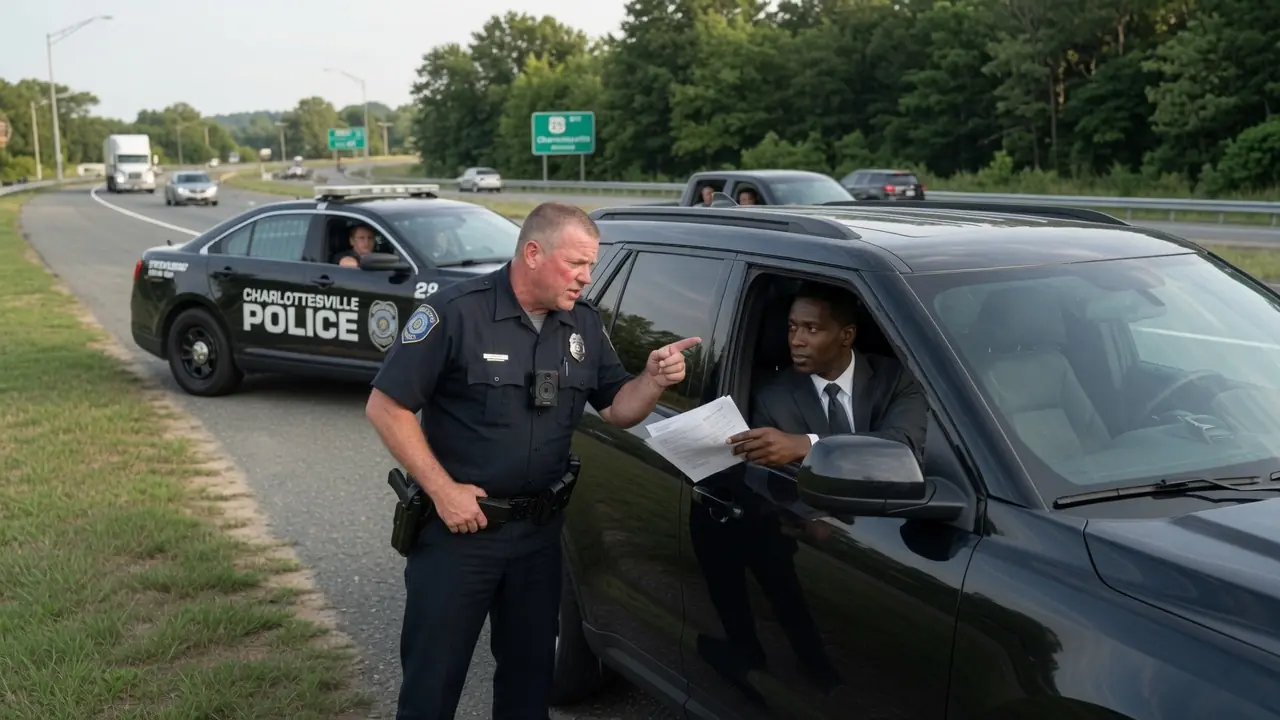
“Do you know why I pulled you over?” Marshall asked, his voice carrying a hint of condescension.
“I assume you’ll tell me,” the man replied evenly. His tone was respectful, but firm.
Marshall frowned, clearly irritated by the absence of nervousness.
“You were speeding,” he declared, though the accusation sounded thin even to him. “Step out of the vehicle, please.”
The man’s eyebrows lifted slightly, but he complied. He stepped out with measured grace, stood tall, and met Marshall’s gaze without fear or defiance.
“What brings you to this area?” Marshall pressed, circling the SUV as though searching for a reason to escalate the situation.
“Work,” the man replied simply, folding his hands in front of him.
“You seem awfully calm for someone who just got pulled over. Got something to hide?”
The young man smiled faintly, but his eyes remained steady.
“No, officer. Do you?”
Marshall’s face hardened. The question struck a nerve. He straightened and tried to loom over the man, but for the first time in a long while, he felt a flicker of unease—not because of anything the driver had done, but because of how completely unshakable he seemed.
What had begun as an ordinary traffic stop was about to take a turn neither man could have predicted, one that would leave Marshall questioning everything he thought he knew about power, respect, and justice.
Marshall’s irritation grew as he walked around the SUV, peering through the windows with exaggerated scrutiny. He tapped the rear of the vehicle with his flashlight even though it was still daylight. It was a subtle, almost habitual gesture, a way of leaving proof that he had been there.
“Open the trunk,” Marshall ordered.
The man hesitated for only a moment, but it was enough to make Marshall’s suspicion flare.
“Is there a problem with my documents?” the man asked. His voice remained calm, now touched with curiosity.
“You seem awfully concerned with my questions,” Marshall snapped. “Just open the trunk.”
The man sighed softly, then complied. He walked to the back of the SUV and opened the trunk with the press of a button. Inside was nothing more than a neatly packed leather briefcase and a small duffel bag.
Marshall rummaged through the bag with little care, unfolding neatly pressed shirts and rifling through personal items.
“Traveling for work, huh? What kind of job requires a wardrobe like this?”
The man leaned against the vehicle, his arms crossed but relaxed.
“The kind where appearances matter. Should I be concerned about the way you’re handling my belongings?”
Marshall straightened, holding up an ordinary shaving kit as though it were suspicious. He was searching for something—anything—but the man remained composed. That calm only fueled Marshall’s frustration.
“You’re awfully bold for someone pulled over on my highway,” Marshall sneered.
“Your highway?” The man tilted his head, his tone carrying a subtle challenge. “I didn’t realize Route 29 was privately owned.”
Marshall stepped closer until they were nearly toe-to-toe, hoping to intimidate him.
“You’ve got a smart mouth. That might not work out so well for you.”
The man held his ground.
“Officer,” he said, his voice suddenly lower and more serious, “are you sure you want to keep going down this path?”
“Is that a threat?” Marshall scoffed.
“No,” the man replied, shaking his head slightly. “It’s a question.”
Before Marshall could answer, a car slowed as it passed. The occupants were clearly observing the scene. Two children in the back seat pressed their faces against the window, their eyes wide with curiosity. Marshall shifted uncomfortably, suddenly aware of how the stop looked from the outside.
“You can stop with the theatrics,” the man said, calm but firm. “I’m not who you think I am, and you’re about to discover that.”
Marshall opened his mouth, ready to fire back, but the words stalled. Something in the man’s tone gave him pause, though his pride would not allow him to admit it. He turned abruptly, returned to his patrol car, and typed the man’s information into the computer.
The results appeared almost instantly.
Marshall froze.
The driver was not simply another citizen passing through. His name was Elijah Porter, the newly elected governor of Virginia.
Marshall stared at the screen, his pulse quickening. Through the windshield, he looked at the man he had stopped and tried to process what the information meant. Elijah had stepped back toward the SUV and was leaning casually against the driver’s door.
When Marshall failed to move, Elijah finally spoke.
“I take it you’ve figured it out by now.”
Marshall climbed out of the patrol car. His movements were stiff and awkward. The confidence he had carried moments earlier had drained from his posture.
“Governor Porter,” he stammered, his tone shifting into something resembling respect.
Elijah pushed away from the vehicle and approached him, his expression unreadable.
“What now, Officer Marshall?”
The power dynamic had changed, but the more important question remained: What would Elijah do with this moment of revelation?
Marshall swallowed hard. The weight of what he had done pressed down on him. He had been caught inside his own assumptions, convinced that the man standing before him could be intimidated and belittled. This was no ordinary citizen. It was the governor, the highest-ranking official in the state, and Marshall had just exposed his own conduct in front of him.
Elijah did not appear angry. Instead, he studied Marshall with calm intensity, as though deciding what should happen next. The silence stretched, each second becoming more unbearable for the officer.
Finally, Elijah spoke.
“Let’s talk about what just happened. I complied with every request you made. My documents are in order. I broke no laws, yet you searched my vehicle and treated me like a criminal. Tell me why.”
Marshall opened his mouth, but no answer came—at least, not one he could say aloud. He shifted uncomfortably and gripped his belt as if it were a lifeline.
“I was just doing my job,” he muttered, though even he did not believe it.
Elijah’s eyebrows lifted slightly, his expression almost pitying.
“Your job? Is that what you call this?” He gestured toward the open trunk and the belongings that had been carelessly disturbed. “Tell me, Officer Marshall. Do you pull over every driver like this, or only the ones who look like me?”
Marshall’s face reddened, but he could not deny the truth. He looked down, avoiding Elijah’s gaze.
“I didn’t know who you were,” he admitted quietly.
“Exactly,” Elijah replied, his tone sharpening. “You didn’t know who I was, but you assumed I was someone you could treat this way. Someone you could dismiss, humiliate, or intimidate. Why? Was it the way I look? The car I drive? Tell me, Officer Marshall. What was it?”
Marshall’s hands clenched at his sides, not in anger, but in shame.
“I…” he began.
Elijah held up one hand and stopped him.
“Save it. I’m not here to humiliate you. I’m here to teach you something. Whether you learn it is up to you.”
Marshall raised his head, confusion flickering across his face.
“Teach me?”
Elijah nodded.
“You’re going to come with me. There is a community forum tonight in a neighborhood not far from here. You’re going to sit there and listen to the stories of the people you claim to serve. Perhaps then you’ll understand the impact of what happened here. Perhaps you’ll see the larger picture.”
Marshall blinked, taken aback.
“You want me to attend a forum?”
“I don’t want you to,” Elijah said. “I’m telling you to, as your governor.”
His voice left no room for argument. Marshall hesitated, his pride wrestling with the undeniable reality of the situation. Deep down, he knew he had no choice.
“Fine,” he said gruffly, though his voice lacked its usual force.
Elijah did not respond immediately. Instead, he stepped closer and held Marshall’s gaze.
“This is not about embarrassing you,” he said quietly. “It is about making sure you never do this to anyone else—not because you’re afraid of who they might be, but because you have learned to respect everyone equally.”
Marshall stared at him as the words sank in. He gave a reluctant nod, though his expression betrayed the turmoil building inside him.
“Good,” Elijah said, turning toward his SUV. “Follow me. I’ll make sure you’re seated in the front row.”
As they drove toward the forum, Marshall could not shake the feeling that the night was about to change everything, for better or worse.
The two vehicles pulled into the parking lot of a modest community center in Charlottesville. A small crowd had already gathered, their voices blending into a hum of anticipation. Inside, rows of folding chairs faced a raised platform where a microphone stood ready to amplify voices that had been ignored for too long.
Marshall stepped out of his patrol car, hesitant and uncertain. He glanced toward Elijah, who stood beside his SUV with the same calm composure he had maintained throughout the traffic stop. The governor gestured toward the building, signaling for Marshall to follow.
The room was full. Men, women, and teenagers occupied the seats, their faces reflecting weariness, hope, frustration, and resilience. Some looked toward Marshall as he entered, their expressions guarded. His uniform, once a symbol of authority, now felt like a scarlet letter beneath their scrutiny.
Elijah led him to the front row, where a seat had been reserved. Marshall sat stiffly with his hands resting on his knees as Elijah approached the microphone.
“Ladies and gentlemen,” Elijah began, his voice steady and commanding, “thank you for coming tonight. This forum exists because your voices matter. Too often, those in power forget that. Tonight, we are here to listen, to learn, and to grow. That includes me, and it includes everyone who serves this community.”
His gaze shifted briefly toward Marshall, subtle but unmistakable.
Murmurs moved through the room before the first speaker stepped forward. She was a middle-aged woman with tired eyes and a trembling voice.
“My son was pulled over last year,” she began. “He was seventeen and had only recently received his driver’s license. The officer claimed his taillight was out, but when we checked it the next day, it worked perfectly.”
Her voice broke.
“He was so frightened that he called me from the car, whispering because he was afraid even to reach for his license.”
Marshall shifted in his seat. He wanted to look away, but the weight of her words held his gaze in place.
Speaker after speaker followed. A young man described being frisked while walking home from work because he supposedly matched a vague description. An elderly man spoke about the fear he felt whenever his grandchildren left the house. A teenage girl told the room how an officer had once asked why she was in a nice neighborhood, as though her presence alone were suspicious.
With every story, Marshall felt the walls of his defenses weakening. The words struck harder than he had expected, peeling back layers of denial he had not realized he carried.
Then a boy no older than ten approached the microphone. His small hands gripped the stand as he looked across the room.
“My dad tells me to always be polite to the police,” he said, his voice high and clear. “But sometimes I think that even if I’m polite, they still won’t like me. Is that true?”
The silence that followed was deafening.
Marshall’s chest tightened as he watched the boy step down. The question remained in the air like a challenge no one dared answer.
Elijah returned to the microphone, his gaze sweeping over the audience.
“This,” he said, his voice heavy with emotion, “is why we are here. We must face hard truths, acknowledge the harm that has been done, and make sure the next generation does not grow up believing respect is a one-way street.”
He turned toward Marshall.
“Officer Marshall, would you like to say something?”
Every eye in the room shifted toward him. For a moment, Marshall could not move. Then, slowly, he rose. His hands trembled slightly as he adjusted his belt. He cleared his throat, his voice rough but sincere.
“I…” He hesitated, then forced himself to meet their eyes. “I have spent years believing I was doing my job the right way. I thought I was enforcing the law. But tonight, I realize that too often I was enforcing my own bias instead. For that, I am sorry.”
A ripple of surprise moved through the crowd.
Marshall swallowed and continued.
“I don’t expect forgiveness, and I don’t expect trust overnight. But I promise you this: I am going to do better. I will start by listening, by learning, and by making sure my actions reflect the respect every one of you deserves.”
The room remained silent for a beat. Then one person began to clap slowly. Others joined, and the sound grew until it filled the community center. Marshall’s throat tightened, but this time it was not shame. It was something closer to hope.
When the forum ended and the crowd began to disperse, Marshall stayed behind. He understood that his journey had only just begun. The energy in the room lingered like the fading notes of a powerful song. He remained seated, staring down at his hands while the weight of the evening settled over him.
Elijah approached and stood silently for a moment before speaking.
“You did something tonight that many people never allow themselves to do,” he said. “You admitted you were wrong. That is the first step, but it is not the last.”
Marshall looked up, his face reflecting gratitude and weariness.
“I don’t even know where to begin,” he admitted quietly.
“You begin by showing up,” Elijah replied. “Not only here, but wherever you are needed. Show up to listen, to learn, and to change. That is how you earn trust—not with words, but with actions.”
Marshall nodded. The simplicity of the instruction struck him deeply.
“I want to be better,” he said, his voice barely above a whisper.
Elijah studied him for a moment, then offered a faint smile.
“Then be better. It is as simple and as difficult as that.”
As they walked out of the building, Marshall felt lighter, though the path ahead still seemed daunting. Elijah paused beside his SUV and turned to face him one last time.
“You know,” Elijah said, “people like you are one of the reasons I ran for office. Not because I wanted to punish people, but because I wanted to change systems. I believe people can learn. Even you, Officer Marshall.”
Marshall gave a dry, self-deprecating chuckle.
“I suppose I have a great deal to learn.”
“We all do,” Elijah replied. He opened the driver’s door, then paused. “But this is not only about you. It is about the people you serve. Never forget that.”
As Elijah drove away, Marshall stood in the parking lot and watched the taillights disappear into the distance. For the first time in years, he did not feel like a man enforcing the law. He felt like a man learning to understand it.
The next day, Marshall returned to work with a notebook tucked into his pocket. He began asking questions he had never thought to ask, attending forums he once would have ignored, and having conversations he previously avoided. The stories he had heard at the community center replayed in his mind, reminding him that every decision he made affected a real person’s life.
Months later, Elijah received a letter in the mail from Marshall. Inside was a handwritten note and a photograph of a newly established Community-Police Relations Board.
The note read, “I still have a lot to learn, but I’m learning. Thank you for giving me the chance to see things differently.”
Elijah smiled as he read the words. He placed the letter on his desk and leaned back, thinking about the young boy who had asked the most difficult question of the night.
“Is it true they won’t like me anyway?”
Elijah knew the answer was complicated. But as he looked at the photograph of the new board, he felt a spark of hope that one day the answer might be different. Perhaps respect would no longer need to be demanded through power or earned through fear. Perhaps it would be given freely because it was right.
The story of Governor Elijah Porter and Officer Ted Marshall is a reminder that change begins with acknowledgment and grows through action. It is not enough to claim good intentions. Real change requires people to listen, learn, and continue showing up long after the public moment has passed.