“You need to step outside. This lounge is for verified clients.”
The words were spoken softly, almost politely, which somehow made them uglier.
Denise Caldwell did not raise her voice when she said them. She did not point toward the door. She simply stood beside the leather chair with her pearl earrings, cream blazer, perfect posture, and that cold little smile people use when they want cruelty to look like policy.
Across from her, Mariah Bennett sat with her hands folded over a slim brown folder.
She was forty-seven years old, Black, calm-faced, and dressed in dark jeans, a white linen shirt, and flat tan loafers that had seen enough airport terminals to stop looking new. She wore no diamond necklace. No designer handbag sat beside her. No assistant stood behind her whispering appointments into a headset.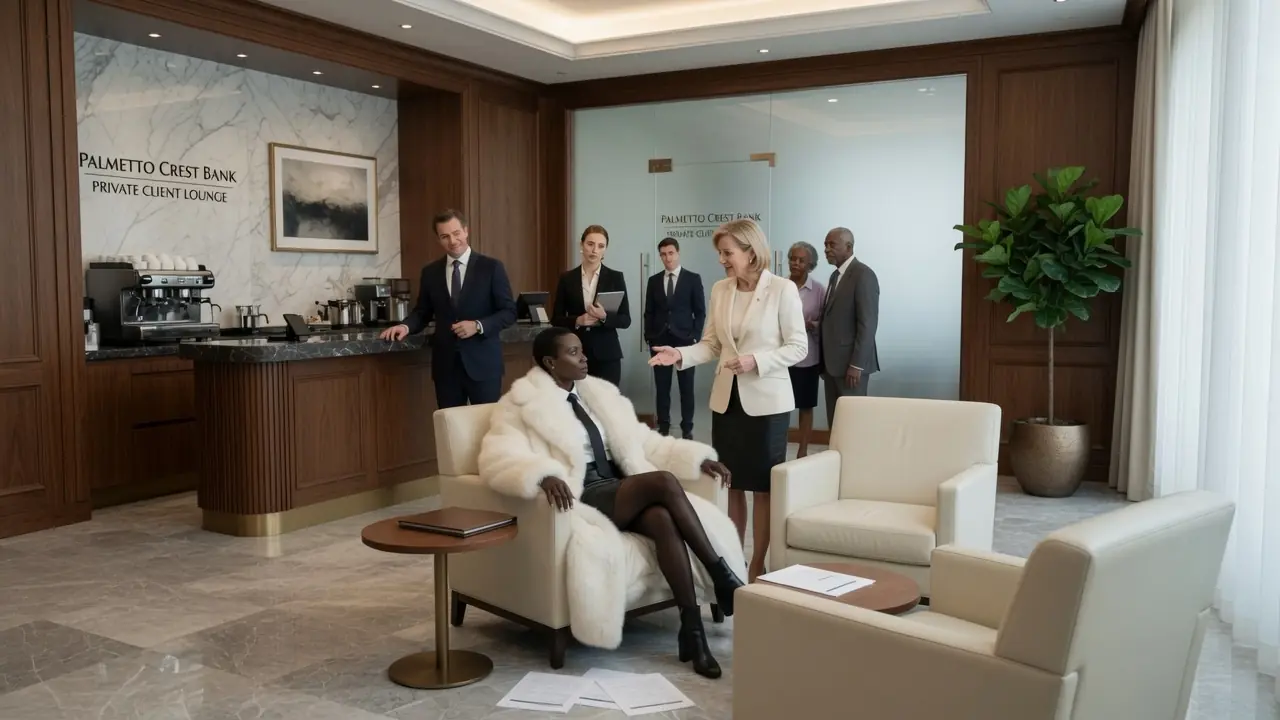
To Denise Caldwell, branch director of Palmetto Crest Bank’s private client office in Bayhaven, South Carolina, Mariah looked like a mistake that had wandered into the wrong room.
That was the problem.
Not Mariah.
The looking.
The private lounge was built to make rich people feel separate from ordinary weather. Marble floors. Walnut tables. Glass walls frosted just enough to suggest privacy without hiding status. A coffee bar with tiny spoons nobody needed. Soft chairs arranged so every client could feel important without having to say so.
Mariah had walked in at 10:12 that morning and requested a private withdrawal review for $750,000.
The young teller at the front desk, a nervous man named Jordan Price, had looked at her account number, gone pale for half a second, and sent her into the lounge. He had not questioned her. He had not smiled much either. He looked like someone who had seen a number on a screen too large for his mouth to explain.
Then Denise arrived.
Five minutes later, the room began changing.
“We will need proof of where these funds came from,” Denise said.
Mariah looked up.
“You have my account number.”
“That does not answer the question.”
“It answers the banking question.”
Denise’s smile tightened.
“Ma’am, we take financial security very seriously here.”
“I hope so.”
That answer annoyed Denise because it did not bend.
Mariah opened the brown folder, removed a document, and placed it on the table. Before Denise could reach for it, a man in a navy suit stepped past the chair and bumped the edge of the table with his hip. The folder slid to the floor.
He looked down at it, then at Mariah.
“My mistake,” he said, though his face said the opposite.
His name was Grant Ellison, a real estate investor with a polished watch, a loud voice, and the moral confidence of a man whose money had protected him from self-awareness for too long. He was waiting for a portfolio review and had already complained twice that his espresso was lukewarm.
Mariah leaned down, picked up the folder, and placed it back on the table.
Grant gave a short laugh.
“People really do try anything these days.”
The lounge went quieter.
Not silent.
Quieter.
That is how rooms behave when people sense something shameful and decide not to be the first person to name it.
Denise did not correct him.
That was the first real sign.
Mariah noticed.
She had spent twenty-five years noticing what people said and what people allowed to be said. She had been called aggressive when she was precise, difficult when she was right, lucky when she was brilliant, and intimidating when she refused to smile through insult. By forty-seven, she had learned that bias rarely entered a room shouting.
It preferred a blazer.
A policy manual.
A raised eyebrow.
A sentence that began with “for security reasons.”
A younger banker stood near the far wall with a tablet tucked against her chest. Her name tag read: Tessa Monroe, Senior Private Banker. She was thirty-two, white, with glossy auburn hair and the expression of someone who had already decided the story before hearing it.
“She is not verified,” Tessa said.
Mariah turned toward her.
“You have not run my name.”
Tessa’s mouth tightened.
“We cannot just run names for walk-ins claiming that kind of liquidity.”
Mariah blinked once.
“Then let me help you. Run Mariah Bennett.”
Denise exhaled, slow and theatrical.
“This is not a retail counter.”
“I am aware.”
“Then you understand why this feels unusual.”
Mariah looked around the room.
At Grant smirking near the coffee bar.
At Tessa watching her shoes.
At Jordan standing frozen near the glass door, too young to be brave and too decent to be comfortable.
At an elderly Black woman in a lavender cardigan sitting three chairs away, clutching her purse as if the insult had brushed against her too.
“Unusual to withdraw money,” Mariah said, “or unusual that I have it?”
Denise’s face cooled.
“Do not turn this into something it is not.”
That sentence had done so much harm in America it should have been printed on warning labels.
A man near the window lowered his magazine.
His name was Marcus Bell, a retired school principal with silver hair, a pressed gray suit, and eyes that had spent forty years recognizing unfairness in children before adults admitted it existed. He watched Denise carefully.
Grant laughed again.
“Oh, come on,” he said. “We all know what this is. She probably found some account number online and thought nobody would check twice.”
Mariah turned toward him.
“Do you usually accuse strangers of crimes before breakfast, or is this a special occasion?”
A woman near the coffee bar covered her mouth.
Grant’s face flushed.
Denise stepped forward.
“Enough. We are not going to have a scene.”
Mariah looked at her.
“You started one when you decided I did not belong here.”
Tessa muttered, “Security should be notified.”
Jordan looked at her sharply.
“For what?”
Everyone turned.
The young teller’s face went red, but he did not look away this time.
Tessa lifted her chin.
“For a suspicious transaction.”
Jordan swallowed.
“She gave an account number.”
“Jordan,” Denise said sharply.
His mouth closed.
Mariah looked at him, and for one brief second, her expression softened.
Not enough for the others to see.
Enough for him.
“Run my name,” she said again.
Denise folded her arms.
“I will not be bullied into bypassing security protocol.”
“Good. Use the protocol.”
“Do not instruct me on my branch.”
Mariah’s eyes sharpened.
“Your branch?”
The two words landed quietly.
Denise missed the weight of them.
She was too busy enjoying authority.
“Yes,” Denise said. “My branch. And I am telling you that until you provide sufficient documentation, you will need to leave this lounge.”
Grant clapped once.
Softly.
Mockingly.
“There it is.”
The elderly woman in lavender stood.
Her name, as Mariah would later learn, was Mrs. Althea Brooks. She had banked at Palmetto Crest since her husband opened a savings account there in 1978, back when the bank still had green carpet and one Black teller everyone in town knew by first name.
“That is not right,” Althea said.
Denise turned with practiced patience.
“Mrs. Brooks, this does not concern you.”
“It concerns me if this is how you treat us when you think nobody important is watching.”
Grant rolled his eyes.
“Here we go.”
Marcus Bell rose from his chair.
“Let her speak.”
The room shifted again.
Small courage has a way of embarrassing silence.
Tessa walked to the wall phone.
“I am calling security.”
Mariah lifted one hand.
“Before you do that, I want everyone in this room to hear me clearly. I am asking you for the third time to verify my name through the system. I have given you an account number, legal identification, and documentation. You have refused to review it, accused me without evidence, and escalated based on appearance.”
Denise’s face reddened.
“You are twisting this.”
“No,” Mariah said. “I am preserving it.”
From her folder, she took out a small recorder and placed it on the table.
Denise stared at it.
“You are recording us?”
“Palmetto Crest records client interactions in private lounges under section nine of its customer experience policy. I am simply making sure my copy does not get misplaced.”
That was the first moment Denise looked unsure.
Only for a second.
But Mariah saw it.
Tessa spoke into the phone. “We need security in the private lounge. Possible fraud attempt. Noncompliant individual refusing to leave.”
“Individual,” Marcus repeated softly.
Althea Brooks shook her head.
Grant leaned against the coffee bar, smiling like a man waiting for entertainment to improve.
Mariah reached into her pocket and pulled out her phone.
She dialed one number.
When the call connected, she said, “Elaine, begin Redwood.”
A woman’s voice answered through the speaker, calm and clear.
“Confirmed. Redwood protocol active. Internal compliance notified. Executive board copied. Audio channel open.”
Denise frowned.
“Who is that?”
Mariah did not answer her.
Elaine continued. “Mariah, I have logged refusal to verify, use of fraud language before review, security escalation, and the client lounge recording notice. Do you want me to pull prior complaints for this branch?”
“Yes,” Mariah said.
Denise gave a brittle laugh.
“This is absurd.”
“No,” Marcus said quietly. “It sounds organized.”
Grant pointed toward Mariah’s phone.
“She is putting on a show.”
Mariah turned toward him.
“Mr. Ellison, you knocked my documents to the floor and accused me of stealing before anyone verified anything. You have not asked one banking question.”
His smirk faded.
“How do you know my name?”
She looked at his client badge.
“I read.”
That stung him more than it should have.
The glass doors opened.
Security arrived in the form of a tall man with a shaved head, dark uniform, and the practiced walk of someone who had been told authority was mostly posture. His badge read: Nolan Briggs.
Denise pointed at Mariah.
“She is refusing to leave.”
Nolan looked at Mariah, then at Denise.
“Ma’am, I need you to come with me.”
Mariah stayed seated.
“On what basis?”
“Suspicious activity.”
“What activity?”
He hesitated.
Denise snapped, “She is attempting to withdraw three quarters of a million dollars without proper verification.”
Mariah lifted the folder slightly.
“I have provided verification. They refused to run it.”
Tessa crossed her arms.
“She is creating a disturbance.”
Althea Brooks spoke from her chair.
“No, baby. She is sitting there breathing while you all panic.”
A few clients murmured.
Nolan’s jaw tightened.
“Ma’am, stand up.”
Mariah looked at him carefully.
“You are making a serious mistake.”
“I am doing my job.”
“No,” she said. “You are doing what they expected you to do without asking whether it is legal.”
Nolan reached for the folder.
Mariah put one hand on it.
“Do not touch my documents.”
His eyes narrowed.
“You want to make this harder?”
Marcus stepped closer.
“Officer Briggs, she has not threatened anyone.”
“I am not an officer,” Nolan said.
“Then stop acting like an arrest is yours to perform.”
The words hung there.
Jordan, still near the glass door, whispered, “He’s right.”
Denise turned on him.
“Jordan, go back to the front desk.”
He did not move.
It was a small rebellion.
The kind that shakes a room because everyone recognizes how much fear it took.
Tessa grabbed the phone again.
“I am calling police.”
Mariah’s face did not change.
“Do that.”
Denise looked almost triumphant.
“You heard her.”
Tessa dialed.
Into the receiver, she said, “Yes, we have a woman in the private client lounge attempting a fraudulent high-value withdrawal. She is refusing to leave and recording staff.”
Mariah looked at the room.
“Notice the language. Woman. Fraudulent. Refusing. Recording. Still no verification.”
Elaine’s voice came through the phone.
“Logged.”
Denise’s head snapped toward the device.
“Who are you?”
Elaine replied, “Elaine Porter, executive counsel.”
The words did not yet land.
Denise was too far into the lie to turn around gracefully.
Grant muttered, “Anybody can say that over a phone.”
Mariah looked at him.
“True.”
Then she opened her folder and removed a black card embossed with the Palmetto Crest crest.
She placed it on the table.
Denise glanced at it.
For half a second, her face went blank.
Tessa saw that and stepped closer.
Nolan shifted his weight.
The room seemed to lean inward.
Denise picked up the card.
Her fingers tightened.
“This is not possible,” she said.
Mariah stood then.
Slowly.
Not dramatically.
She simply rose, and somehow the room understood that the shape of power had changed.
“My name is Mariah Bennett,” she said. “I am the founder and majority owner of Bennett Holdings. Bennett Holdings acquired Palmetto Crest Bank eighteen months ago. I serve as chair of the ownership board and interim executive director of branch ethics.”
Silence.
Complete.
Heavy.
The espresso machine hissed once, then stopped.
Mariah continued.
“I came here today because this branch has generated eleven unresolved client complaints in nine months. Seven involved Black clients. Two involved Latino business owners. One involved an Asian American widow attempting to transfer estate funds. All were dismissed as misunderstandings, incomplete documentation, or client agitation.”
Denise’s face drained of color.
Tessa stepped backward.
Jordan covered his mouth.
Grant looked at the floor.
Mariah turned to Denise.
“I did not come here hoping you would fail. I came here hoping the complaints were wrong.”
Denise’s lips parted.
“Ms. Bennett, I—”
“No.”
One word.
Clean.
Final.
Denise stopped.
Mariah looked toward Nolan.
“You attempted to remove a verified client without asking one independent question.”
Nolan swallowed.
“I was following branch instruction.”
“That is not a defense. It is a confession of training failure.”
The police arrived five minutes later.
Two officers entered carefully, already sensing they had walked into something larger than a fraud call. The first was a Black woman in her forties named Officer Renee Holt. The second was a younger white officer named Daniel Keats, who kept his hand away from his belt and his eyes moving around the room.
Tessa stepped toward them.
“She claimed ownership after—”
Mariah held up a hand.
“I will make a statement after corporate counsel arrives. Until then, I ask that you document who placed the call, the language used, and the fact that no account verification was run before police were contacted.”
Officer Holt looked at Tessa.
“Did you run verification?”
Tessa’s mouth moved.
No sound came out.
Jordan spoke.
“No, ma’am.”
Everyone turned.
He looked terrified now, but he kept going.
“I was at the front desk. The account number triggered an executive review flag. I sent Ms. Bennett here because that is what the system instructed. Ms. Caldwell told me not to interfere after she entered the lounge.”
Denise whispered, “Jordan.”
He looked at her.
“No. I should have said something sooner.”
Mariah watched him.
There was no smile.
But there was recognition.
Officer Holt wrote it down.
Then Althea Brooks stood again.
“I would like to make a statement too.”
Denise closed her eyes.
Althea lifted her chin.
“I saw Mr. Ellison knock that woman’s folder down. I saw Ms. Caldwell refuse to look at her papers. I heard Ms. Monroe call security before any verification was done.”
Grant snapped, “I bumped the table.”
Althea turned.
“Sir, at my age I have seen enough accidents to know when one has a personality.”
A sound moved through the room.
Not laughter exactly.
Relief trying to find a safe place.
Marcus Bell stepped forward next.
“I will also provide a statement. This was not only poor service. It was targeted humiliation covered in procedural language.”
Elaine Porter arrived with two corporate compliance officers eleven minutes later.
By then, the lounge no longer felt like a private banking room.
It felt like a hearing.
Denise stood near the coffee bar, pale and rigid.
Tessa sat in a chair, gripping her tablet with both hands.
Nolan remained by the door, suddenly aware that blocking exits was not the same thing as protecting people.
Grant had tried twice to leave.
Officer Holt told him both times he could do so after giving a statement.
Mariah stood in the center of the room with the calm of a woman who had decided long ago not to waste energy appearing wounded for people who enjoyed the sight.
Elaine handed her a thin packet.
“Board authorization is active,” she said.
Mariah nodded.
“Begin with access logs.”
Elaine looked toward the compliance officers.
“Already pulled.”
She turned her tablet so Mariah could see.
“Verification was available from the moment the account number entered the system. Jordan Price followed procedure. Denise Caldwell overrode the executive alert and marked the client as identity risk. Tessa Monroe initiated security escalation six minutes later. No secondary review was performed.”
Mariah looked at Denise.
“Why did you override the alert?”
Denise’s face tightened.
“I believed the alert was a system error.”
“Based on what?”
No answer.
“Based on what, Denise?”
Denise looked at Mariah’s clothes.
Then realized too late where her eyes had gone.
Mariah nodded once.
“There it is.”
Tessa’s voice cracked.
“We get false attempts.”
“Everyone does,” Mariah said. “But you did not test the attempt. You judged the person.”
Grant scoffed, because some men are incapable of survival if silence is required.
“This whole thing is political theater.”
Mariah turned to him.
“No. Theater requires an audience. This required witnesses.”
Elaine spoke again.
“There is more.”
The room stilled.
Mariah looked at her.
“Say it.”
Elaine took a breath.
“This branch used an unofficial client tag in the CRM system. PDR.”
Jordan frowned.
“What does that mean?”
Tessa stared at the floor.
Denise did not move.
Elaine’s voice sharpened.
“Potential disruption risk. It was applied to twenty-three clients in the last year. Nineteen were Black or Hispanic. Fourteen had no documented behavioral incident.”
Officer Holt looked up slowly.
Marcus Bell closed his eyes.
Althea whispered, “Lord.”
Mariah looked at Denise.
“Who created the tag?”
Denise’s lips tightened.
“I do not know.”
Elaine said, “The first use came from your login.”
That sound, the collapse of a lie inside a quiet room, is not loud.
But everyone hears it.
Tessa began crying.
Mariah turned toward her.
“Do not perform remorse yet. We have not earned the right to believe it.”
Tessa wiped her face quickly.
“I followed what Denise taught me.”
Denise snapped, “Do not put this on me.”
Tessa looked at her, panicked and furious.
“You told us to keep the lounge clean. You told us certain people create friction. You said corporate only cares about complaint numbers, so if we keep the numbers low, everyone wins.”
Mariah’s gaze did not move.
“Everyone?”
Tessa broke.
“No. Not everyone.”
Nolan spoke from the door.
“I removed a man last month.”
Every head turned.
He swallowed.
“A Latino contractor. He came in with a check from a settlement. He got upset because Tessa kept asking how he got it. Denise told me to escort him out before he made clients uncomfortable.”
Elaine’s fingers moved across her tablet.
“Name?”
“Rafael Ortiz.”
Elaine looked up after a few seconds.
“Complaint filed. Marked hostile. Closed without review.”
Mariah closed her eyes briefly.
When she opened them, something in her face had changed.
The calm remained.
But underneath it was grief.
Not personal grief.
Institutional grief.
The kind a leader feels when a building she owns has been quietly hurting people while using her name on the door.
“Effective immediately,” Mariah said, “this branch is closed for the day.”
Denise jerked upright.
“You cannot—”
Mariah looked at her.
“I own it.”
Denise went silent.
Mariah turned toward Elaine.
“Denise Caldwell is terminated for bias, falsification of client risk records, obstruction of verification, and abuse of authority. Tessa Monroe is suspended pending full review, with recommendation for termination based on call records and participation in unlawful escalation. Nolan Briggs is suspended pending security conduct review.”
Nolan lowered his head.
Tessa sobbed into one hand.
Denise stared at Mariah with a hatred that had finally lost its costume.
“You set me up.”
Mariah stepped closer.
“No. I gave you an ordinary client, and you showed me an extraordinary problem.”
Grant stood.
“And me?”
Mariah turned slowly.
“Grant Ellison, your accounts will be reviewed for conduct violations under client dignity provisions. Pending review, your private lounge privileges are revoked.”
He laughed in disbelief.
“You cannot be serious. I have eight figures here.”
Mariah’s expression did not change.
“And somehow no class.”
Althea Brooks made a small sound that might have been a cough.
Officer Keats looked down at his notebook very hard.
Grant’s mouth opened, then closed.
For once, money had reached the edge of its usefulness.
Then a voice rose from the far corner.
Soft.
Young.
“Can I say something?”
A woman in a green jacket stood near the frosted glass divider. She had been quiet the whole time, almost folded into herself. She looked about twenty-six, Black, with a camera bag at her feet and tears standing in her eyes.
“My name is Simone Carter,” she said. “I came here three weeks ago to open a business account for my photography studio. Tessa told me my income was too inconsistent for private services. She never looked at my contracts. She told me I should try a community credit union first.”
Tessa covered her face.
Simone lifted her phone.
“I recorded some of it because I knew nobody would believe the tone if I only described the words.”
Mariah walked toward her.
“You should never have needed proof of your own dignity.”
Simone’s mouth trembled.
“I just wanted to open an account.”
“I know.”
That was all Mariah said.
But it was enough.
The room began to feel different after that.
Not healed.
Healing is too large a word for the first day truth enters a place.
But different.
Clients gave statements. Jordan provided the front desk record. Althea described everything she saw in a voice so steady that Officer Holt stopped asking follow-up questions and simply let her speak. Marcus Bell explained how institutions train silence without ever writing silence into policy.
Grant spoke too, though his statement sounded mostly like a man trying to step around his own shadow.
By noon, the lounge had emptied of its old authority.
Denise had been escorted out through the side hall.
Tessa sat with compliance officers, no longer crying loudly, only staring at the table as if discovering the person she had become and not liking the company.
Nolan gave his statement without asking for mercy.
Jordan returned to the front desk, shaken but standing taller.
Mariah remained in the lounge.
Elaine approached her with a fresh report.
“It is worse than we thought.”
“It usually is.”
Elaine nodded.
“Three years of complaint suppression. Not only here. Bayhaven, Lark Street, Montgomery Ridge, and two branches in Georgia. Same language. Same tags. Same closure patterns.”
Mariah looked through the glass walls toward the main bank floor.
People were still moving there.
Deposits.
Withdrawals.
Mortgages.
College savings.
Small businesses trying to become real.
Families trusting systems they rarely got to see.
“This was not a bad branch,” Mariah said.
Elaine waited.
“It was a culture.”
“Yes.”
Mariah took a breath.
“Then we do not fix it with a press release.”
Elaine almost smiled.
“I assumed not.”
Mariah turned back to the room where Althea, Marcus, Simone, and Jordan still lingered.
“Would you all sit with me for a few more minutes?”
Althea looked surprised.
“You want us?”
“I need you.”
They sat around the same table where Denise had told Mariah to leave.
That mattered.
Mariah placed her folder in the center.
“I am launching a full client dignity audit across every Palmetto Crest branch. Not only numbers. Words. Escalations. Denied services. Security calls. Closed complaints. I want people who know what this feels like to help shape it.”
Marcus leaned back.
“You are asking clients to help rebuild policy?”
“Yes.”
“Good,” he said. “Policy built without memory becomes paperwork with no soul.”
Althea nodded.
“I will help.”
Simone wiped her face.
“I do not know anything about banking policy.”
Mariah looked at her.
“You know what it feels like to be dismissed before you finish a sentence. That is expertise.”
Jordan stood near the doorway.
“Can staff help too?”
Mariah looked at him.
“Only the ones willing to tell the truth when it costs them.”
He swallowed.
“I want to be that kind.”
“Then start today.”
By evening, the story had spread through Bayhaven.
Not because Keith had filmed it.
There was no Keith in this room, no viral clip, no shaky footage edited into outrage. It spread because clients called spouses, employees called friends, and one police report contained enough truth to travel without needing music under it.
Local reporters gathered outside before sunset.
Mariah did not go out to meet them.
Not yet.
Instead, she stood in the private lounge after everyone had gone and looked at the chair where she had been told she did not belong.
Elaine stood beside her.
“You okay?”
“No.”
“Do you want to be?”
“Not today.”
Elaine nodded.
That was why Mariah trusted her.
Good assistants offer solutions.
Great ones know when the honest answer is allowed to stand.
Mariah walked to the coffee bar and picked up the small spoon beside the espresso cups. It was polished, delicate, unnecessary. Everything in that room had been chosen to signal refinement. None of it had taught anyone dignity.
She set the spoon down.
“My father opened his first savings account in a bank where they made him wait until every white customer had been served,” she said.
Elaine said nothing.
“He used to tell me, ‘Baby, money can get you through a door, but character decides what you become once you’re inside.’”
She looked around the lounge.
“I bought the door. I forgot to check the character.”
“You did not build this alone.”
“No. But I own what carries my name.”
The next morning, Palmetto Crest did not release a polished apology.
Mariah wrote the statement herself.
It was plain.
Yesterday, a client in our Bayhaven private lounge was profiled, insulted, escalated against, and denied basic verification procedures. That client was me. But the problem is not that staff failed to recognize an owner. The problem is that they mistreated a person they believed had no power.
That paragraph went everywhere.
Not because it was dramatic.
Because it was true.
By Monday, every branch manager in the region had been ordered into emergency review. By Wednesday, the unofficial PDR tags had led to outside investigation. By Friday, three more employees resigned before interviews began. Within two months, Palmetto Crest created a client dignity board that included business owners, retirees, former tellers, legal experts, and customers who had previously filed ignored complaints.
Simone Carter opened her photography business account with Palmetto Crest.
Fee-free.
Not as charity.
As correction.
Althea Brooks became part of the advisory board and treated every meeting like Sunday school with consequences. She wore lavender often and asked questions so simple they embarrassed executives into honesty.
Marcus Bell helped rewrite training language.
He removed phrases like client quality and preferred profile from internal documents and replaced them with behavior-based standards that had to be supported by facts.
Jordan Price was promoted six months later.
Not because he was perfect.
Because he had been afraid and still chosen truth before it was safe.
As for Denise Caldwell, she sued.
Then withdrew the suit after discovery revealed emails that made even her attorney stop speaking confidently.
Tessa Monroe gave a sworn statement and left banking entirely.
Nolan Briggs entered a security certification program built around de-escalation, legal boundaries, and bias recognition. Mariah did not rehire him, but when he completed the program, she wrote one sentence to the board considering his application elsewhere.
He caused harm, admitted it, accepted consequence, and did not ask the injured party to comfort him.
That was all.
It was enough.
Grant Ellison moved his accounts to another bank and gave an interview about “customer overreach.”
Nobody serious quoted it twice.
A year later, the Bayhaven branch reopened its private lounge after renovation.
Not marble.
Not walnut.
Not a room designed to make certain people feel above others.
Mariah had the frosted glass removed.
The lounge became brighter, warmer, more open. The chairs were still comfortable, but no longer arranged like a quiet throne room. A sign near the entrance read:
Private service does not mean unequal dignity.
On the wall behind the main desk hung a photograph of Palmetto Crest’s first integrated teller class from 1969. Beside it hung a newer photo: Althea Brooks, Simone Carter, Marcus Bell, Jordan Price, and Mariah Bennett standing together on reopening day.
Mariah hated the photo at first because she thought she looked tired.
Althea told her, “Good. Tired means you worked.”
That became one of Mariah’s favorite compliments.
On the first anniversary of the incident, Mariah returned to the lounge alone before opening.
The morning light came through the windows soft and gold. The coffee machine hissed. Somewhere beyond the glass, a teller laughed. The room felt different now, not perfect, but awake.
Elaine walked in carrying two paper cups.
“No tiny lounge cups today,” she said.
Mariah smiled.
“Good.”
They sat at the table.
The same one.
Mariah ran one hand over the smooth surface.
“I can still hear her,” she said.
Elaine knew who she meant.
You need to step outside.
This lounge is for verified clients.
Mariah let the memory sit there.
Then she let it pass.
“I used to think the twist was that I owned the bank,” she said.
Elaine looked at her.
“It wasn’t?”
“No.”
Mariah looked toward the front desk, where Jordan was helping an older man with a cane and a young woman in scrubs at the same time, giving both the full attention of his face.
“The twist was that ownership did not make me safe from the system. It only gave me the power to change it after it showed itself.”
Elaine nodded slowly.
“That is heavier.”
“Truth usually is.”
At 9:00, the doors opened.
The first client was not wealthy in any visible way. She was a Black woman in her early thirties wearing a grocery store uniform, holding a folder against her chest with both hands. She looked nervous, as if she had rehearsed her sentences in the car.
Jordan greeted her warmly.
“Good morning. How can we help you today?”
The woman glanced at the sign.
Private service does not mean unequal dignity.
Then she looked back at him.
“I want to open a savings account for my daughter.”
Jordan smiled.
“Then you are in the right place.”
Mariah watched from the lounge.
No applause.
No speeches.
No cameras.
Just a woman being served without having to prove she deserved respect first.
For Mariah Bennett, that was the real victory.
Not the firings.
Not the headlines.
Not the apology letters from people who suddenly discovered conscience after consequences arrived.
The victory was quieter.
A door opened.
A person entered.
And nobody made her shrink before letting her belong.