Growing up, my sister Brooke never let me forget that I was adopted. While our parents showered both of us with love, she would whisper things like, “They only got you because the agency was having a two-for-one sale,” or, “At least I know where I came from.” I tried not to let it bother me, but every comment chipped away at my confidence.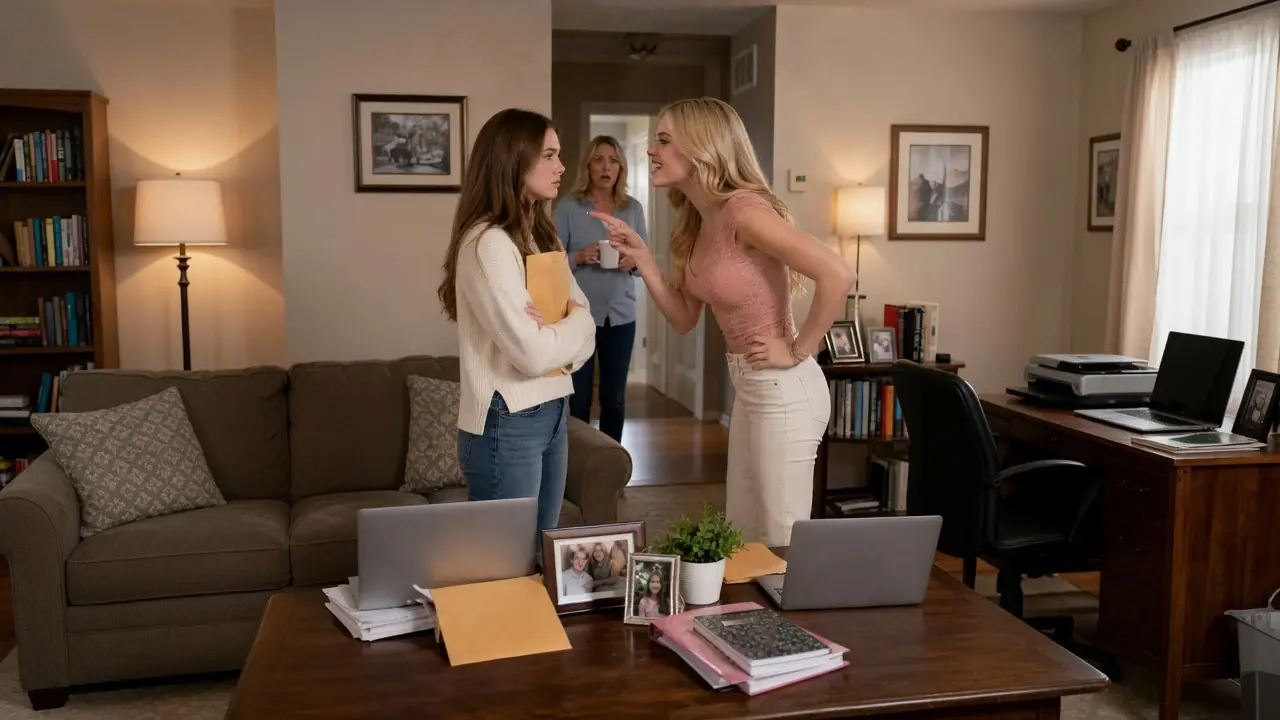
I was eight when my parents chose me. They already had Brooke, who was six at the time, but they wanted another child. After meeting me at the agency, they said it felt as though I had always been meant to be part of their family.
Brooke never accepted that. She hid my homework, blamed me for things she broke, and told other children at school that I was “secondhand goods.” Even when our parents treated us equally, she acted as though their love for me had been stolen from her.
Despite her constant bullying, I worked hard in school while Brooke partied and barely maintained a C average. I took advanced classes, studied late into the night, and quietly built a future for myself. Our parents noticed the difference between us, but they refused to make comparisons, praising both of us whenever they could, even when Brooke had done very little to earn it.
Everything changed during our senior year. Brooke was failing three classes and was at serious risk of not graduating. Instead of studying, she spent her time making TikToks about adopted children being “damaged goods” and posting Instagram stories mocking what she called my “generic-brand DNA.”
One day, I overheard her speaking to a friend on the phone.
“My parents only adopted her because they felt sorry for her,” she said. “Just wait until college applications come around. They’ll remember that blood is thicker than water, and all their money will go to their real daughter’s education.”
That was the last straw. I had already been accepted to Princeton with a partial scholarship, but I had not told anyone yet. Instead, I decided to step back and let Brooke face the consequences of her own choices.
Every time she skipped class to spend time with her boyfriend, I kept quiet. When she forged our mother’s signature on a failed math test, I looked the other way. I watched as she dug herself deeper, convinced that our parents would rescue her simply because she was their biological daughter.
On the day the college decisions were released, all four of us gathered in the living room with our eyes fixed on our laptops. My father sat with one hand resting against his chin, watching in silence. My mother paced back and forth with a cup of tea that had already gone cold.
Brooke seemed far too calm, which was usually a warning that something was about to explode.
“Come on, Brooke,” my mother said, forcing a smile. “Open the email already.”
Brooke huffed as though the entire process were beneath her. “Relax. I already know I got in.”
She still believed her own fantasy. She had applied to seven colleges even though her grades barely met the minimum requirements. For weeks, she had spent more time arranging the perfect Instagram aesthetic for decision day than she had spent completing the applications themselves.
She clicked the first email. Silence filled the room for one long second, stretching until it became a weight in the air. Then she frowned, scrolled down, and read the message again.
“This is a mistake,” she murmured, pulling the laptop closer to her face.
“Honey?” my father asked carefully.
“Rejected,” she said, spitting the word as though it were poison. “They said my application doesn’t meet the academic requirements. That’s wrong. I had recommendation letters.”
My stomach tightened, but I held back the smile that threatened to escape. It was cruel to feel satisfaction at someone else’s downfall, but there was something cathartic about watching her arrogance crumble, layer by layer, as reality finally returned everything she had been spreading for years.
One by one, Brooke opened the other emails. Every answer was a variation of the same polite rejection. By the time she reached the final one, she had turned pale.
For the first time in years, Brooke had nothing to say.
“No.” She slammed the laptop shut. “This makes no sense. I deserve to get in.”
That was when I opened my own email. Without making a speech, I turned my laptop so the screen was visible on the table. The word “Congratulations” was emblazoned across the top of Princeton’s digital acceptance letter.
My mother stepped closer, read it slowly, and looked at me with tearful eyes.
“You already knew?”
I nodded.
“Why didn’t you tell us?”
“Because I knew today would come,” I said. “I wanted the result to speak for itself.”
Brooke gave a dry laugh. “Of course. The prodigy orphan. How wonderful. You think this changes anything?”
“I don’t think so,” I replied, meeting her stare. “But you will.”
She stood so quickly that she nearly knocked over her chair. “Are you really going to spend money on her? On someone who isn’t even your real daughter?”
Our mother reacted before anyone expected it. She struck Brooke once across the cheek—not violently, but with enough force to stop the room cold. The small, sharp sound lingered between us.
“Never speak like that again,” she said firmly. “You are allowed to be angry, frustrated, or sad. You are not allowed to be cruel.”
Brooke stood motionless. Tears gathered in her eyes, but pride kept them from falling.
“You chose her,” she said. “You always choose her. You only had me because it was easy. She was bought.”
My mother exhaled, too hurt to answer. My father reached for Brooke’s shoulder, but she pulled away as though his hand burned. Then she ran upstairs and slammed her door, the sound echoing through the house like a muted scream.
She did not come down for dinner. She did not appear the next morning or at lunch. Her food remained untouched, her bedroom stayed locked, and her Instagram account went silent for the first time in years.
The real shock came two days later, when the school principal emailed our parents. Brooke had been reported for plagiarism on two assignments. A teacher had screenshots showing that her work matched other texts exactly, and the school was opening a disciplinary investigation that could prevent her from graduating.
My father sat on the porch for hours with his phone in his hand. My mother cried quietly in the bathroom. I went to my room and closed the door.
For the first time, I felt no pity. Brooke had created the world she was trapped in. I had simply stopped protecting her from its collapse.
I also knew she would not fall quietly. Brooke was like a wounded animal, and wounded animals often bite.
It took three days.
On the morning of the fourth, I found her sitting at the kitchen table as though nothing had happened. Her hair was pulled into a messy bun, and she wore sunglasses even though she was inside. She stirred a bowl of cereal without any intention of eating it.
When she noticed me, she raised an eyebrow. “Did you enjoy the show? Did you report me to the school, too, or were you waiting for someone to carry me out on a silver platter?”
“I didn’t have to report anything,” I said, taking an apple from the fruit bowl. “You were doing a good job of destroying yourself.”
She smiled, but there was nothing warm in it.
“You think you won, don’t you?”
“It isn’t a competition.”
“Of course it is. It always has been. You only won because nobody expects anything from someone who came from nowhere.”
I did not respond. The words still hurt, but a harder part of me understood that she wanted a reaction. She wanted conflict. She wanted proof that she could still make me bleed emotionally.
What hurt more was seeing our mother standing in the hallway, listening to everything.
The spoon slipped from Brooke’s hand when she noticed her.
“If that is truly how you think about your sister,” my mother said, “then you need to reconsider far more than your grades.”
She turned and walked away. Brooke had never tolerated being ignored, and that quiet rejection landed harder than any argument.
The school acted quickly. Brooke received an indefinite suspension while the plagiarism investigation continued, and her graduation was no longer guaranteed. On the first day, she cried in her room—not from regret, but from rage and humiliation. I heard muffled sobs, objects striking the walls, and then a long silence.
The following week, I discovered that someone had tried to access my email in the middle of the night. A suspicious-login warning appeared on my phone. When I confronted Brooke, she did not even bother denying it.
“Do you think I’m an idiot?” she said. “You left the laptop unlocked. You went through my life, so I’m returning the favor.”
There was a pause between us, one of those moments when two people finally admit who they have become to each other. In that invisible tension, an undeclared war began.
War, I realized, required preparation.
I started saving evidence: screenshots, login histories, deleted messages, and copies of every suspicious conversation. I documented the small acts of sabotage, not because I wanted to use them immediately, but because I needed a shield. I knew Brooke would not stop, and I refused to enter her game defenseless.
Brooke became more subtle, which made her more dangerous. Her fury turned into strategy. She began whispering to our parents that I had changed, that I seemed distant, and that perhaps I was overwhelmed by academic pressure.
At first, it sounded like concern. I recognized it for what it was: poison administered in tiny doses.
My mother began asking more often whether I was all right. My father suggested that I spend less time studying. One Sunday, they sat me down to discuss stress and burnout while Brooke watched from the doorway with a faint smile, as though she were lining up dominoes.
“You have been very closed off,” my father said. “We only want to make sure you’re happy.”
“You heard this from her, didn’t you?”
My parents exchanged a silent look. That was answer enough.
That night, I left my laptop open on purpose. On the screen was a fake email claiming that I had been suspended for using unauthorized notes during a practice test. It was bait.
The next morning, my calculus teacher called me in for a strange conversation.
“We received an anonymous email accusing you of cheating on the last exam,” she said.
I pretended to be shocked. I pretended to be afraid. Inside, I was calm, because the anonymous message had been sent from the same source connected to the earlier attempt to access my account.
I showed the school coordinator everything: screenshots, login records, and footage from the hallway security camera showing Brooke passing my room on the night the message was sent. The investigation moved quickly.
This time, the punishment was not suspension. Brooke was expelled.
The scream she released when she received the notice was something I would never forget. There was no remorse in it, only the raw fury of someone who had finally reached the wall at the end of every lie.
She blamed the school, the teachers, our parents, and me. None of it worked. The mask had fallen, and there was nothing beneath it that anyone could still defend.
The next morning, I saw a suitcase beside the front door.
“She’s going to Aunt Anna’s house,” my mother said. “At least until we figure out what to do.”
“She was expelled, Mom.”
“She is still your sister.”
“Is she?”
My mother did not answer. She only hugged me, a strange embrace full of guilt and unspoken apologies.
As Aunt Anna’s car pulled away, Brooke looked at me through the rear window and smiled. It was not an angry smile or a wounded one. It was the calm expression of someone who knew something the rest of us did not.
In that moment, I knew it was not over.
During the following week, the house seemed cleaner and lighter. Ordinary sounds—the clock ticking, wind touching the hallway window, the backyard gate creaking—became comforting. My parents moved carefully through the rooms, as though ashamed of a truth they had never asked to face but could no longer deny.
I continued attending school, preparing for Princeton, and counting the days until I could leave. Yet even while studying or eating lunch, I felt a shadow at the back of my neck, the certainty that something was moving outside my field of vision.
Then the notes began.
The first appeared inside my backpack, folded four times. The handwriting was careful and unnaturally neat.
“You may have won, but nobody likes someone who steps on others to climb.”
I showed it to my parents, but they dismissed it as resentment from another student.
“You’re going to Princeton,” my mother said, trying to smile. “Some people will be jealous.”
The second note appeared in my school locker.
“Everyone has secrets, including you. I only need one to bring everything down.”
That was when I began to suspect that Brooke had left part of herself behind, as though she could still pull invisible strings from Aunt Anna’s house.
A small but vocal group at school continued to defend her. They described Brooke as the victim of an elitist administration and an ambitious adopted sister. Among them was Ryan, her boyfriend—or former boyfriend; I was no longer certain.
One Tuesday, I found him leaning against the school wall, waiting for me.
“Can I walk you home?” he asked.
“No.”
He followed anyway. “She just wants to talk. She’s sorry. I think you two should try to fix this.”
“You think that,” I asked, “or did she tell you to think it?”
He shrugged. “You won, all right? Everyone knows that. But she isn’t doing well.”
I kept walking.
That same day, someone entered my room. Nothing had been stolen or broken, but everything had been disturbed. My closet had been searched, my clothes refolded differently, and my Princeton notebook lay open on the bed.
Months earlier, I had written on that page that I was frightened I might not be able to handle the pressure. I had admitted that sometimes I felt alone and displaced, as though I were performing a role that had never truly belonged to me.
Beneath my words, someone had added a new sentence.
“It will be beautiful when everyone discovers that the perfect girl is falling apart inside.”
Standing alone with the notebook in my hands, I understood that Brooke was not merely harassing me. She was building a narrative. She wanted to turn me into the person everyone now believed she was.
The next day, I told my parents that someone had entered my room.
“Did you lock the door?” my father asked, focusing on details instead of what the intrusion meant.
“Do you think I’m inventing this?”
My mother tried to embrace me, but I stepped away.
“She is still here even when she is far away,” I said. “You keep pretending this is a phase. It isn’t. She is dangerous.”
They did not answer.
That night, I locked my bedroom door with a key, hid my notebooks, changed every password, and left my phone recording silently toward the doorway. Nothing appeared to happen.
The video showed otherwise.
At 2:43 in the morning, the hallway light switched on. My doorknob turned twice, but the lock held. Then the light went out.
My skin went cold when I watched it. I showed the footage to the school principal and to my parents. Everyone fell silent.
“Do you think it was her?” my mother whispered.
“If it wasn’t,” I replied, “then someone even worse is still inside this house.”
On Saturday, Aunt Anna called.
“She isn’t here anymore,” she said without preamble. “She went out last night, said she was taking a walk, left her phone behind, took cash, and never came back.”
My father dropped the phone onto the table. My mother sank to the floor without speaking.
I closed my eyes, because I knew exactly what it meant. Brooke was free, and she believed she had nothing left to lose.
During the first twenty-four hours, my parents did what adults are expected to do. They called Brooke’s friends, the police, and local hospitals. They filed a missing-person report and used words such as worried and anxious while avoiding the word that described what they truly felt.
Fear.
They were not only afraid of what might have happened to Brooke. They were afraid of what Brooke might be doing.
My father installed new locks on the windows. My mother checked the front door every hour as though it were a ritual. I looked over my shoulder even inside the house, imagining that Brooke might emerge from a dark room like a crack spreading through a wall.
At school, the tension was unmistakable. Some students knew the full story, others knew only rumors, and a few looked at me as though I had caused Brooke’s disappearance. Ryan stared at me in the hallways with the confidence of someone who believed he possessed information I did not.
I suspected he was still in contact with her, emotionally at least, and perhaps physically.
On Tuesday, I found my locker vandalized. Across the metal door, someone had written, “People who climb by stepping on others eventually fall.”
The administration cleaned it and issued a generic warning. Nobody admitted responsibility.
I did not cry, but that night my father slept with a kitchen knife beside the bed, and my mother pushed a chair under their bedroom doorknob.
Brooke had become more than a person. She was a presence infecting the house, the school, and the neighborhood. Her shadow lived in the looks of classmates, the fear of teachers, and the silence of adults who did not know what to do.
Nobody wanted to say it aloud, but everyone understood the same thing: Brooke was capable of almost anything.
Then she appeared at graduation.
One week before the ceremony, I had been selected to give the main speech as the class’s highest-achieving student—the girl accepted to Princeton, the student who had overcome obstacles, as the principal described me without knowing half the truth.
The night before the ceremony, I received an email from the school containing the final version of my speech, supposedly reviewed by the administration. The attached file was not mine.
Instead of the speech I had written, it contained a manifesto written as though Brooke were addressing the public. It described me as a manipulative girl who had destroyed her own sister out of envy, forged evidence, lied to our parents, and stolen Brooke’s place in the family.
The final sentence read, “Maybe blood does not make a family, but sometimes blood is what appears when the mask falls.”
I dropped my phone and ran to my laptop. My original file had been deleted. Every version, backup, and email copy was inaccessible.
I did not know exactly how she had done it, but the signature was unmistakable. Brooke.
The next morning, I took everything to the administration. The school’s IT staff confirmed that the altered document had been sent from my email account, but the login came from an unknown IP address. Ryan worked part-time in the library and had access to several school computers.
The administration asked me to rewrite the speech and promised to review the new version personally. They called the attack a scare, but their faces showed that they understood the danger.
Brooke was closer than ever.
On the day of graduation, my mother helped me into my gown. Her hands trembled, but her smile remained firm.
“You made it this far,” she said. “Nobody can take that away from you.”
My father said nothing during the drive. Deep down, he feared that the ceremony might end with something worse than a disrupted speech.
Security at the school gates had been increased, but surveillance does not stop ghosts. The auditorium was packed with rows of white chairs, artificial flowers, and the sweet, suffocating scent of cheap perfume. Speeches from students, administrators, and parents passed in a blur.
When my name was called, I walked toward the stage feeling the weight of the entire room on my shoulders. Each step felt like a movement toward judgment.
I took the microphone, breathed, and looked into the audience.
Brooke was sitting in the back row.
She wore a dark shirt, her hair tied back, sunglasses over her eyes, and a cap pulled low. I would have recognized her even in complete darkness.
My blood went cold, but I began anyway.
“Good evening, everyone. We are here to celebrate the fact that we made it this far, and that alone is an achievement. But we are also here to acknowledge that the path to this stage is not always fair or kind.”
I improvised because my original words were gone. I spoke about growing up beside someone who constantly tried to erase you. I spoke about fighting for a place in a home that had already been built around someone else.
I spoke about pain, belonging, and quiet courage. I never used Brooke’s name, and I never asked for revenge, but each sentence carried the truth.
Brooke watched me without blinking. Her expression was calm and unreadable, as though she were waiting for a signal.
I finished to loud applause. When I looked toward the back row again, her seat was empty.
I left the stage with my heart in my throat and went directly to the backstage room with two security guards. A brown envelope bearing my name waited on the table.
Inside was an old photograph of me asleep in my childhood bed. A figure stood in the corner of the dark room, mostly hidden in shadow, but I recognized the scarf around her neck.
Brooke.
On the back, written in red ink, were the words, “The house isn’t yours. It never was. I still have the key.”
I stared until the letters blurred. The photograph weighed almost nothing, yet it pressed against my chest like a verdict.
I did not tell my parents that night. I knew what would follow: more cameras, more locks, and more empty assurances that everything would be fine. None of those things had stopped Brooke before.
My parents still saw her as a daughter in crisis. I had come to understand her as a threat that kept expanding.
The next day, I checked every lock in the house. There were no broken windows and no obvious signs of forced entry. Brooke’s old room still contained remnants of her life: books she had never read, blank notebooks, and photographs of us that now looked like evidence from a false history.
Inside the closet, I found a dark wooden box secured with a small padlock. Dust covered the lid, but I knew Brooke rarely left anything to chance.
I forced the lock open. Inside were paper clippings, old notes, printed messages, gifts I had given her, and pieces of my school assignments bearing teachers’ comments. She had been building a file about me.
The worst discovery was my childhood diary. It had disappeared when I was twelve, and I had assumed I had thrown it away by accident.
Brooke had kept it.
Sentences were circled, passages highlighted, and notes written in the margins as though she were editing someone else’s life. She had been studying me for years.
On the final page, in recent ink, she had written, “The world loves you now, but the world loves victims. Let’s see what happens when you become the villain.”
I closed the diary and sat on the floor, trying to breathe. Brooke was not going to stop. She was not running away from us; she was preparing to reverse our roles.
Worse, I felt completely alone.
I returned to my room, locked the door, and called the only person who might still be speaking to her.
Ryan answered on the third ring. His voice was low, either sleepy or pretending to be.
“Are you with her?” I asked.
Silence.
“I know you’re still talking to her. Just tell me one thing. Is she all right?”
More silence, then a whisper. “She’s calm, but not like before. It’s like she has decided something.”
“Decided what?”
“She won’t tell me. She’s collecting things—photos, videos, recordings of you, the school, your mother, everything.”
“Why?”
“She says she wants to tell her version and make the world listen. But I don’t think she wants justice. I think she wants a scene.”
“Tell me where she is.”
“I can’t. Just be careful tomorrow. She said it would happen tomorrow.”
He ended the call.
The following morning, my mother woke me before the alarm. Her face was pale, and her phone shook in her hands.
“Open the school group,” she said.
Brooke had posted a video titled “The Truth About My Perfect Sister.” The thumbnail was a montage of photographs: me smiling on the graduation stage, Brooke crying outside the school, and our father standing in the background looking disappointed.
I pressed play.
The screen darkened, and Brooke’s voice began in a low, carefully controlled tone, like the narration of a documentary. She spoke about me not as a sister, but as a character she had created—a villain.
She reversed every story. According to her, I had sabotaged her since childhood, spread rumors, forged evidence, manipulated our parents, and used my identity as an adopted orphan to hide a cruel and ambitious mind.
The video included photographs, edited clips, and fragments taken out of context. Even my graduation speech had been cut and rearranged until my words seemed calculating instead of honest.
By the time it ended, I was shaking. Comments were already appearing.
“I never thought she was like that.”
“She really does sound manipulative in that speech.”
“Adopted and fake, too. Wow.”
My father entered the room with his face red. “We’re getting this removed. We’ll sue. We’ll call the police.”
My mother sat down and cried as though she had lost something that was still standing in front of her.
I remained silent, because in that moment I understood that Brooke had succeeded at what she had truly wanted. She did not want justice. She did not want to return home.
She wanted to leave me behind in the role she had occupied.
Maybe she had not won the entire war, but she had taken the stage.
The rest of the day became chaos. The school suspended me pending an investigation. The internet turned into a courtroom without evidence or rules. People looked at me on the street as though they knew something terrible, although most of them knew nothing beyond a carefully edited video.
That night, a message arrived from an unknown number.
“Now we really are sisters. You feel what I felt. You sleep in fear. You wake up trying to remember who you are. Welcome to my world. Love, Brooke.”
No matter how much I wanted to hate her, and no matter how strongly I wanted to destroy what she had built, the truth was simple.
Brooke no longer needed to be physically present to haunt me. She had already entered through the front door using the key that, in her mind, had always belonged to her.