The iron tracks began to hum beneath Silas Thorne's boots. Somewhere inside the approaching train was the woman he had ordered from a Chicago marriage agency. He had asked for a plain wife, but what stepped off that train would change his ranch, his daughter, and the secret hidden inside one iron-bound trunk.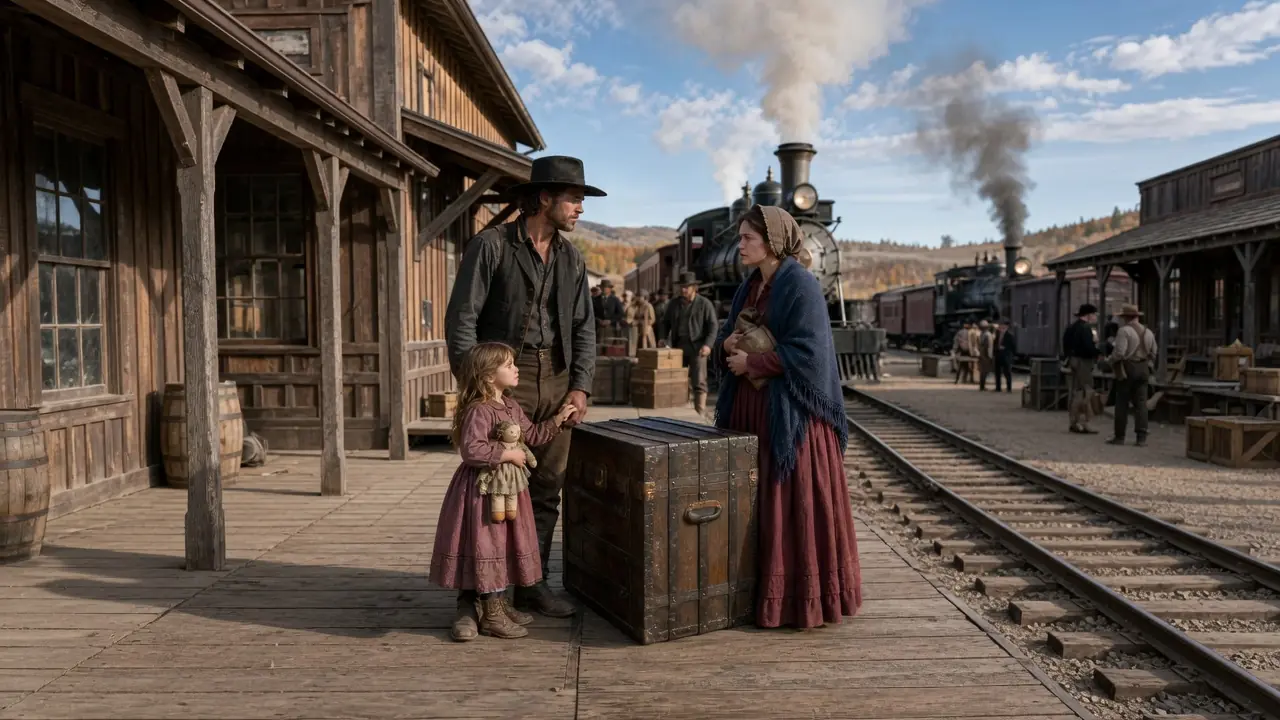
He stood on the platform in Laramie, Wyoming Territory. The year was 1892, and the air carried a bitter edge, the kind of cold that settled into a person's bones and refused to leave. Silas looked down at his daughter, Birdie. The four-year-old was unusually quiet, clutching her rag doll, Martha, so tightly that her tiny knuckles had turned white.
Her eyes were fixed on the horizon, searching for a ghost. "Do you think she'll like me, Papa?" Birdie whispered. Silas looked down and forced a smile. "Any woman with sense will love you before she ever loves this ranch."
The wind swept down from the Medicine Bow Mountains, carrying the scent of ancient pine and the sharp metallic promise of early snow. Silas adjusted the brim of his sweat-stained Stetson. He was thirty-six years old, but in the dark glass of the station window, he saw a much older stranger staring back. His face was a map of hard winters, his skin etched by the brutal, unforgiving sun of the high plains.
He had been a widower for three long, silent years. The silence was the loudest thing on the ranch. It filled the corners of the house and sat at the dinner table where his wife, Sarah, used to pray. The ranch felt too large for one man and a child, and every room seemed hollow without her.
Birdie needed a mother's touch. She needed someone to tell her that the wind was not a monster hiding beyond the walls. Silas needed more than a worker. He needed a partner who did not mind the grit of frontier life, a woman who understood that survival was a choice made every morning.
He had written to an agency in Chicago with thick ink and blunt words. He had been very specific. He wanted a plain woman: sturdy, resilient, able to bake bread, mend clothes, and face a hard winter without breaking. He did not want silk, lace, or city softness, because the Wyoming frontier had no mercy for fragile flowers.
Silas had not written about romance. He had written about a leaking roof, a four-year-old child, forty head of cattle, and the fact that winter sometimes closed the road for weeks. He promised food, shelter, honest work, and a lawful marriage. In return, he asked only that the woman who came would not abandon Birdie when the first blizzard struck.
A massive column of black smoke finally stained the gray sky. The Union Pacific locomotive roared toward the station, steam billowing in great white clouds that swallowed the wooden platform. Silas squinted through the mist as the train groaned to a screeching halt. Passengers began descending into the mud of Laramie, most of them men in dusty coats seeking fortune or a fresh start.
Then he saw her.
She stepped onto the wooden planks with a grace that felt entirely out of place. She wore a deep red frontier dress that stood against the gray station like a flame in winter, with a thick blue wool shawl wrapped tightly around her shoulders. She was not plain. She was striking in a way that caught the breath in Silas's throat.
Her face was pale from the cold, but her eyes were steady, the color of the autumn sky after a violent storm. She looked over the muddy, dung-covered street of Laramie with a mixture of terror and wonder. Silas felt a hard knot tighten in his stomach. This was a mistake—a terrible, beautiful mistake.
He stepped forward, his spurs jingling softly against the wood. The woman saw him and froze, clutching a small canvas bag against her chest as if it were a shield. But it was not the bag that caught Silas's eye. It was the massive hardwood trunk the baggage handlers were struggling to move.
The trunk was reinforced with heavy iron bands, and brass locks gleamed even in the dim afternoon light. Two men grunted as they lowered it from the freight car. It struck the platform with a thud that shook the boards beneath their feet.
"Mr. Thorne?" the woman asked. Her voice was soft and melodic, reminding him of wind chimes in a summer breeze.
"I'm Silas," he answered, his own voice sounding like gravel. He did not remove his hat. He was too busy staring at the velvet trim on her bonnet.
"And this is Birdie?"
The woman knelt in the dirt without seeming to care that her expensive dress touched the filthy platform. "Hello, Birdie," she said softly. "My name is Clara."
Birdie held out her doll with a tentative hand. "This is Martha."
Clara smiled, and for one fleeting moment, the cold wind seemed to die. "She is very beautiful, Birdie."
Silas cleared his throat, trying to find his voice. "The letter said you were a woman of modest means," he said, pointing a calloused finger toward the giant trunk. "That thing weighs more than my best wagon."
Clara stood slowly and pulled her shawl tighter against the wind. "It contains my life, Mr. Thorne. Everything I have left in this world is locked inside it. The agency allowed one trunk for a bride's belongings, and I paid the freight myself. No one asked questions once the bill was settled."
Silas looked at her delicate, unblemished hands. They were the hands of someone who had never pulled a calf from freezing mud or scrubbed a floor until her knuckles split. "Laramie isn't Chicago," he said sternly. "The wind doesn't stop for anyone here, and the work never ends."
Clara looked directly into his eyes. There was steel in her gaze that surprised him. "I am not afraid of work, Silas. I am afraid of other things."
He did not ask what those things were. In 1892, nearly everyone in the West was running from something. Back East, money troubles were already spreading like smoke before a fire, and families with grand names were beginning to hide their fear behind locked doors.
With help from a station hand, Silas hoisted the trunk into the back of his buckboard wagon. His muscles strained under its weight. It felt as though it were filled with lead, or perhaps gold, though he dismissed that thought as foolishness. Gold was for miners and gamblers; he was a cattleman.
The ride back to the Thorne ranch passed in silence. The sun sank behind the jagged peaks, painting the prairie in shades of burning orange and bruised purple. Buffalo grass lay brittle and dry, and cattle stood like silent statues in the distance. Birdie sat between them on the bench, stealing fascinated glances at Clara.
Clara smelled of lavender and something sweet, almost like honey. She did not smell like the ranch. When they reached the property, the house looked smaller than Silas remembered. It was built solidly from timber and fieldstone, but it lacked the warmth of a woman's presence.
The curtains were yellowed and thin, and a loose porch board groaned beneath every step. A child's wooden cup sat beside the washbasin, and Sarah's old Bible remained on a shelf where Silas had been unable to move it. Clara noticed these things without commenting. She seemed to understand that the house was not empty because it lacked furniture; it was empty because grief had taken up too much room.
Silas carried the heavy trunk into the small spare room. "This is yours," he said shortly. "We'll be married by the circuit rider when he passes through on Sunday. Until then, you are a guest in this house."
Clara looked around the plain room. There was only a simple bed and a washstand with a cracked basin. "Thank you," she whispered.
That night, Silas sat by the fireplace cleaning his Winchester rifle in the flickering light of a tallow candle. Through the thin wall, he heard Clara moving in the spare room. Then came the distinct heavy click of a lock, followed by the groan of a lid opening. He wondered why a plain bride needed so many secrets.
The next morning, the harsh reality of the frontier set in. The temperature had fallen below freezing overnight, and jagged frost covered the pump in the yard. Silas went to the barn long before first light. When he returned, the kitchen was unexpectedly warm.
The smell of frying salt pork and bitter coffee filled the room. Clara stood at the iron stove with a coarse, oversized apron tied over her garnet dress. Her sleeves were rolled above her pale forearms. She was clumsy with the heavy skillet, but she was persistent.
Birdie was already at the table. Her hair, usually wild from sleep and prairie wind, had been braided neatly into two perfect plaits. "I didn't ask you to cook yet," Silas said as he hung his coat.
Clara did not turn around. "A house needs breakfast to find its soul, and a child needs a mother's hand to feel safe."
Silas sat without answering. The coffee was strong enough to wake the dead, and the eggs were slightly burned at the edges. It was the finest meal he had eaten in three years.
As the days passed, a strange rhythm formed among them. Clara was a fast and determined learner. She learned to keep the fire roaring against the drafts and to stretch a sack of flour until it lasted nearly a month. She carried water from the pump despite the cold, patched one of Silas's work shirts, and learned that Birdie would only drink warm milk if someone told her a story first.
She made mistakes. She scorched a loaf of bread, dropped a bucket in the mud, and once frightened the hens so badly that Silas spent half an hour gathering them from beneath the porch. Yet she never complained or hid behind embarrassment. Each failure became something she practiced until she could do it well. Still, she never spoke of Chicago or explained why a woman like her had come to a place like this.
One afternoon, a neighbor named Miller rode by. Miller traded in gossip almost as much as he traded in cattle. He saw Clara hanging damp laundry on the line, pulled up his horse, and gave a low whistle.
"Found yourself a real lady, didn't you, Silas?" Miller laughed. "She looks like she'd fetch a pretty penny in a city parlor."
Silas felt a sudden flash of protective anger. "She's my wife-to-be, Miller. Keep your eyes on your own fences and off my porch."
Miller pointed a gloved finger toward the spare-room window. "I saw that trunk through the glass when I passed the other day. That's a city box, Silas—fancy locks and iron bands. You sure you know what kind of woman you brought into your home? Maybe she's running from the Pinkertons, or from a husband who's still breathing."
A cold seed of doubt took root in Silas's chest. He looked toward Clara, who was struggling with a heavy wet bedsheet as the wind tried to tear it from her small hands. She looked painfully fragile against the vast horizon.
He disliked himself for listening to Miller, but suspicion was easier than trust for a man who had already buried the woman he loved. That night, he almost asked Clara to open the trunk. Instead, he stood outside the spare-room door, heard Birdie laughing within, and walked away without knocking.
That evening, Silas found Birdie crying in the shadows of the barn. "What's wrong, little bird?"
The girl held up her rag doll. Martha's arm had torn away from the body. "I broke her," Birdie sobbed. "Mama made her before she went away. Now she's ruined forever."
The words cut Silas deeper than any blade. He could mend a gate, shoe a horse, or stitch a saddle, but he did not know how to repair the last soft thing Sarah had left behind. Clara appeared in the barn doorway.
She did not rush or scold. She simply knelt in the straw and held out both hands. "May I see her, sweetheart?"
Birdie handed over the doll as though she were surrendering a wounded child. Clara studied the torn arm, then looked into Birdie's wet eyes. "Nothing loved is ever truly ruined," she said softly. "Sometimes it only needs patient hands."
They went into the spare room. Silas remained in the doorway, twisting his hat slowly between his hands. Clara unlocked the iron-bound trunk with a small silver key she wore around her neck.
Inside were books, letters, carefully folded dresses, and a small velvet pouch. From the pouch, Clara took a needle and a spool of gold-colored silk thread. "This belonged to my grandmother," she explained. "She told me gold thread was not for displaying wealth. It was for mending what mattered most."
Birdie sat perfectly still while Clara sewed. The room grew quiet except for the wind and the tiny pull of thread through cloth. "Did your mama sing to you?" Clara asked.
Birdie nodded. "Only when the wind scared me."
Clara's hands paused for a moment. Then she began humming a soft old lullaby. It was not Sarah's song, but somehow it filled the same empty space.
Silas turned his face toward the window. For the first time in three years, a tear slid down his weathered cheek. When Clara finished, the doll's arm was whole again, and the gold thread shone against the plain cloth like a small sunrise.
"There," Clara whispered. "She is not exactly as she was before. She is stronger now."
Birdie threw herself into Clara's arms. It was not a shy embrace. It was the kind of hug a child gives when her heart has finally found somewhere safe to rest. Clara closed her eyes and held the girl close.
Silas watched from the doorway and understood something that frightened him. When Clara opened her trunk, she had also opened the first locked room inside his house. Birdie had not called her mother, and Clara had not tried to claim that place, yet something quiet and powerful had begun between them.
But Silas's eyes caught something else among the folded dresses.
He saw legal seals on thick official documents and a name written across one ivory envelope: Davenport.
The Davenport family was famous. They owned shipping interests and railroad holdings across Chicago and were counted among the city's wealthiest families. Why was a Davenport hiding in Laramie? Why was she living in a rough ranch house in the middle of a drought?
Her plainness was a mask. She had not merely been looking for a husband. She had been looking for a fortress.
Silas closed the trunk without touching the papers and placed the key where Clara had left it. He told himself he would ask her after the wedding. By morning, however, the weather had made every private question seem small.
The next day, Wyoming's weather turned lethal. The sky became a heavy bruised gray that seemed to touch the ground, and the wind began to howl with terrifying force. It was not merely a storm. It was a whiteout blizzard.
Silas knew he had to move the cattle into the lower pasture. If they remained on the ridge, they would crowd together and be buried or suffocate. "Stay inside," he ordered Clara. "Keep the fire high and the child warm. Do not open that door for anyone but me."
He stepped into the white abyss. Snow moved horizontally, faster than a horse could gallop, blinding him within seconds. Hours passed like slow, frozen years.
Clara paced the kitchen, her heart racing. Birdie huddled beside the stone hearth, shivering despite the heat. Suddenly, a frantic pounding shook the door.
It was Miller. Clara forced the door open against the weight of the snow, and the neighbor fell onto the floor, his beard covered in jagged ice.
"Silas," Miller gasped, breath coming in broken bursts. "His horse went down in the gully. Silas is pinned beneath it. His leg is trapped, and the snow is burying him alive."
Clara did not hesitate. She no longer looked like a fragile city flower. She looked like a soldier preparing for a final stand.
"Stay here with Birdie," she told Miller.
"But you're a woman," he protested. "You'll freeze before you reach the fence line."
Clara ignored him. She ran to the spare room and flung open the trunk. She did not reach for silk or jewelry. She grabbed a coil of rope, a small flask of whiskey, and the heavy leather gloves she had purchased for her journey west.
She pulled on Silas's old sheepskin coat, tied one end of the rope around her waist, and secured the other to the porch post. She had heard Silas warn Birdie that no one should enter a whiteout without a lifeline. Now that lesson might save them both.
Clara stepped into the screaming wind. Behind her, Miller barred the door and pulled Birdie close to the hearth. The child clutched Martha and begged Clara not to disappear like her first mother had. Clara promised she would bring Silas home, though she had no right to make such a promise.
She followed the faint trail of Miller's horse before the snow could erase it. The cold struck her chest like a physical blow and stole the breath from her lungs.
She found the gully by following the broken fence line and Miller's fading tracks. Through the swirling white, she saw the dark, thrashing shape of the fallen horse. Silas was pinned beneath it, his face ghostly gray.
"Silas!" she screamed into the gale.
He opened his eyes and saw her through the chaos. "Go back," he croaked. "You'll freeze to death out here."
Clara did not move toward safety. She could not lift the horse; no one her size could have. Instead, she dug at the packed snow around Silas's trapped leg with her gloved hands.
She wedged a fallen branch beneath the saddle and pulled with everything she had. The horse shifted only an inch, but it was enough. Silas dragged himself free with a cry that vanished into the storm.
Clara pressed the flask to his lips and pulled his arm over her shoulders. They moved like one wounded animal through the heart of the blizzard. The wind tried to knock them down and the ice tried to blind them, but Clara would not let go.
The rope saved them when the wind erased the trail. Clara followed it hand over hand, sometimes crawling, while Silas leaned against her with nearly all his weight. Twice they fell together, and twice she forced herself upright because the light in the ranch window was still visible through the snow.
When they finally reached the house, Miller helped drag them inside. Birdie cried out and ran toward them, but Miller held her back until the frozen outer clothes had been removed. They wrapped Silas in every blanket they owned, and Clara rubbed his hands between hers until color slowly returned.
"Why?" Silas whispered, looking at her through exhausted, tear-filled eyes. "Why did you risk your life for a man you barely know?"
Clara sat on the edge of the bed, her own hands trembling. "Because this is the first home that ever asked me to stay instead of demanding that I become someone else. I could not walk away and let it take you from us."
The next morning, the world was white, blinding, and silent. Silas sat in a chair with his injured leg tightly bandaged. Clara stood before him holding a leather folder.
"I have to tell you the truth," she said. "My name is Clara Davenport. My father was a very wealthy man in Chicago, and when he died, he left his entire empire to me."
Silas said nothing.
"My uncle wanted the fortune for himself. He tried to have me committed to a private asylum. He said I was mentally unstable because I refused to marry his business partner. In those days, a woman's word carried little weight against a powerful man's accusation."
She opened the folder. "I took what I could from the safe, converted my stocks into gold and bank drafts, hid them inside the trunk, and ran. I chose the only place a man like my uncle would never search: a mail-order bride agency seeking a rancher's wife."
Her uncle would search hotels, banks, train depots, and every respectable Eastern household. He would never imagine that a Davenport woman would humble herself by becoming a mail-order bride in Wyoming. That was why it worked.
The marriage-agency clerk had believed Clara was a governess whose employer had died without paying her wages. Clara had allowed the lie to stand, answering only the questions necessary to secure passage west. Every mile between Chicago and Laramie had felt like a door closing behind her pursuers.
"I wanted to be a plain wife, Silas," Clara said. "I wanted a life that was real, even if it was hard."
Inside the folder were certificates, bank drafts, and ownership papers worth more money than Silas could easily comprehend. Beneath the documents, the trunk held wrapped gold coins, family jewelry, and letters proving Clara's father had intended her to control the estate without interference from her uncle. It was not spending money. It was a fortune capable of buying land, cattle, barns, and a future most families could only dream of.
Silas studied the papers for a long time, then looked at Clara's windburned face. "I don't want your money, Clara. I only ever wanted a wife who would stand beside me when the world turned cold."
Clara smiled, a true radiant smile. "I think I proved I can do that in the gully."
Silas took her hand. Her skin was no longer soft and sheltered. It was rough from work and red from frost. It was becoming the hand of a Wyoming woman, but more importantly, it was the hand of his equal.
"The money can stay in the trunk for now," he said. "We'll use it for Birdie's schooling one day, or if drought takes the cattle. But I'm still the rancher here, and you're still the woman I chose."
Clara laughed with pure liberation. "I would not have it any other way."
They agreed that the fortune would never become a throne inside their home. It would repair the ranch, protect Birdie's future, and give them choices during drought or illness. But their daily bread would still come from work, and neither of them would use money to command the other.
On Sunday, the circuit rider finally arrived through the melting slush. Snow soaked into the thirsty earth, and the sun shone with rare brilliance. Silas and Clara stood on the porch of the small house with Birdie between them.
Birdie wore a new dress Clara had sewn from fine blue silk in the trunk. She held Martha against her chest, the gold thread on the doll's arm gleaming in the sunlight.
"Do you, Silas Thorne, take this woman to be your lawful wife?" the circuit rider asked.
"I do," Silas replied, his voice steady as a mountain. He did not see a rich lady from Chicago. He saw the woman who had pulled him from a frozen grave and brought light back into his daughter's eyes.
"And do you, Clara Davenport, take this man?"
"I do," she whispered, her voice filled with new strength.
Birdie looked up at Clara with trembling lips. She had been holding one word inside her heart all week. "Mama," she whispered.
Clara covered her mouth as tears filled her eyes. Then she knelt and pulled Birdie into her arms. "Yes, sweetheart," she whispered. "If you'll have me."
They had no grand cake or ballroom. They shared a simple dinner of pot roast and potatoes at the scarred kitchen table. Miller came over, apologized for his suspicious tongue, and brought a bottle of good whiskey to celebrate. He also repaired the section of fence damaged during the blizzard without charging Silas a cent, claiming it was the least a man could do after nearly talking himself out of a neighbor's friendship.
As stars spread across the prairie, Silas and Clara sat on the porch. The trunk had been moved into the hallway, where Birdie now used it as a bench while putting on her shoes. It was no longer merely a chest of secrets. It had become part of the foundation of a family.
Birdie slept inside, dreaming of queens and gold thread. Silas put one heavy arm around Clara's shoulders. The Wyoming wind still swept across the grass, but for the first time in three years, it did not feel cold.
"Are you truly happy here, Clara?" he asked softly.
She rested her head against his shoulder and looked over the vast, dark, beautiful land. It was dangerous and unforgiving, but it was finally home. "I am more than happy, Silas Thorne. For the first time in my life, I am free."
They remained there for a long time, watching the moon rise—two souls who had found each other against impossible odds. A cowboy who had lost himself in silence, and a bride who had hidden a fortune in order to find a heart.
Life on the frontier would never be easy. There would be more blizzards, lean years, drought, and struggles for justice in a wild land. But they had the trunk, and more importantly, they had the courage to love.