“Get off my bench, old man.”
“I’m only sitting here.”
“Don’t call me son.”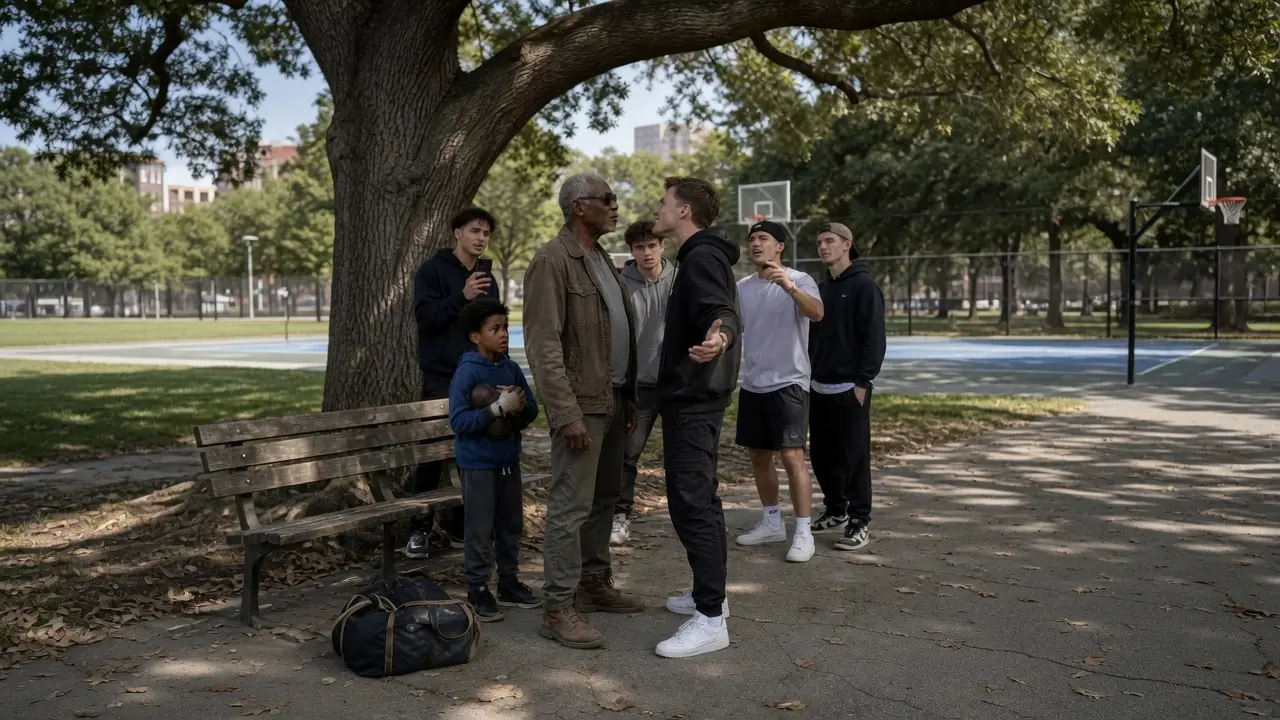
Brad Sawyer grabbed Byron Ingram by the collar and pulled him forward.
“Who do you think you are, acting like you’re my father? You can barely see.”
“Let go of my shirt, please.”
Brad knocked the dark glasses from Byron’s face. They landed on the concrete beneath the oak tree.
“You’re getting on my nerves,” Brad said. “Maybe we should fix that other eye so they match.”
“Don’t say that.”
Brad released him and turned toward the five young men standing behind him.
“Teach him a lesson. This old man thinks he can talk back to me.”
They moved around Byron, cutting off every direction.
Byron rose slowly from the bench. Every joint protested as he straightened his back. He looked at Brad through his one functioning eye.
“You certain about that, son?”
Brad had no idea who he had just attacked.
He did not know about the twenty-three professional victories. He did not know about the championship belt hidden beneath a faded scarf or the name that had once made experienced fighters hesitate before entering a ring.
Most importantly, he did not understand that the quiet old man in front of him was not alone.
Byron Ingram was a single father.
The ten-year-old boy standing several feet behind him was his son.
Byron had lived on Oakfield Road for forty-one years. It was the same narrow house, the same front porch, and the same cracked steps he had promised to repair more times than he could count.
The neighborhood had changed around him. New fences appeared, unfamiliar families moved into renovated houses, and expensive vehicles began lining streets that had once been filled with children’s bicycles.
Byron stayed.
He stayed because his wife, Helen, had planted roses beside the porch. She had been gone for nine years, but the roses still bloomed every April.
He also stayed because the house was the only home his son Caleb remembered.
Byron was seventy-four. He moved slowly in the mornings, especially when rain was approaching. His left eye still saw clearly, but the right saw nothing.
It had been blind since 1984.
A detached retina caused by an illegal strike during a fight that should never have taken place.
That was a long time ago.
To the residents of Oakfield Road, Byron was the quiet older father who swept his sidewalk at six each morning, walked his son to school, and carried groceries for Mrs. Patterson every Tuesday.
They did not know about his twenty-three professional fights.
They did not know he had won all twenty-three.
They did not know about the middleweight championship belt stored in a shoe box beneath his bed, wrapped inside Helen’s old blue scarf.
They did not know that the name Byron “The Ghost” Ingram had once caused grown men to reconsider their career choices.
Byron never spoke about it.
When people asked what had happened to his eye, he told them glaucoma. That explanation was easier.
Every morning at seven, Byron and Caleb walked four blocks to Brandon Park. Byron carried a canvas bag containing two pairs of boxing gloves, a jump rope, and hand wraps so old that the elastic had almost disappeared.
They trained beneath an oak tree near the basketball courts. Its roots had broken the concrete into uneven sections that almost resembled the boundaries of a boxing ring.
Other children had begun joining them three years earlier.
First came Deshawn, twelve years old and angry at almost everyone.
Then Kesha, ten and faster than every child in the group.
But Caleb was the reason Byron returned every morning.
Caleb was ten, small for his age, with a stutter that transformed ordinary words into obstacles. His biological father had been imprisoned before he was born, and his mother, a distant relative of Helen’s, had disappeared when Caleb was an infant.
Byron and Helen had taken him into their home when he was three months old. They later adopted him.
Helen died when Caleb was one.
From then on, Byron raised him alone.
He learned how to warm bottles in the middle of the night, how to recognize different cries, and how to change diapers with hands once trained to break through an opponent’s guard.
He attended school meetings where other parents assumed he was Caleb’s grandfather. He sat beside hospital beds during childhood illnesses and learned to braid hair poorly when Caleb briefly decided he wanted it long.
He became father, mother, coach, nurse, and protector.
The first time Byron brought Caleb to Brandon Park, the boy watched from behind the water fountain.
The second morning, he moved closer.
On the third, Byron held out a pair of gloves.
“You want to try?”
Caleb shook his head.
“That’s all right,” Byron said. “They’ll be here tomorrow.”
It took two weeks.
One morning, Caleb approached, extended both hands, and allowed Byron to wrap them. His fingers trembled.
Byron pretended not to notice.
“First thing,” he said, “plant your feet.”
He demonstrated the stance. Left foot forward, right foot back, weight centered.
It was the stance Curtis Holloway had drilled into him fifty years earlier inside a basement gym in Philadelphia.
“Now bring your hands up. Protect what matters.”
Caleb raised his fists. They barely reached his chin.
“Good,” Byron said. “Real good.”
Caleb smiled.
It was the first real smile Byron had seen from him in weeks.
After that, Caleb trained six mornings a week. He learned the jab, then the cross, then how to avoid a punch by moving his head exactly two inches.
No more.
No less.
Byron taught him the way Curtis had taught him—patiently, quietly, and one skill at a time.
He never shouted. He never demanded more than Caleb could give.
When the boy became frustrated and threw the gloves down, Byron picked them up, placed them on the bench, and said, “They’ll be here tomorrow.”
Caleb always returned.
What Byron taught was not truly boxing.
It was the belief beneath boxing.
He wanted Caleb to understand that his body could accomplish what fear told his mind was impossible. He wanted him to know he could stand before something frightening without running.
The stutter, his small frame, the absence of his biological parents—none of those things decided who Caleb would become.
The gloves simply made that truth easier to believe.
Brad Sawyer first entered Brandon Park on a Tuesday in late September.
He arrived with four friends, all in their early twenties. Two carried gym bags that appeared to contain nothing. Another held a speaker playing music loudly enough to shake the chain-link fence.
Brad was twenty-two and the son of Councilman Garrett Sawyer.
The Sawyer name opened locked doors, ended investigations, and caused official complaints to vanish.
Brad had never held a real job. He spent most days creating short videos for social media.
He called them pranks.
His preferred targets were people unlikely to resist—homeless men, elderly women waiting for buses, and workers who feared losing their jobs if they reacted.
Two hundred thousand followers considered it comedy.
That morning, Byron was teaching Caleb to return his hand quickly after throwing a jab.
“Bring it back,” Byron said. “The punch that hurts is often the one you never see.”
Caleb threw the jab and returned to guard.
He was improving.
Brad noticed them from across the park.
An older Black man wearing dark glasses was teaching a small boy to box on damaged concrete using worn equipment.
Brad pointed toward them.
“Record this. This is perfect.”
The group approached.
Brad kicked Byron’s canvas bag. Gloves and wraps spilled onto the ground.
“What is this?” he asked. “A homeless boxing gym?”
His friends laughed.
The phone was already recording.
Byron did not look at Brad. He placed one hand on Caleb’s shoulder.
“Pick up your gloves.”
“I’m talking to you,” Brad said.
He stepped between father and son.
“You have a permit for this? You can’t establish a training camp in a public park.”
Byron studied him with his one good eye. It was the calm, measured look of a man who had encountered the same kind of person many times.
“We’re exercising.”
“Exercising?”
Brad turned toward the camera.
“Training for the retirement-home Olympics?”
More laughter followed.
Caleb’s hands began shaking.
Byron gathered the equipment and repacked the canvas bag. Then he took Caleb’s hand.
“Come on. We’ll return tomorrow.”
They walked away.
Brad’s laughter followed them to the sidewalk.
Byron came back the next morning.
So did Brad.
This time, Brad carried a bottle of water.
He waited until Byron was teaching Caleb to pivot, then walked up behind him and emptied the bottle over his head.
Water ran down Byron’s face and soaked his collar. His dark glasses fogged.
He remained still.
Brad’s friends screamed with laughter. Two phones captured the scene.
“Look at that,” someone said. “We baptized him.”
“You’re still here?” Brad asked. “I thought I told you to crawl home.”
Byron removed his glasses, dried them on his shirt, and put them back on.
“Caleb,” he said, “show me the pivot again.”
The boy stood frozen. His lips pressed together as he fought against the stutter.
“It’s all right,” Byron said. “Show me.”
Caleb pivoted.
His feet moved perfectly.
His hands still trembled.
Brad watched for another ten minutes. When Byron refused to react, he grew bored and left.
The video appeared online that evening.
OLD BLIND MAN GETS BAPTIZED IN THE PARK.
By morning, it had fourteen thousand likes and hundreds of comments.
Most people were laughing.
Brad returned Thursday.
He went directly to the canvas bag and removed Byron’s oldest pair of gloves. The leather was cracked and the laces were nearly worn through.
Byron had owned them since 1979.
Helen had kept them polished on the mantel long after he stopped fighting.
Brad held them in front of the camera.
“Look at these museum pieces.”
He tossed one toward his friend.
They began throwing the gloves back and forth across the court.
Byron watched.
“Give them back.”
His voice remained even, but his jaw had tightened.
“Or what?”
Brad held one glove above a trash can.
“You want it? Come take it.”
Byron did not move.
Brad dropped the glove into the trash. Then he dropped the other.
“There. Now they match everything else out here.”
Byron said nothing.
He turned toward Caleb.
“We’re finished for today.”
At ten that night, Byron returned to the park alone. Beneath the light from a streetlamp, he retrieved both gloves from the trash.
He carried them home and sat on the porch.
For an hour, he cleaned the leather with a damp cloth, rubbing it the way Helen once had.
His hands remained steady.
His breathing did not.
The following Monday, Brad brought spray paint.
Byron reached the park at seven. Caleb was already waiting beside their bench beneath the oak tree, but he was standing instead of sitting.
Someone had painted a word across the seat in white.
BLIND.
Beneath it, in smaller letters, was another message.
GO HOME.
Caleb looked up.
“M-Mr. Byron—Dad, who did this?”
The stutter had become stronger again. Months of progress seemed to disappear in two words.
Byron placed the canvas bag on the ground.
Then he sat directly on the painted bench.
“Come on,” he said. “We’re working on your cross.”
From Brad’s perspective, the harassment had become his most successful content.
The water video outperformed everything else on his page. His followers demanded more.
“Do it again.”
“Make the old man angry.”
“Make him cry.”
One of Brad’s friends suggested choosing a different target.
Brad refused.
He liked Byron because the old man would not react.
The silence was the joke.
The lack of resistance was what made the content profitable.
Brad also knew what the neighborhood knew.
His father was Garrett Sawyer, a three-term councilman and chairman of the public safety committee. Every police officer in the precinct recognized the name.
Two complaints had already been filed about Brad’s conduct.
Both had been moved to the bottom of the system.
One disappeared completely.
Brad believed he could do anything.
So did the people watching.
Mrs. Patterson saw the water incident from her window. She saw the gloves thrown away and the paint on the bench.
Twice, she lifted the phone to call the police.
Twice, she put it down.
“What would it change?” she told her daughter. “His father controls the whole process.”
Deshawn’s mother removed her son from Byron’s group after the first video spread online.
“I can’t have him around that.”
She did not mean Byron.
She meant the danger created by Byron’s refusal to surrender the park.
Kesha’s father made the same decision.
“Find somewhere else to practice.”
Kesha cried for two days.
Within a week, Caleb was the only child left.
Unlike the others, he could not simply walk away from Byron.
This was his father.
Every morning, Byron arrived.
Every morning, Caleb arrived beside him.
Every morning, Brad appeared.
At night, Byron sat in his garage after Caleb went to sleep.
An old heavy bag hung from a ceiling beam. Byron had installed it in 1986, when a small part of him still believed he might return to professional boxing.
He had not struck it in thirty years.
Now his hands found it in the darkness.
Left jab.
Right cross.
Left hook.
The bag swung, and Byron caught it.
The rhythm returned like breathing.
His right eye saw nothing.
His hands remembered everything.
He worked for an hour the first night.
Then two.
Then three.
He told no one.
Not Caleb.
Not Mrs. Patterson.
Not even the memory of Helen, whose roses he watered each morning before walking to the park.
Something inside Byron Ingram was waking.
That frightened him more than Brad ever could.
The entire neighborhood saw what was happening.
Nobody intervened.
It was not because they did not care.
They simply calculated the risk.
Their calculations left a seventy-four-year-old single father and his ten-year-old son standing alone beneath the oak tree every morning.
On Wednesday night, Byron stopped pretending the training was only memory.
He stood in the garage wrapping his hands the old way.
Two loops around the wrist.
Three across the knuckles.
Tight between every finger.
Curtis Holloway’s method.
Fifty years had passed, but his hands still knew the pattern in darkness.
He struck the bag differently that night.
These were not the slow movements of an older man remembering his youth.
The combinations became sharp and precise.
Jab.
Jab.
Cross.
Hook to the body.
Uppercut.
The bag jumped on its chain. The ceiling beam groaned.
Byron’s dead eye saw nothing, but the left tracked the bag with complete focus. His feet moved the way they had after ten thousand rounds of training.
Muscles remembered.
Bones remembered.
The Ghost remembered.
He stopped after midnight and sat on the concrete floor. His hands throbbed, and his breathing came hard.
The shoe box remained in the corner.
Helen’s scarf still covered the belt.
“I promised you,” he whispered. “I know I promised.”
He had promised Helen he would never allow the fighter inside him to control his life again.
He had also promised to protect their son.
The next morning, Caleb asked the question Byron had known was coming.
“Dad, why don’t you ever fight back?”
Byron looked at him.
The boy was ten years old. A bruise remained near his mouth from the previous week, when Brad had shoved him against the drinking fountain.
Yet Caleb continued showing up.
“Because I haven’t decided yet,” Byron said.
But he had.
It happened Friday, October ninth.
The air smelled of wet leaves, and the sky could not decide between gray and blue.
Byron and Caleb were practicing combinations.
Caleb’s jab had begun to snap. His cross traveled straight instead of curving. When he moved, his feet remained beneath him.
Left foot forward.
Right foot back.
Protect what matters.
“That’s it,” Byron said. “Again. Faster.”
Caleb threw the combination.
Jab.
Cross.
Return to guard.
“Clean. Again.”
The second was better.
Three months of mornings had begun transforming the boy into a fighter.
Not because he was large.
Not because he was naturally powerful.
Because he listened.
Because he was precise.
Because he returned every morning, extended his hands, and trusted his father to wrap them.
That was the morning Brad Sawyer decided to create his masterpiece.
He arrived at eight fifteen with five friends instead of four. The newest member carried a ring light attached to his phone.
Brad had announced the event online the previous night.
Tomorrow, we finish this live at Brandon Park.
More than eleven thousand people were watching when Brad entered through the gate.
He crossed the basketball court and headed toward the oak tree.
Byron saw him approaching.
He placed a hand on Caleb’s shoulder.
“Stay behind me.”
“Well, well,” Brad announced. “The blind museum is still open.”
He looked directly into the camera.
“Everybody watching? Watch this.”
Brad grabbed the gloves from Caleb’s hands.
The boy stumbled backward.
“Give those back,” Byron said.
“Be quiet.”
Brad tossed the gloves to one of his friends.
Then he turned toward Caleb.
“You know what your problem is? You’ve got nobody. Your real father is in prison, your mother disappeared, and this old man can barely see.”
Caleb looked toward Byron.
Brad bent until his face was level with the boy’s.
“You’re nothing. Just like him.”
Caleb’s lower lip trembled.
The stutter swallowed every response.
“Leave my son alone,” Byron said.
His voice was low.
It carried the kind of warning only experienced people recognized.
Brad did not recognize it.
“Or what?”
He straightened and grinned toward the camera.
Then he shoved Caleb.
It was not a playful push.
Both hands drove into the child’s chest.
Caleb fell backward and struck the uneven edge where the oak roots had broken the pavement. His head hit the ground.
A thin cut opened near his eyebrow.
Caleb did not cry.
He lay on the concrete looking toward Byron, one eye partly closed, his fists still curled into guard position.
The livestream had reached sixteen thousand viewers.
Byron looked down at his son.
He saw the cut.
He saw the small wrapped hands still attempting to protect what mattered.
Something shifted behind his eyes.
It was not ordinary anger.
It was older than anger.
Something that had slept in a garage for thirty years was now fully awake.
Byron removed his dark glasses.
He folded them carefully and placed them on the bench.
Then he turned toward Brad.
“You certain about that, son?”
The words were familiar.
The voice was not.
There was no patience left in it.
Brad laughed.
“What are you going to do, Grandpa?”
He threw a wide right hand.
It was the kind of punch thrown by someone who had never expected to be struck in return. There was no balance, no guard, and no foundation beneath it.
Byron moved his head two inches to the left.
No more.
No less.
Brad’s fist passed through empty air. His momentum pulled him forward, and fear appeared on his face for the first time.
Byron’s jab reached him before he could recover.
Straight through the center.
Clean.
Brad staggered and raised his hands too late.
Byron’s cross entered beneath the guard and stopped Brad’s forward movement.
Then came the uppercut.
Byron planted his rear foot and rotated his hips exactly as Curtis Holloway had taught him in the Philadelphia basement.
His fist traveled upward with the precision of a man who had repeated the movement thousands of times.
Brad left his feet for less than a second.
Then he landed on the concrete and remained still, stunned and unable to continue.
Three punches.
Five seconds.
Forty years of silence ended in five seconds.
Brandon Park became quiet.
The sixteen thousand people watching the stream became silent.
Brad’s friends stopped laughing.
The phone attached to the ring light continued recording.
Byron stood above Brad.
His hands shook—not from fatigue, but from the sudden release of something he had spent decades trying to bury.
He opened his fists.
Closed them.
Then opened them again.
He turned and walked toward Caleb.
Byron knelt and placed one hand gently against the cut near the boy’s forehead.
The same hands that had just stopped a grown man now held his son’s face as though it were made of glass.
“You all right?”
Caleb nodded.
His eyes were wide, but he was not afraid of Byron.
“Dad,” he whispered, fighting through the stutter. “You can really fight.”
Byron lifted him and placed him on the bench. He used an old hand wrap from the canvas bag to cover the cut temporarily.
Then he sat beside his son and placed an arm around his shoulders.
There was nothing else to say.
Across the park, Brad’s friends helped him sit up. His nose was injured, and his jaw appeared out of alignment.
The livestream continued.
Twenty-two minutes of footage had been recorded.
Within an hour, someone extracted the five-second combination.
By noon, it had four million views.
By the following morning, forty million.
The comments arrived in waves.
“Who is that old man?”
“That footwork is professional.”
“Somebody identify him.”
The first popular hashtag was #ParkKnockout.
By evening, it had been replaced.
#BlindChampion.
Across town, sixty-eight-year-old retired sports journalist Gene Whitfield watched the clip eleven times.
He paused on the uppercut and enlarged the frame.
He studied the rear foot, the rotation of the hips, and the short path of the hand.
Gene knew that technique.
He had seen it decades earlier from a fighter known as The Ghost.
He picked up the phone.
Councilman Garrett Sawyer saw the video at nine on Saturday morning.
His chief of staff sent it with one sentence.
This is your son.
Garrett watched twice.
Then he closed his office door and made four calls.
The first went to the police chief, whose appointment Garrett had publicly supported.
The second went to the district attorney’s office.
The third went to a media consultant who had managed several of Garrett’s campaigns.
The fourth went to his private attorney.
By Sunday evening, Byron Ingram had been charged with aggravated assault.
Police arrived at six Monday morning.
Two officers knocked on the Oakfield Road door.
Byron opened it wearing the same clothes he normally wore to Brandon Park. His canvas jacket was buttoned, his dark glasses were on, and the equipment bag waited beside the door.
Caleb stood in the hallway behind him.
“Mr. Ingram,” one officer said, “you’re under arrest in connection with the assault of Brad Sawyer.”
Byron did not resist.
He set the bag on the porch and removed his glasses.
Then he extended his wrists.
Caleb stepped forward.
“Don’t take my dad.”
Byron looked back.
“Stay with Mrs. Patterson until I return.”
“I’m coming with you.”
“No.”
The boy’s face tightened.
Byron lowered his voice.
“Plant your feet.”
Caleb stopped moving.
“Hands up,” Byron continued. “Protect what matters. I’m coming home.”
The officers placed handcuffs on a seventy-four-year-old single father while his son watched from the doorway.
Mrs. Patterson saw the arrest through her window. She immediately crossed the street and put an arm around Caleb.
After the police vehicle left, she called her daughter and cried.
Garrett Sawyer held a press conference that afternoon.
His suit was pressed, and an American flag pin shone on his lapel. Brad stood beside him with his jaw secured, his neck supported, and one arm resting in a sling.
The image was perfect.
A powerful father protecting his injured son.
“My son was violently attacked by an unstable individual in a public park,” Garrett said. “Brad is twenty-two years old. He suffered serious facial injuries and a concussion.”
He paused and looked down at his notes.
“This was not self-defense. It was a brutal, unprovoked assault by a person with a history of violence.”
Garrett looked toward the cameras with practiced grief.
“I’m asking the district attorney to pursue the maximum sentence. No one, regardless of age, has the right to attack another person. We are a city of laws.”
No reporter asked about Caleb.
No one asked about the weeks of harassment before the punches.
Garrett’s media consultant had distributed a carefully edited ninety-second video beginning when Byron removed his glasses.
Everything before that moment had been deleted.
The narrative had already been created.
Cable news showed Byron’s uppercut in slow motion. They replayed Brad falling and displayed photographs from the hospital.
A headline appeared beneath the images.
ELDERLY BOXER VICIOUSLY ATTACKS YOUNG MAN IN PARK.
One commentator called Byron a dangerous former fighter hiding in a public area near children.
They did not show Caleb being shoved.
They did not explain why the child had a bandage above his eye.
They did not broadcast the earlier portions of the livestream showing Brad harassing Byron, destroying equipment, and threatening a ten-year-old boy.
The Sawyer legal team labeled that footage unverified.
Public opinion shifted.
Not completely, but enough.
“The old man could have killed him.”
“There is no excuse for that force.”
“Why was someone like that training children?”
A petition appeared demanding the removal of dangerous individuals from Brandon Park.
It received eight hundred signatures by Tuesday.
Byron was released on bail that morning.
His public defender was Sarah Collins, a young attorney with forty-three active cases and a desk covered in folders.
“The situation is serious,” she told him. “The district attorney is pursuing a felony charge. Councilman Sawyer is pressuring everyone involved.”
“Pressuring them to do what?”
“To make an example of you.”
“An example of what?”
She hesitated.
“They say you used professional fighting skills against an unarmed person. That increases the severity.”
Byron sat in silence.
Then he asked, “What about my son? What about what Brad did to Caleb?”
Sarah looked toward her desk.
“No charges have been filed against Brad. His statement claims he was attempting to mediate a disagreement when you attacked without warning.”
“That is a lie.”
“I know.”
“Thousands of people saw it.”
“The full recording is being challenged. Sawyer has a political office, a media team, and a district attorney who has known him for years.”
Sarah leaned back.
“We have an edited viral clip that now makes half the country believe an old man attacked a helpless young person.”
“He’s twenty-two.”
“With the neck support and hospital photographs, he looks younger. That is what viewers will remember.”
A restraining order was filed Wednesday.
Byron was prohibited from coming within five hundred feet of Brandon Park.
Judge Mitchell Crane signed it.
Three months earlier, the judge had attended one of Garrett Sawyer’s campaign dinners.
That evening, someone threw a rock through Byron’s front window.
There was no note and no witness.
Only a hole in the glass and fragments scattered across Helen’s rug.
Byron cleaned them without speaking. Caleb helped until Byron told him to stay away from the broken pieces.
They taped cardboard over the opening.
That night, Byron sat in the dark living room after Caleb went to bed.
He could not return to the park.
He could not train his son beneath the oak tree.
He had lost the only routine that had given his mornings meaning since Helen’s death.
The canvas bag waited beside the front door like a promise he could no longer keep.
Caleb stopped eating properly.
He barely spoke.
Every morning, he sat beside the window facing the direction of Brandon Park.
Once, Byron found him wrapping his own hands.
The tape was uneven, bunching between his fingers.
Caleb stood alone in the bedroom and punched the air.
“Tell me when we’re going back,” he said.
Byron could not answer.
The following morning, Byron woke at seven from habit. He dressed, picked up the canvas bag, and walked to the front door.
Then he remembered the court order.
He placed the bag down and sat on the porch.
He repeated the routine the next morning.
And the next.
On the fourth morning, Caleb was already sitting on the front steps before sunrise.
His hands were wrapped badly again.
The tape crossed his palms at the wrong angles and gathered around his knuckles.
“Dad,” he said, “I don’t want to stop.”
Byron looked at him.
The cut near Caleb’s eyebrow was healing. Dark circles remained beneath his eyes, but his fists were raised.
Guard position.
Protecting what mattered.
Byron sat beside him.
He removed the tape and wrapped the boy’s hands correctly.
Two loops around the wrist.
Three across the knuckles.
Tight between every finger.
Curtis Holloway’s method.
The same way Byron had wrapped hands for fifty years.
“We’re not stopping,” he said.
They trained on the porch that morning.
There was no oak tree, no cracked concrete ring, and no group of neighborhood children.
Only a single father, his son, and a pair of old gloves that had survived everything the world had tried to do to them.
Gene Whitfield had covered boxing for forty-one years.
He had sat ringside at Madison Square Garden and worked press rows throughout Atlantic City. He had watched more than four hundred professional fights and written about hundreds of them.
Gene understood fighters the way a piano tuner understood instruments—not only by how they appeared, but by the rhythm of their movement.
On Wednesday evening, he watched the Brandon Park clip for the fourteenth time.
His wife called him to dinner.
He did not hear her.
The uppercut continued troubling him.
Not because of its power.
Because of the setup.
Byron’s rear foot planted at nearly forty-five degrees. His hips began rotating before the arm moved. The fist traveled from the waist instead of the shoulder.
It was not a street-fighting movement.
It was a trained technique.
More specifically, it was a technique Gene had witnessed only once.
Atlantic City.
A middleweight championship fight involving a boxer known as The Ghost.
Gene entered his basement archive.
Forty-one years of notes, photographs, programs, and clippings filled several cabinets.
He found the folder within twenty minutes.
BYRON “THE GHOST” INGRAM.
Twenty-three fights.
Twenty-three wins.
Fifteen knockouts.
Middleweight champion at twenty-eight.
Then nothing.
No retirement announcement.
No farewell fight.
One day, Byron had been among the most feared middleweights in the country.
The next, he disappeared.
Gene remembered rumors about an unlicensed fight, a severe injury, and an unidentified promoter.
Nothing had ever been confirmed.
The boxing commission possessed no official record.
The sport moved forward and forgot him.
Gene returned to the viral video and paused when Byron removed his glasses.
He enlarged the frame.
The right eye appeared clouded and unfocused.
A detached retina.
The kind of injury caused by a specific impact.
The kind that ended careers.
Gene called a source at the state boxing commission.
“I need every record connected to unlicensed fights in 1984. Middleweight division. Anything involving an eye injury.”
The source called back Thursday morning.
“There is nothing in the official database, but I located an old complaint file. A report was sealed after an underground bout at a Fulton Street warehouse.”
“Who organized it?”
“The complaint names a promoter.”
“Give me the name.”
“Garrett Sawyer.”
Gene sat down slowly.
He read the name twice.
Then he opened Monday’s press conference footage.
Councilman Garrett Sawyer stood beside an American flag and declared that the city respected the law.
It was the same man.
Gene drove to Oakfield Road Thursday afternoon.
He knocked on Byron’s door.
Byron opened it wearing dark glasses. Cardboard covered the damaged window behind him.
“Mr. Ingram, my name is Gene Whitfield. I’m a sports journalist.”
Byron remained silent.
“I covered your Atlantic City title fight in 1984.”
Nothing changed in Byron’s expression.
“I know who you are,” Gene said. “I know what happened to your eye, and I believe I know who was responsible.”
Byron studied him for a long time.
Then he stepped aside.
Caleb sat at the kitchen table doing schoolwork while the two men spoke in the living room.
For two hours, Byron told Gene everything.
The warehouse on Fulton Street.
The heavyweight opponent who outweighed him by forty pounds.
The illegal elbow.
Waking in the hospital unable to see through his right eye.
The promoter who disappeared before anyone could question him.
The career that ended without an announcement or explanation.
“I never knew his name,” Byron said. “He stayed behind a curtain. I only heard his voice.”
“His name was Garrett Sawyer.”
Byron became very still.
He looked toward the shoe box on the shelf. Helen’s scarf remained wrapped around the championship belt inside.
“And his son,” Byron said slowly. “His son is the one who attacked Caleb.”
“Yes.”
Byron closed his functioning eye.
For a moment, both eyes were shut.
Gene spent the following forty-eight hours building the story.
He examined county records, business filings, property deeds, medical documents, and archived complaints.
In 1984, Garrett Sawyer was twenty-nine and operating unlicensed boxing events inside a warehouse leased through a shell company.
There were no certified referees, ringside physicians, or commission inspectors.
Fighters received cash.
There was no insurance and no medical coverage.
On March fourteenth, 1984, Byron “The Ghost” Ingram participated in one of those bouts.
His opponent used an illegal strike that detached Byron’s retina.
No doctor was present.
By the time Byron reached a hospital, the damage was permanent.
Sawyer closed the operation the following week. The shell company disappeared.
He moved into property development, then local politics.
Eventually, he became a city councilman and chairman of the public safety committee.
The man responsible for an operation that ended a champion’s career had built his public reputation around protecting the city.
Decades later, his son targeted that same boxer.
Brad poured water over him, threw his gloves into the trash, marked his bench, attacked his son, and broadcast the humiliation for entertainment.
When Byron finally defended Caleb, Garrett used political influence to bury him again.
Gene published the investigation Friday morning.
It appeared on the front page of the Tribune’s website.
THE GHOST OF BRANDON PARK: HOW A CITY COUNCILMAN DESTROYED A BOXING CHAMPION TWICE.
The report contained everything.
The sealed complaint.
The warehouse address.
The shell company.
Medical records from 1984.
Two photographs appeared beside each other.
The first showed Byron at twenty-eight holding the middleweight belt.
The second showed him at seventy-four sitting on a marked park bench beside his ten-year-old son.
Gene compared the uppercut from Brandon Park with footage from the 1984 championship fight.
The movements were identical.
The same technique.
The same fighter.
Four decades apart.
Garrett Sawyer read the article at six that morning.
His wife later said all color disappeared from his face.
He called his attorney.
No one answered.
He called his chief of staff.
The chief of staff had resigned by email twelve minutes after the article appeared.
By Saturday night, the investigation had forty million views—twice the reach of the original fight clip.
#BlindChampion returned.
This time, it meant something different.
People now understood that Byron was not simply an older man who knew how to fight.
He was a former champion who had lost his career to the same family attempting to destroy his freedom.
The district attorney issued a statement Saturday afternoon.
The charges against Byron Ingram were under review.
By Sunday morning, the Brandon Park restraining order had been suspended.
That afternoon, the state attorney general opened an investigation into Garrett Sawyer.
Sarah Collins called Byron at home.
“Mr. Ingram, have you seen the news?”
“No. I haven’t turned on the television since Monday.”
“The charges are being dropped. The district attorney just announced it.”
Byron said nothing.
“The attorney general is investigating Councilman Sawyer—the underground events, the sealed complaint, and the interference with Brad’s case.”
Sarah waited.
“Mr. Ingram, are you still there?”
“I’m here.”
His voice softened.
“Is it safe for my son and me to return to the park?”
Sarah laughed.
It was the first time she had laughed in weeks.
“Yes. It’s safe.”
Byron ended the call.
He walked to the front door and lifted the canvas bag.
The gloves were inside.
Cracked leather.
Frayed laces.
Decades of silence in every seam.
He stepped onto the porch and looked at the cardboard over the broken window.
Then he looked toward Helen’s roses.
They were blooming late that year.
But they were blooming.
“Caleb,” Byron called.
The boy appeared in the hallway.
“Set your alarm. Tomorrow morning, seven o’clock. Oak tree.”
The investigation moved faster than expected.
On Monday, the attorney general subpoenaed Garrett Sawyer’s financial records.
By Wednesday, investigators had shell-company documents, the Fulton Street warehouse lease, and bank statements showing cash payments to unlicensed fighters between 1982 and 1984.
Fourteen fighters had participated.
None received medical coverage or insurance.
Three suffered injuries that ended their careers.
Byron was one of them.
The other two had never spoken publicly.
On Thursday, Garrett Sawyer was formally charged with operating an illegal sporting enterprise, financial crimes, and obstruction connected to the complaints against Brad.
The sealed 1984 report was opened.
Garrett’s name appeared throughout it.
There was no press conference.
No flag pin.
No podium.
His attorney released two sentences stating that Garrett denied the accusations and intended to defend himself in court.
By Friday, he was no longer a councilman.
He did not resign voluntarily.
The council voted unanimously to remove him.
The former chairman of public safety was escorted from city hall by officers whose department had once buried complaints for him.
Brad faced separate charges for assaulting Caleb, repeated harassment, vandalism, and property damage.
His social-media account was suspended.
Two hundred thousand followers watched his final park video disappear from the platform.
Before the comments vanished, nearly every one contained the same messages.
#BlindChampion.
#JusticeForByron.
Brad’s friends were charged for assisting him.
The man carrying the ring light deleted his account.
It did not matter.
The footage already existed everywhere.
The boxing community found Byron before the court process ended.
The first call came from the World Boxing Association.
Then the International Boxing Hall of Fame contacted him.
Active and retired fighters who had heard stories about The Ghost began reaching out.
They had grown up with rumors about a middleweight champion who vanished without a farewell fight.
Now they knew why.
The World Boxing Association formally recognized Byron’s professional record.
Twenty-three fights.
Twenty-three victories.
Fifteen knockouts.
The statement condemned the illegal event that ended his career and described it as a criminal act that had robbed boxing of one of its most gifted competitors.
Three former middleweight champions recorded messages.
Carlos Rivera, who won the title two years after Byron lost his eye, said something that spread online.
“I always wondered who The Ghost was. Now I know. I wish I could have fought him.”
Rivera paused.
“I think he would have beaten me.”
Gene published a second article the following week.
This one contained no hidden records or political investigation.
It was simply a profile of a single father and his son.
Gene spent a morning on Byron’s porch watching him train Caleb. The canvas bag rested between them, and the old gloves hung from the railing.
“Do you feel vindicated?” Gene asked.
Byron considered the question.
“I feel tired.”
He looked at Caleb.
“But it’s the good kind.”
The neighbors returned first.
Mrs. Patterson brought a casserole and an apology.
She stood on the porch with tears moving down her cheeks.
“I should have called. I should have done something.”
Byron accepted the dish.
“You’re here now. That counts.”
Deshawn’s mother brought her son back.
Kesha’s father did the same.
Within a week, nine children appeared each morning.
Then twelve.
Then fifteen.
Parents began remaining to watch. Some brought folding chairs.
One family set up a table with bottled water and orange slices, as though the cracked section beneath the oak tree had become a professional gym.
The city council, now short one member, passed a resolution the following month.
Brandon Park would receive funding for a permanent community boxing program.
The plan included new equipment, a covered training area, licensed coaches, and free instruction for children under sixteen.
Officials asked Byron to choose the program’s name.
He did not hesitate.
“The Helen Ingram Boxing Program.”
“After your wife?” one council member asked.
Byron nodded.
“She’s the reason I kept my hands down for thirty years.”
He looked toward Caleb.
“And she’s the reason I finally raised them again.”
Byron and Caleb returned to Brandon Park on a Tuesday morning in November.
Seven o’clock exactly.
The canvas bag hung from Byron’s shoulder. He wore new dark glasses mailed by a boxing fan from Detroit.
A handwritten note had accompanied them.
Welcome home, Ghost.
Caleb was already sitting on the bench beneath the oak tree with his hands wrapped and his fists raised.
The white paint was gone.
Someone had sanded and repainted the bench.
A small brass plaque had been attached to the backrest.
THIS BENCH BELONGS TO BYRON INGRAM, HIS SON, AND EVERY CHILD THEY TEACH.
Byron never learned who placed it there.
Caleb smiled when he saw him.
The stutter remained, but the smile had become larger than it.
“You ready?” Byron asked.
“Yes, sir.”
“Show me the jab.”
Caleb threw it.
“Snap it. Straight. Bring it back.”
Again.
Cleaner.
Again.
Morning light passed through the oak leaves and landed on the broken concrete like a spotlight.
The other children arrived one by one.
Deshawn came first.
Then Kesha.
Then children Byron had never met.
Some arrived with parents. Others walked alone.
One boy traveled three miles from the East Side because he had seen Byron’s video and wanted to learn how to stand without running.
Byron taught every student the same way.
One thing at a time.
Plant your feet.
Hands up.
Protect what matters.
The Helen Ingram Boxing Program officially opened in December.
The city installed heavy bags, speed bags, jump ropes, and a covered pavilion beside the oak tree.
Two licensed trainers volunteered. Both were former Golden Gloves competitors who had followed Byron’s story.
On paper, Byron was not officially listed as a coach because he lacked current certification.
Every morning, however, he stood beneath the pavilion.
Every morning, the official coaches stepped aside and allowed him to teach.
No one questioned it.
No one needed to.
Gene Whitfield visited once more and brought a photographer.
The image accompanying his final article became the most shared photograph in the Tribune’s history.
It showed seventy-four-year-old Byron Ingram kneeling on cracked concrete and wrapping his ten-year-old son’s hands.
His functioning eye watched the tape.
His blind eye faced the camera.
Behind them stood fifteen children in a line with their fists raised, learning how to protect what mattered.
The headline was simple.
THE GHOST FOUND HIS WAY HOME.
Garrett Sawyer’s trial was scheduled for March.
Brad pleaded no contest to the assault and harassment charges. He received two hundred hours of community service and a three-year order prohibiting him from entering Brandon Park.
His online account never returned.
His followers moved on.
The internet forgot Brad the way it forgot anyone who was not worth remembering.
Nobody forgot Byron.
Six months after the program opened, Caleb entered his first youth boxing exhibition at the Oakfield Community Center.
He was ten years old and noticeably smaller than his opponent.
His hands shook in the locker room.
Byron wrapped them.
Two loops around the wrist.
Three across the knuckles.
Tight between each finger.
“You scared?” Byron asked.
Caleb nodded.
“Good.”
The boy looked confused.
“Fear means you care. Now plant your feet.”
Caleb entered the ring.
Left foot forward.
Right foot back.
Hands raised.
Protect what matters.
He won during the second round with a clean cross to the body that forced his opponent to take a knee.
The crowd stood.
Mrs. Patterson shouted from the front row.
Deshawn and Kesha jumped beside the ring.
Caleb looked across the ropes at his father.
Byron nodded once.
That was enough.
On the walk home, they passed the roses beside the Oakfield Community Center.
They were blooming early that year.
Byron stopped and touched one petal.
Caleb waited beside him.
“You think Mom would be proud?” the boy asked.
Byron looked at the roses, then at his son.
“I know she would.”
Caleb took his hand.
Together, the single father and the boy he had refused to abandon continued walking home.