The whole town of Ash Hollow had gathered in the muddy square like they had come to watch a hanging.
Boots sank into wet earth. Horses stamped and blew steam into the cold morning air. Men leaned against wagons with their hats low, while women whispered behind gloved hands as if whispering made cruelty respectable.
In the center of the crowd stood a young woman with a rough burlap sack pulled over her head.
Her wrists were tied with rope.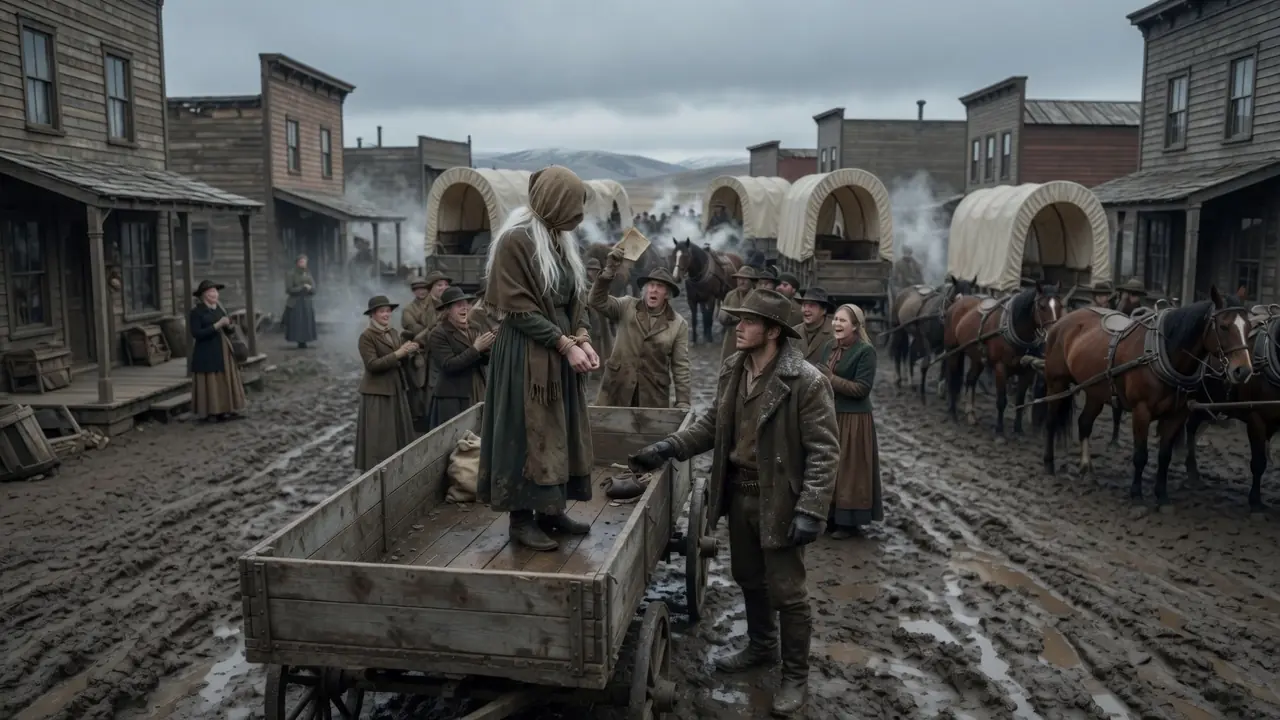
The rope ran through an iron ring bolted to the side of an old freight wagon that had been turned sideways to serve as an auction block. No one stood too close to her. Even the boys who had come to laugh kept a little distance, as if misfortune might jump from her body to theirs if they leaned in too far.
They said she was cursed.
They said her hair was white because death had touched her before birth. They said her skin was too pale for the living and her eyes were the color of winter ghosts. They said every man who looked at her too long lost his luck, his cattle, or his mind.
Some folks laughed when they said it.
Others crossed themselves.
But the girl did not bow.
Even with the sack covering her face, she stood straight. Her shoulders were still. Her chin lifted beneath the cloth as if she had decided long ago that shame belonged to the people watching her, not to her.
A thin man named Porter Vance stood on the wagon, waving a folded paper in the air.
“You all heard the terms,” he called. “Strong enough to work, young enough to last, and quiet enough not to cause much trouble if you keep her covered.”
A few men chuckled.
Porter smiled wider.
“Ten dollars,” he shouted. “Ten dollars and she is yours. You do not even have to look at her face. Keep the sack on if you have a weak stomach.”
A ranch hand near the front spat tobacco into the mud.
“Five,” he said. “Need someone to wash pots.”
Another man laughed.
“I’ll give seven if she can milk without scaring the cows dry.”
The crowd broke into rough laughter.
They spoke about her like she was not standing there.
Like she was a damaged animal.
Like she was a storm to be purchased and locked somewhere out of sight.
At the edge of the square stood a tall man in a heavy buffalo coat dusted with early snow.
His name was Silas Creed.
He had ridden down from the Granite Crown Mountains before sunrise to trade furs, buy flour, and collect a rifle part from the blacksmith before winter sealed the high passes. He was thirty-six years old, broad across the shoulders, quiet in the way men become quiet after war teaches them how useless noise can be.
He had not come to Ash Hollow looking for a bride.
He had not come looking for trouble either.
But trouble had a habit of finding men who still had a conscience.
Silas watched the woman on the wagon.
He watched the crowd laugh.
He watched Porter Vance wave the paper like decency had been auctioned long before the girl.
Silas had seen battlefield dead. He had seen burned homesteads, starving children, and men with less humanity than the animals they rode. But something about this moment tightened his chest in a different way.
Because the girl was alive.
And the town was treating her like she had already been buried.
“Seven dollars,” the ranch hand called again.
Porter grinned.
“Seven dollars going once.”
“Thirty.”
The word cut through the square clean as a rifle shot.
The crowd turned.
Silas stepped forward slowly. Mud clung to his boots. Snow melted on the shoulders of his coat. The people between him and the wagon moved aside before deciding whether they meant to.
Porter’s grin faltered.
“Thirty?” he said. “Creed, you ain’t even seen what you’re taking.”
Silas looked at the girl, not the auctioneer.
“I’m not buying her face.”
Porter gave a crooked laugh.
“Good, because you may not want it.”
Silas’s eyes hardened.
“I’m taking her out of here.”
The girl’s tied hands tightened slightly at her sides.
That was the first sign she had heard him clearly.
Someone in the crowd muttered, “Man’s lost his senses.”
Another voice answered, “Let him. Better his cabin than our town.”
Porter snatched the leather pouch Silas tossed onto the wagon. He counted quickly, then lifted his arms before anyone could change the price.
“Sold,” he shouted. “The mountain man has bought himself a curse.”
Silas climbed onto the wagon.
Up close, the young woman seemed smaller than the rumors around her. The burlap sack hung rough over her head and shoulders, tied loosely at the neck. He saw pale fingers beneath the rope at her wrists, almost luminous against the dirty hemp.
He untied the rope from the iron ring.
For a moment, the whole town waited for him to pull the sack away.
Silas did not.
He would not give them one more piece of her.
“Walk with me,” he said quietly.
She stepped down from the wagon without stumbling.
The crowd watched them leave. Some whispered. Some laughed. One woman made the sign of the cross and turned her face away.
Silas ignored all of them.
Outside town, he mounted his chestnut gelding and brought forward a second horse, a gray mare with a gentle eye. He cut the rope from the girl’s wrists, then helped her onto the mare only after she gave the smallest nod that allowed it.
Her movements were careful.
Balanced.
Not weak.
Not helpless.
They rode north beneath a low gray sky.
For hours, neither spoke.
Ash Hollow disappeared behind them, swallowed by distance and snow. The road narrowed into a mountain trail lined with black pines. Cold wind moved down the slope and lifted the edges of the burlap sack around the girl’s shoulders.
At last, Silas said, “You can take it off.”
She did not answer.
“No one from town is here,” he added.
A long silence followed.
Then she lifted both hands slowly and loosened the cord at her neck. But instead of removing the sack, she only raised the cloth enough to see the trail ahead. Her face remained hidden.
Silas noticed.
He said nothing.
By nightfall, they reached his cabin.
It stood beside a frozen creek at the edge of a pine hollow, rough but solid, built by Silas and his father before fever took the old man. Smoke rose from the stone chimney. A split-rail corral sat behind the cabin, and beyond that, the mountains rose dark and silent against the coming night.
Silas helped her down.
Inside, the fire threw gold light across the log walls. The room smelled of pine, coffee, leather, and woodsmoke. A rifle hung above the mantel. Two chairs stood near the hearth. A narrow ladder led to a sleeping loft.
Silas closed the door.
“Take it off,” he said.
The young woman stood in the center of the room.
Firelight moved over the rough sack covering her head.
She did not move for several heartbeats.
“I will not scream,” Silas said calmly. “And I will not send you back.”
Her hands rose.
They trembled only a little.
Then she pulled the sack upward and lifted it away.
Silas forgot how to breathe.
He had expected burns.
A twisted jaw.
Some injury that cruel men had turned into legend because cruelty was easier than pity.
But there was no scar.
No disfigurement.
No monstrous mark.
The woman standing before him was beautiful in a way he had never seen and would never have had the language to invent.
Her hair fell past her shoulders in long white waves, not gray with age, but white like moonlight on fresh snow. Her skin was very pale, almost translucent in the firelight, with the faintest pink at her cheeks and lips. Her lashes were white too, delicate against eyes so pale blue they looked nearly silver.
She was not cursed.
She was different.
And the difference was breathtaking.
She watched him carefully, waiting for disgust.
Waiting for fear.
Waiting for the old reaction she had learned to expect.
“Well?” she asked quietly. “Do I look like a curse?”
Silas took one slow step closer.
“No.”
Her mouth tightened, as if she did not know what to do with the answer.
He looked at her eyes, her hair, the way the firelight softened around her like the room itself had gone quiet.
“You look like they were afraid of beauty they could not explain.”
That broke something in her face.
Not enough for tears.
Enough for the mask to slip.
“My name is Elowen Vale,” she said.
“Silas Creed.”
“I know.”
He frowned slightly.
“You know me?”
“People in Ash Hollow talk about the mountain man who comes down twice a year and looks at everyone like he already knows the worst thing they have done.”
For the first time all day, Silas almost smiled.
“Fair enough.”
Elowen looked toward the fire.
“They said you were a dangerous man.”
“They say you are cursed.”
Her eyes lifted to his.
“People say many things.”
“Yes,” he said. “And most of them are lazy.”
She looked down at her wrists where the rope had reddened her pale skin. Silas saw the marks and felt anger move through him, low and hot.
“Who put you on that wagon?”
“Porter Vance.”
“Why?”
Her face closed.
“Because Bram Whitlock told him to.”
Silas knew the name.
Everyone in the valley knew Bram Whitlock. He owned cattle, land, men, judges, and at least one preacher if rumor could be believed. He was rich enough to call greed business and powerful enough to call violence order.
“What are you to Whitlock?” Silas asked.
Elowen’s jaw tightened.
“His wife.”
The word changed the air.
Silas said nothing.
“He forced the marriage after my father died,” she continued. “My father owned the north spring and the grazing rights beyond Cedar Pass. Bram wanted both. The will left them to me.”
“So he married you.”
“He tried.”
Silas watched her.
“Tried?”
Elowen looked toward the window, where darkness pressed against the glass.
“The preacher signed the certificate. Bram signed it. I did not. I never said the vows. I never took his name. But people believe paper faster than they believe women.”
Silas felt his hands curl.
“So the curse?”
She gave a small, bitter smile.
“I was born like this. White hair. pale skin. eyes too light. My mother said I was touched by winter and loved me anyway. My father said God made many kinds of dawn.”
Her voice thinned slightly.
“After they died, Bram called me unnatural. Said no decent man would want a woman who looked like a ghost. Said folks already feared me, so fear could be useful.”
Silas understood then.
The sack.
The auction.
The laughter.
It had not been superstition alone.
It had been strategy.
“You are not cursed,” he said.
“No,” Elowen replied. “But men like Bram know a lie repeated by a crowd starts sounding like law.”
For the next few days, the cabin became a quieter world.
Elowen worked without being asked. She cooked plain meals and made them taste better than anything Silas had eaten alone in years. She mended his torn coat with small, careful stitches and organized his supplies in a way that made him realize he had been living more like a survivor than a man.
She also avoided sunlight.
Not fearfully.
Practically.
On the second morning, Silas noticed her standing away from the window when the snow glare brightened the room.
“Your eyes hurt?” he asked.
She hesitated.
“Yes.”
He nailed a strip of old canvas above the window before noon.
She watched him from near the table.
“You do not have to change your house for me.”
“I was tired of the glare.”
“That is a poor lie.”
“I am out of practice.”
That almost made her smile.
By the sixth night, heavy snow began falling.
The mountains disappeared beneath white silence. The creek froze harder. Wind clawed at the cabin walls and pushed smoke sideways from the chimney.
Silas stepped outside to bring in firewood.
Then stopped.
Tracks.
Fresh horse tracks circled the cabin.
Not one rider.
Four.
He crouched and touched the print.
Still sharp.
They had come close, watched, and turned back down the trail.
When he returned inside, Elowen looked up from the table.
“What is it?”
Silas closed the door.
“They found the cabin.”
Her pale face grew still.
“Bram?”
“Maybe his men first.”
She looked toward the fire.
“He will come.”
Silas took the rifle from above the mantel.
“Then we prepare.”
That night, they did not sleep much.
Elowen cleaned cartridges beside the fire, her white hair braided over one shoulder. Silas checked the door bar, the shutters, the loft window, the back wall where the logs had settled unevenly.
Around midnight, Elowen spoke.
“You could send me away before he comes.”
Silas looked at her.
“You think I paid thirty dollars to return you to wolves?”
“You paid thirty dollars to get a stranger out of a square. That does not mean you owe her a war.”
Silas leaned the rifle against the table.
“I do not owe Bram Whitlock my silence.”
She studied him.
“You speak like a soldier.”
“I was one.”
“What did war teach you?”
He looked into the fire.
“That cowards are often loud before the first shot. Brave people usually have work to do.”
Elowen nodded slowly.
“Bram is loud.”
“Then we will listen for his work.”
The attack came two nights later.
It started with a voice in the dark.
“Elowen!”
She went rigid.
Silas stood.
Outside, horses shifted in the snow. Men moved near the trees. The cabin fire crackled softly, almost foolishly, as if the world had not narrowed to the door and the rifle in Silas’s hands.
Bram Whitlock’s voice came again.
“You cannot hide behind that mountain animal forever. Come out before he dies for you.”
Elowen’s eyes sharpened.
“He still thinks fear is a leash.”
Silas handed her the spare rifle.
“You know how to shoot?”
“My father taught me before he taught me embroidery.”
“Good man.”
A shot shattered the front window.
Glass burst inward. Cold wind filled the room. Silas fired through the broken frame and heard a man curse outside.
Elowen moved to the side wall, lifted her rifle, and aimed through a gap in the shutter.
Another rider tried to cross the yard.
She fired once.
He dropped behind the woodpile, screaming.
Bram shouted in rage.
“You think that pale witch is worth dying for, Creed?”
Silas reloaded.
“She is worth more than men like you are capable of measuring.”
The door shook under a heavy blow.
Then another.
The bar held.
Elowen moved toward the back window.
“They will try the rear.”
She was right.
A shadow crossed the snow behind the cabin. The latch began to move slowly, lifted by a knife from outside. Elowen waited until the blade slipped through the crack.
Then she fired through the wood.
A body fell into the snow.
For a moment, everything went quiet.
Even the wind seemed to hold its breath.
Then Bram’s voice came from the trees, lower now.
“This is not over.”
Silas stepped to the broken window.
Through the swirling snow, he saw a tall rider beneath a black hat staring at the cabin. Bram Whitlock’s face was half-shadow, half-fury. Blood darkened one sleeve, but he was still mounted.
Then he turned his horse and vanished down the trail.
Silas barred the damaged door again.
Elowen stood in the center of the room with the rifle in her hands.
Only then did she start shaking.
Silas gently lowered the barrel.
“You did well.”
Her pale eyes glistened.
“He will not stop.”
Silas looked toward the dark window.
“Then neither will we.”
For three days, the storm trapped them in the cabin.
Snow buried the steps. Wind packed white drifts against the walls. The mountains became a closed hand around them.
Inside, the fire burned day and night.
Elowen kept busy because stillness invited memory. She made soup. She cleaned the rifles. She folded bandages from old shirts. She patched the broken window with oiled cloth and strips of wood while Silas held the frame steady.
They spoke more during those days.
Not about fear at first.
About small things.
Her father had been a schoolteacher before he bought land.
Her mother had come from Virginia and believed every child should know the names of birds.
Elowen could read Latin, stitch a wound, ride bareback, and tell time by shadow if the sky was clear.
Silas told her about the war.
About the brother he had buried in Tennessee.
About the reason he stayed in the mountains after returning west.
“People expected me to become what I was before,” he said. “But that man died somewhere too. I just brought his body home.”
Elowen listened.
Not with pity.
With understanding.
On the fourth morning, the storm broke.
Sunlight covered the mountains so brightly that Elowen winced when the door opened. Silas noticed and stood in the doorway to block the glare while she wrapped a blue scarf over her head and around the sides of her face.
“You should not have to hide from daylight,” he said.
“I do not hide from daylight,” she replied. “I negotiate with it.”
That did make him smile.
They rode down the mountain that afternoon.
Not to run.
To learn.
Silas knew a trading post near the fork of the frozen river where information moved faster than mail. Elowen rode beside him, not behind him, her rifle across her saddle and her scarf protecting her pale face from the hard glare of snow.
At the trading post, three men fell silent when she entered.
One crossed himself.
Silas turned toward him.
“Finish that prayer with an apology.”
The man looked away.
Behind the counter, old Martha Cline narrowed her eyes at Elowen.
Then said, “You Vale’s daughter?”
Elowen went still.
“Yes.”
Martha’s face softened.
“I knew your father. He paid fair and never watered whiskey.”
That was praise in Martha’s language.
Silas leaned on the counter.
“What have you heard about Whitlock?”
Martha glanced at the men near the stove.
“Enough.”
“Say it anyway.”
“He has a bounty whispered, not posted. Five hundred dollars for the return of his runaway wife.”
Elowen’s face tightened.
Martha looked at her.
“You his wife?”
“No.”
“Good.”
The old woman reached beneath the counter and pulled out a folded paper.
“Then you may want this.”
Elowen opened it.
Her hands stopped moving.
It was a copy of her father’s will.
Not the one Bram had shown the county court.
The real one.
Her father’s signature.
Two witnesses.
Clear language leaving the north spring, the Cedar Pass grazing rights, and the old silver survey claim to Elowen Vale alone.
“How did you get this?” Elowen whispered.
Martha folded her arms.
“Your father left it with me before he died. Said if Bram Whitlock came smiling too much, I was to give it to you.”
Elowen pressed the paper to her chest.
Silas watched her face.
The twist in the story was no longer only that Bram had lied about her being cursed.
He had built the curse to steal land, water, and a silver claim he could not legally touch.
Martha nodded toward the window.
“Whitlock is not afraid of your face, girl. He is afraid of your name on paper.”
On the ride back, Elowen was silent for a long time.
Then she said, “He put a sack over my head because he could not erase my signature.”
Silas looked at her.
“Then we make the whole valley see both.”
Her pale eyes turned toward him.
“You would stand beside me in court?”
“Yes.”
“And if the court belongs to him?”
“Then we bring more than court.”
“What does that mean?”
Silas looked toward the mountains.
“It means truth travels better when witnesses carry it.”
Over the next week, they gathered those witnesses.
Martha Cline signed a statement. So did the old circuit preacher who remembered Elowen refusing Bram’s vows. So did a former ranch hand who had heard Bram tell Porter Vance that fear would make the pale girl easier to sell.
Not everyone helped out of goodness.
Some helped because Whitlock had cheated them too.
Some helped because they feared Silas.
Some helped because Elowen stood before them without the sack, and they could no longer pretend the monster from the stories was anything but a beautiful young woman with white hair and tired eyes.
The final confrontation came in Ash Hollow.
Not in the muddy square.
In the courthouse.
The same town that had laughed gathered again, but this time the laughter stayed hidden behind tight mouths and nervous glances. Elowen walked through the doors wearing a dark green dress Martha had given her, her white hair braided neatly down her back. A wide-brimmed hat shaded her pale face from the bright windows.
No sack.
No rope.
No shame.
Silas walked beside her.
Bram Whitlock stood near the judge’s bench, his injured arm bound beneath his coat. Porter Vance stood behind him, looking smaller than he had on the wagon.
When Bram saw Elowen, his face changed.
Not with desire.
Not with guilt.
With fear.
For the first time, the town saw it.
Judge Hollis cleared his throat.
“This hearing concerns the claim of Mr. Bram Whitlock regarding the custody and legal status of Miss Elowen Vale.”
“Elowen Whitlock,” Bram snapped.
Elowen stepped forward.
“I never took that name.”
A murmur moved through the room.
Bram smiled thinly.
“She is unstable. Folks know it. Her condition has always affected her mind.”
Silas felt rage move through him, but Elowen lifted one hand slightly.
Not to silence him.
To stand for herself.
“My condition is albinism,” she said clearly. “It affects my hair, my skin, and my eyes. Not my mind. Not my soul. Not my right to own what my father left me.”
The room went still.
Most people had never heard the word.
Albinism.
It sounded less like a curse when spoken plainly.
More like a fact.
Elowen unfolded the will.
“This is my father’s true will. Bram Whitlock hid it. He forged a marriage claim. He spread stories that I was cursed so no man would question why he covered my face and sold me like livestock.”
Porter Vance began sweating.
Bram’s jaw tightened.
“That paper is fake.”
Martha Cline stood from the back.
“No, it is not.”
The court turned.
Martha lifted her chin.
“Her father left it with me. I watched him sign it. I kept it because he feared this very thing.”
Then the preacher stood.
“I never heard this woman speak vows to Bram Whitlock.”
Then the ranch hand stood.
“Whitlock paid Porter to get rid of her before the land hearing.”
Porter Vance broke before anyone asked him to.
“He told me she was cursed,” he cried. “He said nobody would care. He said if Creed bought her, the mountain would swallow them both and the claim would die.”
Bram reached for his pistol.
Silas moved faster.
The sound of his revolver cocking froze the room.
“Do not,” Silas said.
Two deputies seized Bram before he could decide whether pride was worth dying over.
The judge pounded his gavel until the room settled.
By sundown, Bram Whitlock was in custody for fraud, attempted abduction, assault, and conspiracy. Porter Vance confessed in full before the ink dried on the first warrant. The forged marriage claim collapsed. The true will was entered into record.
Elowen Vale owned the north spring.
Cedar Pass.
And the silver survey Bram had nearly stolen with a lie.
When she stepped out of the courthouse, the same town that once laughed at her fell quiet.
A little girl near the steps stared at Elowen’s white hair.
Her mother tried to pull her back, embarrassed.
But Elowen crouched carefully so the child could see her face beneath the hat.
“Are you a ghost?” the girl whispered.
Elowen smiled.
“No.”
“Are you magic?”
“No.”
“Then what are you?”
Elowen thought for a moment.
“Different.”
The child nodded like that answer made perfect sense.
Maybe it did.
Spring came late to the mountains that year.
Snow melted from the creek in silver threads. Pine shadows softened. Wildflowers pushed through the thawed ground near Silas’s cabin, stubborn little things bright enough to shame winter.
Elowen stayed.
Not because Silas bought her.
Not because the town cleared her name.
Not because she needed a place to hide.
She stayed because the mountain air felt clean, because the cabin windows now had soft canvas shades for her eyes, because Silas listened when she spoke, and because for the first time in years, no one asked her to cover her face.
One evening, she stood beside the creek with sunlight low enough not to hurt.
Her white hair glowed gold at the edges.
Silas walked up beside her.
“You ever regret leaving Ash Hollow?” he asked.
She looked at the moving water.
“I did not leave Ash Hollow.”
“No?”
She shook her head.
“I was carried out like shame. Then I walked back in as truth.”
Silas smiled faintly.
“That sounds better.”
She turned toward him.
“You never asked me what you bought for thirty dollars.”
His smile faded.
“No.”
“Do you want to know?”
“I know.”
“What?”
“A chance to do one decent thing before winter.”
Elowen studied him.
Then stepped closer.
“And what did you get?”
Silas looked at her face, her pale lashes, her silver-blue eyes, the beauty the town had mistaken for danger because fear had made them stupid.
“Trouble,” he said.
She laughed softly.
“Is that all?”
“No,” he said. “The best kind.”
Years later, travelers passing through the Granite Crown Mountains spoke of a mountain man and a white-haired woman who lived beside a cold creek north of Ash Hollow.
They said she was the most beautiful woman in the territory.
They said her skin was pale as milk, her hair white as snow, and her eyes bright enough to make men forget the insult they had prepared. They said she could shoot straight, read contracts better than lawyers, and spot a liar before he finished clearing his throat.
No one called her cursed anymore.
At least, not where Silas could hear.
And when young women came through Ash Hollow frightened of being too strange, too plain, too bold, too different, Martha Cline would point toward the mountains and say, “Go ask Elowen Vale. She knows what happens when fools mistake difference for darkness.”
Elowen usually gave the same answer.
“They covered my face because they were afraid of what people might see.”
Then she would smile.
“So I made them look.”