The orange sign was the first thing I saw. It was staked into my own front lawn, fluorescent and proud. "Estate auction today." Below it, my three cars wore neon price stickers like cattle at a fair. My couch sat on the driveway, my grandfather's armchair, the reading lamp my wife had picked out before she passed.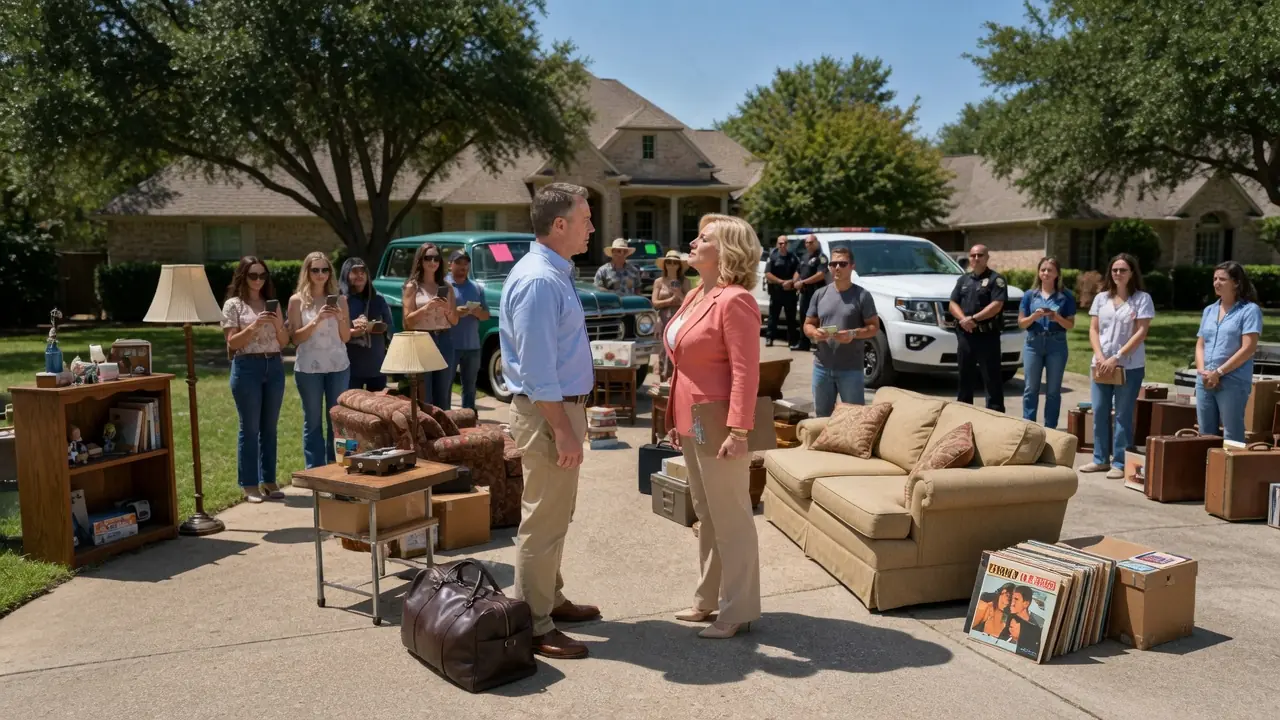
A woman in a navy blazer was taking cash from a man in a contractor's truck. I'd been gone 11 days. I was supposed to be gone 14. The Phoenix closing settled 3 days early, and I had taken the first flight home without telling anyone. I rolled the rental car to a stop at the curb.
The woman with the clipboard turned, saw a stranger, and walked toward me with the brisk pleasantness of someone who already owned the moment. "Sir, this property is under HOA forfeiture," she said. "You'll need to step back. We're in the middle of a legal estate sale." She did not recognize me.
I got out of the car. She stepped between me and my own garage door without breaking stride. "Sir, I need you behind the line. The sale is in progress." There was no line.
There was a folding table, a clipboard, a small crowd of five buyers, and Karen Whitcomb, HOA president for 3 years and counting, wearing the kind of smile people use on telemarketers. Behind her, the brass 412 on my front porch caught the afternoon light. On the driveway, my 1972 Ford pickup wore a windshield sticker that read "$9,500." The two daily drivers behind it had stickers of their own. A folding table held a coffee tin labeled "Deposits" in black Sharpie.
A QR code was taped to the side of the tin. My wife's lamp was on the grass next to a stack of paperbacks from my study. The buyers, five of them, two couples and one older man with a checkbook, stood in a loose half circle, all of them looking at me, none of them looking at her. I asked Karen quietly if I could see the document authorizing a private association to auction off a homeowner's titled vehicles. She held up the clipboard.
It read, "Notice of HOA Foreclosure and Asset Liquidation," in the kind of bold serif font people use when they want to look like a court. Down at the bottom, a notary stamp. I read the date twice. The date was impossible. I knew it was impossible because I had spent 4 months last year walking a commercial client through Texas notary reform.
And the stamp Karen was waving in my face used a format that had been retired before the date written on it. I did not say so. Instead, I said, "Ma'am, I am the owner of record. Please stop the sale until I can speak to the officer you're about to call." She blinked, then her face hardened, the way faces harden when a person decides they would rather double down than be wrong in front of strangers.
"I'm calling 911 right now," she said. "You are trespassing on a sale site." She actually dialed. The contractor with the cash envelope, 50s sunburned forearms, and open and decent face lowered the envelope a few inches. "Wait, hold on.
Ma'am, is this the actual homeowner?" Karen waved him off without looking at him. "No, he's a squatter." A second buyer, the older man with the checkbook, took a step back. The dispatcher's voice came faintly through Karen's phone.
She began describing me, wrong height, wrong weight, confidently wrong. I stood in my own driveway listening to a woman call 911 on me while my couch sat on the grass and my truck wore a $9,500 sticker on the windshield. I felt something settle in my chest, not anger. Anger comes later. This was the quieter feeling, the one you get when you watch someone hand you the rope they think they're using to tie you up.
11 days. 11 days was all it had taken her to get here. To stake the sign in my grass. To slap a price on my truck. To put my wife's lamp out on the lawn where strangers could touch it.
I did not lunge for her phone. I did not raise my voice. I did not even step closer. I let her finish her call. Because the longer she talked, the deeper she dug.
And the orange sign in my grass, the same orange sign she had used three other times in this subdivision on people who never fought back, was about to become the single piece of evidence that ended her. She had no idea the man she had just called 911 on read fake documents like hers for a living. She had no idea 11 days was also all it would take to bury her.
Karen was still on the phone with dispatch when I let my mind walk backward. I had been in Phoenix for 11 days. A commercial mediation. Two companies, one warehouse lease, three lawyers who all hated each other. My job had been to read every clause out loud and ask the kind of questions that make grown men sigh.
We settled Tuesday afternoon. I caught a 6:00 a.m. flight Wednesday morning. I had not told a soul. That was the only reason I was standing on my own lawn watching a stranger price my truck. My work involves a lot of documents and a lot of liars.
I keep copies of everything I sign. I keep the originals in a fireproof envelope in the glove box of whatever car I'm driving. My wife used to tease me about it. Said I treated paperwork like it might run away in the night. After she passed, I kept doing it anyway.
Some habits feel like love. I looked at Karen with the phone pressed to her ear, and I let myself remember the first time I ever spoke to her.
Six months ago. A delivery truck in my driveway dropping off a new washing machine. The truck was in my driveway for 2 hours and 20 minutes. The next morning an HOA violation notice appeared in my mailbox. $400. Commercial vehicle more than 12 consecutive hours in violation of article 7 section C.
I could see it in her face the day she handed me the receipt for the fine. I came to understand over the months that followed that the $400 truck fine had not really been about the truck. It had been a temperature check. She had wanted to know if I was the kind of man who paid and went quiet or the kind who pushed back. I had pushed back politely.
In Karen's ledger, polite pushback was still pushback. And Karen kept a ledger. I learned about that ledger from Mr. Alvarado. Mr. Alvarado was 71, a widower three doors down. In 2023, Karen had organized what she called a compliance demolition, a formal-sounding phrase she had invented herself, to tear down his garden shed.
The shed had been on his property for 19 years. The bylaws had grandfathered it in. None of that mattered because Karen produced a notice that nobody on the actual board remembered voting on and a contractor showed up at 7:00 in the morning on a Saturday and reduced the shed to kindling while Mr. Alvarado was at his wife's grave. He told me about it on a folding chair in his garage the day I moved in. He said it the way old men say things they have stopped expecting anyone to fix.
I had filed the story away. I had not known until today that he had also kept the paperwork. I thought about the 96 homes in our subdivision. I thought about how many of them had quietly written checks to Karen Whitcomb over the past 3 years and gone back inside. I thought about how many of those checks had been deposited into accounts that did not belong to the HOA at all.
And I thought about the 11 days. She had known I would be gone. She had known because the HOA office kept a travel emergency contact form, the kind every homeowner fills out so the board can reach you if a pipe bursts. As president, she had access. She did not call the emergency number.
She did not send certified mail to my actual mailbox. She did not knock on my door before I left. She did not knock on Mr. Alvarado's door to ask if he had heard from me. She did not do any of the things a person doing something legitimate would do. She had picked a window where she believed I would not come home in time.
11 days of silence by design. I looked at the orange sign in my grass and understood that this auction, this clipboard, this folding table with a coffee tin labeled deposits was not a mistake. It was the third or fourth time she had run a version of this play. It was just the first time the man she had picked answered her in writing 6 months earlier.
I came back to the present. The dispatcher's voice on Karen's phone had gone flat and procedural. She was confirming an address, my address. The cul-de-sac had gone quiet around her, the way crowds go quiet when they sense the room about to change. The contractor with the cash envelope had folded it closed and tucked it under his arm.
He had not given Karen the money. He was watching me instead. I caught his eye. I gave him a small, deliberate head shake, the kind a man uses to say, "Don't." He took two slow steps backward toward his truck.
Karen did not notice. She was telling the dispatcher that a male intruder was refusing to leave a private HOA estate sale. She gave my own height wrong by 3 in. She gave my weight wrong by 20 lb. She described me as agitated.
I had not raised my voice once. The older buyer with the checkbook was now standing very still, the way people do when they realize the floor under them might not be a floor. The two couples had drifted closer to each other. One of the women had her phone out, lower than her hip, screen up. She was filming.
Good, I thought. Film all of it. Across the street, on the sidewalk in front of her own driveway, a woman in her mid-30s was standing with one hand on a stroller and the other shading her eyes. Megan Carter, two kids, civil engineer husband, the kind of neighbor who actually read the HOA newsletter. She was looking at Karen the way you look at a person you have wanted to call out for a long time and never had the right room for.
The right room had arrived. I did not know yet, in that moment, that the next 90 minutes would put Karen Whitcomb in the back of a squad car, end her marriage by sundown, and pull a federal agency into a suburb of 96 houses where nothing had ever happened before. I only knew the dispatcher had finished the call. I only knew Karen was lowering the phone with the satisfied look of a woman who believed she had just summoned the cavalry. She had.
The cavalry was coming. It was just not coming for me.
Karen lowered the phone. She smoothed the front of her blazer with both hands, a small gesture that told me she was settling back into the role she had cast herself in, the role of authority, the role of the woman with the clipboard. I walked toward her with my hands open at my sides. "Ma'am," I said, and I kept my voice flat enough that the buyers could hear every word. "I am the registered owner of this property and these three vehicles.
Please stop the sale until the officer arrives. Anyone who has paid a deposit needs to hold off until this is resolved." Karen wheeled on me like I had cursed in a church. "You are interfering with a lawful HOA action. Step back, sir."
I did not step back. I did not raise my voice. I turned instead to face the five buyers standing in the loose half circle behind her. "Nothing on this property has been transferred," I said. "No deed has changed hands.
No title has been signed. Anyone who hands her cash today is handing cash to a stranger. I would strongly advise you to keep your money in your pocket until the officer sorts this out." The contractor's hand went into his jacket. He pulled out a small slip of paper and walked it over to me before Karen could stop him.
It was a receipt, pre-printed, embossed at the top with a navy blue HOA crest that looked official enough to fool anyone who had never read an HOA document in their life. Halfway down the page, the payee line had been filled in by hand. Whitcomb Property Services LLC Not the HOA, not an escrow, a private company carrying Karen's last name. The contractor watched my face as I read it. "I gave her $4,200 cash 20 minutes ago for the Ford," he said.
I took out my phone and photographed the receipt, front and back, without asking permission. The contractor nodded as I did it. He understood, the way working men sometimes understand things faster than people in suits, that the receipt in my hand had just become evidence. Karen saw the photograph happen. Her voice climbed half an octave.
"You cannot film me. This is private HOA business. "Ma'am," I said without looking up, "you are standing on my lawn selling my truck on a public street after calling 911. Nothing about this is private." The older buyer with the checkbook quietly tore the check he had been holding into four pieces and put the pieces in his pocket.
A woman across the cul-de-sac called out, Megan Carter, still by her stroller, her voice cutting clean across the lawn. "Karen, the board hasn't met in 6 weeks. There's been no notice on the bulletin board. There's been no email to homeowners. Whatever you're claiming you voted on, you didn't."
Karen did not look at her. Karen had a way of not looking at people who said things she did not want said. "He's been served," Karen snapped, still talking to the buyers and not to Megan. "He's in default on HOA dues. He's in violation of 17 separate bylaws.
You all saw the certified mail records I posted at the entrance." I had been quiet long enough. I turned my head just slightly toward Karen. "What certified mail records?" She faltered for the first time, half a second, enough.
"At the front entrance, posted on the community board last week." Megan, across the street. "There is nothing posted at the front entrance, Karen. I walked past it this morning." I let the silence stretch.
The buyers were watching Karen's face now, not mine. The woman with the phone at her hip had raised it to chest height. She was openly recording. I lifted my own phone and started recording video openly, framing the orange estate auction today sign in the foreground and Karen's clipboard in the background. "You cannot record me," Karen said again, louder.
"Texas is a one-party consent state, ma'am," I said. "I am the party. I consent." I watched her absorb that sentence. I watched her wonder for the first time whether the man standing in front of her knew something specific about the law she had been mangling for 3 years.
She did not have time to chase the thought because she was already pulling out her phone again. This time she did not call 911. She called somebody named Doug. Doug. Doug, he's here.
He came home early. Get over here. Bring the Yes, bring all of it. She hung up and turned her back to me. I filed the name away.
Doug, treasurer of the HOA board. If I remembered the roster correctly, a retired insurance adjuster, mid-60s, the kind of man who carried a leather folio everywhere he went. I had only ever exchanged two sentences with him. One of them, 6 months ago, had been, "Karen handles the paperwork. I just sign where she points."
That sentence was about to become a confession. I walked a slow circle around the folding table. The coffee tin labeled deposits had a QR code taped to its side. I crouched, pulled up my phone's camera, and scanned the code without touching the tin. It opened a Zelle payment page.
The account name on the Zelle page was not the HOA. It was not Whitcomb Property Services LLC, either. It was a personal account in Karen Whitcomb's name. Direct deposits. No escrow.
No business filing in between her and the cash she was taking from strangers on my lawn. I screenshotted the page. I screenshotted the URL. I screenshotted the timestamp. I stood up.
"Ma'am," I said, "your deposit tin is linked to your personal bank account. That is not how HOA dues work. That is not how foreclosure auctions work. That is not how any legitimate sale works." Karen turned around.
The smoothness was gone from her blazer now. There was a thin line of sweat above her upper lip. "You don't know what you're talking about. The board authorized this. Doug authorized this."
"You just told the dispatcher Doug wasn't here." "Doug is Doug is on his way." The older buyer with the torn check spoke for the first time. His voice was dry, almost amused. The voice of a man who had spent a lifetime watching people dig holes in their own backyards.
"Lady," he said, "I sell commercial real estate in Tyler. I have closed 300 properties. There is not one thing about this sale that looks legal to me. Not one." A second buyer, one of the women who had been quietly filming, added, "I drove 40 minutes for this.
I gave you $800 cash for the dining set. I want my money back." Karen's mouth opened. Karen's mouth closed. In the distance, a siren started.
Karen turned toward the sound the way a drowning person turns toward a rope. Her shoulders dropped half an inch. Her chin lifted. A small smile pulled at the corner of her mouth. The smile of a woman who had not yet understood what kind of rope was coming.
She actually waved. 2 minutes later, the squad car pulled into my cul-de-sac. Karen was smiling. She actually waved. Two officers stepped out of the squad car.
The lead was in his mid-50s, a sergeant by the stripes, the kind of police veteran who moved slowly because he had learned that slow was almost always faster in the end. His partner was younger, maybe early 30s, already pulling out a notebook before his boots hit the pavement. Karen got to them first. She walked across my lawn like a woman receiving guests at her own dinner party. "Officer, thank you for coming.
This man is trespassing on a court-ordered HOA estate sale. He's been refusing to leave for 20 minutes. He's harassing the buyers. I'd like him removed from the property." The sergeant tilted his head about half an inch.
It was not a yes, and it was not a no. Ma'am, you said a court order. It's an HOA order, but it functions as a court order. We have full authority under the bylaws to liquidate assets for unpaid dues and violations. The sergeant looked at her for a long moment.
Ma'am, he said, "Those are different things." I stayed exactly where I was. I had learned somewhere along the way that when other people are doing the work of digging your enemy's grave for you, the right thing to do is hand them a shovel and step back. The sergeant turned to me. "Sir, can I get your name?"
I gave it. "And do you live at this address?" I own this property. My deed and the titles to all three of these vehicles are in the glove box of my rental car at the curb. May I get them?
He looked at his partner. The partner moved a few steps with me, polite and watchful, and waited at the driver's side while I leaned in and pulled out the fireproof envelope my wife had once teased me about. I handed it to the sergeant on the lawn. He opened it the way men in uniform open paperwork, carefully, with two thumbs, like the document might bite. He read the deed first.
Then he read the title to the 1972 Ford. Then he read the titles to the two daily drivers. He took his time on each one. I watched his shoulders change. You can see it when a cop's posture shifts from managing a dispute to documenting a crime.
The shoulders square, the hands rest a little differently, the voice drops half a register. The sergeant got there somewhere between the deed and the second title. And by the time he finished the third, he was a different officer than the one who had stepped out of the car. He turned, slowly, to Karen. "Ma'am, may I see your authorization document?"
Karen handed him the clipboard with a flourish. She was still riding the momentum of the first 30 seconds when she had been the woman calling the police on a trespasser. She had not noticed the room change. The sergeant read the forged notice front to back. He paused on the notary stamp.
He read it again. He did not say anything. He just turned the clipboard sideways so the partner could see it, and the partner stopped writing for a second, looked at the date, looked at the stamp format, and then started writing twice as fast. "Ma'am," the sergeant said, "when was this notice notarized?" Karen pointed at the date.
"It's right there, last month." "Ma'am, the format on this stamp was retired before that date. Notaries in this state stopped using this specific format last year." Karen's face did a small, tight thing. "That can't be right.
Our notary... We used a licensed notary." "Who?" "I'd have to look up the name." A voice came from the sidewalk behind us.
"She did this to me in 2023." Mr. Alvarado was walking across the cul-de-sac, 71 years old, navy windbreaker, a manila folder pressed against his ribs, the way old men press things they have been carrying for too long. He came up the driveway slowly, nodded once to the sergeant, and held the folder out without any speech. "Same form," he said, "different date. She tore my shed down with this."
The sergeant took the folder. He opened it. Inside, clipped to a single sheet, was a notice that read, "Notice of HOA Compliance Demolition." The phrase Karen had invented and used and reused for 3 years. The template was identical to the one in his other hand.
Same serif font, same fake court formatting. The notary stamp on Mr. Alvarado's 2023 paper had a slightly different date, but the same retired format. The sergeant held both pieces of paper up side by side where Karen could see them. He did not say anything. He did not have to.
Megan crossed the street with her stroller. She came up to the partner with the notebook and said clearly, "I'm Megan Carter, 414 Lantana. The HOA board has not held a meeting in 6 weeks. There has been no vote on anything regarding 412 Lantana. There has been no notice posted at the entrance.
I walk past that board every morning. I am happy to make a formal statement." The partner wrote her name and address down. The contractor stepped up next. He held out the receipt, the one with Whitcomb Property Services LLC in the payee line, and he said, "I gave her $4,200 cash.
I have my dashcam running on my truck. The whole conversation when I paid is on it. It's yours if you need it." The partner took the receipt. He took the contractor's name.
He noted the dashcam. Karen's smile, the one she had used when the squad car pulled in, was now completely gone. Her hand had drifted up to her phone again. She was scrolling fast, head down, calling somebody, texting somebody. I caught the partner's eye and tipped my chin slightly toward her.
He saw it. He did not say anything, but he angled his body half a degree so he could keep her in his peripheral vision while he took the contractor's statement. I stayed quiet through all of this. I had said one sentence to the officer when he asked, "I own this property." And I had not added a single word since.
I had learned that too somewhere along the way. The deed and the titles were already speaking. Mr. Alvarado was speaking. Megan was speaking. The contractor was speaking.
The orange sign in the grass was speaking. There was nothing for me to add yet that was not already in the air. The sergeant turned the document over one more time and read the notary stamp out loud, slowly, for his partner to write down. He said the date. He said the format identifier.
He said the name printed beneath the stamp, a notary I had never heard of, with an address that, when he keyed it into the laptop in his squad car a few minutes later, turned out not to exist. Karen, by then, had stopped scrolling. She was staring at her phone screen, not moving. I could see, even from where I stood, the name at the top of the conversation she had pulled up. Doug.
She was typing a message to Doug, very fast. The partner officer, behind her, glanced down at the same screen as he passed her on his way to the squad car. He did not comment. He just made another note. A second message popped up underneath hers, from Doug.
Two words. I could not read them at that distance, but Karen could. Whatever they said, they made her go still. She lowered the phone. She looked at me for the first time since the squad car had arrived.
Her face had a question in it now, a small, late question that should have been asked 11 days ago. "Who are you?" I did not answer her. I let her keep wondering.
Doug's black SUV pulled into the cul-de-sac 11 minutes after Karen had called him. I knew it was 11 minutes because I had checked my watch when she made the call, and I had checked it again when his tires crossed the curb. Habits from a job that bills in 6-minute increments. He stepped out carrying a leather binder. He was wearing what people in our subdivision called Sunday casual, even on a Wednesday afternoon.
Pressed slacks, a polo shirt with the HOA crest stitched on the left chest, loafers that had never been outside without a doormat under them first. He walked toward the squad car the way men of a certain age walked toward problems they believed they could defuse, which is to say without enough urgency. "Officer," he said, holding out his free hand, "Doug Henderson, HOA treasurer and acting authority on this sale. I'm sure we can clear this up quickly." The sergeant did not shake his hand.
"Mr. Henderson, do you have authorization paperwork for this auction?" "Of course." Doug opened the binder on the hood of the squad car. He turned the pages with the ease of a man who had practiced. "Resolution to liquidate, signed by the board, meeting minutes from the vote, notice posted in accordance with bylaws.
Everything is in order." The sergeant looked at the meeting minutes first. The date at the top of the page was April 14. Megan, still standing on the lawn with her stroller, made a small sound, not a laugh, not quite, and stepped forward. "Officer," she said, "April 14th was the community Easter brunch.
I have 43 photographs on my phone. So does half the cul-de-sac. There was no board meeting that day. There was a hot dog cart and an inflatable bouncy castle for the kids." The sergeant's eyes moved to Doug.
Doug did not look up from the binder. A man in a Texas A&M cap, who had been standing on his porch across the street, walked down his driveway. "I was there. I took pictures of my granddaughter on the bouncy castle. I have a video of Karen herself running the raffle table."
He held up his phone. "April 14th, 2:17 p.m. Time stamp." The sergeant turned to Doug. "Sir," he said, "I'd like to ask you one question very directly. Who notarized the notice of HOA foreclosure that's currently in my hand?"
The whole cul-de-sac heard it. Doug's eyes moved, just for a second, half a beat, to Karen. Karen saw it. Karen saw what was about to happen. She moved a step toward him. "Doug.
Doug, look at me." Doug did not look at her. He looked at his binder. He looked at the sergeant. He looked at the patch of asphalt under his loafers.
He cleared his throat, and when he spoke, his voice was quieter than it had been 30 seconds earlier. I believe Karen handled the notarization through her office. Karen's voice went up an octave. "Doug, that is not what we agreed you would say." It came out before she could stop it.
It came out in front of the officer, the partner, the contractor, Megan, Mr. Alvarado, the older buyer with the torn check, the Texas A&M neighbor with his time-stamped photos, the two women with phones at chest height, and the eight other neighbors who had drifted into the cul-de-sac because they had felt the air change. It came out in front of my orange sign and my couch on the grass and my truck with its $9,500 sticker. The partner officer wrote that sentence down word for word. A young woman in workout clothes on the sidewalk lifted her phone and said, calmly, "I'm live-streaming this on Facebook."
She angled the camera. "If anyone in the neighborhood is watching, the link is in my story." Karen's head snapped toward her. "You can't." "Public street," the woman said without looking up from her phone.
"I'm on a public sidewalk. You're standing on someone else's lawn." Karen's mouth closed. The sergeant turned back to Doug. "Mr. Henderson, I'm going to need you to walk me through the chronology of how this auction was authorized.
I'd suggest you think very carefully before you answer." Doug looked at the binder. The binder did not help him. "I signed the resolution Karen put in front of me. She told me it had been voted on.
I trusted her. She handled all the paperwork. I just signed where she pointed." There it was, the exact sentence I had heard him say six months ago in passing, in a different context entirely. Now it was a confession.
The partner wrote that down, too. Karen made a noise I am not going to try to describe in writing. It was something between a laugh and a denial and the sound a person makes when they realize the floor is gone. "He's lying," she said, loud. Loud enough that the livestream microphone caught every syllable.
"I had nothing to do with the notarization. Doug is the treasurer. Doug handles the books. Doug handles the legal paperwork. I trusted Doug."
Doug, very quietly to the sergeant. "Officer, I'd like to speak with an attorney before I answer any more questions." The sergeant nodded. "That is your right, sir." The contractor, who had been standing patiently at the edge of the lawn the whole time, said, "Officer, I paid $4,200 cash.
There's a woman who drove down from Oklahoma yesterday. She wired more. I think you should talk to her, too." A woman near the back of the small crowd raised her hand. Mid-50s, sun hat, out-of-state license plate visible on the Buick parked along the curb.
"My name is Renee Picard," she said. Her voice carried that long, soft Oklahoma vowel that turns Picard into something closer to a song. "I wired $18,500 yesterday afternoon from my bank in Tulsa for the 1972 truck. The bank transfer went to Whitcomb Property Services LLC. I have the confirmation on my phone."
The sergeant turned slowly to look at his partner. The partner stopped writing. I did not need to be a federal prosecutor to know what had just happened in the air over my lawn. An interstate wire transfer to a private LLC pretending to be an HOA escrow account, money crossing state lines under false pretenses. That was no longer a county matter.
That was a federal one. The sergeant said, very evenly, "Ma'am, I'd like you to come sit in the back of my vehicle and tell me about that wire transfer in detail, just so I have it on the record." Renee nodded and walked toward the squad car. Karen watched her go. I watched Karen watch her.
Karen had walked into that morning believing she was going to make $60,000 or $70,000 in cash and bank transfers, victimize a homeowner she could not stand, and stand on my driveway smiling. She had not understood, until this exact moment, that the moment she had taken Renee's wire across the Oklahoma border, she had stopped being a problem for our sergeant. She had become a problem for people with badges that say three letters on them. Karen's livestream count on the young woman's phone had just crossed 2,000 viewers. The Texas A&M neighbor had quietly walked back to his porch to grab a folding chair for Mr. Alvarado, who sat down on it without a word, and watched the proceedings like a man watching weather he had been told for years was never going to come.
The partner officer crouched by the coffee tin labeled deposits, took out a glove, and bagged it as evidence. Doug had moved without anyone telling him to, 10 feet away from Karen. Karen noticed. She turned on him. "Doug, get back here.
Doug, we are on the same side of this." Doug did not move. Karen's voice went up another notch. "You signed it, too. You signed all of it.
You're going down with me, Doug." Doug looked at her. Looked at her the way drowning men look at the person who pushed them in, and said nothing. That is when Karen started screaming.
Karen's scream did not last long. It came out in three short bursts, at Doug, at the sky, at the squad car, and then it died in her throat because nobody on the lawn was reacting to it the way she expected. The contractor looked at his boots. Mr. Alvarado kept his hands folded in his lap. The sergeant did not even glance up from the binder.
A scream only works in a room where people are still willing to be afraid of you, and that room had closed sometime in the last 10 minutes. A silver Acura turned into the cul-de-sac. Karen saw it and physically straightened. The relief on her face was so naked, it was almost embarrassing. She wiped under both eyes with the back of her wrist and pulled her blazer down at the hem.
"Now," she said, loud enough for the livestream to catch it. "Now we'll see who's trespassing on whose property."
The car parked. The door opened. A woman in her early 40s stepped out. Charcoal pantsuit, low heels, briefcase in her left hand, phone in her right. Her hair was pulled back tightly enough that you could tell she had been pulled out of something important.
Her face had the contained tension of a professional who had received a phone call she had not wanted to receive. She did not look at Karen. She looked at the squad car, then the orange sign in my grass, then the contractor's receipt visible in the partner's hand, then the buyers, then Mr. Alvarado on his folding chair, then, finally, briefly, at me. She walked to the sergeant first. "Sergeant," she said, and her voice was quiet enough that I had to lean half a step closer to hear.
My name is Elena Marquez. I'm retained counsel for the Cypress Hollow Home Owners Association. I'm here because Doug Henderson called my office 23 minutes ago asking me to come in person. I am not here as Karen Whitcomb's attorney. I want that on your record before we go any further."
The partner officer wrote it down. Karen's face did something small. The wrist that had just wiped under her eyes paused mid-motion. Elena set her briefcase on the hood of the squad car, opened it, and pulled out a slim binder of her own. It was thinner than Doug's.
It was also tabbed and color-coded in a way Doug's was not. "This is the official board resolution log for the past 12 months," she said. "Every meeting, every motion, every vote, every signature. I keep the master copy. The HOA keeps a duplicate in the office safe.
There is no entry, none, authorizing a foreclosure or asset sale against the property at 412 Lantana. There is no entry authorizing the use of HOA funds for a private auction. There is no resolution on April 14th because April 14th was a community event day and no business was conducted." She set the log open on the squad car hood. The sergeant looked.
The partner looked. Megan, from a few feet away, looked. Karen tried to step forward. Elena did not raise her voice and did not raise her hand. She just turned her head 1° toward Karen and said, "Karen, don't."
Karen stopped. Elena turned back to the sergeant. "The notice in your hand, the one Mrs. Whitcomb produced, used a board letterhead template that lives on a shared drive in my office. I checked the access logs on the way over. That template was downloaded on the 18th, twice, from an IP address that matches the HOA office computer Mrs. Whitcomb uses as president.
The notice was created using my firm's draft formatting. That, separately, is a forgery against my law firm. We will be filing on that ourselves." I heard the partner officer's pen pause, then start again, faster. Elena finally turned her body to face Karen directly.
"Karen, I am the HOA's lawyer. I am not your lawyer. I have never been your lawyer. The conversations you and I have had in the office about options for problem homeowners were general policy conversations and at no point did I ever advise you that the HOA had the authority to seize and auction private property. You need to hire your own counsel right now, today, before you say one more sentence in front of these officers."
Karen's mouth opened. Karen's mouth closed. "And Karen, for the record, in front of the officers and in front of these neighbors, the HOA disavows this auction. The HOA disavows the notice you produced. The HOA disavows any sale that occurred today.
Anyone here who paid Mrs. Whitcomb a deposit did not pay the homeowners association. They paid her personally. The HOA will be cooperating fully with law enforcement." The livestream count on the young woman's phone had crossed 4,000 viewers. I did not say a word.
I did not have to. A man I had never seen before, Karen's own newly hired personal attorney, summoned in panic during the screaming, pulled up in a second Acura, this one black, and stepped out with a particular hustle of a defense lawyer who knows he has arrived in the middle of his client's worst day. He went straight to Karen without acknowledging anyone. "Don't say another word," he told her, "not one, not a syllable." Karen, who had been about to say something at Elena, closed her mouth.
The attorney turned to the sergeant. "My client is exercising her right to silence and to counsel. I'd like to speak with her privately before any further questions." The sergeant nodded slowly. "She's not in custody yet, counselor, but we are documenting an active scene."
"Understood." I watched Elena Marquez, the HOA's lawyer, not Karen's, close her own binder and step away from the squad car. She did not look at Karen as she walked back toward her Acura. She did look at me, briefly, and gave a small nod that was not quite an apology and not quite a thank you. It was the nod of a professional acknowledging a fellow professional who had not yet been introduced.
She had read me somehow in the 30 seconds she had spent on this lawn. She got in her car. She made a phone call. She did not leave. She just sat in her driver's seat, parked at the curb, watching.
The cul-de-sac was full now. Megan had been joined by 12 other neighbors. Mr. Alvarado was on his folding chair. The contractor and Renee stood near the squad car having given their statements. The two couples who had been buyers stood at the far edge of my lawn, neither leaving nor approaching.
The Texas A&M neighbor was holding three water bottles he had brought out from his house, distributing them without speaking. Megan came over with two more, handed one to Mr. Alvarado, and handed one to me. I took it. I thanked her. It was the first sip of water I had had since Phoenix.
The young woman with the live stream walked her phone in a slow arc, capturing the lawn, the squad car, the bagged coffee tin, the orange sign, the truck, the couch, the older buyer with the torn check who had stayed the whole time. The audio caught everything. 4,700 viewers. 5,000. The numbers were climbing fast.
Mr. Alvarado looked at me from his folding chair and gave one slow nod. I returned it.
A second unmarked vehicle pulled into the cul-de-sac. Dark blue. No light bar. A man in plain clothes stepped out. Early 40s.
Polo shirt. Badge clipped at the belt. The loose easy gait of a detective who had been doing this for 15 years. He walked toward the sergeant and they spoke quietly. The sergeant gestured at the binder.
The detective looked through it. The detective looked at Karen. The detective looked at Doug. The detective looked at the orange sign. Karen's brand new lawyer stepped forward.
"Detective, my client has not been formally questioned, and I'd like to assert her right to counsel before-" The detective held up one hand. He did it politely. He did it the way men do who have used the gesture 10,000 times. "Counselor," he said, "I'm not here for your client." "I'm sorry?"
"I'm not here for your client. Not yet." "Then?" "I'm here for the property crime. I'll get to your client when I get to your client."
He walked past the attorney without waiting for a reply. Karen watched him pass. Whatever color had been left in her face went out of it. The detective walked to the sergeant first. They spoke for about 90 seconds.
I could not hear the words. I could read the conversation in shoulders and head tilts. The sergeant handing over the deed and the three titles, the detective flipping through the forged notice, the detective glancing at Elena's resolution log, the detective looking at the bagged coffee tin sitting on the trunk of the squad car. At one point, the sergeant pointed at Renee. The detective nodded once.
Then the detective walked to Elena Marquez and spoke with her for another 40 seconds. Elena said three sentences, opened her binder, pointed at one tab, closed the binder, and said one more sentence. The detective nodded again. Then the detective walked to Karen. Karen's newly hired attorney moved between them.
"Detective, my client is exercising her right to silence and to counsel." "Counselor, I'm not asking your client questions. I'm taking your client into custody." The attorney's shoulders dropped about two inches. "On what charges?" The detective answered him without looking at Karen. "Felony theft over $30,000, forgery of a government instrument, fraudulent use of identifying information, specifically the notary identification used on the document in my hand, attempted theft of titled motor vehicles, engaging in organized criminal activity based on the second confirmed instance, Mr. Alvarado's 2023 case, and a pattern that may extend further.
And pending coordination with the United States Attorney's Office for the Eastern District, federal wire fraud arising from the $18,500 interstate transfer Mrs. Picard executed yesterday." He said all of that quietly. The livestream microphone caught every word anyway. Karen made one small sound, not a word, just air. The detective turned slightly to address the partner officer.
"Cuff her, please. Hands in front. She's not resisting." The partner officer stepped forward with handcuffs. Karen looked at her own front yard, at my front yard, at the orange sign she had staked into the grass 3 hours earlier, at the coffee tin, at the truck with the $9,500 sticker still on the windshield, at the couch she had carried out of someone else's house, at the buyers she had taken cash from, at Doug, at Elena, at Mr. Alvarado, at Megan, at the livestream phone with 12,000 viewers on it now, and finally at me.
The cuffs went on. They went on gently, professionally. The partner officer narrated each step for the body cam. "Cuffing in front, ma'am. Right wrist, left wrist.
Comfortable?" Karen did not answer. I had not said a word in almost 90 minutes. The detective turned to me before he turned to anyone else. "Sir, I'm Detective Riggs.
I'd like a brief statement for my report if you're willing." "Of course." "In your own words, what is on this lawn that belongs to you?" I took half a beat. "Everything," I said.
"The house behind me, the three vehicles in the driveway, the furniture on the lawn, the lamp by the curb, that was my wife's. The deed and the titles to all three vehicles are in your sergeant's hand. The HOA dues for this property have been paid every quarter for 4 years by check. The bank statements are accessible on my phone if you need them now. I keep copies of every document I sign.
It's a professional habit." He wrote, nodding. "And what do you do, sir?" I looked at him. I looked at Karen in cuffs on my lawn.
I said evenly, "I review contracts for a living." He stopped writing. He looked at me for a second longer than the question required. Then he allowed himself a very small, very professional smile, and he wrote one more line in his notebook. I did not say anything else.
I did not need to. Karen had heard the sentence. Her eyes closed. She kept them closed for about 3 seconds, and when she opened them again, she was not looking at anyone on the lawn anymore. She was looking somewhere about a foot above the grass, at the place a person looks when they are running the last 11 days backward in their head, and watching every single decision compound.
She had stood in front of a contracts attorney, waving a forged contract for 90 minutes. The cascade ran on without her. The sergeant lifted the forged notice of HOA foreclosure, and held it next to Mr. Alvarado's 2023 demolition notice. For the report, same template, same retired notary format, same fabricated signature block. Two confirmed instances, 3 years apart.
We will be looking for more. Mr. Alvarado, on his folding chair, said only, "There are more. I know of two. I'll bring you names." The detective wrote that down.
Elena stepped forward and placed her resolution log on the squad car hood, open at a tab. For the report, no board vote authorizing today's auction, no board vote authorizing the 2023 demolition. Mrs. Whitcomb, as president, had unilateral access to the office computer and the shared drive. The template used in both notices originated from my firm. We will be filing a separate complaint on the forgery against our letterhead.
The detective wrote that down. The contractor stepped forward and held up his receipt. For the report, $4,200 cash paid to Whitcomb Property Services LLC, not the HOA. I have my dashcam audio of the conversation when I paid. It's already been emailed to the partner officer.
The detective wrote that down. Renee stepped forward, quieter than the others, holding her phone. For the report, $18,500 wired from First National of Tulsa to the same LLC. Confirmation numbers on my screen. I drove down from Oklahoma yesterday at her request.
The detective wrote that down. He flagged it. The young woman with the livestream tilted her phone to capture each receipt in turn. The viewer count climbed past 13,000. Somewhere on the internet, total strangers were watching an HOA president get arrested on her victim's front lawn in real time.
The comments were probably ugly. I did not look. I did not need to. I walked to each of the buyers in turn, five of them, including Renee and the contractor, and I gave each one my business card. The card has my name and a phone number.
It does not have a firm name. It does not have a title. I told them plainly, "If the LLC account turns out to be empty, my office will help you file claims. You were defrauded, too. There's no charge."
The contractor shook my hand. His grip was the grip of a man who had spent the last hour wondering if he was about to lose $4,200 he could not afford to lose. He did not say thank you. He nodded twice and walked back to his truck. Renee took the card with both hands.
She looked at it. She looked at me. "I drove down from Tulsa because the listing online had photographs of the truck in front of this house. I thought it was an estate. I thought somebody had died.
I'm so sorry, sir." "You don't owe me an apology, ma'am. You owe yourself an $18,500 refund. We'll get it." She nodded.
She did not trust her voice. The older buyer with the torn check, the commercial real estate broker from Tyler, handed me his card as well, unprompted, and said, "If you need a witness, you have one." Then he walked to his car and left. The detective came back to me one more time. "Sir, we'll need to take the orange sign, the clipboard, the coffee tin, the auction table, and the QR code as evidence.
We'll need to take the printed price stickers off the vehicles. Your vehicles, your house, and your furniture are not going anywhere. They are yours. You can move the furniture back inside whenever you're ready. We'll be in touch about a formal statement at the station tomorrow."
"Understood." He gestured to the partner officer. The partner walked Karen, now in cuffs, across the same patch of grass she had told me to step back from 90 minutes earlier. She walked past the orange sign she had staked into the lawn. She walked past her own clipboard, now in an evidence bag.
She walked past Mr. Alvarado on his folding chair. He did not look up at her. He looked at his hands. She walked past Doug, who had been quietly separated and was being escorted to a second vehicle by a different officer, not yet cuffed, his binder open in his lap, already taking notes for the deal he would sign 3 days later. She walked past Elena Marquez, who was on her phone with the HOA board, calling an emergency meeting for that evening.
She walked past Megan, who had her stroller turned so her 2-year-old could not see anything. She walked past me. She did not look at me as she passed. The partner opened the back door of the squad car. Karen ducked her head as a person in cuffs has to.
She sat down on the back bench. The partner shut the door. Through the window glass, Karen mouthed something nobody on the lawn could read. I did not lean closer to look. She had called 911 to remove a trespasser from a sale she did not have the authority to hold.
She left in the back of the same squad car that 911 had sent. They wouldn't even let her bring the clipboard.
Six weeks later, I stood on my front lawn at the same time of day and listened to nothing happen. It was a Sunday. The cul-de-sac was the way a cul-de-sac is supposed to be on a Sunday afternoon. A sprinkler running two houses down, a kid riding a bike in slow circles, a dog barking once at something I could not see. The kind of quiet you do not notice when you have always had it.
And the kind of quiet you notice in your chest when you have not had it for a long time. The orange sign was gone. So was the patch of dead grass it had left behind. Megan's husband, the civil engineer, had reseeded it himself one Saturday morning the week after the auction without being asked. A neat green rectangle of new growth now sat in the exact spot where Karen had staked it into my lawn.
From the porch, you could only tell if you knew where to look. The brass 412 on my wall was still there. So were the three vehicles in my driveway, exactly where they had been the day I came home 11 days early. I had not had to fight for any of them since.
The legal part had moved the way legal things move when the receipts are clean and the witnesses are willing. Karen Whitcomb had been indicted by a grand jury on 14 counts. Felony theft, forgery of a government instrument, fraudulent use of identifying information, attempted theft of titled motor vehicles, engaging in organized criminal activity, and four counts of federal wire fraud arising from Renee's transfer and three other transfers we did not even know about on the day of the auction. She was out on a $100,000 bond awaiting trial. The prosecutor had filed for restitution.
Her attorney had told her on television that she was confident in her client's defense, and then had not made any further public statements after the third week. Doug Henderson had taken a plea deal in the fourth week. He agreed to testify against Karen in exchange for reduced charges. The deal included full cooperation, full document production, and a list of names, homeowners over the past 3 years who had been pressured into paying fines and fees that never went to the HOA. Mr. Alvarado's name was on that list.
So were 11 others. The HOA itself, under Elena Marquez's guidance, had held an emergency meeting the night of the auction. Karen was removed as president by unanimous vote of the remaining board members, who then resigned en masse to allow a clean election. A new five-member board was elected 2 weeks later by an in-person vote in the clubhouse. The chair of the new board was Megan Carter.
Her first motion was to abolish the compliance demolition rule that had taken Mr. Alvarado's shed. The motion passed five to zero in under 3 minutes. The new board also retained an independent compliance auditor. The auditor's preliminary report, released to homeowners the week before that Sunday, identified $240,000 in fines collected over 3 years that could not be matched to any HOA bank deposit. The board was working with the Tyler County District Attorney's Office on recovery.
My own contribution to that figure was $1,600: the $400 from the delivery truck and the $300 each from four other small fines over 4 years that I had paid quietly because the amounts had not been worth my time. I had not had to ask for the refund. A check had arrived in the mail with a one-page letter from the new board, signed by Megan. The letter apologized. I read it once and put it in the fireproof envelope where it belonged.
Mr. Alvarado's case had been reopened. The contractor who had demolished his shed in 2023 had agreed to cooperate with investigators. A civil settlement was in progress. Mr. Alvarado told me about it on a folding chair in his garage, the same folding chair he had been sitting on the day I moved into the subdivision. He said it the way he had said the original story, quiet, without expectation, but his hands were different when he said it, steadier.
The contractor from the auction got his $4,200 back from the frozen Whitcomb Property Services LLC account inside the second week. Renee got her $18,500 back two days after that. So did the four other out-of-state buyers we eventually located, three of whom had wired smaller deposits Karen had quietly accepted in the weeks leading up to the auction itself. Every one of them had been told, in writing, that they were buying property from an HOA-managed estate sale. Every one of them had been told a lie.
The livestream video from that afternoon had crossed two and a half million views by the second week. The young woman who had filmed it, a graduate student in environmental engineering who had been walking her sister's dog when the squad car arrived, did not monetize it. She turned off comments after the first 100,000 because, she told me later, the things strangers were saying about Karen were uglier than anything she wanted to be responsible for. The story had been picked up by the local news, then the regional news, and then, briefly, in the third week, by a national segment on HOA abuse that ran for 4 minutes on a Tuesday morning.
The segment did not name me. I had asked them not to. Karen Whitcomb had moved out of the subdivision. Her husband had filed for divorce in the second week. The house at the end of the cul-de-sac where she had lived for 6 years was already listed.
I do not know if any of this is what justice is supposed to look like. I know that on that Sunday afternoon, I drank a cup of coffee on my porch and watched Mr. Alvarado walk past on his morning loop. He had taken to walking again, slowly with a cane, around the perimeter of the subdivision and back three times a week. When he passed my driveway, he tapped the cane once on the curb, the way an old man taps a hello. I lifted my coffee to him.
He nodded and kept walking. A neighbor's kid waved from a bike. I waved back.
I went inside. The fireproof envelope sat on the bookshelf in my study where it had always lived. I opened it. The deed was on top, exactly where the sergeant, Detective Riggs's partner, had returned it 3 days after the auction, along with the three vehicle titles, each one accompanied by a short property receipt form. I slid the deed back into the envelope.
I slid the titles in behind it. I set Megan's apology letter on top. I closed the envelope and put it back on the shelf. Next to it, on the same shelf, was the briefcase I had been carrying for 15 years. The briefcase had been in my rental car at the curb on the day of the auction.
It had not left the car. I had not opened it once that afternoon. Every receipt that mattered had already been in the glove box, the lawn, the cul-de-sac, the neighbors, the livestream, and the room Karen Whitcomb had spent 3 years building around herself. I had not needed the briefcase that day. I left it closed.
I sat down on the couch, my couch, the one that had been on the driveway with a price sticker on it, and I drank the rest of the coffee. 11 days was all it had taken her to bury herself. 6 weeks was all it had taken the rest of us to put the flowers on top.