Officer Bradley Hayes told me I looked like I belonged in a police report before he ever asked for my receipt. He said it in the middle of SaveMart on Elm Street, in front of a mother buying cereal, a college kid holding a frozen pizza, two cashiers pretending not to stare, and a store manager whose smirk had already decided I was guilty. The fluorescent lights buzzed above aisle seven. The floor smelled like bleach and old produce.
My wrists were already aching because Hayes had one hand on my arm, his thumb digging into a nerve just above the bone. The glue sticks I had paid for sat on the counter in a white plastic bag. My receipt was in my hand. My name was Alicia Turner.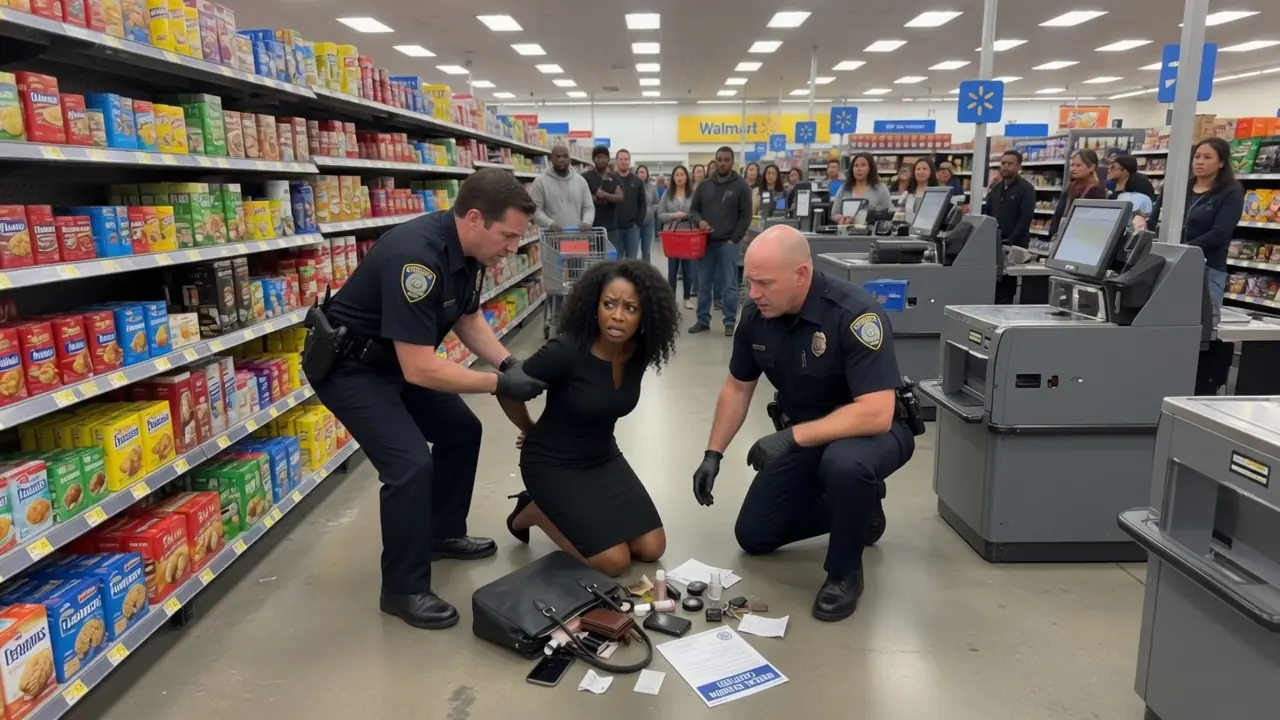
I was thirty-five years old. I taught third grade at Greenville Elementary. I had been named Teacher of the Year the spring before by the same city that now had a uniformed officer twisting my arm behind my back because I was a Black woman in a discount store with a tote bag. "Officer," I said, keeping my voice even because twenty-two children depended on me to practice what I taught, "I paid for everything." He slapped the receipt out of my hand.
It fluttered to the floor like it had done something shameful. "You people always have receipts after the fact," he said. A little girl near the checkout whispered, "Mommy, why is he talking to her like that?" Her mother pulled her close and said nothing. That silence hurt more than Hayes’s grip for one second.
Then the manager laughed. His name tag said Dennis. He had checked my bag three minutes earlier and found nothing stolen. Nothing hidden. Nothing suspicious. But now he stood behind Hayes with his arms folded, enjoying the show.
"Probably teaches those kids how to steal too," Dennis said. I looked at him. I wanted to say I had stayed after school that week helping one of my students learn long division because his father worked nights and his mother had three jobs. I wanted to say I spent my own money on pencils, tissues, snacks, notebooks, birthday cards, and winter coats.
I wanted to say I had taught half the children in District 7 to spell dignity before some adults in Greenville learned what it meant. But I knew men like Dennis did not want information. He wanted a performance. He wanted my humiliation to confirm what he already believed.
Hayes leaned closer. "Turn around." "Officer, I have not committed a crime." "Turn around." "I am complying under protest." His hand tightened. "Hands behind your back." I looked at the counter. I looked at the receipt on the floor.
I looked at the little girl watching me with wide blue eyes. I thought of my son, Jaden, eight years old, waiting at my mother’s apartment for glue sticks to finish a cardboard volcano. I thought of my husband’s coffee pot on my kitchen counter, the one I still used two years after cancer took him in six weeks and left me to figure out how to be widow, mother, teacher, and witness all at once. Then I turned around.
The first cuff clicked around my right wrist. Cold. Hard. Too tight. The second closed around my left wrist. Hayes pressed down until the metal bit. A small sound escaped my mouth.
Not a cry. Not exactly. A human sound. The manager’s smirk widened. Then Hayes grabbed my tote bag.
It was faded blue canvas. Three years old. The zipper had broken the month before, and the metal teeth no longer aligned. I had planned to replace it after rent, after Jaden’s shoes, after the electric bill, after everything else that always came first.
Hayes lifted it high. "Let’s see what you were hiding." He turned it upside down over the checkout counter. Everything fell. My wallet. Keys. Lesson plan folder. Jaden’s math homework.
A laptop charger. Permission slips. A pack of red grading pens. A peanut butter cracker wrapper I had meant to throw away. The glue sticks rolled against the register.
Then the small black voice recorder bounced once and landed face up. Its red light blinked steadily. On. Recording.
Hayes stared at it. The first change in his face was small. A tightening around the eyes. A flicker of calculation.
He had been loud before. Now he went quiet. More papers slid from the bag. A USB drive hit the counter with a tiny metallic click.
Dennis saw it. His smirk faltered. But what came next killed it completely. A manila envelope slid out of my bag and landed face up on the counter.
It was thick. Nine by twelve. Stamped with the seal of the United States District Court for the District of South Carolina. The black letters were clear enough for everyone in line to read.
Civil Rights Complaint. 42 U.S.C. Section 1983. Plaintiff Alicia J. Turner. Defendant Officer Bradley Hayes et al.
Case No. CV-2024-00856-HMM. Hayes read his own name once. Then again. The color drained from his face so quickly that even the little girl noticed. "Mommy," she whispered, "why did the policeman turn white?" Dennis stepped backward.
His hands lifted, palms out, as if the envelope itself might arrest him. "Oh, God," he whispered. The college kid holding the frozen pizza raised his phone. A woman near the candy rack had already been recording.
Another customer stepped closer, saw the recorder blinking, and said, "Is that thing on?" I turned my head slightly. "Yes." My voice did not shake. "It has been on since before Officer Hayes entered the store." The checkout area went dead silent. Not empty. Not peaceful. Full. The kind of silence that arrives when power suddenly realizes there are witnesses it did not choose.
Hayes’s hand hovered over the recorder. "Ma’am, I need to examine this device." "Do not touch my property," I said. His eyes snapped to mine. The old aggression tried to come back, but now it had to fight fear.
"This is part of an investigation." "No," I said. "It is evidence in a federal civil rights case where you are already a named defendant." The college kid muttered, "Oh, damn." I kept speaking clearly. "March 12, 2024." "Approximately 2:31 p.m." "SaveMart, Elm Street, Greenville, South Carolina." "Officer Bradley Hayes detained me without probable cause, searched my property, handcuffed me after I provided proof of purchase, and attempted to seize recording equipment after learning he was being recorded." Hayes swallowed. His throat moved hard.
Dennis looked like a man trying to disappear inside his own shirt. I lifted my wrists slightly. "Am I under arrest?" Hayes did not answer. "Am I free to go?" Five phones were recording now. Six. Seven.
The blinking red light sat on the counter like a second heartbeat. Hayes reached for the cuff key. The metal opened. My wrists burned when the cuffs came off.
Red marks circled the skin. I held them up for the cameras. Then I picked up my recorder first. The red light was still blinking.
I picked up the envelope next and tapped it once against the counter, straightening the edge. The sound was soft. It still felt like a gavel. Then I picked up my Teacher of the Year badge and clipped it to my shirt.
I gathered my receipt from the floor. Smoothed it. Folded it. Placed it in the envelope. When I walked toward the exit, Hayes did not block me. Dennis did not speak.
The little girl watched me pass. Her mother finally found her voice. "She did nothing wrong," she said softly. I looked at the child.
"No," I said. "I didn’t." Then I walked out of SaveMart with my head high, my wrists burning, and the whole store staring at the scattered remains of a mistake powerful men had made in public. Eight hours earlier, I had woken before sunrise to the sound of my son dropping a pencil in the kitchen. Jaden never walked quietly when he was anxious.
He stomped, shuffled, tapped, opened drawers, closed drawers, and made every movement sound like a question he did not know how to ask. I opened my eyes and saw the ceiling crack above my bed, thin and crooked, running from the corner toward the light fixture. It had been there since we moved into the District 7 apartment two years before. Rent was $985 a month.
The landlord promised to repair it every spring. Every spring became next fall. Every fall became after the holidays. I used to argue harder.
Then my husband got sick. Then bills arrived in white envelopes with red warnings. Then I learned there are only so many battles a person can fight at once without becoming nothing but bruises. I rolled out of bed at 5:45 a.m. The apartment was still dark.
The air smelled faintly of old coffee and lemon dish soap. In the kitchen, Jaden sat at the table in his dinosaur pajamas, forehead pressed to his math worksheet. "Mom," he said without looking up, "I forgot to finish number eight." I kissed the top of his head. "Good morning to you too." He sighed dramatically.
"I’m serious." "So am I." I poured coffee into the mug my husband Marcus had used every morning until his hands shook too badly to hold it. The mug said World’s Okayest Dad because Jaden had picked it out when he was five. Marcus had laughed for ten minutes. Two years after his funeral, I still reached for that mug when I needed courage.
Grief had changed over time. At first, it had been a storm. Then a weight. Then a room I walked into unexpectedly when something small happened.
The smell of his soap. A basketball game on television. Jaden laughing exactly like him. Now grief was mostly a quiet companion sitting beside the rent bill, the lesson plans, and the grocery list.
I scrambled eggs while Jaden explained the math problem badly. I set the plate down and sat beside him. "Show me where you got lost." He pointed to the second line. "You skipped the regrouping." "I didn’t skip." "You teleported." He laughed.
There it was. Marcus’s laugh. Bright. Unprotected. I helped Jaden correct three answers. Then I packed his lunch, signed his reading log, found one clean sock under the couch, and reminded him that cardboard volcanoes did not build themselves. "I need glue sticks," he said.
"I know." "And red paint." "We have red paint." "It’s almost empty." "It is emotionally full." "Mom." "I’ll stop after school." He hugged me hard before we left. At 7:30 a.m., I stood in Room 8 at Greenville Elementary and wrote three words on the whiteboard. Civil Rights. Dignity. Documentation. Twenty-two third graders copied them in notebooks, on loose paper, and in one case on the back of a lunch menu because Devon had lost his social studies folder again. My students were eight and nine.
Old enough to know when adults lied. Young enough to still hope adults would stop. That week, we were studying the civil rights movement. Not the soft version with smiling portraits and easy slogans.
The real version. The version where people were arrested, threatened, fired, watched, mocked, beaten down by systems that used polite paperwork to defend cruel habits. I showed them a slide of Rosa Parks. Then one of Ruby Bridges.
Then one of John Lewis. Then a slide titled: What To Do If Your Rights Are Violated. I did not write that lesson because I wanted children afraid of the world. I wrote it because some of my students already were.
Many had watched parents pulled over. Searched. Questioned. Handcuffed. Some had seen police at their apartment buildings more often than librarians. Some believed officers were helpers. Some believed officers were danger.
Most believed both depending on the day. A boy named Malik raised his hand. "Miss Turner, have police ever stopped you?" The classroom grew quiet. Children can sense when a question finds a scar.
I could have lied. I could have protected the lesson from reality. Instead, I thought of February 10. 7:15 p.m. Driving home from parent conferences.
Blue lights behind me. Officer Bradley Hayes at my window. No reason given. Forty-three minutes on the shoulder while cars slowed and neighbors watched. No ticket. No warning. Just questions.
Where are you coming from? Whose car is this? Why are you nervous? What are you doing in this area?
I thought of filing the complaint two days later. Two pages. Typed. Facts. Timeline. Badge number. Delivered in person to Greenville Police internal affairs. I thought of the response dated March 1. Complaint reviewed. Officer acted within policy. Case closed. Six words.
No phone call. No interview. No witness request. No justice. "Yes," I told Malik. "A police officer has stopped me." His eyes widened.
"What did you do?" "I stayed calm." "I asked questions." "I wrote everything down afterward." "Did they get in trouble?" "No." The classroom went quieter. That was not the answer they wanted. It was the answer they needed. "That is why documentation matters," I said.
"If something wrong happens and nobody writes it down, records it, or tells the truth, people with power can pretend it never happened." On slide twelve, the students copied my bullet points. Stay calm. Do not resist. Record if possible. Ask for badge number.
Remember, you have rights even when someone in power acts like you do not. I did not know that one week later, those words would be quoted across the country. I did not know teachers in other states would download the slides. I did not know parents would argue at school board meetings about whether children should be taught how to survive encounters with authority.
I only knew my students were writing carefully. Justice. Dignity. Documentation. At lunch, Principal Dorothy Graham stopped by my room. She was usually composed in a floral-blazer kind of way, but that day she looked tired. "You doing okay, Alicia?" "Yes." She glanced toward my tote bag on the chair.
The manila envelope stuck out slightly. She knew about the federal complaint because I had told her I might need time off for legal meetings. "Any updates?" "Rachel filed it last week." Rachel Foster was the ACLU attorney who had listened when internal affairs did not. She had taken my February stop and built it into thirty-two pages of legal language I had read three times and still found frightening.
42 U.S.C. Section 1983. Violation of civil rights under color of law. Plaintiff Alicia J. Turner. Defendant Officer Bradley Hayes and Greenville Police Department.
When Rachel first told me to carry a copy, I thought it sounded dramatic. Then she said, "If he targets you again, you need proof of the pending complaint." "If he knows about it and retaliates, that matters." So I carried it. Not waving it around. Not as a threat. As armor.
I carried the Sony voice recorder too. Model ICD-PX470. Sixty dollars on Amazon. Small enough for my palm. Rachel suggested it.
South Carolina allowed recording conversations when one party consented. I was the party. I consented. The red light blinked whenever I left home now. A tiny witness I could afford.
After school, I stayed late helping Malik fix the introduction to his civil rights paragraph. Then I graded math quizzes, answered two parent emails, cleaned pencil shavings from the floor, stacked tomorrow’s worksheets, and remembered Jaden’s glue sticks at 2:05. SaveMart was closest. Elm Street. Fifteen minutes in and out.
I checked the recorder before entering. Red light blinking. Good. SaveMart smelled like floor cleaner, soft bananas, and tired air conditioning. The fluorescent lights made everyone look a little sick.
I went straight to aisle seven. School supplies. Bottom shelf. Elmer’s glue sticks. $4.99 for a three-pack. I grabbed two.
While crouched near the shelf, I felt someone watching. When I stood, the manager was at the end of the aisle. Dennis. Crooked name tag. Thinning hair. Store-issued polo stretched across his stomach.
He smiled without warmth. "Ma’am." "Yes?" "I need to check your bag." I looked at him. The old calculation began. Rights versus risk.
Dignity versus survival. A lawyer might say I could refuse. A mother thinks about getting home. "Is there a reason?" "Store policy." I had shopped there twice a week for three years.
No one had ever checked my bag. Still, I walked to the front and opened the tote. Wallet. Keys. Lesson plans. Teacher badge. Manila envelope. Recorder still blinking. He looked inside. Saw nothing.
For a moment, uncertainty crossed his face. Then the entrance bell chimed. Officer Hayes walked in. I recognized him instantly.
My body did too. Heart rate up. Shoulders tight. Hands suddenly cold. Hayes walked with purpose, one hand near his belt.
He did not look surprised to see me. That mattered later. He had been nearby. Maybe waiting. Maybe called by Dennis. Maybe worse.
"Ma’am," Hayes said. "Step over here." I looked directly at his body camera. "Officer Hayes." I said his name clearly. For the recorder. For memory.
For the record. His jaw flexed. "The bag." Dennis exhaled with relief, like now the problem belonged to someone else. I held the bag open.
"I have paid for nothing yet except items already in my possession from earlier." "The glue sticks are on the counter." "I have not left the store." Hayes did not care. He grabbed the tote. I held on instinctively because it had my life inside it. He yanked harder.
The strap tore. "Turn around." That was how the checkout counter became a courtroom without a judge. That was how my lesson plan became reality. That was how evidence fell out.
By 4:12 p.m., Brenda Ellis had uploaded the video to Facebook from her car in the SaveMart parking lot. Brenda was sixty-two, retired from the county library system, and angry enough to learn social media in real time. Her caption read: Watch this police officer’s face when he realizes the Black woman he handcuffed already has a federal lawsuit with his name on it. SaveMart on Elm Street.
I saw everything. By 4:45, the video had two thousand shares. By 5:30, local news had it. By 6:18, the clip was everywhere.
The moment the envelope slid out. Hayes reading his own name. Dennis going pale. The blinking recorder.
My wrists in cuffs. My Teacher of the Year badge on the counter. People online called it dramatic. Satisfying. Perfect timing. They did not see me sitting on my couch that night with ice on my wrists and my son asleep in the next room, trying not to shake.
They did not hear the voicemail from an unknown number at 8:11 p.m. You should have kept your mouth shut. They did not see the email that arrived seventeen minutes later. Bad things happen to people who do not know their place. They did not see the next one with my home address in the subject line.
Or the one that mentioned Jaden’s bus stop. Viral justice looks clean from the outside. Inside, it smells like fear. At 9:00 p.m., my phone rang. Unknown number.
I almost did not answer. Then I thought of my recorder. Evidence requires answering sometimes. "This is Alicia Turner." "Miss Turner, my name is Sarah Bennett." "I’m an investigative reporter with Greenville Truth." "I’ve covered Officer Hayes for three years." "I saw the video." I said nothing. She continued.
"That recorder and that complaint are what we’ve been missing." "Missing for what?" "A pattern." Her voice softened. "You are not the first woman he has done this to." I closed my eyes. Part of me already knew. Knowing still hurt.
"How many?" "I don’t know yet." "More than one." A pause. "Probably more than ten." I looked toward Jaden’s bedroom door. The hallway night-light glowed blue. "What do you need from me?" "Your permission to tell the story correctly." "I don’t want to be famous." "I’m not asking you to be famous." "I’m asking you to be believed in public." That sentence broke something open.
I had filed a complaint and been dismissed. I had taught rights while wondering if they would protect me. I had carried evidence because Rachel said proof mattered. Now the proof had fallen out in front of everyone.
Maybe the story had to go where the evidence led. "Yes," I said. "We can talk." The first article ran at 6:00 the next morning. Sarah wrote like a person building a case, not chasing a headline.
She embedded Brenda’s video. She obtained SaveMart security footage. She pulled Hayes’s body camera through an urgent public records request. The body camera confirmed what I remembered.
Hayes never stated probable cause. Never identified a crime. Never explained why I was detained. Never documented the reason after letting me go.
He reached toward my recorder after seeing it. He read the federal complaint. He uncuffed me only after realizing everything was being recorded. Sarah’s headline read: Federal Lawsuit Falls From Teacher’s Bag During Store Detention.
Body Camera Raises Questions About Officer Retaliation. By noon, the article had fifty thousand reads. By evening, national outlets had picked it up. A legal analyst on CNN called it "textbook retaliation." I was sitting beside Jaden while he ate cereal when my own face appeared on television.
He stared at the screen. "Mom, are you famous?" "No, baby." "Just someone who wrote things down." He watched Hayes’s face go pale on the screen. "Is that why he looks scared?" "Because you wrote things down?" "Yes," I said. "That is exactly why." Two days later, Sarah called again.
"The USB drive that fell out of your bag." "What is on it?" "Lesson plans." "Mostly." "Can I see them?" I hesitated. Teachers are private about lesson plans in strange ways. They are labor. Heart. Late nights. Unpaid hours. But I sent them.
The file that went viral was titled Know Your Rights. Forty-three slides. Rosa Parks. Ruby Bridges. John Lewis. The Fourth Amendment. How to stay calm. How to document encounters.
How to ask for a badge number. How to report misconduct. Slide twelve became the one everyone shared. Compliance keeps you safe.
Documentation keeps you protected. Teachers across South Carolina downloaded it. Parents debated it. Some accused me of making children fear police.
Others wrote that their children already feared police and finally had language for it. My students started a petition before I knew anything about it. Not a polished adult petition. A student one.
Names written in crayon. Marker. Pencil. Miss Turner taught us our rights. Bring her back. That was because the district placed me on administrative leave.
Paid leave, they emphasized. Standard protocol, they said. Pending legal matters, they said. Safe learning environment, they said.
They never said punishment. They never had to. The email came from Principal Graham with careful wording and no warmth. I was not allowed on school grounds.
Not allowed to contact students. Not allowed to attend meetings. I read it three times at the kitchen table. Jaden asked, "Does that mean you are in trouble?" "No." "Then why can’t you teach?" Because institutions fear controversy more than injustice.
Because the school district liked my awards better than my lawsuit. Because they wanted a Black teacher’s resilience at ceremonies, not her evidence on CNN. "I don’t know yet," I said. That was not enough for him.
It was all I had. The threatening messages continued. Some racist. Some vague. Some specific enough that Rachel told me to file police reports even though we both knew who employed Hayes. A car I did not recognize idled near our apartment two nights in a row.
My sister Maya told me to come to Atlanta. "Bring Jaden," she said. "Start over." I looked at job postings at 2:00 a.m. Atlanta. Columbia. Charlotte. Anywhere not Greenville.
Then Jaden woke and found me crying on the couch. "Mom?" I wiped my face. "Just tired." He climbed beside me, small and warm and too young to carry this. "Are we in trouble?" "No." "Then why did that officer put you in handcuffs?" I stared at the dark television screen.
Because he thought nobody would stop him. Because the city let him practice on people until he reached someone with a recorder. Because being innocent is sometimes not enough. "Sometimes people with power use it wrong," I said carefully.
"And sometimes people without much power have to fight back." He leaned against me. "Are you fighting back?" "Yes." "Good." He yawned. "Dad would want you to." That nearly undid me. Marcus had fought cancer until his body could not carry the fight anymore.
He had never confused losing with quitting. At 4:00 a.m., after I carried Jaden back to bed, I texted Sarah. I’ll be at the meeting. What time?
The meeting was at a coffee shop on Main Street. Six women sat around the corner table. All Black. All tired in different ways. Kesha Williams had been stopped by Hayes at SaveMart in 2021 while buying diapers.
He accused her of hiding formula under her coat. She had not stolen anything. She was handcuffed, humiliated, released, then offered $18,000 by the city if she signed paperwork promising never to speak. "My daughter needed medicine," she said.
"I took it." Tamara Johnson worked at Greenville General Hospital. Hayes stopped her outside Quick Gas after a night shift and said she matched the description of someone using stolen cards. No description existed. He searched her car while she stood in scrubs under bright parking lot lights.
The city paid her $22,000. Nicole. Jasmine. Renee. Diamond. Different years. Same officer. Same pattern. Suspicion first. Proof never. Humiliation always. Then money to make the record disappear. "Why now?" I asked them. Kesha answered. "Because we saw your video." "We saw his face when the envelope fell out." "We saw him realize he got caught." She looked around the table.
"We could not do it alone." "Maybe we can do it together." Sarah recorded with permission. Rachel took notes. I mostly listened. There is a special kind of grief in realizing your pain is not unique.
It means you were not crazy. It also means the harm was bigger than you feared. That evening, Sarah received a flash drive from a former city attorney’s office employee named Monica. Monica had processed settlement paperwork.
She had quit because, in her words, "I got tired of watching the city buy silence from people it refused to protect." The spreadsheet changed everything. Seven years. Police misconduct settlements. Many never publicly filed. Most from District 7.
Hayes’s name repeated again and again. Formal complaints. Pre-complaint settlements. Nondisclosure agreements. Cash amounts. Notes. Recanted after union contact. Settlement same day as hospital visit. Complainant advised not to pursue due to career concerns.
Total paid to make Hayes’s cases disappear: $394,000. Total police misconduct payouts citywide: $2.1 million. Publicly acknowledged: Almost none. Then came the quota email.
Deputy Chief Alan Wilson to patrol supervisors. Subject: Q1 Performance Goals. District 7 stops declined 11% in Q4. City council expects visible presence ahead of budget review.
Target increase stops 15% in Q1. Prioritize high-traffic locations: SaveMart Elm Street. Quick Gas. Martin Luther King Boulevard Laundromat. Washington Avenue corridor.
Reminder: Federal community policing grant renewal requires demonstrable engagement metrics. Let’s show results. SaveMart. Named. District 7. Targeted. Stops down. Increase them. Demonstrable engagement. A clean phrase for putting bodies into reports. Sarah’s next article was devastating. The Spreadsheet.
How Greenville Paid $2.1 Million to Hide Police Misconduct and Why Alicia Turner Almost Became Number 41. By morning, the Department of Justice announced it was reviewing the evidence. The FBI field office in Columbia confirmed preliminary contact with civil rights attorneys. Greenville PD issued no comment.
No comment can be louder than denial when the documents speak. The city council emergency meeting took place March 21 at 7:00 p.m. Fire marshals capped the chamber at 250 people. Another hundred stood outside watching on screens. The room was hot, crowded, tense, and full of cameras.
Hayes came in uniform. He sat near the back with his union representative, jaw locked, eyes forward. I wondered whether he wore the uniform as confidence or armor. I sat in the front row with Rachel, Sarah, and the six women from the coffee shop.
When my name was called, I walked to the microphone. My hands did not shake. That surprised me. "My name is Alicia Turner." "I teach third grade at Greenville Elementary." "On March 12, Officer Bradley Hayes handcuffed me inside SaveMart for shopping while Black." A murmur moved through the room.
"I know that sentence makes some people uncomfortable." "It should." "Because the evidence supports it." "No stolen item was found." "No probable cause was stated." "No charge was filed." "Body camera footage shows no lawful basis for detention." "My recorder captured the encounter." "Multiple witnesses recorded the scene." "And when my federal complaint fell out of my bag, Officer Hayes’s behavior changed immediately." I looked toward him. He would not meet my eyes. "I teach my students that dignity matters." "I teach them that rights must be documented when powerful people deny them." "On March 12, I became my own lesson plan." A few people clapped softly. I continued. "This is not only about me." "This city has paid hundreds of thousands of dollars to silence people harmed by the same officer." "This city has targeted District 7 with stop metrics tied to budget pressure." "This city treated complaints as public relations problems instead of warnings." "And this city placed me on leave from teaching children because I embarrassed the wrong people by telling the truth." Councilwoman Rita Jackson leaned forward.
She had been quiet until then. "Miss Turner," she said, "thank you." Then she turned to Police Chief Morrison. "Chief, I need to put something on the record." He shifted in his chair. "My daughter was stopped by Officer Hayes in our own driveway last November." The room went silent.
"She was seventeen." "Honor student." "Track athlete." "She was driving a car registered to me." "He asked if it was stolen." "He held her for nineteen minutes." "No ticket." "No warning." "She did not tell me for weeks because she was afraid I would believe her and still not be able to do anything." Councilwoman Jackson’s voice shook. "How many daughters, Chief?" "How many mothers?" "How many people had to be humiliated before this city stopped calling it policy?" Chief Morrison had no answer. The six women testified one by one. Kesha’s voice broke.
Tamara’s did not. Nicole held up her settlement agreement and tore the signature page in half at the microphone. The crowd erupted. The mayor gaveled for order.
The union representative tried to read a statement about Officer Hayes’s distinguished service. People booed. He read anyway. When he finished, I asked to respond. The mayor allowed it.
"Proper channels failed," I said. "I filed an internal complaint." "It was dismissed." "I filed a federal lawsuit." "I was targeted again." "I documented everything." "I was handcuffed." "My bag spilled." "My evidence became public by accident." "The only reason we are here tonight is because the truth fell out where everyone could see it." I looked at the council. "How many people did not have a recorder?" "How many did not have a federal complaint?" "How many took settlement money because rent was due and fighting was too expensive?" "How many bags never spilled?" That question stayed in the air. Then the vote came.
Six to one. Independent investigation. Civilian oversight board. Public reporting of stops, searches, arrests, complaints, and outcomes by demographics. Mandatory body camera review.
Audit of all Hayes complaints. Immediate suspension of Officer Bradley Hayes pending investigation. Outside city hall, reporters asked how it felt to win. I almost laughed.
Winning? Hayes still had supporters. Threats still came. The DOJ investigation had just begun.
My wrists still hurt. My son still asked if police were going to come to our apartment. Six women had spent years carrying shame the city bought cheaply. I looked into the cameras.
"This is not winning." "This is accountability starting." "Winning is when Black women can shop without fear." "Winning is when complaints are investigated before videos go viral." "Winning is when children learn rights as history, not survival." The next morning, Principal Graham called. "The board voted." "You are reinstated effective immediately." "Can you come back Monday?" I closed my eyes. Room 8. The whiteboard. Twenty-two students. Jaden’s crayon sign folded on my desk. "Yes," I said.
"I’ll be there." On Monday, the children cheered when I walked in. Not polite applause. Full chaos. Little arms around my waist. Questions shouted over questions.
Someone had made a crooked banner. Welcome Back Miss Turner. My Teacher of the Year badge sat on my desk beside the recorder. The red light was off.
Ready if needed. I wrote on the board: Documentation. Then under it: Why Writing Things Down Matters. A student named Aaliyah raised her hand.
"Miss Turner, were you scared?" "Yes," I said. "Very." "Then how were you brave?" I thought about Marcus. Jaden. The women at the coffee shop. Sarah’s notes. Rachel’s legal pads. Brenda’s video.
The envelope falling. Hayes turning pale. The whole city finally seeing what District 7 had known for years. "Scared and brave are not opposites," I said.
"Usually, they show up together." "Brave is just scared with a reason to keep going." Malik raised his hand. "And documentation?" I smiled. "Documentation is how brave leaves a record." The federal investigation took months. Real justice moves slowly enough to test everybody’s faith.
Hayes was eventually terminated. Then indicted on charges tied to civil rights violations, retaliation, unlawful detention, and falsified reporting. Deputy Chief Wilson resigned before his disciplinary hearing. Chief Morrison retired under pressure.
The city settled with the six women and reopened prior Hayes complaints. The nondisclosure agreements were voided. The settlement database became public. Greenville adopted a civilian review board with subpoena power.
Stop quotas were banned. Body camera violations triggered automatic review. The Department of Justice placed the Greenville Police Department under a reform agreement with outside monitoring. None of it fixed everything.
No policy rewrites memory. No settlement restores dignity exactly as it was before humiliation. No firing erases a child watching his mother flinch when a patrol car rolls by. But change came.
Not because Greenville suddenly became noble. Because evidence made denial too expensive. One evening in late summer, Jaden and I walked into SaveMart again. He needed poster board.
I needed to prove something to myself. The store looked the same. Same fluorescent lights. Same floor cleaner smell.
Same checkout counter. Dennis no longer worked there. The new manager, a woman named Carla, greeted me carefully. Not with pity.
Not with fear. With respect. I appreciated that. At checkout, Jaden looked at the counter where my bag had spilled months earlier. "Was it right here?" "Yes." He placed the poster board down.
"Where the envelope fell?" "Yes." He thought about that. "Did it fall on purpose?" I smiled. "No." "But it helped on purpose." "That is a good way to put it." He picked up the receipt after we paid. "Keep this," he said.
"For documentation." I laughed. A real laugh. The first one I had felt fully in months. "Yes, sir." "I will." Officer Hayes had seen my skin and assumed guilt.
Dennis had seen my tote bag and assumed theft. The city had seen complaints and assumed silence would be cheaper than change. They were wrong. They did not know I had already filed in federal court.
They did not know the recorder was blinking. They did not know my students had copied words like dignity and rights into notebooks that same week. They did not know six other women were waiting for one visible crack in the wall. They did not know a retired librarian was filming.
They did not know a reporter was ready. They did not know paperwork could become power when carried by a woman who had finally run out of reasons to stay quiet. They handcuffed me in a store. They dumped my bag.
They expected shame to fall out. Instead, out came the recorder. The Teacher of the Year badge. The lesson plans.
The federal complaint with Officer Bradley Hayes’s name printed on the first page. That was why his face turned pale. Not because I had become powerful in that moment. Because he realized I had been documenting his power all along.
And documentation, once it hits the light, does not go quietly back into the bag.