My son was the reason I came home early.
That is the sentence I still have trouble saying out loud, because for a long time I hated the shape of it. Not because Eli did anything wrong. He was thirteen, nervous about a school presentation, and carrying a cardboard model of our family garage like it was a museum artifact instead of a seventh-grade project. He had forgotten one small thing, and I turned the truck around.
That was all.
One forgotten folder.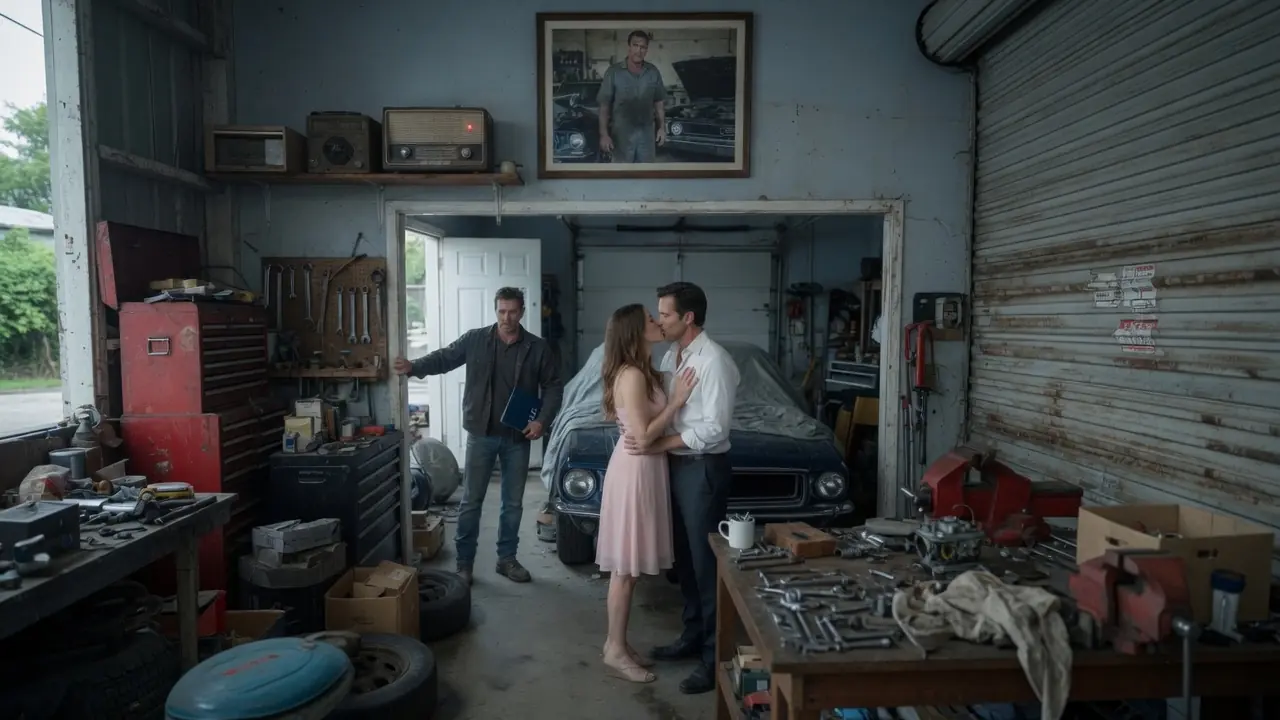
One five-minute detour.
One ordinary mistake that opened the door to a truth my wife had been hiding in the same garage where my father taught me how to change oil.
My name is Daniel Hayes, and before that Thursday morning, I thought I understood the life I had built. I lived in a quiet neighborhood called Briar Glen, just outside the fictional city of Millstone, Kentucky. I owned Hayes Classic Auto, a small restoration shop known mostly by word of mouth, old men with checkbooks, and younger men who wanted their fathers’ cars brought back to life.
My wife’s name was Megan.
My best friend’s name was Cole Barrett.
For twenty-two years, I believed one of those names meant home and the other meant brother.
By 8:14 that morning, I knew both beliefs had been built on rotten wood.
Eli and I were halfway to Hawthorne Ridge Middle School when he made a sound from the passenger seat that every parent knows. Not words. Not a sentence. Just a small inhale of panic that means something has gone wrong inside a child’s head before he has decided how to tell you.
I looked over.
He was staring at the cardboard model on his lap, face gone pale under his freckles.
“Dad,” he said.
“What?”
“I forgot the folder.”
I glanced at the clock on the dashboard.
His presentation started at nine. We had time, barely, if traffic stayed kind and the school drop-off line did not turn into its usual slow funeral of minivans and brake lights. I should have been annoyed, but I saw his fingers tightening around the cardboard garage and swallowed it.
“What folder?”
“The one with the pictures,” he said. “The interview questions. The printed stuff about Grandpa.”
Eli had spent three weeks working on a project called “A Place That Built My Family.” Most kids chose churches, diners, farms, or old houses. Eli chose our garage. Not the commercial shop on Mercer Road, but the detached three-car garage behind our home, where my father’s 1968 midnight-blue Mustang sat under a gray cover while I pretended I would restore it someday.
That garage was where my father taught me patience.
Where he made me sand until my hands ached.
Where he told me a machine tells the truth if you listen carefully enough.
After he died, I could barely walk inside for six months. Then Eli chose it for a school project, and somehow that little cardboard model helped me see the place as more than a room full of grief.
So when he said he had forgotten the folder, I turned the truck around.
“It’s okay,” I said. “We’ll get it.”
Eli nodded too quickly.
“Thanks.”
I remember that.
Too quickly.
At the time, I thought he was just anxious about the presentation. Later, I would understand that my son’s fear had nothing to do with missing a grade. He was carrying something much heavier than a cardboard garage on his lap.
The morning was gray and damp, the kind of early spring weather that makes every lawn look tired. Briar Glen was still waking up. A mail truck idled near the corner. Mrs. Hanley from two houses down was dragging her trash bin back from the curb in slippers and a pink robe. Somewhere, a dog barked like the day had personally insulted him.
I pulled into our driveway at 8:27.
Megan’s white SUV was there.
That did not surprise me. She worked from home on Thursdays, managing accounts for a medical supply company out of a spare bedroom she had turned into a perfect little office. A blue lamp, white shelves, fresh flowers, matching notebooks, and a chair she claimed helped her posture but mostly looked expensive.
The thing that surprised me was Cole’s truck.
Not in the driveway.
Not at the curb.
Tucked behind the garage, half-hidden by the old redbud tree.
Cole drove a black Ram with a dent above the left rear wheel, a dent I knew because I had been with him the night he backed into a hunting trailer outside Harper’s Lake Bar and spent twenty minutes insisting the trailer had “come out of nowhere.”
I slowed the truck without meaning to.
Eli looked straight ahead.
“Dad?”
I stared at Cole’s truck.
“He’s probably helping Mom with something,” Eli said.
The sentence came too fast.
Too prepared.
I looked at him, but he would not look back.
Something moved in my stomach then. Not suspicion yet. Suspicion is too clean a word. This was older, more animal, the quiet warning a man feels before his mind has enough facts to defend it.
“Stay in the truck,” I said.
Eli’s eyes widened.
“But the folder—”
“I’ll get it.”
He swallowed.
“Okay.”
I stepped out and closed the door softly.
That was the first strange thing I did.
Softly.
A man coming home to get a school folder has no reason to close his truck door softly. A man who has already begun listening does.
The house was quiet from the outside. The curtains in Megan’s office were half open. No light on. No movement. The front door was locked, but I still had my keys. I could have gone in through the house and grabbed Eli’s folder from the kitchen table, where it should have been.
Instead, I walked toward the garage.
I do not know why.
Maybe it was Cole’s truck.
Maybe it was the fact that the side door of the garage was not fully latched.
Maybe it was the low sound of music coming from inside, something slow and warm that did not belong to a Thursday morning.
The garage smelled like dust, motor oil, old rubber, and my father’s Mustang.
The smell hit me before the sight did.
I opened the door quietly.
For half a second, the world made no sense.
Cole stood near the Mustang, his back partly turned to me, one hand against the covered hood, the other at Megan’s waist. Megan was pressed close to him, wearing the blue blouse I liked, the one she said made her feel professional on video calls. Her hair was down, and his face was buried near her neck like he belonged there.
They were not talking.
They were not fixing anything.
They were intimate in my garage, beside my father’s car, beneath the framed photograph of Dad holding me at sixteen after we rebuilt my first engine.
The old radio on the shelf played a song from the seventies.
I remember that detail because betrayal is cruelly specific.
Your mind records stupid things while your life catches fire.
Cole saw me first.
His whole body locked.
Megan turned because he stopped moving, and when she saw me, her hands flew to her blouse.
“Daniel.”
My name came out like a dropped glass.
I stood in the doorway.
I did not yell.
That is another part people never understand. They think betrayal turns you into a storm right away. Sometimes it makes you very still because your mind refuses to accept the size of what it is seeing.
Cole stepped back from her.
“Danny,” he said.
Nobody called me Danny except people who had earned the right before age twenty.
In that moment, hearing it from him felt like someone putting muddy boots on my father’s kitchen table.
“Don’t,” I said.
Just one word.
He stopped.
Megan buttoned her blouse with shaking hands.
“It’s not what you think.”
I looked at her.
Then at him.
Then at the gray cover wrinkled across the Mustang’s hood.
“It is exactly what I think.”
She started crying instantly.
That should have hurt me.
It did not.
Not at first.
Because those tears were too fast, and fast tears often come from fear of consequences, not sorrow over harm.
Cole lifted both hands.
“Listen, man, this got out of control.”
I almost laughed.
Out of control.
As if they had been standing in the garage, discussing weather, and accidentally fell into betrayal.
“How long?” I asked.
Neither answered.
That answered enough.
I took out my phone and started recording.
Megan’s face changed.
“Daniel, don’t.”
“Why? You suddenly care what gets documented?”
Cole’s expression hardened.
“Put the phone down.”
I turned the camera toward him.
“You want to say that again?”
He looked at the phone, then at me, and for the first time since I had known him, I saw calculation replace confidence.
Cole was not a stupid man. He was handsome, charming, and dangerous in the way men become when they learn that apologies work better when delivered with a crooked smile. He had been my best friend since junior year at Millstone Central High, when we got suspended together for racing shopping carts behind a grocery store. He stood beside me when I married Megan. He held Eli at the hospital when my hands were shaking too hard after the birth.
He ate Thanksgiving at my table.
He called my mother “Mama Hayes.”
He knew where the spare key was.
And now he was standing half-buttoned in my garage telling me to stop recording.
Megan stepped forward.
“Daniel, please. Eli is outside.”
That was the first time my body moved.
Not toward her.
Toward the door.
I stepped outside, closed the garage door behind me, and walked to the truck. Eli sat rigid in the passenger seat, both hands on the cardboard model. His face told me he knew enough, maybe not exactly what I had seen, but enough that childhood had already shifted under him.
“Dad?” he asked.
I opened the driver’s door and leaned in.
“I need you to listen carefully. I’m going to call Aunt Rebecca, and she’s going to take you to school. You are safe. You did nothing wrong. Do you hear me?”
His lips trembled.
“Did Mom do something?”
I wanted to lie.
A father’s first instinct is often to protect a child from truth, even when the truth is already sitting beside him.
“Yes,” I said quietly. “But that is between adults. Not you.”
He looked at the garage.
“Is Uncle Cole in there?”
Uncle Cole.
The words hurt worse than seeing them.
“Yes.”
Eli looked down at the cardboard model.
“I’m sorry.”
That broke something in me.
I put my hand on the back of his head gently.
“No. You do not apologize for adults who failed you.”
My sister Rebecca answered on the second ring. I told her only what she needed to know: emergency, come get Eli, school project, no questions until later. She heard my voice and did not ask for details. That is how you know who your people are.
While we waited, I stood between the truck and the garage.
Megan opened the side door once.
I looked at her.
“Go back inside.”
She did.
Cole stayed out of sight.
That was wise.
Rebecca arrived nine minutes later in a navy minivan with one missing hubcap and the speed of a woman prepared to commit crimes for family. She hugged Eli, took the model, took the folder I had not yet retrieved but now found lying beside the garage workbench, and looked at my face.
“Do I need to call someone?” she asked.
“I already am.”
“Lawyer?”
“Yes.”
“Police?”
“Not unless he refuses to leave.”
She looked toward the garage.
“Cole?”
I nodded.
Her mouth tightened.
Rebecca had never liked Cole as much as I did. She once told me charm is just debt with good lighting. I told her she was being dramatic. Sisters have a terrible habit of being right too early.
After she drove away with Eli, I went back into the garage.
Megan was sitting on an old wooden stool, crying into both hands.
Cole stood near the tool chest, fully dressed now, arms crossed, face set in that familiar expression he used when he wanted a room to believe he was the reasonable one.
“Let’s not blow this up,” he said.
I looked at him.
“You were intimate with my wife in my garage.”
He exhaled.
“I know how it looks.”
“You always were gifted with language.”
His jaw tightened.
Megan whispered, “Daniel.”
I ignored her.
“You need to leave.”
Cole glanced at her, then back at me.
“Not until we talk.”
I stepped toward him slowly.
That was enough.
He stepped back.
I had never been a violent man, but I had spent twenty years lifting engines, hauling transmissions, and working with tools that punish careless hands. Cole was gym-lean and country-club confident. I was not afraid of him.
“You will leave now,” I said. “Or I will call the police and have you removed from my property.”
His face changed again.
“There is no need for that.”
“There was no need for this either.”
Megan sobbed harder.
Cole grabbed his jacket from the stool and walked toward the side door. As he passed me, he lowered his voice.
“This marriage was already dead, Danny.”
I looked at him.
“Then why did you have to sneak?”
He had no answer.
He left through the side door, crossed the yard, climbed into his truck, and drove away without looking back. I stood there until the sound of his engine disappeared down Briarwood Drive.
Then I turned to my wife.
She looked smaller than she had fifteen minutes earlier.
But smaller does not mean innocent.
“How long?” I asked again.
She wiped her face.
“Daniel, I never meant for you to find out like this.”
That sentence was a confession wearing perfume.
“How long?”
She swallowed.
“Six months.”
The garage tilted slightly.
Six months.
Six months of family dinners. Six months of Cole asking me how the shop was doing while touching his beer bottle at my kitchen island. Six months of Megan kissing me goodbye while carrying him inside her phone, her mind, her body, her day.
“Six months with my best friend.”
She flinched.
“It wasn’t supposed to happen.”
“Then when did it become scheduled?”
Her eyes closed.
“I don’t know.”
“You know.”
She shook her head.
“It started after your dad died.”
That made me go still.
My father had been dead eight months.
Grief had barely finished setting up furniture inside me.
“What?”
“You shut down,” she said. “You lived in this garage. You barely talked. I felt alone.”
I looked around the garage.
At the Mustang.
At Dad’s photograph.
At the workbench where his old coffee mug still sat full of bolts.
“You felt alone,” I repeated.
“Yes.”
“And Cole made you feel seen.”
She nodded before realizing the answer would hurt.
I laughed once.
Not because it was funny.
Because the words were so predictable they sounded borrowed from every ruined marriage that had ever needed a script.
“You could have told me.”
“I tried.”
“No,” I said. “You complained. You sighed. You said I was distant while I was grieving my father. You did not say, ‘Daniel, I am so lonely I am about to sleep with your best friend in the garage where your father’s car sits.’”
Her face crumpled.
“I know.”
“Do you?”
She looked at me like she wanted me to rescue her from the sentence.
I had done that for years.
Not today.
“I want you out of the house,” I said.
Her eyes widened.
“Daniel, please.”
“Pack a bag. Go to your mother’s. Go to a hotel. Go to Cole, if that’s still the plan. I don’t care. But you are not sleeping here tonight.”
“You can’t just throw me out.”
“I can ask you to leave before I file, and you can decide whether you want Eli to come home to a screaming match.”
That landed.
Her love for Eli had always been real, even when everything else became unrecognizable. She stood slowly, wrapped her arms around herself, and walked toward the house without another word.
I stayed in the garage.
For the first time in my life, I hated that room.
The Mustang sat under the cover like a witness.
My father’s photo smiled from the wall.
I wanted to rip it down because I could not bear the thought of him seeing this. Then I realized I was the one who needed to see it. Not the betrayal. The fact that I had survived the first moment without becoming someone I would later regret.
My attorney’s name was Marla Jennings. She had handled business contracts for Hayes Classic Auto for six years and was the only lawyer I knew who could make “good morning” sound like a deposition. I called her from the garage.
She listened.
Then said, “Tell me exactly what you recorded.”
“Faces. The garage. Enough.”
“Good. Do not send it to anyone except me. Do not threaten to release it. Do not destroy anything. Do not move money without calling me. Do not let him back in the house.”
“The house?”
“Affairs are emotional,” she said. “Divorce is paperwork. Paperwork rewards the person who thinks clearly first.”
I leaned against the workbench.
“My son was outside.”
Her voice softened for the first time.
“I’m sorry.”
“So am I.”
After the call, I went inside.
Megan was in our bedroom, packing badly. She was usually neat, almost ritualistic about folding clothes, but now she was stuffing things into a gray suitcase like the drawers were burning. I stood in the doorway and watched the woman I had loved for fifteen years become a stranger using familiar hands.
She turned.
“I ended it with him,” she said.
“When? Between the garage and the bedroom?”
Her face tightened.
“That’s cruel.”
“No. Cruel was bringing him into our home.”
She looked down.
“I don’t know who I am right now.”
“I do,” I said. “You’re the woman who put our son in the passenger seat of this.”
She sat on the edge of the bed like her knees had given out.
“I didn’t know he was outside.”
“But you knew he existed.”
That was the first sentence that made her truly cry.
Not panic.
Not performance.
Pain.
I left her there because I did not trust myself to stay.
That evening, Eli came home with Rebecca.
He had given his presentation.
He got an A minus.
Rebecca told me that first, because she knew parents need something normal to hold when the world has gone strange. Eli walked into the kitchen carrying his cardboard garage, his eyes searching my face like he was checking for weather.
Megan was gone by then.
Her suitcase was gone.
Her perfume still hung faintly in the hallway, and I hated it.
Eli sat at the kitchen table.
“Is Mom coming back?”
I sat across from him.
“She’s staying at Grandma Lynn’s tonight.”
“Because of Uncle Cole?”
I closed my eyes for one second.
Then opened them.
“Yes.”
His chin trembled.
“Did he do something bad?”
“They both made choices that hurt our family.”
He nodded slowly.
Kids know when adults are editing for safety.
Sometimes they are grateful for it.
Sometimes they need more.
“Are you getting divorced?”
The question was too big for his face.
“I don’t know yet,” I said, though part of me already did.
He looked down at the cardboard garage.
“My presentation went okay.”
“I’m proud of you.”
“I said Grandpa taught you that machines tell the truth.”
My throat tightened.
“He did.”
Eli touched the little cardboard garage door.
“Do people tell the truth too?”
I looked at my son.
Not as a child anymore.
As someone being introduced to the unfairness of the world too early.
“Sometimes,” I said. “And when they don’t, we still have to.”
He nodded.
Then he stood, came around the table, and hugged me so hard his shoulder dug into my chest.
I held him like he was the only solid thing left.
For the next two weeks, our life became logistics.
Megan called. I let most calls go to voicemail. Cole texted once, a long message about regret, confusion, and “things being more complicated than they looked.” I deleted it after forwarding it to Marla.
Rebecca became our command center.
She took Eli when I had meetings with the lawyer. She stocked my fridge with casseroles labeled in a handwriting that looked aggressive enough to be legally binding. She also called Cole a “walking midlife crisis with boat shoes,” which was the first thing that made me laugh after discovery.
Megan’s mother, Lynn, called me on the fourth day.
She cried.
Not loudly.
Just enough.
“I am ashamed,” she said. “And I love my daughter. Both can be true.”
“I know.”
“She says she wants to come home.”
“That doesn’t surprise me.”
“She says it’s over with Cole.”
“I believe she says that.”
Lynn was quiet.
Then she said, “I won’t ask you to forgive what I wouldn’t know how to survive.”
That earned my respect.
At work, I told my shop manager, Austin, enough to explain why I might be distracted. Austin was twenty-seven, tattooed, brilliant with electrical systems, and emotionally direct in the way younger men sometimes are when nobody has trained them to bury everything under sarcasm.
He listened, then said, “That guy ate Thanksgiving at your house, right?”
“Yes.”
“Then he didn’t betray you once. He practiced.”
That sentence stayed with me.
Because he was right.
Affairs are not one decision.
They are rehearsed.
They require hiding, deleting, arranging, lying, smiling at dinner, asking about someone’s day while knowing you have already stolen from it.
Cole’s betrayal was not just touching my wife.
It was hugging my son.
It was calling my mother on her birthday.
It was borrowing my trailer and telling me I was lucky to have Megan.
The financial twist came through accident, or what I thought was accident then.
Marla asked for all household accounts, insurance records, business documents, and recent large transactions. I started digging through folders in my home office and realized something was missing. The folder for Hayes Classic Auto’s expansion loan was gone.
That folder contained preliminary documents for a second shop bay I had been considering, along with draft LLC paperwork Marla had told me not to sign until she reviewed final terms.
I tore the office apart.
Nothing.
Then I checked the garage, because I sometimes left papers on the workbench when taking calls. Beneath a stack of Eli’s project materials, I found a manila envelope I did not recognize.
Inside were photocopies of my business license, tax forms, and an unsigned operating agreement for a new company called HCBR Holdings.
Hayes.
Cole.
Barrett.
Restorations.
My hands went cold.
Cole had always wanted in on my business.
Not openly.
Not at first.
He had a sales background and used to say things like, “You need a front man,” or “You’re a craftsman, Danny, but you think too small.” I told him I did not want investors. He laughed and said, “One day you’ll get tired of being noble and broke.”
I had thought it was friendly teasing.
Now I saw the shape of something else.
I called Marla.
She told me to photograph everything and bring it in immediately.
The next day, she confirmed what I feared. Cole had been preparing paperwork that would position him as an outside business development partner if I signed the expansion deal through the wrong entity. It was not complete. It was not legally binding yet. But it showed intent.
Worse, the documents included a scanned copy of my signature from an old loan reference letter.
Marla’s face when she saw that was terrifying.
“Did you authorize him to use this?”
“No.”
“Did Megan have access to these files?”
“Yes.”
She sat back.
“This is no longer only adultery.”
That night, I confronted Megan over the phone.
Not at home.
Not in person.
I wanted everything recorded.
She denied knowing about HCBR Holdings at first.
Then she got quiet.
The quiet told me more than the denial.
“Did Cole ask you for my business files?” I asked.
She whispered, “He said he was helping.”
“Helping who?”
Silence.
“Megan.”
“He said you were too emotional after your dad died to think clearly about the expansion. He said you’d thank us when the business grew.”
Us.
There it was.
Not just betrayal of bed.
Betrayal of future.
“You gave him my files.”
“I didn’t know he was going to use them like that.”
“But you gave them to him.”
“I thought he was making a proposal.”
“You thought my best friend, who was sleeping with my wife, was making a proposal for my benefit?”
She began to cry.
I felt tired.
So tired.
“I don’t know what I thought.”
That may have been the truest thing she had said.
Cole disappeared from my life faster than he entered the garage that morning. Once Marla sent a legal notice regarding unauthorized use of business materials, he stopped texting me. When my attorney contacted his employer, a regional lending company in Millstone, the situation became uglier for him. He had used his work email for part of the draft deal.
That was Cole.
Always confident enough to be careless.
He resigned before they fired him.
Or so I heard.
Megan moved from her mother’s house into a short-term apartment near the old train depot. She sent long emails. Apologies. Explanations. Memories. Promises. She claimed Cole had manipulated her grief over my distance. She claimed she felt invisible. She claimed she got scared when the affair became more serious than she intended.
There is a sentence cheaters love: I never meant for it to go this far.
As if betrayal is a car with bad brakes instead of a road they kept choosing.
I read some messages.
Not all.
One email said, “I miss who we were.”
I replied only once.
“So do I. That’s why this hurts.”
The divorce filing happened six weeks after discovery.
People in Briar Glen found out because people in neighborhoods always find out, no matter how gently destruction walks. A truck seen behind the garage. A wife no longer at home. A best friend no longer coming by. A sister in a navy minivan arriving too often with casseroles.
The story grew its own legs.
Some people were kind.
Some were curious.
Some looked at me like betrayal was contagious.
Eli hated school for a while because children hear more than adults think. Someone asked him if his mom had “a boyfriend now.” He punched the kid in the shoulder. Not hard enough to cause real harm, but hard enough for the principal to call me.
I picked him up from Hawthorne Ridge Middle and found him sitting outside the office, jaw locked, eyes wet with fury.
In the truck, he stared out the window.
“I shouldn’t have hit him,” he said.
“No.”
“But he shouldn’t have said it.”
“No.”
He looked at me.
“Are you mad?”
“I’m worried.”
“That’s worse.”
I almost smiled.
“It usually is.”
He wiped his face angrily.
“I hate that everyone knows.”
“I know.”
“I hate Uncle Cole.”
“You don’t have to call him uncle anymore.”
He nodded.
Then whispered, “I hate Mom too.”
That sentence hurt, but not because it shocked me.
Because I understood it.
“You can feel that,” I said. “You don’t have to live there forever.”
He looked confused.
“Does that mean I have to forgive her?”
“No. It means don’t let what she did become the only place you know how to stand.”
He looked out the window again.
“You sound like Grandpa.”
“That might be the nicest thing anyone’s said to me this year.”
A small smile touched his mouth.
Then disappeared.
Time moved in strange ways after that.
Some days felt like progress.
Some days felt like walking through wet cement.
I slept badly. I worked too much. I avoided the garage until Eli asked one night if we could go in together. I wanted to say no, but the look on his face stopped me.
We stood beside the Mustang in silence.
The gray cover was still wrinkled from that morning.
I had not touched it.
Eli reached for the edge.
“Can we take it off?”
I swallowed.
“Yes.”
Together, we pulled the cover back.
The Mustang emerged slowly, dusty and beautiful, midnight-blue paint dull under the fluorescent lights. My father had bought it when I was ten. He always said he would restore it when he retired. He died three months before retirement.
Eli ran one hand lightly along the front fender.
“Grandpa would be mad,” he said.
“At the car?”
“At them.”
I nodded.
“Yes.”
“Would he be mad at us if we stopped coming in here?”
That question entered me carefully.
Like a key.
“No,” I said. “But I think he would tell us not to let them steal the whole room.”
Eli nodded.
“Then we should fix it.”
“The car?”
“The room first.”
So we did.
Not all at once.
We threw out the old couch near the door because I could not look at it without seeing clothes piled on it. We painted the walls a warm gray. We replaced the broken radio. We moved Dad’s photograph to the center wall and hung Eli’s cardboard model beneath it in a clear case I bought online.
Then, one Saturday afternoon, we started the Mustang.
It coughed.
Complained.
Then turned over with a sound that made both of us laugh in shock.
For the first time since discovery, the garage gave me something back.
The twist came three months later.
By then, the divorce was underway, Cole was gone from Millstone, and Megan and I had a custody schedule that felt like an insult to all the years we had once shared without calendars. Eli spent weekdays mostly with me and weekends partly with Megan. He loved her and punished her at the same time, which is one of the brutal talents children develop when parents break their world.
One rainy Sunday evening, Eli came home from Megan’s apartment quiet.
Too quiet.
I asked if he was okay.
He said yes.
That meant no.
I waited until after dinner.
He barely ate.
Finally, he went to his room, came back with the blue folder from his school project, and placed it on the kitchen table between us.
“I need to tell you something,” he said.
My body tensed before I knew why.
“What is it?”
His hands shook.
“I didn’t forget the folder that day.”
The room went silent.
Rain tapped softly against the kitchen window.
“What do you mean?”
“I knew it was in the truck.”
I stared at him.
He opened the folder and took out a small black memory card inside a plastic sleeve.
“I saw them before.”
My heart seemed to stop.
“Who?”
“Mom and Cole.”
I closed my eyes.
“When?”
“Two weeks before you found them. I came home from Owen’s house because his mom brought me back early. Mom didn’t hear me. They were in the garage.”
I gripped the edge of the table.
“Eli.”
“I didn’t see everything,” he said quickly. “Not like that day. But I saw enough. I heard Cole say your name. I heard him say you would sign whatever Mom put in front of you because you trusted her.”
The words went through me slowly.
Like cold water under a door.
Eli pushed the memory card toward me.
“I had set up the little camera for my project. Remember? For the time-lapse of the garage? It was still on the shelf. It recorded them talking.”
I could barely breathe.
“Why didn’t you tell me?”
His face crumpled.
“Because I didn’t know how. I thought if I said it, everything would be my fault.”
“No.”
“I thought you would be mad that I recorded without asking.”
“No.”
“I thought Mom would hate me.”
That one cut deep.
I moved around the table and crouched in front of him.
“Listen to me. None of this is your fault. Not the affair. Not the documents. Not the divorce. Not any adult choice made in this house.”
Tears spilled down his face.
“I made you come home.”
The sentence broke me.
He had carried it for three months.
“I said I forgot it,” he whispered. “Because I knew Mom’s work calls started at nine, and Cole had texted her that he would come after you took me to school. I saw it on her tablet. I thought if you came back, maybe you would know and I wouldn’t have to say it.”
I pulled him into my arms.
He folded into me like the thirteen-year-old boy he still was.
“I’m sorry,” he sobbed. “I’m sorry, Dad.”
I held him tighter.
“No. You saved me.”
He shook his head against my shoulder.
“You got hurt.”
“I was already being hurt. I just didn’t know where the wound was.”
We stayed on the kitchen floor for a long time.
The rain kept tapping.
The refrigerator hummed.
Somewhere in the house, the old pipes clicked.
When Eli finally calmed, we watched the footage together with Marla present the next day. I did not let him sit through the whole thing. He had heard enough. But the audio was clear.
Cole’s voice.
Megan’s voice.
The business plan.
The stolen files.
The sentence that made Marla pause the recording and write something down.
Cole: “Once Daniel signs the expansion documents, the garage and shop assets can be folded under the new LLC.”
Megan: “What about Eli?”
Cole: “He’ll adjust. Kids always do.”
Marla looked at me.
I felt something in me go very still.
Not rage.
Not sadness.
A colder thing.
The kind of clarity that does not need noise.
That recording changed the divorce.
It changed the business dispute.
It changed Megan’s ability to claim confusion.
It also changed my understanding of that morning forever.
My son had not forgotten anything.
He had done the only thing a terrified child could think to do.
He had created a path for truth to walk into the room.
Megan did not know that at first.
When she found out through her attorney that Eli’s project camera had captured evidence, she called me crying harder than I had ever heard. I did not answer. She left a voicemail saying she had never meant to hurt him, never meant for him to know, never meant for any of it to touch our son.
I deleted it.
Not because I wanted to be cruel.
Because “never meant” had become the anthem of every person who kept choosing harm until it chose back.
The final settlement was quiet.
Megan received her fair share of marital assets, but the court took the business evidence seriously. Hayes Classic Auto remained mine. The house remained mine for Eli’s primary residence. Cole avoided criminal charges only by signing an agreement, surrendering all claim to anything related to the business, and disappearing from any professional contact connected to my shop.
Last I heard, he moved to Tennessee and was selling insurance.
That sounded about right.
Megan and I learned to speak only through a co-parenting app for a while. Eli entered therapy. I did too, though I hated admitting how much I needed it. Rebecca kept showing up with food until I told her my freezer had become a casserole museum.
She said, “Good. Museums preserve history.”
That was her way of saying she was not leaving.
A year after the garage, Eli and I finished the Mustang.
Not perfectly.
Not show-quality.
But running, polished, and alive.
We drove it first to my father’s grave at Green Valley Cemetery. The sky was blue, the grass still damp from morning rain, and the car smelled like leather, old metal, and fresh possibility. Eli placed a printed photo of his cardboard garage project beside Dad’s headstone.
Then he stood there with his hands in his pockets.
“I think Grandpa would like it,” he said.
“He would love it.”
“He’d probably say the idle is rough.”
I laughed.
“He absolutely would.”
On the drive home, the Mustang rumbled beneath us, imperfect and beautiful.
Eli looked out the window, then said, “I don’t want to hate Mom forever.”
“You don’t have to.”
“But I’m still mad.”
“You get to be.”
“Are you?”
I thought about Megan.
About Cole.
About the garage door opening.
About the recording.
About Eli carrying a secret too large for his age because adults had turned trust into a trap.
“Yes,” I said. “But not the way I was.”
“What does that mean?”
“It means anger used to feel like fire. Now it feels more like a fence.”
He considered that.
“To keep bad people out?”
“To remind me where the property line is.”
He nodded like that made sense.
Maybe it did.
Two years later, the garage no longer felt haunted.
Hayes Classic Auto expanded without Cole’s hands anywhere near it. Austin became my shop partner the right way, through contracts, transparency, sweat, and trust earned in daylight. Rebecca still called Cole “boat shoes,” though none of us had seen him in years.
Megan rebuilt some kind of relationship with Eli slowly.
Not the old one.
Maybe not ever.
But something honest enough to exist.
She apologized without asking him to comfort her. That mattered. She showed up for school events. She respected his silence when he needed it. She learned that being a mother after betrayal meant accepting that forgiveness, if it came, would be on the child’s schedule, not hers.
As for me, I never remarried during the years people expected me to.
I dated once, badly.
Then again, better.
Eventually, I learned that loneliness is not an emergency. It is a room. You can furnish it with desperation, or you can sit in it long enough to understand what you actually need.
I chose the second.
Most evenings, I worked in the garage after dinner.
Not to hide.
Not anymore.
Sometimes Eli joined me. Sometimes he did not. The Mustang sat near the back wall now, clean and covered only when winter dust got bad. Dad’s photograph stayed in the center, and beneath it was Eli’s school project in its clear case.
People who visited noticed it.
They always asked.
“Did your son make that?”
I would nod.
“He did.”
“Looks like he loved this place.”
I would look at the little cardboard garage, the uneven doors, the tiny paper Mustang, the glued-on sign that read Hayes Family Garage.
“Yes,” I would say. “He loved it enough to save it.”
I used to think betrayal was the moment I opened the garage door and saw my wife with my best friend.
I was wrong.
That was only the moment betrayal stopped hiding.
The real betrayal was every ordinary day before it. Every dinner where Cole laughed with my son while knowing what he was doing. Every morning Megan kissed my cheek while carrying a lie into her home office. Every document copied, every message deleted, every plan made under the assumption that I was too trusting to defend what I loved.
But the twist life gave me was this: the same trust they mistook for weakness had raised a boy brave enough to lead me back to the truth.
Eli did not save my marriage.
No child should ever have to.
He saved my name.
My work.
My father’s garage.
And maybe the part of me that still wanted to believe truth could arrive before destruction finished its meal.
I still wish he had never had to know.
I wish he had forgotten only a folder.
I wish I had turned around that morning annoyed at traffic, grabbed the project, kissed my wife goodbye, and lived inside the old illusion a little longer.
But illusions are not homes.
They are rooms with painted windows.
Sooner or later, you reach for light and touch a wall.
That Thursday morning, my son said he forgot his folder.
He was lying.
For the first time in my life, I was grateful for a lie.
Because his lie led me to the truth.
And truth, no matter how much it hurts when it first enters, is still better than spending your life sleeping beside someone who keeps the lights off so you cannot see the room you are really in.